
高三英语developing and developed countries教案
Module 2Developing and Developed Countries基础自主回顾Ⅰ.课标单词1.__________测定;测量;评估(vt.)2.__________位置(n.)3.__________数字(n.)4.__________拥挤的(adj.)5.__________位置;所在地(n.)6.__________交通工具(n.)measurepositionfigurecrowdedlocationtransport7.__________交换(n.)8.__________饥饿(n.)→__________(adj.)9.__________贫穷(n.)→__________(adj.)10._______________发展(n.)→__________(v.)→__________发展中的(adj.)→__________发达的(adj.)11.__________教育;培养;训练(vt.)→__________(n.)12.__________类似;相似(n.)→__________(adj.)exchangehungerhungrypovertypoordevelopmentdevelopdevelopingevelopededucateeducationsimilaritysimilar13.__________不幸的;遗憾的(adj.)→__________(反义词)→__________(n.)14.__________工业的(adj.)→__________(n.)15.__________(adj.)受到污染的→__________(vt.)→__________(n.)16._______________娱乐(n.)→__________(v.)unfortunatefortunatefortuneindustrialindustrypollutedpollutepollutionentertainmententertainⅡ.常用短语1._______________达到;直到2._______________取得进步3.________________努力4.________________减少到5.________________以……幅度增加6.________________尤其是up tomake progressmake an effortreduce... toincrease... byin particular7._____________________与……有联系;与……有关8.__________________与……相似9._______________________鼓励某人做某事10.__________________接近;靠近11._________________在某人看来be connected withbe similar toencourage sb. to do sth.be close toin one's opinionⅢ.重点句型1.____________________ the Human Development Report.人类发展报告就出自于这一协议。
答案:From this agreement came2.... ____________ all children have education up to the age of 11... ……保证所有的孩子接受教育直至11岁……答案:make sure that3.Beijing doesn't have ________________ Sydney does.北京没有悉尼那么多的高速公路。
答案:as many freeways as4.It's an agreement between towns or cities ________________... 它是有着相似的面积和年代的城镇之间的一份协定……答案:of similar size and ageⅣ.模块语法1.The building must be saved, ________ the cost may be.A. no matter howB. howeverC. whatD. whatever答案:D2.Excuse me for breaking in, ________ I have some news for you.A. soB. andC. butD. yet答案:C3.She thought I was talking about her daughter, ________,in fact, I was talking about my daughter.Tom thought I was reading the novel, ________,as a matter of fact, I was thinking about something important.A. whomB. whereC. whichD. while答案:D4.The changes in the city will cost quite a lot, ________ they will save us money in the long run.A. orB. sinceC. forD. but答案:D5.Uncle Jim is a shy man, ________ he is not afraid of anything or anyone.A. andB. butC. thenD. therefore答案:B6.He was not praised. ________,he was scolded.A. OtherwiseB. ThereforeC. InsteadD. As a result答案:C7.Wait till tomorrow morning ________ you might get caught in the storm.A. butB. andC. orD. unless答案:C8.Don't be afraid of asking for help ________ it is needed.A. unlessB. sinceC. althoughD. when答案:D9.—Did you remember to give Tom the money you owed him?—Yes, I gave it to him ________ I saw him.A. whileB. the momentC. suddenlyD. once答案:B10.________ I admit that he is not perfect, I do actually like the person.A. WhileB. SinceC. BeforeD. Unless答案:A考点探究解密考点解读1.measure v.测定;测量;评估;尺寸,措施The snow there is measured not in/by inches,but in/by feet.①measurable adj.可测量的②measureless adj.无限的,不可量的③measurement n.测量法,度量,(量得的)尽寸,度量单位制④in a/some/great/large measure 在某种/很大程度上⑤take measures 采取措施⑥make...to one's measure 按某人的尺寸定做(衣服等)⑦measure against 拿……和……比⑧measure oneself against/with 同……较量⑨measure out 量出;配出⑩measure up to/with 能够上,达到(标准等);符合,满足要求、条件等朗文在线:①Mother measured me to see what size of dress I should have.妈妈给我量尺寸,好知道我该穿多大号的衣服。
②He's a man who measures his words.他是个用词很讲究的人。
③They took strong measures against dangerous drivers.他们对危害公众的司机采取强硬的措施。
活学巧练:(1)The room_____________(量上去)five metres across.(2)She works hard and doesn't___________(考虑)the cost to her health.measuresmeasure(3)The government has promised to take________to help the laid-off workers find new jobs.A.step B.meansC.measurements D.measures答案与解析:D句意:政府许诺采取措施帮助下岗工人找到新工作。
take measures to do sth.采取措施做某事,或用take steps to do...。
measurement指测量的结果。
2.expectancy n.[U]预期,预料;期待There was an air of expectancy among the waiting crowd.等待的人群有一种期盼的心情。
词汇派生:expect vt.预料;预计;期待;盼望;指望expectation n.预料,预期;期待,盼望expectant adj.期待的,预期的,期望的精讲拓展:①expect sth.of/from sb.要求指望某人(做某事)②expect sb.to do sth.期望某人做某事③contrary to expectations出乎意料④meet expectations满足期望⑤life expectancy=expectation of life寿命误区警示:I expect that-clause句型中,注意应否定前移的语法规则。
朗文在线:①I saw the look of expectancy in the children's eyes.我从孩子们眼中看到了期待的神情。
②The troops expect the attack will come at dawn.部队预期将于拂晓发起进攻。
DevelopingandDevelopedCountries(发展中国家和发达国家)

早 。 measure“ 评 估 , 衡 量 ” , 符 合 题 意 。 value“ 重 视 ” ; conclude“得出(结论),总结”;count “计算;数”,均不合 题意。
重点短语 重点句型
1.up to直到 2.reduce...to减至 3.increase...by以……的幅度增加
4.make an effort 努力 5.be connected with与……有联系;与……有关 6.be close to接近,靠近
1.The bottom ten countries are all African countries,with Sierra Leone (in West Africa) at the bottom of the
v.测量,测定;考虑,评估;衡量 归纳拓展 (1)make clothes to one's measure为某人量体裁衣 in some/large/full measure有几分/在很大程度上/最大限 度地 take measures to do sth.采取措施做某事 (2)measure up to符合(期望);达到(标准)
据句意,选B。
【答案】 B
4.agree vt.承认,同意,使……达到一致 vi.同意,赞 同;允诺;答应;与……一致,相同;相宜,调和
归纳拓展 agree with...同意某人的意见/想法;与……一致;对…… 适合 agree with one's idea/opinion/what sb.said/sb.'s words同 意某人的意见/观点/某人所说的话 agree to one's plan/arrangement/suggestion 同意某人的计划/安排/建议 agree on/upon sth.就某事达成共识(主语是两个以上的人) agree to do sth.同意做某事 agree that...同意…… 天气或食物+agree(s) with sb.气候、食物等适合某人
外研版高中英语必修三模块二全套教案
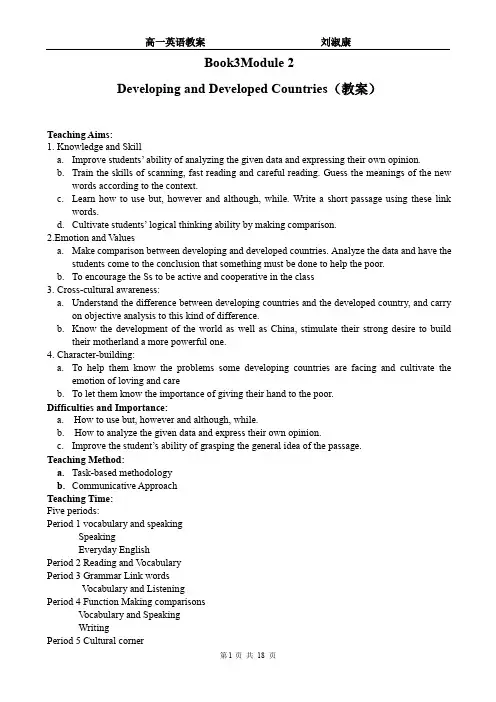
Book3Module 2Developing and Developed Countries(教案)Teaching Aims:1. Knowledge and Skilla.Improve students’ ability of analyzing the given data and expressing their own opinion.b.Train the skills of scanning, fast reading and careful reading. Guess the meanings of the newwords according to the context.c.Learn how to use but, however and although, while. Write a short passage using these linkwords.d.Cultivate students’ logical thinking ability by making comparison.2.Emotion and Valuesa.Make comparison between developing and developed countries. Analyze the data and have thestudents come to the conclusion that something must be done to help the poor.b.To encourage the Ss to be active and cooperative in the class3. Cross-cultural awareness:a.Understand the difference between developing countries and the developed country, and carryon objective analysis to this kind of difference.b.Know the development of the world as well as China, stimulate their strong desire to buildtheir motherland a more powerful one.4. Character-building:a.To help them know the problems some developing countries are facing and cultivate theemotion of loving and careb.To let them know the importance of giving their hand to the poor.Difficulties and Importance:a. How to use but, however and although, while.b. How to analyze the given data and express their own opinion.c.Improve the student’s ability of grasping the general idea of the passage.Teaching Method:a.Task-based methodologymunicative ApproachTeaching Time:Five periods:Period 1 vocabulary and speakingSpeakingEveryday EnglishPeriod 2 Reading and V ocabularyPeriod 3 Grammar Link wordsV ocabulary and ListeningPeriod 4 Function Making comparisonsV ocabulary and SpeakingWritingPeriod 5 Cultural cornerTask writing an advertisement for your hometownTeaching Procedur es:Period 1 Introduction&Speaking&Everyday EnglishStep 1. Warming upLook at the map of the world. And answer the following questions.1. How many continents are there in the world?2. Do you know the meaning of the following word?Australia France Germany IcelandJapan Norway Swedenthe Netherlands the UK the US3. Can you find the countries above on the map?2 when people have very little money3 an illness4 when you do not have food, especially for a long period of time5 the money that you make6. a country that has a lot of business and industry7. a country that is poor and does not have much industrySuggested answers:1. education2. poverty3. disease4. hunger5. income6. developed country7. developing countryStep 3 Discussions. Try your best to find the specific reasons to support your idea.1) Which countries are developed countries and which are developing ones?2) What are the differences between developing and developed countries?Income: ( larger / smaller)Industry and commerce: (flourishing / laggard)Education: (good / little)Life expectancy: (live long/short)Environment: good/bad(terrible)3) What are the problems that the developing countries face? How to solve them?PovertyLess educationDiseaseHungerBad environmentSuggested answers:1) Developed countries are most of the western countries. Mainly included: America, Germany, France, the UK, Italy, Canada and Japan.Developing countries are most of countries in Asia, Africa and Latin America.2)3) Any suitable answers are available.Step 4 Everyday EnglishChoose the correct answer.1. How do you find it? Means_______.a. What is your opinion about it?b. How did you get here?2. It’s totally fascinating means ________.a. It’s very, very interesting.b. It’s very, very important.3. as you see(them) means ________.a. while you see themb. in your opinion4. I didn’t get that means________.a. I didn’t take thatb. I didn’t hear what you said5. (Let’s) find some of the action means ______.a. Let’ do something interestingb. Let’s act.Suggested answers:1. a2. a3. b4. b5. aStep 5 Speakinga.Work in pairs.Student A: You are collecting money for a charity that gives money to developing countries.explain to Student B why he/she should give money.Student B: Listen to Student A and ask questions. Decide whether you want to give money. If you decide to give money, say how much you will give and why.b.Make the dialogue in the right order.1 Hi, David. I am collecting money for a charity. Can you give some money?2 what about 5 dollars?3How much should I give?4 God. I do think I should give some money to them.5Thank you. If we make greater efforts, more people will have safe drinking water.6 You are right. Now I know we should do our best to help people in developing countries to reduce poverty.7 For developing countries?8 We are collecting money for developing countries.9 It’s so kind of you.10 That’s intere sting. But why?11 Yes, you know, every day 799 million people in developing countries are hungry.12 It’s up to you.Suggested answer:1; 10; 8; 7; 11; 4;9; 3;12;2;5;6Homework:1.Memorize the new words we have learned in the class.2.Preview the passage: The human development report.Period 2 Reading and VocabularyStep 1 representationAs we all know, there are two kinds of countries in the world; if the country is rich, we call it a developed country; if the country is poor, we call it a developing one. Now, what’s the difference between them? Let’s learn the text, the human development report will give the difference between them.Step 2 While-readinga.Skimming and Scanningb.Detailed ReadingRead the text quickly and silently and find the answers to the questions.1.What did world leaders agree to do in 2000?2.What does the Human Development Index measure?3.What are the first two Development Goals?4.What progress have we made towards these goals?5.What do developed countries need to do?Suggested answers:1.147 world leaders agreed to work together to reduce poverty by 2015 or earlier.2.It measures a country’s achievement in three ways: life expectancy, education andincome3.To reduce poverty and hunger, and ensure all children are educated up to the age of 11.4.There are some examples of successful development, like in China, but more effort isneeded.5.They need to give more money.Step 3. Post-readingWe know there are lots of problems in some developing countries, they need our help, how should we help them?Discuss in a group of four, try to think of ways to help them. These topics may help you.When you enjoy your meal, remember lots of people are hungry;When you study, remember lots of children can not;When you enjoy yourself, remember lots of people suffer from diseases;When you live peacefully, remember lots of people suffer from the war.So let’s give our hand and help them. Then the world will become a better one.Step5 Language Explanations:B3m2language points1.develop vt. 发展;发育;冲洗(照片)developing adj.发展中的;developed adj.发达的development n.发展develop an interest in 培养对…的兴趣China is a large country belonging to the developing countries.cation n.教育。
2019版高考英语精准备考一轮:单元检测(十四) Developing and Developed Countries 含解析
单元检测(十四)Developing and Developed CountriesⅠ.阅读理解ALike many young people around the world, Emmanuel dreamed of getting a university education in the United States. The 26-year-old is an undocumented immigrant. This means he does not have the official permission needed to enter, live in, or work in the U.S. Emmanuel came to America from Mexico five years ago, when he discovered that he had to learn English and his dream was much more difficult to achieve. The major difficulty he realized was that there were very few opportunities for him to really receive a formal education.Federal laws do not prevent immigrants from going to college. But laws do ban illegal immigrants from receiving government financial aid. The average cost of a four-year degree at a public university is $9,410. By comparison, the average cost at a private university is $32,405.Many immigrants come to the U.S. with little money, so they usually can't afford the expensive education. Emmanuel read about University of the People which has no tuition fee. The classes and teaching materials are all free online. All the teachers are volunteers. But students must be at least 18 years old and have completed high school. The university just requires students to pay a $50 application fee when they are admitted and a $100 test fee when they complete a class.Shai Reshef is the president of University of the People. He was born in Israel. He decided to create a tuition-free university after visiting several poor countries, where people had limited higher education opportunities. He notes that University of the People is a model to show universities and governments that the issue can be solved. Higher education can be affordable, can be high-quality and shouldn't leave anyone behind.Currently, there are more than 2,500 students studying with the University of the People. It only provides degrees in computer science and business administration. The university expects the student number to double next year.语篇解读:本文是一篇说明文。
高中英语 Module 2《Developing and Developed Countries》文
高一外研Module 2《Developing and Developed Countries》辅导With复合结构与独立主格结构with复合结构与独立主格结构是英语中常见的两种结构形式。
从某种意义上说,它们可以算作是非谓语动词用法的延伸。
它们都可以在句中作原因状语、伴随状况状语、条件状语、时间状语或结果状语用,一般也可以相互转换。
虽然它们的语法功能和意义相同,但其结构形式和名称却不相同。
抓住这一点,就可以把二者融会贯通,从而在阅读中减少不必要的理解障碍。
with复合结构的模式是:with+名词/代词〔作逻辑主语〕+分词/形容词/副词/不定式/介词短语〔作逻辑谓语〕独立主格结构的模式是:主格名词/代词〔作逻辑主语〕+分词/形容词/副词/不定式/介词短语〔作逻辑谓语〕请看下例:一、作时间状语1、With winter coming on, the trees turn yellow and some birds fly south.=Winter coming on, the trees turn yellow and some birds fly south.2、With our work having been finished well, we went out for a holiday.=Our work having been finished well, we went out for a holiday.3、With the traffic light green, the bus got moving.=The traffic light green, the bus got moving.4、With the wedding dinner party(being) over, we left the hotel.=The wedding dinner party(being) over, we left the hotel.二、作原因状语5、With it being Sunday, the library was closed.=It being Sunday, the library was closed.6、With the weather terribly cold, we entered the room to warm ourselves.=The weather terribly cold, we entered the room to warm ourselves.7、With us to care for the children you are able to be carefree away from home. =We to care for the children, you are able to be carefree away from home.〔注意此处的we 不得改成us,用了us便不是独立主格结构了。
高中英语Module2DevelopingandDevelopedCountriesSectionⅠ
该报告最重要的部分之一是人类发展的指数。这是对 175 个国家 成就的检验。这项指标从三个方面衡量一个国家的成就:寿命、教育 和收入。这项指标显示了一些令人感到意外的情况。挪威高居榜首, 而美国则排在第七。其他排名前五的国家分别是:冰岛(2),瑞典(3), 澳大利亚(4),荷兰(5)。英国排在第十三位,而中国则排在名单的中 间。处于末端的十个国家均是非洲国家,塞拉利昂(西非)排在最后。
D.n.收入
( )5.measure
E.n.贫穷
( )6.goal
Fposition ( )cate ( )10.figure
G.vt.教育;培养;训练 H.vt.测定;测量;评估 I.n.位置 J.n.(与动物等对比的)人
【答案】 1-5 CDEBH 6-10 AJIGF
while the US is at number 7.③ The other top five countries are: Iceland (2),Sweden(3),Australia(4),the Netherlands(5).The UK is in the thirteenth position,while China is in the middle of the list.The bottom ten countries are all African countries,with Sierra Leone (in West Africa) at the bottom of the list④.
Module 2 Developing and Developed Countries
发展中国家在第二次世界大战之后迅速崛起,其经济、政治、教 育日益发展,但是在其教育发展的过程中,还存在着一系列的问题和 挑战。
高考英语大一轮复习Module2DevelopingandDevelopedCountries习题含解析外研版必修3
Module 2 Developing and Developed Countries假设你是李华,你的美国朋友Tom发来邮件想了解中国的茶文化。
请你给他回封邮件,内容包括:1.茶文化的悠久历史;2.茶与文学(唐代“茶圣”陆羽写了第一本关于茶的书《茶经》);3.茶与健康。
参考词汇:《茶经》TheClassicofTea茶圣TeaSaintDearTom,Inyoure-mailyouaskedaboutteacultureinChina.NowIwanttoletyouknowofsomethinga boutit.Tea isnativeto ChinaandChineseteaculturehasalonghistory.It playsanimportantpar tin Chineseculture.Agreatmanyfamouspoetsandwritershavewrittenmanyworks inapprecia tionof teaandabouttheloveforit,amongwhomwasLuYuintheTangDynasty,whowroteTheClass icofTea,thefirstbookonteaand wasregardedas the“TeaSaint”.TeaispartoftheChinese'sdailylife.Sinceancienttimes,teahas beenknownas the “nationaldrink”ofChina.NotonlydotheChinesebelievethathavingtearegularlycanprolonglifeandbenefi thealth,butmodernsciencehasprovedthatteaisanaturalhealthdrinkgoodforthebody.IhopeyoucancometoChina tolearnmoreaboutit.Yours,LiHua1.文章体裁:应用文——电子邮件。
高三英语Module 2Developing and Developed Countries英语听力
听力理解Module 2 Developing and Developed Countries英语听力http:///res/2007-12-28/r291382.html请点击此地址下载播放器播放英语听力Goal: Understand the description of countries.AWork in pairs. Talk about the differences between developing countries and developed countries, Use the words in the box to help you.although while however but more fewer less much increase reducecars pollution crowded lively freeways safety industry education noisy modern peaceful poverty tourism wealthhunger dangerous construction dirty incomeFor example:A: While there are more cars in a developed country, there are less freeways in a developing country.B: It could be more peaceful in a developing country.BWork in pairs. Talk about the following questions.1. Have you ever visited a foreign country? If not, what country would you like to visit?2. Which developed countries do you know about?3. Would you rather live in a developing or a developed country? Why?For example:A: What country would you like to visit?B: Well I would like to visit an African country.A: Why?B: I’ve known enough from films about the developed countries such as the US. I would be more interested in visiting a developing country someday.CListen and tick (√) the true sentences.1. This is Li Ming’s first visit to the UK.( )2. The cities of Leeds and Hangzhou have been twinned since 1999. ( )3. Li Ming will stay in the UK for six months. ( )4. Li Ming is living at the school. ( )5. Li Ming sees many similarities between Leeds and Hangzhou. ( )DListen and choose the correct answers.1. When was UNICEF started?a) 1936. b) 1946. c) 1906.2. Which of the following is NOT one of the goals of UNICEF?a) Provide food. b) Increase income, c) Improve health.3. How many countries has UNICEF encouraged development in?a) More than 140. b) More than 150. c) More than 130.4. By the year 1996, UNICEF had helped to bring medicine to how many children in developing countries?a) 80%. b) 50%. c) 20%.5. Along with rising costs, what is the other problem that UNICEF is facing now?a) Poverty is increasing in developing countries.b) Natural disasters are increasing in the world.c) They don’t receive as much money as before.EListen and tick (√) the true sentences.1. Wang Qiang visited two countries recently. ()2. He went to India in December. ( )3. He felt sorry for the poor people of small towns in India. ( )4. He thinks that the cities in Sweden are very modern. ( )5. He said that tourism is a big industry in India. ( )6. He does not suggest Jack to visit India. ( )7. He believes that education is the key to development. ( )FListen and choose the correct answers.1. Where is Chris from?a) Canada. b) America c) Australia2. What does Chris say about Canadian people?a) They are all rich.b) Most of them are rich.c) Some of them are poor.3. What does Chris NOT describe as being part of a developed country?a) Good education.b) Good roads and freeways.c) Good medical services.4. Which of the following did Chris’ family have when he was young?a) Money. b) Food. c) A car.5. How has life changed now that Chris and his brother and sister have graduated fromschool?a) They enjoy a richer life.b) They have a car.c) They have children.GListen and complete the passage.James has been studying in Beijing for over (1) years. He thinks that Beijing is turning into a very (2) city. There is a lot of (3) going on, with many new (4) and buildings. However, finding ways to (5) pollution is very important, or else industries like (6) will suffer.HListen and choose the correct answers.1. How many people visited China in the year 2001 ?a) Over 26 million. b) Over 27 million. c) Over 28 million.2. What did the World Tourist Organisation say about China?a) It will have 60% of all tourists in the world.b) It will be the No. 1 tourist destination in the world.c) Both a and b.3. Where do most of China’ s tourists come from each year?a) Japan and Korea.b) Other Asian countries.c) Both a and b.4. According to the report, why is it easier for tourists to travel around China now?a) Because more scenic sites are opening to the foreigners.b) Because transportation is more available than before.c) Because the gate tickets of the scenic sites are cheaper than before.5. According to the report, why is pollution not good for China?a) If will reduce tourism.b) It will increase health problems.c) Both a and b.听力原文及答案CTapescript:Peter: Li Ming, I’m so happy that you could visit us here in Leeds. This is your first time to the UK, isn’t it?Li Ming: Yes, Peter. It’s my first time abroad actually. Thanks to the town twinning between our two cities, Leeds in the UK and Hangzhou in China, our schools have made this trip possible.Peter: How long have our two towns been twinned? It’s been a long time, hasn’t it?Li Ming: Yes, since 1989 actually.Peter: I’m sure that you’ll have a great time here. How long are you staying for?Li Ming: I’m staying for about six months. Our school has arranged for me to live with alocal family that has children my age.Peter: Excellent! How are you finding it so far?Li Ming: Oh, I love it! It’s so interesting to live in a foreign culture. Everything seems so different and exciting, but what is really interesting is that the more that I learn about life in the UK, the more similarities that I see with China.Peter: How so?Li Ming: When I first arrived in the UK, I noticed the differences between our two cities-the language, the colour of our skin, the food and the architecture. Now, however, as I have more experience, I am seeing the similarities. People, no matter where they are from, are pretty much the same. We all love our parents, want to do well in school, get a good job and have a happy life. Key:1.√ 3. √ 5. √DTapescript:United Nations International Children’s Emergency Fund (UNICEF) is a charitable organisation created by the United Nations in 1946. UNICEF has three main goals to help the children of the world: to provide food and reduce hunger, to improve health and to provide for education needs.Since 1950 UNICEF has encouraged development in more than 140 developing countries. This is done, for example, by working with community leaders to improve the basic living condition of the people and to provide them with clean drinking water and a clean living environment. UNICEF also works with schools and teachers in teacher training programmes in an effort to bring basic education to areas that suffer from poverty. In 1965, UNICEF won the Nobel Prize for International Peace. UNICEF also provides help for children and their parents in areas that have suffered disasters, such as floods, earthquakes and droughts. Since 1990 UNICEF has brought medicine to children in many poor and developing countries. In 1990 only 20% of children had the medicine to fight deadly diseases, however UNICEF helped to bring that number up to 80% by 1996.UNICEF receives money and encouragement from more than 150 national governments. Like many such international organisations, however, UNICEF has rising costs and is receiving less and less money each year from developed countries. In the years to come, UNICEF’s goal is to encourage more countries, companies and people to support their efforts in bringing a better life to the poor children of the world.Key:l.b 2. b 3. a 4. a 5. cETapescript:Hi, Jack,How have you been? I just got back from a trip with my father to two very different countries and I wanted to tell you about it. First, my father took me to India in November and in December we went to Sweden. It was fascinating!These two countries are very different in so many ways. India is a developing country, butSweden is already developed. It was like two different worlds. The streets in India were Very crowded, while the streets in Sweden had few people and were very safe. Unfortunately, the inhabitants of some of the smaller towns in India looked very poor and there were many hungry children in the street. I felt very sorry for them and gave them some food and money. In Sweden, however, there was little pollution and the buildings were very attractive. The cities are modern and tourism is a big industry there. Similarly, I understand that tourism in India is a growing industry, too, so I hope that it brings them some wealth and helps to reduce the poverty in the countryside and improve the quality of life for the people.This trip taught me so much about the vast difference between developing and developed countries. I would encourage you to visit either or both of these countries. I think I will try my best to help those poor people in the world from now on and I will also get the most education that I can to help my country be a developed country as soon as possible.From,Wang QiangKey:1. √ 3. √ 4. √FTapescript:Chen Gang: Chris, you come from Canada, don’t you?Chris: Yes, I do.Chen Gang: Are all Canadian people rich?Chris: It’s true that Canada is a developed country, but that doesn’t mean that all the people are rich. In fact, many Canadians have an average income. When people say that Canada is a rich country, they are talking about the level of development.Chen Gang: What do you mean?Chris: Well, a developed country means that the inhabitants enjoy a high standard of life. That is to say, we have good education, good medical services and a good living environment.Chen Gang: Could you tell me about your family?Chris: Sure. When I was young, my family was kind of poor. I mean we had food to eat and enough room to live in, but we didn’t have much money.Chen Gang: Did you own your apartment?Chris: No, we couldn’t afford to buy an apartment or a house so we rented.We didn’t have a car or money in the bank, but at least we had a roof over our heads and food to eat. My brother and sister and I went to school and got a good education. Now that we have graduated we have a better life, with more money and more opportunities. When we have children, we’ll be able to give them a better life.Key:1. a2. c3. b4. b5. aGTapescript:Jennifer: Hi, James. Long time no hear!James: Hi, Jennifer. How have you been?Jennifer: I’m good, thanks. How’s Beijing these days?James: It’s good, really good.Jennifer: Tell me about it.James: Well, as you k now I’ve been studying here in Beijing for over two years now. It’s a huge and fascinating city.Jennifer: You must have seen a lot of changes since you’ve been there.James: Oh, yeah. There’s a huge amount of construction going on just about everywhere, with new freeways and buildings being built almost overnight. Beijing is turning into a very modern city.Jennifer: But what about the pollution from all that development?James: Well, it’s unfortunate, but the pollution is a big problem. However, I thi nk people are becoming more and more aware of this problem and are finding ways to reduce the pollution.Jennifer: They will have to or other industries like tourism will suffer. No one wants to visit a dirty city. How do you find the tourism industry in Beijing?James: Busy and growing. The streets are crowded with tourists. Tourism is definitively a growing industry in Beijing.Jennifer: Well, hopefully I can visit Beijing sometime soon, too, so that I can see you again! Key:1. two2. modern3. construction4. freeways5. reduce6. tourismHTapescript:Millions of tourists visit China each year to see the vast landscapes, the historical sites and the culture. Popular tourist locations include the Great Wall, the Forbidden City and the Potala Palace. In 2001, over 27 million people visited China. The World Tourism Organisation has forecast that China will become the No. 1 tourist destination by the year 2020. More than 60 percent of the international tourists are from Japan, Korea and other Asian countries, however, the numbers of visitors from western countries is increasing every year.With the increase in transport opportunities available in China, it is easier than ever for foreigners to travel in China and visit different locations in the country. In recent news, the opening of the new Beijing—Tibet railroad will offer an excellent opportunity for tourists to visit both of these fascinating cities. Also, Dunhuang in Gansu Province is planning to build an international airport because the number of international tourists arriving to see the ancient cave paintings is growing by 30 percent every year. Over 79,000 tourists visited Dunhuang in 2005.Another attraction that China has to offer is the high level of safety in the cities. Peple can walk the crowded streets at any time of day or night without worry. Many visitors to China are surprised at the modern cities and the similarity with many western countries.Pollution, however, is still a problem in China. This will have to be reduced if the tourism industry hopes to increase and grow.Key:1. b2. b3. c4. b5. a。
2022年高考英语一轮复习Module2evelopedCountries课后练习含解析外研版必修3
Module 2 Developing and Developed Countries 课后双卷·练透提能得分点A卷单元语基巩固卷Ⅰ.单句语法填空1.We study in a classroom measuring (measure)30 feet long and 20 feet wide.2.We should make great efforts (effort)to make up for the lost time.3.God gave us the gift of life; it is up to us to give (give)ourselves the gift of living well.4.The bus was so crowded (crowd)that I had to stand all the way to the school.5.The city can provide much convenience and entertainment (entertain),and that's why many people can't bear to part with city life.6.Learning English is of great importance for our future's development.7.He was in a position where he had to force a decision.8.Some citizens are in favor of the plan,while others are strongly against it.9.He had an income of 1,000 yuan a month,so it was difficult for him to pay off the debts.10.Put your own name and present address at the bottom of the application form.Ⅱ.选词填空In the beginning,I was poor in my studies,math 1.in particular.However,encouraged by my teacher,I 2.made efforts to catch up with others,and 3.made progress little by little.4.As a result,I was 5.at the top of the exam list in the final exam,which made me overjoyed.Generally speaking,health problems,6.such as overweight, 7.are connected with bad eating habits and a lack of exercise.To 8.make sure we are in good health,we should eat healthily and 9.be/get close to nature.In some ways,it's 10.up to us to decide whether we are healthy or not.Ⅲ.完成句子1.学校附近有很多游戏室,这些地方经常挤着许多男孩和女孩。
高考英语总复习精品课件:Unit2 Developing and Developed Countries(外研版必修3)
必修3
Module 2
高考英语总复习
10.________ (n.) 类似;相似→________ (adj.) 相似 的→________ (adv.) 相似地 11.________ (adj.) 不幸的;遗憾的→________ (adj.) 幸运的→________ (n.) 运气;财富 12.________ (adj.) 受到污染的→________ (vt.) 污 染→________ (n.) 污染
外 研 版
必修3
Module 2
高考英语总复习
考题巧解
B
position“位置”;stage“舞台;时 “形势,局
外 研 版
期”;condition“条件,状况”;situation 势”。
必修3
Module 2
高考英语总复习
2.教材原句: ...so it is right that they should do so. 真题呈现 (上海高考)It has been proved ________
外 研 版
必修3
Module 2
高考英语总复习
外 研 版
必修3
Module 2
高考英语总复习
1.教材原句: The UK is in the thirteenth position,_while China is in the middle of the list. 真题呈现 (陕西高考)From their________on the top of the TV Tower, visitors can have a better view of the city. A.stage C.condition B.position D.situation
2020版 创新设计 高考总复习 英语 (外研版)第一部分 教材知识梳理第一部分 必修三 Module 2
Modul e 2Devel oping and Devel oped Countries狂背单词////////////////////////////////////////////Ⅰ.单词语境记忆1.achieve one’s goal实现目标2.battle position战斗位置3.a smart kid 一个聪明的孩子4.have no income没有收入5.the price index物价指数6.some household affairs 一些家庭琐事7.contribute to a charity为慈善团体捐款8.vast grasslands 广阔的草原9.the inhabitants of our village 我们村的居民10.the freeway under construction 正在修建的高速公路Ⅱ.词性转换与派生记忆1.measure v t.测定;测量;评估→n.测量;措施;尺寸2.figure v.计算;认为→n.数字;图形;雕像;人物;身材;画像;人影3.exchange v.交换;兑换→n.交换4.hunger n.饥饿→hungry adj.饥饿的5.poverty n.贫穷→poor adj.贫穷的6.development n.发展→develop v.发展→developing adj.发展中的→developed adj.发达的7.expectancy n.(根据概率得出的)预期数额→expect v.期望→expectation n.期望cate v t.教育;培养;训练→education n.教育→educated adj.受过教育的,有教养的9.crowded adj.拥挤的→crowd n.人群v t.推挤10.similarity n.类似;相似→similar adj.相似的→similarly ad v.相似地11.unfortunate adj.不幸的;遗憾的→unfortunately ad v.不幸地→fortunate adj.幸运的→fortunately ad v.幸运地→fortune n.运气;财富12.tourism n.旅游业;观光业→tourist n.旅行者,观光客→tour v t.在……旅游;巡回演出13.industrial adj.工业的→industry n.工业14.polluted adj.受到污染的→pollute v t.污染→pollution n.污染15.entertainment n.娱乐→entertain v t.使快乐→entertainer n.演艺人员,表演者→entertaining adj.有趣的,令人愉快的16.homeless adj.无家可归的→home n.家,住宅→homesick adj.想家的;思乡病的17.location n.位置;所在地→located adj.位于(某处)的→locate v t.使坐落于……『联想记忆』1.盘点-ant结尾名词①inhabitant n.居民②participant n. 参与者③accountant n. 会计④servant n. 仆人⑤assistant n. 助手;助理2.合成名词(adj.+n.)小聚①freeway n. 高速公路②loudspeaker n. 扬声器③blackboard n. 黑板④software n. 软件⑤mainland n. 大陆3.“收入”名词集锦①income 收入②pay 报酬③salary 薪水④wage 工资⑤profit 利润⑥pension 养老金⑦earnings 收入,收益4.trans-开头高频词全接触①transport n. 交通②transportation n. 运输③transplant v. 移植④transfer v. 运送⑤transform v. 改造⑥transmit v. 传输5.后缀-less形容词大观园①homeless 无家可归的②hopeless 无望的③breathless 气喘吁吁的④endless 无休止的⑤countless 数不清的⑥sleepless 不眠的狂背短语//////////////////////////////////////////////////////『短语背诵』1.up to达到;忙于;胜任;由……决定2.at the top/bottom of 在……顶端/底部3.make sure 确定;弄明白4.make progress 取得进步5.make efforts 努力6.in particular 尤其;特别7.be close to 接近;靠近8.such as 像,诸如9.as a result 因此,结果『词块积累』1.developed/developing country发达/发展中国家2.make money 挣钱3.in the last ten years 在最近十年4.receive a good education 接受良好的教育5.collect money 筹钱,募集资金6.make comparisons 作比较7.be connected with 与……有联系;与……有关狂背佳句//////////////////////////////////////////////////////1.Norway is at the top of the list,while the US is at number 7.挪威高居榜首,而美国则排在第七。