
小学英语六年级下学期章节Unit1Personalinformation
教学设计
科目年级
小学英语六年级下学期章节
Unit 1 Personal information Height and weight 学习目标 1. 知识目标:学会询问他人或者物品关于高度和体重的相关信息及其回答。
2. 能力目标:掌握有关数字的认读以及单位的换算并进行正确表达。
能在实际情景中灵活运用How tall/ heavy are you? How tall/heavy is it? 进行询问他人
或物品高度和体重的相关信息。
教学环节教师活动
设计意图呈现
教师引入两位同学的谈话,再讨论即将参观博物馆
的活动,可以看到恐龙展览。
通过参观游览的话题,激发学生的学习兴趣,并且渗透感知恐龙一词以及对这个动物的相关了
解。
学习观看短片(课文):Zhang Peng: Look! That ’s the tallest dinosaur in this
hall.
Mike: Yes, it is. How tall is it?
Zhang Peng: Maybe 4 metres.
Mike: Wow! It ’s taller than both of us together.
Zhang Peng: Look! There are more dinosaurs over
there!
Mike: They ’re all so big and tall.
通过课文对话,询问主人公与恐龙身高体重,聚焦重点句型和词汇。
Zhang Peng: Hey, this dinosaur isn’t tall. I’m taller
than this one.
Mike: Oh, yes. How tall are you?
Zhang Peng: I’m 1.65 metres.
How tall is it?
4 metres, It’s 4 metres.
How tall are you?
1.65 metres, I’m 1.65 metres.
How heavy are you, Mark?
52 kilograms, I’m 52 kilograms.
P9: How heavy is it?
Let’s see. Oh, too heavy. 5 tons, Maybe 5 tons.
You can also say it’s 5000 kilograms.观看课文后,根据再次提问,利用图片加深理解,学习新知。
How tall/heavy are you?
I’m…. metres.
I’m … kilograms.
How tall/heavy is it?
It’s … metres.
It’s …kilograms/tons.
练习See, this is Mark’s mother.
She usually takes a trip by plane. She wants to take
her luggage away. But it’s too heavy.
利用Mark’s mother这条主线,结合生活实际,
创编了一条故事主线,其中穿插本节课的重点句
型,便于学生在实际生活中更生动地运用语言。
How heavy is it? Can you guess? Yes, you’re right. It’s about 4 kilograms for the luggage.
And Mark’s Mother and his little sister weigh themselves once a week at home.
How heavy are you?
ams.
Oh, I’m 45 kilogr
Can you choose the right answer? Listen and check.
In the afternoon, Mark’s mother goes to the gym everyday. Look at that young man. He looks tall.
How tall are you?
I’m 1.82 metres. Oh, you’re tall.
Yes, because I like playing basketball on weekends.
So, class. How tall is it?
Let’ me tell you. It’s about 3 metres.
小结Today, we have learned about some parts about
personal information. You know, if you want to ask
about the height, you can use "How tall are you?" or
"How tall is it?", then you’ll get the different
answers.
When we talk about the "weight". You can use "How
heavy are you? "or "How heavy is it?".
Pay attention here, never ask a lady weight, it's very
impolite.
So much for today. See you next time.
课堂内容小结。
六年级下册英语人教版第一单元笔记
六年级下册英语人教版第一单元笔记English: In the first unit of the sixth grade English textbook, students will be introduced to various topics related to greetings, introductions, and personal information. They will learn how to greet people using expressions like "hello" and "good morning", as well as introduce themselves using sentences like "My name is..." and "I am from...". In addition, students will also learn how to ask and answer questions about someone's name, age, nationality, and other personal information. Through engaging activities and exercises, students will practice using the new vocabulary and structures in real-life conversations. Overall, this unit aims to help students improve their communication skills and build confidence in interacting with others in English.中文翻译: 在六年级英语教材的第一单元中,学生将被介绍到与问候、介绍和个人信息相关的各种主题。
六年级下册英语第一单元a talk
六年级下册英语第一单元a talkA TalkHello, everyone! Today, I am going to talk to you about the first unit in the sixth grade English textbook. This unit is all about different types of conversations and how to have effective communication in English.In this unit, we learn how to introduce ourselves, ask and answer questions, make requests, give directions, and express preferences. These are all essential skills for everyday communication in English.One of the key phrases we learn in this unit is "Can you help me?" This phrase is useful when you need assistance or when you want to ask someone for a favor. For example, if you are lost and need directions, you can say, "Excuse me, can you help me find the nearest bus stop?" This simple phrase can open the door to communication and help you get the information you need.Another important conversation skill we learn in this unit is how to express preferences. We study phrases like "I like...", "I prefer...", and "I don't like...". These phrases can help us communicate our likes and dislikes in English, which can beuseful in a variety of situations, from ordering food at a restaurant to choosing a movie to watch with friends.In addition to learning specific phrases and expressions, we also practice listening and speaking skills in this unit. We listen to dialogues and conversations, and then we practice speaking by role-playing with our classmates. This helps us improve our pronunciation, fluency, and overall communication skills in English.Overall, the first unit in the sixth grade English textbook is a great starting point for building our communication skills in English. By learning how to introduce ourselves, ask questions, give directions, and express preferences, we can become more confident and effective communicators in English. So let's keep practicing and improving our English skills together! Thank you for listening to my talk.。
英语六年级下册第一到四单元作文
英语六年级下册第一到四单元作文Unit 1: My School Life。
I am a sixth-grade student, and in this unit, I will share my school life with you. My school is a wonderful place where I learn, play, and make friends.Firstly, let me tell you about my daily routine. I wake up early in the morning and get ready for school. After having a quick breakfast, I take the school bus to reach my school. As soon as I arrive, I meet my classmates and we all go to our classroom together. Our school has spacious and well-equipped classrooms. Each classroom has a blackboard, desks, chairs, and a projector. We have a class monitor who helps our teacher in maintaining discipline.Our school has a variety of subjects, and we have different teachers for each subject. We study subjects like English, Math, Science, Social Studies, and Chinese. My favorite subject is English because I find it interesting and enjoyable. We have interactive lessons where we participate in group activities, discussions, and presentations. Our teachers use multimedia resources to make the lessons more engaging.Apart from academics, we also have extracurricular activities in our school. We have a sports period every week, where we play different sports like basketball, football, and badminton. Our school also organizes various competitions and events, such as debate competitions, art exhibitions, and science fairs. These activities help us showcase our talents and develop our skills.One of the best things about my school is the library. It is a treasure trove of books, and I love spending time there. The library has a wide range of books, including storybooks, reference books, and encyclopedias. I enjoy reading storybooks and exploring new topics in the reference section. The library also has computers with internet access, which we can use for research purposes.In my school, we have a strong sense of community and teamwork. We often work on group projects and assignments, which helps us develop our teamwork andcommunication skills. Our teachers encourage us to help and support each other, creating a friendly and supportive environment.I am grateful to have such a wonderful school life. My school provides me with a nurturing and stimulating environment to learn and grow. I have made lifelong friends and created beautiful memories. I believe that my school plays a crucial role in shaping my future and preparing me for the challenges ahead.Unit 2: My Hobbies。
六年级下册英语译林版第一单元笔记
六年级下册英语译林版第一单元笔记Unit 1 Hello!Lesson 1 Greetings- Greetings:- Hello! Hi! Good morning! Good afternoon! Good evening! Good night!- How are you? I'm fine, thank you. How about you? I'm great, thanks.- Goodbye! See you later! Bye! Take care!- Introducing oneself:- My name is Tom. What's your name? Nice to meet you.- I'm 12 years old. How old are you? I'm from China. Where are you from?- I like playing basketball. What do you like to do?- Introducing others:- This is my friend Peter. He's my classmate. Nice to meet you Peter.- My mom is a teacher. What does your dad do?- Asking about personal information:- How many people are there in your family? I have two brothers. What about you?- What is your favorite color/food/subject? My favorite color is blue. What's yours?- Do you have any pets? I have a dog and a cat.- Responding to questions:- Yes, I do. No, I don't. Yes, I can. No, I can't.Lesson 2 Numbers- Ordinal numbers:- first, second, third, fourth, fifth, sixth, seventh, eighth, ninth, tenth- Cardinal numbers:- 1 – one, 2 – two, 3 – three, 4 – four, 5 – five, 6 – six, 7 –seven, 8 – eight, 9 – nine, 10 – ten- 11 – eleven, 12 – twelve, 13 – thirteen, 14 – fourteen, 15 –fifteen, 16 – sixteen, 17 – seventeen, 18 – eighteen, 19 – nineteen, 20 – twenty- 30 – thirty, 40 – forty, 50 – fifty, 60 – sixty, 70 – seventy, 80 – eighty, 90 – ninety- 100 – one hundred, 200 – two hundred, etc.- Counting:- Count from 1 to 100- Count by tens: 10, 20, 30, 40, 50, 60, 70, 80, 90, 100- Count by fives: 5, 10, 15, 20, 25, 30, 35, 40, 45, 50- Count by twos: 2, 4, 6, 8, 10, 12, 14, 16, 18, 20Lesson 3 Colors- Basic colors:- red, blue, green, yellow, orange, purple, black, white, brown, pink- Learning colors through objects:- The sky is blue. The grass is green. The sun is yellow.- I have a red apple. She wears a pink dress. He has a black dog.- Mixing colors:- red + blue = purple- blue + yellow = green- red + yellow = orangeLesson 4 Days and Dates- Days of the week:- Monday, Tuesday, Wednesday, Thursday, Friday, Saturday, Sunday- Months of the year:- January, February, March, April, May, June, July, August, September, October, November, December- Learning about dates:- Today is Monday, May 4th. Tomorrow is May 5th. Yesterday was May 3rd.- My birthday is on July 20th. What about your birthday?- Talking about weekly activities:- On Mondays, I have math class. On Wednesdays, I have art class.- I play soccer on Saturdays. She dances on Sundays.Lesson 5 Time- Telling time:- What time is it? It's three o'clock. It's 3:15. It's half past four.- Daily routines:- I wake up at 7 o'clock. I have breakfast at 8 o'clock. I go to school at 9 o'clock.- I have lunch at 12 o'clock. I do my homework at 4 o'clock.I go to bed at 9 o'clock.Lesson 6 Weather- Learning weather vocabulary:- sunny, cloudy, rainy, snowy, windy, hot, warm, cool, cold- Describing the weather:- It's sunny today. It's 28 degrees. It's too hot.- It's raining heavily. It's very windy. It's snowing lightly.- Talking about weather forecasts:- The weather forecast says it will be rainy tomorrow. The temperature will drop to 20 degrees.- There will be strong winds on Friday. Be careful while walking outside.Overall, this unit focuses on basic greetings, personal information, numbers, colors, days, dates, time, and weather. It provides a foundation for students to communicate effectively in English and understand essential concepts related to daily life.。
六年级下册英语第一单元知识点
六年级下册英语第一单元知识点Here is a 700-word English article covering the key knowledge points from the first unit of the 6th grade English textbook:Learning English: An Adventure Awaits。
Learning a new language can be an exciting and rewarding journey. As students embark on their 6th grade English studies, they will discover a world of possibilities open up before them. English is a global language spoken by millions around the world, and mastering it can unlock doors to new experiences, relationships, and opportunities. 。
One of the foundational elements of English is vocabulary. Students will expand their English word power by learning a variety of nouns, verbs, adjectives, and other parts of speech. This includes common everyday words as well as more academic vocabulary. Knowing the meanings of words and how to use them properly is crucial for communicating effectively in English. 。
新模式英语unit1lesson1
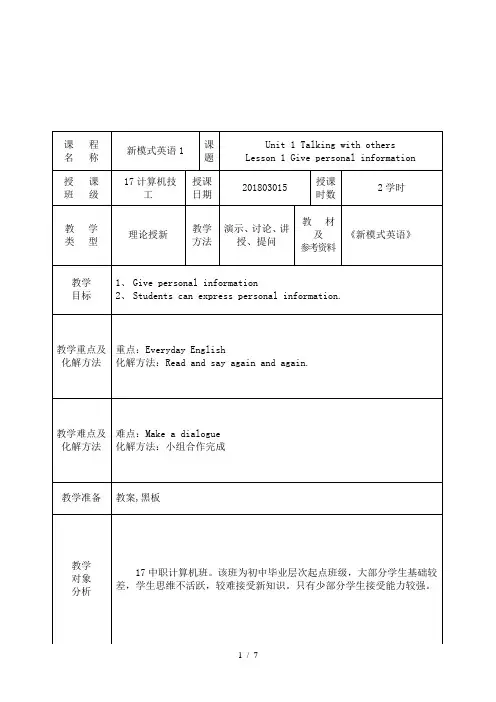
1 What are you from?
2 What’s your name?
3 Are you married?
4 How old are you ?
三、Grammar
Sb.+be(am/is/are)+adjy.
你来自哪?
你开心吗?
同学们找到自己的搭档根据自己原有的知识来回答老师的问题。
教师观察学生的表现,调节课堂的气氛。
10分钟
理论授新
理论授新
1.Learn new words and短语
板书讲授
教师讲解新的单词和短语的用法
学生停下一切及课堂无关的活动专心听讲
教师观察学生课堂的表现,及时提醒不注意听课的同学
教师根据学生的答案进行点评并给予肯定
10分钟
教学总结
对这节课所讲述的知识点进行归纳总结
概述、提问
教师进行知识点的归纳总结,并提出几个问题让学生解答
认真回答教师提出的问题
教师根据学生的解答的进行点评并给予肯定,指出这堂课的不足指出
8分钟
布置作业
1.背诵单词。
2.能够自由表达4个句型。
教师布置作业并记录
展示、讲述、讨论
教师要求学生以小组合作的方式把自己的信息写出来及大家分享。
学生认真准备,可以小组研究讨论完成。
教师观察学生课堂的表现,及时提醒不注意听课的同学
10分钟
5.Finish the exercises P3-G,H.
讨论、讲述
教师认真听学生的练习,总结学生存在的问题,并鼓励做得好的同学。
学生停下一切及课堂无关的活动,认真听录音,并找出答案
He,she
六年级下册英语第一单元知识点笔记
一、Greetings and Introductions1. How to greet people in different situations2. How to introduce yourself and others3. How to ask and answer simple questions about personal information二、Numbers and Dates1. Cardinal and ordinal numbers2. How to tell time and date3. How to ask and answer questions about age, birthday, etc.三、Family and Friends1. Vocabulary related to family members2. How to describe people's appearance and personality3. How to talk about family activities and relationships四、D本人ly Activities1. Vocabulary related to d本人ly routines and activities2. How to use simple present tense to talk about habits and routines3. How to ask and answer questions about d本人ly activities五、Food and Drinks1. Vocabulary related to different types of food and drinks2. How to describe taste and preferences3. How to order food in a restaurant or cafe六、Places and Directions1. Vocabulary related tomon places in themunity2. How to ask and give directions3. How to talk about locations and distances七、Hobbies and Interests1. Vocabulary related to different hobbies and interests2. How to talk about favorite activities and pastimes3. How to ask and answer questions about hobbies and interests八、Weather and Seasons1. Vocabulary related to different types of weather2. How to talk about weather conditions in different seasons3. How to ask and answer questions about the weather九、School Life1. Vocabulary related to school subjects, activities, and facilities2. How to talk about d本人ly school routines and schedules3. How to ask and answer questions about school life十、Transportation1. Vocabulary related to different modes of transportation2. How to talk about travel andmuting3. How to ask and answer questions about transportation十一、Jobs and Professions1. Vocabulary related to different types of jobs and professions2. How to talk about career aspirations and work experiences3. How to ask and answer questions about jobs and professions这些是六年级下册英语第一单元的知识点笔记。
朗声高考英语复习新概念Unit 1 Personal Information
people on how to set objectives that
develop the best teaching and learning
within their schools.
目的
Post-reading
根据本文内容与首字母提示,拼写所缺单词。
Ralph Tyler is one of the most famous educators in America. During his life as a teacher and researcher, he made many contributions to the educational world. After he officially retired, he still served in educational organizations at home and abroad.
原因
While-reading
阅读本文,请把握文中以年份为主线的时间 脉络,关注其中6处定语从句,尝试将表示 修饰和限制的定语从句用表示原因、条件、 并列和目的的状语从句来理解和翻译。
Even in his 80s he traveled across the
country to advise teachers and management
nationality
American
education & working experience
1938-1967 After 1967
Working as director of the Center for Advanced Study for fourteen years.
Retired officially, but still serving in many educational organizations in the United States and abroad.
英语六年级下册第一单元重点句型
英语六年级下册第一单元重点句型全文共3篇示例,供读者参考篇1Unit 1 of the sixth grade English textbook focuses on introducing basic sentence structures and verb tenses to students. Let's take a look at some key sentence patterns and grammar points in this unit.1. Present Simple TenseThe present simple tense is used to talk about habitual actions, routines, general truths, and facts. It is formed by using the base form of the verb.Example:I play basketball every weekend.He is a good student.They live in a big house.2. Present Continuous TenseThe present continuous tense is used to talk about actions happening at the moment of speaking or around the presenttime. It is formed by using the present tense of the verb "to be" and the present participle (-ing form) of the main verb.Example:She is reading a book now.They are playing football in the park.I am listening to music.3. Present Simple vs. Present ContinuousStudents will learn to distinguish between the present simple and present continuous tenses in this unit.Example:I play tennis every Sunday. (Present Simple)I am playing tennis right now. (Present Continuous)4. Wh- QuestionsStudents will practice forming questions using "wh-" question words such as who, what, where, when, why, and how.Example:Where do you live?What is your favorite color?Who is that boy over there?5. Subject-Verb AgreementStudents will learn about subject-verb agreement, ensuring that the subject and the verb in a sentence agree in number.Example:He likes to read books. (singular subject)They like to read books. (plural subject)6. ImperativesStudents will learn how to give commands or instructions using imperatives.Example:Sit down.Open your books.Don't talk in class.7. Possessive AdjectivesStudents will learn how to use possessive adjectives to show ownership.Example:This is my book.That is your pencil.Her dog is very cute.8. Adverbs of FrequencyStudents will learn how to use adverbs of frequency to talk about how often something happens.Example:I always go to the park on Sundays.She rarely eats fast food.He sometimes watches TV after school.These are just some of the key sentence patterns and grammar points covered in the first unit of the sixth-grade English textbook. By mastering these structures, students will be able to form accurate and meaningful sentences in English.篇2Unit 1 of the sixth grade English textbook focuses on introducing students to various sentence structures and patterns. In this unit, students will learn how to construct sentences usingdifferent tenses, question forms, and imperatives. Here are some key sentence patterns and structures covered in this unit:1. Simple Present Tense:- I play soccer every Saturday.- She eats breakfast at 7 o'clock every morning.- They go to the park on Sundays.2. Present Continuous Tense:- We are watching a movie right now.- He is reading a book.- They are playing outside.3. Simple Past Tense:- I visited my grandparents last weekend.- She baked a cake yesterday.- He went to the mall with his friends.4. Question Forms:- Do you like to play basketball?- Can I borrow your pen?- Where is the nearest supermarket?5. Imperatives:- Please close the door.- Don't forget to brush your teeth.- Turn off the lights before you go to bed.These are some of the key sentence patterns and structures that students will learn in Unit 1 of the sixth grade English textbook. By mastering these sentence constructions, students will be able to communicate effectively in both spoken and written English.篇3Unit 1 of the sixth grade English textbook focuses on various topics related to greetings, introductions, and personal information. In this unit, students will learn and practice key sentence structures that are commonly used in everyday conversations. Below are some of the key sentence patterns that students should master in order to effectively communicate in English:1. Greeting someone:- Hello! How are you?- Hi, how’s it going?- Good morning/afternoon/evening!- How do you do?2. Introducing yourself:- My name is [name].- I’m [name].- Nice to meet you.- Pleased to meet you.3. Asking for someone’s name:- What’s your name?- Can you tell me your name?- May I ask what your name is?4. Responding to someone’s introduction: - I’m [name]. Nice to meet you.- Hi, I’m [name].- It’s a pleasure to meet you.5. Asking about someone’s well-being:- How are you?- Are you okay?- Is everything alright?6. Responding to questions about well-being: - I’m fine, thank you. And you?- I’m feeling great, t hanks for asking.- I’m okay, how about you?7. Asking about someone’s day:- How was your day?- Did you have a good day?- What did you do today?8. Responding to questions about the day:- It was good, thank you.- I had a great day.- I did a lot of fun things today.9. Asking for and giving personal information: - Can you tell me your age?- How old are you?- What’s your favorite color?- My favorite color is blue.10. Asking for and giving personal preferences:- What do you like to do in your free time?- Do you have a favorite hobby?- I enjoy playing soccer in my free time.By mastering the above sentence patterns, students will be able to engage in meaningful conversations, make new friends, and express themselves confidently in English. Practice is key to improving language skills, so students are encouraged to practice these sentence structures with classmates, friends, and family members. With consistent practice and dedication, students will be well on their way to becoming proficient English speakers.。
六年级下册英语人教版第一单元笔记
六年级下册英语人教版第一单元笔记全文共3篇示例,供读者参考篇1Unit 1 Hello!Lesson 1 GreetingGreetings:- Greetings include saying hello, hi, good morning, good afternoon, good evening, etc.- You can use these depending on the time of day and the formality of the situation.Introducing yourself:- When you meet someone for the first time, you can introduce yourself by saying "Hello, my name is [your name]."- You can also ask the other person's name by saying "What's your name?" or "May I ask your name?"Lesson 2 IntroductionIntroducing family members:- You can introduce your family members by saying "This is my mother/father/sister/brother."- You can also use possessive adjectives like "my" or "our" before family members' names.Asking about family:- You can ask questions about family members by saying "Do you have any brothers or sisters?" or "How many people are there in your family?"Lesson 3 AgeTalking about age:- You can ask someone's age by saying "How old are you?" or "What is your age?"- You can also talk about your own age by saying "I am [your age] years old."Guessing age:- You can guess someone's age by saying "I think you are [age]."- You can also use phrases like "You look [age]" to make a guess.Lesson 4 NationalityTalking about nationality:- You can ask about someone's nationality by saying "Where are you from?"- You can also talk about your own nationality by saying "I am [nationality]."Introducing nationality:- You can introduce someone's nationality by saying "He/she is [nationality]."- You can also ask "What is your nationality?"Lesson 5 OccupationTalking about occupation:- You can ask someone's occupation by saying "What do you do?" or "What is your job?"- You can also talk about your own occupation by saying "I am a [job title]."Introducing occupation:- You can introduce someone's occupation by saying"He/she is a [job title]."- You can also ask "What do your parents do for a living?"Practice dialogue:- A: Hi, I'm Lisa. Nice to meet you.- B: Hello, I'm Tom. Nice to meet you, too.- A: How old are you, Tom?- B: I'm 12 years old. How about you?- A: I'm 11. Where are you from?- B: I'm from Canada. And you?- A: I'm from the U.S. What do your parents do?- B: They are both teachers. How about your family?- A: My father is a doctor, and my mother is a nurse.These are the key points from Unit 1 of the sixth-grade English People's Education Edition. It's important to remember these greetings and introductions when meeting new people. Practicing these dialogues will help improve your English speaking skills. Good luck!篇2Title: Unit 1 Notes for Grade 6 English, People's Education PressUnit 1: My Family1. Key Vocabulary:- Family (n): a group of people related by blood or marriage- Parents (n): a person's mother or father- Brother (n): a male sibling- Sister (n): a female sibling- Grandparents (n): a parent of one's parent- Cousin (n): the child of one's uncle or aunt- Uncle (n): the brother of one's parent- Aunt (n): the sister of one's parent2. Grammar:- Pronouns: I, you, he, she, it, we, they- Possessive Pronouns: my, your, his, her, its, our, their- Verb to be: am, is, are- Present Simple Tense: He reads books every day.3. Sentence Structures:- My family consists of my parents, my two brothers, and my sister.- My grandparents live in the countryside.- I have three cousins - two boys and one girl.4. Conversation:A: "Who is that woman?"B: "She is my mother."A: "And who is that man next to her?"B: "He is my father."A: "How many siblings do you have?"B: "I have two brothers and one sister."5. Practice Exercises:1. Write a paragraph about your family members.2. Fill in the blanks with the correct pronouns: ___ am a student. ___ name is Jenny.3. Complete the sentences with the correct form of the verb to be: My sister ___ playing soccer now.6. Songs and Rhymes:- "My Family" song:My family, my family,We all live together happily.My parents, my brothers, my sister too,We all love each other, it's true.7. Fun Activities:- Family tree project: Draw a family tree showing your immediate family members.- Family photo album: Bring in photos of your family members and introduce them to the class.Remember to review the key vocabulary, practice grammar structures, and engage in conversation to improve your English skills. Have fun learning about family in this unit!篇3Unit 1 My Day1. In the morning, I usually wake up at 6:30.2. I brush my teeth and wash my face.3. Then, I have breakfast with my family.4. After breakfast, I go to school by school bus.5. The first class starts at 8:00.6. We have English, math, and science classes in the morning.7. We have a break at 10:00 and I eat a snack.8. After that, we have Chinese and PE classes.9. We have lunch at 12:00.10. In the afternoon, we have history, geography, and art classes.11. After school, I do my homework and review what I've learned.12. At 6:30, I have dinner with my family.13. After dinner, I watch TV or play games.14. I go to bed at 9:00.Vocabulary:1. wake up – to open your eyes and stop sleeping2. brush – to clean something with a brush3. wash – to clean something with water and usually soap4. breakfast – the first meal of the day5. school bus – a bus that takes students to school6. class – a lesson in school7. snack – a small amount of food that is eaten between meals8. Chinese – the language of China9. PE – physical education, the subject that involves exercises and sports10. lunch – the midday meal11. history – the study of past events12. geography – the study of the Earth's physical features13. art – the expression of human creative skill and imagination14. review – to look at or consider againActivities:1. Draw a picture of your daily routine and label it with the vocabulary words.2. Make a list of the classes you have in school and write down what you learn in each one.3. Write a paragraph about your favorite part of the day and why you like it.4. Create a timetable for your day and share it with your classmates.5. Practice telling the time in English using a clock or watch.。