
人教版初中英语八年级下册unit4 why don't you talk to your parents_ 课件
Words Review allow v. 允许;准许 wrong adj. 有毛病;错误的 What’s wrong? 哪儿不舒服? get enough 得到足够的睡眠 sleep hang out 闲逛 after-school 课外辅导班 classes
Do you have such problems?
语,数,外,政,史,地, 生…
.
Summary
1.too many, too much, much too 的区别 2. allow的用法 3.get into a fight with sb. 4. Why don’t you 的用法。
Exercises
C 1.He eats ______food, so he is ______ fat now. A. too much, too many B . too many , too much C. too much, much too D. too many , much too 2. Mary’s mother doesn’t allow her ______ to play (play) computer games. B 3._____ go for a picnic and relax ourselves. • A. Would you like B. Why not • C. What about D . Why don’t B 4. I got ____ a fight with my classmate. • A. to B. into C. at D. for
too much homework 太多的家庭作业 study too much 学习太多
too many after-school 太多的课外辅导班 classes don’t allow to hang out 不允许和朋友闲逛 get into a fight with 和朋友打了一架 friends
Listen and circle the 1b problems you hear in 1a.
1b Listen and circle the problems you hear in 1a. 1.I have to study too much so I don’t get enough sleep. 2. I have too much homework so I don’t have any free time to do things I like. 3. My parents don’t allow me to hang out with my friends. 4. I have too many after-school classes. 5. I got into a fight with my best friends.
Unit 4 Section A
Why don't you talk to your parents?
To learn to talk about problems too much…, too many…, have to, don’t allow …to do, get into a fight with… To learn to give advice -Why don’t you…? Why not … -OK /All right/SuImagine this is your problems. Can you guess “what’s wrong with you?
What’s wrong with you?
Why don’t you talk to your parents?
I have too many after-school classes.
I have too much homework.
All right
What’s wrong?
.
Why not talk to your best friend?
I got into a fight with my best friend.
Good idea
Why don’t you talk to your parents? 为什么不和你父母谈谈呢? Why don’t you 后加________. 动词原形 表示委婉的建议 相当于Why not 后加 _________________ 。 动词原形 提建议的答语: All right /ok… Good idea /Sure …
Preview the new words and expressions.
Preview the Grammar Focus.
too much homework don’t get enough sleep
语,数,外,政,史, 地,生….
study too much
too many after-school classes
don’t allow to hang out
get into a fight with friends
1C:pair work
Look at the problems in 1a.
A: What’s wrong? B: I … A: Why don’t you talk to your parents /teachers/… B: Yes, you’re right./OK/Good idea/I think so.
Sure.
What’s wrong with you?
Why don’t you talk to your teachers?
I have to study too much, so I don’t get enough sleep.
OK
What’s wrong with you ?
Why not talk to your teachers?
八年级英语人教版下册Unit4Whydon'tyoutalktoyourparents教学设计

(4)巩固:通过听力、阅读练习,帮助学生巩固所学知识,提高听力和阅读能力。
(5)拓展:鼓励学生课后观察和思考家庭成员之间的沟通问题,尝试用英语与家人进行有效沟通,将所学知识运用到实际生活中。
3.教学评价设想:
5.引导学生树立正确的人生观和价值观,关注家庭和谐,为构建和谐社会贡献自己的力量。
二、学情分析
八年级的学生已经具备了一定的英语基础,他们在一、二年级的学习中,掌握了基本的语法、词汇和日常会话。在此基础上,他们对英语学习有了更深入的了解,具备了一定的自学能力和合作学习能力。然而,在语言实际运用方面,尤其是家庭成员之间的沟通问题,学生们的表达能力和解决问题的能力还有待提高。
5.教师在教学过程中关注学生的个体差异,给予个性化的指导和鼓励,提高学生的学习信心。
(三)情感态度与价值观
1.培养学生关爱家人、尊重家庭成员之间的差异,学会与家人沟通、解决问题的情感态度。
2.培养学生团结协作、互相帮助的精神,增强团队意识。
3.培养学生面对问题时,保持积极乐观的心态,勇于承担责任。
4.增进学生对家庭、亲情和友谊的认识,培养珍惜家人、朋友之间的感情。
(1)形成性评价:关注学生在课堂活动中的表现,鼓励学生积极参与,给予及时的反馈和指导。
(2)终结性评价:通过单元测试、口语表达等形式,全面评估学生的学习效果。
(3)个性化评价:针对学生的个体差异,给予个性化的评价和指导,激发学生的学习兴趣和自信心。
四、教学内容与过程
(一)导入新课
1.教师展示一幅家庭成员争吵的图片,引导学生观察并思考:“What is happening in this picture? Can you guess why they are arguing?”
人教版八年级英语下册Unit 4 Why don’t you talk to your parent
1. Why don’t you talk to your parents? 为什么不跟你的父母谈谈呢?
【自主领悟】(1)Why don’t you do sth. ? 这是一个否定疑问 句, “为什么不……? ”常用来征求意见和提出建议, 相当于 Why not do sth. ? 句式。例如: Why don’t you go with us? = Why not go with us? 为什么不同我们一起去呢? (2)talk to sb. 意为“同某人谈话”。例如: He talked to me about my study. 他跟我谈了关于我的学习的事情。
Unit 4 Why don’t you talk to your parents?
Section A (1a-2d)
Ⅰ. 短语互译 1. get enough sleep 2. have a fight with sb. 3. look through 4. hang out 5. 把……归还给…… 6. 允许某人干某事 7. 成功地发展; 解决 答案: 1. 有足够的睡眠 2. 跟某人打架 3. 浏览 4. 闲逛 5. give. . . back to. . . 6. allow sb. to do sth. 7. work out
【归纳拓展】allow的不同搭配 (1)allow sth. /doing sth. 允许(做)某事 例如: We don’t allow eating in the classroom. 我们不允许在教室里吃饭。 (2)allow sb. sth. (双宾语)给予某人某物 例如: He allows his son too much money. 他给他儿子太多的钱。
speak to sb. “跟某人讲话”
人教新目标版英语八下Unit4《Whydon’tyoutalktoyourparents》说课稿

人教新目标版英语八下Unit 4《Why don’t you talk to your parents》说课稿一. 教材分析人教新目标版英语八下Unit 4主要讨论了如何与父母沟通的问题,通过本节课的学习,学生能够掌握一定的沟通技巧,提高与父母交流的能力。
本单元的主题贴近学生的生活,有利于激发学生的学习兴趣和积极性。
二. 学情分析根据我对学生的了解,他们在学习过程中已经掌握了基本的英语语法和词汇,具备一定的听说读写能力。
但部分学生在与父母沟通方面存在一定的困扰,可能因为害羞、害怕被批评等原因而不愿意与父母交流。
因此,本节课的教学目标在于帮助学生克服这些障碍,提高他们的沟通能力。
三. 说教学目标1.知识目标:学生能够掌握本节课的重点词汇和句型,如“Why don’tyou…?”,“Because…”等,并能够运用这些词汇和句型进行简单的交流。
2.能力目标:学生能够通过听力、口语、阅读和写作等多种方式,提高自己的英语应用能力。
3.情感目标:学生能够认识到与父母沟通的重要性,学会尊重和理解父母,提高与父母相处的质量。
四. 说教学重难点1.重点:本节课的重点是让学生掌握并运用句型“Why don’t you…?”和“Because…”进行交流。
2.难点:如何帮助学生克服害羞、害怕被批评等心理障碍,提高他们与父母沟通的勇气和信心。
五. 说教学方法与手段1.任务型教学法:通过设计各种真实的任务,让学生在完成任务的过程中运用所学知识,提高英语实际应用能力。
2.情境教学法:创设各种与父母沟通的情境,让学生在模拟实践中学会如何与父母交流。
3.小组合作学习:通过小组讨论、分享等方式,促进学生之间的互动,提高他们的合作能力和沟通能力。
六. 说教学过程1.导入:通过一个关于父子间沟通的小故事,引发学生对与父母沟通的思考,激发他们的学习兴趣。
2.呈现:介绍本节课的主题,展示相关的词汇和句型,让学生初步感知和学习。
3.实践:设计各种与父母沟通的情境,让学生在模拟实践中运用所学知识。
人教新目标八年级英语下册Unit4Whydon'tyoutalktoyourparents说课稿
人教新目标八年级英语下册Unit 4 Why don’t you talk to your parents说课稿一. 教材分析人教新目标八年级英语下册Unit 4 Why don’t you talk to your parents是一篇关于日常交流和沟通的文章。
本篇文章主要讲述了在遇到问题时,如何与父母沟通,寻求解决方案。
通过本节课的学习,学生能够掌握情态动词why not的用法,以及如何运用交际策略进行日常交流。
教材内容贴近学生生活,有利于激发学生的学习兴趣和积极性。
二. 学情分析八年级的学生已经掌握了基本的英语语法和词汇,具备一定的听说读写能力。
但在实际交流中,学生往往因为害羞、紧张等原因不敢开口说英语,本题正好可以引导学生学会如何与父母沟通,提高他们的交际能力。
同时,学生在这个年龄段开始关注家庭和社交问题,对本节课的内容会产生浓厚兴趣。
三. 说教学目标1.知识目标:学生能够掌握情态动词why not的用法,了解日常交际中的沟通策略。
2.能力目标:学生能够运用所学知识进行日常交流,提高口语表达能力。
3.情感目标:学生学会与父母沟通,增进家庭关系,培养良好的交际习惯。
四. 说教学重难点1.重点:情态动词why not的用法和日常交际策略。
2.难点:如何运用所学知识进行实际交流,克服羞涩、紧张等心理障碍。
五. 说教学方法与手段1.情景教学法:通过设定情景,让学生在实际语境中学习英语,提高交际能力。
2.任务型教学法:学生分组完成任务,激发学习兴趣,培养合作精神。
3.互动式教学法:教师与学生互动,引导学生积极参与课堂讨论,提高口语表达能力。
六. 说教学过程1.导入:用一段关于家庭沟通的短片引出本节课的主题,激发学生的学习兴趣。
2.新课呈现:教师展示文章,引导学生关注文章标题和关键词,预测文章内容。
3.课堂讲解:教师讲解情态动词why not的用法和日常交际策略,让学生通过例句理解并掌握。
4.实践环节:学生分组进行角色扮演,运用所学知识进行实际交流,教师巡回指导。
人教八下Unit 4 Why don't you talk to your parents课文及听力翻译(PDF版)
03)):1*0B,*316 6"*'(/#7 "1$'$&0.9< 4-" 931!, "3:
E»¼=K½stuP ¾&B=TUrs
+*, 9341 B19 *'++,(&*$%" '$ " (-*&&%'$%2 4*,-
¿FGDvwP "ÀÁÂÃD¯ÄÅp[P
"3:$ H$3,-($! K3: +-3:'9 "85#$&( %' " 18.$%& ,-B,
('*2"1( "* 3"% 5*2%' %&'- 23 %&' $))*")*2$%' +"67 8. 9 &$:; %" (%1<0 %"" -1=& (" 9 >"3 % ?'% '3"1?&
(,'')7 @7 9 &A:' %"" -1=& &"-'B"*4 (" 9 >"3 % &A:' A30
"#$%&"'()*+,-./0 "1 234# 789:;<0 =>8?@AB" CDEFGHI0 H&=>34JKD N OP "EQR"&STUVHWXY=>Z[ \]0 ^=> DabBVcKdef hi j">*kNP lm" nY"oE&;pP = q&Er"s"FGDtuvwP Byk
初中英语_Unit4 Why don’t you talk to your parents?教学设计学情分析教材分析课后反思

Step 5:Listening活动一、出示听力图片引导学生猜测“Is she happy? What ’s wrong with the girl?” 播放录音 并根据学生完成听力情况调整听力次数 看图片做听力猜测,读1a 句子做好听力准备,核对答案。
活动二、fill in the blanks再次听力,补全朋友给出的建议。
重视听力策略的训练 活动二的设计一方面是根据学生的水平对听力材料难度进行的调整,另一方面也是为了让学生继续感知问题与建议这一话题。
Step 6:Group work If your classmates have some troubles, can you giv e them some advice? Try to give advice in groups. 并进行总结给出建议的几种方式。
小组合作讨论问题并给出恰当的建议,利用小组的作用,调动学生的积极性。
Step 7 :pair work T : There is something wrong with me . can you give me advice?T: Now it ’s your turn. Work in pairs to makea new conversation从师生对话过渡到生生对话,进行目标语言的操练。
Step8: ListeningShow the picture lead in the listening 2a 、2b Look at the picture and guess “What ’s the matter with Peter?”Read the advice that Peter ’s friend gives himand the reason why Peter doesn ’t like theadviceDo listening and Check the answers.通过导入听前活动,做好听力准备,进行听力训练。
人教八年级英语下册《Unit4 Why don't you talk to your parents
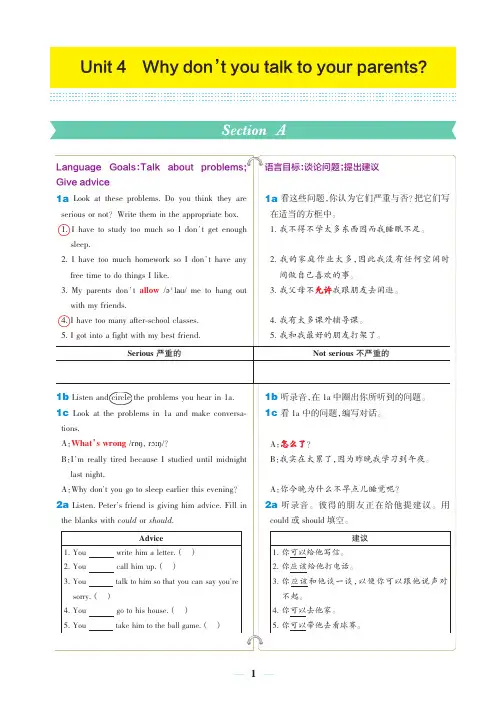
2.有毛病,错误的 4.午夜,子夜 6.猜测,估计 8.重要的事 10.和睦相处,关系良好 12.交流,沟通(n.) 14.云,云朵 16.代替,反而 18.焦虑的,担忧的 20.正确的,恰当的 22.交流,沟通(v.) 24.清楚易懂的,晴朗的 26.归还,回来
1.look through 浏览
He is looking through the books in the library.
look around 四处张望 look up 向上看;查找 look into 调查 look after 照顾;照看 look at 看看 look for 寻找
2 .Although she’s wrong , it’s not a big deal. 尽管她做得不对,但也没什么大不了的。 although 引导让步状语从句 虽然;尽管 big deal 重要的事情或状况 It is not a big deal.= It is no big deal. deal n. 协议;交易 n.大量 a good / great deal (of sth) vi.处理;应对 deal with
3 Hope things work out. 希望事情会好起来。 work out解决(问题)改善(状况)
Do you want to stay with us to see how things work out?
1.用功学习
2.得到足够的睡眠
人教版八年级英语下册Unit 4 Why don't you talk to your parents教学设计
Share their answers.
2. 2a
First get the students to read the instruction and understand the means of could and should.
Then get them to listen and fill in the blanks.
(2) 2d : Role play the conversation.
Answer the following questions:
1) Why did Kim look sad?
2) Does Kim’s sister return his new magazines and CDs?
3) What did Kim think of his sister?
1)words 2)phrases 3) sentences
2.当堂检测(见学案):教师要随堂进行评价,批改可以由学习小组内互批、组间互批、集体订正等方法,批阅后教师要统计达标情况,收集反馈信息,当堂矫正补救。
VI. Assignment
作业
1.口头作业:听并跟读录音,编对话,背笔记。
2.书面作业:
3.能熟练掌握并使用下列重点句式:
A: What’s wrong?
B: I’m really tired because I studied until midnight last night.
人教版八年级英语下册集体备课教案:Unit4 Why don’t you talk to your
课题课时Period 1教学目标语言技能听:能听懂他人他人陈述困难和麻烦的简单对话的内容,并获取主要信息。
说:1.能询问、陈述自己或他人的困难和麻烦,如What’s wrong?I’m really tired because I studied until midnight last night.2.能针对别人的困境提出解决的办法和建议,如What should Ido?Well,you should call him so that you can say you’re sorry.语言知识语音:熟练把握邀请句的升调语调,同时,在口语交流时能做到语音、语调准确、自然、流畅。
词汇:1.熟练运用:allow,wrong,midnight,guess,de al.2.掌握:What’s wrong, look through,work out.语法:1.能正确使用情态动词could,should表达或劝告,如:Youcould go to his house.2.能正确使用Why don’t you...?句型表达建议。
功能:学会询问、陈述自己或他人的困难和麻烦。
话题:了解人际交往的相关知识。
情感态度1.培养学生用英语交际能力,学会与人进行流畅的沟通和交流;2.使学生在活动中学会真诚、坦然地与人交谈。
学习策略认知策略:能在具体的情境中询问、陈述自己或他人的困难和麻烦,从而进一步主动练习和实践。
调控策略:.能针对别人的困境提出解决的办法和建议,并与人进行交流。
交际策略:培养学生合作能力,不断完善知识点,加强对话练习,学会与人闲聊,进行交流。
资源策略:通过多媒体、录音机等教学辅助工具。
文化意识了解中西方家长对待孩子参加课外活动和课外学习班的态度与做法。
教学重难点教学重点1.能正确使用情态动词could,should表达或劝告。
2.能正确使用Why don’t you...?句型表达建议。
教学难点1.Talk about problems.2.Give advice.教学方法听说法,交际法,教学辅助手段PPT, recorder.板书设计Unit4 Why don’t you talk to your parents?Sectio n A 1a-2dallow What’s wrong?wrong Why don’t you...?midnightguessdeal教后反思本节课学会了提建议的方式有:Why don’t you...? /Why not…?等Teaching ProcedureStages/TimingStep 1. warming-upStep 2 PresentationStep3 DiscussionStep 4Pre sentationStep 5 ListeningTeach ers’ a ctivitiesAfter greeting, ask students :What day is it today?What’s the date today?What’s the weather like today?1. Show the picture of a girl:T: Please look at this girl,what isshe doing?T: Look at her face,she isworried.because she has a lotof homework to do.Do yo uhave too much homework todo?Do you think it is serious?1a.Get them to read the followingsentences and discuss wheatherthey are serious or not. And thenwrite them in the approprite boxT:Do you have theseproblems?What kind of problemsdo you have?Students’ activitiesStudents answer the questions。
人教版八年级下册 Unit4 Why don't you talk to your parents
Unit 4 Why don’t talk to your parents?I 听力部分II阅读下面的材料,在空白处填上适当的内容(1个单词)或括号内单词的正确形式(1个或几个单词),使句子通顺正确。
1.I have the same opinion ________ (像..一样) you.2.________ (what) you say, we won’t believe you.3.My ________ (old) brother is two years ________(old) then me.4.Please ________ this bike with that one, and then tell me the differences between them.5.Please ________ (归还) the book to the library on time.6.The math problem is too difficult. I can’t work it ________. Could you give me a hand?7.Frank is not ________(足够高) to join the school basketball team.8.-My parents ________ m so hard! I have much pressure.-You should talk to them about this.9. -Are you going to come?- ________(也许). I’ll see how I feel.10. She didn’t answer me, ________, she asked me another question.11. Today, WeChat becomes very popular, and more and more people like to use it tocommunicate ________ each other.12. Before you choose a book, you’d better ________(浏览) the first few pages to know whetherit’s too easy or too difficult for you.13. -Mom, I took my partner’s math book home by mistake(失误地).- Well, you should call her ________ you can say sorry to her.14. -Mark, you look so tired.- Oh, I didn’t go to bed ________ it was 12 o’clock last night.15. - Thanks for giving me so much useful advice.- It’s my ________.III 完形填空When you are free, you can go outside to play in the street. You can also stay at home to surf the Internet. 16 do you think is safer? Maybe some people think surfing the Internet at home is 17 . In fact surfing the Internet at home is not safe. So you should be 18 when you surf the Internet. Here are some 19 for you.Be careful about strangers on the Internet, just as you 20 strangers in the street. Of course, we know the strangers are the persons whom we don’t know.If someone says some dirty words to you, don’t 21 and just leave.You should 22 tell others about your real name, home address or telephone number. They are your personal information. If you tell others about that, that may get you 23 danger.Never 24 to meet someone you know on the Internet. He or she might be a bad person!Don’t make too many net friends. If you have free time, you should 15 time with your real friends in your real life.16. A. which B. why C. When D. How17. A. more dangerous B. safer C. more comfortable D. cheaper18. A. careful B. helpful C. worried D. pleased19. A. stories B. advice C. questions D. suggestions20. A. are interested in B. stay away with C. give up D. look like21. A. answer B. stop C. keep D. catch22. A. always B. never C. often D. usually23. A. for B. off C. on D. in24. A. refuse B. agree C. help D. have25. A. spend B. bring C. pay D. costIV 阅读理解ALast month we made a survey among 300 students at our school. The questions we asked were “Who would you talk with when in trouble?” and “Why?”. Here are some answers fro mA. parentsB. classmatesC. friendsD. brothers27. Chen Lei likes to talk with his friends when in trouble because ________.A. they are older than himB. they always give him good suggestionsC. he likes t keep secretD. they have more experience of life28. From Li Yan’s answer we know she is ________.A. braveB. activeC. funnyD. quiet29. From the passage we know that ________ often ask others for help.A. Zheng Hao and Chen LeiB. Zheng Hao and Li YanC. Chen Lei and Li YanD. all of the three30. Which is TRUE according to the passage?A. Chen Lei is afraid to face the troubles in life.B. Zheng Hao and Li Yan like to keep secrets to themselves.C. Li Yan only trusts herself so she never tells others her secretsD. Zheng Hao doesn’t have any friends but Chen Lei has many.A. Try to relax.B. You could make a gift to give her.C. You could write her a letterD. Tell her to ask questions after class32. _________ is under too much pressure and should learn to relax.A. ErinB. MaryC. MayD. Alice33. What is the matter with Mary?A. She can’t go to her friend’s birthday party.B. She can’t hear the teacher clearly in classC. She did badly in an exam.D. She has no money to buy a gift.34. Which of the following is TRUE?A. Erin and Mary are of the same age.B. May lives in England.C. Lana is very popular in class.D. Alice is Erin’s good friend.35. What is the best title for this next?A. Can I Help You?B. What Should I Do?C. How to Make Friends?D. Why Not Tell Him?V 任务型阅读阅读下面短文,按要求完成各项任务。