
最新中考英语语法专题复习 动词
I
must _____study hard, because I want to go to Beijing University. I _______go shopping,because have to is empty now. the fridge
SHOULD/WOULD/OUGHT TO 应该 愿意 理所应当
必须 MUST/HAVE TO
不得不
1.must表个人意志和主观上的必要,意 为“必须”“应该”用于一般现在时; I must go now. 2.have to表客观上的必要。意为“必 须”“不得不” 除可用于现在时外,还可以表将来时 shall/will have to和过去式had to。
1.这台电视机不能用了,我们必须买 台新的。 This TV doesn’t work. We have to buy a new one. 2.那时我们必须买台新的。 We had to buy a new one. 3.我们将不得不买台新的。 We will have to buy a new one.
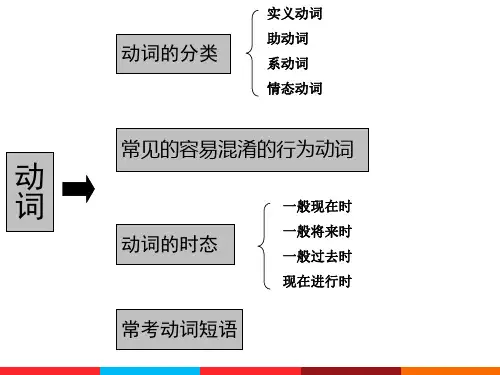
动词的分类
1.系动词 2.实义动词(及物和不及物) 3.助动词 4.情态动词
一、系动词
系动词:它本身有词义,但不能单独用作 谓语,后边必须跟表语,构成系表结构说 明主语的状态、性质、特征等情况。
He is wrong.(系词+表语做谓语)
be表示状态(am, is, are)
感官动词(smell, feel,sound, taste等)
情态动词有词义,不能单独做谓 语,无人称和数的变化,后面必 须接动词原形。
CAN/COULD/BE ABLE TO
1.三个都表“能力”could 是can的过去式。
eg: I couldn’t speak English. I can speak English now. 将来能力使用shall/will/be able to. eg: I will be able to speak French.
四、情态动词
She
can speak French and I can’t.
什么叫情态动词?
表示说话人对所述动作的看法,如需
要、可能、意愿或怀疑等情感或状态。
情态动词的特征
He can speak English well,but I can’t. We must stay here.
2. can/could 表“请求、允许” could 比can 更委婉。 Could I borrow your book? 3. can/could 表“怀疑、推测” 可能性 can‘t be It can’t be Lily’s bag.
MAY/MIGHT
1.表“请求、许可” might 比may更委婉、 客气。 eg:May I come in? Might I come in? 2. “可能”,表推测。 可能性 may be >might be eg:He may come tomorrow. He might come tomorrow.
HAVE/HAS/HAD
I
have a book.其中have是助动词吗? 答案:NO.
have/had+V.过去分词 现在完成时/过去完成时
其中have是助动词吗? 答案:YES.
WILL/SHALL
用于一般将来时态。 will用于所有人称,shall只用于第一人
称。 She will finish her homework in ten minutes. Shall I take an umbrella?
三、助动词
I like it. 其中like是实意动词,如何变否定疑问. 用do来帮助它,我们把do、does、did等 称为助动词。 I don’t like it. Do you like it?
助动词,无词义,不能独立做谓语, 帮助构成时(态),语(态),否(定句)和 疑(问句)。 常见助动词有五个,be,do,have,shall,will. be构成被动与进行,do构成疑问和否定 have构成现在完成时,shall,will表示将来时
二、实义动词
能独立做谓语的词,主要表示主 语的动作、状态和品质。按句法 作用分为及物和不及物动词。
I
hit
及物vt.
her.
He
cut
及物vt.
his finger.
rises.
不及物vi.
The
sun
注意:同一动词有时可用作及物动词, 有时可用作不及物动词。
She can dance and sing. 她能唱歌又能跳舞。(sing在此用作不及物动词。) She can sing many English songs. 她能唱好多首英文歌曲。(sing用作及物动词。)
She is kind and honest. You must keep healthy. The leaves turn green. Lily seems very angry. He went blind at the age of seven.
EXERCISE
1.Autumn
is coming,the leaves ______yellow. turn looks 2.The girl _______beautiful. 3.The food_______delicious. tastes gets and 4.Autumn is coming,it______colder colder. 5.That song ________ well. sounds
动词
动词是表示动作或状态的词。英语句子中,常需要有个 动词来充当谓语,说明主语“是什么”或“做什么”。 动词有人称、数、时态、语态、语气的变化。 动词有五种形态:原形(Original Form)、 第三人称单数形式(Singular From in Third Personal)、 过去式(Past Form)、过去分词(Past Participle)、 现在分词(Present Participle)。
情态动词表推测
must be
may be
might be
can’t be
>
>
>
DARE , NEED
既可作情态动词,又可作行为动词。
做情态动词,无人称、数变化,主要
用于否定句和疑问句
情态动词类型
1.只作情态动词的有: must,can(could),may(might) 2.可作情态动词也可作实义动词的有 need,dare 3.可作情态动词也可作助动词的有 will(would).shall(should) 4.具有情态动词的某些特征的有have to,ought to
系 动 词
持续系动词表示主语继续或保持一种状况或态度 (keep, rest, remain, stay, lie, stand)
变化系动词表示主语变成什么样 (become, grow, turn, fall, get, go, come, run.) 表像系动词表示"看起来像"这一概念,主要有 seem, appear, look
BE(AM/IS/ARE/WAS/WERE)
1.I am watering the flowers. 帮助构成(现在/过去)进行时。 2.Tom was hit by his father yesterday. 帮助构成被动语态。 小测试: She is Lily.(is 是助动词吗?) 答案:NO.
ought to 1.You are his mother, you _____________ look after him. should 2.You are a student, you _______ study hard. 3.She would be glad if you ______ help her. would
2024年九年级中考英语语法复习——动词课件
二.实义动词
实义动词即表示具有一定意义的动作的词。 比如:skate,swim,listen,clean等。 实义动词有及物动词与不及物动词之分。
1.及物动词 及物动词本身的表意不完整,需要接宾语来使表意完整,有三种形式: ✓ 及物动词+宾语 He reads English every day. ✓ 及物动词+宾语+宾语补足语 I always keep my desk clean. ✓ 及物动词+间接宾语+直接宾语 My friend lends me a book.
(5)过去分词 现在分词使用在句子的完成时态中,或语法规定的其他情况,表达动作已经 完成的状态 • I have done my homework. • When I arrived, the movie had finished.
【拓展】英语动词还有一些变化形式。 ★ 动词不定式(to do)I like to play basketball after dinner. ★ 动名词形式(doing)Drawing is an art.
2.不及物动词
✓不及物动词本身表意完整,不需要接宾语。
如:The sun rises.
很多不及物动词也可以用作及物动词,还有的不及物动词后面带上某个介词就变成 可带宾语的及物动词。 如:We are reading. (read为不及物动词)
We read English every day. (read为及物动词) He is waiting at the bus stop. (wait为不及物动词)
如果用could提问,回答 时,用can,不能用could
can’t:“不可能”; may not:“可能不”。 注意:may not不缩写。
2024年中考英语一轮复习-动词不定式的用法及语法功能
动词不定式的用法及语法功能不定式中所谓“不定”,是指不受主语的人称和数的变化的影响。
动词不定式的基本形式有两种,一种是带to的不定式,另一种是不带to的不定式。
动词不定式没有人称和数的变化,在句子中不能作谓语,但可以担任除谓语外的任何成分——主语,表语,定语,状语和宾语补足语。
动词不定式仍然保留动词的特点,即有自己的宾语和状语,也就是说,动词不定式和它的宾语或状语构成它自己的不定式短语。
不定式的语法功能不定式在句子中有各种作用,不定式具有名词,形容词和副词的特征。
不定式作名词的用法不定式在句子中的作用,有时和名词相同,在句子中担当主语,表语,宾语和宾语补足语。
不定式作主语:常用句型 It is … to …不定式作主语的句子通常用 It is … to+不定式的句型来代替,在句子中it 作形式主语,真正的主语式后面的动词不定式。
在这里,不定式被视为第三人称单数,所以动词要用 is (现在时) 或was (过去时)。
如以下例句所示:It is important to learn English well.It is dangerous to play in the street.It is hard to say goodbye with you.不定式作表语:To do 不定式作表语e.g. The best plan is to leave here. 最好的计划是离开这里。
不定式作宾语:不定式在及物动词后作宾语,常见的及物动词有:Ask, decide, begin, fail, continue, forget, hate, help, like, long, want, wait, manage, need, start, pretend, refuse, try, dare, agree, know, wish, afford 等不定式作副词的用法:不定式有时起副词作用,修饰动词或形容词,在句子中相当于状语,表示目的和原因表目的:-不定式在不及物动词后担当状语e.g. My mom came to see me yesterday evening.-针对why的疑问句回答时,如果表示目的,可用不定式来代替。
2025年外研版中考英语总复习专题一实义动词、系动词和助动词

2. Vacations are a chance to ____f_il_l____ your free time ____w_i_th____ meaningful activities.
命题点2 实义动词及短语词义辨析 一、猜测画线动词或短语在语境中的汉语意思(熟词生义) 1. Jimmy helps the old man every weekend, and his kindness
deeply touches his classmates. ____触__动____ 2. I thought he was kidding when he said he was going to leave
5. Allen is my best friend, and I have never questioned her honesty.怀__疑__;__质__疑__
一 二三
二、从方框中选择合适的单词或短语并用其适当形式填空 connect with, hide, cheer...up, offer, separate, take up, manage, expect, fill...with, turn out
school. __开__玩__笑____
一 二三
3. It’s time for me to leave home and I feel sad to part from my parents. _和__…__…__分__开_
4. As time went on, he grew more and more patient with his children. _逐__渐__变__得___
初中英语2024届中考语法专项练习(动词和动词+形容词和副词+动词的语态+动词的时态)(附参考答案)
中考英语语法专项练习班级考号姓名总分一、动词和动词短语一、根据句意并结合汉语或首字母提示写单词。
1.-What do you think of this piece of music?-It’s beautiful but a little sad.2.The students in our school will w traditional clothes to experience the Sichuan Opera next weekend.3.It's our duty to save energy.Please r to turn off lights and computers when you leave the office.4.They have already c Li Ping to be the team captain.5.-Could you tell me the way to the nearest cinema?- Well, I'm going there.Just me.6.I've finally realized why my grandpa loves drinking tea and tea sets.7.At yesterday's meeting,I the speed of speaking and made myself heard clearly.8.I've never the decision to work in West China.9.ManyZhuang people songs while walking, farming and doing housework.10.A Chinese tennis player Wu Yibing the Dallas Open on Feb.12,2023.二、单项选择。
2023年中考英语语法---动词及动词短语专题复习及练习题(含答案)

2023年中考英语语法---动词及动词短语专题复习及练习题(含答案)一、动词的基本框架动词包括实义动词、系动词、助动词和情态动词。
(一)实义动词实义动词是能独立作谓语的动词。
按其句法功能可分为及物动词和不及物动词;按其持续性可分为延续性动词和非延续性动词。
1.及物动词:及物动词本身意义不完整,需要接宾语才能使其意思完整。
(1)动词+宾语I like this book very much.我非常喜欢这本书。
(2)动词+宾语+宾补We call the bird Polly.我们叫这只鸟Polly。
I saw the children play in the park yesterday.昨天我看见孩子们在公园玩。
注意:用省略to的不定式或现在分词作宾补的动词有:have,see,watch,notice,hear等。
(3)动词+间接宾语+直接宾语Please pass me the salt.请把盐递给我。
常见的带双宾语的动词有:give,bring,buy,get,leave,lend,make,offer,pass,teach,tell等。
2.不及物动词不及物动词自身意思完整,不用接宾语。
Horses run fast.马跑得快。
(1)有些动词既可作及物动词又可作不及物动词。
We study English.我们学习英语。
(及物动词)We study hard.我们努力学习。
(不及物动词)(2)有些不及物动词与一些别的词搭配在一起构成动词短语,它的作用相当于一个及物动词。
①动词+介词Listen to the teacher carefully.仔细听老师讲。
此类动词短语后面的宾语无论是名词还是代词,都只能放在介词后面,不能放在动词和介词之间。
②动词+副词+介词Let’s go on with our work!让我们继续我们的工作吧!He gets along well with his classmates.他与他的同学们相处得很好。
(人教版)中考英语总复习语法:专题6-动词(88页)
(3)及物动词也可跟“复合宾语”(宾语和宾语补足 语)。 I found a little boy cry in the corner yesterday. 昨天我发现一个小男孩在角落里哭。 注:带省略to的不定式或现在分词作宾语补足语 的动词有:make,let,have,see,watch,notice, hear等。
专题六
动
词
考点一
动词的分类
动词按含义及它们在句中的作用分为四类:实义 (行为)动词、连系动词、助动词和情态动词。 1.实义(行为)动词 实义动词意义完整,能够独立作谓语。按其句法 作用,又可细分为及物动词和不及物动词。
(1)及物动词(vt.)需要跟宾语。 I learn English every day.(English是learn的宾语) 我每天都学英语。
考查动词词义辨析。 cost“花费”,
物作主语; spend“花费”, 人作主语; pay for“付款”, 人作主语。由句意可知选 A 项。
4 . The roof of the house needs repairing. It's raining now; you'd better get something to ________ rain drops. A.control B.cover C.carry D.catch 【解析】D 考 查 动 词 词 义 辨 析 。 catch rain drops“接住/装雨水”,符合语境。故选 D。
易混提醒:(1)比较can和be able to 两者表示能力时用法相同,但can只有现在式can 和过去式could两种形式,be able to有现在、过去和将 来时等多种形式。另外,be able to常常有做成了某件 事的意味。
初中英语2025届中考动词考点分类讲解练习(实义动词+系动词+助动词+情态动词)
中考英语动词考点分类讲解练习动词是表示动作或状态的词。
动词在句子中充当谓语,用来说明主语是什么或做什么。
一、实义动词实义动词按照其后是否能跟宾语可分为及物动词和不及物动词。
1.及物动词及物动词就是后面必须跟宾语意义才完整的动词。
如love,need,want,have,teach,make等。
I love my mother.我爱我的母亲。
2.不及物动词(1)不及物动词本身意义完整,其后不必跟宾语。
如come,go,run,travel,listen,swim,live,work等。
The man works hard.这个人工作努力。
(2)如果需要带宾语,则不及物动词需要跟适当的介词连用。
Look at the blackboard.看黑板。
3.短语动词l 动词+介词look after照看look for寻找l 动词+副词put up 建立;举起turn on打开l 动词+副词+介词catch up with 赶上do away with 废除l 动词+名词+介词take care of照料;照顾pay attention to注意make use of利用l 动词+名词lose heart失去信心take place 发生【提醒】“动词+副词”形式的短语动词可用作及物或不及物动词。
如果作及物动词,若宾语是名词,可以放在副词之后,也可以放在动词与副词之间。
如果宾语是代词,则必须放在动词与副词之间。
【即学即练】1.—What’s wrong with Simon? He isn’t at school today.—His legs hurt. He was by a motorcycle this morning.A.treatedB.hitC.operatedD.cured2.While traveling in a strange place, you’d better the local people and follow their customs(习俗).A.watchB.changeC.controlD.teach1答案:B2答案:A二、系动词系动词不能单独作谓语,必须与表语一起构成谓语。
2023中考英语语法复习之考点专题——动词时态(原卷版)
2023中考英语语法复习之考点专题——动词时态(原卷版)2023中考英语语法复习之考点一网打尽专题十二动词时态目录考点1 一般现在时(一般用法)考点2(易错)一般现在时(表客观事实和真理)考点3(重点)主将从现考点4(易错)主将从现(if宾语从句与状语从句区分)考点5 一般过去时考点6 一般过去时(used to do)考点7(重点) used to do sth/be used to doing sth辨析考点8 一般将来时(be going to)考点9 一般将来时(will/shall)考点10 现在进行时考点11(易错)现在进行时表将来考点12 过去进行时(表示过去某一刻正发生的动作)考点12 过去进行时(表示过去某阶段一直发生的动作)考点13(重点)过去进行时(含when/while 引导的状语从句)考点14 现在完成时(表过去的事对现在的影响:已经做了...)考点15 现在完成时(表过去的事一直持续到现在:一直做....)考点16(重点)现在完成时(have been to/have gone to/have been in辨析)考点17(难点)现在完成时(延续性与非延续性动词)考点18 过去将来时考点19 过去完成时考点1 一般现在时(一般用法)考点讲解1.(2021·上海松江·二模)Tim likes watching films. He _________ to the cinema with his girlfriend once a week.A.goes B.is going C.has gone D.will go2.(2020·湖北恩施)I hear that it often ________ in Sichuan and there are usually floods, especially in summer.A.rains B.rained C.will rain3.(2021·北京房山·二模)Mary ________ her grandparents every weekend.A.visits B.was visiting C.is visiting D.has visited4.(2021·广西桂林)The zebra eats grass, but it ________ eat meat.A.doesn’t B.didn’t C.don’t5.(2021·黑龙江·齐齐哈尔市碾子山区教师进修学校一模)—Do you like the flower? —Yes. It ________ sweet.A.is smelling B.smells C.smelt考点2(易错)一般现在时(表客观事实和真理)考点讲解精选练习6.(2020·天津红桥·二模)In the past, people didn't know the earth ________round the sun. A.going B.goes C.will go D.go7.(2021·吉林长春·模拟预测)The teacher told us that the sun ________ in the east. A.rises B.rise C.rose D.rising考点3(重点)主将从现考点讲解精选练习8.(2021·四川乐山)—What’s your plan for the summer holiday?—I’ll go to Chendu as soon as the school term ___________.A.end B.ends C.will end9.(2021·广西河池)Mrs. Green will take her son to the amusement park if she ________ the tickets.A.got B.gets C.is getting D.will get10.(2021·辽宁丹东)We can’t avoid traffic accidents unless everyone ________ the rules. A.follows B.breaks C.will follow D.will break考点4(易错)主将从现(if宾语从句与状语从句区分)考点讲解精选练习11.(2021·辽宁鞍山)—Tina wants to know if you ________ to the park with us tomorrow. —I’d love to. But if it ________, I may go to the library instead.A.go; will rain B.go; rains C.will go; rains D.will go; will rain12.(2020·黑龙江牡丹江)—I wonder if we ________a farewell party next week. —If we________it, I will call you.A.will have ; have B.have;will have C.will have; will have13.(2021·黑龙江哈尔滨)—I wonder if you ________ us for the English party tomorrow. —If I ________ free, I will go with you.A.will join, am B.will join, will be C.join, am考点5 一般过去时考点讲解精选练习14.(2021·广西贵港)—Where does Bill live? —He ________ me his address, but I can’t remember it now.A.tells B.told C.is telling D.will tell15.(2021·四川达州)— Alice has gone out. — Oh, has she? What time ________ she________?A.has; gone B.will; go C.did; go D.is; going16.(2021·江苏徐州)In my school days, I ________ a lot of reading in English every day. That was how I learned English at that time.A.do B.did C.have done D.will do17.(2021·重庆)Last Sunday my brother and I ________ our grandparents.A.will visit B.visits C.visit D.visited18.(2021·内蒙古兴安盟)— Have you ever been to Shanghai? — Of course. Actually, I________ there for six years, but now I live in Beijing.A.worked B.was working C.would work D.have worked考点6 一般过去时(used to do)考点讲解精选练习19.Mr Jiang isn’t as busy as before because there ___________no home robot to help him.A.used to be B.may be C.used to have D.may have20.I ________ in this small mountain village when I was a child.A.use to live B.used to living C.used to live D.used to life21.(2019·江苏镇江)Yao Ming, a basketball giant , ___________ water polo when he was young.A.is playing B.used to play C.is used to playing D.was playing考点7(重点) used to do sth/be used to doing sth辨析考点讲解精选练习22.(2020·湖南益阳)Diana used to _________ to work, but now she is used to ________ because the road is crowded and she wants to keep fit.A.drive; walk B.drive; walking C.driving; walk23.Dick __________ in America, but he has been ___________ Chinese food since he moved to China.A.used to live; used to eating B.is used to live; used to eat C.is used to live; used to eating D.used to living; used to eat24.—How does your brother go to school? —He ___________ ride a bike, but now he__________ there to keep fit.A.used to; is used to walk B.used to; is used for walking C.was used to; is used to walking D.used to; is used to walking考点8 一般将来时(be going to)考点讲解一般将来时表示将来某个时间要发生的动作,事情或存在的状态,也表示将来经常或反复发生的动作或事情。
(人教版)中考英语总复习语法:专题8-动词的时态、语态(101页)
(2)过去完成时与现在完成时的主要区别是时间参 照点不同: 过去完成时的时间参照点是某个“过去的” 时间;现在完成时的时间参照点是“现在”。因此现在 完成时中的很多规则,也适用于过去完成时。 When I got to the cinema, the film had been on. 当我到达电影院时,电影已经开始了。
以辅音字母+y结尾的动词, 把y变为i再加-ed
以一个元音字母加一个辅音 字母结尾的重读闭音节词, 双写结尾字母再加-ed
study→studied carry→carried stop→stopped drop→dropped prefer→preferred
3.一般将来时 (1)表示将来某个时间要发生的动作或存在的状 态,其构成形式:“will/shall+动词原形”。常与表 示将来的时间状语tomorrow,next week,in+一段时 间等连用。 当主语是第一人称I或we时,问句中一般用shall。
③表单纯性的将来,与人的主观愿望和判断无关 时。 If it's made of wood, it will float on water. 这要是木材做的,它能浮在水面上。 (4)当主句为一般将来时态时,在if,as soon as, until, when等引导的状语从句中用一般现在时代替一 般将来时。 I will call you as soon as I get there. 我一到那儿就给你打电话。
特殊情况:have→has,am/are→is 考查热点:如果主句为一般将来时,if,unless等 引导的条件状语从句和when,until,as soon as等引导 的时间状语从句常用一般现在时表示将来。 What about going climbing if it doesn't rain tomorrow? 如果明天不下雨,去爬山怎么样?
2023年英语中考语法总复习—10.非谓语动词
十、非谓语动词构成:(to) + 动词原形动词不定式作用:作除谓语外的任何成分构成:v.-ed(规则动词)动词的非谓语形式过去分词作用:表、定、状、补构成:v.-ing动名词作用:主、宾、表、定一、动词不定式1. 不定式的构成动词不定式的基本形式:(to) + do, 其否定形式为:not + (to) do。
3. 不定式的特殊用法①常接"疑问词+带to的不定式"的动词有teach, show, tell, learn, find out, decide, know, forget等。
►My mother taught me how to cook yesterday. 昨天我妈妈教我如何做饭②使役动词和感官动词后跟动词不定式作宾语补足语,须省略to。
此类动词有:一感(feel)、二听(hear, listen to)、三让(let, make, have)、四看(look at, see, watch, notice)、五帮(help)。
变为被动语态时,省略的to 则要加上。
③常见的动词不定式句型:1)It takes sb. + some time + to do sth. 意为:做某事花费某人多长时间。
2)It’s + sb’s +名词+ to do sth. 意为:做某事是某人的……3)It’s +形容词+ (for/of sb) + to do sth. 意为:某人做某事是……注意:当形容词为kind, careless, clever, wise, foolish, honest, lazy, kind, silly, stupid等描述人的品质和特点的词时,应选择介词of,其他情况选择for。
④常见的一些不带to的动词不定式:Why not do …? Why don’t you do …? had better(not) do …, would rather do…, Could/Will/Would you please do …? 例如:I would rather stay in the room. 我宁愿呆在家里。