
牛津深圳版英语九上Unit 4《Problems and advice》(Period 4)ppt课件
got off the train when it reached his station
B Listen to the recording again and complete the notes below. Write one word in each blank.
Homework
1. 模仿录音的语音、语调,朗读Talk time部 分的对话。 2. 两人一组,自创情境,运用征求和给予建 议的表达方法编制对话,准备在下节课上 表演。 3. 完成《综合练习册》第54至56页Listening and speaking的练习。
Talk time
Listen to the conversation. Then answer the questions.
Read the conversation below and practise it in pairs. Pay attention to the words in blue.
征求建议: My problem is that … What would you do in my situation? What can I do to make it right?
给予建议: I think/believe it is (not) important/proper/right/fair to … In my opinion, you must remember that … I think you should … Why not do …? How about (doing) …?
Speak up
In pairs, make conversations according to the situations below. You may use your own situations.
You can also choose one of the following situations: S1 saw a child fall off his bike in the park but did not know what to do to help the child. S2’s friend forgot to pay for the things he/she took from the local shop yesterday. S2 is worried that his/her friend spends too much time playing computer games.
Oxford English
Unit Module 2 Ideas anห้องสมุดไป่ตู้ viewpoints
4
Problems and advice
Period 4
Listening
A Listen to Ben calling a radio programme to ask for advice. Then decide whether the following sentences are T (True) or F (False).
2022—2022新牛津版九年级英语上册unit4ProblemsandAdvice语法知识点解析

2022—2022新牛津版九年级英语上册unit4ProblemsandAdvice语法知识点解析unit4ProblemandAdvice语法部分考点解析】英语中的句子成分一般包括主语、谓语、宾语、定语、补语、状语和表语等七类。
A.主语指的是句子要表达,描述的人或事(物)。
其是句子叙述的主体。
请看下面句子的划线部分:B.谓语是说明主语做了什么事或处于什么状态。
谓语由动词来充当,一般放在主语的后面。
助动词必须跟实义动词连用,整个部分作谓语。
请看下面句子的划线部分:4.Samtochoolonfoot.C.宾语是动作的对象或承受者,一般位于及物动词或介词后面。
英语中的宾语包括直接宾语和间接宾语。
请看下面句子的划线部分:D.定语可描述名词、代词、短语或从句的性质、特征范围等。
定语可由名词、形容词、动名词和形容词作用的词、短语充当。
如果定语是单个词,定语一般放在被修饰词的前面,称为前置定语。
如果是词组,定语放在被修饰词的后面,称为后置定语。
请看下面句子的划线部分:4.Idon’tknowtheboyE.状语用来说明事物发生的时间、地点、原因、目的、结果方式、条件或伴随情况、程度等。
状语可由副词、短语以及从句来充当。
请看下面句子的划线部分:Iwon’tgothere.F.补语用来补充说明结果、程度、趋向、可能、状态、数量等。
可回答“怎么样”、“多少次”、“何地”、“何时”、“什么结果”等问题。
补语通常放在中心语的后面。
补语多用形容词、数量词、介宾结构来充当。
请看下面句子的划线部分:G.表语用来说明主语的身份、性质、品性、特征和状态。
表语常由名词、形容词、副词、介词短语、不定式、动词的-ing、从句来充当。
表语常位于系动词,appear,eem,look,ound,feel,get,mell...)之后。
如果句子的表语也是由一个句子充当的,那么这个充当表语的句子就叫做表语从句。
请看下面句子的划线部分:巩固练习】请判断下面划线部分的句子成分:5.Amy’jobi。
牛津深圳版英语九年级上册:Unit 4 《Problems and advice》 教案4
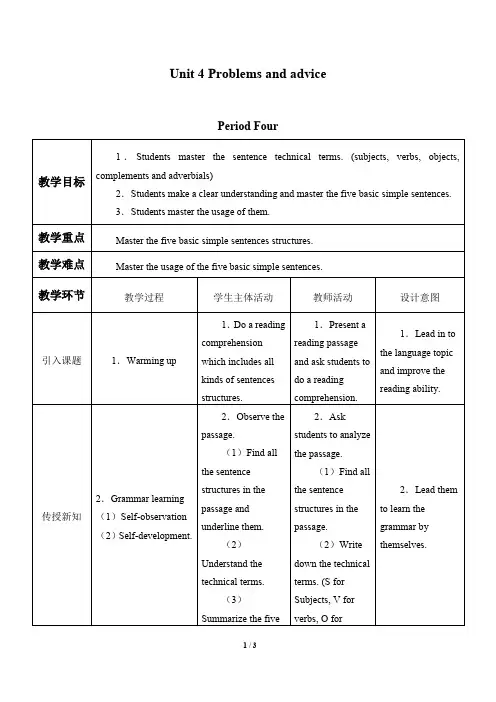
Unit 4 Problems and advicePeriod Four教学目标1.Students master the sentence technical terms. (subjects, verbs, objects, complements and adverbials)2.Students make a clear understanding and master the five basic simple sentences.3.Students master the usage of them.教学重点Master the five basic simple sentences structures.教学难点Master the usage of the five basic simple sentences.教学环节教学过程学生主体活动教师活动设计意图引入课题1.Warming up1.Do a readingcomprehensionwhich includes allkinds of sentencesstructures.1.Present areading passageand ask students todo a readingcomprehension.1.Lead in tothe language topicand improve thereading ability.传授新知2.Grammar learning(1)Self-observation(2)Self-development.2.Observe thepassage.(1)Find allthe sentencestructures in thepassage andunderline them.(2)Understand thetechnical terms.(3)Summarize the five2.Askstudents to analyzethe passage.(1)Find allthe sentencestructures in thepassage.(2)Writedown the technicalterms. (S forSubjects, V forverbs, O for2.Lead themto learn thegrammar bythemselves.basic simple sentences structure.S+VS+V+OS+V+IO+DOS+V+DO+IOS+V+O+A(4)Analyze the sentence elements:What kind of sentence structure are they?(5)Students answer the questions to show if they have understood.(6)Read the sentences loudly. objects, C for complements, A for Adverbials on the blackboard and ask students to understand them.)(3)Ask students to summarize the five basic simple sentences structures according to the passage.(4)Ask the students to analyze the sentence elements in the passage.(5)Ask them to give the answers and give some help if necessary.(6)Ask them to read the sentences loudly.课堂练习3.Play a game.3.Work ingroups, and choose alucky number andanswer some3.Introducethe rules of thegame:(1)The3.Make theclass lively andstrengthen theirgrammar by games.questions to get points. (Some questions are what kinds of sentences structures they are. Some should be make a sentence according to the instruction. Some should be easy enough to write the five simple sentence structure.) name of the gameis Boom.(2)Work ingroups, andchoose one of thenine luckynumber. You mayanswer somequestions to getsome points. Youmay be boomedand lose all points.You may be luckyenough to getpoints withoutdoing anything.4.Cultivatetheir habit of takingnotes.课时小结4.Grammar exercises.4.Finish theexercises.4.Askstudents to finishthe exercises.5.Strengthentheir grammar byexercises.作业布置5.Summary andhomework5.(1)Listencarefully and takenotes.(2)Make 2sentences accordingto each sentencestructure.5.(1)Askstudents to takesnotes.(2)Summarize themain content ofthe grammar.(3)Assignment.6.Summarizeand cultivate theirhabits of takingnotes.。
Module2Unit4ProblemsandadviceVocabulary(牛津深圳版九上)
7. We saw a lady lying in the street.我们看见一位女士正躺在街上。see sb. doing sth. 看见某人正在做某事表示在某个情景或时间所见的事情正在进行中;see sb. do sth. 看见某人做了某事表示看事情发生的全过程。例如:
当我到达那里的时候,我看见莉莉正和她的朋友谈话。When I got there, I saw Lily talking to her friend. 你看见他拿了我的书吗?Did you see him take my book?我经常看见他们在学校打篮球。I often see them play basketball at school.
fail v. 不及格 p.58careless adj. 粗心造成的 p.58out of place 格格不入 p.58
New words and expressionsSpeaking
comment n. 评论 p.59*request n. 要求;请求 p.59polite adj. 有礼貌的 p.59none pron. 没有一个;毫无 p.59exam n. 考试 p.60
*worry about ... 担心……*make up one’s mind 下定决心*pay attention to ... 注意……*stop doing sth. 停止做某事
短语收藏夹(More practice)带*的是学过的短语
沪教牛津版-英语-九年级上册4单元 Problem and advice P4 课件
Why don’t you tell her how you feel?
L1ine.tRg’rosoleusppeslea; ywthhe iccohnvegrrsoatuiopn 2. Rodleopelsaytthhee cboensvetr.sation
1.S1 failed his/her Maths test because of some careless mistakes. He/She is afraid to tell his/her parents.
2.S2 is taller than all his/her classmates. He/She feels so out of place!
Let’s have a race!
Ready? Make up your own conversations.
Use the conversation A as a model. Which group is the best?
B Speak up
In pairs, make conversations according to the situations below. You may use your own situations. (P 58)
I think you should + V. … Maybe you should + V. … You could + V. … Why don’t you +V. …? Why not + V. …?
点击此处
Objectives
牛津深圳版英语九年级上册:Unit 4 《Problems and advice》 教学设计1
牛津深圳版英语九年级上册:Unit 4 《Problems and advice》教学设计1一. 教材分析《牛津深圳版英语九年级上册》Unit 4《Problems and advice》主要讨论了现代社会中人们面临的一些普遍问题,如学习压力、环境污染、健康饮食等,并通过对话和阅读材料让学生学会如何提出问题、给出建议以及如何表达自己的观点。
本课内容贴近学生的生活,有利于激发学生的学习兴趣和参与欲望,同时也培养了学生的批判性思维和解决问题的能力。
二. 学情分析九年级的学生已经具备了一定的英语基础,能够听懂并运用一些基本的日常用语进行交流。
但同时,他们在学习过程中可能会遇到一些问题,如词汇量不足、语法掌握不扎实、听说能力较弱等。
因此,在教学过程中,教师需要关注学生的个体差异,针对不同学生制定相应的教学策略,提高他们的英语综合运用能力。
三. 教学目标1.知识目标:学生能够掌握本课的生词、短语和句型,了解文章的主旨大意,理解文章中的人物观点和建议。
2.能力目标:学生能够运用所学知识进行日常交流,具备提出问题、给出建议和表达自己观点的能力。
3.情感目标:学生能够关注社会问题,积极参与讨论,培养批判性思维和解决问题的能力。
四. 教学重难点1.重点:本课的生词、短语和句型,以及文章的主旨大意。
2.难点:学生如何运用所学知识进行实际交流,提出问题、给出建议和表达自己观点。
五. 教学方法1.任务型教学法:通过设定各种真实的任务,让学生在完成任务的过程中运用所学知识,提高他们的实际运用能力。
2.情境教学法:创设各种生活情境,让学生在真实的语境中学习英语,增强他们的学习兴趣。
3.小组合作学习:鼓励学生进行小组讨论和合作,培养他们的团队精神和批判性思维。
六. 教学准备1.教师准备:提前准备好教材、课件、多媒体教具等教学资源。
2.学生准备:学生提前预习课文,了解本课的主题,准备相关的个人经历或观点。
七. 教学过程1.导入(5分钟)教师通过展示一些社会问题(如学习压力、环境污染等)的图片,引导学生进行思考,并提问:“Do you have any problems in your dly life? What advice would you give to solve them?”让学生发表自己的观点。
牛津深圳版英语九上Unit 4《Problems and advice》(Period 3)ppt课件
d
• I had some meat.
b
Read the sentences and underline the two adverbials in each sentence.
1. Prince Charles opened a new sports centre in Stoke yesterday. 2. He also spoke with several young people. 3. The sports centre was first planned in 1994. 4. Naturally, the local council could not finance the project without help. 5. Luckily, they managed to get money from the National Lottery.
Sentence elements: subjects, verbs, objects, complements and adverbials
I smile. (S+V) The braces hurt my teeth. (S+V+O) I feel embarrassed. (S+V+C) She is driving me mad. (S+V+O+C) I saw a sick lady two days ago. (S+V+O+A) I am studying at home. (S+V+A)
Think and tell which sentence element the underlined part is.
牛津深圳版英语九年级上册Unit4基础知识讲解+练习题(含答案)
牛津深圳版英语九年级上册Unit 4 : Problems and advice I. Words and phrases:II. Key points of vocabulary:1.online adj. 在线的反义词 off-line You can chat to other people who are online. diet n. 规定饮食(be) on a diet 节食2.regret v. 懊悔同义词 be sorry forregret doing sth regret (that)I now regret leaving school so young.He was beginning to regret that he'd come alone.3.though conj. 虽然, 尽管同义词 although though 可放在句首或句中,不能与but 连用Though she's almost 40, she still plans to compete.Tom kept himself in though he was very angry.4.ashamed adj. 惭愧;羞愧feel ashamed of/at be ashamed to do sth ashamed thatI felt ashamed of the things I'd said to him.I'm ashamed to admit it.I'm ashamed that I haven't replied to your letter yet.5.mad adj. 很生气;气愤 especially angrydrive sb. mad 让某人受不了 mad at sb mad about sth go/get mad We get mad at each other sometimes.There's no need to get mad about it!Look at this mess! Mum will go mad!Her behaviour drives me mad.6.mess n. 杂乱;不整洁messy adj. 杂乱的;不整洁的make a mess 搞得一塌糊涂The house was a _______________ The house was _______________ When I got home, the house was a complete _______________7.annoying adj. 使恼怒的;使生气的annoyed adj. 恼怒的, 气恼的annoy v. 使生气, 惹恼类似构词:interest -interesting-interested surprise-surprising-surprisedfrighten-frightening-frightened excite-exciting-excited8.out of place 格格不入I felt out of place at the birthday party.hear from 收到某人的信件同义词 get/receive a letter from9.none pron. 没有一个;毫无She waited for a reply, but none came.Even an old car is better than none.None of my friends phone me any more.none/no one区别:none:一般用来回答how many +n, how much +n 及含any+n引起的疑问句no one:回答who,及含anyone,anybody引起的疑问句 none of one's business 与某人无关10.careless adj. 粗心造成的反义词 careful11.fail v. 不及格;失败反义词 succeed failure n. 失败 success fail to do sth12.request n. 要求;请求v. 要求;请求13.hate v. 厌恶;憎恶同义词 dislike 反义词love14.polite adj. 有礼貌的反义词 impolite/rude politely adv. politeness n.15.exam n. 考试同义词 examination / test pass/fail an examugh at 嘲笑;讥笑同义词 make fun of17.advantage n. 优势反义词 disadvantageIII. key points of Reading:1. We saw a lady lying in the streetsee sb. doing sth. 看到某人正在做某事see sb. do sth 看到某人做过(经常做)某事 I saw the little girl crying in the park. _______________________________________The old man saw the man play with the cat. _____________________________________________ lie (撒谎) lied lied lying(躺) lay lain lying拓展:hear/notice/watch和see有相同的用法2. It was awful of them to laugh at her,and I regret not saying anything.It is +adj+of sb + to do sth.=sb. is adj. to do sth.They were awful to laugh at her.regret doing sth. 后悔/内疚做过某事 regret to do sth 遗憾地去做某事I regret to tell you that you can't pass the examination ___________________________________3.... it was a mistake for my mother to make me wear these ugly braces.It is +adj+for sb + to do sth.=To do sth is adj for sb.To make me wear these ugly braces was a mistake for my mother. __________________________________ make sb do sth . 使某人做某事wear 穿(戴)着[表状态];put on 穿上[表动作] dress 打扮[后接人]4. She has a habit of playing the piano ... studying,and she always takes my things without telling me. have a habit of doing sth 有做某事的习惯The Smiths have a habit of going out for a walk after dinner. ______________________________________ take one's thing without telling sth 未经允许就拿走某人的东西Little Tom took his classmate's ruler without telling him. _________________________________________5.I try to keep the room tidy,but....try to do sth 尽力做某事try doing sth 尝试做某事You must try to be more careful. _________________________________I tried gardening but didn't succeed. ____________________________________keep sth adj 保持某物某种状态keep sb doing 使某人持续做某事Please keep the window open/closed. ___________________________He kept the little girl laughing. ____________________________Unit 4 : Problems and advice 课后练习一、英汉互译。
牛津深圳版英语九年级上册:Unit 4 《Problems and advice》 教学设计5
牛津深圳版英语九年级上册:Unit 4 《Problems and advice》教学设计5一. 教材分析本课是牛津深圳版英语九年级上册Unit 4《Problems and advice》的教学设计。
本单元的主要话题是讨论问题和提出建议,通过本课的学习,学生能够运用所学知识描述生活中遇到的问题,并提出解决问题的建议。
本课的主要内容是讨论环境问题,学会用英语表达各种环境问题,并能够提出相应的解决方案。
二. 学情分析九年级的学生已经具备了一定的英语基础,能够听懂并运用简单的英语进行日常交流。
但是,对于一些环境问题的专业词汇和表达方式可能还不够熟悉,因此,在教学过程中,需要帮助学生掌握相关词汇和表达方式,并能够灵活运用。
三. 教学目标1.知识目标:学生能够听懂、说出一系列环境问题,并能够用英语提出相应的解决方案。
2.能力目标:通过本课的学习,学生能够提高自己的英语听力、口语和表达能力。
3.情感目标:通过讨论环境问题,学生能够增强环保意识,提高自己的社会责任感和公民素质。
四. 教学重难点1.重点:学生能够掌握与环境问题相关的词汇和表达方式。
2.难点:学生能够运用所学知识,提出针对环境问题的具体解决方案。
五. 教学方法1.任务型教学法:通过设计各种任务,让学生在实际语境中运用所学知识,提高学生的综合语言运用能力。
2.情境教学法:通过创设各种环境问题的情境,让学生在真实的环境中学习和使用英语。
3.小组合作学习:通过小组讨论和合作,提高学生的团队协作能力,培养学生的自主学习能力。
六. 教学准备1.教师准备:教师需要准备相关的教学材料,如PPT、环境问题的图片、视频等。
2.学生准备:学生需要预习本课的内容,了解一些环境问题的背景知识。
七. 教学过程1.导入(5分钟)教师通过展示一些环境问题的图片或视频,引导学生关注环境问题,激发学生的学习兴趣。
2.呈现(10分钟)教师通过PPT呈现本课的主要内容,包括环境问题的词汇和表达方式,以及如何提出解决方案。
深圳牛津 九年级 Unit4 Problems and advice
辅导讲义教师jiang 科目英语上课日期总共学时学生年级上课时间第几学时类别基础提高培优Unit4 Problems and advice重点单词:1. online adj. 在线的;在网上 adv. 在线;在网上This online article is very interesting. 这篇在线文章很有趣。
2. model n. 模特儿Sally is going to be a model because she thinks she is good-looking. Sally自以为相貌出众,所以想当模特。
提示:model还有以下的含义:a. (依照实物按比例制成的)模型。
a model planeb. 样式;设计;型。
The latest model will be on display at the car show.c. 模范;典型 a model student3. diet n. 规定饮食(为健康或减肥等目的)I’ve only lost two pounds sin ce I started this diet. 从这次节食开始到现在我只减了2磅。
4. though conj. 虽然;尽管Aunt Anna likes Tim though he often annoys her._________it's difficult to make her dream come true, she never gives up.A. ThoughB. UnlessC. BecauseD. If_________the teacher was very busy, ________ he still helped me with my English.A. Though, butB. Because, butC. Though, yetD. Because, /5. advantage n. 优势反义词: ______________ n. 缺点;劣势In his eyes, the school’s only advantage was its location.6. situation n. 情况;状况The situation was under the control.局面得到了控制。
初中九年级英语深圳牛津版上册unit4 Problems and advice教学课件
Who
What
Why
Anna Peter
Worried about her Jolin is _a_lw__ay_s__on__a_d_ie_t__
friend
getting too thin
His friends laughed at
_A_s_h_a_m_e_d_ of himself _a_l_a_d_y__ly_i_n_g_i_n_t_h_e_s_t_r_e_e_t___
He _w_a_n_t_e_d_t_o__h_e_lp__h_e_r_, but
his friends told_E_m_b_a_r_r_a_s_s_e_dabout His friends _la_u_g_h_e_d_a_t _h_im_
wearing braces
worse. • avoid being blamed • more convenient for...to get assisstance/ help
Learning objectives: 学习目标