
英语必修5 Unit1 Great Scientists Warming up
今日事,今日毕。
Who is he?
He is called the greatest scientist in the 20th century. He is famous for the Theory of Relativity.
Unit 1
Great scientists
Warming up
Lead in
Have you ever dreamed to be a scientist? If so, which field do you want to take part in?
Warming Up
What do you know about great scientists?
3. Who invented the first steam engine?
Thomas Newcomen
4.Who used peas to show how physical characteristics are passed from parents to their children?
Miniature(小型的) Miner's Safety Lamp
the Safety Lamp
9.Who invented the earliest instrument to tell people where earthquakes happened?
seismograph
Zhang Heng
Gregor Mendel (1822-1884) Czech (捷克人)
5. Who discovered radium?
Nothing in life is to be feared. It is only to be understood.
生活中没有什么可怕的东西, 只有需要理解的东西。
Marie Curie
1.Which scientist discovered that objects in water are lifted up by a force that helps them float?
Archimedes (287-212 BC) an ancient Greek mathematician & physicist
比赛已经提前到一点半举行。
他在会议上提出了一个计划。 He put forward a plan at the meeting. 他们把婚礼的日期提前了一周。 They put forward the date of their wedding by one week. 我们将把讲座的日期提前/延期到9月9号。 We’ll put forward/put off the date of the lecture to September 9th.
scientists in our brain
Guessing game
Who are they?
Who is he?
He has made a famous kite experiment. He learned a lot from it and invented lightning rod (避雷针). He is … Benjamin Franklin
2. Who wrote a book explaining how animals and plants developed as
the environment changed? Charles Darwin (1808-1882) British author of The Origin of Species
Leonardo da Vinci (1452-1519) Italian artist
Mona Lisa
Last Supper
8.Who invented a lamp to keep miners safe underground?
Sir Humphry Davy (1778-1829)British
generation to generation.
3) Pass the letter ___ on to the person next to you . by and never notice 4) So many people pass ___ the change.
5.Who invented the way of giving electricity to everybody in large cities? 是谁发明了把电带给大城市中的每个人的办法? the way of doing sth.= the way to do … “做…..的方法” She showed us the way of cleaning it.= She showed us the way to clean it. 她给我们示范清洗它的办法. the way引导的定语从句的引导词有三种, 可以用that; 可以用in which; 还可以省略.
2. explain explain sb. sth. (F) explain sth. to sb. (T) 3. characteristic n./adj. Some genetic characteristics are not obvious. The two groups of children have quite different characteristics. Forgetfulness is often characteristic of aged people. 特有的,典型的
阿基米德 Archimedes 达尔文 Charles Darwin 纽可门 Thomas Newcomen 孟德尔 Gregor Mendel 居里夫人 Marie Curie 爱迪生 Thomas Edison 达芬奇 Leonardo de Vinci 汉弗来.戴维爵士 Sir Humphry Davy 张衡 Zhang Heng 斯蒂芬.霍金 Stephen Hawking
Their wedding has been called off(取消).
put away 抛弃;舍弃 put down 写下来; 记入名单 put on 穿上; 戴上; 增加 put off 耽误; 延期 put out 熄灭(灯); 扑灭 (火) put up 建立; 建造 put up with… 忍受… You can take anything from the shelf and read, but please ______ the books when C you’ve finished with them. A. put on B. put down C. put back D. put off
enthusiastic Co-operative
positive
bright
common characteristics
strict
cautious
Match the names and what they famous for.
遗传学 电 浮力定理 镭 进化论 画家 蒸汽机 矿工安全灯 黑洞理论 地动仪
Language Points 1. discover & invent invent v. 发明, 发明原先不存在的东西 Who invented the steam engine? 谁发明了蒸汽机? discover v. 发现, 探索或揭示早就客观 存在着事物 Columbus discovered America in 1492. 哥伦布于1492年发现了美洲。 Who discovered radium? 谁发现了镭?
6. Who invented the way of giving electricity to everybody in large cities? Thomas Alva Edison
Genius is one percent inspiration and ninetynine percent perspiration.
4. pass sth from… 从…处传来, 传下 pass by 路过, 经过… pass down 把…传下来 pass on 传递, 传授 passed from their ancestors. 1)The tradition is ___________ 2) This spirit should be passed ______ down from
I don’t like the way _______________ (that/ in which) you speak to your father. 我不喜欢你跟你父亲讲话的方式. 与way相关的短语: by the way 顺便说 by way of … 通过…的方法 lose one’s way 迷路 no way (俚语)没门, 别想 feel one’s way 摸黑走, 谨慎从事 on one’s way to… 在去…的路上 in this way=by this means=with this method 用这种方法
天才就是百分之九十九的汗水加上 百分之一的灵感。
The Inventions of Thomas Edison
Phonograph (留声机)
Lightbulb(电灯泡)
ห้องสมุดไป่ตู้
Motion Pictures(电影)
7.Who was the painter that studied dead bodies to improve his painting of people?
You cannot teach a man anything. You can only help him find it within himself. 你不可能把一切都教给一个人,你只能帮助 他从内心去发现(和了解)事物。
英语:Unit1《Great scientists》Warming Up & Reading-Language Points课件(新人教版必修5)
③In conclusion,I would like to say how much I have enjoyed myself today. 总而言之,我想说我今天玩得很开心。 ④He concluded his speech by reading a poem. 他以朗诵一首诗结束了他的演讲。 ⑤What can you conclude fromthese facts? 从这些事实中你能得出什么结论?
牛刀小试 (2011年三明高二检测)He ________ the conclusion with the ________ evidence and presented it at the conference. A.draws;supporting B.drew;supporti C.came to;supported D.reached;supported 解析:选B。句意:他用有力的证据得出这个结 论,并在会议上展示。supporting evidence是“ 有力证据”的意思。由presented可看出时间应为 过去。
由我们的老师提出的建议证明是非常实用的。
【助记】
自我探究 put forward意为提出(计划、建议等)。
归纳拓展
1put forward还有其他意义: ③The new school semester was put forward a week. 新学期提前了一周。 ④You ought to put your watch forward ten minutes. 你的表应该拨快十分钟。 put forward在此处的含义为:把„„提前 2与put有关的其他词组: put aside把„„放在一边;储蓄 put away收好;积蓄,攒钱 put back将„„放回;拖延;向后拨 put down放下;镇压;写下,记下 put off推迟 put on穿上;上演;增加体重 put out熄灭 put...into practice把„„付诸实施 put up举起;搭建;张贴;留„„住宿 put up with忍受 3come up with提出;想出 come up被提出
高中英语 Unit 1 Great Scientists(第1课时)Warming up教案 新人教版必修5
Book 5 Unit 1 Great ScientistsA general review of Unit 1Period 1 Word study, Warming up, pre-readingPeriod 2 Reading (P2)Period 3 Language points, learning about languagePeriod 4 Using language( listening), GrammarPeriod 5 Listening & Reading (p44-45)Period 6 Reading & writing (p6)Period 7 Exercises & SummaryPeriod 1Pre-class task:1. Preview new vocabulary of Unit 1, and especially pay attention to the pronunciation of the new word2. Finish the quiz in Warming up( p1) in groups of four by referring to books or surfing the net.Step 1 Learning GoalsGet Ss to go through the summing up form on p 8 in order to have a general idea of the learning goals of Unit 1Step 2 Word Study1. (Pair work) Get Ss to learn the new words and phrases on p91 within 3 mins, by reading them aloud to each other to make sure that they can pronounce the words correctly---- Get Ss to read aloud the words in pairs by turns, e.g. 1 pairs read 4 words then go to next pair2. PracticeUse the correct form of the words to fill in the blanks.infectionexamination=examscience /scientistconcludeanalysisdefeatvalueinstructor/instructioncontribution /contributor contributivecreatecalculatemovecompletionenthusiasm3. Fill in the blanks using the new words in this unit1) Mrs. White bought a pan with a long ________. (handle)2) The pollution is so ________ that we have to take some measures to stop it. (severe)3) He has a big nose that is a ________ of his family. (characteristic)4) Water and salt are ________ into our blood stream every day. (absorbed)5) If a doctor or a medical treatment ________ someone’s illness, they make the person well again. (cure)Step 3. Warming up(Group competition) Check the answers to the quiz to find out which group knowthe most . Show pictures to introduce some scientists while Ss giving the correct answers-- congratulations to the winning groupStep 4 Pre-reading1. (Pair work) What five most important qualities do you think a scientist should have? Give reasons.clever/talented strict patient creative determined/strong-willed positive honest energetic intelligent/hard-working ambitious careful co-operative confident brave2. (Group work) Ex2, p1Do you know how to prove a new idea in scientific research? Discuss in groups the stages in examining a new scientific idea. What order would you put them in?Draw a conclusion Think of a method Collect results Make up a question Find a problem Analyse the resultsStep 5. Summary1. Seeing much, suffering much, and studying much are three pillars (支柱,要素)of learning.2. learning without thought is a labour lost; thought without learning is perilous(危险的)3. To know the disease is half the cure. 找出病根等于医治了一半。
人教版 必修五 unit1 great scientists warming-up
Seismograph 地震仪
• 1. I was an American. • 2. I invented electric light bulb(电灯泡). • 3. I invented the way of giving electricity to everybody in large cities.
Stages in examining a new scientific idea
1.Draw a conclusion: (得出结论)
2.Think of a method:
3.Collect results: 5.Find a problem:
(找出研究方法)
(收集材料) (发现问题)
4.Make up a question: (形成研究主题) 6.Analyse results: (分析材料)
times and it Uncontrolled was very difficult to de If you want to be a scientist in the future, what do you want to solve or invent?
Repeat if necessary
Draw a conclusion
Homework:
• Learn the new words of this unit • Read the passage of John Snow
Defeats "King Cholera".
From:
Charles Darwin 达尔文
1. I am Englishman. 2. I’ve worked in astronomy. 3. I’ve put forward a theory about black holes.
Unit 1 Great Scientists warming up课件 新人教版必修5课件
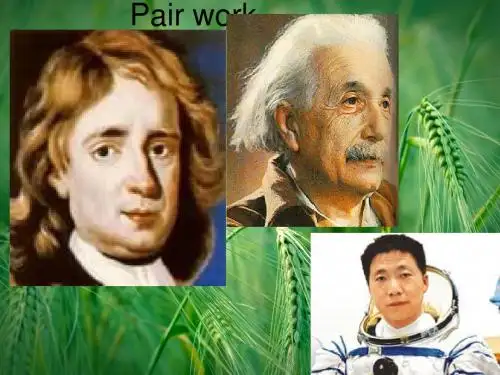
Stephen Hawking,British(1942--- )
He has worked in astronomy and studied black holes in space. He has shown that black holes do not only absorb everything around them but, from time to time, throw out matter as well. This may mark the beginning of new galaxies. This is an advance on the old theory which said that black holes “eat” everything they come across.
• Give me a place to stand on, and I can move the earth. ----Archimedes
Charlie Darwin(1808-1882)
Britain naturalist. The Origin of Species was published in 1859. It explained how plants and animals had changed over time to fit in with a changing environment. His book showed that people had developed form apes.
Leonardo da Vinci(1452-----1519)
He was a famous Italian artist whose skill for showing human skin tones made his paintings seem to come alive. He used to study dead people in order to make his paintings as accurate as possible. Some of his famous paintings include “The smile of Mona Lisa” “The Last Supper”. Later in his life he lived in France where he designed a submarine and a flying machine.
高中英语新人教必修五Unit1GreatscientistsWarmingupReading

C. Thomas Edison
教学ppt
6
“Give me a place to stand on, and I can move the earth.”
Archimedes
“给我一个支点,我就可以翘起整个地球.”
教学ppt
7
2. Who wrote a book explaining how animals and plants developed as the environment changed?
教学ppt
18
10.Who put forward a theory about black holes?
A. Stephen Hawking B. Archimedes C. Copernicus
教学ppt
19
Black hole
Stephen Hawking (1942--) British, a physicist
Warming up& Reading Book 5,Unit 1
教学ppt
1
What do they have in common?
They are scientists
教学ppt
2
Unit 1
Great Scientists
教学ppt
3
What do you know about them ?
约翰.斯诺
教学ppt
27
Speaking
Who is your favorite scientists? Why ?
教学ppt
28
Reading
教学ppt
29
It infects people’s intestines(肠道),
人教新课标必修五 Unit1 Great scientists-Warming up[课件]
![人教新课标必修五 Unit1 Great scientists-Warming up[课件]](https://360docs-1393072327.cos.ap-beijing.myqcloud.com/5a3633a9d1f34693daef3ede.webp)
Archimedes 阿基米德
Archimedes, Ancient Greek (287-212 BC), a mathematician.
2. Who wrote a book explaining how animals and plants developed as the environment changed?
Charles Darwin达尔文
Charles Darwin, Britain (18081882).The name of the book is Origin of Species.
3. Who invented the first advanced steam engine? James Watt瓦特
7. Who was the painter that studied dead bodies to improve his painting of people?
Leonardo da Vinci 达芬奇Leonardo da Vinci,
Italian, an artist.
8. Who invented a lamp to keep miners safe underground?
6. Who invented the way of giving electricity to everybody in large cities?
Thomas Edison 爱迪生
Thomas Edison, American, an inventor. He invented the lights and the gramophone.
3.The following measures should be taken to prevent cholera except________ A.Always drinking beer B.Instructing the water companies not to expose people to polluted water any more C.Examing all water supplies D.Finding new methods of dealing with polluted water.
人教版(新课程标准必修五Unit1GreatscientistsWarmingup课件
Miniature (小型的) Miner’s Safety Lamp
the Safety Lamp
ห้องสมุดไป่ตู้
9. Who invented the earliest instrument to tell people where earthquakes happened?
seismograph
Zhang Heng
1)The tradition is _p_a_ss_e_d__fr_o_m__ their ancestors. 2) Patriotic spirit should be passed _d_o_w__n_ from
generation to generation. 3) Pass the letter o_n__ to the person next to you. 4) So many people pass _b_y_ and never notice
He has made a famous kite experiment. He learned a lot from it and invented lightning rod (避雷针). He is … Benjamin Franklin
Never leave that until tomorrow, which you can do today.
no way
(俚语)没门, 别想
in the way 挡路
on one’s way to… 在去……的路上
in this way=by this means=with this method 用这种方法
6. Who put forward a theory about black holes? 谁提出了黑洞的理论? put forward: 1. They put forward the date of their wedding by one week. (____) 2. He put forward a plan at the meeting.(___) =被动句A plan__________ at the meeting. (同义句)He_ca_m_e__u_p_w_i_tha plan at the meeting
人教新课标必修五Unit_1_Great_scientists-warming_up_and_reading[课件]
steam engine It’s used for taking water out of mines.
James Watt
4. Who used peas to show how physical characteristics are passed from parents to their children?
Collect results Analyse the results
Find supporting evidence Draw a conclusion
Task 2
Mind Map of the text
Read the passage and number these events in the order that they happened.
6
He had the handle removed from the water pump.
Discussion: Discuss the following questions in groups of four.
1.
John Snow believed Idea 2 was right. How did he finally prove it? Do you think John Snow would have solved this problem with- out the map? Give a reason.
Street
No death happened here.
The water from the pump was to blame.
Match them
Para 1 Para 2
Find a problem Make up a question
人教新课标必修五Unit1Great-scientists-warming-up-andreadin
It’s used for taking water out of mines.
James Watt
4. Who used peas to show how physical characteristics are passed from parents to their children?
float?
It’s… Archimedes
2. Who wrote a book explaining how animals and plants developed as the environment changed?
Charles Darwin
3. Who invented the first steam engipainter that studied dead bodies to improve his painting of people?
Leonardo da vinci
Sir Humphry Davy
8. Who invented a lamp to keep miners safe underground?
Reading
Do you know what did this map was used for in 1854?
Finding out the cause of Cholera.
What method did he use?
Public house
Many dAeamthsahpapopefnBedrhoeared. Street
Gregor Mendel
What’s this?
radium
It’s used in the treatment of some diseases, especially cancer.
高中英语新人教版必修五Unit1 Great Scientists warming up
分析材料
Find supporting evidence 找到确实证据
Find a problem
Make up a question Think of a method
Collect results Analyse the result Find supporting evidence
Draw a conclusion
Gregor Mendel
5. Who discovered radium?
radium Marie Curie
Thomas Edison
He invented the way of giving electricity to everybody in large cities.
7. Who was the painter that studied dead bodies to improve his painting of people?
B. The cause of Cholera was polluted water.
C. The source of all drinking water should be examined.
D. How John Snow collected, analysed data and found the cause of the disease and solved it .
Spread from one person to another. So it is an infectious Disease.
Broad Street
1. Skimming
What’s the main idea of the passage?
A. John Snow was a well-known doctor in London.