
名词性从句讲解(二)
1. We know the truth that the earth goes round the sun.
2. The fact that she had not said anything surprised all of us. 3. They asked me the question whether the work was worth doing. 4. They problem whether it is right or wrong has not yet been decided.
It is
a pity / an hounor a shame one’s duty that – clause no surprise no wonder
It is a pity that we can’t go.
It is no surprise that our team has win the game. It is no wonder that you have achieved so much success.
二、表语从句
1. This was what Tom was looking for.
这是汤姆正在找的东西。
2. That is why she was absent yesterday.
那是她昨天为什么迟到。
3. The house is where Lu Xun once lived.
这个房子是鲁迅曾今住过的地方。
4. This is how we overcame the difficulties.
这就是我们如何克服困难的。
5. The truth is that I have never been there.
真相是我从来没去过那。
注意事项:
1. 当reason做主语时,后面跟表语从句,从句要 用that 引导。
He has made it clear that anyone who breaks the law is to be punished.
4. doubt, doubtful后面跟宾语从句时,肯定句用whether/if,
否定句和疑问句用that。 I doubt whether/if he will pass the exam. I don’t doubt that he will pass the exam. Do you doubt that he will pass the exam?
3. It + be + 过去分词 + that从句
insisted suggested
It s
advised
ordered
that – clause
demanded It was insisted that you should be there on time.
It is suggested that the meeting should be put off.
1. 有些动词带宾语从句是需要在宾语从句前加it,
这类动词有hate, like, enjoy, love, dislike,
appreciate, see to, depend on等。
I hate it when they talk with their mouth full of food. You may depend on it that I shall always help you.
It looks as if it is going to rain.
似乎、好像 It looked as if he had understood this question. He was absent yesterday. That is because he was ill.
He was crying. That is because he had lost his bike. I didn’t see the film last night. That is because I had to 因为 help my sister with her homework.
从句谓语动词用should+动词原形
4. It +特殊动词(seem/appear/happen/matter)+ that从句
It seems that Alice is not coming to the party at all. It happened that I was out that day. matter一般用于否定句或疑问句中 It doesn't matter what I need.
四、同位语从句 同位语从句在主句中作某个名词的同位语,这
些名词常见的有fact, news, hope, truth, idea,
suggestion, order, thought, question, problem,
belief, doubt, fear等。引导同位语从句的连词
通常有that和whether, what, why, how…等。
It is important that we all should attend the meeting. It is certain that she will do well in her exam. It is probable that he told her everything.
2. It + be + 名词词组 + that从句
3. 如果宾语从句后边有宾语补足语,则用it作形式宾语, 而将宾语从句后置。这种句型的谓语动词有think, make, feel, find, consider, believe等。
We thought it strange that Xiao Wang did not come yesterday.
为了使句子保持平衡,常用It来代替主
语从句,而把主语从句放到后面,尤其
是连接词that引导的主语从句常用于此 种句式中,但what, whatever, whoever,
whichever引导的主语从句一般不后置。
用it做形式主语的常用句型
1. It + be + 形容词(adj.) + that-clause strange 经常用虚拟语气 important should+动词原形 necessary It is certain that – clause probable possible likely
介词后的宾语从句
1. I was pleased by what he told me. 2. We are talking about whether we admit students into our club. 我们正在讨论是否让学生加入我们的俱乐部。 3. The new book is about how Shenzhou 6 manned spaceship was sent up into space. 这本新书是关于神州6号载人航天飞船是如何 升入太空的.
3. It + be + 过去分词 + that从句
said decided
reported
It is thought that – clause
hoped
believed known
It is thought that Joe drives badly. It is reported that our school will be rebuilt. It is said that he is the best student in the class.
注意事项:
3. 注意why和because引导的表语从句的区别
He was absent yesterday. That is because he was ill.
He was ill. That is why he was absent yesterday.
总结:
because引导的表语从句,从句说的是某事的原因或理由 why引导的表语从句,从句说的是某种原因的后果或结果 ---I drove to Zhuhai for the air show last week. ---That is _______ why I didn’t see you.
The teacher suggested that we should call off the plan.
I demanded that he should answer me immediately.
He ordered that the work should be started at once.
I am doubtful whether/if he will pass the exam.
注意事项:
在insist, suggest, demand, desire, order, propose, recommend, require, request等表示请求、要求、 建议、命令等后面的宾语从句,从句用虚拟语气 (should+动词原形),should可省略。
The reason was that he got up late. The reason why he was late was that he got up late.
The reason which he gave me was that he got up late.
注意事项:
2. 表语从句还可以用as if/though, because引导。
It doesn’t matter whether he is going there or not.
名词性从句讲解(2)

名词性从句讲解(2 )应城市第三高级中学刘琪一.表语从句:在复合句中,位于系动词之后作表语的从句叫表语从句。
引导表语从句的关联词与引导主语从句的关联词大致一样,表语从句位于系动词后,有时用as if引导。
1.that 引导表语从句,无词义,只起连接作用,不可省。
2.联系动词可为be,look,seem,sound,appear等。
3.主语可为名词fact,truth,cause,question,explanation,trouble,assumption,belief等,代词this,that,these,it等。
4.whether 引导表语从句The fact is that we have lost the game.That’s just what I want.This is where our problem lies.That is why he didn’t come to the meeting.It looks as if it is going to rain.China is not what it used to be.The question is whether the enemy is marching towards us。
【注意】1.当主语是reason时,表语从句要用that引导而不是because。
The reason why he was late was that he missed the train by one minute this morning.2.whether可引导表语从句,但与之同义的if却通常不用于引导表语从句。
3.That is why…译为“这就是……的原因”。
其中why引导的名词性从句在句中做表语,该句型通常用于针对前面已经说过的原因进行总结。
That is why you see this woman before you know.That is why I came.区别:①That is why ……与That is the reason why …同义,只不过从语法结构上讲,前者中的why引导表语从句,后者中的why引导定语从句。
名词性从句讲解
(2) It (so) happened that It seemed/appeared that It occurred to sb that It doesn’t matter whether/when…
(六)常见表语从句句型 1。 … is that/what/whether/where… 。 2. … look as if./as though
Let’s discuss the question when we shall set off f) 1. It is a surprise/an honour … that 2. It is clear/strange… that 3. It is (has been) proved/hoped/said/found/….that
(七)常见宾语从句句型 1. vt.+ that/what/where… 2.prep+ what/that/where… 3.(sb) be adj + that/what/where…
(2) Who/where…do you think sb do sth? Who/Where…do you believe sb do sth? Who/Where…do you suppose sb do sth? Who/Where…can you suggest sb do sth? Who/Where…can you imagine sb do sth? Eg. What do you think he will do soon?
(3) a. make/think/consider /feel/find b. it adj. it n. to do... doing ... that … c. take it for granted that…
名词性从句导入语法讲解(2)

B.比较
• 1.Bob is our teacher. • 2.What we need is more money. • 作主语可以是(一个)词,也可以是
( 一个句 子 )
• 1.I don’t know the answer • 2. I don’t know what the answer is • 作宾语可以是( 一个 )词,也可以说
• 2. The news that he couldn’t come to made us upset.
• 作同位语可以是( 一个)词,也可以说 ( 一个句 子 )
合作探究
你能总结出什么叫名词性从句和它的种类吗?
• 一、名词性从句简介
• 1.定义
• 在句子中起 名词性即主、宾、表、同位语 作用的从句称为 名词性从句.
• 1. China is no longer what it used to be. ___表__语_____从句
• 2. The truth that the earth turn around the sun is known to all.
______主_语______从句
• 3. It was snowing when he arrived at the station.
• 5. Where he has been is still a puzzle.
• 6. She had a feeling that she was being watched. • •
• 1 That he will succeed is certain.
Whether
•2
he will go there is not known.
whole school. _____同__位__语___从句
英语的名词性从句知识点
英语的名词性从句知识点关于英语的名词性从句知识点名词性从句,语法书把它讲得繁琐而复杂。
尤其是各种各样的引导词,什么“从属连词”啊,“连接代词”啊,“连接副词”啊,等等,英语初学者往往记不住甚至混淆不清。
其实,只要我们把它们进行归类、对比,就发现名词性从句有规律可循。
顾名思义,名词性从句就是具有名词作用的从句。
因为它在句中可以作主语、宾语、表语和同位语,所以又分为:主语从句,宾语从句,表语从句和同位语从句四种。
其实,我们换个角度来看,名词性从句一点也不复杂。
名词性从句,我们先不考虑它们用何种引导词来引导。
我们只考虑,这些句子如果是简单句的话,它们是些什么样的`句子?原来就是我们学过的陈述句、一般疑问句和特殊疑问句啊。
因此我们要记住:陈述句用that引导,一般疑问句用whether引导,特殊疑问句用特殊疑问词(即wh-word)引导。
这样,基本问题就解决了。
下面我们用3组例句进行讲解,每组例句都分别包含一个主语从句,宾语从句,表语从句和同位语从句,这样归纳看起来是很有意思的。
(一)that引导的各种名词性从句1. That our team had won the match made us excited.2. The headmaster said that our team had won the match.3. The fact was that our team had won the match.4. The headmaster announced the news that our team had won the match.【特别提示】在本组句子中,每句都含有that our team had won the match. 它在句1中作了句子的主语,是主语从句。
在句2中作了said的宾语,是宾语从句。
在句3中作了was的表语,是表语从句。
在句4中作了news的同位语,是同位语从句。
名词性从句讲解
主 语 谓 语 宾语 宾语从句 每个人都知道 地球 围着太阳 运行。 主语 状语 谓语
Everyone knows that the earth moves around the sun.
同样的一个句子,当把它放在宾语的位置时,我们 便称其为宾语从句。
主语从句 主语 系 表语 地球围着太阳运行 是 一条真理。
I doubt whether he is right. (√) Can you doubt that she will win? (√)
2.关系代词,关系副词(连接代词,连接副词)
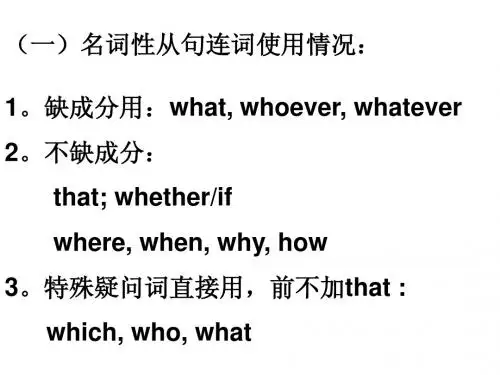
(1)引导名词性从句的关系代词有 who ---谁(主格) whom --谁(宾格) what ----什么…..的东西;所….的 which --哪一个/些 whose ---谁的(所有格) whatever—无论什么 whichever—无论哪个 whoever-无论谁
名词性从句的具体分类
在句子中起名词作用的句子叫名词性从句 (Noun Clauses)。 名词性从句的功能相当 于名词(词组), 它在复合句中能担任主语、 宾语、表语、同位语、介词宾语等,因此 根据它在句中不同的语法功能,名词性从 句又可分别称为主语从句、宾语从句、表 语从句和同位语从句。
(一) 主语从句
在句子中既是连接词,同时又做从句 的状语。
He told me how he studied English in the university to go abroad five years ago. -He told me where he studied English hard to go abroad five years ago. -He told me why he studied English hard in the university five years ago. -He told me when he studied English hard in the university to go abroad. The question is how we can get so much money. Fall is when the fruits become ripe. That’s where he used to lived. The question is how we can get there on time.
名词性从句讲解(共30张PPT)
I don’t like his job. I don’t like what he does every day.
I don’t know about the man, Mr. White. I don’t know about the fact that he is a teacher.
主语
表语
4. This is what he does every day.
主语
表语
5. I don’t like what he does every day. 动词宾语
主语
宾语
英语句子的种类
简单句 (simple sentence) 并列句 (compound sentence) 复合句 (complex sentence)
❖Lin Tao feels (that) his own team is even better. ❖She says (that) she won’t take part in the sports meeting next Sunday. ❖Jim thought (that) the train was like a big moving party.
引导词
连词 that, whether, if
疑问代词 who, whom, whose, which, what, whoever, whatever等
疑问副词 when, where, why, how等
Object Clause 宾语从句
1. I know him . (简单句)
主语 谓语 宾语
think, find, consider, believe, feel, make
英语名词性从句讲解【完整版】
2、I asked him if he could do me a favor .
If与whether的区别:
1、If不能引导放于句首的主语从句,而whether可以。 2、引导表语从句用whether,不用if。 3、引导同位语从句用whether,不用if。 4、whether可以引导从句作介词的宾语,不用if 。 5、whether or not 连在一起可以,但if不可以。而 “whether-----or not = if -----or not”
同位语从句:
定义:在复合句中充当同位语的句子。 同位语从句用来对其前面的抽象名词进行解释说明,被解释说明的词和 同位语在逻辑上是主表关系。 同位语常见名词:fact, suggestion, advice, idea, decision, news, thought, hope, belief, truth, doubt, promise, possibility, truth, warning, message, reason, report, question,explanation, wish, problem等。 常见的连接词:that, whether, what, who, how, when, where等。 用法: The thought that I want to buy my mother a birthday gift makes me excited.that 引导的同位语从句,解释说明 thought,从句不缺成 分 There is some doubt whether he will come. whether 引导同位语从句,if 不能引导同位语从句 we haven’t made the decision where we are going to spend our vacation. 有时同位语从句可以不紧跟解释说明的名词后面。 The news is surprising that he won the match.
赛领考研语法2名词性从句讲解
❖ (2)宾语从句类型 ▪ 1. 及物动词Vt. + 宾语从句
▪ King Juan Carlos of Spain once insisted kings don’t abdicate, they die in their sleep. (2015-1-阅读1)
❖This has created a paradox in that recruiting first-generation students, but then watching many of them fail, means that higher education has continued to reproduce and widen, rather than close achievement gap based on social class, according to the depressing beginning of a paper forthcoming in the journal Psychological Science. (2015-2-阅读2)
▪ Darkness gives me black eyes.
❖主语 + 系动词 + 表语 ▪ 系动词 • Be:is, am, are, was, were • 感官:seem, appear, look, sound, feel, taste, smell • 静态:remain, stay, keep • 动态:turn, become, grow, get, go ▪ 表语 • 形容词 • 名词
▪ 3. 不及物动词Vi. + 介词 + 宾语从句
• To filter out what is unique from what is shared might enable us to understand how complex cultural behavior arose and what guides it in evolutionary or cognitive terms.(12-1-翻译)
牛津高中英语模块三Unit1_语法讲解和训练__名词性从句 2
模块三Unit1 语法讲解和训练名词性从句一、概述在句子中起名词作用的从句称为名词性从句。
名词性从句包括主语从句,宾语从句、表语从句和同位语从句。
二、名词性从句的引导词1、连接代词:who, whom, whose, what, which, whoever, whatever等2、连接副词:when, where, why, how等3、从属连词: that, whether, if, as if, because (as if, because 只引导表语从句)连接代词和连接副词在句中不再是疑问词,因而从句中用陈述语序。
三、用法详解(一)主语从句1、主语从句用连接代词、连接副词和从属连词that, whether引导。
that不可省略。
That you don’t like him has nothing to do with me.Whether John can do the experiment remains a question.Who will be sent abroad to further his studies is not announced.What surprised me most was that such a little girl can play the violin so well.2、当主语过长时,常常用it作形式主语,而把真正的主语从句放在主句后面。
常用句型有:1)It +be +形容词(true, possible, certain, likely, surprising, strange, important…)+ that从句It’s certain that she will do well in the exam.It’s likely that he will tell me everything about that night.2)It +be +名词词组(no wonder, an honor, a pity, high time等)+that 从句It’s a pity that he can’t come.It’s high time that you turned in your homework.3)It +be +过去分词(said, reported, expected, supposed等)+that 从句It’s said that he is quite self-confident.It’s reported that a letter from the university has reached him.4)It +seem/ happen/look as if等+that从句tIt seems that Alice is not coming.It happened that I was a witness to the accident.5)It +doesn’t matt er(make no difference)+wh-It doesn’t matter whether you know my name or not.It makes no difference to me where we shall have the meeting.(二)宾语从句1、宾语从句用连接代词、连接副词和从属连词that, whether, if引导。
名词性从句
名词性从句(知识讲解)名词性从句是相当于名词的句子在句中作主语、宾语、表语、同位语, 因此分别称为语从句、宾语从句、表语从句、同位语从句。
一、主语从句(一)引导主语从句的关联词有四类:1. that引导,that 不充当句子成分,没有词汇意义,在句首不省略That they were in truth sisters was clear from the facial resemblance between them.从她们相似的面容可以清楚地看出她们实际上是姐妹。
2. wheth er “是否”引导Whether he will come here is not clear.他是否会来还不清楚。
3.疑问词引导,有词义并在句子充当成分(1)疑问代词:what, which, who, whom, whoseWho will give the speech is not known yet. 谁要发言还不知道。
Who/Whom the prize will be given to is not decided yet. 奖要发给谁还不一定。
Whose room it is is not clear. 这是谁的房间还不清楚。
What he said at the meeting is not known yet. 他在会议上讲的什么还不知道。
Which (one) you like has nothing to do with me. 你喜欢哪个与我无关。
(2)疑问副词where, when, how, why,how many/much/old/long/far/often….Where the meeting will be held depends on the weather. 在哪里举行会议取决于天气。
When they are leaving is being discussed. 他们什么时候走还正在讨论。