
人教版八年级英语下册unit9 Have you ever been to a museum sectionA1a-2d
Conversation 1
1. Tina went to the space museum last year. T / F 2. John has never been to the space museum. T / F 3. They are going to take the subway. T/F
√ √ √
Sarah
√
√ √
1c Ask and answer questions about the places.
A: Let’s go somewhere different today. B: OK. Where do you want to go?
A: Have you ever been to the space museum?
Space Museum
History Museum
Art Museum
Nature museum
Unit 9 Have you ever been to a museum?
SECTION A 1a-2d 孟家湾中学 吴红艳
ห้องสมุดไป่ตู้
Amusement park
4. ------I have never seen such an interesting water park.
park.
----Me n
.
1. —Have you ___________ been to Beijing? —Yes, I _____________. 2. —Have you ever _________to England? —No, I _____________. 3. —_________ you ever been to Chengdu? — No, I’ve ______been there. 4. —Have you______ been to the Great Wall? —Yes, I __________. 5. —_______ you ever been to an amusement park? —No, I ________.What’s an amusement park?
1b Listen. Have these students ever been
to these places? Check (√) the boxes.
Science History Art Nature Space museum museum museum museum museum
Claudia
根据首字母完成单词使句子意思完整, 通顺
1. Have you ever b_________ to a museum? 2. They have g_____ to see the movie. It’s so interesting.
3. I hope that they will have a wonderful time in the a
Name Where have you been? When did you go there? How did you go there? What did you do there? What do you think of it? Where will you go on Summer vacation? Why?
B: No, I haven’t. How about you? A: …
2a Look at the map of the town. Listen and circle the places you hear.
2b
Listen again and circle T for true or F for false.
Have you ever
been to the
amusement park?
Water park
Have you ever been to
a water
park?
1a
Which of these places would you like to visit? Rank them from 1 (most) to 6 (least). space museum ________ history museum ________ art museum ________ water park _________ zoo ________ amusement park _________
Read 2d and answer these questions.
1.When did Jill go to the film museum?
In April.
2.What does Jill love the film museum?
She loves all the old movie cameras.
Conversation 2 1. Linda has been to the amusement park. T/F
2. Linda went to the amusement park yesterday. T / F 3. Linda is going to the amusement park again by bike.
3.Who did Jill camp with on the weekend?
With her friends.
4.Has Anna ever been camping?
No, she hasn’t.
2c.Look at the map in 2a and make conversations about the Places. A: Have you ever been to the space museum? B: Yes, I have. How about you? A: No, I haven’t. B: Oh, it’s fantastic. Let’s go tomorrow. A:OK. How are we going to get there? B: We can take the subway.
T/F
Conversation 3 1. Frank had a great time at the water park. T/F
2. Frank’s friend has never been to the water park. T / F 3. Frank and his friend are going skating. T/F
art museum , amusement park , zoo, history museum………….. take the train, take the bus walk, ride the bike ………
Have a try
Choose the best answer. 1.—Where is Bruce? Is he at home? —I think he _____ school. A. has gone B. has been C. has gone to D. has been to 2.—I have never been to European countries. What about you? —_____. A. So do I B. So have I C. Neither do I D. Neither have I 3.—How long have you studied English? —_____. A. For 5 years B. 5 years ago C. Since 5 years D. 5 years before
人教版八年级下册Unit9 have you ever been to an amusement 现在完成时
Chairman Mao died in 1976. Chairman Mao has died for 36 years. × Chairman Mao has been dead for 36 years.
Hale Waihona Puke 非延续性动 与一段时间连用时的 表达方式 词
buy borrow close move to die leave wake
wonderful a. 奇妙的,惊奇的 a wonderful thing 精彩的事 wonder n 惊奇,奇迹. eight wonders 八大奇迹 wonder v: 对…感到惊奇,想知道 I wonder chicken lays an egg or the egg gives birth to chicken. .
fear v&n 害怕,惧怕 fear doing sth / like doing sth (表习惯性动作) fear to do sth / like to do sth (表某次具体动作) I fear learning Physics, while I like learning English I fear to tell you that I am nervous now.
☺句型转换
1 She’s already gone to England. (否定句) gone yet haven’t She ______ ______ to England _____.
3 I have known Monkey King since I was a child. (划线部分提问) How long have _____ _____ ______ you known Monkey King.
人教版八下 unit_9_Have_you_ever_been_to_a_museum.SectionA
amusement park
water park
bookshop
A: Have you ever been to a…? B: Yes, I’ve been to a... A: A: I’ve Me, also too. been to a...
A: Have you ever been to ...? B: No, I’ve never been to … A: Me I’veneither. never been to ...
Conversation 2 Linda has been to the amusement park. T / F Linda went to the amusement park yesterday . T / F Linda is going to the amusement park again by bike. T / F
Make up a conversation:
Has Dick /Lucy ever been to …? Yes, he /she has. / No, he / she hasn’t. Me too. /Me, neither.
1a Which of these places would you like to visit? Rank them from 1 to 5.
你曾经去过…吗?
A: Have you ever been to a beach? B: Yes, I have.
the Great Wall
A: Have you ever been to …? B: No, I haven’t.
zoo
A: Have you ever been to a zoo? B: Yes, I’ve been to a zoo.
Unit9Haveyoueverbeentoamuseum_SectionA1a-2c课件人教版英语
Free talk Have you ever been to a/an_...? Yes, I have. /No, I haven’t.
have been to (去过),可 以与never[从没], ever [曾经], just[刚刚], once [一次], before[之前]连接。
ahsnmsciapsiawetutaruonscatrrecetmeymemrmzumeopusnuuoeastsuserepeumkuuammrmk
“我也是”结构: So+助动词/情态动词/be+主语(肯定) “So+助动词/be动词/情态动词+主语I.”=Me,too.
Drills --I have ever been to _a_s_c_i_en__ce__m__u_se_u_m___.
Have you ever been there?
回答1:Yes, __I_h_a_v_e___.
➢ 拓展:表示后者与前者情形相同,即“……也不……”时, 常用Me neither.或neither/nor引起的倒装句: Neither/Nor+助动词/系动词be/情态动词+主语.
时态上与前文保持一致,数要与其后的主语一致。
例:—I have never been to a water park.
Look at the map of the town. Listen and circle the places you hear.
2b Listen again and circle T for true or F for false.
Conversation 1
1. Tina went to the space museum last year. T/F
新课标人教版八年级英语下册Unit 9 Have you ever been to an amuse
—So did Tina.
中国地图
蒂娜也去了。
—He has been a soldier for two years.
要点点拨
他已经当了两年兵了。
go inline skating 滑旱冰
—So have I.
我也是。
全析提示
3.Look at the map of the town.Listen and circle the places 助动词 have 和 has 可以与前面的
you hear.
主语缩略’ve 和’s。
看城镇的地图。听录音并圈出你听到的地方。
如:we’ve,they’ve,he’s,
water world 水上世界
it’s 等。
city library 城市图书馆
have not 常缩略为 haven’t,has
fun times amusement park
如果说“欢迎回家”该怎么说呢?
把 1a 中你的回答和你搭档的回答对照一下。
Wele back home!
4.For me,“I have to!” is number two.
对我来说“I have to!”是第二位的。
要点点拨
5.Listen to a teacher interview a student.Circle the newsletter 业务通讯;新闻信札
route“路线、小路、小巷”,使
The main attraction was a Charlie Chaplin film.
用 X 围也较小。course 表示船的
吸引人的主要是查理·卓别林的电影。
“航道”或飞机的“航线”。
The idea of being a teacher has little attraction to young
人教版英语八年级下册Unit 9《Have you ever been to a museum》教学

人教版英语八年级下册Unit 9《Have you ever been to a museum》教学设计一. 教材分析人教版英语八年级下册Unit 9《Have you ever been to a museum》主要讨论了人们参观博物馆、公园等地方的经历。
通过本节课的学习,学生能够掌握一般过去时的疑问句和回答,以及描述过去发生的事情。
教材中包含了丰富的图片、对话和练习,有助于激发学生的学习兴趣,提高他们的语言运用能力。
二. 学情分析八年级的学生已经掌握了一般现在时和一般过去时的基本用法,具备一定的听说读写能力。
但部分学生在实际运用中仍存在困难,如疑问句的构成、时态的运用等。
此外,学生的英语学习兴趣和动机有待提高。
三. 教学目标1.知识目标:–学会一般过去时的疑问句和回答;–掌握描述过去发生事情的句型;–了解博物馆、公园等地方的相关词汇。
2.能力目标:–能够用英语询问并描述别人过去的经历;–提高学生的听说读写能力。
3.情感目标:–培养学生对英语学习的兴趣;–培养学生热爱博物馆、公园等公共场所的意识。
四. 教学重难点•一般过去时的疑问句和回答;•描述过去发生事情的句型。
•疑问句的构成和时态的运用;•动词过去式的拼写规则。
五. 教学方法1.情境教学法:通过创设情境,让学生在实际语境中感受和运用英语;2.交际法:鼓励学生参与课堂互动,提高他们的口语表达能力;3.任务型教学法:通过完成任务,培养学生运用英语解决问题的能力;4.游戏教学法:通过趣味游戏,激发学生的学习兴趣。
六. 教学准备1.教学课件:制作课件,包含图片、动画、练习等;2.教学道具:准备相关场所的图片、卡片等;3.音频材料:下载相关听力材料,如录音、歌曲等;4.课堂练习:准备相应的练习题,巩固所学内容。
七. 教学过程1.导入(5分钟)–教师展示一张博物馆的图片,询问学生是否去过博物馆,引导学生谈论自己的经历。
2.呈现(10分钟)–教师展示课件,呈现本节课的主要内容,包括博物馆、公园等地方的词汇以及一般过去时的疑问句和回答。
人教新目标版初中英语八年级下册Unit9Haveyoueverbeentoamuseum要点讲解
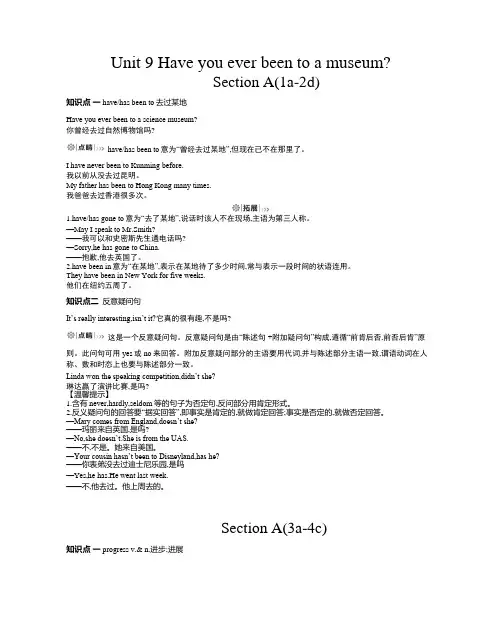
Unit 9 Have you ever been to a museum?Section A(1a-2d)知识点一have/has been to去过某地Have you ever been to a science museum?你曾经去过自然博物馆吗?have/has been to意为“曾经去过某地”,但现在已不在那里了。
I have never been to Kunming before.我以前从没去过昆明。
My father has been to Hong Kong many times.我爸爸去过香港很多次。
1.have/has gone to意为“去了某地”,说话时该人不在现场,主语为第三人称。
—May I speak to Mr.Smith?——我可以和史密斯先生通电话吗?—Sorry,he has gone to China.——抱歉,他去英国了。
2.have been in意为“在某地”,表示在某地待了多少时间,常与表示一段时间的状语连用。
They have been in New York for five weeks.他们在纽约五周了。
知识点二反意疑问句It’s really interesting,isn’t it?它真的很有趣,不是吗?这是一个反意疑问句。
反意疑问句是由“陈述句 +附加疑问句”构成,遵循“前肯后否,前否后肯”原则。
此问句可用yes或no来回答。
附加反意疑问部分的主语要用代词,并与陈述部分主语一致,谓语动词在人称、数和时态上也要与陈述部分一致。
Linda won the speaking competition,didn’t she?琳达赢了演讲比赛,是吗?【温馨提示】1.含有never,hardly,seldom等的句子为否定句,反问部分用肯定形式。
2.反义疑问句的回答要“据实回答”,即事实是肯定的,就做肯定回答;事实是否定的,就做否定回答。
—Mary comes from England,doesn’t she?——玛丽来自英国,是吗?—No,she doesn’t.She is from the UAS.——不,不是。
人教版英语八下U9Have you ever been to a museum 讲义
Unit9 Have you ever been to a museum?一、重点词汇及拓展1. amusement n. 娱乐;游戏e.g. The old ladies played the games just for amusement.老太太们玩这个游戏只是为了取乐。
amuse v. 消遣,逗笑;使开心,使愉快amusing adj. 有趣的,好玩的,好笑的amused adj. 被逗乐的;感到好笑的2.amusement park 游乐场e.g. The amusement park is open from May through October.游乐园从五月到十月开放。
3.somewhere adv. 在何处;到某处pron. 某个地方e.g. Maybe the keys are somewhere in the dining room.也许钥匙在餐厅某个地方。
I need to find somewhere to stay tonight.我得找到今晚要住的地方。
4.camera n.照相机;摄影机;摄像机e.g. I heard your parents bought you a cameras as a gift.我听说你的父母亲给你买了一台照相机作为礼物。
5.invention n.发明;发明物e.g. Do you think mobile phone is a great invention?你认为手机是一个伟大的发明吗?6.invent v.发明;创造inventor n.发明家invention n.发明;发明物e.g. As we all know that Edison invented light bulb.我们都知道爱迪生发明了灯泡。
7. unbelievable adj. 难以置信的;不真实的unbelievably adv. 难以置信地;不真实地unbelievably bad/good 坏得/好得令人难以置信incredible adj. 难以置信的e.g. I still find this story both fascinating and unbelievable.我仍然觉得这个故事非常有趣和难以置信。
人教版英语八年级下册Unit 9听力原文及翻译
Unit 9 Have you ever been to a museum?Section A, 1bSarah:I’m bored, Claudia. Let’s do something interesting.克劳迪娅,我很无聊。
我们来做些有趣的事儿吧。
Claudia:Have you ever been to a science museum?你去过科学博物馆吗?Sarah:Yes, I have. I went to the National Science Museum last year. Have you ever been to a history museum?是的,去过。
我去年去了国家科学博物馆。
你去过历史博物馆吗?Claudia:No, I haven’t.没去过。
Sarah:Me neither. Let’s go to one tomorrow.我也没去过。
我们明天去吧。
Claudia:Well, that sounds good, but I’m not interested in history.额,听起来不错,但我对历史不感兴趣。
Sarah:Really? I didn’t know that. Well, how about the art museum? Have you been to the art museum?真的吗?我不知道。
那艺术博物馆怎么样?你去过艺术博物馆吗?Claudia:I’ve been to the art museum many times.我去过艺术博物馆很多次了。
Sarah:Me, too. But I’d like to go again. Hmm, let’s see…how about the nature museum?I’ve been there a few times.我也是,但我还想去。
嗯,我看看,自然博物馆怎么样?我去过几次。
Unit9单元讲义人教版八年级英语下册
Unit9 Have you ever been to a museum?单词短语及重点句型一、单词讲解1 somewhere adv.在某处;到某处somewhere 不定副词,意为“某地”。
go somewhere different 意为“去与众不同的某地,去某个独特的地方”。
I want to go somewhere different and live alone. 我想去一个与众不同的地方独自生活。
拓展:由some, any, no, every分别加上where构成的副词叫不定副词。
即:somewhere 某个地方, anywhere 任何地方, nowhere 无处,哪里都不, everywhere 每个地方。
2 invent v.发明;创造1)invent 作动词,意为“发明;创造”。
Edison invented the light bulb. 爱迪生发明了电灯。
2)invent还可以表示“虚构”。
The whole story was invented. 整个故事是虚构的。
3)invent的名词形式有两个,一个是inventor(发明者;发明家),另一个是invention(发明物)。
Edison is a great inventor in history. 爱迪生是历史上伟大的发明家。
辨析:invent和discover的辨析:①invent 意为“发明,发明之物”指“从无到有”。
Alexander Graham Bell invented the telephone in 1876. 亚历山大•格雷厄姆•贝尔在1876年发明了。
②discover 意为“发现”,指“本来就已经存在,但不为人知”的事物。
Columbus discovered America in 1492. 哥伦布在1492年发现了美洲。
3 unbelievable adj.难以置信的;不真实的unbelievable作形容词,意为“难以置信的;不真实的”,是由believable“可相信的;可信任的”加否定前缀un派生而来的。
人教版八年级下册《Unit 9 Have you ever been to a museum 》教案
4a. Put the correct forms of the verbs in the blanks.
4b.Fill in the blanks with the correct forms of the verbs in brackets.
4c.Answer the survey questions and then ask your partner.
2.. Show the words one by one
quickly and ask students to speak out the
Chinese meaning of the words as soon as
quickly.
Step2:Grammar focus
Make a dialogue according to the text.
Yes, I have. I went there last year./
No, I haven’t.
I’ve been to the art museum many times.
Me, too. And I’ve also visited the nature museum.
二、情感态度与价值观
通过本课的学习,热爱祖国的大好河山,同进也要拥有乐观向上的精神
Play a video and ask students to watch it carefully. Try to understand the meaning of the video.
Step 2:Free talk
Show a picture ofdifferent museum. Ask students to sayHave you ever been to a museum?