
人教版八年级英语上册Unit 7 Section A 1a-2c 课件
New drills
In the future --Will there be more trees or fewer trees? --I think there will be ________ trees.
--Will there be more people or fewer people? --I think there will be ________ people.
• A: Only one c_o_u__n_tr_y_ in the world? • W__i_ll_ there _b_e_ world _p_e_a_c_e?
• B: I h__o_p_e_s_o_.
• A: I _t_h_in__k kids w__o_n_’_t go to school. They will _st_u_d__y at home on c_o_m__p_u__te_r_s.
water pollution
air pollution
white pollution
--Will there be more pollution or less pollution? --I think there will be ________ pollution.
fewer more trees
-Yes, they will. In 100 years, people _w__il_l _h_a_v_e_r_o_b_o_t_s___ in their homes.
will 将要 will not =won't 将不会(接动词原形)
--Will people use money?
-No, they won’t. In 100 years, People___w_o_n_’_t _u__se_____money. Because everything will be free.
computers. A D 5. There will be only one country. A D 6. People will live to be 200 years old.
Pairwork Make conversations in pairs.
A: What’s your prediction about the future? B: I think ...will ...What’s your prediction about the future? A: I think ...will ...
可数 不可数
few many
much little
fewer fewest more most 修饰可数和不可数名词
less least
more less water
people pollution tree fresh air student car
free time
job
more / fewer
Pre-listening
•What are the boys talking about? •Can you describe the two pictures?
1b Listen and circle the predictions you hear.
1. People will have robots in their homes. 2. People won’t use money. Everything will
1. People will have robots in their homes. 2. People won’t use money. 3. Books will be only on computers. 4. Kids won’t go to school. 5. People will live to be 200 years old. 6. There will be only one country.
• B: Oh, I _d_i_s_a_g_r_ee_.
• A: You do?
• B: Yeah, there will a__lw__a_y_s be schools.
Video time
Watch the flash.
Read and check your answers.
Boy 1: Do you think people will have robots in their homes in 100 years? Boy 2: Yes, I do. I saw a robot on TV, and it cleaned the kitchen. Boy 1: Well, I don’t think people will use money. Boy 2: Do you think everything will be free? Boy 1: Yeah, probably. Boy 2: I think there will be only one country. Boy 1: Only one country in the world? Will there be world peace? Boy 2: I hope so. Boy 1: I think kids won’t go to school. They’ll study at home on computers. Boy 2: Oh, I disagree. Boy 1: You do? Boy 2: Yeah, there will always be schools.
• Fill in the blanks.
• A: Do you _t_h_in__kpeople will _h_a_v_e__r_o_b_o_ts in their homes _I_n_1__0_0_y_e_a_r_s?
• B: Yes, I do. I saw a robot on TV, and it
2b Listen again. Check (√) the predictions you hear.
____ 1. There will be fewer people. ____ 2. There will be less free time. ____ 3. People will use the subways less. ____ 4. There will be more pollution. ____ 5. Cities will be very big and crowded.
be free. 3. Books will only be on computers, not on
paper. 4. Kids won’t go to school. They’ll study at
home on computers. 5. There will be only one country. 6. People will live to be 200 years old.
Unit7 Will people have robots?
Section A 1a-2c
人教新目标版 八年级上
Warming-up
Let’s enjoy a video.
Future life
Time tunnel(时空隧道)
Make predictions(预测)
-Will people have robots in their homes?
1c Ask and answer questions about the predictions in 1a.
A: Will there be only one country? B: Yes, there will. There will be world peace. Will people lቤተ መጻሕፍቲ ባይዱve to be 200 years old? A: Yes, they will.
-Yes, they will. In 100 years, people __w_i_ll_l_iv_e__to__b_e_____ 200 years old.
only one country
there be有 there will be将会有
--Will there only be one country? --Yes, there will. In 100 years, __th_e_r_e__w_i_ll__b_e___ only one country.
How will the world be different in the future, 100
1a years from now? Read these predictions. Check (√)
A (for agree) or D (for disagree).
A D 1. People will have robots in their homes. A D 2. People won’t use money. Everything will be free. A D 3. Books will only be on computers, not on paper. A D 4. Kids won’t go to school. They’ll study at home on
building clean water dirty water money
city robot
more / less
2a
Listen and circle the words you hear.
1. There will be (more/ less/ fewer) people. 2. There will be (more/ less /fewer) free time. 3. There will be (more/ less/ fewer) cars. 4. There will be (more/ less/ fewer) pollution. 5. There will be (more/ less/ fewer) trees.
人教版八年级英语上册Unit2第1课时(SectionA1a-2c)教学设计

基于课程标准的“教-学-评”一致性课堂教学设计科目英语授课教材人教版八年级上册授课题目Unit 2 How often do you exercise?课时第1课时主题情境谈论课余活动授课教师内容分析本课内容是义务教育教科书人教版英语八年级上册第二单元第一课时听说课。
1a-1c部分侧重课外活动及常见频率副词的学习与训练;2a-2d进一步学习how often…?询问句及用单位时间内次数的表达方式应答。
学情分析八年级的学生已经有了较强的模仿能力,熟知多种英语听力策略,具备一定的词汇基础。
本课时的话题是与学生日常生活息息相关的课外活动,学生有话可说。
曾经学习过个别的频率副词,在本课应进行相应的复习与拓展,系统归纳总结其用法。
课标要求Ÿ 能准确识别并提取,整理,概括关键信息,。
Ÿ 能围绕相关话题,运用所学语言结构,与他人进行日常交流,语音,语调,用词基本正确。
Ÿ 能对英语学习有持续的兴趣和较为明确的学习目标与需求。
教学目标1.语言能力:学习课余活动的表达,频度副词以及how often引导的特殊疑问句和描述从事周末活动,课余活动的频率,提升听说能力。
2.文化意识:能够了解国外中学生常见业余活动,树立丰富自己的课余生活意识;同时立志做一个有毅力,做事能持之以恒的人。
3.思维品质:通过听力活动练习,了解关于课余生活及频率的关键信息,并在此基础上联系自身实际,发表个人观点,实现知识与思维能力的迁移。
4.学习能力:通过谈论课余生活,提高学习兴趣,提升听力策略。
教学重难点重点:部分课外活动的表达法,频率副词的准确掌握以及单位时间内活动次数的表达方式难点:掌握常见副词在表达级别上的细微差别,以及句子中的位置关系。
学习目标1.通过情景体验学习,能够明白频率副词的含义2.通过听力训练,能够使用恰当的策略获取听力中的信息3.通过合作互动,能够正确使用频率副词就课余活动进行对话教学工具PPT,教材教学策略情景体验式教学、启发式教学预设问题学生在运用频率副词时会出现位置错误的现象解决方案通过提供例句观察学习并总结频率副词的正确位置。
Section A(1a-1c)课件-八年级英语上册(人教版)

good- better more loudly more quietly
A+be动词+形容词比较级+than+B
A+实义动词+副词比较级+than+BA
Presentation
游戏规则: 1.2.3.4分别为组名 如:big出现在1时, 1组全员起立并说出 big比较级bigger
1
2
3
4
twins
2.W3.Whyhdaot athreeythceaylldtohiinsgn?ame? Th1e.WyBaehrcaeatpu’essretfhothremenyianamgr[eepəotˈhffeɔtːhmtwis] iobnnas.nthde?stage.
They are playing instruments.
(work) hard
常用
系表结构。
来修
2.常用在名 hard-working (get up) early
饰动
词前做定
词。
语。
smart
lazy
2a
Listen. Are the words in the box used with -(i)er or more? Complete the chart.
Priscila
Presentation
Flash
Flash speaks slowly
.
Priscila speaks slowly
.
Both Flash and Priscila speak
slowly.
Practice
tall taller short shorter long longer fast faster thin thinner heavy heavier
Unit8第1课时(SectionA1a-2c)(教学设计)八年级英语上册(人教版)
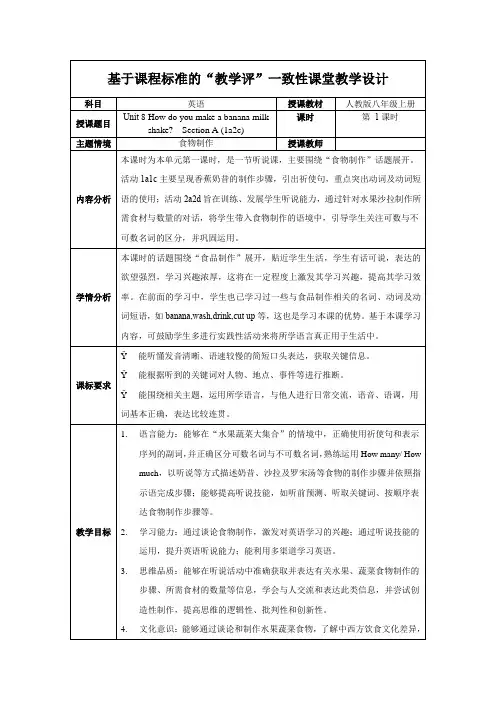
观察图片填空并预测听力内容。
看图并分类。
观看视频并回答问题。
完成书本2a部分任务。
完成书本2b部分任务。
跟读录音。
听力前先带领学生熟悉图片内容和听力方向,引导学生观察图片内的关键任务,猜测他们所进行的话题,为听力找寻关键词。
跟读录音模仿并角色扮演,培养了学生的口语能力和应用能力。
3.T asks students toListen again and fill in the blanks.
4.T asks students toTry to retell the steps of make a banana milk shake.
5.T asks students tofinish the task in1c—Cover the instructions above. Tell your partner how to make a banana milk shake.
学情分析
本课时的话题围绕“食品制作”展开,贴近学生生活,学生有话可说,表达的欲望强烈,学习兴趣浓厚,这将在一定程度上激发其学习兴趣,提高其学习效率。在前面的学习中,学生也已学习过一些与食品制作相关的名词、动词及动词短语,如banana,wash,drink,cut up等,这也是学习本课的优势。基于本课学习内容,可鼓励学生多进行实践性活动来将所学语言真正用于生活中。
课标要求
能听懂发音清晰、语速较慢的简短口头表达,获取关键信息。
能根据听到的关键词对人物、地点、事件等进行推断。
能围绕相关主题,运用所学语言,与他人进行日常交流,语音、语调,用词基本正确,表达比较连贯。
教学目标
人教版英语八年级下册Unit7SectionA1a~2c说课稿

2.生生互动:
(1)小组讨论:学生分成小组,针对某一话题展开讨论,促进相互交流和合作;
(2)角色扮演:学生模拟真实场景进行角色扮演,锻炼口语表达能力;
(3)互评互改:学生相互评价对方的作业或表演,提出改进意见,共同提高。
(二)学习障碍
在学习本节课之前,学生已经掌握了基本的英语语法和词汇,能够进行简单的日常交流。然而,他们可能在前置知识或技能方面存在以下不足:
1.对一般现在时和情态动词"would"的掌握不够熟练,容易混淆;
2.在实际场景中,可能不知道如何恰当地使用所学句型进行礼貌请求和应答;
3.部分学生可能因为词汇量不足,导致理解对话和表达观点时遇到困难。
2.课后访谈学生,了解他们对课堂活动的感受和建议;
3.教师自我反思,总结课堂上的亮点和不足。
反思和改进措施:
1.针对学生掌握不牢固的知识点,进行针对性复习;
2.丰富课堂活动,提高学生的参与度和兴趣;
3.加强课堂时间管理,确保教学任务的高效完成。
2.学生在角色扮演活动中可能存在紧张、不自信的情况;
3.课堂时间分配可能不合理,导致教学进度受到影响。
应对策略:
1.针对语法难点,设计专项练习,并进行个别辅导;
2.鼓励学生积极参与角色扮演,提高他们的自信心;
3.灵活调整课堂节奏,确保教学任务顺利完成。
课后评估教学效果:
1.检查学生作业完成情况,了解他们对知识点的掌握;
4.针对难点知识,如情态动词"would"的用法,设计专项练习,帮助学生巩固记忆。
(三)巩固练习
为了帮助学生巩固所学知识并提升应用能力,我计划设计以下巩固练习或实践活动:
Unit7SectionAGrammarfocus-3c课件人教版英语八年级上册2

Grammar Focus
What does"will"mean? What is"won't"?
3. People now usually live to be about 70-80 years old, but in the future _p_e_o_p_le__w_i_ll_l_iv_e__to__b_e_2_0_0__y_e_a_rs_o_l_d_._
4. Families usually spend time together on weekends, but maybe in 200 years _e_v_e_ry_d_a_y__c_a_n_b_e__w_e_e_k_e_n_d_, _ _b_e_ca_u_s_e_t_h_e_y_h_a_v_e__ro_b_o_t_s_t_o_d_o__e_v_e_ry_t_h_in_g_._________
1. In the future, there will be _l_e_s_s_ fresh water because there will be __m__o_r_e pollution in the sea.
2. In 100 years, there will be _m__o_r_e_ cars because there will be __m__o_r_e people in the cities.
Uncountable nouns
There will be more pห้องสมุดไป่ตู้llution. There will be less free time.
人教版八年级英语上册Unit 9 Section A1a-2c课件

Unit 9
Section A (1a-2c)
Learning goals: Learn how to make, accept and turn down the invitation.学会发出邀请,接受邀请和如何委婉拒绝别人的邀请。
invite
play basketball
climb mountains
go shopping
Colorful weekend Activities
What do you often do on weekends?
help my parents with housework
Free talk
help sb. (to) do sth.help sb. with sth.
1. can 是_____动词, 可以表示_____, _____ 或_____,在本单元中表示______。 can 没有______ 和________ 的变化,其否定形式是________。当用can来向别人发出邀请时,要用一般疑问句形式,其句式为______________________________.接受邀请时:谢绝邀请时:
study for a test
What will you do on weekends?
Words and phrases
prepareprepare forexamfluavailableanother time
v.使做好准备;把……准备好为……做准备 n.考试 n.流感 adj.有空的;可获得的 其他时间;别的时间
play the piano
visit grandparents
Colorful weekend Activities
人教版八年级英语上册说课稿UNIT 7 Period 1 (Section A 1a-2c)
人教版八年级英语上册说课稿UNIT 7 Period 1 (Section A 1a-2c)一. 教材分析人教版八年级英语上册Unit 7 Period 1(Section A 1a-2c)主要讨论了关于野生动物的保护问题。
通过本节课的学习,学生将了解到野生动物面临的威胁以及我们应该如何保护它们。
教材通过丰富的插图、情景对话和阅读材料,使学生在轻松愉快的氛围中掌握相关词汇和语法知识,提高口语表达能力和阅读理解能力。
二. 学情分析八年级的学生已经具备了一定的英语基础,能够理解和运用一些基本的词汇和语法知识。
但他们在口语表达和阅读理解方面还存在一定的困难。
因此,在教学过程中,教师需要关注学生的个体差异,针对不同学生的学习需求进行有针对性的教学。
三. 说教学目标1.知识目标:学生能够掌握本节课所学的词汇和语法知识,如 wildanimal, protection, hunting 等。
2.能力目标:学生能够运用所学知识进行口语表达和阅读理解,提高英语应用能力。
3.情感目标:学生能够认识到保护野生动物的重要性,培养关爱动物、保护环境的意识。
四. 说教学重难点1.重点:本节课的重点是让学生掌握与野生动物保护相关的词汇和语法知识。
2.难点:学生如何在实际语境中运用所学知识进行口语表达和阅读理解。
五. 说教学方法与手段1.交际法:通过情景对话,让学生在实际语境中练习英语口语,提高交际能力。
2.阅读理解:通过阅读关于野生动物保护的文章,培养学生的阅读理解能力。
3.任务型教学法:通过小组讨论、展示等活动,激发学生的学习兴趣,提高合作能力。
六. 说教学过程1.导入:教师通过展示一些野生动物的图片,引导学生谈论关于动物的话题,激发学生的学习兴趣。
2.presentation:教师讲解新词汇和语法知识,如 wild animal,protection, hunting 等。
3.practice:学生进行情景对话练习,运用所学知识进行口语表达。
Unit7SectionAGrammarFocus-3c课件人教版英语八年级上册
We can use less water and plant more trees. Everyone should play a part in saving the earth.
2d Role-play the conversation
Nick: What are you reading, Jill?
_l_e_s_s_beer.
3a Fill in the blanks with more, less or fewer.
1. In the future, there will be l_e_s_s____ fresh water because there will bemore _____ pollution in the sea.
be fewer trees and the environment will be in greats bad! Will we have to move to other planets? Jill: Maybe. But I want to live on the earth. Nick: Me, too. Then what can we do? Jill: We can use less water and plant more trees. Everyone should play a part in saving the earth.
3. People now usually live to be about 70-80 years old, but in the future_____________ _p__eo__p_le__w_i_ll_l_iv_e__to__b_e_2_0_0__y_e_a_r_s_o_ld__. _____
Unit7SectionA1a-2c课件人教版英语八年级上册
1b
In 100 years …
people will have robots in their homes
200 Years Old
people will live to be (活到)200 years old
there will be only one country
1b In 100 years, …
FREE
people won’t use money. Everything will be free.
Here are more predictions(预测). Read them and check (✔) A for agree
1a and D for disagree.
____A ____D ____A ____D ____A ____D ____A ____D
Section A (1a-2c)
Free Talk
A: What do you want to be when you grow up? B: I want to be …
A: How are you going to do that?
B: I’m going to … = I will … will +动词原形:将要做某事
If you work hard, the future will be predictable. 若君努力,未来可期!
Homework
1. Review what we have learned today. 2. Preview Grammar Focus. 3. Finish exercises.
THANK YOU.
____A ____D ____A ____D
人教版英语八年级上册课件
Unit 1 Where did you go on vacation?
Section A (1a-1c)
New words
stayed at home visited my uncle
went to New York City
New words
went to summer camp
went to the mountain
Listen. Where did Nancy, Kevin, and Julie go
2a on vacation? Match the person with the place .
New York City the beach home
2b Listen again. For each question check (√ ) “Yes ,
人教版英语 八年级上册单元课件
unit1
Where did you go on vacation?
unit1
Where did you go ononA (1a-1c) • 2.sectionA (2a-2d) • 3.SectionA grammar focus-3c • 4.SectionB (1a-1e) • 5. SectionB (2a-2e) • 6. SectionB (3a-self check) • (单击上面课题进入对应幻灯片)
问题探究
1. anyone 的用法
1) 有谁去过山区吗?Did anyone go to the mountains? 2) 我不想告诉任何人这件事。
I don't want to tell anyone about the thing. 3) 任何人可以做这件事。 Anyone can do the thing. 4) 你见过有趣的人吗? Did you meet anyone interesting?