
剑桥(join in)版英语五年级下册Unit 3 Television(2)
I watchTV on Saturday and Sunday. I often watch sports. My favourite programmes are cartoons. I don’t like science fiction very much. programmes and nature films. Romantic and detective films. Barbara
He thinks sports programmes are wonderful. Sports programmes begin at quarter past eight
He often watches sports programmes at quarter past eight.
My fatherdoesn’t like science fiction films. He thinks science fiction films are stupid. He never watches science fiction films.
Pete
Text 2: Answer
I often watch TV . I like nature programmes. My father often watches football. My mum doesn’t often watch sports programmes.She likes romantic film and nature programmes.
Unit 3
Television
Survey:
Do you know some TV shows? What are your favourite TV shows ?
What kind of TV show is it?
news show
What kind of TV show is it?
So, what are your favourite
TV shows?
Talk about you and your family
I like… I don’t like… …are boring/interesting I always/often/never watch …
My father/mother likes… He/she doesn’t like… …are boring/interesting He/She always/often/never watches…
talk show
What kind of TV show is it? sports show
What kind of TV show is it?
game show
What kind of TV show is it? soap opera
nature show
Name
I
My father My mother
Talk about yourselves
I like… I don’t like… …are boring/interesting I always/often/never watch …
Talk about your family
My father/mother likes… He/she doesn’t like… …are boring/interesting He/She always/often/never watches…
Reason 原因Fra bibliotekgreat boring
Hobbies 习惯
always never
wonderful often
stupid
never
interesting often
boring
never
I like cartoons. I think cartoons are great.
Cartoons begin at quarter to five.
My mother likes nature programmes. She thinks nature programmes are interesting.
Nature programmes begin at ten past ten.
She often watches nature programmes .
My mother doesn’t like detective films. She thinks detective films are boring. She never watches detective films.
Game
1、同一小组派出三个队员抽单词组合成一个句子。 2、如果组合正确请其余组员把句子正确读一遍后得1分。 3、如果组合不正确其余组员起立读出正确的句子后得1分。
I always watch cartoons at quarter to five.
I don’t like romantic films. Romantic films are boring.
I never watch romantic films.
My fatherlikes sports programmes.
like don’t like
watch
likes doesn’t like watches
Text 1 Answer:
• I often watch TV . I like detective films very much.
• My father and my mother also like detective films. I do not like romantic films. • I think they are stupid.
Unit3TelevisionPart2(课件)joinin外研剑桥英语五年级下册
时间表达
1.整点的时间都可以用【小时 + o'clock】直接读 2.表述的时间为半小时(半点表达),用【half + past + 小时】
3.表述的时间在半小时之内(过点表达),用【分钟 + past + 小时】 quarter 一刻钟=15分钟
4.表述的时间在半小时之外(差点表达),用【(相差的)分钟 + to + (下一)小时】
注:在问题中出现的人名回答时通常会使用he/she代替
Let's practice(P45 4)
Let's learn
单 三
单 三
特殊疑问句
否定
Let's practice(P46 5)
When do the programmes begin
When和What time的区别用法
Let's review
Let's learn
Let's practice(P46 6)
Homework 完成练t 2
Questionnaire
Let's learn
Do或Does引导的一般疑问句
Do you like...
单三形式
肯定回答:Yes I do. 否定回答:No, I don't.
Does he/she/人名 like...
肯定回答:Yes,he/she does. 否定回答:No, he/she doesn't
五年级下册英语剑桥Join in知识要点汇总

JOIN IN英语五年级期下册课本知识点Start unit Join in againWords touch触摸enjoy享受……的乐趣everyone每个人fun乐趣head头near接近shake hands握手alphabet字母Sentences1.Touch your nose and shake your head.触摸你的鼻子,摇摇你的头。
2.Welcome back now.欢迎回来。
3.Learning can be lots of fun.学习充满乐趣。
4.Enjoy your time in class again.很高兴再次回到课堂。
5.Sing and dance and rock with me.跟我来唱跳摇滚吧。
6.Shake hands with your partner.和你的同伴摇摇手。
7.Turn around.转圈。
8.Dance with me.跟我跳舞。
Unit1A phone callWordsask问before在……以前call通话get收到,接到ill病paint颜料programme节目something某物,某事website网站work运转wrong有问题的across穿过;横过like喜欢read读collect收集Phraseshave to不得不listen to music听音乐do shopping购物mobile phone移动电话over there在那边,在那儿phone call电话phone box电话亭write emails写邮件play games玩游戏get messages收信息watch TV programmes看电视节目see films看电影make phone calls打电话visit websites访问网站take photos拍照send messages发邮件Sentences 1.Wait a moment.稍等。
《JOIN IN》五下 Television教学设计

《JOIN IN》剑桥小学英语五下《JOIN IN》剑桥小学英语五下Unit3 Television一、教学内容分析本课选自《英语》(Join in)改编版小学五年级下学期使用教材Unit3 Television(Part5)。
单元中心话题“TV programmes”这一话题是孩子们比较感兴趣的一类。
这节课要求学生通过阅读三段文本,并完成阅读练习,了解如何介绍自己和家人喜欢的电视节目,并尝试在教师的提示和引导下进行写作尝试。
二、教学目标1、知识与技能:(1)对本单元所学语法和单词的综合复习和运用。
(2)对My mum doesn’t often watch sports programme中doesn’t often用法的理解和运用(3)引导学生自己阅读小短文,理解并完成短文练习。
(4)自己尝试模仿写短文。
2、过程与方法:(1)以短文为媒介,培养学生自己阅读的能力。
(2)通过对本单元知识的复习,让学生能够综合运用,如排序,写作等。
3、情感、态度、价值观:(1)结合生活实际,导入教学,激发学生学习兴趣。
(2)以任务型教学方法为指导,让学生在自主完成一系列的任务中,增强他们学习英语的兴趣和自信心。
4、教学重点:(1)引导学生自己阅读小短文,理解并完成短文练习。
(2)自己尝试模仿写短文。
5、教学难点:(1)对My mum doesn’t often watch sports programme中doesn’t often用法的理解和运用(2)自己尝试模仿写短文。
三、教学策略(1)借助图片与已学词汇,猜测短文意思。
(2)在小组活动中能积极与他人合作,相互帮助,共同完成学习任务。
(3)利用多媒体辅助教学。
四、教学过程1. Warming-up1) T: Hi, everybody! Do you like watching TV? Now, Let’s watch an English programme. (课件出示已学过的电视节目单词,出示的形式或以图片、或以反文字、或以视屏等形式出现。
外研剑桥版英语五年级下册Unit 3 Television 习题2

Unit 3 Television 习题一、单项选择1. Xi Yang yang and Hui Tai lang is a _______.A romantic filmsB cartoonC detective films2. My father ________ detective films.A don’t likeB likeC doesn’t like3. _____ about the nature and animals.A nature programmesB romantic filmsC cartoon4. There are ____ different TV programmes.A manyB muchC little5. She ____ watch Man and Nature this afternoon.A areB willC is6. Children usually ____ cartoons.A wantB likesC like二、连词成句1. never, watch, I, romantic, films__________________________2. brother, sports, programmes, my, watches, often__________________________3. like, programmes, he, nature, doesn’t__________________________4. detective, films, and, I, nature, programmes, like__________________________三、圈出正确的单词1. I (don’t doesn’t)often watch TV.2. We(don’t doesn’t)like romantic films.3. My sister Jane(don’t doesn’t)like detective films.4. My father(don’t doesn’t) often watch sports programmes.5. I(don’t doesn’t) often watch detective films.6. Steven(don’t doesn’t)often play basketball.7. His father and mother always(watch watches)nature programmes.8. My brother Frank(don’t doesn’t)like to eat ice cream.9.My teacher doesn’t(like likes)to watch cartoons.10.Kevin always(do does)his homework at home.参考答案一、B C A A B C二、1. I never watch romantic films.2. My brother often watches sports programmes.3. He doesn’t like nature programmes.4. I like nature programmes and detective films.三、1. don’t2. doesn’t3. doesn’t4. doesn’t5. don’t6. doesn’t7. Watch8. doesn’t9. like 10. do。
剑桥(join in)版小学英语五年级下册单元知识梳理总结(全册)
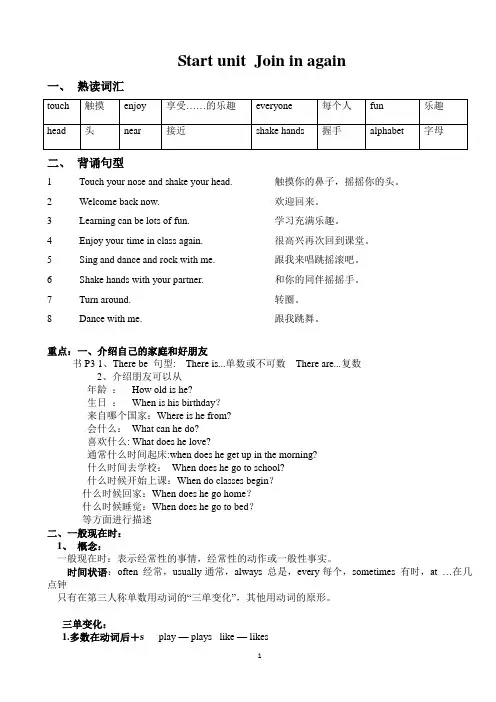
Start unit Join in again一、熟读词汇二、背诵句型1 Touch your nose and shake your head. 触摸你的鼻子,摇摇你的头。
2 Welcome back now. 欢迎回来。
3 Learning can be lots of fun. 学习充满乐趣。
4 Enjoy your time in class again. 很高兴再次回到课堂。
5 Sing and dance and rock with me. 跟我来唱跳摇滚吧。
6 Shake hands with your partner. 和你的同伴摇摇手。
7 Turn around. 转圈。
8 Dance with me. 跟我跳舞。
重点:一、介绍自己的家庭和好朋友书P3 1、There be 句型: There is...单数或不可数There are...复数2、介绍朋友可以从年龄:How old is he?生日:When is his birthday?来自哪个国家:Where is he from?会什么:What can he do?喜欢什么: What does he love?通常什么时间起床:when does he get up in the morning?什么时间去学校:When does he go to school?什么时候开始上课:When do classes begin?什么时候回家:When does he go home?什么时候睡觉:When does he go to bed?等方面进行描述二、一般现在时:1、概念:一般现在时:表示经常性的事情,经常性的动作或一般性事实。
时间状语:often 经常,usually通常,always 总是,every每个,sometimes 有时,at …在几点钟只有在第三人称单数用动词的“三单变化”,其他用动词的原形。
剑桥(join in)版五年级下册英语知识梳理 (1)

剑桥(join in)版五年级下册英语知识梳理Unit 1 A phone call1. 电话用语: Is that Mike? 那边是迈克吗?Yes, it's Mike. 是的,我是迈克。
Who's speaking ? 谁打来的?It's your granny speaking. (This is your granny speaking.)是你的奶奶。
2. write emails 写邮件listen to music 听音乐watch TV programmes 看电视节目play games 玩游戏make phone calls 打电话visit websites 浏览网页see films 看电影send(get)messages 发送(接收)信息take photos 照相do shopping 购物take notes 做笔记watch the weather report 看天气预报3. What can you do with a mobile phone ? 你能用手机干什么?I can send and get messages. 我能发送和接收信息。
4. My cousin works hard at English. 我堂姐学习英语很认真。
Unit 2 Life in the Arctic1.jump in the water 跳进水里swim across the lake 游过湖walk through the snow 走过雪地run up the hill 跑上小山come to the top 来到山顶look around 环顾四周2.There are no playgrounds.There aren't any playgrounds. 这儿没有操场。
3.We are going to the playground.We'll go to the playground. 我们准备去操场。
Join in五年级下册Unit 3Television教案详案
Unit 3 TelevisionTeaching Contents: Parts1 – 3bTeaching Aims:1. Knowledge Objectives:By the end of this period, students will be able to identify the meanings of some words ( cartoons, nature programmes, detective films, sports programmes, science fiction films, romantic films). 2. Ability Objectives:By the end of this period, students will be able to read, listen and write the new words.And learn to use the words to talk about what sorts of films someone like or doesn’t like.3. Emotion Objectives:By the end of this period, students will be able to be more interested in English.Teaching Impotant Points:By the end of this period, students will be able to identify the meanings of some words and speak, listen and write the new words.Teaching Diffidult Points:By the end of this period, students will be able to talk about what sorts of films someone like or doesn’t like with the new words..Teaching Aids: PPT & vocabulary cardsTeaching Procedures:Teaching Steps Teacher’s activities Students’ activities PurposeI. Warming-up Step 1Show a picture of a TV and leadto the word“television ”and thenlearn to read and understand“television”.Learn to read theword “television”and understand itsmeaning.To lead tothe topicStep 2 Have a free talk on the topic ofTV programmes.Listen and answerthe questions.II. Presentation Step 3 Show the videos of cartoons,nature programmes,sportsprogrammes, detective films;romantic films; science fictionfilms and ask some questions toteach the words: cartoons ;Sports programmes; natureprogrammes; detective films;romantic films; science fictionfilms. e.g. Do you like cartoons?Do you like romantic films?Look at the videosand answer thequestions and learnto read the words:cartoons ;Sports programmes;nature programmes;detective films;romantic films;science fiction films.To make thestudentslearn thenew wordsactively.And let thestudentslearn thenew wordsin thesentencesStep 4 Look and say. Show the picturesof TV programmes to the pupils.Look at the picturesand say the words. Show some TV pictures and the Look at the picturesIII. PracticeStep 5 words and ask the student tomatch them..and words andmatch them.Toconsolidatethe newwords byreading andlistening. Step 6Play a game: playing susliks Look at the wordsand read the wordsquickly.Step 7Listen and tick: ask the studentsto read the words next to thepictures and listen and tick thewords.Listen and tick thewords.Step 8Check the answers. Then ask thepupils to look at the answers totalk about what TV programmesthe children like or don’t like.Listen again andanswer the questionsIV. Pairwork Step 9 Work in pairs: ask the pupils totalk about the TV programmesthey like and they don’t like.Talk about in pairs. ToconsolidatethesentencesV. Summary Step10We have learnt some new wordsand talk about our favourite TVprogrammes.To read the newwords together. Step11Homework: Practice the newwords by talking about with yourparents.To complete thehomeworkBlckboard Design:Unit 7 Televisioncartoons nature programmessports programmes detective filmsscience fiction films romantic films。
外研剑桥(joinin)版Unit3Television单词导学课件
(形容词)真实的
短 语 a true story 一个真实的故事 例 句 This is a true story. 这是一个真实的故事。 其他词义 true 正确的 变换字母记忆 tree 树 第一个 e 改为 u true 真实的
联 想 telephone 电话
(名词) 电视,电视机
(名词)〔非正式〕电视机
同义词 TV/television
例 句 I don’t want to watch telly. 我不想看电视。
(数词)一千
短 语 two thousand 两千 thousands of 成千上万的 例 句 There are about three thousand students in
(名词) 侦探
短 语 detective films 侦探电影
例 句 His uncle is a detective. 他的叔叔是一名侦探。
反义词 same 相同的
(形容词) 不Leabharlann 的短 语 be different from 与……不同
例 句 I’ve got two different bikes. 我有两辆不同的自行车。
我只在周末购物。
(形容词) 关于爱情的
短 语 romantic films 爱情电影
例句
—Does she like romantic films? 她喜欢爱情电影吗?
—No, she doesn’t. 不,她不喜欢。
其他词义 romantic 浪漫的
科幻小说
短 语 science fiction films 科幻电影
第三人称单数情势 wants
Unit 3 Television 重点单词短语归纳 外研版Join in 小学五年级下册第三单元单元
Unit 3 Television重点单词、短语、句子【单词】callv.呼唤,喊叫;召唤,叫来,召集;下令,命令;打电话给n.喊叫,大声喊;电话联络;必要,理由;要求1. Listen here, young lady. Don't you call me that!你给我听着,小姐。
别那样叫我!2. Check us in at the hotel and wait for my call.去宾馆替我们办理好入住手续,然后等我的电话。
interestingadj.令人感兴趣的,有趣的;引起兴趣的;有趣的;令人关注的It was interesting to be in a different environment.到一个全新的环境中是很有意思的。
starn.星;星状物;星级;明星1. To the side of the large star is a smaller star.大星星旁边是一颗小一点的星星。
2. She has some cockeyed delusions about becoming a pop star.她还幻想着自己能成为流行歌星。
wantv.想要;希望;打算;需要…在场1. I don't want any more of that heavy stuff.我再也不想碰那种麻烦事了。
2. "Steve, what do you want?"— "Coke, Pepsi, it doesn't matter."“史蒂夫,你要喝点什么?”——“可口可乐,百事,随便啦。
”【短语】Watch TV 看电视Switch on 打开,开动,启动;接入;起动Watch for 寻找,等待【句子】Do you often watch TV? 你经常看电视吗?What programmes do you often watch? 你经常看什么节目?Does he/ she like nature/ sports programmes? 他/她喜欢看自然/体育节目吗?The cartoon/ film begins at......那个动画片/电影从......(时间).开始。
剑桥Join in5下英语---3系列教学设计(第4课时):Television
Unit 3 Television教学设计(第4课时)【教学内容】Part 7, Part 8【教学目标】(一)知识与技能1.能将单词排列成为正确的句子。
2.能读懂关于看电视的短文,并仿写有关看电视的短文;3.能听懂、会说小诗Kevin Dee.(二)过程与方法1.以小组合作与情景教学为主,运用游戏帮助学生理解与运用所学知识;2.指导学生通过听音获取正确的信息,掌握一定的听音技巧。
3. 采访身边同学的电视观看情况。
(三)情感、态度与价值观1. 通过电视话题的讨论与访谈,激发学生学习英语的兴趣;2. 提高他们获取信息和组织语言的能力;培养他们团结合作的学习精神。
【教学重点】就看电视的习惯进行访谈并汇总成表格,培养学生使用英语的能力。
【教学准备】关于电视的图片、教材相配套的录音带和课件、视频【教学过程】Step 1 Warming up观看关于电视介绍的英文视频,让学生了解英语国家的学生一般观看何类电视节目。
Step 2 Revision1.玩一个连锁游戏复习上节课所学句型和词汇。
如:S1: When does the cartoon / … begin?S2: It begins at…2.老师可采用游戏等方法帮助学生巩固电视节目单词。
Step 3 Read the texts1.学生打开课本到24页,独立阅读第一篇短文,并在图片下写出相应的单词。
2.师生共同核对答案。
3.学生再读第一篇短文,思考问题:What sort of TV programmes do they like?Does Peter like romantic films?What does he think of romantic films?4.老师根据学生的答案,一次板书关键信息。
5.学生根据图片提示,尝试谈论Peter和他的爸爸妈妈喜欢看的节目。