
外研版英语七下第九模块《 Life history》重要知识点总结
Module 9 Life historyUnit 1 He left school and began work at the age of twelve.1.关于month的词汇及其简写:January一月(Jan.); February二月(Feb.); March三月(Mar.);April四月(Apr.); May五月(May); June六月(Jun.);July七月(Jul.); August八月(Aug.); September九月(Sept.);October十月(Oct.)November十一月(Nov.);December十二月(Dec.)2.Tom Sawyer, by the famous American writer, Mark Twain. by, 介词,意为“由……创作;出自”。
3.辨析:find out & find & look for一言辨异:eg.I looked for my umbrella everywhere, but I couldn’t find it. Please help me find out who took it by mistake.我到处寻找我的雨伞,但是没有找到。
请帮我查一下是谁错拿了它。
4.“真实的”real(1)real,形容词,意为“真实的;真正的”。
real name,“真名”。
(2)really,副词,意为“确实;真正地”。
really happy,“确实很高兴”。
一言辨异:Tom really wants to make a real friend.汤姆真的很想结交一个真正的朋友。
5.age表达法at the age of +基数词 = at + 基数词,意为“在……岁时”相当于when sb. was... (years old)。
eg.At the age of 5/At 5,Jack could learn to read and write. =Jack could learn to read and write when he was 5 (years old). Jack 5岁时就学会了读书认字。
6.“确切的”exact(1)作为形容词,意为“准确的;确切的”。
exact date,“确切的日期”。
(2)其副词形式为“exactly”,“准确地;确切地;的确如此等”。
That’s exactly what I want to say to you.那就是我想对你说的话。
拓展:1.not exactly,意为“并非如此;不完全是这样”。
2.to be exact,意为“确切地说”,常用作插入语。
To be exact, he is a great father.确切地说,他是一位非常出色的父亲。
7.in the 1860s/1860’s的用法“在19世纪60年代”年代表达法中,介词要用in;世纪、年代前要加定冠词the;年代要用整十的基数词,后面加s或’s。
Unit 2 He decided to be an actor.1.“爱玩的”play(1)可数名词,意为“剧本;戏剧”。
(2)动词,意为“玩(游戏等);打(篮球等);踢足球;表演;扮演(角色)等”。
一言辨析:Yu Qian plays a teacher in the TV play.于谦在这部电视剧中扮演了一位老师。
2.“谈婚论嫁的”marry(1)及物动词,意为“嫁;娶;和……结婚”。
Rose is going to marry Jack next month.Rose 准备下个月嫁给Jack。
(2)不及物动词,意为“结婚”。
Betty married when she was 21 years old.=Betty was/got married when she was 21 years old.Betty 21岁时就结婚了。
(3)表示“和……结婚”,也可以用be/get married to sb.。
Rose was/got married to Jack last month.Rose上个月和Jack结了婚。
3.“成功的”successful(1)形容词,意为“成功的”。
Jack Ma is a successful businessman.马云是一个成功的商人。
(2)其副词为successfully,意为“成功地”。
Linda finished the work successfully.Linda成功地完成了这项工作。
(3)其名词为success,意为“成功”。
名言警句:Failure is the mother of success.失败是成功之母。
(4)其动词为succeed,意为“成功”,其用法为succeed in doing sth.“成功做成某事”,相当于have success in doing sth.或者be successful in doing sth.Tom succeeded in working out the difficult maths problem at last.=Tom had success in working out the difficult maths problem at last.=Tom was successful in working out the difficult maths problemat last.Tom最后终于成功地算出了那道数学难题。
4.“奄奄一息的”die(1)不及物动词,意为“死;去世”。
David’s grandfather died at the age of 90.David的爷爷90岁时去世了。
(2)其动词常见用法有:①die of,表示“由于衰老、疾病等自身内部的原因而导致的死亡”。
The old lady died of lung cancer.那个老太太死于肺癌。
②die from,表示“由于地震、交通事故等外部原因等造成的死亡”。
The young man died from a car accident last week.那个年轻人上周死于一场车祸。
(3)其形容词dead,意为“死亡的;不在的;去世的”。
Look!There is a dead fish in the river.看!河里有一条死鱼。
(鱼已死了)(4)其形容词dying,意为“垂死的;奄奄一息的”。
Look!The little fish is dying.看!那条小鱼快死了。
(鱼奄奄一息,还没死)(5)其名词death,意为“死亡”。
The death of the pet dog made the little girl very sad.宠物狗的死亡让这个小女孩非常伤心。
考点拓展:翻译:鲍勃的爷爷去世5年了。
(×)Bob’s grandfather died for 5 years.(√)Bob’s grandfather died 5 years ago.(√)Bob’s grandfather has been dead for 5 years.5.build用法(1)及物动词,意为“建筑;建造”。
(2)其名词building,意为“建筑物”。
(3)其名词builder,意为“建筑工人;建造者”。
一言辨析:Look!Many builders are working hard to build the high building now.看!很多建筑工人此刻正在建造那座高楼。
6.work用法(1)作可数名词,意为“作品;著作”。
I like Lu Xun’s works very much.我非常喜欢鲁迅先生的作品。
(2)作不可数名词,“工作”。
Kate has a lot of work to do this weekend.这个周末Kate有很多事情要做。
(3)作动词,意为“工作”。
We work from Monday to Friday.我们周一至周五上班。
(4)常见work短语①work on“从事于”②be out of work “失业”③work for “为……工作;为……效力”④work out计算出;解出(数学题答案等)名言警句:All work and no play makes Jack a dull boy.只工作不玩耍,聪明孩子也变傻。
7.“丰富的”rich(1)形容词,意为“有钱的;富有的等”,常用短语be rich in,意为“在……方面富有”。
The young man is a very rich businessman.那个年轻人是一个非常有钱的商人。
Shanxi Province is rich in coal.山西省煤炭资源丰富。
(2)“the+形容词”,表示“一类人”。
the rich,意为“有钱人;富人”,当其作主语时,谓语动词用复数形式。
The rich are not always happy.有钱人也并非总是很幸福。
8.around the world=all over the world“世界各地;环游世界”9.fire的用法(1)名词,意为“火;火灾”。
be on fire“着火”。
Boys,never play with fire!孩子们,千万不要玩火!(2)动词,意为“开火;射击;发火;解雇等”。
He was fired by his boss.他被他的老板解雇了。
Unit 3 Language in use1.辨析as well as & not only...but also...注意:(1)as well as连接主语时,其谓语动词的人称和数的形式应该和它之前的名词或者代词保持一致。
Jay Chou as well as some other young singers is popular with people.周杰伦还有其他一些年轻的歌手深受人们的欢迎。
(2)not only...but also...连接并列主语时,其谓语动词的形式应该和but also之后的代词或者人称保持一致。
Not only the students but also the teacher likes playing football.学生和老师都喜欢踢足球。
2.be worth doing sth. “值得做某事”This book is worth reading.这本书值得一读。
名言警句:One today is worth two tomorrow.一个今天抵得上两个明天。
外研版七年级英语下册Module 9 Life history模块知识点归纳
2021年春季Module 9 Life history必背单词1. writer n.作家→write v.写2. real adj.真实的;真正的→really adv.真正地3. exact adj.准确的;确切的→exactly adv.准确地4. become v.成为→became(过去式)5. March n. 3月6. April n. 4月7. June n. 6月8. July n. 7月9. August n. 8月10. September n. 9月11. October n. 10月12. November n. 11月13. December n. 12月14. newspaper n. 报纸15. date n. 日期必背短语16. Women's Day 妇女节17. National Day 国庆节2021年春季18. Children's Day 儿童节19. find out 发现;查明,弄清20. at the age of 在……岁时21. in the 1860s 在19世纪60年代必背句子22. I'm writing about him for my English class.我正在为我的英语课写关于他的东西。
23. Look at this!看这个!24. What did he do?他做什么工作?25. Enjoy the book.愿你喜欢这本书。
必背单词1. marry v.结婚→married(过去式)2. successful adj.成功的→succeed v.成功→success n.成功→successfully adv.成功地3. work n.作品;著作→works pl.4. build v. 建造→built(过去式)→building n.建筑物5. die v.死;去世→dead adj.死的→death n.死亡2021年春季6. rich adj.富有的→poor(反义词)贫穷的7. play n. 剧本;戏剧8. poem n. 诗歌9. on prep. 在……河边10. fire n. 火,火灾11. language n. 语言必背短语12. in one's life 在某人的一生中13. many other languages 许多其他的语言14. see plays 看戏剧15. finish school 毕业必背句子16. Like many people 400 years ago, Shakespeare's parents didn't learnto read or write.像400年前的许多人一样,莎士比亚的父母没有学习过读书和写作。
外研版英语七年级下册Module9Lifehistory总结
Module 9 Life historyUnit 1常用词组1.Teachers’Day 教师节2.Women’s Day 妇女节3.National Day 国庆节4.Children’s Day 儿童节5.May Day 五一劳动节6.be different from... 与……不同7.in April 1935 在1935年4月8.by sb. 由某人创作9.write about sb. 写关于某人的事10.find it/them out 把它/它们搞清楚、弄明白11.real name 真名12.leave school 离开学校(不上学)13.begin work 开始工作14.at the age of... 在……岁时15.write for... 为……而写16.other cities 其他城市17.begin stories 开始写故事18.take the name Mark Twain 取名马克·吐温19.become famous 变得出名20.in the 1860s 在19世纪60年代21.as well 也22.a newspaper writer 一名报社作者重点句型1.Betty’s grandfather’s life was different from Betty’s.贝蒂爷爷的生活与贝蒂的不同。
2.He was born in April 1935.他出生在1935年4月。
3.We can find out about him on the Internet.我们可以在互联网上查到关于他的信息。
4.He left school and began work at the age of twelve.他12岁时离开学校并开始工作。
5.Look at this!看这个!6.Enjoy the book. 享受这本书。
要点精析1. Women’s Day 妇女节women’s是所有格形式,不以-s结尾的复数名词的所有格加“’s”。
最新精编 外研版 七年级英语下册 Mudule 9 Life history专题讲解 (新版)外研版
Module 9 Life history本单元提纲1. 主题功能:能够谈论名人的生平。
2. 重点单词:12 months, real, newspaper, marry, become等。
3. 重点词组: find out, at the age of, around the world等。
重点句型:1. He left school and began to work at the age of twelve.2. He wrote for a newspaper.3. He became a very successful actor and began to write plays.核心语法:一般过去时(3)重难点精讲He left school and began to work at the age of twelve.十二岁时,他离开了学校开始工作。
at the age of 意为“在.....岁时”,和“at+年龄”是同义表达。
题一:(翻译题)他们18岁时离开了学校。
...so he decided to be an actor when he finished school at fourteen.......所以,在他14岁毕业那年,他决定成为一名演员。
finish意为“结束、完成”,finish后名词或动名词。
不接动词不定式。
题二:1. 你能在三天之内完成这项任务吗?2. 他们上星期完成了工作。
题三:—When shall we take a walk?— After I finish ____ the clothes.A. washB. washingC. washedD. to washHe married in 1582 and had three children.1. marr y是动词,意为“结婚”,它是短暂性动词,不能和时间段搭配。
2. married是形容词,意为“结婚的,已婚的”。
外研版七下 M9 U2--

Module10 Life historyUnit 2 He decided to be an actor.课型:读写课【学习目标】1. 知识目标:掌握以下单词和短语::actor, writer, play, poem, age, marry, move, join, company,become, successful, rich, build, work, die, language, young; thelife of , a writer of plays and poems, be born, decide to be an actor,at the age of, become a successful actor, in many other languages,around the world,2. 能力目标: 能够用一般过去时描述自己和他人过去的经历。
3. 情感目标: 通过对莎士比亚的了解,培养对文学家的崇敬之情及对文学的兴趣。
【教学重点】一般过去时的用法(特殊疑问)【教学难点】一般过去时的句式转换。
【教学过程】[课前准备]:1.学生朗读重点词汇,养成自主学习词汇的习惯,迅速进入学习状态。
2.小组派代表将预习归纳的短语提前写在黑板上。
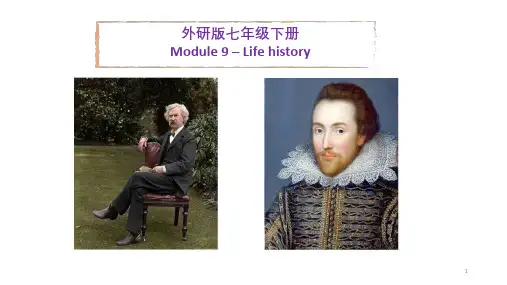
一、导入新课(头脑风暴)方法一:教师在屏幕上给学生们看一些著名电影的剧照,如《哈姆雷特》、《罗密欧与朱丽叶》,让学生简单讨论莎士比亚及其作品,从而导入新课。
方法二:“To be or not to be , that is a question.”知道这句出自莎士比亚作品《哈姆雷特》饿经典台词吗?一起走进本单元来了解这位名人的生平吧!二、多层阅读(自主完成)(一)快速默读全文,完成Activity1.A. playsB. poemsC. stories(二)默读课文:完成activity 2.a. Shakespeare went to London. ( )b. Shakespeare’s company built the Globe Theatre. ( )c. Shakespeare married. ( )d. Shakespeare liked plays at school ( )e. Shakespeare died at the age of fifty-two. ( )f. Shakespeare decided to be an actor. ( )(二)再读文章,完成activity 3(三)精读文章, 回答下列问题。
外研版七年级下册 Unit 9 Life history PPT课件
Task 2 words 重点词汇
16
词汇拼读
March April June Women’s Day National Day Children’s Day July August September October November December writer
real newspaper exact date become play poem marry successful work build on fire
Bring-brought; buy-bought; catch-caught; teach-taught
8
语法讲解: 一般过去时(实义动词) 不规则动词过去式变化规则:
(4) i 变为o
ride-rode; drive-drove; write-wrote
(5) ow/aw 变为ew
know-knew; grow-grew; throw-threw; draw-drew
(6) 以d结尾的动词,把d变为 t
lend-lent; build-built; spend-spent; send-sent
9
语法讲解: 一般过去时(实义动词) 2. 结构:含实义动词句子的一般过去时结构: 否定形式:主语+didn’t+动词原形+其他 例如: Betty didn’t buy the new book just now. My father didn’t drive home yesterday.
12
练习:
1. 他搬到伦敦,并参加了一个戏剧公司。 He ___m_o_v_ed_ ___to___ London and joined a theatre company.
外研版初中英语句子翻译复习(外研版)初一下册

初中一年级下册 2013.5.23
第一模块:人物和地点
• 1. 我们正玩得很开心。 2. 其他人正在做什么? 3. 托尼正在吃冰激凌。 4. 他正在拍摄大量照片。 5. 她在买一些礼物。 6. 他正躺在阳光下吃午饭。 7. 此刻,在世界不同的地方人们正在做着不同的事情。 8. 他们正在等公共汽车和赶火车。 9. 一些人正在家里喝下午茶或者正走向酒吧要喝一杯。 10. 人们没在起床、洗漱或者穿衣服。
第三模块:计划
• 26. 周末你打算做什么? 27. 在星期六晚上,我打算参加朋友家里的一个 聚会。 28. 晚上,我打算复习考试。 29. 我正盼望着见到我的女儿。 30. 我们将去观光游览因为我喜欢中国文化。 31. 我们将去参观故宫,然后我们去爬长城。 32. 我打算学英语因为我想交几个美国朋友。 33. 我的妻子和我将躺在沙滩上因为我的孩子们 喜欢游泳。 34. 他们将横渡太平洋和大西洋。 35. (天气)将多风。
Module 1 People and places
• 1. We’re having a great time. 2. What are the others doing? 3. Tony is eating an ice-cream. 4. He is taking lots of pictures. 5. She is buying some presents. 6. He is eating lunch and lying in the sun. 7. At this moment, in different places of the world people are doing different things. 8. They are waiting for buses and running for trains. 9. Some are having afternoon tea at home or walking to pubs and having a drink. 10. People aren’t getting up, washing or getting dressed.
2019春外研版七年级英语下册作业课件:Module 9 Life history Unit 1 第一课时
三、用方框中所给词的适当形式填空,每词限用一次。
December in Harbin. 11.It's very cold in
12.—Where does your father work?
—He works for an English newspaper . 13.—What's the —It's June 6. 14.We call him Xiaodong,but it isn't his
8.Oscar Wilde was a great writer (write) in the world. 9.Those women hope to stay at home onWomen's (woman) Day. 10.The boy became (become) a middle school student one year ago.
二、用括号内所给词的适当形式填空。 6.On Children's (child) Day,the children always have a good time. 7.—Where did you go yesterday? —My parents
took
(take) me to the zoo.
the
1860s .
大多数孩子在七岁时开始上学。
►Spring
Festival
is
in
January
or
February.春节在一月或二月。 表示“在……月份”时,应用介词in,表示“ 星期几”时,应用介词on。 【归纳】January 一月;February 二月;
March 三月;April 四月;May 五月;June 六月
外研版(新标准)英语七年级下册Module 9 Life history模块测试题及答案
Module 9标准检测卷(满分:120分时间:100分钟) 题号一二三四五六七八九十总分得分听力部分(20分)一、听句子,选择符合句意的图画(每小题1分,共5分)1.________ 2.________ 3.________4.________ 5.________二、听对话,根据所听对话内容选择正确的答案(每小题1分,共5分)6.Where are the speakers now?7.How did they go to the supermarket?8.What did the woman do last Sunday?9.Who's the man's favourite writer?10.Which season does Daming like best,winter,summer or autumn?三、听对话,回答问题(每小题1分,共5分)听第一段对话,回答第11、12小题11.How does Helen often go to school?A.By bus. B.By bike. C.By car.12.Why did Helen go to school by car this morning?A.Because her bike was broken.B.Because her home is far from the school.C.Because her father drove to meet her maths teacher.听第二段对话,回答第13、14、15小题13.What does Susan's father do now?A.A teacher.B.A farmer.C.A hotel manager. 14.Was Susan's father very rich when he was young?A.Yes,he was. B.No,he wasn't.C.We don't know.15.What did her father often do in his free time?A.He often played cards.B.He often watched TV.C.He often played chess.四、听独白,根据所听内容选择正确的答案(每小题1分,共5分) 16.How old was little Helen then?A.Eight months. B.Nine months.C.Ten months.17.What was wrong with Helen?A.She couldn't hear. B.She couldn't see.C.She couldn't speak.18.How did Helen's parents feel after they saw the first doctor?A.They were sad. B.They were angry.C.They were happy.19.Where did the good doctor live?A.In the town. B.On a farm.C.In a big city.20.What did Helen learn to do later?A.To play computer games.B.To play football.C.To draw pictures.笔试部分(100分)五、单项选择(每小题1分,共15分)21.—When is the World Book and Copyright Day(世界读书日)?—It's________23 April.A.in B.at C.on D.during22.Look! My camera is different ________ yours.They're ________ different colours.A.from;from B.in;inC.from;in D.in;from23.—Why didn't you buy any bread?—Sorry, I ________.A.forget B.forgotC.remember D.remembered24.The Chinese ________ Mo Yan won the 2012 Nobel Prize in literature(文学), and it cheers us up.A.artist B.scientistC.writer D.singer25.—________ did you visit the Science Museum?—Three months ago.A.When B.Where C.What D.Which26.You can read Shakespeare's works ________ many other languages today.A.in B.on C.for D.at27.Oh, no! I ________ my book in the lab.A.leave B.leftC.will leave D.was leaving28.Li Ling ________ go swimming yesterday.She went to the cinema.A.does B.did C.doesn't D.didn't29.Last week Vivian ________ a dress for her mother with her first-month salary.A.buy B.boughtC.will buy D.would buy30.—Did you play computer games in the past?—________.But I played games like chess.A.Yes,I did B.Yes,I wasC.No,I didn't D.No,I wasn't31.Tom ________ Lucy in 2011.A.marries B.marriedC.married with D.married to32.They were very happy to ________the league.A.join B.join inC.take part in D.go in33.Teachers' Day is ________ September 10.A.in B.on C.at D.for34.—Mr. Smith, what do Chinese often do on________?—They usually enjoy the full moon and think of their relatives or friends in the open air.A.the Spring FestivalB.the Water FestivalC.the Mid-Autumn FestivalD.Teachers' Day35.Wang Xiaoli decided ________ an actress because she liked TV plays very much.A./ B.was C.be D.to be六、完形填空(每小题1.5分,共15分)(词数:约120;建议用时:5分钟)William Shakespeare was a writer ________(36) plays and poems.Some of ________(37) famous plays are Hamlet and Romeo and Juliet.He was born ________(38) 1564 in England.At school he liked watching plays.He decided ________(39) an actor when he finished school at the age of fourteen.He ________(40) in 1582 and had three children.At twenty-eight he ________(41) to London and joined a theatre company.He became a successful actor and started ________(42)plays.Queen Elizabeth Ⅰenjoyed Shakespeare's plays.In 1599 the company ________(43)the Globe Theatre on the River Thames in London.You can go to the Globe Theatre today.William Shakespeare died at the age of fifty-two.He was rich and ________(44).You can still see his plays in English and in many other languages.He is one of ________(45) famous writers in the world.36.A.off B.of C.out D.out of37.A.his the most B.the his most C.his most D.his better38.A.out B.on C.at D.in39.A.to be B.be C.is D.are40.A.to marry B.marry C.married D.married to41.A.moves B.went C.go D.move42.A.writes B.to writes C.write D.writing43.A.to build B.to building C.built D.building44.A.successful B.succeed C.success D.successfully45.A.the more B.most C.the most D.more七、阅读理解(每小题2分,共20分)A(词数:约130;建议用时:6分钟)Lu Xun is one of the famous writers in China.His real name is Zhou Shuren.He was born in 1881 in Shaoxing,Zhejiang Province.He wasn't fat or tall.He always wore a long old coat at that time.He got married in 1906.At first,he wanted to be a doctor and save people's lives.So he studied medicine(医学)and decided to be a doctor in ter he gave it up and began to write.He wanted to cheer up Chinese by writing.He wrote his first novel in 1918 and later he wrote many famous novels like The True Story of Ah Q,Kong Yiji and so on.He died in 1936.But we still can read his novels in many languages today.We can always learn many things by reading his works.根据短文内容判断正(T)误(F)。
Module+9+Unit+3课本+作文课件2022-2023学年外研版七年级英语下册
6. I _r_e_a_d_ (read) Tom Sawyer. 7. Later he _g_o_t_ (get) work on a boat. 8. He _w_e_n_t_ (go) to Europe as well. 9. He _b_e_c_a_m_e_ (become) a successful
2. 有ow/aw时, 将ow/aw变 为ew
know→ knew throw→ threw
draw→ drew know→ knew
3. 将元音字 母i变为a
begin→ began drink→ drank give→ gave ring→ rang
sing→ sang swim→ swam
4. 将字母i变 为o
(3) He wrote thirty-eight plays. (4) In 1599 the company built the Globe Theatre.
不规则动词的过去式总结
常见单词
1. 与动词原
cost→ cost hurt→ hurt
形相同 put→ put let→ let read→ read
C.bought; rides D.bought; is riding
1 Complete the sentences about
P58
Betty’s life.
1 Betty _w_a_s_b_o_r_n_ (be born) in Quincy. 2 She_w_e_n_t_ (go) to John Adams Primary
3. He w__r_o_te_ (write) thirty-eight plays. 4. In 1599 the company _b_u_i_lt__ (build)
(完整版)初中英语外研版教材目录与知识点
•Module 11 National heroes11一般过去式:特殊疑问句形式
•Module 12 A holiday journey12一般过去式:不规则变化的动词
•Revision module B
八年级上
•Module 8 Different habits8行为动词的一般现在时(2):变化形式
•Module 9 A trip to the zoo9现在进行时(3):第三人称
•Module 10 Computers10现在进行时(4)和序数词
•Revision module B
七年级下
•Module 1 People and places1现在进行时(1)
•Module 2 Education2代词
•Module 3 Now and then3形容词与副词
•Module 4 The way we look4介词与介词短语
•Module 5 Rules and suggestions5情态动词
•Revison A
•Module 6 Look after yourself6时态
•Module 10 My perfect holiday10 would与状语从句(3):让步状语从句
九年级上
•Module 1 Wonders of the world1六种时态的复习
•Module 2 Great books2一般现在时的被动语态
•Module 3 Sporting life3一般过去时和一般将来时被动
•Module 6 The Olympic adventure6形容词比较级和副词