
PEP小学英语五年级下册总复习资料
P E P 五年级下册期末总复习Unit 1 This Is My Day do morning exercises 晨练 eat breakfast 吃早饭 have english class 上英语课play sports 进行体育运动 eat dinner 吃晚饭 when 什么时候evening 夜晚;晚上 get up 起床 at 在……点钟 usually 通常;一般 noon 中午 climb mountains 爬山go shopping 购物;买东西 play thepiano 弹钢琴 visit grandparents 看望祖父母 go hiking 去远足 weekend 周末 often 经常 sometimes 有时候 话题1:日常生活 时态:一般现在时 1.When do you do morning exercises? 你什么时候做早操?I usually do morning exercises at 8:00. 我经常八点钟做早操。
(I usually get up at 12:00 at noon . 我经常在中午十二点起床。
)2.When do you eat dinner ? 你什么时候吃晚餐?I eat dinner at 7:00 in the evening. 我在晚上七点种吃晚餐。
3. When is the best time to go to Beijing? Fall. 最好在什么时候去北京?秋天。
语法考点:1.When 引导的特殊疑问句,就作息时间进行问答:--- When do you + 行为活动?--- I + 行为活动 + 具体时间。
例: A: When do you eat dinner? B: I eatdinner at 7: 00. .2.What 引导的特殊疑问句,就活动内容进行问答:--- What do you do + 时间?(教材主要是周末)--- I + sometimes / often / usually + 行为活动+ 时间。
例: A: What do you do on the weekend?B: I often play football.Unit 2 My Favourite Seasonspring春天 summer夏天fall秋天 winter冬天season季节which哪一个 best最;极 swim游泳 fly kites放风筝 skate滑冰make a snowman堆雪人 plant trees种树 why为什么because因为 sleep睡觉话题2:季节时态:一般现在时1.Which season do you like best ?Ilikespringbest.(Spring.)你最喜欢是什么季节?我最喜欢春季。
2.What is your favourite season?Myfavouriteseson isspring.(Spring.) 你最喜爱的季节是什么季节?我最喜爱的季节是春季。
3.Why do you like summer? BecauseI can…….(Because it’swarm ,windy and sunny.) 你为什么喜欢夏天?因为我可以……(因为天气是……) 4.I like summer, because I can swim in the lake. 我喜欢夏天。
因为我可以在湖里游泳。
5.Spring is good ,but fall is myfavouriteseason.春天是好的。
但秋天是我最喜欢的季节。
6.What’s the weather like in fallinBeijing?It’ssunny andcool.秋天的北京是什么天气?是晴朗和凉爽的。
7.What season is it in March inBeijing?It’sspring.在北京的三月份是什么季节?是春天。
语法考点:1.Which 引导的特殊疑问句,谈论最喜欢的季节:--- Which season do you like best? / What's yourfavouriteseason?--- I like + 季节+ best.2.Why 引导的特殊疑问句,谈论喜欢某个季节的原因:--- Why do you like + 季节?--- Because I can +行为活动。
Unit 3 My BirthdayJan./January一月Feb./February二月 Mar./March三月 Apr./April四月May五月 June六月July七月 Aug./Augest八月Sept./September九月Oct./October十月Nov./November十一月Dec./December十二月 birthday生日 date日期话题3:生日节日时态:一般现在时1.When is Teacher’s Day ? 什么时候是教师节?Children’s Day( June 1st ) 儿童节NewYear’sDay(Jan.1st )新年Army Day ( Aug. 1st ) 建军节Women’sDay( Mar.8th )妇女节Christmas Day ( Dec. 25th ) 圣诞节NationalDay( Oct.1st ) 国庆节Tree Planting Day ( Mar. 12th ) 植树节April F ool’s Day ( Apr. 1st ) 愚人节2.Whose birthday is in July ? Mike’s birthday is in July.谁的生日在七月?Mike的生日在七月。
3.Is her birthday in June? Yes,itis .No,itisn’t .她的生日在六月吗?是的。
不是的4.When is your birthday? My birthday is in May.What’s the date? It’s May 10th.你的生日是什么时候?我的生日在五月。
几号?五月十日。
5.What is the date today? It’s June 3rd.今天是几月几号?今天是六月3号。
语法考点:1.When引导的特殊疑问句,就什么时候过生日进行问答:--- When is + 某人的(你的,我的,他、她的)+ birthday? --- It's in +月份。
2.Is引导的一般疑问句,就某人的生日是否在某个时间进行提问:--- Is + 某人的+ in + 月份?--- Yes, it is. / No, it isn't.3.What引导的特殊疑问句,就节日(包括生日)的具体日期进行问答:--- What's the date? --- It's + 几月几号(具体日期)。
Unit 4 What Are You Doing? draw pictures画画 cook dinner做饭 read a book 看书answer the phone接电话 listen to music听音乐 clean the room 打扫房间 write a letter写信write an e-mail写电子邮件study书房话题:日常生活时态:现在进行时 ( be doing now )1.What is ZhangPeng doing ?张鹏正在做什么?He is answering the phone. 他正在听电话。
Grandpa is writing a letter.外祖父正在写信。
Brother is doing homework .哥哥(弟弟)正在做作业。
Mom is cooking dinner in thekich en. 妈妈正在厨房里做饭。
Father is writing an e-mail.爸爸正在写电子邮件。
2. Hello, this is ZhangPeng.你好,这是张鹏。
Can I speak to ChenJie ,Please?我可以跟陈洁通话吗?Sure. Please hold on. She ’s listening to music. 可以。
请别挂机。
她正在听音乐。
3. What are you doing? I am doing the dishes. 你正在做什么?我正在洗碗碟。
语法考语: 正在进行时 be doing(now / look! / Listen!)1. What 引导的特殊疑问句,直接提问对方正在干什么:--- What are you doing? --- I'm + 行为活动。
2. What 引导的特殊疑问句,提问对方、某人正在干什么:--- What is + 某人 + doing? --- He / She / 某人 + is + 行为活动 (doing). 3. 电话用语:介绍自己:This is / It's + 自己的名字. 要找某人:Can I speak to + 要找的人. 请稍等:Please hold on.Unit 5 Look at the Monkeysfly 飞 jump 跳 walk 走 run 跑 swim 游泳 sleep 睡觉 climb 往上爬 fight 打架 swing 荡;荡秋千 drink water 喝水话题:动物 时态:现在进行时 1. What do you see ? I see twokangaroos. 你看见什么?我看见两只袋鼠。
2. What can monkey do? It can swing. 猴子能干什么? 它会荡秋千。
3. What is the mother kangaroodoing? 母袋鼠正在做什么?She’s jumping.她正在跳跃。
4.Look at the monkey. What is itdoing ? It’s eating bananas.看那只猴子。
它正在做什么?它正在吃香蕉。
5.What are the tigers doing ? Theyare fighting. 老虎正在做什么?它们在打架。
6.Are you eating lunch ? 你们(你)正在吃午餐吗?Yes, we are. Yes, I am .No,wearen’t.No,I amnot. 我们是。
我是。
我们不是。
我不是7. Are the ants eating honey ?蚂蚁正在吃蜜糖吗?Yes, they are. No ,theyaren’t .它们是。
人教PEP版小学五年级下册英语单元复习课件(全册)

does和doesn’t 在句中的用法
2.一般疑问句:Do(Does)+主语+动词原形+其它。 eg:Do you often play sports? 你经常做运动吗? Yes, I do. / No, I don’t. 当主语为第三人称单数时,要用does构成。 eg:Does she/he often play sports? Yes, she/he does. / No, she/he doesn’t.
语法:动词词组的固定搭配
3.have + 课程/三餐 eg:have English(上英语课), have maths(上数学课)
have breakfast(吃早餐),have lunch(吃午餐) 4.do 做什么事情
do homework(做家庭作业), do kung fu(练功夫), do morning exercises(做早操)
四、Read and translate. 英汉互译。 1. 他的英语书 _h__is_E__n_g_li_s_h_b_o_o_k 2. 我自己 __m__y_s_e_lf____ 3. my teacher __我__的__老__师__ 4. those ____那__些____
2. you (复数形式) __y_o_u_ 4. these (反义词)_t_h_o_s_e
动词变成相应的三单形式
在一般现在时中,跟在第三人称单数后面的动词也要变成相应的三单 形式。 eg: I go shopping every day. 如果主语是三单,动词要变化: He goes shopping every day. She goes shopping every day. Jane goes shopping every day.
小学英语五年级下册各个单元复习资料
小学英语五年级下册各个单元复习资料第一单元:At the zoo单词复习•lion(狮子)•elephant(大象)•giraffe(长颈鹿)•monkey(猴子)•tiger(老虎)•panda(熊猫)•kangaroo(袋鼠)•snake(蛇)•zebra(斑马)•crocodile(鳄鱼)句子复习1.I see a lion at the zoo.(我在动物园看到一只狮子。
)2.The elephant is big.(这只大象很大。
)3.Look at the giraffe’s long neck.(看看长颈鹿的长脖子。
)4.The monkey can climb trees.(猴子会爬树。
)5.The tiger is sleeping.(老虎在睡觉。
)6.The panda eats bamboo.(熊猫吃竹子。
)7.Kangaroos have long tails.(袋鼠有长尾巴。
)8.The snake is slithering.(蛇在蠕动。
)9.Zebras have black and white stripes.(斑马有黑白相间的条纹。
)10.Be careful, the crocodile is dangerous.(小心,鳄鱼很危险。
)第二单元:In the city单词复习•street(街道)•building(建筑物)•park(公园)•bank(银行)•supermarket(超市)•hospital(医院)•restaurant(餐厅)•museum(博物馆)•library(图书馆)•cinema(电影院)•police station(警察局)句子复习1.I live on a busy street.(我住在一条繁忙的街道上。
)2.The tall building is the post office.(那座高楼是邮局。
)3.Let’s go to the park and play.(我们去公园玩吧。
PEP小学英语五年级下册各单元知识重点总结
PEP小学英语五年级下册各单元知识重点总结Unit 1: My School- Grammar: Singular and plural nouns, possessive 'sUnit 2: My Family- Vocabulary: mother, father, sister, brother, grandparents- Grammar: The verb 'to be' (am, is, are) to describe family membersUnit 3: Out and About- Vocabulary: park, zoo, museum, supermarket, post office- Grammar: Present continuous tense to talk about actions happening nowUnit 4: Let's Eat!- Vocabulary: breakfast, lunch, dinner, fruit, vegetables- Grammar: Imperative sentences to give instructionsUnit 5: At the Farm- Vocabulary: farmer, barn, cow, pig, chicken- Grammar: There is/There are to talk about existenceUnit 6: Our Town- Vocabulary: street, hospital, police station, fire station, city- Grammar: Prepositions of place (in, on, under, behind, next to)Unit 7: Weather Report- Vocabulary: sunny, cloudy, rainy, snowy, windy- Grammar: Adjectives to describe weatherUnit 8: Fun with Friends- Vocabulary: play, sing, dance, swim, draw- Grammar: Simple present tense to talk about daily activitiesUnit 9: In the Ocean- Vocabulary: fish, dolphin, shark, octopus, seahorse- Grammar: Wh- questions using 'What' and 'Where'Unit 10: Happy Holidays- Vocabulary: Christmas, Easter, Halloween, New Year's Day, Thanksgiving- Grammar: Use of can for ability。
PEP小学五年级下册英语知识点总结全
第一单元知识点一、主要单词:do morning exercises 晨练,做早操eat breakfast吃早饭have English class上英语课play sports进行体育活动eat dinner吃晚饭eat lunch吃午饭climb mountains 爬山go shopping购物,买东西play the piano 弹钢琴visit grandparents 看望(外)祖父母go hiking去远足二、主要句子: When do you eat dinner?你什么时候吃晚饭?I eat dinner at 7:00 in the evening.我晚上七点吃晚饭。
When do you get up?你什么时候起床?I usually get up at 12:00 at noon.我通常在中午12点起床。
What do you do on the weekend?你在周末干什么?Usually I watch TV and go shopping.我通常看电视和购物。
Sometimes I visit my grandparents.有时候我去看望我的外祖父母。
I often play football.我经常踢足球。
Sometimes I go hiking.有时候我去远足。
三、同义词eat breakfast—have breakfast eat lunch—have lunch eat dinner—have dinner play sports—do sports usually—often复数形式:policeman—policemen policewoman—policewomen四、表示频度的副词:always 总是,一直usually 通常,常常often 经常sometimes 有时候五、以复数形式出现的词组:visit grandparents plant trees六、介词后跟表示时间的词语时,表示在某年、某月、某个季节,某个时候(在上午,在下午,在晚上)用in;表示在某一天,在星期几用on,在具体的几点几分用at.七、too 和either的用法区别:too和either都是“也”的意思,但too用于肯定句,either用于否定句。
PEP小学英语五年级下册期末总复习知识重点及练习
PEP五年级下册期末总复习Unit 1 This Is My Daydo morning exercises晨练eat breakfast吃早饭have english class上英语课play sports进行体育运动eat dinner吃晚饭when什么时候get up起床climb mountains爬山go shopping购物;买东西play the piano弹钢琴visit grandparents看望祖父母go hiking去远足on the weekend 在周末in the morning 在早上in the afternoon 在下午in the evening 在晚上at noon (noon ) 在中午often经常usually 通常;一般sometimes有时候at在……点钟话题:日常生活时态:一般现在时1.When do you do morning exercises? 你什么时候做早操?I usually do morning exercises at 8:00. 我经常八点钟做早操。
I usually get up at 12:00 at noon . 我经常在中午十二点起床。
) 2.When do you eat dinner ? 你什么时候吃晚餐?I eat dinner at 7:00 in the evening. 我在晚上七点种吃晚餐。
3.When is the best time to go to Beijing? Fall. 最好在什么时候去北京?秋天。
语法考点:1.When(什么时候)引导的特殊疑问句,就作息时间进行问答:--- When do you + 行为活动?--- I + 行为活动+ 具体时间。
例:A: When do you eat dinner? B: I eat dinner at 7: 00. .2.What(什么)引导的特殊疑问句,就活动内容进行问答:--- What do you do + 时间?(教材主要是周末)--- I + sometimes / often / usually + 行为活动+ 时间。
小学英语人教版PEP五年级下册1-6单元知识点总结
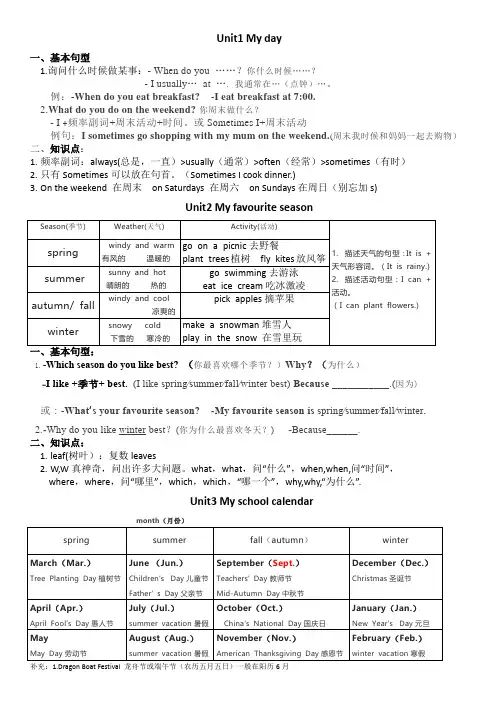
Unit1 My day一、基本句型1.询问什么时候做某事:- When do you ……?你什么时候……?- I usually…at …. 我通常在…(点钟)…。
例:-When do you eat breakfast?-I eat breakfast at 7:00.2.What do you do on the weekend?你周末做什么?- I +频率副词+周末活动+时间。
或Sometimes I+周末活动例句:I sometimes go shopping with my mum on the weekend.(周末我时候和妈妈一起去购物)二、知识点:1.频率副词:always(总是,一直)>usually(通常)>often(经常)>sometimes(有时)2.只有Sometimes可以放在句首。
(Sometimes I cook dinner.)3.On the weekend 在周末on Saturdays 在周六on Sundays在周日(别忘加s)Unit2 My favourite season1.-Which season do you like best? (你最喜欢哪个季节?)Why?(为什么)-I like +季节+ best.(I like spring∕summer∕fall∕winter best) Because ___________.(因为)或:-What‘s your favourite season? -My favourite season is spring∕summer∕fall∕winter.2.-Why do you like winter best?(你为什么最喜欢冬天?) -Because______.二、知识点:1.leaf(树叶):复数leaves2.W,W真神奇,问出许多大问题。
what,what,问“什么”,when,when,问“时间”,where,where,问“哪里”,which,which,“哪一个”,why,why,“为什么”.Unit3 My school calendar补充:1.Dragon Boat Festival 龙舟节或端午节(农历五月五日)一般在阳历6月2.月份首字母大写。
PEP小学英语五年级下册单词句子总复习
PEP小学英语五年级下册单词句子总复习Unit1 this is my dayl 、你能听、说、读、写下面的的单词吗?do morning exercises晨练eat breakfast吃早饭have English class上英语课play sports进行体育活动eat dinner吃晚饭when什么时候evening夜晚,晚上get up 起床at在……点钟usually通常,一般noon中午weekend周末often经常climb mountains爬山go shopping去购物play the piano弹钢琴visit grandparents 探望(外)祖父母go hiking去远足sometimes有时候2、这些难词、难句你都会使用了吗?一When do you do morning exercises?你什么时候晨练?一I usually do morning exercises at 8:30.我通常在8:30晨练。
What do you do on Mondays\S undays…?你星期一/星期日……干什么?I usually\often\sometimes climb mountains.一How about you?= What about you? 你呢?Unit 2 my favourite season1. 你能听、说、读、写下面的的单词吗?spring春天summer夏天fall秋天winter冬天season季节which哪一个best 最;极swim游泳fly kites放风筝skate滑冰;滑冰鞋make a snowman堆雪人plant trees植树why为什么because因为sleep睡觉2.这些难词、难句你都会使用了吗?一What's your favourite season?你最喜欢哪个季节?一Winter.冬天。
--Why do you like summer? 你为什么喜欢夏季?--Because l can swim in the sea.因为我可以在海里游泳。
最新人教pep版小学英语毕业课本知识点单元复习第17课时五年级下册 Unit 5
是你的。
返回目录
4. A: Is he drinking water? 他在喝水吗?
重 B: No, he isn't. He's eating.
不是。他在吃东西。
点 句 5. A: Are these rabbits eating? 这些兔子在吃东西吗?
返回目录
8. eating (eat的-ing形式) (正在)吃 重 9. playing (play的-ing形式) (正在)玩耍 点 单 10. jumping (jump的-ing形式) (正在)跳 词 11. drinking (drink的-ing形式) (正在)喝(水)
12. sleeping (sleep的-ing形式) (正在)睡觉
返回目录
单元整体提升
一、Read and write.写出下列单词的名词性物主代词。
1.my→___m_i_n_e_____
2. your→y_o_u_r_s______
3. his→__h_i_s______ 5. our→__o_u__rs_____
4.her→_h_e_r_s______ 6. their→___th__ei_r_s___
store is ___t_h_e_ir_s___.
5. A: Look! That's my dog.
B: Yes, It's ___y_o_u__r___ dog. The dog is ___y_o_u_r_s___.
6. A: Sam and Peter, wash ____y_o_u_r___ hands.
返回目录
PEP小学五年级下册英语unit6复习
将下列句子改成一般疑问句,并分别做肯定和否定回答
1. They are catching butterflies. Are they catching butterflies? Yes, they are. / No, they aren't. 2. We are eating lunch. Are you eating lunch? Yes, we are. / No, we aren't. 3. She is counting insects. Is she couting insects? Yes, she is. / No, she isn't. 4. He’s playing chess. Is he playing chess? Yes, he is. / No, he isn't. 5. Sam is picking up leaves. Is Sam picking up leaves? Yes, he is. / No, he isn't.
• 8. ----____ you doing? C A.What do
B.Why are
B • 9. ----____ is Li Peng?
A.What
----He’s in the woods. C.Who
B.Where
• 10. What is your grandpa doing? B A. She's drawing. B. He's reading the newspaper. C. Grandma is doing the dishes. • 11. Are they catching butterflies? A A .Yes, they are. B. No ,they can’t. C. Yes, they can.
人教版PEP小学英语五年级下册知识点汇总(最新)
人教版PEP小学英语五年级下册知识点汇总(最新)Unit One: This Is My DayBasic Vocabulary:Activities: get up。
do morning exercises。
have English class。
play sports。
play the piano。
climb mountains。
go shopping。
go hiking。
visit grandparents。
eat breakfast。
eat dinner.Basic XXX Structures:1.Asking about daily routines:When do you。
(你什么时候。
)XXX I。
(我通常在。
(点钟)。
(做什么事)。
有时。
)XXX: When do you go to school。
(你每天几点去上学?)I usually go to school at 7:00.Sometimes I go to school at7:10.2.Asking about XXX:What do you do on the weekend。
(你周末做什么?)XXX I。
(我通常/经常。
有时。
)XXX: What do you do on the weekend?I often play XXX I go shopping with my mom.3.Introducing one's own habits:Every weekend。
I go hiking。
(我每个周末远足。
)Every day。
I do my homework at 8:00 in the evening。
(我每天晚上8点做作业。
)4.Asking XXX:What do you do。
(你是干什么的?)Time:morning。
afternoon。
evening。
noon。
at night。
6:00.on Sunday。