
2013年6月cet4四级真题听力原文(第2套)
听力短对话11.M: I don't know what to do with Timmy.Thismorning I found orange juice spilled all over the kitchen floor.W: Don't be so hard on him. He's only four.Q: What does the woman mean?12.W: Excuse me, sir. I would like to knowabout the fitness training program in your club.M: I'll have you speak with the director incharge of new accounts.Q: What is the woman interested in?13.W: It's really cold in this apartment. Canwe turn up the heat a little bit?M: Sorry. I've run out of money and canhardly pay the fuel bill.Maybe you'd better put on a sweater.Q: What does the man mean?14.M: I'm sorry, Miss. But you have to comewith me to the security office. The video camerasin our s hop have recordedeverything you did.W: No. No. I... I didn't do anything.I'llcall the police if you dare insult me.Q: What does the man think the woman wasdoing?15.M: I think you ought to see a doctor rightaway about that cough.W: Well, I'll wait a few more days. I'msure I'll get over it soon.Q: What do we learn about the woman?16.M: I've heard that Pamela made quite a fewmistakes in her lab report.W: Well, she wouldn't have if she hadn'tbeen in such a hurry to get it done.Q: What does the woman imply?17.M: We'd better check out before 12 o'clock,Mary. And now there are only 30 minutes left.W: Let's hurry up. You go pay the bill andI'll call the reception to have our luggage takendownstai rs.Q: Where did this conversation most probablytake place?18.W: Have you ever heard this speaker before?M: Yeah. She's excellent. She gets herpoint across and is entertaining at the same time.Q: What does the man say about the speaker?听力长对话原文1Conversation OneM: What should I do about Mr. Romero?Remember? He said it was important and couldn'twait. I t hink he may want youfor that new movie he'sdirecting.W: That's absolutely correct. Now, we haveto fit him in somewhere. Mmm, what doesMonday mo rning look like?M: That doesn't look so good. You have a make-upsession starting at 6:00. Then filmingstarts at 8: 00 and that's going to takethe whole morning.W: Well, what's after that?M: You have lunch with your agent todiscuss the awards ceremony and you ought to meethim at one o'clock at therestaurant.W: Oh, terrific. Listen, I cannot missthat. But I still have to make time for Mr. Romero.M: Well, now, don't forget you've got athree-o'clock appointment with your fashion designer.W: That's right. You know he's showing thelatest fashions from Japan? You know thatloose-fitting look? Those clothes areon show in this year.M: At 4:30, you have an appointment withyour hairdresser. Then at 7:00, you have dinnerwith a j ournalist. Nowremember, be nice to that guy.W: Do I have to? That won't be easy andit's likely to run late. How does Tuesday look?M: Well, you have to spend the wholemorning at the photographer's. They are takingphotos to pu blicize your newmovie.W: What about the afternoon? Am I freethen?M: Let me see...Yes, you are free after3:30.W: Then you can set up a meeting with Mr.Romero at 4:00.M: OK. I'll get on it right away.Questions 19 to 21 are based on theconversation you have just heard.19. What are the speakers doing?20. What is the woman going to discuss withher agent over lunch on Monday?21.What do we learn from the conversation about the man?听力长对话原文2Conversation TwoM: I'm phoning up about this job youadvertise in this paper. This...er...young salesmanager?W: Oh, yes.M: I'd like to apply for it. Would you sendme an application form?W: No. You simply send in a writtenapplication, a letter.M: Can you tell me a bit more about thejob?W: Well, we are really looking for someone whoisn't too concerned about working fairlylong hou rs.M: What do you mean by “long hours”?W: This is a job which does, as theadvertisement says, have travel possibilities, and veryoften, one would beaway at weekends, for instance.M: Oh, I thought you meant working in theevenings and working overtime.W: Well, it could also mean working in theevenings. But for a managerial post, I'm afraid wedon't pay overtime. Mmm...that'sfor other grades.M: Oh. What kind of money are you payingthen?W: Well, this is to be negotiated. Oh, itdepends partly on your experience and education.Perhaps y ou can tell me brieflywhat that is?M: I've just left school and got A level ingeography.W: Oh, I see.M: And it's the travel that appeals to me. That'swhy I'm inquiring about the job.W: Yes, I see. What sort of salary were youthinking in terms of?M: Starting off, I thought it would besomething like £500 a week?W: Well, send in a written application andthen we'll consider your case along with all theother ap plicants.M: Alright. Many thanks. Goodbye.W: Bye.Questions 22 to 25 are based on the conversation you have just heard.22. What does the woman say an applicant should do first to apply for the job?23. What kind of a person is the company looking for?24. What does the man like most about the job?25. What does the woman say about the salary if the man is accepted by the company?听力短文原文Passage 1A typical large supermarket offers around17 000to 20000 items for sale and it wants to make surethat its customers seeas many of them as possible.That's why you'll only find essential goods like bread, vegetables and meat in completely different parts of the store.Products with a high profit margin are always placed on shelves within easy reach of the customer, while lower margin itemslike sugar or flower are on the top or bottom shelves. Manypeopl e makeshopping lists before they visit supermarkets. But even so, around 60% ofallsupermarket purc hases are the result of decisions that are taken in the store. Forthis reason,supermarkets try to attract their customers by placing certainkinds of products next to eachother.In the UK, beer will often be found next toitems for babies because research shows thatfathers of babies buy them ontheir way home from work and will buy beer at the same time.Research has alsosh own that this kind of impulse buy happens more frequently when nosalesassistants are nearby. Super markets have made selling such a fine art thattheir customersoften lose all sense of time. When intervi ewed, customersnormally guess they've only spent halfan hour in the supermarket even whenthey ha ve been there for over 45 minutes. But thatshouldn't be too surprising.Any witty profitable superma rket knows that it should keep itsclocks wellhidden.Questions 26 to 29 are based on the passageyou have just heard.26. Why are essential goods displayed intotally different parts of the supermarket?27. Where are goods with a high profitmargin usually found?28. What does the speaker say aboutsupermarket goers?29. What shouldn't be too surprisingaccording to the speaker?Passage 2When Matty Sallin was working on a degreein arts and technology at university, he got aninteresti ng assignment inelectronics class: create something for the household. He decided tocreate analarm c lock.“Everybody has to use an alarm clock of some kind every day, andit's extremely unpleasant!” he says. He asked different people what they'd liketo wake up toinstead of a noisy alarm. A lot of them said, “the smell ofbacon.” So Sallin invented a new kindof alarm clock: a wooden box with a pigface and a di gital clock that uses the smell of cookingbacon rather than soundto wake someone up.He explains,“There's no danger of burning,because I built it carefully. It uses light bulbsinstead of a flame forcooki ng and turns off automatically after ten minutes.” Just a few easysteps arerequired to set the “alarm.” “What you do is put in a couple of frozen stripsthe nightbefore,” says Sallin. Bacon is preserved, so the re is no danger ofits spoiling overnight.“If youset the alarm for 8:00, it will turn on at 7:50and slow cook for ten minutes under the bulbs,”he says.“Then the bulbs turnoff and a fan blows the smell out through the nose of the pig. Soinstead of analar m, you smell yourself awake,” says Sallin.“Then you can open the door ontheside and pull the bacon out and eat it.”Questions 30 to 32 are based on the passageyou have just heard.30. What was Matty Sallin doing when hecreated an alarm clock?31. What did Matty Sallin do before makingthe new type of alarm clock?32. What makes the newly invented alarmclock so unique?Passage 3Most people feel lonely sometimes, but itusually only lasts between a few minutes and a fewhour s. For some people,though, loneliness can last for years. Psychologists are studying thiscomplexpheno menon and have identified three different types of loneliness.The first kind of loneliness is temporary. Itusually disappears quickly and does not requireany sp ecial attention. Thesecond kind, situational loneliness, is a natural result of aparticularsituation, for ex ample, a divorce or moving to a new place.Although this kind of loneliness can causephysical problems, it usually does not last formore than a year. Unlike thesecond type, the third kind of loneliness usually lasts more thantwo years andhas nospecific cause. People who experience habitual loneliness haveproblemssocializing and becoming clo se to others. Unfortunately, many of them thinkthere islittle or nothing they can do about it. Psycholog ists agree that oneimportant factor in lonelinessis a person's social contacts, for example,friends, fam ily members, etc. We depend on variouspeople for differentreasons. For instance, our families give us emotional support and ourfriendsshare similar interests and activities. However, psychologists have f ound thatthe numberof social contacts we have is not the only reason for loneliness. Itis more import ant how many social contacts we think or expect we should have. Inother words, though lonely people mayhave many social contacts, they sometimesfeel they should have more. They question theirown p opularity.Questions 33 to 35 are based on the passageyou have just heard.33. What does the speaker say aboutsituational loneliness?34. What problem will people have if theyexperience habitual loneliness?35.Why do some people suffer loneliness according to psychologists?听力填空There was a time when any personalinformation that was gathered about us was typed on apiece of paper and lockedaway in a file cabinet. It could remain there for years and, oftenforgotten,never re ach the outside world.Things have done a complete about-facesince then. Responsible for the change has beenthe astoni shingly swiftdevelopment in recent years of the computer. Today, any data that iscollectedabout us in one place or another—and for one reason or another—can be stored inacomputer bank.It can then be easily passed to othercomputer banks. They are owned by individuals and byprivat e businesses andcorporations, lending institutions, direct mailing and telemarketing firms,creditburea us, credit card companies, and government agencies at the local, state,and federallevel.Agrowing number of Americans are seeing the accumulation and distribution ofcomputerized da ta as a frightening invasion of their privacy. Surveys show thatthe numberof worried Americans has been steadily growing over the years as thecomputer becomesincreasingly efficient, easier to operat e, and less costly topurchase and maintain. In 1970, anational survey showed that 37 percent of thep eople questioned felt their privacy was beinginvaded. Seven years later,47percent expressed the same worry. A recent survey by a credit bureau revealedthat the number of alarmed citizens had soared up to 76 percent.【长对话1总评】这是一篇以面试为场景的听力对话。
201306-2cet4听力原文

听力短对话11.M: I don't know what to do with Timmy.Thismorning I found orange juice spilled all over the kitchen floor.W: Don't be so hard on him. He's only four.Q: What does the woman mean?12.W: Excuse me, sir. I would like to knowabout the fitness training pro gram in your club.M: I'll have you speak with the director incharge of new accounts.Q: What is the woman interested in?13.W: It's really cold in this apartment. Canwe turn up the heat a little bit ?M: Sorry. I've run out of money and canhardly pay the fuel bill.Maybe you'd better put on a sweater.Q: What does the man mean?14.M: I'm sorry, Miss. But you have to comewith me to the security offi ce. The video camerasin our shop have recordedeverything you did.W: No. No. I... I didn't do anything.I'llcall the police if you dare insul t me.Q: What does the man think the woman wasdoing?15.M: I think you ought to see a doctor rightaway about that cough.W: Well, I'll wait a few more days. I'msure I'll get over it soon.Q: What do we learn about the woman?16.M: I've heard that Pamela made quite a fewmistakes in her lab report.W: Well, she wouldn't have if she hadn'tbeen in such a hurry to get it done.Q: What does the woman imply?17.M: We'd better check out before 12 o'clock,Mary. And now there are only 30 minutes left.W: Let's hurry up. You go pay the bill andI'll call the reception to hav e our luggage takendownstairs.Q: Where did this conversation most probablytake place?18.W: Have you ever heard this speaker before?M: Yeah. She's excellent. She gets herpoint across and is entertainin g at the same time.Q: What does the man say about the speaker?听力长对话原文1Conversation OneM: What should I do about Mr. Romero?Remember? He said it was i mportant and couldn'twait. I think he may want youfor that new movie he' sdirecting.W: That's absolutely correct. Now, we haveto fit him in somewhere. Mmm, what doesMonday morning look like?M: That doesn't look so good. You have a make-upsession starting at 6:00. Then filmingstarts at 8:00 and that's going to takethe whole mornin g.W: Well, what's after that?M: You have lunch with your agent todiscuss the awards ceremony a nd you ought to meethim at one o'clock at therestaurant.W: Oh, terrific. Listen, I cannot missthat. But I still have to make tim e for Mr. Romero.M: Well, now, don't forget you've got athree-o'clock appointment wit h your fashion designer.W: That's right. You know he's showing thelatest fashions from Japan ? You know thatloose-fitting look? Those clothes areon show in this year.M: At 4:30, you have an appointment withyour hairdresser. Then at 7 :00, you have dinnerwith a journalist. Nowremember, be nice to that guy.W: Do I have to? That won't be easy andit's likely to run late. How do es Tuesday look?M: Well, you have to spend the wholemorning at the photographer's. They are takingphotos to publicize your newmovie.W: What about the afternoon? Am I freethen?M: Let me see...Yes, you are free after3:30.W: Then you can set up a meeting with Mr.Romero at 4:00.M: OK. I'll get on it right away.Questions 19 to 21 are based on theconversation you have just heard.19. What are the speakers doing?20. What is the woman going to discuss withher agent over lunch on Monday?21.What do we learn from the conversation about the man?听力长对话原文2Conversation TwoM: I'm phoning up about this job youadvertise in this paper. This...er.. .young salesmanager?W: Oh, yes.M: I'd like to apply for it. Would you sendme an application form?W: No. You simply send in a writtenapplication, a letter.M: Can you tell me a bit more about thejob?W: Well, we are really looking for someone whoisn't too concerned a bout working fairlylong hours.M: What do you mean by “long hours”?W: This is a job which does, as theadvertisement says, have travel pos sibilities, and veryoften, one would beaway at weekends, for instance.M: Oh, I thought you meant working in theevenings and working ove rtime.W: Well, it could also mean working in theevenings. But for a manag erial post, I'm afraid wedon't pay overtime. Mmm...that'sfor other grades.M: Oh. What kind of money are you payingthen?W: Well, this is to be negotiated. Oh, itdepends partly on your experie nce and education.Perhaps you can tell me brieflywhat that is?M: I've just left school and got A level ingeography.W: Oh, I see.M: And it's the travel that appeals to me. That'swhy I'm inquiring abo ut the job.W: Yes, I see. What sort of salary were youthinking in terms of?M: Starting off, I thought it would besomething like £500 a week?W: Well, send in a written application andthen we'll consider your ca se along with all theother applicants.M: Alright. Many thanks. Goodbye.W: Bye.Questions 22 to 25 are based on the conversation you have just heard.22. What does the woman say an applicant shoulddo first to apply for the job?23. What kind of a person is the company looking for?24. What does the man like most about the job?25. What does the woman say about thesalary if the man is accepted by the company?听力短文原文Passage 1A typical large supermarket offers around17 000to 20000 items for sale and it wants to make surethat its customers seeas many of them as possible.That's why you'll only f ind essential goods like bread, vegetables and meat in completely different parts of the store.Products with a high profit margin are alwaysplaced on shelves within easy reach of thecustomer, while lower margin itemslike sugar or flower are on the top or bottom shelves. Manypeople makeshopping lists before they visit superm arkets. But even so, around 60% ofallsupermarket purchases are the result of decisions that are taken in the store. Forthis reason,supermarkets try to attract their customers by placing certainkinds of products next to eachot her.In the UK, beer will often be found next toitems for babies because re search shows thatfathers of babies buy them ontheir way home from work and will buy beer at the same time.Research has alsoshown that this kindof impulse buy happens more frequently when nosalesassistants are near by. Supermarkets have made selling such a fine art thattheir customersoft en lose all sense of time. When interviewed, customersnormally guess the y've only spent halfan hour in the supermarket even whenthey have been t here for over 45 minutes. But thatshouldn't be too surprising.Any witty p rofitable supermarket knows that it should keep itsclocks wellhidden.Questions 26 to 29 are based on the passageyou have just heard.26. Why are essential goods displayed intotally different parts of the s upermarket?27. Where are goods with a high profitmargin usually found?28. What does the speaker say aboutsupermarket goers?29. What shouldn't be too surprisingaccording to the speaker?Passage 2When Matty Sallin was working on a degreein arts and technology at university, he got aninteresting assignment inelectronics class: create so mething for the household. He decided tocreate analarm clock. “Everybody has to use an alarm clock of some kind every day, andit's extr emely unpleasant!” he says. He asked different people what they'd liketo wake up toinstead of a noisy alarm. A lot of them said,“the smell ofbacon.” So Sallin invented a new kindof alarm clock: a wooden box with a pigface and a digital clock that uses the smell of cookingb acon rather than soundto wake someone up.He explains,“There's no danger of burning,because I built it carefully. It uses light bul bsinstead of a flame forcooking and turns off automatically after ten mi nutes.” Just a few easysteps arerequired to set the “alarm.”“What you do is put in a couple of frozen stripsthe nightbefore,” says Sall in. Bacon is preserved, so there is no danger ofits spoiling overnight. “If youset the alarm for 8:00, it will turn on at 7:50and slow cook for ten minutes under the bulbs,”he says.“Then the bulbs turnoff and a fan blows the smell out through the nose of the pig. Soinstead of analarm, you smell yourself awake,” says Sallin. “Then you can open the door ontheside and pull the bacon out and eat it.”Questions 30 to 32 are based on the passageyou have just heard.30. What was Matty Sallin doing when hecreated an alarm clock?31. What did Matty Sallin do before makingthe new type of alarm clo ck?32. What makes the newly invented alarmclock so unique?Passage 3Most people feel lonely sometimes, but itusually only lasts between a few minutes and a fewhours. For some people,though, loneliness can last for years. Psychologists are studying thiscomplexphenomenon and have i dentified three different types of loneliness.The first kind of loneliness is temporary. Itusually disappears quickl y and does not requireany special attention. Thesecond kind, situational lo neliness, is a natural result of aparticularsituation, for example, a divorce or moving to a new place.Although this kind of loneliness can causephysical problems, it usuall y does not last formore than a year. Unlike thesecond type, the third kind of loneliness usually lasts more thantwo years andhas no specific cause. P eople who experience habitual loneliness haveproblemssocializing and b ecoming close to others. Unfortunately, many of them thinkthere islittle o r nothing they can do about it. Psychologists agree that oneimportant fact or in lonelinessis a person's social contacts, for example,friends, family members, etc. We depend on variouspeople for differentreasons. For insta nce, our families give us emotional support and ourfriendsshare similar i nterests and activities. However, psychologists have found thatthe numbe rof social contacts we have is not the only reason for loneliness. Itis more important how many social contacts we think or expect we should have. I nother words, though lonely people mayhave many social contacts, they sometimesfeel they should have more. They question theirown popularity .Questions 33 to 35 are based on the passageyou have just heard.33. What does the speaker say aboutsituational loneliness?34. What problem will people have if theyexperience habitual lonelin ess?35.Why do some people suffer loneliness according to psychologists?听力填空There was a time when any personalinformation that was gathered ab out us was typed on apiece of paper and lockedaway in a file cabinet. It c ould remain there for years and, oftenforgotten,never reach the outside w orld.Things have done a complete about-facesince then. Responsible for th e change has beenthe astonishingly swiftdevelopment in recent years of th e computer. Today, any data that iscollectedabout us in one place or anoth er—and for one reason or another—can be stored inacomputer bank.It can then be easily passed to othercomputer banks. They are owned by individuals and byprivate businesses andcorporations, lending instituti ons, direct mailing and telemarketing firms,creditbureaus, credit card co mpanies, and government agencies at the local, state,and federallevel.Agrowing number of Americans are seeing the accumulation and dis tribution ofcomputerized data as a frightening invasion of their privacy. Surveys show thatthe numberof worried Americans has been steadily gro wing over the years as thecomputer becomesincreasingly efficient, easier to operate, and less costly topurchase and maintain. In 1970, anational su rvey showed that 37 percent of thepeople questioned felt their privacy w as beinginvaded. Seven years later,47percent expressed the same worry. A recent survey by a credit bureau revealedthat the number of alarmed citizens had soared up to 76 percent.【长对话1总评】这是一篇以面试为场景的听力对话。
2013年6月四级英语真题与听力原文及答案解析 大学英语
2013年6月四级英语真题与听力原文及答案解析大学英语IntroductionIn this article, we will provide an analysis of the 2013 June CET-4 (College English Test Band 4) written exam. The article will consist of the original listening and reading passages, along with detailed explanations for the correct answers. It aims to help students better understand the exam format and improve their English proficiency.Reading Passage 1[Passage 1]Questions 1-4:1. B2. A3. D4. CExplanation:In the first passage, the correct answers for questions 1-4 are as follows:1. The ability to form general ideas.- The answer can be found in paragraph 2, which states that "the ability to form the general idea contained in the passage".2. The idea that reading interests develop rather smoothly.- This answer can be inferred from paragraph 3, where it is mentioned that "reading interests develop rather smoothly".3. Their ability to be leaders.- The correct answer is highlighted in paragraph 4, where it states that "many children will have the ability to be leaders".4. Building a reading habit from a young age.- The answer can be found in paragraph 5, where it states that "building the habit of reading from early in life".Reading Passage 2[Passage 2]Questions 5-8:5. C6. B7. A8. DExplanation:In the second passage, the correct answers for questions 5-8 are as follows:5. Whether teachers select textbooks.- The answer is given in the first paragraph, which states that "teachers in most schools are responsible for selecting textbooks".6. There are guidelines for textbook selection.- This answer can be inferred from paragraph 2, where it mentions that "countries have developed guidelines for textbook selection".7. Feedback from students.- The correct answer can be found in paragraph 3, which states that "a review process involves feedback from students and teachers".8. The effectiveness of textbooks.- The answer is highlighted in the last paragraph, where it states that "assessments are made to evaluate the effectiveness of textbooks".Listening Passage 1[Listening Passage 1]Questions 9-12:9. C10. B11. A12. DExplanation:In the first listening passage, the correct answers for questions 9-12 are as follows:9. The professor's name.- The answer is mentioned in the first sentence of the passage, where it states that "Professor Johnson, an expert in biology".10. The significance of the discovery.- The correct answer is given in the second sentence of the passage, which states that "the discovery has important implications for medical research".11. The target audience of the lecture.- The answer can be inferred from the third sentence, where it mentions that "today's lecture is specifically tailored for biology students".12. The location of the discovery.- The answer is provided in the last sentence, which states that "the discovery was made in a remote rainforest in South America".ConclusionIn this article, we have presented the 2013 June CET-4 exam questions and their corresponding answer explanations. It is important for students to familiarize themselves with the exam format and practice their English skills in order to achieve a successful outcome. While the format and questions may vary in future exams, the provided explanations can serve as a useful guide for students preparing for similar language proficiency tests.Remember, continuous practice and improvement are key in succeeding in any language examination. Good luck with your studies!。
2013年6月英语四级考试真题以及答案(第2套)
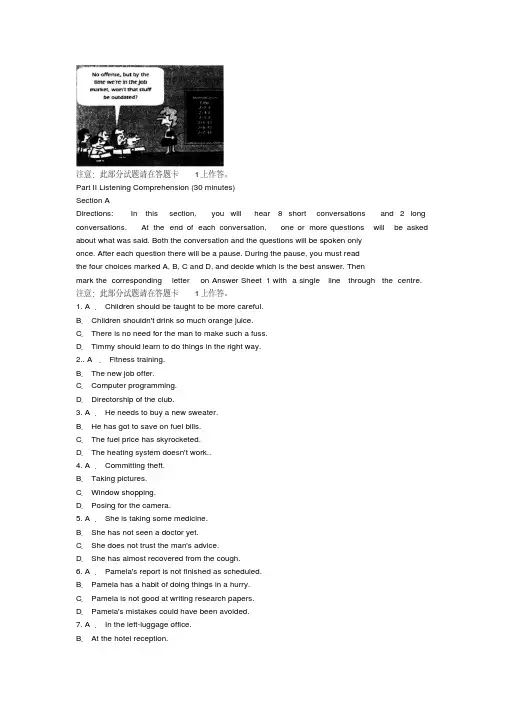
注意:此部分试题请在答题卡1上作答。
Part II Listening Comprehension (30 minutes)Section ADirections: In this section, you will hear 8 short conversations and 2 long conversations. At the end of each conversation, one or more questions will be asked about what was said. Both the conversation and the questions will be spoken onlyonce. After each question there will be a pause. During the pause, you must readthe four choices marked A, B, C and D, and decide which is the best answer. Thenmark the corresponding letter on Answer Sheet 1 with a single line through the centre. 注意:此部分试题请在答题卡1上作答。
1. A. Children should be taught to be more careful.B. Children shouldn't drink so much orange juice.C. There is no need for the man to make such a fuss.D. Timmy should learn to do things in the right way.2.. A. Fitness training.B. The new job offer.C. Computer programming.D. Directorship of the club.3. A. He needs to buy a new sweater.B. He has got to save on fuel bills.C. The fuel price has skyrocketed.D. The heating system doesn't work..4. A. Committing theft.B. Taking pictures.C. Window shopping.D. Posing for the camera.5. A. She is taking some medicine.B. She has not seen a doctor yet.C. She does not trust the man's advice.D. She has almost recovered from the cough.6. A. Pamela's report is not finished as scheduled.B. Pamela has a habit of doing things in a hurry.C. Pamela is not good at writing research papers.D. Pamela's mistakes could have been avoided.7. A. In the left-luggage office.B. At the hotel reception.-C. In a hotel room.D. At an airport.8. A. She was an excellent student at college.B. She works in the entertainment business.C. She is fond of telling stories in her speech.D. She is good at conveying her message.Questions 9 to 11 are based on the conversation you have just heard.9. A. Arranging the woman's appointment with Mr. Romero.B. Fixing the time for the designer's latest fashion show.C. Talking about an important gathering on Tuesday.D. Preparing for the filming on Monday morning.10. A. Her travel to Japan.B. The awards ceremony.C. The proper hairstyle for her new role.D. When to start the makeup session.11. A. He is Mr. Romero's agent.B. He is an entertainment journalist.C. He is the woman's assistant.D. He is a famous movie star.Questions 12 to 15 are based on the conversation you have just heard.12. A. Make an appointment for an interview.B. Send in an application letter.C. Fill in an application form.D. Make a brief self-introduction on the phone.13. A. Someone having a college degree in advertising.B. Someone experienced in business management.C. Someone ready to take on more responsibilities.D. Someone willing to work beyond regular hours.14. A. Travel opportunities.B. Handsome pay.C. Prospects for promotion.D. Flexible working hours.15. A. It depends on the working hours.B. It is about 500 pounds a week.C. It will be set by the Human Resources.D. It is to be negotiated.Section BDirections: In this section, you will hear 3 short passages. At the end of eachpassage, you will hear some questions. Both the passage and the questions will bespoken only once. After you hear a question you must choose the best answer fromthe four choices marked A, B, C and D. Then mark the corresponding letter on Answer-Sheet 1 with a single line through the centre.注意:此部分试题请在答题卡1上作答。
2013年6月15日英语四级(CET-4)真题及答案

Part II (15 minutes) 1、回答1-11题: Can Digital Textbook Truly Replace the Print Kind? The shortcomings of traditional print edition textbooks are obvious: Forstarters they're heavy, with the average physics textbook weighing 3.6 pounds.They're also expensive, especially when you factor in the average collegestudent's limited budget, typically costing hundreds of dollars every semester. But the worst part is that print version of textbooks are constantlyundergoing revisions. Many professors require that their students use only thelatest versions in the classroom, essentially rendering older texts unusable.For students, it means they're basically stuck with a four pound paper-weightthat they can't sell back. Which is why digital textbooks, if they live up to their promise, couldhelp ease many of these shortcomings. But till now, they've been something likea mirage (幻影) in the distance,more like a hazy (模糊的) dream thanan actual reality. Imagine the promise: Carrying all your textbooks in a 1.3pound iPad? It sounds almost too good to be true. But there are a few pilot schools already making the transition (过度) over to digital books. Universities like Cornell and Brown havejumped onboard. And one medical program at the University of California,Irvine, gave their entire class iPads with which to download textbooks justlast year. But not all were eager to jump aboard. "People were tired of using the iPad textbook besides using it forreading," says Kalpit Shah, who will be going into his second year atlrvine's medical program this fall. "They weren't using it as a source ofcommunication because they couldn't read or write in it. So a third of thepeople in my program were using the iPad in class to take notes, the otherthird were using laptops and the last third were using paper and pencil." The reason it hasn't caught on yet, he tells me, is that thefunctionality of e-edition textbooks is incredibly limited, and some studentsjust aren't motivated to learn new study behavior. But a new application called Inkling might change all that. The companyjust released an updated version last week, and it'll be utilized in over 50undergraduate and graduate classrooms this coming school year. Digital textbooks are not going to catch on," says Inkling CEO MattMaclnnis as he's giving me a demo (演⽰) over coffee. "What I mean by that is the current perspectiveof the digital textbook is it's an exact copy of the print book. There's CourseSmart, etc., these guys who take any image of the page and put it on a screen.If that's how we're defining digital textbooks, there's no hope of that becominga mainstream product." He calls Inkling a platform for publishers to build rich multimediacontent from the ground up, with a heavy emphasis on real-world functionality.The traditional textbook merely serves as a skeleton. At first glance Inkling is an impressive experience. After swiping (敲击) into the iPad app (软件), which youcan get for free here, he opens up a few different types of textbooks. Up first is a chemistry book. The boot time is pretty fast, and henavigates through (浏览) a fewchapters before swiping into a fully rendered 3D molecule that can be spunaround to view its various building blocks. "Publishers give us all of thesource media, artwork, videos," he says, "We help them think throughhow to actually build something for this platform." Next he pulls up a music composition textbook, complete with playabledemos. It's a learning experience that attacks you from multiple sensorydirections. It's clear why this would be something a music major would love. But the most exciting part about Inkling, to me, is its notation (批注) system. Here's how it works! When you purchase a used print book, it comes with its previous owner'shighlights and notes in the margins. It uses the experience of someone whoalready went through the class to help improve your reading (how much you trusteach notation is obviously up to you). But with lnkling, you can highlight a piece of content and make notes.Here's where things get interesting, though: If a particularly importantpassage is highlighted by multiple lnkling users, that infbrmation is stored onthe cloud and is available for anyone reading the same textbook to come across.Thai means users have access to notes from not only their classmates andFacebook friends, but anyone who purchased the book across the country. Thebest comments are then sorted democratically by a voting system, meaning thatyour social learning experience is shared with the best and brightest thinkers. As a bonus, professors can even chime in (插话) on discussions. They'll be able to answer the questions ofstudents who are in their class directly via the interactive book. Of course, Inkling addresses several of the other shortcomings intraditional print as well. Textbook versions are constanly updated, motivatingpublishers by minimizing production costs (the big ones like McGraw-Hill arealready onboard). Furthermore, students will be able to purchase sections ofthe text instead of buying the whole thing, with individual chapters costing aslittle as $2.99, There are, however, challenges. "It takes efforts to build each book," Maclnnis tells me. Andit's clear why, Each interactive textbook is a media-heavy experience built from theground up, and you can tell that it takes a respectable amount of manpower toput together each one. For now the app is also iPad-exclusive, and though a few of theseeducational institutions are giving the hardware away for free, for otherstudents who don't have such a luxury it's an added layer of cost ---and anexpensive one at that. But this much is clear. The traditional textbook model is and has beenbroken for quite some time. Whether digitally interactive ones like Inklingactually take off or not remains to be seen, and we probably won't have adefinite answer for the next few years. However the solution to any problem begins with a step in a direction.And at least for now, that hazy mirage in the distance? A little more tangible(可触摸的), a little less of a dream.The biggest problem with traditional print textbooks is that A.they are not reused once a new edition comes out B.they cost hundreds of dollars every semester C.they are too heavy to carry around D.they take a longer time to revise Part I Writing(30 minutes) 1、Directions:For this part, you are allowed 30 minutes to write a short essay. You should start your essay with a brief description of the picture and then express your views on the importance of doing small things before undertaking something big. You should write at least 120 words but no more than 180 words.Part II (15 minutes) 2、What does the author say about digital textbooks? A.It's not likely they will replace traditional textbooks. B.They haven't fixed all the shortcomings of print books. C.Very few of them are available in the market. D.Many people still have difficulty using them. Part I Writing(30 minutes) 2、 Directions:For this part, you are allowed 30minutes to write a short essay. You should start your essay with a brief description of the picture and then express your views on the importance of reading literature. You should write at least 120 words but no more than 180 words.Part II (15 minutes) 3、According to Kalpit Shah, some students still use paper and pencil because ________. A.they find it troublesome to take notes with an iPad B.they are unwilling to change their study behavior C.they have get tired of reading on the iPad D.they are not used to reading on the screen 4、Inkling CEO Matt Maclnnis explains that the problem with Course Smart's current digital textbooks is that ________. A.they have to be revised repeatedly B.they are inconvenient to use in class C.they are different from most mainstream products D.they are no more than print versions put on a screen 5、Matt Maclnnis describes the updated version of lnkling as ________. A.a good example of the mainstream products B.a marvelous product of many creative ideas C.a platform for building multimedia content D.a mere skeleton of traditional textbooks 6、The author is most excited about lnkling's notation system because one can________. A.share his learning experience with the best and brightest thinkers B.participate in discussions with classmates and Facebook friends C.vote for the best learners democratically D.store information on the cloud 7、One additional advantage of the interactive digital textbook is that ________. A.students can switch to different discussions at any point B.students can download relevant critical comments C.professors can join in students' online discussions D.professors can give prompt feedback to students' homework 8、One of the challenges to build an interactive digital textbook from the ground up is that is takes a great deal of ________. 9、One problem for students to replace traditional textbooks with interactive digital ones is the high of the hardware. 10、According to the author, whether digital textbooks will catch on still ________. Part Ⅲ Listening Comprehension:11-35 11、听录⾳,回答11-47题:点击播放A.Children should be taught to be more careful. B.Children shouldn't drink so much orange juice. C.There is no need for the man to make such a fuss. D.Timmy should learn to do things in the right way.12、 A.Fitness training. B.The new job offer. C.Computer programming. D.Directorship of the club.13、 A.He needs to buy a new sweater. B.He has got to save on fuel bills. C.The fuel price has skyrocketed. D.The heating system doesn't work.14、 A.Committing theft. B.Taking pictures. C.Window shopping, D.Posing for the camera.15、 A.She is taking some medicine. B.She has not seen a doctor yet. C.She does not trust the man's advice.D.She has almost recovered from the cough.16、 A.Pamela's report is not finished as scheduled. B.Pamela has a habit of doing things in a hurry. C.Pamela is not good at writing research papers. D.Pamela's mistakes could have been avoided.17、 A.In the left-luggage office. B.At the hotel reception. C.In a hotel room. D.At an airport.18、 A.She was an excellent student at college. B.She works in the entertainment business. C.She is fond of telling stories in her speech. D.She is good at conveying her message.19、Questions 19 to 21 are based on the conversation you have just heard. A.Arranging the woman's appointment with Mr. Romero. B.Fixing the time for the designer's latest fashion show. C.Talking about an important gathering on Tuesday. D.Preparing for the filming on Monday morning.20、 A.Her travel to Japan. B.The awards ceremony. C.The proper hairstyle for her new role. D.When to start the makeup session.21、 A.He is Mr. Romero's agent. B.He is an entertainment journalist. C.He is the woman's assistant. D.He is a famous movie star.22、Questions 22 to 25 are based on the conversation you have just heard. A.Make an appointment for an interview.B.Send in an application letter. C.Fill in an application form. D.Make a brief self-introduction on the phone.23、 A.Someone having a college degree in advertising. B.Someone experienced in business management. C.Someone ready to take on more responsibilities. D.Someone willing to work beyond regular hours.24、 A.Travel opportunities. B.Handsome pay. C.Prospects for promotion. D.Flexible working hours.25、 A.It depends on the working hours. B.It's about 500 pound a week. C.It will be set by the Human Resources.D.It is to be negotiated.26、Questions 26 to 29 are based on the passage you have just heard. A.To give customers a wider range of choices. B.To make shoppers see as many items as possible. C.To supply as many varieties of goods as it can. D.To give space for more profitable products.27、 A.On the top shelves, B.On the bottom shelves. C.On easily accessible shelves. D.On clearly marked shelves.28、 A.Many of them buy things on impulse. B.A few of them are fathers with babies. C.A majority of them are young couples, D.Over 60% of them make shopping lists.29、 A.Sales assistants promoting high margin goods. B.Sales assistants following customers around. C.Customers competing for good bargains, D.Customers losing all sense of time,30、Questions 30 to 32 are based on the passage you have just heard. A.Teaching mathematics at a school. B.Doing research in an institute. C.Studying for a college degree. D.Working in a high-tech company.31、 A.He studied the designs of various choices. B.He did experiments to different materials. C.He bought an alarm clock with a pig face. D.He asked different people for their opinions.32、 A.Its automatic mechanism. B.Its manufacturing pattern. C.Its way of waking people up. D.Its funny-looking pig face.33、Questions 33 to 35 are based on the passage you have just heard. A.It's often caused by a change of circumstances. B.It usually doesn't require any special attention. C.It usually appears all of a sudden. D.It usually lasts for several years.34、 A.They can't mix well with others, B.They emotionally receive their friends. C.They depend severely on family members. D.They share similar interests with friends.35、 A.They lack consistent support from peers. B.They doubt their own popularity. C.They were born psychologically weak. D.They focus too much attention on themselves.。
2013年06月大学英语四级真题含答案

2013年6月大学英语四级考试试题Part Writing (30 minute)Directions: For this part ,you are allowed 30minute to write a short essay on the topic of students selecting their lectures. You should write at least 120 words following the outline when bellow:1.有些大学允许学生自由选择某些课程的任课教师2.学生选择教师时所考虑的主要因素3.学生自选任课教师的益处和可能产生的问题Part II Reading comprehension (skimming and scanning ) (15 minute)HighwayA government study recommended a national highway system of 33,920 miles, and congress passed the Federal-Aid Highway Act of 1944,which called for strict, centric controlled desert criteria.The interstate highway system was finally launched in 1956 and has been hailed as one of the greatest public works projects of the century .To build its 44,000-mile web of highways, bridge and tunnels, hundreds of unique engineering designs and solutions had to be worked out. Consider the many geographic, features of the country: mountains, steep grades, wetlands, rivers, deserts and plains. Variables included the slope of the land, the ability of the pavement to support the load. Innovative, designs of roadways, tunnels, bridges, overpasses, and interchanges that could run through or bypass urban areas soon began to weave their way across the country, forever altering the face of American.Long-span, segmented-concrete, cable-stayed bridges such as Hale Boggs in Louisiana and the Sunshine Skyway in Florida ,and remarkable tunnels like Fort Mchenry in Maryland and Mr. baker in Washington developed under the nation's physical challenges, Traffic control systems and methods of construction developed under the interstate program soon influenced highway construction around the world, and were invaluable in improving the condition of urban streets and traffic patterns.Today the interstate system links every major city in the U.S, and the U.S with Canada and Mexico. Built with safety in mind the highways have wide lanes and shoulders, dividing medians, or barriers, long entry and exit lanes, our engineered for safe turns, and limited access. The death rate on highways is half that of all other U.S roads (0.86 deaths per 100 million passenger miles compared to 1.99 deaths per 100 million on all other roads)By opening the North American continent, highways have enabled consumer goods and services to reach people in remote and rural areas of jobs, access to the growth options in terms of jobs access to cultural programs health care, and other benefits. Above all, the interstate system provides individuals with what they enrich most: personal freedom of mobility.The interstate system has been an essential element of the nation's economic growth in terms of shipping and job creation: more than 75 percent of the nation's freight deliveries arrive by truck. And most products that arrive by rail or air use interstates for the last leg of the journey by vehicle.Not only has the highway system affected the American economy by providing shipping routes, it has led to the growth of spin-off industries like service stations ,motels, restaurants, and shopping centers. It has allowed the relocation of manufacturing plants and other industries from urban areas to rural.By the end of the century there was an immense network of paved roads, residential streets, expressways, and freeways built to support millions of vehicles. The high way system was officially renamed for Eisenhower to honor his vision and leadership. The year construction began he said: "Together, the united forces of our communication and transportation systems are dynamic elements in the very name we bear -United States. Without them, we would be a mere alliance of many separate parts."1. National standards for paved roads were in place by 1921.2. General Eisenhower felt that the broad German motorways made more sense than the two-lane highways of America.3. It was in the 1950s that the American government finally took action to build a national highway system.4. Many of the problems presented by the country’s geograp hical features found solutions in innovative engineering projects.5. In spite of safety considerations, the death rate on interstate highways is still higher than that of other American roads.6. The interstate highway system provides access between major military installations in America.7. Services stations, motels and restaurants promoted the development of the interstate highway system.8. The greatest benefit brought about by the interstate system was___________9.Trucks using the interstate highways deliver more than__________________10.The interstate system was renamed after Eisenhower in recognition_____________Part Ⅲ Listening ComprehensionSection A11. A)The girls got on well with each other. B)It's understandable that girls don't get along.C)She was angry with the other young stars. D)The girls lacked the courage to fight.12. A)The woman does her own housework. B)The woman needs a housekeeper.C)The woman's house is in a mess. D)The woman works as a housekeeper.13. A)The Edwards are quite well-off.B)The Edwards should cut down on their living expenses.C)It'll be unwise for the Edwards to buy another house.D)It's too expensive for the Edwards to live in their present house.14.A)The woman didn't except it to be so warm at noon. B)The woman is sensitive to weather changes.C)The weather forecast was unreliable D)The weather turned cold all of a sudden.15. A)At a clinic. B)At a restaurant. C)In a supermarket. D)In an ice cream shop.16. A)The woman did not feel any danger growing up in the Bronx.B)The man thinks it was quite safe living in the Bronx district.C)The woman started working at an early age to support her family .D)The man doesn’t think it safe to send an 8-year-old to buy things.17. A)The man has never seen the woman before. B)The two speakers work for the same company.C)The two speakers work in the same floor. D)The woman is interested in market research.18. A)The woman can't tolerate any noise. B)The man is looking foe an apartment.C)The man has missed his appointment. D)the woman is going to take a train trip.Questions 19 to 21 are based on the conversation you have just heard.19. A)To make a business report to the woman . B)To be interviewed for a job in the woman's company.C)To resign from his position in the woman's company. D)To exchange stock market information with the woman.20. A)He is head of a small trading company. B)He works in an international insurance company.C)He leads s team of brokers in a big company. D)He is a public relations officer in a small company.21. A)The woman thinks Mr. Saunders is asking for more than they can offer.B)Mr. Saunders will share one third of the woman's responsibilities.C)Mr. Saunders believes that he deserves more paid vacations.D)The woman seems to be satisfied with Mr. Saunders' past experience.22. A)She's worried about the seminar. B)The man keeps interrupting her.C)She finds it too hard. D)She lacks interest in it.23. A)The lecturers are boring. B)The course is poorly designed.C)She prefers Philosophy to English. D)She enjoys literature more.24. A)Karen's friend. B)Karen's parents. C)Karen's lecturers. D)Karen's herself.25. A)Changing her major. B)Spending less of her parents' money.C)Getting transferred to the English Department. D)Leaving the university.Section BPassage One Question 26 to 29 are based on the passage you have just heard.26. A) Rent a grave. B) Burn the body. C) Bury the dead near a church. D)buy a piece of land for a grave.27. A) To solve the problem of lack of land. B)To see whether they have decayed.C)To follow the Greek religious practice. D)To move them to a multi-Storey28. A)They should be buried lying down . B)They should be buried standing up.C)They should be buried after being washed. D)They should be buried when partially decayed.29. A)Burning dead bodies to ashes. B)Storing dead bodies in a remote place.C)Placing dead bodies in a bone room. D)Digging up dead bodies after three years.Passage Two Question 30 to 32 are based on the passage you have just heard.30. A)Many foreign tourist visit the Unite States every year. B)Americans enjoy eating out with their friends.C)The United States is a country of immigrants. D)Americans prefer foreign foods to their own food.31. A)They can make friends with people from other countries.B)They can get to know people of other cultures and their lifestyles.C)They can practice speaking foreign languages there.D)They can meet with businessmen from all over the world.32. A)The couple cook the dishes and the children help them .B)The husband does the cooking and the wife serves as the address.C)The mother does the cooking while the famepand children within the guests.D)A hired cook prepares the dishes and the family members serve the guests.Passage Three Questions 33 to 35 are based on the passage you have just heard .33. A)He took them to watch a basketball game. B)He trained them to play European football.C)He let them compete in getting balls out of a basket. D)He taught them to play an exciting new game.34. A)The players found the basket too high to teach. B)The players had trouble getting the ball out of the basket.C)The players had difficulty understanding the complex rules. D)The players soon found the game boring.35. A)By removing the bottom of the basket. B)By lowering the position of the basket.C)By simplifying the complex rules. D)By altering the size Of the basket.Section CF or American time is money. They say, “you only get so much time in this life; you'd better use it wisely." The(36)__________without be better than the past or present. As American are (37)__________to see things, unless people use their time for constructive activity, Thus American(38)__________a "well-organized" person is punctual and is(40)__________of other people's time. They do not (41)__________people's time with conversation or other activity that has no(42)__________beneficial outcome.The American attitude toward time is not (43)__________shared by others, especially non-Europeans. They aremore likely to regard time as (44)__________.One of the more difficult things many students must adjust to in the states is the notion that time must be saved whenever possible and used wisely every day.In the contest (45)__________.McDonald’s, KFC, and eating meals. As McDonald’s restaurants(46)__________, bringing not just hamburgers but an emphasis on speed, efficiency, and shiny cleanliness.Part IV reading comprehension(reading in depth)Section AEI Nino is name given to the mysterious and often unpredictable change in the climate of the world. This strange ___47_____happens every five to eight years. It starts in the Pacific Ocean and is thought to be caused by a failure in the trade winds(信风),which affects the ocean currents driven by these winds. As the trade winds lessen in ____48____,the ocean temperatures rise causing the Peru current flowing in form the east to warm up by as much as 5`C.The warming of the ocean has far-reaching effects. The hot, humid(潮湿的)air over the ocean causes severe ___49___thunderstorms.The rainfall is increased across South American ____50____floods to Peru. In the West pacific, there are droughts affecting Australia and Indonesia. So while some parts of the world prepare for heavy rains and floods, other parts face drought, poor crops and____51____.EI Nino usually lasts for about 18 months The 1982-83 EI Nino brought the most___52____weather in modern history .Its effect was worldwide and it left more than 2,000 people dead and caused over eight billion pounds ____53___of damage. The 1990 EI Nino will ____55___,but they are still not __56___sure what leads to it or what affects how strong it will be.A)estimate B)strength C)deliberately D)notify E)tropical F)phenomenon G)stable H)attractionI)completely J)destructive K)starvation L)bringing M)exhaustion N)worth O)strikeSection BPassage OneCommunications technologies are far from equal when it comes to conveying the truth. The first study to tell lies in phone conversations as they are in emails. The fact that emails are automatically recorded-and can come back to haunt(困扰)you appears to be the key to the finding.Jeff Hancock of Cornell University in Ithaca, Mew York, asked 30 students to keep a communications diary for a week. In it they noted the number of conversations or email exchanges they had lasting more than 10 minutes, and confessed to how many lies they told. Hancock then worked out the number of lies per conversation foe each medium .He found that lies made up 14 per cent of emails, 21 per cent of instant messages,27 per cent of face-to-face interactions and an astonishing 37 per cent of phone calls.His resolves to be presented at the conference on human-computer interaction in Vienna, Austria, in April, have surprised psychologists. Some expected e-mailers to be the biggest liars, reasoning that because deception makes people uncomfortable, the detachment(非直接接触)of emailing would make it easier to lie. Others expected people to lie more in face-to-face exchanges because we are most practiced at that form of communication.But Hancock says it is also crucial whether a conversation is being recorded and could be reread, and whether it occurs in real time. People appear to be afraid to lie when they know the communication could later be used to hold them to account, he says. This is why fewer lies appear in email than on the phone.People are also more likely to lie in real time in a instant message or phone call say-than if they have time to think of a response, says Hancock. He fond many lies are spontaneous(脱口而出的)responses to an unexpected demand, such as: “Do you like my dress?"Hancock hopes his research will help companies work our the best ways for their employees to communicate. For instance, the phone might be the best medium foe sales where employees are encouraged to stretch the truth. But, given his result, work assessment where honesty is a priority, might be best done using email.57.Hancock's study focuses on ____________.A)the consequences of lying in various communications’ media.B)the success of communications technologies in conveying ideas.C)people are less likely to lie in instant messages.D)people 's honesty levels across a range of communications media.58.Hancock's research finding surprised those who believed that________________.A)people are less likely to lie in instant messages. B)people are unlikely to lie in face-to-face interactions.C)people are most likely to lie in email communication D)People are twice as likely to lie in phone conversations.59. According to the passage, why are people more likely to tell the truth through certain media of communication?A)They are afraid of leaving behind traces of their lies. B)They believe that honesty is the best policy.C)They tend to be relaxed when using those media. D)They are most practiced at those forms of communication.60. According to Hancock the telephone is a preferable medium for promoting sales because____________.A)Salesmen can talk directly to their customers. B)Salesmen may feel less restrained to exaggerate.C)Salesmen can impress customers as being trustworthy. D)Salesmen may pass on instant messages effectively.61. It can be inferred from the passage that_____________.A)Honesty should be encouraged in interpersonal communicationsB)more employers will use emails to communicate with their employeesC)suitable media should be chosen for different communication purposesD) email is now the dominant medium of communication within a company.Passage TwoIn a country that defines itself by ideals, not by shared blood, who should be allowed to come to work and live here? In the wake of the Sept.11 attacks these questions have never seemed more pressing.On December .11,2001,as part of the effort to increase homeland security ,federal and local authorities in 14 states staged "Operation Safe Travel" -raids on airports to arrest employees with false identification(身份证明).In Salt Lake City there were 69 arrests. But those captured were anything but terrorists, most of them illegal immigrants from Central or South American .Authorities said the undocumented worker's illegal status made them open to blank mall(讹诈)by terrorists Many immigrants in Salt Lake City were angered by the arrests and said they felt as if they were being treated like disposable goods.Mayor Anderson said those feelings were justified to a certain extent. “We’re saying we want you to work in these places, we’re going to look the other way in terms of what our laws are, and then when it's convenient for us, or when we can try to make a point in terms of national security, especially after Sept.11, then you’re disposable Ther e are whole families being uprooted for all of the wrong reasons,” Anderson said.If Sept.11 had never happened the airport workers would not have been arrested and could have gone on quietly living in America, probably indefinitely .Ana Castro, a ,mana ger at a Ben & Jerry’s ice cream shop at the airport had been working 10 years with the same false Social Security card when she was arrested in the December airport raid. Now she and her family are living under the threat of deportation(驱逐出境)。
2013年6月四级听力(第2套)

[01:45.84]College English Test (Band 4)Part ⅢListening ComprehensionSection ADirections: In this section, you will hear 8 short conversations and 2 long conversations. At the end of each conversation, one or more questions will be asked about what was said. Both the conversation and the questions will be spoken only once. After each question there will be a pause. During the pause, you must read the four choices marked A), B), C), and D), and decide which is the best answer. Then mark the corresponding letter on Answer Sheet 2with a single line through the centre. Now let’s begin with the 8 short conversations.Now let’s begin with the 8 short conversations.[02:39.49]11. M: I don’t know what to do with Timmy. This morning I found orange juice spilled all over the kitchen floor.W: Don’t be so hard on him. He’s only four.Q: What does the woman mean?[03:10.96]12. W: Excuse me, sir. I would like to know about the fitness training program in your club.M: I’ll have you speak with the director in charge of new accounts.Q: What is the woman interested in?[03:42.22]13. W: It’s really cold in this apartment. Can we turn up the heat a little bit?M: Sorry. I’ve run out of money and can hardly pay the fuel bill. Maybe you’d better put on a sweater.Q: What does the man mean?[04:15.63]14. M: I’m sorry, Miss. But you have to come with me to the security office. The video cameras in our shop have recorded everything you did.W: No. No. I...I didn’t do anything.I’ll call the police if you dare insult me.Q: What does the man think the woman was doing?[04:53.36]15. M: I think you ought to see a doctor right away about that cough.W: Well, I’ll wait a few more days.I’m sure I’ll get over it soon.Q: What do we learn about the woman?[05:25.64]16. M: I’ve hear d that Pamela made quite a few mistakes in her lab report.W: Well, she wouldn’t have if she hadn’t been in such a hurry to get it done.Q: What does the woman imply?[05:58.07]17. M: We’d better check out before 12 o’clock, Marry. And now there are only thirty minutes left.W: Let’s hurry up. You go pay the bill and I’ll call the reception to have our luggage taken downstairs.Q: Where did this conversation most probably take place?[06:35.06]18. W: Have you ever heard this speaker before?M: Yeah. She’s excellent. She gets her point across and it’s entertaining at the same time.Q: What does the man say about the speaker?[07:06.96]Now you will hear the two long conversations.[07:11.36]Conversation OneM: What should I do about Mr. Romero? Remember? He said it was important and couldn’t wait. I think he may want you for that new movie he’s directing.W: That’s absolutely correct. Now, we have to fit him in somewhere. Mmm, what does Monday morning look like?M: That doesn’t look so good. You have a make-up session starting at 6:00. Then filming starts at 8:00 and that’s going to take the whole morning.W: Well, what’s after that?M: You have lunch with your agent to discuss the awards ceremony and you’ll have to meet him at one o’clock at the restaurant.W: Oh, terrific. Listen, I cannot miss that. But I still have to make time for Mr. Romero.M: Well, now, don’t forget you’ve got a three-o’clock appointment with your fashion designer. W: That’s right.You know he’s showing the latest fashions from Japan?You know that loose-fitting look? Those clothes are on show in this year.M: At 4:30, you have an appointment with your hairdresser. Then at 7:00, you have dinner with a journalist. Now remember, be nice to that guy.W: Do I have to? That won’t be easy and it’s likely to run late. How does Tuesday look?M: Well, you have to spend the whole morning at the photographer’s.They’ll take you photos to publicize your new movie.W: What about the afternoon? Am I free then?M: Let me see… Yes, you are free after 3:30.W: Then you can set up a meeting with Mr. Romero at 4:00.M: Ok. I’ll get on it right away.[09:03.86]Questions 19 to 21 are based on the conversation you have just heard.19. What are the speakers doing?20. What is the woman going to discuss with her agent over lunch on Monday?21. What do we learn from the conversation about the man?[10:16.28]Conversation TwoM: I’m phoning up about this job you advertise in this paper. This...er...young sales manager? W: Oh, yes.M: I’d like to apply for it. Would you send me an application form?W: No. You simply send in a written application, a letter.M: Can you tell me a bit more about the job?W: Well, we are very looking for someone who isn’t too concerned about working fairly long hours.M: What do you mean by long hours?W: This is a job which does, as the advertisement says, have travel possibilities, and very often, one would be away at weekends, for instance.M: Oh, I thought you meant working in the evenings and working overtime.W: Well, it could also mean working in the evenings. But for a managerial post, I’m afraid we don’t pay overtime. Mmm, that’s for other grades.M: Oh. What kind of money are you paying then?W: Well, this is to be negotiated. Oh, it depends partly on your experience and education. Perhaps you can tell me briefly what that is?M: I’ve just left school and got A level in geography.W: Oh, I see.M: And it’s the travel that appeals to me.That’s why I’m inquiring about the job.W: Yes, I see. What sort of salary were you thinking in terms of?M: Starting off, I thought it would be something like £500 a week?W: Well, send in a written application and then we’ll consider your case along with all the other applicants.M: Alright. Many thanks. Good bye.W: Bye.[12:02.82]Questions 22 to 25 are based on the conversation you have just heard.22. What does the woman say an applicant should do first to apply for the job?23. What kind of a person is the company looking for?24. What does the man like most about the job?25.What does the woman say about the salary if the man is accepted by the company?[13:39.79]Section BDirections:In this section, you will hear 3 short passages. At the end of each passage, you will hear some questions. Both the passage and the questions will be spoken only once. After you hear a question, you must choose the best answer from the four choices marked A), B), C) and D).Then mark the corresponding letter on Answer Sheet 2 with a single line through the centre.[14:12.34]Passage OneA typical large supermarket offers around 17 000 to 20 000 items for sale and it wants to make sure that customers see as many of them as possible. That’s why you’ll normally find the central goods like bread, vegetables and meat in completely different parts of the store. Products with a high profit margin are always placed on shelves within easy reach of the customer, while lower margin items like sugar or flower are on the top or bottom shelves. Many people make shopping list before they visit supermarkets. But even so, around 60% of all supermarket purchases are the result of decisions that are taken in the store. For this reason, supermarkets try to attract their customers by placing certain kinds of product next to each other.In the UK, beer will often be found next to items for babies because research shows that fathers of babies buy them on their way home from work and will buy beer at the same time. Research has also shown that this kind of impulse buy happens more frequently when no sales assistants are nearby. Supermarkets have made selling such a fine art that their customers often lose all sense of time. When interviewed, customers normally guess t hey’ve only spent half an hour in the supermarket even when they have been there for over 45 minutes. But that shouldn’t be too surprising. Any really profitable supermarket knows that it should keep its clocks well hidden. [16:06.68]Questions 26 to 29 are based on the passage you have just heard.26. Why are central goods displayed in totally different parts of the supermarket?27. Where are goods with a high profit margin usually found?28. What does the speaker say about supermarket goers?29. What shouldn’t be too surprising according to the speaker?[17:42.51]Passage TwoWhen Matty Sallin was working on a degree in art and technology at university, he got an interesting assignment in electronics class: Create something for the household. He decided to create an alarm clock. "Everybody has to use an alarm clock of some kind every day, and it’s extremely unpleasant!" he says. He asked different people what they'd like to wake up to instead of a noisy alarm. A lot of them said, "The smell of bacon." So Sallin invented a new kind of alarm clock: a wooden box with a pig face and a digital clock that uses the smell of cooking bacon rather than sound to wake someone up.He explains, "There's no danger of burning, because I built it carefully. It uses light bulbs instead of a flame for cooking and turns off automatically after ten minutes." Just a few easy steps are required to set the "alarm." "What you do is put in a couple of frozen strips the night before," says Sallin. Bacon is preserved, so there is no danger of its spoiling overnight. " If you set the alarm for 8:00, it will turn on at 7:50 and slow cook for ten minutes under the bulbs," he says. Then the bulbs turn off and a fan blows the smell out through the nose of the pig. "So instead of an alarm, you smell yourself awake," says Sallin. "Then you can open the door on the side and pull the bacon out and eat it."[19:31.91]Questions 30 to 32 are based on the passage you have just heard.30. What was Matty Sallin doing when he created an alarm clock?31. What did Matty Sallin do before making the new type of alarm clock?32. What makes the newly invented alarm clock so unique?[20:47.16]Passage ThreeMost people feel lonely sometimes, but it usually only lasts between a few minutes and a few hours. For some people, though, loneliness can last for years. Psychologists are studying this complex phenomenon and have identified three different types of loneliness. The first kind of loneliness is temporary. It usually disappears quickly and does not require any special attention. The second kind, situational loneliness, is a natural result of a particular situation, for example, a divorce or moving to a new place.Although this kind of loneliness can cause physical problems it usually does not last for more than a year. Unlike the second type, the third kind of loneliness usually lasts more than two years and has no specific cause. People who experience habitual loneliness have problems socializing and becoming close to others.Unfortunately, many of them think there is little or nothing they can do about it. Psychologists agree that one important factor in loneliness is a person's social contacts, for example, friends, family members, etc. We depend on various people for different reasons.For instance, our families give us emotional support and our friends share similar interests and activities. However, psychologists have found that the number of social contacts we have is not the only reason for loneliness. It is more important how many social contacts we think or expect we should have. In other words, though lonely people may have many social contacts, theysometimes feel they should have more. They question their own popularity.[22:45.98]Questions 33 to 35 are based on the passage you have just heard.33. What does the speaker say about situational loneliness?34. What problem will people have if they experience habitual loneliness?35. Why do some people suffer loneliness according to psychologists?[24:00.71]Section CDirections:In this section, you will hear a passage three times. When the passage is read for the first time, you should listen carefully for its general idea. When the passage is read for the second time, you are required to fill in the blanks numbered from 36 to 43 with the exact words you have just heard. For blanks numbered from 44 to 46 you are required to fill in the missing information. For these blanks, you can either use the exact words you have just heard or write down the main points in your own words. Finally, when the passage is read for the third time, you should check what you have written.[24:49.83]Now listen to the passage.There was a time when any personal information that was gathered about us was typed on a piece of paper and locked away in a file cabinet. It could remain there for years and, often forgotten, never reach the outside world.Things have done a complete about-face since then.Responsible for the change has been the astonishingly swift development in recent years of the computer. Today, any data that is collected about us in one place or another— and for one reason or another—can be stored in a computer bank. It can then be easily passed to other computer banks. They are owned by individuals and by private businesses and corporations, leading institutions, direct mailing and telemarketing firms, credit bureaus, credit card companies, and government agencies at the local, state, and federal level.A growing number of Americans are seeing the accumulation and distribution of computerized data as a frightening invasion of their privacy. Surveys show that the number of worried Americans has been steadily growing over the years as the computer becomes increasingly efficient, easier to operate, and less costly to purchase and maintain. In 1970, a national survey showed that 37 percent of the people questioned felt their privacy was being invaded. Seven years later, 47 percent expressed the same worry. A recent survey by a credit bureau revealed that the number of alarmed citizens had soared up to 76 percent.。
2013年6月四级听力真题
W: Simon,could you return the tools I lent you for building the bookshelf last month?M: Oh,well, I hate to tell you this, but I can't seem to find them.Q: Whatdo we learn from the conversation?12.W: I amgoing to Martha's house. I have a paper to complete. And I need to use hercomputer.M: Whydon't you buy one yourself? Think howmuch time you could save.Q: What does the man suggest the woman do?13.W: Daddy,I've decided to give up science and go to business school.M: Well, it is yourchoice as long as you pay your own way, but I should warn you that not everyonewith a business degree will make a successful manager.Q: What do we learn from the conversation?14.W: I justread in the newspaper that The Lord of the Rings is this year's greatest hit. Whydon't we go and see it at the Grand Cinema?M: Don'tyou think that cinema is a little out of the way?Q: Whatdoes the man mean?15.W: Bobsaid that Seattle is a great place for conferences.M: He iscertainly in the position to make that comment. He has been there so often.Q: Whatdoes the man say about Bob?16.W: Mr.Watson, I wonder whether it's possible for me to take a vacation early nextmonth?M: Didyou fill out a request form?Q: Whatis the probable relationship between the two speakers?17.M: Do youwant to go to the lecture this weekend? I hear that the guy who is going todeliver the lecture spent a year living in the rainforest.W: Great,I am doing a report on the rainforest. Maybe I can get some new information toadd to it.Q: Whatdoes the woman mean?18.M: Thisarticle is nothing but advertising for housing developers. I don't think thehouses for sale are half that good.W: Comeon, David. Why so negative? We are thinking of buying a home, aren't we? Just atrip to look at the place won't cost us much.Q: What can be inferredfrom the conversation? Now you will hear the two long conversations. Conversation OneM: OK.Now we'd better make sure you enjoy your studies. We offer a wide range ofoptions on the foundation course, but you can only take five courses. What haveyou selected?W:Physical sciences, basic electronics, art and design CAD...M: Oh,right. CAD and ... English. That's quite strange. Don't you want to do maths, orcomputer programming, for example? Why did you choose art and design?W: Well,I'm interested in electronics and in writing computer games. I'd like toproduce educational software and educational games. I've taught myself a lot ofprogramming. So I don't think I'd benefit much from a foundation level course.M: Oh,no. I see that. Go on, please.W: So, Iwant the basics-the physical science and electronics. I was hopeless at physicsin school and we didn't have electronics. But I was good at maths. I don'tthink I need that.M: Thenwhat about the art and design?W: Thatwill be good for my graphics. I need that to produce games,and CAD too-I've never done CAD before.M: Right.They've got some powerful packages in the computer graphics and CAD offices. Y ou'llenjoy that. Then English. I know your English is very good, but why did youtake it?W: Infact, I don't have any problem in speaking, but my writing is terrible.M: Then Isuggest you join the study skills class. They'll have lectures on reportwriting and that may help you with how to structure your essays and so on.W: Right.That sounds good.Questions 19 to 21 are based on the conversation you have just heard.19. Whatare the two speakers talking about?20. Whatis the woman's favorite course?21. Why did the woman takean English course?听力长对话原文2Conversation TwoW: Goodmorning, Mr. Johnson. I'm Diana Huston.M: Goodmorning. What can I do for you?W: I'm acollege student. I'm taking a business course which needs three weeks' workexperience. My lecturer, Mr. Armstrong, suggested I contact you as you'veallowed students before to practice in your company. I've brought a letter ofreference from Mr. Armstrong for you.M:Thanks. Y es, our company has a good relationship with the university. We've hadmany students here over the past years. We usually take students who are in thesecond half of their courses. What about you?W: I'malmost at the halfway mark. I've got some exams in two weeks. Then I'll beready to start before the beginning of the second semester. But I thought I'dget this organized before the examsstart.M: That'sa very responsible way of thinking. It's a good idea to get in early. I'm surethere will be many students soon.W: Icould start in three weeks if you like.M: Do youunderstand what's involved in the practice?W: Ithink so. Mr. Armstrong explained the procedures to us. I have to work regularhours, and write a comprehensive report on what I've learnt as an assignmentfor Mr. Armstrong and the personnel department of the company as well. And youwill send a report about my work to Mr. Armstrong and that will also be part ofmy assessment.M: That'sright. But I'll have to discuss this application with the personnel department.And I will let you know as soon as possible if you've been accepted.W: Yes,please. If I'm not accepted, I'll have to apply somewhere else.Questions 22 to 25 are based on the conversation you have just heard.22.What'sthe woman's main purpose of the visit?23. Whichkind of students will the company usually accept?24. Whatwould the man do for the woman's practice if she were accepted?25. Whenwill the woman's practice begin?Passage OneIn thenext few decades, people are going to travel very differently from the way theydo today. Everyone is going to drive electrically-powered cars, so in the fewyears, people won't worry about running out of gas. Some of the largeautomobile companies are really moving ahead with this new technology. F&CMotors, a major auto company, for example, is holding a press conference nextweek. After the press conference, the company will present its newelectronically-operated models. Transportation in the future won't be limitedto the ground, many people predict that traffic will quickly move to the sky. Inthe coming years, instead of radio reports about road conditions and highwaytraffic, news reports will talk about traffic jams in the sky. But the skyisn't the limit. In the future, you will probably even be able to take a tripto the moon. Instead of listening to regular airplane announcements, you willhear someone say: the spacecraft to the moon leaves in ten minutes. Please check your equipment. And remember no more than ten ounces of carry-onbaggage are allowed.Questions 26 to 28 are based on the passage you have just heard.26. What will be used to power cars in the next few decades?27. What will future news reports focus on when talking about transportation?28. What will passengers be asked to do when they travel to the moon?Passage TwoCountyfairs are a tradition in New England towns. They offer great entertainment. Onepopular event is the pie-eating contest. If you want to take part in thecontest, it is a good idea to remember these guidelines: first, make sure yourstomach is nearly empty of food. Eating a whole pie can be hard if you havejust finished a meal. Next, it is helpful to like the pie you are going to eat.The cream types are a good choice. They slide down the throat more easily. Placingyour hands in the right position adds to the chances of winning. There is atemptation to reach out and help the eating process. This will result inbecoming disqualified. Don't just sit on your hands, if your hands are tiedbehind your back, you will not be tempted to make use of them. Now you areready to show your talent at eating pies. The object, of course, is to get tothe bottom of the pie plate before the other people. It is usually better tostart at the outside and work toward the middle. This method gives you a goalto focus on. Try not to notice what the other people near you are doing. Letthe cheers from the crowd spur you on. But do not look up. All you should thinkabout is eating that pie.Questions 29 to 32 are based on the passage you havejust heard.29. Whereis the pie-eating contest usually held?30. Whatshould a person do before entering a pie-eating contest?31. Whereis the person advised to put his hands during the contest?32. Whatsuggestion is offered for eating up the pie quickly?Passage ThreeTheperiod of engagement is the time between the marriage proposal and the weddingceremony. Two people agree to marry when they decide to spend their livestogether. The man usually gives the woman a diamond engagement ring. Thattradition is said to have started when an Austrian man gave a diamond ring tothe woman he wanted to marry. The diamond represented beauty. He placed it onthe third finger of her left hand. He chose that finger because it was thoughtthat the blood vessel in that finger went directly to the heart. Today we knowthat this is not true, yet the tradition continues. Americans generally areengaged for a period of about one year if they are planning a wedding ceremonyand a party. During this time, friends of the bride may hold a partyat whichwomen friends and family members give the bride gifts that she will need as awife. These could include cooking equipment or new clothing. Friends of the manwho is getting married may have a bachelor party for him. This usually takesplace the night before the wedding. Only men are invited to the bachelor party.During the marriage ceremony, the bride and her would-be husband usuallyexchange gold rings that represent the idea that their union will continueforever. The wife often wears both the wedding ring and the engagement ring onthe same finger. The husband wears his ring on the third finger of his lefthand. Many people say the purpose of the engagement period is to permit enoughtime to plan the wedding. But the main purpose is to let enough time pass, sothe two people are sure they want to marry each other. Either person may decideto break the engagement, if this happens, the woman usually returns the ring tothe man. They also return any wedding gifts they have received.Questions33 to 35 are based on the passage you have just heard.33. Whatwas the diamond ring said to represent?34. Whydid the Austrian man place the diamond ring on the third finger of the lefthand of his would-be wife?35. What is the chiefadvantage of having the engagement period?听力填空In the centerof a big city there are usually dozens of large office buildings that house bigbanks, corporation headquarters, and government agencies. Thousands of peoplework in these buildings. People who do all the office work are calledwhite-collar workers. Secretaries and receptionists, bookkeepers and computeroperators work for many different kinds of companies. Many office workers dreamof working their way up to the top, from clerk to president of a corporation. Theway lies through middle management. Middle management includes juniorexecutives, who may fill specialized jobs, supervise other workers in thecompany, recommend action to top management, or see that the company's policiesare being carried out. At the very top are the senior executives. Theyestablish the polic ies for their own companies, especially financial matters. TheChief Executive Officer, or CEO, of a large corporation has a great deal ofpower and influence. It is believed that one can start out at the bottom and goall the way to the top. Because financial matters are so important, someaccountants become top executives. In companies where technology is important, peoplewith an engineering background can also rise to the top. Nowadays, however,education plays a central part in the selection of people for management jobs. Universitiesin many countries offer courses in business administration. The graduates ofthese courses often start out in middle management jobs. From there, they caneasily get promoted if they show the necessary personality and ability.。
2013年6月英语四级考试真题以及答案(第2套)(1)
2013年6月四级真题(第2套)Part I Writing (30 minutes)Directions: For this part, you are allowed 30 minutes to write a short essay. You should start your essay with a brief description of the picture and then express your views on .the importance of learning basic skills. You should write at least 120 words but no more than 180 words.注意:此部分试题请在答题卡1上作答。
Part II Listening Comprehension (30 minutes)Section ADirections: In this section, you will hear 8 short conversations and 2 long conversations. At the end of each conversation, one or more questions will be asked about what was said. Both the conversation and the questions will be spoken only once. After each question there will be a pause. During the pause, you must read the four choices marked A, B, C and D, and decide which is the best answer. Then mark the corresponding letter on Answer Sheet 1 with a single line through the centre. 注意:此部分试题请在答题卡1上作答。
2013年6月附赠真题听力原文
!"#$%& '() '*+,)+-".,),*%)+/,%01""12)3!)4)/0%%),*%12 567 8%,)!%)9%%:);%9<)=".)+0%)/0%%)+/,%0)>(>?& @(7 A*%17=".7B+179%,7.C7+7!%%,$1D7E$,*750:7F"!%0"7+,7G(??: 5(7 HI:747E$JJ7D%,7"17$,70$D*,7+E+=: !"#$%&'($ )* %' +) ,-# .,$#/ '( %0# 1'(2#-$,%&'( 3'" 0,2# 4"$% 0#,-/5 KL:7 @*+,7+0%7,*%79C%+M%097N"$1D2 O?:) @*+,)$9),*%)E"!+1)D"$1D),")N$9B.99)E$,*)*%0)+D%1,9)"#%0)J.1B*)"1)5"1N+=2 OK: @*+,)N")E%)J%+01)/0"!),*%)B"1#%09+,$"1)+-".,),*%)!+12 6'(2#-$,%&'( 78' 5() 4!!)/$1N$1D)".,)+-".,),*$9)P"-)="."#%)+N#%0,$9%N)$1),*%)C+C%0:)A*$9<).*<)=".1D)9+J%9)!+1+D%02 @() H*<)=%9: 5() 4#N)J$M%),")+CCJ=)/"0)$,:)@".JN)=".)9%1N)!%)+1)+CCJ$B+,$"1)/"0!2 @() Q":);".)9$!CJ=)9%1N)+)E0$,,%1)+CCJ$B+,$"1<)+)J%,,%0: 5() R+1)=".),%JJ)!%)+)-$,)!"0%)+-".,),*%)P"-2 @() @%JJ<)E%$0%)0%+JJ=)J""M$1D)/"0)9"!%"1%)E*")$91%,),"")B"1B%01%N)+-".,)E"0M$1D)/+$0J=)J"1D)*".09: “J"1D)*".09” 2 5() @*+,)N")=".)!%+1)-=) @() A*$9)$9)+)P"-)E*$B*)N"%9<)+9),*%)+N#%0,$9%!%1,)9+=9<)*+#%),0+#%J)C"99$-$J$,$%9)+1N)#%0=)"/,%1)"1%)E".JN)-%)+E+=)+,) E%%M%1N9<)/"0)$19,+1B%: 5() H*<)4),*".D*,)=".)!%+1,)E"0M$1D)$1),*%)%#%1$1D9)+1N)E"0M$1D)"#%0,$!%: @() @%JJ<)$,)B".JN)+J9")!%+1)E"0M$1D)$1),*%)%#%1$1D9:)S.,)/"0)+)!+1+D%0$+J)C"9,<)4)+!)+/0+$N)E%)N"1&,)C+=)"#%0,$!%:) T!:::,*+,'9)/"0)",*%0)D0+N%9: 5() H*<)E*+,)M$1N)"/)!"1%=)+0%)=".)C+=$1D),*%12 @() @%JJ<),*$9)$9),")-%)1%D",$+,%N:)T*<)$,)N%C%1N9)C+0,J=)"1)=".0)%UC%0$%1B%)+1N)%N.B+,$"1:)V%0*+C9)=".)B+1),%JJ)!%) -0$%/J=)E*+,),*+,)$92 5() 4(#%)P.9,)J%/,)9B*""J)+1N)D",)3)J%#%J)$1)D%"D0+C*=: @() H*<)4)9%%: 5() 31N)$,*9),*%),0+#%J),*+,)+CC%+J9),")!%:)A*+,+9)E*=)4,!)$1W.$0$1D)+-".,),*%)P"-: @() ;%9<)4)9%%:)@*+,)9"0,)"/)9+J+0=)E%0%)=".),*$1M$1D)$1),%0!9)"/2 5() X,+0,$1D)"//:::)4),*".D*,)$,)E".JN)-%)9"!%,*$1D)J$M%)Y??)C".1N9)+)E%%M: @() @%JJ<)9%1N)$1)+)E0$,,%1)+CCJ$B+,$"1)+1N),*%1)E%-JJ)B"19$N%0)=".0)B+9%)+J"1D)E$,*)+JJ),*%)",*%0)+CCJ$B+1,9: 5() 3JJ)0$D*,:)5+1=),*+1M9:)Z""N-=%: @() S=%: 9":$%&'($ ++ %' +; <-: =<$:> '( %0: ?'(2:-$,%&'( 3'" 0,2: 4"$% 0:,->5 OO:) @*+,)N"%9),*%)E"!+1)9+=)+1)+CCJ$B+1,)9*".JN)N")/$09,),")+CCJ=)/"0),*%)P"-2 O[:) @*+,)M$1N)"/)+)C%09"1)$9),*%)B"!C+1=)J""M$1D)/"02 OG:) @*+,)N"%9),*%)!+1)J$M%)!"9,)+-".,),*%)P"-2 OY:) @*+,)N"%9),*%)E"!+1)9+=)+-".,),*%)9+J+0=)$/),*%)!+1)$9)+BB%C,%N)-=),*%)B"!C+1=2 @:?%&'( A B<$$<C: D(: 3) ,=C$B+J) J+0D%) 9.C%0!+0M%,) "//%09) +0".1N) K\<???) ,") O?<???) $,%!9) /"0) 9+J%<) +1N) $,) E+1,9) ,") !+M%) 9.0%) ,*+,) $,9) B.9,"!%09)9%%)+9)!+1=)"/),*%!)+9)C"99$-J%:)A*+,.9)E*=)="./JJ)"1J=)/$1N)%99%1,$+J)D""N9)J$M%)-0%+N<)#%D%,+-J%9)+1N)!%+,) $1)B"!CJ%,%J=)N$//%0%1,)C+0,9)"/),*%)9,"0%:)V0"N.B,9)E$,*)+)*$D*)C0"/$,)!+0D$1)+0%)+JE+=9)CJ+B%N)"1)9*%J#%9)E$,*$1)%+9=) 0%+B*)"/),*%)B.9,"!%0<)E*$J%)J"E%0)!+0D$1)$,%!9)J$M%)9.D+0)"0)/J"E%0)+0%)"1),*%),"C)"0)-",,"!)9*%J#%9:)5+1=)C%"CJ%)
二套 2013年6月大学英语四级听力试题
2013年6月大学英语四级听力试题Part III Listening ComprehensionSection ADirections: In this section, you will hear 8 short conversations and 2 long conversations. At the end of each conversation, one or more questions will be asked about what was said. Both the conversation and the questions will be spoken only once. After each question there will be a pause. During the pause, you must read the four choices marked A), B), C) and D), and decide which is the best answer. Then mark the corresponding letter on Answer Sheet 2 with a single line through the center.11.A. The woman is the manager’s secretary.B. The man found himself in a wrong place.C. The man is the manager’s business associate.D. The woman was putting up a sign on the wall.12.A. He needs more time for the report.B. He needs help to interpret the data.C. He is sorry not to have helped the woman.D. He does not have sufficient data to go on.13. A. A friend from New York.B. A message from Tony.C. A postal delivery.D. A change in the weather.14. A. She is not available until the end of next week.B. She is not reliable source of information.C. She does not like taking exams.D. She does not like psychology.15.A. He will help the woman carry the suitcase.B. The woman’s watch is twenty minutes fa st.C. The woman shouldn’t make such a big fuss.D. There is no need for the woman to be in a hurry16. A. Mary is not so easygoing as her.B. Mary and she have a lot in common.C. She finds it hard to get along with Mary.D. She does not believe what her neighbors said.17. A. At an information service.B. At a car wash point.C. At a repair shop.D. At a dry cleaner’s.18. A. The woman came to the concert at the man’s request.B. The man is already fed up with playing the piano.C. The piece of music the man played is very popular.D. The man’s unique talents are the envy of many people.Section BQuestions 19-22 are based on the conversation you have just heard.19. A. He has taught Spanish for a couple of years at a local school.B. He worked at the Brownstone Company for several years.C. He owned a small retail business in Michigan years ago.D. He has been working part-time in a school near Detroit.20. A. He prefers a full-time job with more responsibility.B. He is eager to find a job with more responsibility.C. He likes to work in a company close to home.D. He would rather get a less demanding job.21. A. Sports. B. Travel.C. Foreign languages.D. Computer games.22. A. When he is supposed to start workB. What responsibilities he would have.C. When he will be informed about his application.D. What career opportunities her company can高分子5、6班英语四级听力练习(二)offer.Questions 23-25 are based on the conversation you have just heard.23. A. She is pregnant.B. She is over 50.C. She has just finished her project.D. She works as a sales manager.24. A. He takes good care of Lisa.B. He is the CEO of a giant company.C. He is good at business management.D. He works as a sales manager.25. A. It is in urgent need of further development.B. It produces goods popular among local people.C. It has been losing market share in recent years.D. It is well positioned to compete with the giants. Questions 26 to 29 are based on the passage you have just heard.26. A. It is lined with tall trees.B. It was widened recently.C. It has high buildings on both sides.D. It used to be dirty and disorderly.27. A. They repaved it with rocks.B. They built public restrooms on it.C. They beautified it with plants.D. They set up cooking facilities near it.28. A. What makes life enjoyable.B. How to work with tools.C. What a community means.D. How to improve health.29. A. They were obliged to fulfill the signed contract. 第- 3 - 页共3页B. They were encouraged by the city officials’ praise.C. They wanted to prove they were as capable as boys.D. They derived happiness from the constructive work.Question 30 to 32 are based on the passage you have just heard.30. A. The majority of them think it less important than computers.B. Many of them consider it boring and old-fashioned.C. The majority of the find it interesting.D. Few of them read more than ten books a year.31. A. Novels and stories.B. Mysteries and detective stories.C. History and science books.D. Books on culture and tradition.32. A. Watching TV. B. Listening to music.C. Reading magazines.D. Playing computer games. Questions 33-35 are based on the passage you have just heard.33. A. Advice on the purchase of cars.B. Information about the new green-fuel vehicles.C. Trends for the development of the motor car.D. Solutions to global fuel shortage.34. A. Limited driving range.B. Huge recharging expenses.C. The short life of batteries.D. The unaffordable high price.35. A. They need to be further improved.B. They can easily switch to natural gas.高分子5、6班英语四级听力练习(二)C. They are more cost-effective than vehicles powered by solar energy.D. They can match conventional motor cars in performance and safety.Section C Compound DictationMy favorite TV show? “The Twilight Zone.” I 36) especially like the episode called ―The Printer’s Devil. It’s about a newspaper editor who’s bein g driven out of business by a big newspaper syndicate –you know, a group of papers 37) owned by the same people.He is about to 38) commit suicide when he is interrupted by an old man who says his name is Smith. The editor is not only offered 5,000 dollars to pay off his newspaper’s 39) debts, but this Smith character also offers his services for free. It turns out that the guy 40) operates the printing machine with amazing speed, and soon he is turning out newspapers with 41) shocking headlines. The small paper is successful again. The editor is amazed at how quickly Smith gets his stories – only minutes after they happen – but soon he is 42) presented with a contract to sign. Mr. Smith, it seems, is really the devil! The editor is frightened by this news, but he is more 43) frightened by the idea of losing his newspaper, so he agrees to sign. But soon Smith is reporting the news even before it happens –and it’s all terrible –one 44) disaster after another. Anyway, there is a little more to tell, but I don’t want to ruin the story for you. I really like these old episodes of the Twilight Zone, because the stories are 45) fascinating. They are not realistic. But then again, in a 第- 5 - 页共3页way they are, because they deal with human nature.。