
外商独资企业注册的流程及报价(中英文对照版)
State Taxation Registration
11
Local Taxation Registration
12
Registration in the Statistics Bureau
13
Capital Report- additional charge baseБайду номын сангаас on capital amount, ( or customer itself provide )
Stamps of the Company
charged on real expense
7
Enterprise Organization Code
8
Foreign Exchange Certificate and Notification of Account Open
9
Open the bank account(customer itself provide)
17
Registration in the Customs
14
Changing for the formal licence & Organization Code
15
Registration in the Finance Bureau
16
Recording in the District andCountyAdministrationof Industry and Commerce
First fax yourbusiness introductions tous. If they successfully passed the examination, the following procedures will begin.
NO
ITEMS
SEVICE FEE
EXPENSE
1
Name approval
0.08%
of the capital registered
2
Approval for the articles
3
TemporaryEnterpriseOrganization Code
4
Approval for the Certificate
5
Temporary Business license
6
外商独资企业注册的流程及报价
6
公安局备案、刻章审批(公司章、财务专用章、法人章、合同专用章、报关专用章等)
据实收取
7
技术监督局办理企业代码证、IC卡
8
外汇管理局注册登记
9
银行开户(自行办理)
10
国税局注册登记
11
地税局注册登记
12
统计局注册登记
13
企业验资-按资产另行收费(可自行办理)
14
入资后换发营业执照、企业代码
15
财政局登记
16
区工商局备案
17
海关备案
共计(人民币元)
编号
项目
服务费
工本费
1
企业名称预核
注册资金
的千分之
零点八
2
企业章程及董事会成员批复
3
企业预代码
4
企业批准证书
5
企业临时营业执照
Quotation and Required Materials for Setting up the
Wholly Foreign-Owned Enterprises
注册外资公司,外资公司的注册流程
注册外资公司什么是外资公司?外资公司是指在中国境内由外国投资者或者者来自香港、澳门、台湾的投资者投资的公司,通常被称为“外商投资企业”或“外商独资企业”。
外资公司在中国的发展受到了政府的支持和鼓励。
中国政府为吸引外资进行投资,出台了一系列的优惠政策。
因此,成立外资公司成为了很多企业进入中国市场的首选方式。
注册外资公司的好处1.拥有独立法人资格和自主管理、经营权2.可享受国家的税收优惠政策以及各种支持和优惠的待遇3.较容易获得香港、澳门、台湾等地区投资的资金4.可充分利用国际市场资源,拓展自身市场格局5.促使中国市场的竞争和改革,推动经济发展。
外资公司的注册流程在中国注册外资公司,需要遵循一系列的流程:第一步:项目预审在注册外资公司的时候,首先需要进行项目预审。
这一步是非常重要的,因为预审的结果将会直接影响到后续的各种步骤。
在进行项目预审的时候需要提供以下材料:•公司注册的申请表•管理者的简历和工作证件•公司的营业执照•公司的开户银行账号•公司的股权资料•公司的实际经营地址•公司的工商税务登记证•公司的相关法律文件第二步:注册审批如果项目预审通过,接下来需要进行注册审批。
在进行注册审批的时候,需要提供以下材料:•公司的名称•公司的经营范围•公司的实际控制人•公司的股东资料•公司的注册资本•公司的董事、监事、经理、职员名单•公司的法定代表人信息第三步:企业名称预先审核在确定好公司名称后,需要进行企业名称预先审核。
第四步:签订合同若企业名称审核通过,接下来就需要和当地的财税相关部门签订合同。
第五步:办理营业执照和机构代码证签订合同之后,就需要办理营业执照和机构代码证,这些证件是公司正式开展业务的凭证。
第六步:登记税务拿到营业执照和机构代码证之后,需要注册企业税务,在当地国家税务机关进行税务登记。
总结以上介绍了注册外资公司的流程,若能够依照正常流程进行操作,就可以顺利注册外资公司。
在注册外资公司的同时,也需要了解国家不同地区的政策,合理规划公司的发展方向,经营范围和营业策略,提高公司的生存和竞争能力。
外资企业设立流程(中英文)超详细!
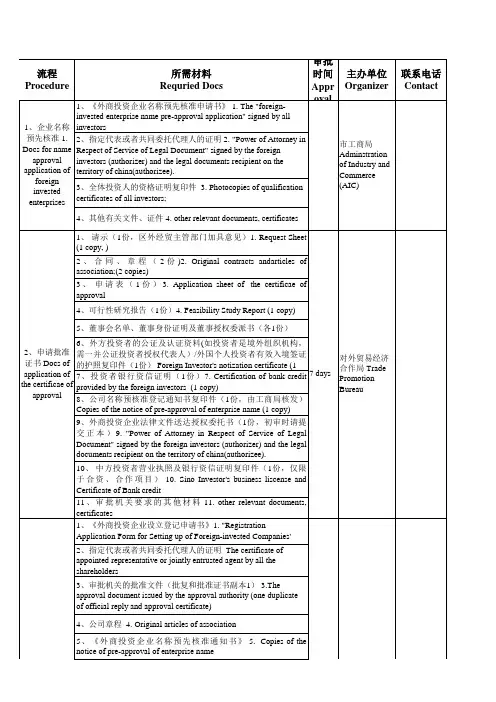
审批 时间 Appr oval
主办单位 Organizer
联系电话 Contact
1、企业名称 预先核准 1. Docs for name approval application of foreign 3、全体投资人的资格证明复印件 3. Photocopies of qualification invested certificates of all investors; enterprises 4、其他有关文件、证件 4. other relevant documents, certificates 1、 请示(1份,区外经贸主管部门加具意见)1. Request Sheet (1 copy, ) 2 、 合 同 、 章 程 ( 2 份 )2. Original contracts andarticles of association;(2 copies) 3 、 申 请 表 ( 1 份 ) 3. Application sheet of the certificae of approval 4、可行性研究报告(1份)4. Feasibility Study Report (1 copy) 5、董事会名单、董事身份证明及董事授权委派书(各1份) 2、申请批准 证书 Docs of application of the certificae of approval 6、外方投资者的公证及认证资料(如投资者是境外组织机构, 需一并公证投资者授权代表人)/外国个人投资者有效入境签证 的护照复印件(1份) Foreign Investor's notization certificate (1 7 、投资者银行资信证明( 1 份) 7. Certification of bank credit 7 days provided by the foreign investors (1 copy) 8、公司名称预核准登记通知书复印件(1份,由工商局核发) Copies of the notice of pre-approval of enterprise name (1 copy) 9、外商投资企业法律文件送达授权委托书(1份,初审时请提 交 正 本 ) 9. "Power of Attorney in Respect of Service of Legal Document" signed by the foreign investors (authorizer) and the legal documents recipient on the territory of china(authorizee). 10、 中方投资者营业执照及银行资信证明复印件(1份,仅限 于 合 资 、 合 作 项 目 ) 10. Sino Investor's business liscense and Certificate of Bank credit 11 、 审 批 机 关 要 求 的 其 他 材 料 11. other relevant documents, certificates 1、《外商投资企业设立登记申请书》1. "Registration Application Form for Setting up of Foreign-invested Companies' 2、指定代表或者共同委托代理人的证明 The certificate of appointed representative or jointly entrusted agent by all the shareholders 3、审批机关的批准文件(批复和批准证书副本1) 3.The approval document issued by the approval authority (one duplicate of official reply and approval certificate) 4、公司章程 4. Original articles of association 5 、《外商投资企业名称预先核准通知书》 5. Copies of the notice of pre-approval of enterprise name
外商注册公司流程 英文
外商注册公司流程英文Foreign companies registering in China typically follow a standardized process that involves several key steps. While the specific details may vary depending on the location, industry, and other factors, the general process remains relatively consistent.Step 1: Name Reservation and Approval.The first step in the process is to reserve and obtain approval for the company name. This involves submitting an application to the local commercial registration authority, along with the required documents and fees. The application should include the proposed company name, the business scope, and details about the investors.Once the application is approved, the commercial registration authority will issue a "Notice of Enterprise Name Pre-Approval," which confirms that the proposed nameis available for use.Step 2: Obtaining Approval from the Relevant Departments.After obtaining name approval, the next step is to obtain approval from the relevant departments. This typically involves submitting additional applications and documents to the local commercial, industry, and tax authorities. The specific requirements and process may vary depending on the industry and location.Step 3: Registration of the Company.Once all the necessary approvals have been obtained, the next step is to register the company with the local commercial registration authority. This involves submitting a comprehensive application, including details about the company's ownership, management, capital structure, and business plan. The application should also include the necessary documents, such as the articles of association, the board of directors' resolution, and the investors' identification documents.After the registration is approved, the commercial registration authority will issue a business license, which authorizes the company to operate legally in China.Step 4: Obtaining Other Licenses and Permits.Depending on the industry and location, the company may need to obtain additional licenses and permits from other authorities, such as the environmental protection agency, the fire department, or the quality supervision authority. The specific requirements and process for obtaining these licenses and permits may vary.Step 5: Setting Up Bank Accounts and Tax Registration.After obtaining the business license, the company needs to set up bank accounts and register for tax purposes. This involves opening a bank account with a local bank and submitting the necessary documents to the tax bureau for tax registration.Step 6: Ongoing Compliance and Reporting.Once the company is registered and operational, it is responsible for complying with all relevant laws and regulations, including those related to tax, labor, environmental protection, and intellectual property. The company also needs to submit regular reports and financial statements to the relevant authorities.In summary, the process of registering a foreign company in China involves several key steps, including name reservation and approval, obtaining approval from the relevant departments, company registration, obtaining other licenses and permits, setting up bank accounts and tax registration, and ongoing compliance and reporting. The specific requirements and process may vary depending on the location, industry, and other factors. It is recommended that companies seeking to register in China consult with local legal and professional advisers to ensure compliance with all relevant laws and regulations.。
外商独资企业章程(中英文对照)_Articles of Association【呕心沥血整理版】

ARTICLES OF ASSOCIATION章程OF之CO。
, LTD。
有限公司Date:【】, 2011日期:2011年【】月【】日At【】地点:【】CHAPTER.I第一章GENERAL PRINCIPLES总则Article.1第 1 条These Articles of Association of Co。
, Ltd。
(hereinafter called the “Company”) are incorporated in accordance with the ”Laws of the People's Republic of China on Wholly Foreign—Owned Enterprises”and the detailed rules for the Implementation thereof,and other pertinent rules and regulations of the People’s Republic of China (hereinafter called ”PRC’)。
根据《中华人民共和国外资企业法》及其实施细则,以及中华人民共和国(以下简称“中国”)其它相关法律法规,制订有限公司(以下简称“公司”)《章程》.Article.2第 2 条公司的中文名称为【】有限公司,英文名称为【】.2.2T he legal address of the Company is 【】, zip code【】。
公司的法定地址为中国北京市【】,邮政编码:【】。
Article.3第 3 条5.1The Company is incorporated in accordance with the ”Law of the People's Republic ofChina on Wholly Foreign-Owned Enterprises” and its detailed implementation rules,and other relevant rules and regulations of the PRC.公司依照《中华人民共和国外资企业法》及其实施细则,以及中国其它相关法规和规章成立.5.2The Company has the status of a PRC legal person and is governed and protected by thelaws of PRC。
外商注册公司流程 英文

外商注册公司流程英文英文回答:Step 1: Determine the Type of Company.The first step in the process of registering a foreign company in China is to determine the type of company that you want to establish. There are several different types of companies that foreign investors can choose from, including:Wholly foreign-owned enterprises (WFOEs)。
Joint ventures.Representative offices.Each type of company has its own advantages and disadvantages, so it is important to carefully consider which type of company is right for your business.Step 2: Choose a Company Name.Once you have determined the type of company that you want to establish, you will need to choose a company name. The company name must be unique and must not be already in use by another company in China. You can search for available company names on the website of the State Administration for Industry and Commerce (SAIC).Step 3: Prepare the Necessary Documents.To register a foreign company in China, you will need to prepare the following documents:A business license application form.A copy of the company's articles of incorporation.A copy of the company's bylaws.A list of the company's shareholders and directors.A financial statement.A tax registration certificate.All of these documents must be translated into Chinese and notarized.Step 4: Submit the Application.Once you have prepared all of the necessary documents, you will need to submit them to the SAIC. The SAIC will review your application and make a decision within 30 days.Step 5: Obtain a Business License.If your application is approved, the SAIC will issue you a business license. The business license will allow you to operate your business in China.Step 6: Register with the Tax Authorities.Once you have obtained a business license, you willneed to register with the tax authorities. The tax authorities will issue you a tax registration certificate. The tax registration certificate will allow you to pay taxes in China.Step 7: Open a Bank Account.Once you have registered with the tax authorities, you will need to open a bank account in China. The bank account will allow you to receive and make payments in China.中文回答:步骤 1,确定公司类型。
外商独资企业设立流程是怎样的?需要的材料有哪些-.doc
外商独资企业设立流程是怎样的?需要的材料有哪些?由正副董事长签署的外商投资企业登记注册申请书。
合同、章程(含附件、中外文本)以及审批机关的批准文件和批准证书(副本)。
项目建议书、可行性研究报告及批准文件。
投资者所在国(地区)政府主管部门颁发的。
设立外资企业申请书。
可行性研究报告。
随着国际间的交流与发展,外商独资企业设立已经不再那么困难,也逐渐多了起来。
既然是在我国土地上设立,自然要符合我国相关法律的规定,并且遵照我国法律的设立流程。
那么,外商独资企业设立流程是怎样的,需要的材料有哪些?下面就让为大家进行介绍吧。
一、外商独资企业设立流程根据不同的申请流程会有所不同,大致的流程如下:(一)申请核查;(二)申请外商投资批文;(三)申请外商投资批准证书;(四)代办公司;(五)申请电子营业执照;(六)代办公章、财务章、法人章;(七)代办组织机构代码证;(八)代办组织代码IC卡;(九)外汇登记证;(十)代理外汇登记IC卡;(十一)办理外汇业务核准件; (十二)办理外汇管理用户手册; (十三)办理税务登记表;(十四)办理国税登记证;(十五)办理地税登记证;(十六)办理统计证;(十七)办理财政登记证。
二、外商独资企业设立申报材料(一)立项(计划委审批)1、申请报告2、项目建议书3、投资者营业执照副本(商业登记证)或者自然人明(二)申请批准可行性报告(计划委)1、申请报告2、可行性报告3、银行出具的外商资金证明书4、投资者营业执照副本(商业登记证)或者自然人身份证明(三)申请审批章程、申领批准证书(市外经委)1、外资企业申请表2、工商核定的企业名称通知书(名称核准申请书、投资者法人资格证明)3、可行性分析报告4、申请人或企业法人签署的企业章程、董事会名单5、投资者的银行资金证明6、投资者的企业登记证、注册证书或个人身体证复印件或投资者委托代理人公证书7、投资新在地环保、消防、卫生、土地管理部门对该项目的意见附件(四)企业名称核准申请名称预先核准应提交下列文件:1、的全体股东或者的全体发起人签署的公司名称预先核准申请书;2、股东或者发起人的法人资格证明或者自然人的身份证明;3、公司登记机关要求提交的其他文件。
外资办事处注册流程英文版
外资办事处注册流程英文版Setting up a foreign-owned enterprise in China can be a complex and time-consuming process. However, with the right guidance and knowledge of the requirements, the process can be completed efficiently.The first step in establishing a foreign-owned enterprise in China is to choose a suitable business scope and company name. This will involve conducting research to ensure that the proposed business activities are permitted under Chinese law, and that the company name is not already in use.The next step is to submit the necessary documentation to the relevant authorities. This will typically include a feasibility study, articles of association, and other supporting documents.Once the documentation has been approved, the company must obtain a business license from the local Administrationfor Industry and Commerce. This may also involve obtaining a unique organizational code certificate, which is required for tax registration and other purposes.Foreign-owned enterprises in China are also required to register with the local tax authorities and obtain a tax registration certificate. This will involve submittingfurther documentation, such as the company's business license and organizational code certificate.In addition to these steps, foreign-owned enterprises may also need to obtain other permits and licenses, depending on the nature of their business activities. For example, companies operating in certain industries may require additional approvals from specialized government agencies.Overall, the process of setting up a foreign-owned enterprise in China involves multiple steps and requires careful attention to detail. However, with the right preparation and assistance, it is possible to navigate theprocess successfully and establish a successful presence in the Chinese market.。
外资企业注册流程图
外资企业注册流程图
办理前置审批
1 名称预先核准登记
7 组织机构代码
3需前置审批
6 领取营业执照
5 设立登记
8税务登记
9 开设基本账户
2 办理预赋码
4 批准证书
3不需前置审批
10 申请外汇登记证
11 领取开户许可证
00
流程说明:
1、网上申请名称核准通知书(打印通知书及表格);
2、到代码局办理预赋码;
3、如经营范围涉及到前置审批,按工商部门要求办理前置审批(如食品
流通、酒类批发、环保批文);
4、到辖区经促局递交资料,办理批准证书、批文(特种行业到市局办
理);
5、领批准证书,到辖区市监局递交文件,办理设立登记;
6、领取执
照,到刻章店办理刻章,印章刻好后取刻章登记卡;
7、办理组织机构代码;
8、办理税务登记证;
9、申请基本账户(5-15个工作日打银行电话查询许可证)
10、到外管局申请外汇登记证(周五下午不对外)
11、接到银行通知后,领基本户开户许可证
12、开设资本金账户(外币币种与客户确认);
13、办理财政登记;
14、如公司有进出口业务,按后续流程办理。
有进出口业务
无进出口业务
14 申请对外贸易经营者备案登记
15 海关登记
完成
18 电子口岸
13 财政登记
12 开设资本金账户
16 商检登记
17 人民银行备案(开外汇账户信息及进口单位对外付汇名录登记) 19 出口核销备案
图示说明:表示维持原有作业
表示判断。
外商独资企业章程(中英文版)
Articles of AssociationforZhongbao Energy Resources Service CompanyChapter 1 General ProvisionsChapter 2 Objectives, Scope and Scale of Production and Business Chapter 3 Total Investment Amount and the Registered CapitalChapter 4 InvestorsChapter 5 Board of DirectorsChapter 6 SupervisorsChapter 7 Business Management OfficeChapter 8 Labor ManagementChapter 9 Trade UnionChapter 10 T axation and FinanceChapter 11 Exchange ManagementChapter 12 D istribution of ProfitsChapter 13 D uration and TerminationChapter 14 InsuranceChapter 15 Supplementary ProvisionsChapter 1 General ProvisionsArticle 1In accordance with Law of the People's Republic of China on Foreign-Capital Enterprises ,Company Law of the PRC and other relevant Chinese laws and regulations, __Treasure China Investment Limited intends to set up Zhongbao Energy Resources Service Co. Ltd. (hereinafter referred to as the Company), an exclusively foreign-owned enterprise. For this purpose, these Articles of Association hereunder are worked out.Article 2The investing party is a legal person registered with Hong Kong in accordance with the laws of Hong Kong. Basic information as follows:The legal name of the investing party is Treasure China Investment Limited. Its legal representative: Name NationalityThe legal address of the Company is at Rooms 1001-4A, Champion Building, 287-291 Des Voeux Road Central, Hong Kong.Tel:Fax:Article 3The name of the Company in Chinese is中宝能源设备服务有限公司The name of the Company in English is Zhongbao Energy Resources Service Company.The legal address of the Company is at 6,Gangwu Avenue, Xi’an International Trade &Logistics Park, Xi’an, China.Article 4Chairman of the Board is the legal representative, perform his or her duties comply with the stipulations of the Chinese laws, decrees and relevant regulations.Article 5The Company is Chinese legal person, its activities is under the governance of Chinese laws and regulations. All the legitimate rights and interests of the company is under the guarantee and protection of Chinese law. The company form is Co., Ltd. The responsibility of the investor is limited to the registered capital of the company. Company is responsible for the debts by all its assets. After being agreed by China relevant departments, company can set up branches or subsidiaries on domestic or abroad.Chapter 2 Objectives, Scope and Scale of Production and Business Article 6The objective of the Company is to strengthen economic cooperation and technological exchange, also promote the development of Chinese national economy and ensure satisfactory economic benefits for the investing party. Article 7The business scope of the Company is Drilling equipment and accessories sales, labor services, drilling engineering, petroleum technology consulting and services (above the range are free from state laws and regulations and restrictions prohibit operating the project, involving licensing qualification, with operating permits)Chapter 3 Total Investment Amount and the Registered CapitalArticle 8The amount of total investment of the Company is USD90,000,000; theregistered capital is USD50,000,000. The registered capital is paid in _____ installments. Within three months upon the issuance of business license, _____ of the first installment shall be paid, and the rest part shall be paid off in two years.The difference between the total amount of investment and the registered capital can obtain from bank loans or shareholder loans.Article 9The proportion for export of the Company is _________. The Board of Directors or the corporate management with authorization from the Board of Directors can decide at its own discretion on domestic or overseas sale of the products of the Company.Chapter 3 Total Investment Amount and the Registered Capital Article 10The amount of total investment of the Company is ______________; the registered capital is ______________.Article 11The contribution methods of the Company are,cash _____________________;kind equivalent of ___________.Article 12The investing party shall contribute the registered capital with the following method: (Note: choose one of them)1. Paying off all the capital within six months upon the issuance of businesslicense.2. The registered capital is paid in ___________ installments. Within threemonths upon the issuance of business license, _______ of the first installment shall be paid, accounting for ___% of its subscribed capital, and the rest part shall be paid off in ___ months. (Note: The contribution to the first installment shall not be less than 15% of its subscribed capital.)The capital contribution of each party shall be converted according to the current numeraire exchange rate of the People's Bank of China.The capital contribution in kind shall be recognized as available on the day when the Company obtains the certificate of right.Article 13Within 30 days upon the capital contribution of the Company to any installment, the Company shall engage certified public accountants registered in China to verify the capital and present a report on the verification of capital. Within 30days upon receipt of the report on capital verification, the Company shall present a certificate of capital contribution to the investing party and file with the original examination and approval authority and the administrative department of industry and commerce.Article 14The readjustment of registered capital or total investment amount shall, after being unanimously agreed by the Board of Directors, be submitted to the original examination and approval authority for approval and go through alteration formalities with the administrative department of industry and commerce.Chapter 4 Board of DirectorsArticle 15The Company shall set up the Board of Directors, which shall be the highest authority of the Company. It shall decide on all major issues concerning the Company. The date of issuance of the approval certificate of the Company shall be the date of the establishment of the Board of Directors.Article 16The Board of Directors is composed of _____directors, with one chairperson and ____ vice-chairpersons. The members of the Board shall be appointed by the investing party. The term of office for the directors, chairperson and vice-chairpersons is four years, and their term of office may be renewed if continuously appointed by the appointing party. Any party shall inform the other party of its appointment or replacement of directors and put it on file with the administrative department of industry and commerce.Article 17The chairperson of the Board is the legal representative of the Company. Should the chairperson be unable to exercise his/her responsibilities for any reason, he/she shall authorize the vice-chairperson or any other director to exercise rights and fulfill obligations.Article 18The Board of Directors shall convene at least one meeting every year. The meeting shall be called and presided over by the chairperson of the Board. The chairperson may convene an interim meeting based on a proposal made by more than one third of the total number of directors.Article 19The Board meeting (including interim meeting) shall not be held without the attendance of more than two thirds of directors. Each director has one vote.Article 20In case a director cannot attend the Board meeting, he/she should issue a letter of attorney entrusting other person to attend the Board meeting and vote on his/her behalf. Should he/she not attend or entrust other person to attend the Board meeting in due course, he/she shall be deemed to waive his/her right.Article 21Unanimous approval of all the directors present to the Board meeting shall be required for any decisions concerning the following issues:1. modification of the Articles of Association of the Company;2. termination or dissolution of the Company;3. readjustment of registered capital of the Company;4. split of the Company or merger with other economic organizations.5. issues which, according to the Board of Directors, must be unanimously passed by all directors.Other issues can be passed by the decisions of simple majority.Article 22Each Board meeting shall have detailed minutes, which shall be signed by all the directors present at the meeting. The meeting minutes shall be put on file of the Company for future reference.Chapter 5 Business Management OfficeArticle 23The Company exercises general manager responsibility system under the leadership of the Board of Directors, with ____ general managers and ____ deputy general managers to be engaged by the Board of Directors.Article 24The general manager is directly responsible to the Board of Directors and shall carry out the various decisions of the Board and organize and guide the overall production of the Company. The deputy general managers shall assist the general manager in his/her work. The terms of reference of the general manager and deputy general managers shall be decided by the Board of Directors.Article 25Several department managers may be appointed by the management office to be responsible for the work in various departments respectively, handle the matters handed over by the general manager and deputy general managers and be responsible to them.Article 26The general manager, the deputy general managers and all the other managers shall earnestly perform their duty and shall not hold concurrent post as a manager or other forms of employee for other companies.In case of malpractice or serious dereliction of duty on the part of the general manager and deputy general managers, they can be dismissed at any time upon the decision of the Board meeting.Article 27The departments of the Company and the setup of department structure shall be planned by the general manager and deputy general managers through consultation and shall be determined by the Board of Directors. Other sub-departments and the setup of positions other than senior managers shall be determined by the general manager and the deputy general managers through consultation.Article 28In case of malpractice or serious dereliction of duty on the part of the senior managers, the Board of Directors shall have the power to dismiss them at any time.Chapter 6 Taxation, Finance and Foreign Exchange Management Article 29The Company shall pay various items of taxes in accordance with relevant Chinese laws and stipulations on taxation.Article 30Staff members and workers of the Company shall pay individual income tax according to Individual Income Tax Law of the People's Republic of China. Article 31The Company shall implement accounting system in accordance with relevant financial management system of the People's Republic of China. The Company shall, according to international practice, adopt accrual accounting system and debit-credit book-keeping method.Article 32The fiscal year of the Company shall be from January 1 to December 31 of each Gregorian calendar year. The first fiscal year shall be from the day when the business license is issued to December 31 of the same year.Article 33All accounting vouchers, account books and statements shall be written in Chinese and shall, if written in foreign languages, be supplemented with Chinese.Article 34The Company shall use RMB bookkeeping. Conversion of RMB with other currencies shall be calculated on the basis of middle rate promulgated by the State Administration of Foreign Exchange on the day of arising.Article 35The Company shall, in accordance with applicable Chinese laws and regulations, open a foreign currency account and a RMB account in domestic banks.Article 36In the first 3 months of each fiscal year, the general manager shall prepare the previous year's balance sheet, profit and loss statement and profit distribution proposal and submit them to the Board of Directors for examination and approval.Financial checking and examination of the Company shall be conducted by an auditor registered in China and the auditor's report shall be submitted to the Board of Directors.Article 37The foreign exchange issues of the Company shall be handled in accordance with the relevant laws and regulations concerning foreign exchange administration.Chapter 7 Distribution of ProfitsArticle 38The Company shall set aside allocations for reserve funds, expansion funds of the Company and welfare funds and bonuses for staff and workers from the after-income-tax profits. The specific proportion of allocations shall be decided by the Board of Directors in accordance with Rules for the Implementation of the Law of the People's Republic of China on Foreign- Capital Enterprises and other relevant laws and regulations of China.Article 39The remaining profits after payment of company income tax and allocation of various funds in accordance with the stipulations of Article 38 shall be distributed to the investing party according to the decision of the Board of Directors.Article 40The profits of the Company shall be distributed annually and no profits shall be distributed should the losses in the previous years not be covered. The undistributed profits in the past fiscal years can be distributed together with the distributable profits in the current fiscal year.Chapter 8 Labor ManagementArticle 41Such issues of the Company as recruitment, employment, dismissal, resignation, welfare, labor protection and labor discipline shall be handled in accordance with relevant stipulations of China on labor and social insurance. The Company shall not employ child labor.Article 42The Company shall enter into labor contract with the employees and shall file with the local labor administration authority.Article 43The Company has the power to impose punishment such as disciplinary warning, demerit recording, wage reduction and even dismissal in case of grave misconduct on the staff members and workers violating the rules, regulations and labor discipline of the Company. Dismissal of staff member or worker shall be filed with the local labor administration authority.Article 44The wages and remuneration of the staff members and workers of the Company shall be decided by the Board of Directors in accordance with relevant stipulations in China and according to the situation of the Company and shall be specifically stipulated in the labor contract.Chapter 9 Trade UnionArticle 45The staff members and workers of the Company have the right to set up grassroots trade union organization and carry out trade union activities in accordance with the provisions of Trade Union Law of the People's Republic of China.Article 46The trade union of the Company represents the interests of the staff members and workers. It plays the following roles:safeguarding the lawful rights and interests of staff members and workers according to law,assisting the Company in proper allocation and utilization of employee welfare and bonus fund,organizing the staff members and workers to study politics, science, technology and professional knowledge and carry out recreational and physical activities,educating the staff members and workers to observe labor discipline and strive to fulfill the various economic targets of the Company.Article 47The trade union of the Company can, on behalf of the staff members and workers, enter into collective labor contract with the Company and supervise the performance of the labor contract.Article 48When the Company study and decide on the issues relating to staff members and workers such as reward and punishment, wage system, welfare, labor protection and insurance, the representatives of the trade union have the right to attend the meeting as a non-voting delegate. The Company shall listen to the opinions of the trade union and seek cooperation from the trade union. Article 49The Company shall actively support the work of the trade union and, in accordance with Trade Union Law of the People's Republic of China, provide the trade union with necessary premises and facilities to conduct work, hold meeting and carry out collective welfare, cultural and physical activities for the staff members and workers.Article 50The Company shall allocate on a monthly basis 2% of the actually paid wages of the staff members and workers as its trade union fund, which shall be used by its trade union in accordance with the measures of All-China Association of Trade Union on the management of trade union fund.Chapter 10 InsuranceArticle 51Insurance policies of the Company on various kinds of risks shall be underwritten with the insurance companies in China. Types, value and duration of insurance shall be decided by the Board of Directors in accordance with the stipulations of the insurance companies.Chapter 11 Duration, Dissolution and LiquidationArticle 52The operating period of the Company is ___________ years and shall start from the date on which the business license of the Company is issued.Article 53Should the investing party decide to extend the operating period, it shall submita written application to the original examination and approval authority at lease6 months prior to the expiry date of the operating period. The duration can be extended upon the approval of the examination and approval authority and completion of registration formalities in the original registration authority. Article 54In addition to expiration of the operating period, the Board of Directors can decide to terminate the Company ahead of time due to the following reasons:1. Heavy losses due to mismanagement;2. Unable to go on business due to heavy losses caused by force majeure such as natural disaster and war;3. Bankrupt;4. Revoked according to law due to violation of Chinese laws and regulations and damage to public interests;5. Occurrence of other causes for termination as stipulated in the present Articles of Association.Article 55Upon the expiration or termination of the operating period of the Company, the Board of Directors shall formulate liquidation procedures and principles and organize a liquidation committee. The liquidation committee shall be composed of at least three members, who will be selected by the Board of Directors from the directors or engaged by the Board of Directors from the relevant professionals.Article 56The liquidation committee shall conduct liquidation on the Company in accordance with Liquidation Measures for Foreign-funded Enterprises. The role of the liquidation committee is to check up completely the assets, creditor’s rights and liabilities of the Company, prepare balance sheet and statement of assets, formulate liquidation scheme and implement this scheme after the investors pass it.Article 57During the period of liquidation, the liquidation committee shall act as the legal representative of the Company in filing and responding to lawsuits.Article 58The liquidation expenses shall be paid in priority from the existing assets of theCompany.Article 59After the liquidation of the Company is over, the remaining assets after liquidation of debts shall be distributed to the investing party.Article 60After the liquidation is over, the Company shall go through the formalities of registration cancellation with the administrative department of industry and commerce, hand in the business license for cancellation and announce the liquidation to the public.Chapter 12 R ules and RegulationsArticle 61The Company shall formulate the following rules and regulations through the Board of Directors:1. business management system, including the function and power andworking procedure of the subordinate management departments;2. code of conduct for employees;3. labor and wage system;4. work attendance, promotion, reward and punishment system foremployees;5. employee welfare system;6. financial system;7. liquidation procedure for liquidation of the Company;8. other necessary rules and regulations.Chapter 13 S upplementary ProvisionsChapter 62The present Articles of Association shall be written in (1) Chinese. (2) in Chinese and _______. Both language versions are equally authentic. In the event of any discrepancy between the two aforementioned versions, the Chinese version shall prevail. (Note: choose either (1) or (2).)The present Articles of Association shall be made in _____ original copies, with one copy for the investing party, one copy for the examination and approval authority and one copy for the administrative department of industry and commerce.Article 63The formation, validity, execution and interpretation of the present Articles of Association shall be governed by the relevant laws and regulations of the People's Republic of China. In case there is no applicable Chinese law for aspecific issue, international practices shall be used as reference.Article 64The present Articles of Association will become valid only upon the approval of Nanjing Foreign Trade & Economic Cooperation Bureau. The same applies to the amendment to these Articles of Association.Article 65The present Articles of Association is signed in ___________ (place) on _____________ (date) by the legal representative of the investing party or its authorized representative.Legal representative of the Company or its authorized representative Signature (stamp)外商独资企业章程(设董事会)第一章总则第二章宗旨、经营范围第三章投资总额和注册资本第四章董事会第五章经营管理机构第六章税务、财务和外汇第七章利润分配第八章职工第九章工会第十章保险第十一章期限、终止与清算第十二章规章制度第十三章附则第一章总则第一条根据《中华人民共和国外资企业法》及中国其它有关法律、法规,______国_____________________ 公司拟在南京浦口开发区设立独资经营企业_______________________有限公司(下称公司).为此,特制定本章程.第二条公司中文名称为:__________________________有限公司公司英文名称为:__________________________________________公司法定地址为:__________________________________________第三条投资方:系依_________国法律在___________ 国合法注册的法人,其法定名称为:____________________________________;法定地址为:______________________________________________;法定代表人:______________;国籍:___________;职务:__________.第四条公司组织形式为有限责任公司.投资方以其认缴出资额为限对公司承担责任,公司以其全部资产对外承担债务.第五条公司受中国法律管辖和保护,其一切活动必须遵守中国的法律、法令和有关条例的规定,不得损害中国的社会公共利益.第二章宗旨和经营范围第六条公司的宗旨是:采用先进而适用的技术和科学的经营管理方法,生产____________产品,发展新产品,并促进产品在质量、价格等方面具有国际市场上的竞争能力,提高经济效益,使投资方获得满意的经济利益.第七条公司的经营范围为:_______________________________第八条合营公司投产后生产规模为 .第九条合营公司外销比例为: .本公司自产的产品可由董事会或董事会授权经营层自行决定在中国境内或境外销售.第三章投资总额与注册资本第十条公司的投资总额为________________;注册资本为_______________.第十一条公司出资方式为现金__________________;实物折___________________.第十二条投资方将按以下方式出缴注册资本:(任选一种)1. 在营业执照签发之日起六个月内一次性全部缴清.2. 注册资金分______期缴付,第一期在营业执照签发之日起三个月内缴付____________,占出资额的______%, 其余部分在_____ 个月内缴齐.(注:第一期出资不得低于认缴出资额的15%)出资均按缴款当日中国人民银行公布的基准汇率折算.以实物等形式出资的,其到资日为公司取得权利证书之日.第十三条公司缴付任一期出资额后三十日内,由本公司聘请在中国注册的会计师验资,并出具验资报告.公司在收取验资报告之日起三十日内向出资方出具出资证明书,并报原审批机关及工商行政管理部门备案.第十四条公司投资总额和注册资本的调整,应由董事会一致通过后,报原审批机关批准,并向工商行政管理机关办理变更登记手续.第四章董事会第十五条公司设董事会.董事会是本公司的最高权力机构,决定本公司的一切重大问题.公司批准证书签发之日即为董事会成立之日.第十六条董事会由______人组成,设董事长一名,副董事长_____名,董事会成员由投资方委派.董事、董事长和副董事长每届任期四年,经委派方继续委派可以连任.不论委派还是撤换董事,均应书面通知另一方,并向工商行政管理部门备案.第十七条董事长是本公司的法定代表人.董事长因故不能履行职责时,应授权副董事长或其他董事代表行使权利及义务.第十八条董事会会议每年至少召开一次,由董事长召集并主持会议.经三分之一以上的董事提议,董事长应召开董事会临时会议.第十九条董事会会议(包括临时会议)应当有三分之二以上的董事出席方能举行.每名董事享有一票表决权.第二十条董事因故不能参加董事会会议的,应出具委托书,委托他人代表其出席会议和表决,如届时未出席也未委托他人出席,则视作弃权.第二十一条下列事项需要由出席董事会会议的董事一致通过决定:1、公司章程的修改;2、公司的终止解散;3、公司注册资本的调整;4、公司的分立及与其他经济组织的合并;5、董事会认为须由董事一致通过的事项.对其他事宜,可采取简单多数通过决定.第二十二条每次董事会会议均应详细记录,并由出席会议的全体董事签字.会议记录由公司存档备查.第五章经营管理机构第二十三条公司实行董事会领导下的总经理负责制,设总经理___人,副总经理___人;总经理、副总经理由董事会聘任.第二十四条总经理直接对董事会负责,执行董事会各项决议;组织和领导本公司的全面生产.副总经理协助总经理开展工作.总经理、副总经理的职权范围由董事会讨论决定.第二十五条经营管理机构可设若干部门经理,分别负责企业各部门的工作,办理总经理和副总经理交办的事项,并对总经理和副总经理负责.第二十六条总经理、副总经理以及其他所有经理均应认真履行其职责,不得兼任其他公司的经理或其他形式的雇员.总经理、副总经理有营私舞弊或严重失职的,经董事会会议决议可随时撤换.第二十七条公司的部门及部门结构设置由总经理商副总经理制定方案,由董事会决定.其他部门及管理人员之外的其他职位设置由总经理商副总经理决定.第二十八条高级管理人员有营私舞弊或严重失职的,董事会可随时解聘.第六章税务、财务和外汇管理第二十九条公司依照中国法律和有关税收的规定缴纳各种税金.第三十条本公司职工收入按照《中华人民共和国个人所得税法》缴纳个人所得税.第三十一条公司的会计制度,按照中华人民共和国的有关财会管理制度执行.公司采用国际通用的权责发生制和借贷记帐法记帐.第三十二条公司的会计年度为公历年制,即公历一月一日到十二月三十一日止.第一个会计年度自营业执照签发之日起至同年十二月三十一日止.第三十三条公司的会计凭证、账簿、报表,应用中文书写,用外文书写的,应加注中文.第三十四条公司采用人民币为记账本位币.人民币同其它货币折算,按实际发生之日国家外汇管理局公布的中间价计算.第三十五条公司应根据中国适用的法律法规在境内银行开立外汇账户和人民币的账户.第三十六条每一营业年度的头三个月,由总经理组织编制上一年度的资产负债表、损益计算书和利润分配方案,提交董事会会议审查.公司的财会审计聘请在中国注册的会计师审查、稽核,并将审查结果报告董事会.第三十七条公司的外汇事宜,依照中国有关外汇管理的法规办理.第七章利润分配第三十八条公司从缴纳所得税后的利润中提取储备基金、企业发展基金和职工奖励及福利基金.具体比例由董事会根据《外资企业法实施细则》和中国其他有关法律法规决定.第三十九条依法缴纳公司所得税并提取第三十八条规定的各项基金后剩余的利润,根据董事会的决定分配给投资方.第四十条公司的利润每年分配一次.以往年度亏损尚未弥补前不得分配利润.以往会计年度未分配的利润,可与本会计年度可供分配的利润一并分配.第八章职工第四十一条公司职工的招收、招聘、辞退、辞职、福利、劳动保护、劳动纪律等事宜,按照中国有关劳动和社会保障的规定办理.公司不得雇用童工.第四十二条公司与录用员工依法订立劳动合同,并报当地劳动管理部门备案.第四十三条公司有权对违犯公司的规章制度和劳动纪律的职工,给予警告、记过、降薪的处分,情节严重可予以开除.开除职工须报当地劳动部门备案.第四十四条公司职工的工资待遇,参照中国有关规定,根据公司具体情况,由董事会确定,并在劳动合同中具体规定.第九章工会组织第四十五条公司的职工有权依照《中华人民共和国工会法》的规定,建立基层工会组织,开展工会活动.第四十六条公司工会是职工利益的代表.它的任务是:依法维护职工的合法权益;协助公司合理安排和使用职工福利、奖励基金;组织职工学习政治、科学技术和业务知识,开展文艺、体育活动;教育职工遵守劳动纪律,努力完成公司的各项经济任务.第四十七条公司工会可以代表职工同公司签订集体劳动合同,并监督劳动合同的执行.第四十八条公司研究决定有关职工奖惩、工资制度、生活福利、劳动保护和保险问题,工会代表有权列席会议,公司应当听取工会的意见,取得工会的合作.第四十九条公司应当积极支持本企业工会的工作,依照《中华人民共和国工会法》的规定,为工会组织提供必要的房屋和设备,用于办公、会议、举办职工集体福利、文化、体育事业.第五十条公司每月按企业职工实发工资总额的百分之二拨交工会经费.由本企业工会按照中华全国总工会有关工会经费管理办法使用.第十章保险第五十一条公司的各项保险均在中国的保险公司投保,投保险别、保险价值、保期等按照保险公司的规定由董事会决定办理.第十一章限期、终止与清算第五十二条公司的经营期限为_____年,从营业执照签发之日起计算.第五十三条若投资方决定延长经营期限,应在合营期满前并至少提前六个月,向原审批机关提出书面申请.经审批机构批准并在原登记机构办完登记手续后方能延长期限.第五十四条除经营期满外,因下列原因董事会可决定提前终止公司:1.经营不善,严重亏损;2.因自然灾害、战争等不可抗力而遭受严重损失,无法继续经营;3.破产;4.违反中国法律、法规,危害社会公共利益被依法撤销;5.本章程规定的其他解散事由已经出现.第五十五条公司经营期满或提前终止,董事会应制定清算程序和原则,组织清算委员会.清算委员会至少由三人组成,其成员由董事会在董事中选任或者聘请有关专业人员担任.第五十六条清算委员会依据《外商投资企业清算办法》对公司进行清算.清算委员会的任务是对公司的资产、债权和债务进行全面清查、编制资产负债表和资产目录、制定清算方案,并在投资者通过后执行该清算方案.第五十七条在清算期间,清算委员会代表公司起诉或应诉.第五十八条清算费用从企业现存财产中优先支付.第五十九条公司清算结束后的资产,在清偿债务之后分配给投资方.第六十条本公司清算结束,应当向工商行政管理机关办理注销登记手续,缴销营业执照并将清算对外公告.第十二章规章制度第六十一条公司通过董事会应制订下列规章制度:1、经营管理制度,包括所属各个管理部门的职权与工作程序;2、职工守则;3、劳动工资制度;4、职工考勤、升级与奖惩制度;5、职工福利制度;6、财务制度;7、公司解散时的清算程序;8、其他必要的规章制度.第十三章附则第六十二条本章程用(1)中文写成.(2)中文和文写成,两种文字具有同等效力,上述两种文本如有不符,以中文本为准.(注:任选一种)本章程一式份,投资方执一份,审批部门及工商行政管理部门各执一份.第六十三条本章程及其附件的订立、效力、履行和解释适用中国的有关法律法规.如果对某一特定事宜,中国未颁布法律,则须参照国际惯例.第六十四条本章程须中华人民共和国对外经济贸易部(或其委托的审批机构)批准才能生效.其修改时同.第六十五条本章程由投资方法定代表人或其授权代表于_______ 年___月 ___日在____________签字.公司法定代表人或其授权代表签字(盖章)合作协议书甲方:珠海思雅教育咨询有限公司乙方:甲乙双方本着“各展所长精诚合作坦诚以待互利共赢”的原则就青少年华杯赛项目相关事宜达成协议签署本合作协议书.一、合作项目青少年华杯赛培训项目二、合作期限自2010年10月15日起至20______年____月____日止为期______.如双方认可合作可以续签协议.三、合作方式华杯赛项目品牌由思雅教育咨询有限公司所有华杯赛项目由双方负责组织招生、甲方负责具体的常规管理工作负责智力检测服务及学习管理教师和心理咨询教师由乙方负责华杯赛训练课程授课.四、利益分配以单个学生学费为标准甲方收取每生600基础费用后再进行招生受益分成所剩学费甲乙双方按照55的比例分配收益.甲方在协议期内不再提高600元基础费用华杯赛参赛费用、交通费用、前期招生运营费用由甲方负责.五、双方职责(一)甲方职责.1.负责提供办学所需的基本条件包括社会力量办学许可证、公章等提供需要数量的办公室和教室2、负责草拟全部宣传推广招生广告的策划、设计、文字和内容3、负责学生教学班级日常教学管理具体工作宣传推广、招生广告、招生咨询、招生报名、除华杯赛教学内容以外教学组织、教学安排、学生管理、学员答疑等4.协助乙方加强安全管理保证合作项目的正常运营与乙方就招生、课程安排、教学教务管理等友好协商以项目正常运转为要务.5、负责开具学员学费的正式收据并收取相关课程费用.(二)乙方职责.。
外资设立流程
外资设立流程外资设立是指外国投资者在中国境内设立企业,包括独资企业、合资企业和合作企业等多种形式。
外资设立的流程相对复杂,需要投资者按照相关法律法规和政策规定逐步完成各项手续。
下面将详细介绍外资设立的流程。
第一步,确定投资方案。
外资设立的第一步是确定投资方案,包括投资规模、行业领域、企业性质等。
投资者需要根据自身情况和市场需求,制定合理的投资方案,并进行初步的市场调研和项目可行性分析。
第二步,申请核准。
投资者需要向中国国家有关部门提交外商投资企业设立申请,包括填写《外商投资企业设立登记申请表》等相关申请材料。
申请材料需真实、完整、准确,符合相关法律法规和政策规定。
第三步,审批机关受理。
申请材料提交后,审批机关将对申请进行受理,并进行初步审核。
审核内容包括投资方案的合规性、申请材料的完整性等。
审批机关将在规定时间内作出是否受理的决定,并通知投资者。
第四步,审核材料。
审批机关受理后,将对申请材料进行审核。
审核内容包括投资者的资质、投资方案的合规性、投资资金来源等。
审核过程中,审批机关可能会要求投资者补充或修改相关材料。
第五步,核准。
审核通过后,审批机关将对外商投资企业设立进行核准。
核准内容包括企业名称、注册资本、经营范围等。
核准通过后,审批机关将颁发《外商投资企业批准证书》,投资者可凭证书进行下一步手续。
第六步,登记注册。
核准通过后,投资者需要向工商行政管理部门办理企业登记注册手续。
登记注册包括领取营业执照、刻章、申领组织机构代码证等。
登记注册完成后,外商投资企业正式成立。
第七步,税务登记。
外商投资企业成立后,需要向税务部门办理税务登记手续。
税务登记包括领取税务登记证、办理税务开户等。
税务登记完成后,外商投资企业可依法参与国内市场经济活动。
第八步,申请外汇登记。
外商投资企业成立后,需要向外汇管理部门申请外汇登记。
外汇登记包括外汇账户开立、外汇收支结算等。
外汇登记完成后,外商投资企业可依法进行跨境资金运作。