
PEP小学英语五年级上册Unit1解说教材
教学方法 课时安排
单元目标
能力目标
知识目标
1、能够简单描述 及询问自己教师 的体貌特征及性 格特点。 2、能够听懂一些 描述任务特征的 简单对话。 3、能够听懂会唱 歌曲“My New Teachers ”。
1、理解A 、B部分Read and
write中的会话。
Task time Story time
Good to know Let’s sing
Part A Part Байду номын сангаас Warm-up
Pronunciation
Let’s check
Part C
重点内容
Let’s learn 部分学习10个描述人物特征的单词。 要求听、说、读、写,并能在情景中恰当运用。
4、理解Let’s chant,了 解Story time、Good to know、Task time.
内容结构
Let’s learn Let’s play Read and write Group work Let’s talk Pair work Let’s try Let’s chant
Let’s start Let’s chant Main scene
Let’s try部分一方面利用听 力形式复习词汇,另一方面 通过听录音,让学生听觉感 知即将学习的新句型。
新旧知识结合体现了语言从听、 说、读、写四个方面循序渐进的 过程,如果学生一时听不懂,教 师可反复播放录音指导听音、看 图、理解关键词,帮助学生完成。
重点
要求学生能听懂,会说: Who’s your math teacher? Let ’s’s talk What he 通过对话形式学 like? He’s… 习本单元的重要句型 。 并能在情景中进行运用。
1.
2.
温旧引新法 体态语言教学 词不离句教学法 游戏操练教学法
卡片游戏 我来比划你来猜
对话教学
• 扮演角色教学 • 情景教学法 • 巧妙替换教学法
阅读教学
• 自主探究教学 • 多媒体动画展示 • 任务型教学法
课时安排
课时 Lesson 1 Lesson 2 内容
Let’s chant A Let’s learn C Let’s sing
Let’s play A Let’s try Let’s talk C Story time Pair work
Lesson 3
Lesson 4
A Read and write
Let’s play
C Pronunciation
Main scene Let’s start B Let’s learn Let’s chant C Task time B Let’s try Let’s talk Let’s play C Good to know
Thank you for listening!
Grade Five
Unit 1 My New Teachers
新课标对本教材的要求
解 说 流 程
单元目标 教材编写意图 单元具体解析 内容分析 教学方法 教学难点 课时安排
新课标对本教材的要求
《小学英语课程标准》强调从学生兴趣、 阅历认知水平出发
实践 体验
参与
合作 交流
以发展学生综合语言运用能力、 情感态度为目标;把学习过程作为培 养学生主动思维、大胆实践的过程, 从而形成学生自主学习的方式,提高 跨文化意识和形成自主学习能力的过 程。
Lesson 5 Lesson 6
B Read and write Group work C Let’s check
让我们共同努力:将我们的 英语课堂变成真正人文的,灵动 的,现实的,焕发生命活力的舞 台。在这里,只有智慧与智慧的 碰撞,心灵与心灵的交融;在这 里,每一个人都能感受到自己的 存在,每一个人都能拥有自己的 尊严,每一个人都能感受到自己 生命的成长。
要求学生能听懂,会说: Who’s that lady? She’s… Is she strict/active? Yes, she is./No, she isn’t. •要求学生能使用替换图演练 句型。
Read and write 是复习A、 B部分的主要 语汇,并适当扩展语言,培养学生阅读能力, 要求学生能够听、说、读、写粗体彩色句子:
教材编写意图
教材在整体构思、内容安排、活动设计和 教学方法选用等方面都紧密联系学生的生 活实际,贯彻了语言的交际功能和语言应 用的基本原则,把知识和技能目标融会在 完成任务的过程之中,从而体现了把话题-功能—结构--任务结合起来的总思路。
Unit1 My New Teachers
教学难点
内容分析 单元目标
教学难点
A、B部分 Read and write 对话的 口头以及书面表达。
句型拓展
学会描述及询问他人的 在教学中采取观看爸爸妈妈照 长相,区分人称进行提问 片(可以让学生拿自己家人照片)
•What is he like ? He’s …. •What is she like? She’s….
引出句型 What is your father like? He’s…. What is your mother ike? She’s…. 理解he/she的运用。
2、能够听、说、读、写A 、 B部分Let’s learn、 Read and write中的四会单词和句 子。 3、了解ea ee bl br的发音规 律及其例词的读音。
情感、 策略、 1、情感态度:充 文化目 分发挥主观能动性, 标 积极主动地进行英
语学习。 2、学习策略:培 养合作学习的精 神。 3、文化目标:了解 中西方在称呼上 的不同习惯。
新版pep五上unit1 单元教材解析及教案

5. 能听懂、会唱歌曲“Who’s your teacher?”。
目
6. 复习元音字母在单词中的发音,培养学生对英语单词发
标 音的语感。部分的字母组合在单词中的发音,并能熟练读 出例
词。
情感、策略、文化等有关目标:
1. 激发学生学习英语的兴趣,帮助学生树立学好英语的信
心,逐步培养学生自主学习、合作学习的能力和欲望。
1. 将本节课学习的新单词在四线三格内抄写 5 遍并背会。 2. 听录音,跟读本部分内容。
家庭 3. 准备几张家人或朋友的照片,利用本节课学习的新词汇和句型描述照片中的人 作业 物。
预计作业时间: 15 分钟
教学过程
个性化修改
一、课前热身(Warm-up) 1. Free talk T: Good morning, everyone. Welcome back to school. How are you today? Ss: Fine, thank you. T: Nice to see you again. Ss: Nice to see you, too. T: This is the first class of our new term. What grade are you in now? Ss: We are in Grade Five now. 2. 简单介绍各科老师。 T: Now let me ask and you answer. (出示英语书) What’s this? Ss: It’s an English book.
的关键词,编写对话,如: S1: Who’s your maths teacher? S2: He’s Mr Li. S1: Is he strict? S2: Yes, he is. 然后教师请几对学生上讲台表演对话,表扬表演到位的学生。 2. A. Ask and answer (1) 教师出示本班班主任的照片,与学生进行对话,如: T: Who’s he / she in the picture? Ss: He’s / She’s Mr / Miss … T: He’s / She’s your head teacher. (帮助学生明白词组“head
人教版PEP小学英语五年级上册Unit1名师讲解+课文单词+知识点梳理+单元练习
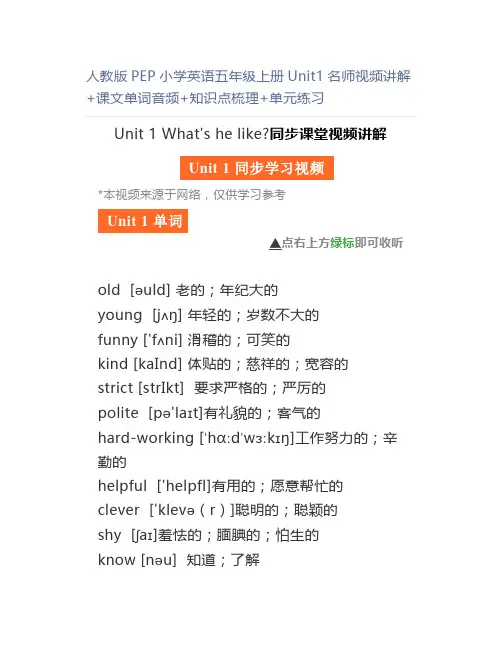
人教版PEP小学英语五年级上册Unit1名师视频讲解+课文单词音频+知识点梳理+单元练习Unit 1 What's he like?同步课堂视频讲解*本视频来源于网络,仅供学习参考▲点右上方绿标即可收听old [əuld] 老的;年纪大的young [jʌŋ] 年轻的;岁数不大的funny ['fʌni] 滑稽的;可笑的kind [kaInd] 体贴的;慈祥的;宽容的strict [strIkt] 要求严格的;严厉的polite [pə'laɪt]有礼貌的;客气的hard-working [ˈhɑːdˈwɜːkɪŋ]工作努力的;辛勤的helpful ['helpfl]有用的;愿意帮忙的clever ['klevə(r)]聪明的;聪颖的shy [ʃaɪ]羞怯的;腼腆的;怕生的know [nəu] 知道;了解our [‘aʊə]我们的Ms [mIz](用于女子的形式或姓名前,不指明婚否)女士will [wɪl](谈及将来)将要sometime ['sʌmtaɪmz]有时;间或robot ['rəʊbɒt]机器人him [hɪm](用作宾语或表语)他speak [spiːk] 会说;会讲(某种语言)说话finish ['fɪnɪʃ]完成;做好Unit 1 知识点梳理五年级英语(上)PEP版Unit 1 What's he like?重点:询问某人的外貌特征或性格特点的句型连词but和and的用法情态动词can的用法难点:询问他人的外貌特征或性格特点人称代词、物主代词、be动词的用法四会单词短语old老的;年纪大的young年轻的;岁数不大的funny滑稻的;可笑的kind体贴的;慈祥的;宽容的strict要求严格的;严厉的polite有礼貌的;客气的hard-working工作努力的;辛勤的helpful有用的;愿意帮忙的clever聪明的;聪颖的shy羞怯的;腼腆的;怕生的三会单词短语know知道;了解our我们的Ms(用于女子的姓氏或姓名前,不指明婚否)女士wiII(谈及将来)将要sometimes有时;间或robot机器人him(用作宾语或表语)他speak会说;会讲(某种语言);用(某种语言)说finish完成;做好headteacher校长music teacher音乐老师惯用表达式Great!太棒了!Really?真的吗?Cool!酷!重点句式或句型1.-Who' s your art teacher?谁是你的美术老师?-Mr Jones.琼斯老师。
人教PEP版五年级英语上册Unit 1 说课稿

人教PEP版五年级英语上册Unit 1 说课稿Unit 1 What’s he like?Ⅰ. The analysis of teaching materialFirstly, I’d like to talk something about the analysis of teaching mater ial. This book is from Unit 1 of PEP primary English book Ⅴand the main topic is some adjectives and sentence structures to describe a person. Through learning this unit, students will be able to use these words and sentence structures to talk about people in their daily life.Ⅱ. The analysis of studentsSecondly, I will analyse my students. Students in grade 5 have just learnt some English knowledge, but it’s still quite difficult for them to speak English in daily life. So I will mainly use Communicative Approach and Situational Approach to help them learn better.Ⅲ. The analysis of teaching aimsAccording to New Curriculum Standard, I set three teaching aims. The first one is knowledge aim: students will be able to read and write some adjectives like polite, shy, helpful, clever.... The second one is ability aim: through corporation and discussion, students can use the words and structures to describe other people smoothly and fluently. The last one is emotional aim: students can be interested in learning English by doing different activities.Ⅳ. The analysis of teaching key &difficult pointsBased on the analysis of teaching material, students and the teaching aims, my teaching key and difficult points are as follows. The teaching key point is that students can read and write the new words and sentence structures in this lesson. The teaching difficult point is that students are able to use these words and sentence structures to describe a person in their daily life.The analysis of teaching methodsTo overcome teaching key and difficult point, I will mainly use Communicative Approach and Situational teaching method.Ⅴ. The analysis of teaching proceduresNow, let’s focus on the most important part of my teaching design, that is the teachingprocedures. It includes four parts, warming-up, presentation, consolidation, summary &homework.Step1:Warming-upAfter the daily greeting, I will ask my students to do some actions to cheer us up. In this way, I can create a active learning surrounding for my students and let them learn happily.Step2:PresentationIn this step, I will use five pictures to introduce the new words to my students. In these five pictures, there are five different people, students are asked to describe each person and from their description, I can get the new words easily, they are “polite, helpful, clever...” And after the introduction, I will play a game named “finger game” with them. Th e reason why I do this is to help students be familiar with the topic and understand the new words and phrases in the listening material, so as to sweep the listening obstacle. Then I will play the tape for three times. Before I play the tape for the first time, I will ask my students what’s it about. And after they finish the listening, I will ask some students to tell me the answer, they may get part of the information and I will combine their answers and get the main idea. And then I will play the tape for the second time, before they listen to it, I will ask them to get some details according to the structure given “what’s Wu Yifan like” after their listening, I will ask someone to tell me the answer and I will get the “He’s hard-working”. After they tot ally understood the listening material, they are asked to listen to the tape for the third time, and pay attention to the pronunciation and the intonation of the speaker. If possible, they can also imitate it. By listening to the conversation for three times, students will master every little details in it .Step3:ConsolidationIn this age, I will play a game named Apple game with my Ss: I will show an apple tree covered with many apples on the PPT, and on each apple, there is a word. Then I will ask students to read these words, the more they pronounce, the more apples they will get. At last, who gets the most apples will be awarded a smiling face. After doing this, theyNext, I will play another game with my Ss named Point and Say: Students are asked to show their own photos and describe their appearance using the new words and sentences. In this way, what we have learnt in this class will be consolidated.Step4: Summary & HomeworkAt the end of the class, I will guide students to summarize what we have learnt today. And give them today’s homework: they should draw a picture about their favorite cartoon character and try to describe him or her next class.Ⅵ. The analysis of blackboard designLastly, I will put forward the analysis of blackboard design, my blackboard design includes three parts, topic , key words and key sentence structures. You can see very clearly what we have learnt today.That’s all for my presentation, thanks for your listening.。
PEP人教版五年级上册 Unit 1 单元解读
词汇
知识目标
1. 能够在语境中理解生词或短语,
并能正确运用。
2. 能够正确使用本单元的新单词
或短语进行外貌和性格的询问 及描述。
3.科目词汇的理解和掌握。
语法
1. 特殊疑问句和一般疑问句的问与 答的初步区分
2. be动词(am/is/are)的区分和使用
学习策略目标
在表达中,体会语法现象; 在比较中,发现语法规律; 在练习中,掌握语法规则。
考点
1. be动词的使用 2. 重点句型的问答 3. Mr Mrs Miss Ms 这四种身份
的区分、性别和读音的差别
合作点
1. A/ B Let’s learn学习单词环节, 小组合作进行新单词的学习。
2. A/ B Let’s talk表演对话环节, 小组合作进行充分的排练,表 演对话。
3. 作文:口头练习作文环节。
1. Read in pairs. 2. Role play.
向组内同学介绍自己、老师或朋友,一 人说其他人听并帮助他纠正错误 (主要以描述外貌,性格为中心)来自文化意识&情感态度
1. 中外课程的异同。 2. 养成正确的品格。
old 年老的 young 年轻的
funny滑稽的 kind 慈祥的
strict 严厉的 polite 有礼貌的
helpful
clever
愿意帮忙的 聪明的
hard-working shy 工作努力的 害羞的
1. 自己读新单词一遍 2. 全组齐读一遍
3. 一个同学读单词,其他同学听并帮他纠正
读音
Work in groups
本单元重点
Who’s your …teacher? Is he/she …? What’s he/she like? He/She is…
PEP小学英语五年级上册unit1what's he likeBlet's learn说课稿

Unit 1 What's he like ?Part B Let’s learn Match and say 说课稿学情分析:五年级大部分学生是喜欢上英语并有能力学好英语这门学科的, 且有部分学生是有能力进行英语的课后拓展学习的, 对于这部分学生, 教师在教学中应该多积极鼓励, 充分调动他们学习英语的兴趣和热情, 帮助他们更好地提高英语成绩。
五年级的学生已掌握一些语言, 对英语学习也有了一定的兴趣, 并具有想多用英语表现自己的愿望。
本课时的部分动词词组在四年级上、下册中都已经出现过, 教学时, 可以引导学生温故而知新, 分散重难点。
同时, 及时进行巩固操练, 拓宽他们的英语思维空间。
教学目标知识与技能: 1 、能熟练运用“what ’s he/she like 以及What are they like ?------He/She is ... 和They are …( polite 、hard-working ,helpful,shy 、clever) ”. 句型。
2 、能正确听、说、读、写polite 、hard-working ,helpful,shy 、clever 等表示性格特征的词汇, 并能运用它们描述人物性格。
3 、在对话交流中使学生养成用英语交流的习惯, 培养良好的语音语调和语感。
过程与方法: 能运用所学语言简单介绍自己的老师和同学, 并在实际情景中准确运用。
培养学生综合运用语言的能力。
情感、态度与价值观: 培养学生的英语学习兴趣, 积极主动参与学习和大胆开口说英语, 并进一步做到学以致用。
激发刻苦勤奋,乐于助人的思想感情。
教学重点: 1. 能够掌握并熟练运用表示性格特征的词汇: polite 、hard-working ,helpful,shy 、clever 等。
2. 能熟练运用“what ’s he/she like 以及What are they like ?------He/She is ... 和They are …( polite 、hard-working ,helpful,shy 、clever) ”. 句型与他人交流。
人教PEP五年级上册英语Unit1 What's he like PartA 说课教案

Unit1 What’s he like? 说课稿一、说教材本课是人教版小学英语五年级上册第一单元B部分,对话课,涉及Let’s try 和Let’s talk两个环节。
Let’s try部分是针对本单元核心句型What’s he/she like? 而设计的听力活动。
旨在使学生能够借助图片及核心词的提示听懂简短对话,抓住关键信息,提高听的能力。
Let’s talk部分学习的核心句型是Whats he/she like? She is ... 教材通过陈杰和John 聊天,谈论新语文老师的情景,让学生感知上述句型的语义及语用情景。
二、说学生本课内容以小学五年级学生为教学对象。
五年级学生已经具备一定的听说读写能力。
能正确朗读、书写26个英文字母,了解一定的单词拼读规律。
经过三、四年级两年的英语学习,课堂上已经基本能够听懂老师的提问,根据图片提示能听懂文本内容。
能够运用英语互质问候,表达描述人物特征,例如:He is tall. She has long hair. 学习过有关学校科目的单词例如:English, math, Chinese 以及本册第一单元A部分所学习过的Is she kind/strict? Yes, she is. / No, she isn’t. 句型来表述他人性格特征等。
因此结合本课教学内容和学生已有知识,本课应让学生在语境中理解What’s he/she like? He/She is ... 。
三、说教学目标义务教育阶段的英语课程具有工具性和人文性双重性质。
英语课程承担着培养学生基本英语素养和发展学生思维能力的任务。
通过英语学习,学生形成初步的综合语言运用能力,促进心智发展,提高综合人文素养。
根据《义务教育英语课程标准》“语言技能”要求的二级标准,在本单元的学习过程中:听力方面,学生能够借助教材、课件中的图片,教师的手势等听懂本单元对话,完成听录音选择图片、单词的教学活动。
人教PEP版小学英语五年级上册第一单元《Unit1 PartB Let's talk》教学课件PPT1
What is he/she like? He/She is ____.
polite
clever
shy
What _a_re_ t_h_e_y like?
_T_h_e_y _a_re_ ____.
helpful hard-working
-What’s Si Maguang like? - H__e_’s_c_l_e_ve_r_._____.
young, kind, funny, helpful, polite, clever, friendly, shy, hard-working, quiet
√
Listen again and fill in the blanks. 听对话,填空。
_W__h_o_’s__th_a_t__w_o_m_a_n_?
任务二:听音,回答
She’s friendly. He’s funny.
Homework
1. Read and recite the dialogue on P7. 2. Copy the sentences for 3+1. What's she like? She's kind. Is she strict? Yes, sometimes.
-What’s Kong Rong like? -_H_e_’s__po_l_it_e___.
-What are they like? -T_h_e_y__a_re__h_a_r_d-_w__or_k_in_g_.
Pair work
A:Who’s your good friend? B: XXX. A:What’s she//he like? B: She//He is _____.
pep小学英语五年级上册说课稿
在课前我播放本课时需要听懂、学会的歌曲“My new teachers”,让学生初步感知本单元的新语言。接着,再放第2页中Let’s chant的录音,让学生听歌谣猜猜本单元的课题,激发学生对新学期第一单元英语学习的兴趣。然后再播放三年级下册第六单元中的Let’s do ,师生一起边说边做动作:tall, tall, tall, Make yourself tall; short, short, short , Make yourself short. Big, big, big, Make your eyes big; Long , long , long, Make your arms long…复习以前曾经学过的有关人物体貌特征的形容词。让学生对本课的主要内容有个初步印象。
根据学生已有的认知基础及本课在单元中的地位及作用,依据小学英语教学的总体目标,结合小学英语词汇教学的特点,我确立本课的教学目标为:1、能听懂部句:Who’syour art teacherWhat’s he like并能正确作答。2、能够听、说、读、写单词:old, short, thin , tall, strong. 并能一上下文中理解其意思。 3、能够听懂指示语,并按照指令完成Let’s find out 中的简单任务,找出正确的画面。4、能够听懂、会唱歌曲“My new teachers”. 本课时的教学重点是Let’s learn 部分的单词:old , short, thin, tall, strong, young, funny, kind.要求学生在学习过程中能结合所给句型替换关键词,在情境中学习新单词,并逐步学会听、说、读、写单词:old, short, thin , tall, strong.
PEP小学英语五年级上册一单元教材解说
PEP小学英语五年级上册一单元教材解说1.五年级上、下册教材中的主句型在Let's talk 部分只要求达到听、说、认读,在Read and write 部分要求达到能够书写。
五年级上册的主句型在Let's talk 部分即要求达到听、说、读、写四会掌握,五年级上、下册教材中的Read and write 部分改为Let's read,也就是阅读理解部分。
2.语音部分由原来的字母组合朗读和绕口令欣赏过渡到国际音标的认读和音标、单词及其释意图的连线游戏。
本册教材也主要有两个特点:一是复现率高。
教材里大量的复现了学生已经学过的词汇和语言,所以学生学习这册教材的时候感不太困难。
注重单元与单元内容之间的衔接,这样学生的语言在不断的滚动与重复中得到了更好地巩固和掌握。
比如说,第一单元,我们谈论的是交通方式,第二单元紧接着谈论的地点和方位,告诉别人怎么去某个地方,除了用turn left, turn right, go straight,还可以用第一单元里边的by bike, by bus等,第三单元谈论打算做某事,同样可以问:What are you going to do ? Where arr you going? How are you going?又可以连接到交通方式上。
第四单元和第五单元也是紧密地相连的,第四单元谈论的是朋友笔友的爱好,第五单元是在谈论职业的时候结合谈论爱好、习惯、日常生活等等,本册书的最后一个单元体现了学科融合,讲了学生很喜欢问的水的循环问题还有种花种草等等,旨在培养学生的爱科学的意识。
二是实践性强。
在一到三单元中设计了各式各样的地图,给学生们模拟真实的情境,让学生们在实践运用当中掌握表示方位的词,表示怎么样去某个地方、行走和路线等等的语言,第六单元通过让学生阅读小水滴旅行记的卡通故事,激起学生对水是怎么样循环的问题的兴趣,还有讲种花种草,和观察日记,学完这个内容以后,教师就可以布置他们去找一个小小的种子,亲自做一做,写一些观察日记。
pep小学英语五年级上册教材分析
2.知识目标 (1)理解A、B部分Read and write中的会话,并根 据提示填充句子或回答问题。 (2)听、说、读、写A、B部分Let's learn和Read and write中的四会单词和句子。 (3)理解Let's start、Let's find out、Let's sing、 Let's chant和Pair work等部分的内容。 (4)了解Pronunciation部分的字母组合在单词中的 发音,并能熟练读出例词。 (5)了解Task time、Story time、Good to know等 部分的内容。
3.情感、策略、文化等有关目标 (1)培养学生的合作精神和创新意识,引 导学生通过以旧带新的方式自主学习,同时 也要注重合作学习。 (2)了解中国表示美好愿望的传统美食, 并介绍其他国家的代表性食物,开拓学生的 视野。
教学重、难点分析
1.第一课时教学重难点:重点掌握有关食物的单词: tomato, tofu, green beans, fish, potato, pork, cabbage, mutton, eggplant。要求通过四年级上册第 五单元所学句型“What would you like for lunch?” 操 练所学新单词。 难点是本课时词汇量大,要求四会掌握的单词多。要 让学生在课堂上较好掌握这些单词,教师需巧教、趣 教,努力调动学生的积极性。如:教师比较potato和 tomato两个单词的异同,引导学生速记。教师还可激 励学生小组间展开拼读单词比赛,借以突破教学难点。
教学建议
1、本单元的教学难点应充分利用所提供的情 景,以旧引新,让学生进入积极地学习状态加 以突破。 2、Let’s start部分在学生用书当中首次出现, 教师应正确理解此部分的辅垫作用,可根据实 际教学需要加以运用,并帮助学生熟悉教材内 容的变化。 3、利用学生用书中设计的Pair work 、Group work、Talk and draw 以及Task time部分,培 养学生合作学习的意识。