
牛津版英语九年级上册 unit3 Teenage Problems--welcome to the unit(ppt)
Do a survey
Which problem do you have?
1. 2. 3. 4. 5. 6. Getting too many tests and exams Not having enough sleep Too noisy at home No communication with family members having no close friends Parents are always busy
Teaching steps
Step Ⅱ. While-task (1)
T: Eddie has the same problem. Look at his stomach, it’s so large. He asked Hobo for some advice. But did Hobo really want to help him? Let’s listen to their conversation. (For stronger class, you can firstly ask students to guess what they are saying, then play the tape.)
Maybe you’re right.
Good. I’ll finish the food for you then.
Then ask some questions. 1. Why is Eddie getting fat? 2. What are good for Eddie? Do you agree with Hobo? 3. Does Hobo really want to help Eddie? Why not? Pay attention to these two sentences: “ I’m getting fat.” “ It’s unhealthy for you to eat too much.”
This student has too much homework to do.
This student doesn’t focus on his lessons.
Their parents are strict with them.
They get low marks in exams.
Look at my stomach!
Hobo,I’ve got a problem.
What is it, Eddie?
I’m getting fat. Look at my stomach.
It’s unhealthy for you to eat too much. Try more exercise.
This student is sleepy.
They often quarrel with others.
1.T: Our friends in Beijing Sunshine Secondary School also have some problems. Find out what their problems are. ( Do part A on page 43.) Check answers: What is Millie/ Simon…’s problem? Make dialogue: S1: Why does Millie feel tired? S2: Because she doesn’t get eework
noise parents sleep
sleep
homework
The TV is always on at my noisy noise almost drives home. The ______ me mad.
I don’t have any close friends friends _______ to talk to. Sometimes I feel lonely.
My cousin always makes quarrel a lot of noise and disturbs _______ me when I’m studying.
parents
close, closed
close v. 关闭,结束 n. 结束,终止 a. 接近的,亲密的 closed a. 关闭的,保密的
3. Key sentences: a. I’ve got a problem. b. Eating too much makes you unhealthy. c. Running and swimming are good for you. d. Maybe you’re right. e. I’ll finish the food for you then. f. They don’t have time for me. g. I don’t have enough time to do my homework.
2.T: Now suppose you are an expert of teenage problems. These students are asking you for some advice. How can you help them? ( Work in groups of four. Try to find out the way to solve their problems.) ( Then let students make dialogue.) S1: Hello, Mr…. I don’t get enough sleep. I feel tired in class. S2: You should…
Unit 3
Welcome to the unit
Teaching aims: 1. To talk abut problems and their causes 2. To think about personal problems and how to deal with them
Key points: 1. Key words: stomach, noisy, quarrel, (teenage, teenager), close, closed 2. Key phrases: get a problem, get fat, be good for you, get enough sleep, be on, don’t have close friends/ have no close friends, feel lonely, quarrel with sb., do enough exercise, family members
Teaching steps
Step Ⅰ. Leading-in (1)
T: I’ve got a problem recently. I’m getting fat. I can’t wear the clothes I bought last year. Can you give me some advice? S: You should eat less./ You should do more exercise.
The biggest problem students in Class 2 Grade 9 have is….
Homework
1. Talk with your partners about your biggest problems. 2. Translation: a. 和你聊天使我感觉放松多了。 b. 你必须多休息并且有充足的睡眠 c. 我没有足够的时间做运动。 d. 你有亲密的朋友吗? e. 你是否经常和别人吵架? f. 我的父母总是没时间和我交谈。
teenagers
teenage problems
T: What other teenage problems might you meet in your lives? ( Show some photos) 1. a teenager being told off by his parent (strict) 2. a teenager with a deskful of homework 3. a student getting low marks in exam 4. a student quarrel with others
It’s unhealthy for you to eat too much. Try more exercise.
T: How many of you have the same feeling with me and Eddie? Do you also think you’re getting fat? Do you know why? S: Eat too much. / Do not have time to do some sports./ Lazy. T: Not only you, but many teenagers around the world have this problem either. And this problem has become one of the most serious teenage problems.
5. a sleepy student 6. a student can’t focus on his teacher’s words (Ask students to describe them with the sentence: “This student is/ has …”) T: What problem do you have? ( Ask volunteers to answer.) S1: I have too much homework to do. S2: I can’t sleep well.
Thank you!
九年级英语上册《Unit 3 Teenage problems》教案 牛津版
《Unit 3 Teenage problems》教案I. Teaching objectives 教学目标II. Teaching materials analyzing and rearranging教材分析和重组1.教材分析本单元以谈论学生面临的现实问题为主题,以一些学生常见的问题为引言,并对此展开调查,以获取学生如何看待各种问题轻重大小的相关信息。
在此基础上,本单元特安排了两封学生来信,信中集中介绍了目前学生较为普遍的问题,并向“Sigmund Friend”寻求帮助。
这使得后面“Sigmund Friend”回信提建议这一写作内容顺利成章。
本单元围绕着“谈问题——提建议”这一形式,设计了一系列的口头和笔头练习.这大量的练习中,包含了一些行之有效的处理问题的方法。
所以,学生在学到了相应知识的同时,提高了处理实际问题的能力。
而本单元的语法项目则是 1. ‘to’- infinitive (不定式) 2. ‘wh-‘ words+ ‘to’-infinitives (疑问词+动词不定式样) 3. Sentence types (句子类型,包括陈述句,疑问句,祈使句和感叹句)Welcome to the unit中的A部分以图片形式列举了学生生活中常见的问题。
(如没有充足的睡眠时间,没有足够的时间做作业,缺少好朋友等)。
同时呈现了一些新词汇,让学生进行图文匹配。
B部分是一项调查,要求学生把常见的问题根据个人实际情况按其大小进行排列。
Reading中的A部分是两篇学生的来信。
来信向我们展示了两位学生所遇到的困难并请求Sigmund Friend的帮助。
而B是对阅读文章中重点词汇的理解及运用。
C以记录表的形式,考查学生对两封书信总体意思的理解和把握。
而D则是对来信所作的回复。
该环节的设计,不仅再一次巩固了A的内容,也是对学生的一次写作训练。
Vocabulary向学生介绍单词get的一词多义性。
其中A要求学生用其他所提供的单词来替换get,使学生初步了解get的多层含义。
英语:牛津译林版九年级上Unit3《Teenage problems》

Sometimes, I feel lonely. 5My cousin always makes a lot of noise
Listening
1. What’s Eddie’s problem?
He is getting fat.
2. What’s Hobo’s advice?(建议)
Eddie shouldn’t eat too much and should try more exercise.
3. What’s Eddie’s new problem?
Tell us your problems.
A survey
Which do you think is the biggest problem on the blackboard?
sleepy
Homework!
lonely
noisy
commun ication
--We’re late again. ---Yes, but…
Homework
1. Read the dialogue 2. Remember the words and useful expressions
But this time Hobo plays a trick on Eddie again. Poor Eddie.
Acting time
Please try to act the dialogue out with your partners. You can use your own words.
牛津译林版英语九上Unit 3《Teenage problems》(Welcome to the u

牛津译林版英语九上Unit 3《Teenage problems》(Welcome to the unit)说课稿一. 教材分析《牛津译林版英语九上Unit 3 Teenage problems》主要讨论了青少年面临的一些普遍问题,如学习压力、与父母沟通、健康饮食等。
本单元旨在帮助学生了解并关注这些问题,提高他们的英语语言运用能力。
二. 学情分析九年级的学生已经具备了一定的英语基础,能够理解和运用一些基本的英语表达。
但同时,他们面临着中考的压力,对于如何正确处理学习、生活和家庭中的问题还有一定的困扰。
因此,在教学过程中,需要关注学生的实际需求,帮助他们解决实际问题。
三. 说教学目标1.知识目标:学生能够掌握本单元的重点词汇和句型,如“teenager”、“problem”、“communicate with parents”等,并能够运用所学知识进行简单的交流。
2.能力目标:学生能够通过听力、阅读和写作等环节,提高自己的英语语言运用能力。
3.情感目标:学生能够认识到青少年面临的问题,学会正确处理这些问题,形成积极健康的人生态度。
四. 说教学重难点1.重点:本单元的重点是让学生掌握相关的词汇和句型,并能运用到实际情境中。
2.难点:如何引导学生正确处理青少年面临的问题,提高他们的心理素质和抗压能力。
五. 说教学方法与手段1.采用任务型教学法,让学生在完成任务的过程中,自然而然地学习和掌握英语知识。
2.利用多媒体教学手段,如图片、视频等,激发学生的学习兴趣,提高他们的学习积极性。
3.开展小组讨论活动,鼓励学生发表自己的观点,培养他们的合作意识和团队精神。
六. 说教学过程1.导入:通过展示一些青少年常见的问题,如学习压力、与父母沟通等,引导学生进入本课的主题。
2.呈现:教师通过图片、视频等手段,展示本课的重点词汇和句型,让学生初步感知和理解。
3.实践:学生通过听力、阅读和写作等环节,运用所学知识进行实际操作,巩固所学内容。
Welcome+to+the+unit
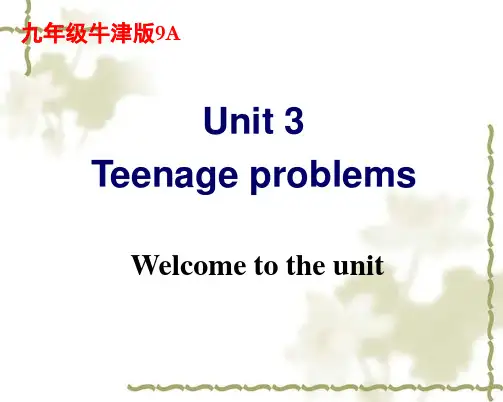
Hobo: Eat_l_e_s_s__ and take _m__o_r_e___ exercise. Eddie: What __e_ls_e___ can I do? Hobo: Running _i_s__ good for you. And you can also
I’m getting fat. Look at my stomach.
It’s unhealthy for you to eat too much. Try more exercise.
Maybe you're right.
Good, I’ll
finish the food for you then.
have time for me.
Go to bed early and don't watch too much TV.
Try to be friendly to others and chat with them after class.
Plan your time carefully and try to finish your homework quickly.
__s_w__im____ in the river.
Eddie: Thank you _fo__r__ your advice, Hobo.
Hobo: You are welcome.
Kitty
Simon Millie
What are their problems?
Daniel
Amy
Sandy
Millie
Make a dialogue:
Eddie: Hello, Hobo. I have a problem.
unit3teenageproblems课件3牛津英语九年级上
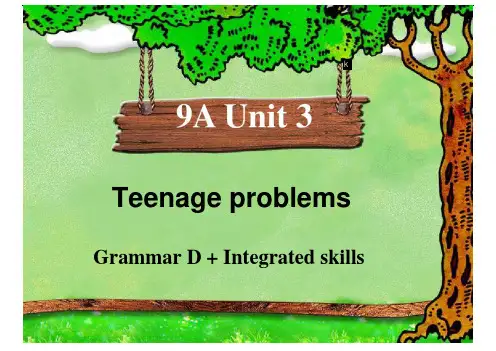
kJTeenage problems Grammar D + Integrated skills卜Five kinds of sen fence structureThe telephone rang ・His father might have died.We all breathe, drink and eat.s +v-主语+谓语Subject (S) » Millie Verb (V)is sleeping.成分。
但在某种情况下,不加状语便不能表达完整的意思,看看下◊主语+谓语+状语:The meeting lasted for two hours. We walked for five miles>He lives in Guangzhou.They will fly to London.( Subject (s) Verb (\f)Direct object (DO) 2.S + V + DO—MUl is reading abook. k主错+谓语+直接宾语You may have seen each other.He is doing morning exercises・This factory makes machine tools.I Mary has ordered a new dress・■iI have had myjunch・,E这种结构中的谓语动词是及物动丿词,后面只跟一个宾语,因此称单'宾及物动词,一般不需状语即可表达完整的意思。
但在某些情况下,状语必不可少,看看下面的句型:逆◊主语+谓语+宾语+状语He put the vase on the table.Jim brought his suitcases upstairs.take Mary to the station. They treated him kindly.Verb (V)) SubjectJS)广^ Predictive (P)^S + V + P->Millie is 盂忌承主语+系动词+表语The plan sounds perfect.This material feels soft.This is where I work.Directobject (DO) 宀a book. 主语+谓语+间接宾语+直接宾语She made herself a new dress. My father bought me a novel.+10 + DO —Millie Subject (S) Indirect Verb object (10) gave AmyPass me the salt.Meet object Object Complement (DO) (OC) 5.S+ V + DO + OC Millie主语+谓语+宾语+宾语补足语 I We have proved him wrong. ■She found the child fast asleep.I called him a fool.ubject(S)Verb (V ) her dog Eddie.calls分下列句子的成分illie is eating. 主语谓语2) Millie is eating主语谓语a cake. 宾语3) fhe cake tastes丿主语谓语4) Lucy will buy me主语谓语间宾delicious. 表语a big cake. 直宾行nd 语谓语the question wrong. 宾语宾补Millie does not know the sentences structures very well. Help her finish the following exercises. 1』ay named his dog Bobby, s + v + DO + oc 2.He bought a T-shirt- s + v + DO3.She laughed・s +v4. He gave Laura a present, s + v + io + DO5.She looks lovely. s +v + p 羣6. The teacher is marking the tests・s +v +7. They consider John the best actor.s + v + 8」find the article on star signs interesting.s + v + DO + oc /Sigmund Friend is writing some notes on teenagers' problems. However, his Computer broke down suddenly and all the words are now in the wrong order. Help him rearrange the words to form complete sentences and name the sentence structures. (Book Page 49)1 -teenagers/have/an/Many/unhealthy/diet S+V+DOMany teenagers have an unhealthy diet.2.makes/weak/your body/un healthy/diet/An® S+V+DO+OC An unhealthy diet makes your body weak.3-unhappy/are/They S+V+PThey are unhappy. 汽4.find/difficult/homework/They/their 拓S+V+DO+O They find their homework difficult.5. hobbies/Teenagers/many/have^Teenagers have many hobbies・S+V+DO 6. tired/They/are倉They are tired. S+V+P7. write/letters/Many/me/teenagersMany teenagers write me letters. S+V+IO+DO .cry/Some/them/ofSome of them cry. S+Vj Irttegrated skills\ Dealing with problems IjHelp Sigmund Friend complete his notes with as much information as you can, using Sue's profile・2.Listen to the dialogue between Sue and Sigmund. Complete notes. INameFavourite subjects: English, Maths ,Science ・ First problem:Advice:Second problem: Does not have many friends … classmates laugh at her and call her i Bookworm ,Talk to your best friend when feeling sad and shareyour problems with her;pay no attention to those studentsj^Hcfe一也aHgjgfang ,SueYifang, Sue Not good at sport —can't run fast anc jhates swimming Just try your best in PE lessons, enjoythe exerciseAdvice:laugh at you and be proud of schoolur work・Wang3|flfang 5Sue SiEie is the topttudents jn her class at Beijing Sunshine Secondary School. Her favourite Subjects are English 弓 Ma/s and Science .Although Sue does well in examl she has some problems."She is not very good at sport. She cannot run fast and hatesswimming. Also, her classmates call her Bookworm \This makes her feel bad.I told try her to payn 。
九年级英语上册《Unit 3 Teenage problems》课件 (新版)牛津版

home . The TV is always on. The __n_o_is_e___almost
drives me mad.
I don’t have close f_r_ie_n_d_s_.
Sometimes,
I feel lonely.
Sometimes I get low _m_a_r_ks__ in exams. I feel sad.
What advice does Millie’s mum give her?
Millie should manage her time better and go to bed earlier.
Practice
Let’s read the conversation and make a conversation with your partner.
Homework
1. Recite the dialogue.
2. Remember the words and useful expressions.
Have a good day Goodbye
homework
quickloyff the TV
try to be friendly to study harder and ask others and chat with for teacher's help
them after class
ask parents to e home early
Mille and her classmates have some problem. Look at the pictures. What problems do they have?
Do you have the problems: sleepy
九年级英语上册Unit3Teenageproblems教案(新版)牛津版
课时
安排
3
10月
9日
Reading2
7
教
学
目
标
1. To review the details in the article.
2. To learn the key phrases and drills in the article.
________________________
Wish
__________________ so that she can _______________________
_______________________
Step 6 Have a debate
T: Millieknowsit’s important to do her homework. However, she hardly has any time for her hobbies. What should she focus on? Choose one and have a debate.
2. To guess meaning from the context.
3. To master different ways of talking about teenage problems.
难点
教学过程设计
集体备课
二次备课
Step 1 Free talk
1. Do you have any problems in your daily life?
Teenage problems
教
学
目
标
To revise vocabularyand expressions to describe teenage problems at the same time, learn more new words and phrases.
牛津译林版九上9A英语Unit3 Teenage problems reading1
Different problems
His parents often quarrel with each other.He feels very unhappy
Different problems
Amy’s cousin always makes a lot of noise and disturbs her when she is studying.
Different problems
Millie doesn’t get enough sleep. She feels tired in class.
•
9、 人的价值,在招收诱惑的一瞬间被决定 。2021/5/112021/5/11T uesday, May 11, 2021
•
10、低头要有勇气,抬头要有低气。2021/5/112021/5/112021/5/115/11/2021 7:09:21 AM
guess :
What problems do they meet with?
Millie’s problem
Too much homework
Doubt? Too much homework
Worth?
refuse it?
have no choice but to do it
Stay up late
Unit 3 Teenage problems
What should I do?
Vocabulary preview
预习展示
strict choice spare doubt awake worth imagine suggestion valuable
想象 珍贵的,宝贵的 醒着的 建议 选择 怀疑 空闲的,多余的 值得 严格的,严厉的
牛津版九年级英语A Unit3 teenage problems教案
Unit3 teenage problemsPeriod One(Wele to the unit/ vocabulary )●objectives1.to talk about problems and their causes2.to think about personal problems and how to deal with them.3.To understand the different meanings of the verb “to be”4.To use the verb “to get” when talking about problems●Language function and focusI’ve got a problem.=I have a problem.Eating too much makes you unhealthy. Get too many tests and examsQuarrel with sb. Family membersGet a bus=take a bus get angry=bee angryI don’t have much time to revise for tests.●Teaching methodsListening/ writing/ speaking/discussing●Teaching proceduresPart A1.Explain that most teenagers have problems. Tell students that if they ever need to talk abouttheir problems, they should talk to their teachers, friends or family. Tell students that having a problem is nothing to be ashamed if ----everyone has worries from time to time.2.Ask students work in groups. Discuss their problems and write on the paper. The teacher callsome groups to speak out the problems and help them how to solve them.3.Show the students pictures about problems. Ask individuals to speak out which problem it is.If one has spoken out, he or she can ask his or her best friend to speak out next problem.4.Ask students to work in pairs to plete Part A on Page 39. Once all students have finished, askone student at a time to read out what they have written. Listen for mistakes and mispronunciation.Part B1.tell students you want to do a survey of the problems that students in the class have. Write thefollowing headings on the board:Not enough sleepNot enough time to do homeworkToo noisy to studyLonelyArgue with cousin/classmate/parentParents are always busyRead out each problem in turn, and ask students to raise their hands if they have this problem. Make a tally of the problems that students have. This will reinforce a group feeling. Finally, make a note of the biggest problem the class has. Write the following on the board:“The biggest problem Class …Grade ... has is …”2.Explain that part B is different from the previous exercise, as students have to rank how bigthese problems are in their lives.Explain to students that number 5 means that this is a big problem for them while number 1 means it is a small problem.3.Tell students to plete Part B on their own. You may want to give the exercise as homework, asstudents may feel fortable writing about their problems in private. You could ask volunteers to give their answers but do not force students. If there are no volunteers, do not go over the answers to this exercise with the class. Keep the students’ answers confidential.4.For stronger classes, ask students to add what they consider to be the biggest problemsteenagers face to the list if these are different to those on the list.V ocabularyPart A1.Explain that the words in the box at the top of Page 44 are synonyms of the verb “to get”below the pictures, and can be used to replace “get” in each picture.2.Ask students to work in pairs to plete Part A.3.For weaker classes, ask students to read out the answer for each picture. For stronger classes,after students have read out the answers, ask them to make sentences using the phrases under the pictures.Part B1.Explain to students that they can use their answers from Part A to help then with the exercisein Part B. for weaker classes, students can work in pairs to plete Part B. For stronger classes, students can work on their own.2.For stronger classes, once students have finished, ask two students to read out the whole letter.pliment them on parts of the letter they read particularly well.3.For weaker classes, ask students if they have the same problems as Amy. Ask students to raisetheir hands if they do. For stronger classes, ask students what their advice would be for Amy. ic strip1.Play the tape for the students to find out the problem. If they can’t get the answer, the teachercan play the second time.2.Explain some language points for the whole class. Then ask them to try to perform this shortplay.Homework:1.If you have any ___________ (问题),you can ask your teacher for help.2.Eating too much is bad for our ____________. It makes us __________ (健康)3.____________ (游泳) is one of my favourite sports.4.John got up too late to have breakfast, so he felt ___________ at school.5.The meeting has bee ___________ (结束) for two hours.6.Thank you for ___________ (邀请) me to your party.7.You must look after y_________ and keep healthy, Mum and Dad.8.We have our first class at a _____________ (一分钟)to eight.Design on BbStudent s’ problemstoo noisy after classDon’don’(quarrel with/get enough sleep/be on/feel lonely/revise for tests/receive low marks/I’ve got a problem)Period Two (Reading )●Objectives:1.to understand how to write about problems and to express feelings2.to ask for advice3.to recognize and understand vocabulary about problems.●Language function and focusI want to know how( to solve it.)The problem is that……..I spend so much time doing homework that I cannot find any time for my bobbies. When (to do my homework) and when (to spend on my hobbies)Can you please teach me how to achieve a balance between the two.Can you offer me some suggestions? = Can you give me some advice?I wish I could have my parents support.●Teaching methodsReading/practicing/listening/working in groups●Teaching procedures(part A)1.Ask students whether they read advice columns, e.g. , newspapers, magazines and websites.Bring in some samples from newspapers and and magazines to show students.2.Explainthe context. Millie and Simon have both written letters to a youth worker.3.Ask students to scan the text and see if there are words that they do not know. Explain thesewords briefly.4.reads Millie’s letter aloud. Ask students to listen carefully to you and follow the text on page40. Ask questions to check understanding, e.g.What is Millie’s favorite hobby? (painting)What is Millie’s problem? (She doesn’t have enough time for hobbies and homework.)5.Ask one student at a tome to read a paragraph, ask students to say which parts of the text theydo not understand. Clarify any points if necessary.6.Read Simon’s letter aloud. Ask students to listen carefully to you and follow the text on page41. Ask questions to check understanding, e.g.When does Simon play football? (After school until late.)How do his parents feel about it? (They don’t like this and ask him to go home before 6 p.m.)7.Ask one student at a tome to read a paragraph, after each paragraph, ask students to say whichparts of the text they do not understand. Clarify any points if necessary.(part B)1.Remind students that the vocabulary that the vocabulary listed in Part B appears in Millie andSimon’s letters on pages 40 and 41. If students are not sure what a word means, it may help them to read the word in context on those pages.2.Ask students to work in pairs to plete Part B. When students have plete all the answers, theyraise their hands. The first pair to finish the exercise correctly is the winner.3.When students have finished, give the correct answer to each question.(part C)1.Tell students that in Part C, they must play the role of Sigmund Friend, and must “diagnose”what is wrong with Millie and Simon.2.Remind students that they can find all the answers inthe reading passage on pages 40 and 41.They should plete the exercise by putting a cross or a tick in the blanks. For more able students, ask them to plete the exercise without referring the back to the reading passage.3.After checking the answers with the class, ask more able students to look for phrases orsentences in Millie and Simon’s letters to support their answers.4.This is a straightforward exercise and students of all levels should be able to plete it on theirown.(part C)1.Revise key vocabulary. Write the following words on the board:advise keepearlier laterfocus helpforget about school workgive up rememberhobby ignorehomework go homepainting studyspend hours work hardtime drawingstay out hours2.Explain that for each word in the column on the left, there is a related word in the column onthe right. The words may be opposites, synonyms or related words. Point to the first word and ask the class to find the matching word in the right-hand column. Ask volunteers to e to the front of the class and draw a line between two words to link them. weaker classes might find this task difficult. Go through the words in the two columns with students before asking them to match the words.Answers are as followings:advise keep (opposite)earlier later (opposite)focus help (synonym)forget about school work (related word/opposite)give up remember (opposite)hobby ignore (opposite)homework go home (opposite)painting study (related word)spend hours work hard (related word)time drawing (related word/synonym)stay out hours (related word)3.Once students are clear about the vocabulary, ask them to plete Part D on Page 43. More ablestudents can plete the exercise on their own. Less able students can work in pairs or small groups.4.Once students have finished Part D, ask two students to read the letters aloud. Praise studentsfor areas where they do well. Try not to focus too much on their mistakes as this will crush their confidence when speaking in front of the class.Homework:完成课时卷(reading)Design on BbMillie1.What Grade is she in? 92.What are Millie’s hobbies? Read/write poems/walk/shop3.What’s her favourite hobby? painting4.Does she have a lot of homework every day? yes5.What does she think important? Work hard/hand in homework on time6.What’s the problem?When to do homework and when to spend on hobbiesPeriod Three (Grammar )●Teaching objectives1.To use “wh-” words + “to” infinitives to talk about problems.2.To learn about sentences types3.To study five kinds of sentences structures4.To learn to use object plements●Language function and focusSimon does not know what to do.Paul knows who to talk to for help.We believe it unnecessary to give students tests every day.We have proved him wrong. Consider David the best chairpersonJay named his dog Bobby.●Teaching methodsDiscussing/writing/practising●Teaching proceduresPart A1.Remind students that when we talk about “wh-” words, we mean question words. i.e., what,when, why, where, who, how2.For stronger classes, introduce “whom” and “whose”. “Whom” is the object pronoun form of“who”,e.g. Whom did you invite to the party? However, it is rarely used nowadays except in formal contexts.Normally, we simply say “who”. “Whose” is the possessive form of “who”,e.g. “Whose book is that?3. Explain to students that they need to use the “wh-“ words+to do structure to plete the exercise on page45. The “wh”- words can be used more than once.4. This is a fairly challenging exercise and all students will benefit from guidance. For strongerclasses, ask students to do it by themselves and the n check their answers. Less able students will benefit from working in pairs. More able students can work on their own, but encourage students to share their difficulties with the class. If one students finds something difficult, it is likely that the others do too. Be on hand to offer help for this exercise.\For weaker classes, tell students that it may be easier it may be easier if they find either the “wh-“ word or “to”-infinitive first before working out the whole answer.5. Once students have finished, choose one student to play the part of Millie and another student toplay the part of Sigmund. Ask them to read the conversation aloud. Check for incorrect answers and mispronunciation. For weaker classes, ask several pairs of students to read one exchange each.Part B1.As a warm-up activity, write the following form on the board:2.Ask students to make up a sentence in each blank on the right according to the requirement onthe left. Students make up their ownsentences on a piece of paper. Less able students can work in pairs. Encourage more able students to work on their own.3.Ask a student to e to the front of the class and write the sentence in the right column. If theanswer is correct, he / she can choose the next students to the front to continue. If not, you choose the next student.4.Go through the table at the top on page 46. Ask studentsif they have any questions.Make surethey understand the four types of sentences.5.Tell students the basic use of a statement is to give information, e.g., “Millie wrote toSigmund Friend for advice.”T he negative form of this statement is “Millie did not write to Sigmund Friend for advice.”S ome statements do more than give information. They can also be used to ask for information, express approval or sympathy, thank someone, give orders or provide an offer.Tell students the basic use of a question is to ask for information, e.g., “When do you usually go to school?” We can also use questions in other ways, such as making requests, e.g., “Can I have a cup of tea, please?” making suggestions, e.g., “Shall we bring more water?”, making offers, e.g., “Can I help?” or asking for permission, e.g., “May I e in?”Tell students that the imperative form is the base form of the verb. The imperative is used to give orders or to get someone to do something. When giving orders, you expect the person will obey. For example, when I say “Stop making so much noise!”, I mean that “You should stop making noise.”An imperative can also be used to give suggestions, warnings,instructions, invitations or good wishes.Tell students that an exclamation is a sentence spoken with emphasis. We can use “what” or “how” to start an exclamation, e.g.,“How lucky we are today!”“What a lucky day!”6.Explain to students that in the exercise on page 46 they must identify the different types of thesentences and write the correct answers in the blanks. This is a fairly simple exercise. Students can work out their own.7.Once students have finished, ask the class to check the answers with you.Part C1. Write these two sentences on the board,Millie was tired.Playing basketball made Millie tired.Ask students to pare the two sentences. In the first sentence, “tired” is the predicative of the sentence whereas in the second sentence, “tired”is the object plement that describes the object of the sentence (Millie).2. Ask students to look at the table at the top of page 47. Tell students that an object plement is an adjective (or adjective phrase) or noun (or noun phrase) that relates to the object. Encourage students to ask questions about object plements.3. For stronger classes, tell students that if we add the verb “to be”between the object and the object plement and then use the object as a subject to start a new sentence, the original object plement bees a predicative of the new sentence, e.g.,They painted the box red.The box is red.4. Tell students that not all verbs can be followed by an object plement. Some words that can beused in this pattern are:Appoint elect like prove believe find make think call getname vote consider keep paint want declare leave prefer5.Explain the context. Students should circle the object plements found in Millie’s homework.Ask more able students to report their difficulties to the class. Be ready to offer help for this exercise.6.Ask twelve students to each read one answer to the class. Check the answers as a class.Part D1.Review the definitions and the main uses of the sentence elements, such as the subject, thepredicative, the direct object, the indirect object and the object plement. Ask students to refer to pages 11 and 47 for more details.2.Explain to students that different binations of the sentence elements form different sentencestructures. Go through the five basic sentence structures at the top of page 48 ans explain the structures to students, e.g.,Eddie is eating.Eddie is having his dinner.Eddie is hungry.Hobo givesEddie another cake.Hobo calls Eddie Big Stomach.3.Ask students to work in pairs and make up a sentence for each of the five sentencesstructures. Ask them to write their sentences for the first structure. Praise them if the sentence is correct. If not, ask other students to help correct the sentence. Students can benefit from correcting each other’s mistakes in gaining a better understanding of the structure.4.Explain the exercise in Part D1 on page 48. More able students may work on their ownwhile weaker students may work in pairs. Once students have finished, ask seven students to read their sentences aloud and check the answer s as a class. Praise them for any parts that they have done correct. Try not to focus on their mistakes.5.For stronger classes, you can write more sentences on the board and ask students to identifythe sentence structures.6.Explain on the context. Sigmund is writing some notes on teenagers’problems. However,the words in the sentences are all mixed up because of puter problems. Students need to rearrange the words to form correct sentences using their knowledge of sentence structures.Then ask students to name the type of sentences.7.For stronger classes, ask students to work alone. For weaker classes, ask them to work inpairs.8.Once students have pleted the exercise, ask seven students to each read one sentence and thesentence type to the class. Check the answers as a class. If students have different opinions, ask them to give their reasons.9.Try not to focus on the mistakes. Praise students if they have done well in any parts. Homework:<<补充习题>> P 19(A2), P20(B1), P21(C1)Design on Bbprefer the drink hotprove him right 宾补made me happy形容词或名词词组call my dog Chattyfind the picture beautifulPeriod Four (Integrated skills)Objectives1.To extract information from a studentprofile2.To write notes about a student profile3.To extract information from a conversation4.To write a record of a visit●Language function and focusI always do well in exams. (be good at )pay no attention to sb./ sth. share problems with my friendsbe proud of reply to my last three sThanks for listening to my problem and giving me your adviceThat’s what friends are for.●Teaching methodsListening / practice / reading / discussing●Teaching proceduresPart A1.Read through Sue’s profile on page 50 with students. Ask them to think about what theirstudent profile would say. Write the following on the board.Name:Class:Grade:Subjects I like:Subjects I do not like:2. Ask the students to think about something they are very good at. It does not need to be a school subject. It could also be a hobby. This will reinforce their confidence. Point out to students that no one can be good at everything. Everyone has different skills and talents.3.Aska student to read Sue’s profile aloud. Explain to students that some of the information inthe student profile will help them to plete the notes about Sue.However, tell studentsthat they will not be able to find all the answers in the profile.For weaker classes, do the first one together so that students understand what they have to do.If students are really weak, tell them in advance that only answers 1-4 e from Sue’s profile. 4.Tell students to look carefully at what they have written, and pay attention to the gaps theyhave not yet been able to fill.5.Play the recording again, stopping so that students can write their answers, if you feelthis isnecessary.6.Tell students to look at their answers. If they still have some unfilled gaps, ask them to readthe profile again at the top of the page in case they have missed something. Then play the recording once more without stopping.7.Ask students to read one answer each. Check for mistakes and mispronunciation.8.For weaker classes, it is useful to play the recording again once students have pleted theexercise. This consolidates what studentshave learnt and gives them a sense of achievement.9.Explain to students that they can use the profile and the note from page 50 to help them pletePart A3 on page 51. However, they should pay no attention to the syntax and make appropriate change of forms where necessary.10.Divide the class into pairs. Each pair must work together to e up with the correct answers. Thefirst pair to get all of the answers correct wins.11.Ask a person from each pair to read one sentence at a time. Encourage students to listen formistakes and raise their hands when they have a question.Part B1.Review “worried”, “reply”, “e-card”and “advice”. For stronger classes, ask students tovolunteer some definitions. For weaker classes, you can give the explanations to students.2.Ask students to work in pairs. Tell them to read the conversation aloud, then change roles snread the conversation again.3.Check students’ conversation of the passage. Ask them the following questions:Who has a problem? (Millie)What is her problem? (Her pen friend hasn’t replied to her s.)Does Amy agree that Millie’s pen friend doesn’t want to write to her any more? (No.)Why does Amy think Millie’s pen friend hasn’t written? (She’)What advice does Amy give Millie? (Millie should send an e-card to her pen friend and let her know she misses her very much.)Do you think Millie feels better after discussing her problem with Amy? (Yes.)For weaker classes, students can give on-word answers. For stronger classes, ask students to reply using full sentences.4.Ask the students to use the conversation as a model to talk about their own problems and giveadvice. Ask them to practice their new conversations. Allow less able students to write down their conversations before practicing with a partner. Walk around the class and give help where necessary.5.Ask a few pairs to read their conversations aloud to the whole class.Homework:( on exercise books)完成下列句子。
unit3teenageproblems知识梳理及练习(牛津英语初三上)doc初中英语
unit3teenageproblems知识梳理及练习(牛津英语初三上)doc初中英语一词汇teenage(名)_____disturb(形)________choose(名)_______suggest(名)_______value(形)_______young(名)_______true(名)_______(副)_______quarrel(过)_______reply(过)______ _first(副)_______because(名)_______spell(名)_______use(名)_______please(名)___ ____二依照汉语提示填词1.Would you please not_______〔打搅〕me when I sleep?2.You should show your______〔勇气〕when you face the trouble.3. Her father told her that she had made a good______.〔决定〕4.Tell us the______〔真相〕,don’t lie.5.If you want to join us, you must get your_______〔父母〕support.6.He hasn’t been to Tibet, me______〔也〕.7.This book is well worth__________〔看〕.8. It seems that he spends less time ___________ (练习) the piano .9. What will you do if someone ___________ (笑) at you ?10. I decided to work it out though there were many ___________ (困难)11. It is ___________ (共同的,平常的) for students to have problems.三、用所给单词的适当形式填空1. We don’t have enough time ___________ (chat) on the Internet .2. Please keep the windows ___________ (close) it’s cold outside .3. That is w___________ I am telling you my problems4. I do not have close friends. Sometimes, I feel l___________.5. I hope I can o___________ you some useful suggestions.6. You will feel better if you s___________ your problems with you friends.四、语言点1.在….方面弱be weak in…..2.对…….有好处be good for…. 4.对……有用be useful to ….3.吃得太多eat too much4.担忧太多worry too much5.如何样处理how…deal with…= what… do with…6.变胖get/become fat7.青青年的咨询题teenage/teenagers’ problems8.得到足够的睡眠get/have enough sleep9.〔灯、电视等〕开着、亮着be on10.关于某事与某人争吵quarrel(argue) with sb about sth.11.整天/整夜all day/night 12.目前at the moment = at present = now13.不在意……pay no attention to….14.如何在两者之间获得平稳how to achieve a balance between the two15.有时from time to time=at times=sometimes16.提供某物给某人offer /give sb. sth. = offer sth. to sb.17.收到某人来信hear from sb.(短)= get/receive a letter from sb.〔短〕=have a letter from sb.〔延〕18.解出(代词放中间)work ..out(代词放在中间)19.这条建议this piece of advice=a suggestion20.不记得某事forget about sth.------forget doing sth// forget to do sth21.上交〔我的作业〕hand in (my homework ) 〔代词放中间〕22.按时;准时on time 及时in time 32.得到低/高分get/receive low/high marks23.复习迎考revise for tests 34.休息一会儿have a rest for a while24.如何样解决那个咨询题how to solve this problem25.和某人分享某物share sth. with sb.26.为…感到自豪be proud of = take pride in… 39.轮番做某事take turns to do sth.27.回复,回答〔我的电子邮件〕reply to (my e-mails) = answer (my e-mails)28.为…腾出足够的时刻make enough time for…29.对...感到糟糕feel bad about…30.将担忧留给自己keep your worries to oneself31.舍弃某事〔代词放中间〕give sth. up32.舍弃做某事give up doing sth.33.忍耐…痛楚suffer from34.成功..succeed in doing sth.= be successful in doing sth.35.有价值be of value=be valuable36.对某人/物要求严格be strict with sb/in sth37.常见花费的用法:It takes sb.some time to do sthSb spend some time/some money( in)doing sthSb spend some time/some money on sthSth cost sb some moneySb pay some money for sthSb buy sth for some money 具体详见9A精讲精练p3738.让人发疯drive/make sb mad39.期待做…..look forward to doing sth 40.同意sb agree with sb41. My pleasure=It’s my pleasure.=It’s a pleasure. 42.被看见在做…be seen doing sth 被看见做了或经常做…be seen to do sth 另外类似有hear/watch /notice…43.打开电视…..turn on the TV 另外类似有turn down/off/up……44.大量……plenty of/a lot of /a number of……注意a number of 和the number of 区分45.发送……send …..to….46.出什么咨询题….what’s the problem/trouble/matter with…..?What’s wrong with…..?47.嘲笑……laugh at….. 48.Maybe you’re right.=You may be right.49.有靠近的朋友讲话have a close friend to talk to…50.不无选择have no choice but to…51.熬夜stay up late=go to bed late 52.拒绝做…refuse to do sth 53.主动提出做…offer to do sth54.如何做…what to do=how to do it55.到达…arrive in/at…=get to…=reach…56.单独留下…leave sb/sth alone=by oneself=on one’s own57.告诉某人事实/讲实话tell sb the truth58.值得做…be worth doing sth(worth不能用被动语态)59承诺〔不〕做…allow sb 〔not〕to do sth60.Eating too much makes you unhealthy.另外同学们注意本单元的重点是:1.专门疑咨询词引导动词不定式。