
2014年6月大学英语六级阅读理解考试真题
2014年6月大学英语六级阅读理解考试真题Part III Rdading Comprehension (40minutes)Section ADirections:In this section, thereis a passage with ten blanks,You are required to select One word for each blankfrom a list of choices given in a word bank following the passage.Read the passage through carefully before making yourchoices. Each choice in the bamk is identified by a letter.Please mark thecorresponding letter for each item on Answer Sheet 2 with a single line through the centre You may not useany of the words in the bank more than once.For investors who desire low riskand guaranteed income,U.S. Government bonds are a secure investment becausethese bonds have the financial backing and full faith and credit of the federalgovernment.Municipal bonds,also secure,are offered by local governmengts andoften have____36______such as tax-free interest.Some may even be____37______.Corportate bonds are a bit more risky.Two questionsoften_____38_____first-time corportate bondinvestors.The first is”If I purchase a corpo rtate bond,do I have to hold it until thematueity date?”The answer is no.Bonds are bought and sold daily on____39_____securities exchanges.However,if your bond does not have____40_____that make it attractive to other investors, you may be forced to sell yo ur bondat a____41____i.e., a price less than the bond’s face value. But if your bond is highly valued by otherinvestors, you may be able to sell it at a premium, i.e., a price above itsface value. Bond prices gcncrally____42____ inversely (相反地)with current market interest rates. Asinterest rates go up, bond pnccs tall, and vice versa (反之亦然).Thus, like all investments,bonds have adegree of risk.The second question is “How can I ___43_______ the investment risk of a particular bondissue?” Standard & Poor’s and Moody’s Investors Service rate the level of risk of many corporateand government bonds. And ____44______, the higher the market risk of a bond,the higher the interest rate. Investors willinvest in a bond considered risky only if the _____45_____return is highenough.注意:此部分试题请在答题卡2上作答。
A) advantages I) fluctuateB) assess J) indefiniteC) bother K) insuredD) conserved L) majorE) deduction M) naturallyF) discount N) potentialG) embarrass 0) simultaneouslyH) featuresSection BDirections:In this section,youare going to read a passage with ten statments attached to it.each statementcontains information given in one of the paragraphs.identify the paragraph fromweich the information is derived.you may choose a parpgraph more than once.eachparagraph is marked with a letter.answer the questions by marking thecorresponding letter on answer sheet 2.lessons from a Feminist Paradise[A]On the surface,Sweden appearsto be a feminist paradise.Look at any global survey of gender equality andSweden will be near the top.Family-friendly policies are its norm-with 16months of paid parental leave,special protections for part-time workers,and state-subsidizedpreschools where,according to a government website,"gender-awarenesseducation is increasinglycommon."due to an unfficial quota system,womenhold 45 percent of positions in the swedish parliament.they have enjoyed theprotection of government agencies with titles like the Ministry of Integrationand Gender Equality and the Secretariat of Gender Research.So why are Americanwomen so far ahead of their Swedish counterparts in breaking through the glassceiling?[B]in a 2012 report,the World EconomicForum found that when it comes to closing the gender gap in"econmicparticipation and opportunity,"the United States is ahead of not onlySweden but also Finland,Denmark,the Netherlands,Iceland,Germany,and the UnitedKingdom.Sweden's rank in the report can largely be explained by its politicalquota system.Though the United States has fewer women in the workorce(68percent compared to Sweden's 77 percent).American women who choose to beemployed are far more likely to work full-time and to hold high-level jobs asmanangers or professionals.They also own more businesses,lauch more start-ups(新创办的企业),and more often work in traditionally malefields.As for breaking through the glass ceiling in business,American women arewell in the lead.[C]what explains the Americanadvantage?How can it be that societies like Sweden,where gender equality isvigorouslypusued and engorced,have fewer femalemanagers,executives,professionals,and business owners than eh laissez-faire(自由放任的)united states?A new study by clrnelleconomists Francine Blau and Lawrence Kahn gives an explanation.[D]Generous parental leavepolicies and readily available part-time options have unintendedconsequences:instead of strengthening women's attachment to the workplace,theyappear to weaken it.In addition to a 16-month leave,a swedish parent has theright to work six hours a day (for a reduced salary)until his or her child iseight years old.Mothers are far more likely than fathers to take advantage ofthis law,But extended leaves and part-time employment are known to be harmfulto careers—for both genders. And with women a second factor comes intoplay:most seem to enjoy the flexible-time arrangement(once known as the “mommytrack”)and never find their way back tofull-time or high-level employment.In sum:generous family-friendly policies dokeep more women in the labor market,but they also tend to diminisb theircareers.[E] According to Blau andKahn,Swedish-style paternal(父亲的)leavepolicies and flexibletime arrangements pose a second threat to woman’s progress:they make employers cautious about。
2014年6月大学英语六级考试真题(一)

2014年6月大学英语六级考试真题(一)Part I Writing (30 minutes) Directions:For this part, you are allowed 30 minutes to write an essay explaining why it is unwise to jump to conclusionsupon seeing or hearing something. You can give examples to illustrate your point. You should write at least 150words butno more than 200words.注意:此部分试题请在答题卡1上作答。
PartⅡListening Comprehension (30 minutes)Section ADirections:In this section, you will hear 8 short conversations and 2 long conversations. At the end of each conversation,one or more questions will be asked about what was said. Both the conversation and the questions will be spoken onlyonce. After each question there will be a pause. During the pause, you must read the four choices marked A), B), C) and D), and decide which is the best, answer. Then mark the corresponding letter on Answer Sheet 1 with a singleline through the centre.注意:此部分试题请在答题卡1上作答。
2014年6月大学英语六级真题及-答案完整版

2014年6月大学英语六级真题及答案完整版PartI Writing ( 30minutes)Directions: For this part, you areallowed 30 minutes to write an essay explaining why it is unwise to put allyour eggs in one basket. You can give examples to illustrate your point .Youshould write at least 150 words but no more than 200 words.Directions: For this part, you areallowed 30 minutes to write an essay explaining why it is unwise a person bytheir appearance. You can give examples to illustrate your point .You shouldwrite at least 150 words but no more than 200 words.Directions: For this part, you areallowed 30 minutes to write an essay explaining why it is unwise to jump toconclusions upon seeing or hearing something. You can give examples toillustrate your point .You should write at least 150 words but no more than200words.Part Ⅱ Listening Comprehension (30 minutes)Section ADirections:In this section,youwill hear 8 short conversations and 2 long conversations.At the end of eachconversation, one or more questions will be asked about what was said.Both theconversation and the questions will be spoken only once.After each questionthere will be a pause.During the pause,you must read the four choices markedA),B),C)and D),and decide which is the best answer.Then mark thecorrespondingletter on Answer Sheet1 with a single line through the centre.注意:此部分试题请在答题卡1上作答。
2014年6月大学英语六级仔细阅读训练答案及解析

Passage One Questions 56 to 60 are based on the following passage. University of York biologist Peter Mayhew recently found that global warming might actually increase the number of species on the planet,contrary to a previous report that higher temperatures meant fewer life forms—a report mat was his own. In Mayhew’s initial 2008 study,low biodiversity among marine invertebrates(⽆脊椎动物)appeared to coincide with warmer temperatures on Earth over the last 520 million years. But Mayhew and his colleagues decided to reexamine their hypothesis,this time using data that were“a fairer sample of the history of life.”砌this new collection of material.they found a complete reversal of the relationship between species richness and temperature from what their previous paper argued:the number of different groups present in the fossil record was higher,rather than lower,durin9“greenhouse phases.” Their previous findings rested on an assumption that fossil records can be taken to represent biodiversity changes throughout history.Thisn’t necessarily the case.because there are certain periods with higher.quality fossil samples.and some that are much more difficult to sample well.Aware of this bias.Mayhew’s team used data that standardized the number of fossils examined throughout history and accounted for other variables like sea level changes that might influence biodiversity in their new study to see if their old results would hold up. Two years later,the results did not.But then why doesn't life increasingly emerge on Earth as our temperatures get warmer? While the switch may prompt some to assert that climate change is not hazardous to living creatures,Mayhew explained that the timescales in his team’s study are huge--over 500million years--and therefore inappropriate for the shorter periods that we might look at as humans concerned about global wanning.Many global warming concerns are focused on the next century.He said——and the lifetime of a species is typically one to 10 million years. “I do worry that these findings vill be used by the climate skeptic community to say‘look.Climate warming is fine。
2014年6月大学英语六级阅读练习题附答案及解析水印版

2014年6月大学英语六级阅读练习题附答案及解析目录2014年6月大学英语六级阅读练习题附答案及解析 (1)2014年6月大学英语六级仔细阅读练习题附答案及解析(1) (2)2014年6月英语六级长篇阅读匹配练习题附答案解析(1) (11)2014年6月英语六级选词填空习模拟练习附答案(1) (17)2014年6月大学英语六级仔细阅读练习题附答案及解析(2) (21)2014年6月英语六级长篇阅读匹配练习题附答案解析(2) (30)2014年6月英语六级选词填空习模拟练习附答案(2) (37)2014年6月大学英语六级仔细阅读练习题附答案及解析(1) Passage OneQuestions 56 to 60 are based an the following passage.Dropping out of university to launch a start-up is old hat. The twist with Joseph Cohen, Dan Getelman and Jim Grandpre is that their start-up aims to improve how universities work. In May 2011 the three founders quit the University of Pennsvlvania. to launch Coursekit,soon renamed as Lore.whichhas already raised $ 6m to develop what Mr. Cohen, its 21-year-old chief executive, describes as a social-learning network for the classroom".Lore is part of a trend that builds on the familiarity with social networking that has come with the success of Facebook. It customizes the rules of a network to meet the specific needs of students. Anyone teaching a class would reasonably worry that students using Facebook were gossiping rather than learning useful information from their network of friends. Lore allows teachers to control exactly who is in the network by issuing a class-membership code and to see how they are using it. They can also distribute course materials, contact students, manage tests and grades, and decide what to make public and what to keep private. Students can also interact with each other.In the academic year after launching its first version last November, Lore was used in at least one class in 600 diversities and colleges. Its goal for its second year, about to begin, is to spread rapidly within those 600 institutions, not least to see what the effects of scale are from having lots of classes signed up within the same institution.The firm has a fast-growing army of fans in the faculty common room. Lore, says Edward Boches, who uses it for his advertising classes at Boston University, makes teaching "more interactive, extends it beyond the classroom and stimulates students to learn from each other rather than just the professor."Among other challenges for the company, there remains the small matter offiguring out a business model. For the moment it has none. Mr. Cohen hopes that eventually Lore could become the primary marketplace for everything from courses to textbooks, but so far the service is free and carries no advertising. Blackboard, the industry incumbent (占有者), charges users for its course-management software. It remains to be seen how it will respond to the upstart(新贵).The lack of a plan does not appear to bother Lore's founders or investors, -who seem content to learn a lesson from another university drop-out, Mark Zuckerberg, the co-founder of Facebook: achieve critical mass in your network and the profits will follow. And after that perhaps they can expect an honorary degree from the a/ma mater(母校).56. What do we learn from the first paragraph about Lore?A.It specializes in producing old hats.B.It aims to improve the way universities work.C.It invests $ 6m in the development of social network.D.It promotes the communication among classmates.57. What does Lore enable teachers to do?A.Meet specific needs of students.B.Learn useful information from friends.C.Control the online class membership.D.Monitor students' personal privacy.58. For its second-year goal, Lore is to __A.increase fans in the faculty common roomB.launch its second version in 600 universitiesC.make more classes from 600 institutions signed upD.spread its influence within the same institution59. Concerning the prospect of Lore, Mr. Cohen expects it toA.confront with Blackboard as an equalB.offer free service to the advertisersC.cover businesses from courses to textbooksD.Develop its own come-management software60. What do we learn about Lore's founders?A.They can't be bothered to design a business model.B.They learn a lesson from the success of Facebook.C.They will not make profits without drawing mass users.D.They desire to receive an honorary degree from the alma mater.Passage TwoQuestions 61 to 65 are based on the following passage.A bull grazes on dry wheat husks(Phi) in Logan, Kansas, one of the regions hit by the record drought that has affected more than half of the U. S. and is expected to drive up food prices.Leadinu water scientists have issued one of the sternest warnings yet about global food supplies, saying that the world's population may have to switch almost completely to a vegetarian diet over the next 40 years to avoid catastrophic shortages.Adopting a vegetarian diet is one option to increase the amount of water available to grow more food in an increasingly climate-unstable world, the scientists said. Animal protein-rich food consumes 5 to 10 times more water than a vegetarian diet. One third of the world's arable(适于耕种的) land is used to grow crops to feed animals. Other options to feed people include eliminating waste and increasing trade between countries in food surplus and those in deficit."900 million people already go hungry and 2 billion people are malnourished in spite of the fact that per capita food production continues to increase," they said. "With 70% of all available water being in agriculture, growing more food to feed an additional 2 billion people by 2050 will place greater pressure on available water and land."The report is being released at the start of the annual world water conference in Stockholm, Sweden, where 2,500 politicians, UN bodies, non-governmental groups and researchers from 120 countries meet to address global water supply problems.Competition for water between food production and other uses will intensifypressure on essential resources, the scientists said. "The UN predicts that we must increase food production by 70% by mid-century. This will place additional pressure on our 'already stressed water resources, at a time when we also need to allocate more water to satisfy global energy demand--which is expected to rise 60% over the coming 30 years--and to generate electricity for the 1.3 billion people currently without it," said the report.Overeating, undernourishment and waste are all on the rise and increased food production may face future constraints from water scarcity."We will need a new recipe to feed the world in the future," said the report's editor, Anders Jagerskog.A separate report from the International Water Management Institute (IWMI) said the best way for countries to protect millions of farmers from food insecurity in sub-Saharan Africa and south Asia was to help them invest in small pumps and simple technology, rather than to develop expensive, large-scale irrigation projects."Farmem across the developing world are increasingly relying on and benefiting from small-scale,locally-relevant water solutions. These techniques could increase yields up to 300% and add tens of billions of U. S. dollars to household revenues across sub-Saharan Africa and south Asia. " said Dr. Colin Chartres, the director general.61. What can be inferred from the water scientists' warning?A.The record drought forces half of the U. S. to go hungry.B.The record drought drives up food prices m the U. S.C.Severe food shortage may happen without proper measures.D.A vegetarian diet is the only option to avoid disastrous shortages.62. What do the scientists say can be done to increase food supply?A.Grow more animal protein-rich food.B.Turn pastures into arable lands.C.Promote trade between countries self-sufficient in food.D.Increase the amount of water for food production.63. According to the water scientists' report,A.per capita food production has been increasingB.reduced food supply will make more people malnourishedC.70% of water will be used to feed 2 billion people by 2050D.researchers begin to seek solutions to tackle water problem64. In regard to the problem of water supply, scientists believeA.more water should be allocated to satisfy energy demandB.food production must be increased to 70% by mid-centuryC.energy demand will intensify pressure on water resourcesD.electricity generation must be increased by 60% 30 years later65. What does the IWMI say is the best solution to food insecurity in sub-Saharan Africa and south Asia?A.Applying small pumps and simple technology.B.Launching large-scale irrigation projects.C.Increase the local household revenues.D.Investing in a new expensive irrigation project.答案解析:56 B)。
2014年6月至2015年6月英语六级长阅读理解真题及问题详解【9套卷全】
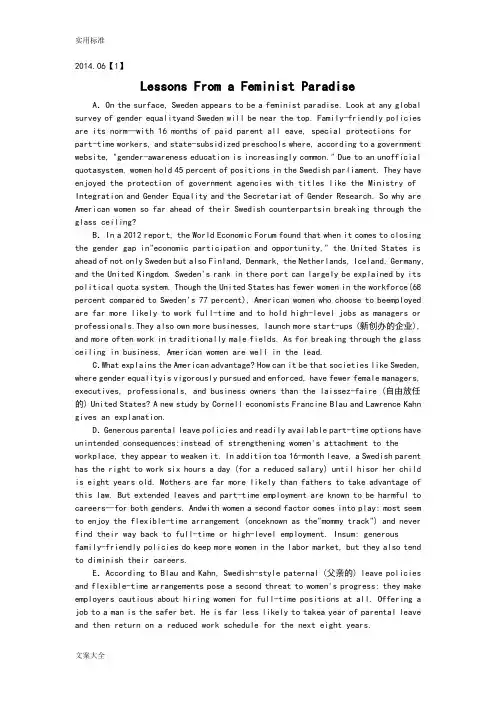
2014.06【1】Lessons From a Feminist ParadiseA.On the surface, Sweden appears to be a feminist paradise. Look at any global survey of gender equalityand Sweden will be near the top. Family-friendly policies are its norm--with 16 months of paid parent all eave, special protections for part-time workers, and state-subsidized preschools where, according to a government website, "gender-awareness education is increasingly common." Due to an unofficial quotasystem, women hold 45 percent of positions in the Swedish parliament. They have enjoyed the protection of government agencies with titles like the Ministry of Integration and Gender Equality and the Secretariat of Gender Research. So why are American women so far ahead of their Swedish counterpartsin breaking through the glass ceiling?B.In a 2012 report, the World Economic Forum found that when it comes to closing the gender gap in"economic participation and opportunity," the United States is ahead of not only Sweden but also Finland, Denmark, the Netherlands, Iceland, Germany, and the United Kingdom. Sweden's rank in there port can largely be explained by its political quota system. Though the United States has fewer women in the workforce(68 percent compared to Sweden's 77 percent), American women who choose to beemployed are far more likely to work full-time and to hold high-level jobs as managers or professionals.They also own more businesses, launch more start-ups (新创办的企业), and more often work in traditionally male fields. As for breaking through the glass ceiling in business, American women are well in the lead.C.What explains the American advantage? How can it be that societies like Sweden, where gender equalityis vigorously pursued and enforced, have fewer female managers, executives, professionals, and business owners than the laissez-faire (自由放任的) United States? A new study by Cornell economists Francine Blau and Lawrence Kahn gives an explanation.D.Generous parental leave policies and readily available part-time options have unintended consequences:instead of strengthening women's attachment to the workplace, they appear to weaken it. In addition toa 16-month leave, a Swedish parent has the right to work six hours a day (for a reduced salary) until hisor her child is eight years old. Mothers are far more likely than fathers to take advantage of this law. But extended leaves and part-time employment are known to be harmful to careers--for both genders. Andwith women a second factor comes into play: most seem to enjoy the flexible-time arrangement (onceknown as the"mommy track") and never find their way back to full-time or high-level employment. Insum: generousfamily-friendly policies do keep more women in the labor market, but they also tend to diminish their careers.E.According to Blau and Kahn, Swedish-style paternal (父亲的) leave policies and flexible-time arrangements pose a second threat to women's progress: they make employers cautious about hiring women for full-time positions at all. Offering a job to a man is the safer bet. He is far less likely to takea year of parental leave and then return on a reduced work schedule for the next eight years.F. I became aware of the trials of career-focused European women a few years ago when I met a post-doctoral student from Germany who was then a visiting fellow at Johns Hopkins. She was astonished bythe professional possibilities afforded to young American women. Her best hope in Germany was a government job-prospects for women in the private sector were dim. "In Germany," she told me, "we have all the benefits, but employers don't want to hire us."G. Swedish economists Magnus Henrekson and Mikael Stenkula addressed the following question in their2009 study: why are there so few female top executives in the European egalitarian (平等主义的)welfare states? Their answer:"Broad-based welfare-state policies hinder women's representation in elitecompetitive positions."H. It is tempting to declare the Swedish policies regressive (退步的) and hail the American system assuperior. But that would be shortsighted. The Swedes can certainly take a lesson from the United Statesand look for ways to clear a path for their ambitious female careerists. But most women are notcommitted careerists. When the Pew Research Center recently asked American parents to identify their"ideal" life arrangement,47 percent of mothers said they would prefer to work part-time and 20 percentsaid they would prefer not to work at all. Fathers answered differently: 75 percent preferred full-timework. Some version of the Swedish system might work well for a majority of American parents, but theUnited States is unlikely to fully embrace the Swedish model. Still, we can learn from their experience.I) Despite its failure to shatter the glass ceiling, Sweden has one of the most powerful and in novative economies in the world. In its 2011-2012 survey, the World Economic Forum ranked Sweden as the world's third most competitive economy; the United States came in fifth. Sweden, dubbed the "rocks tar of the recovery" in the Washington Post, also leads the world in life satisfaction and happiness. It is a society well worth studying, and its efforts to conquer the gender gap impart a vital lesson--though notthe lesson the Swedes had in mind.J) Sweden has gone farther than any other nation on earth to integrate the sexes and to offer women the same opportunities and freedoms as men. For decades, these descendants of the Vikings have been trying to show the world that the right mix of enlightened policy, consciousness raising, and non-sexist child rearing would close the gender divide once and for all. Yet the divide persists.K) A 2012 press release from Statistics Sweden bears the title"Gender Equality in Sweden Treading (踩)Water" and notes:~ The total income from employment for all ages is lower for women than for men.~ One in three employed women and one in ten employed men work part-time.~ Women's working time is influenced by the number and age of their children, but men's working time is not affected by these factors.~ Of all employees, only 13 percent of the women and 12 percent of the men have occupations with an even distribution of the sexes.L) Confronted with such facts, some Swedish activists and legislators are demanding more extreme and far-reaching measures, such as replacing male and femalepronouns with a neutral alternative and monitoring children more closely to correct them when they gravitate (被吸引) toward gendered play. When it came to light last year that mothers, far more than fathers, chose to stay home from work to care for their sickkids, Ulf Kristersson, minister of social security, quickly commissioned a study to determine the causes of and possible cures for this disturbing state of affairs.M) Swedish family policies, by accommodating women's preferences effectively, are reducing the number of women in elite competitive positions. The Swedes will find this paradoxical and try to find solutions. Letus hope these do not include banning gender pronouns, policing children's play, implementing moregender quotas, or treating women's special attachment to home and family as a social injustice. Most mothers do not aspire to (向往) elite, competitive full-time positions: the Swedish policies have given them the freedom and opportunity to live the lives they prefer. Americans should look past the gender rhetoric and consider what these Scandinavians have achieved. On their way to creating a feminist paradise, the Swedes have unintentionally created a haven (避风港) for normal mortals.46. Sweden has done more than other nations to close the gender gap, but it continues to exist.【J】47. Sweden is one of the most competitive economies in the world and its people enjoy the greatest life satisfaction.【I】48. More American women hold elite job positions in business than Swedish women.【B】49. Swedish family-friendly policies tend to exert a negative influence on women's careers.【D】50. The quota system in Sweden ensures women's better representation in government.【A】51. Though the Swedish model appears workable for most American parents, it may not be accepted by them in its entirety.【H】52. Swedish women are allowed the freedom and opportunity to choose their own way of life.【M】53. Swedish employers are hesitant about hiring women for full-time positions because of the family-friendly policies.【E】54. Gender-awareness education is becoming more and more popular in state-subsidized preschools in Sweden.【A】55. Some lawmakers in Sweden propose that gender less pronouns be used in the Swedish language.【L】2014.06【2】The Street-Level SolutionA. When I was growing up, one of my father's favorite sayings (borrowed from the humorist Will Rogers) was: "It isn't what we don't know that causes the trouble; it's what we think we know that just ain't so. "One of the main insights to be taken from the 100 000 Homes Campaign and its strategy to end chronic homelessness is that, until recently, our society thought it understood the nature of homelessness, but it didn't.B. That led to a series of mistaken assumptions about why people become homeless and what they need. Many of the errors in our homelessness policies have stemmed from the conception that the homeless are a homogeneous group. It's only in the past 15 years that organizations like Common Ground, and others, have taken a street-level view of the problem--distinguishing the "episodically homeless" from the,"chronically homeless" in order to understand their needs at an individual level. This is why we can now envisage a different approach--and get better results.C. Most readers expressed support for the effort, although a number were skeptical, and a few utterly dismissive, about the chances of long-term homeless people adapting well to housing. This is to be expected; it's hard to imagine what we haven't yet seen. As Niccol6 Machiavelli wrote in The Prince, one of the major obstacles in any effort to advance systemic change is the "incredulity of men," which is to say that people "do not readily believe in new things until they have had a long experience of them. " Most of us have witnessed homeless people on the streets for decades. Few have seen formerly homeless people after they have been housed successfully. We don't have reference points for that story. So we generalize from what we know--or think we know.D. But that can be misleading, even to experts. When I asked Rosanne Haggerty, founde of Common Ground, which currently operates 2 310 units ofsupportive housing (with 552 more under construction), what had been her biggest surprise in this work, she replied: "Fifteen years ago, I would not have believed that people who had been so broken and stuck in homelessness could thrive to the degree that they do in our buildings." And Becky Kanis, the campaign's director, commented:"There is this sense in our minds that someone who's on the streets is almost in their DNA different from someone who has a house. The campaign is creating a first-hand experience for many people that that is really not the case."E. One of the startling realizations that I had while researching this column is that anybody could become like a homeless person--all it takes is a traumatic (创伤的) brain injury. A bicycle fall, a car accident, a slip on the ice, or if you're a soldier, a head wound--and your life could become unrecognizable. James O'Connell, a doctor who has been treating the most vulnerable homeless people on the streets of Boston for 25 years, estimates that 40 percent of the long-term homeless people he's met had such a brain injury. "For many it was a head injury prior to the time they became homeless," he said. "They became unpredictable. They'd have mood swings, fits of explosive behavior. They couldn't hold onto their jobs. Drinking made them feel better. They'd end up on the streets."F. Once homeless people return to housing, they're in a much better position to rebuild their lives. But it's important to note that housing alone is not enough. As with many complex social problems, when you get through the initial crisis, you have another problem to solve which is no less challenging. But it is a better problem.G. Over the past decade, O'Connell has seen this happen. "I spend half my time on the streets or in the hospital and the other half making house calls to people who lived for years on the streets," he said. "So from a doctor's point of view it's a delightful switch, but it's not as if putting someone in housing is the answer to addressing all of their problems. It's the first step."H. Once in housing, formerly homeless people can become isolated and lonely. If they've lived on the streets for years, they may have acquired a certain standing as well as a sense of pride in their survival skills. Now indoors, those aspects of their identity may be stripped away. Many also experience a profound disorientation at the outset. "If you're homeless for more than six months, you kind of lose your bearings," says Haggerty. "Existence becomes not about overcoming homelessness but about finding food, begging, looking for a job to survive another day. The whole process of how you define stability gets reordered."I. Many need regular, if not continuous, support with mental health problems, addictions and illnesses-and, equally important, assistance in the day-to-day challenges of life, reacquainting with family, building relationships with neighbors, finding enjoyable activities or work, managing finances, and learning how to eat healthy food.J. For some people, the best solution is to live in a communal (集体) residence, with special services. This isn't available everywhere, however. In Boston, for example, homeless people tend to be scattered in apartments throughout the city.K. Common Ground's large residences in New York offer insight into the possibilities for change when homeless people have a rich array of supports. Inaddition to more traditional social services, residents also make use of communal gardens, classes in things like cooking, yoga, theatre and photography, and job placement. Last year, 188 formerly homeless tenants in four of Common Ground's residences, found jobs.L. Because the properties have many services and are well-managed, Haggerty has found posthousing problems to be surprisingly rare. In the past 10 years, there have been only a handful of incidents of quarrels between tenants. There is very little graffiti (破坏) or vandalism (涂鸦). And the turnover is almost negligible. In the Prince George Hotel in New York, which is home to 208 formerly homeless people and 208 low-income tenants, the average length of tenancy is close to seven years. (All residents pay 30 percent of their income for rent for the formerly homeless, this comes out of their government benefits. ) When people move on, it is usually because they've found a preferable apartment.M. "Tenants also want to participate in shaping the public areas of the buildings," said Haggerty. "They formed a gardening committee. They want a terrace on the roof. Those are things I didn't count on." The most common tenant demand? "People always want more storage space--but that's true of every New Yorker," she adds. "In many ways, we're a lot like a normal apartment building. Our tenants look like anyone else."N. As I mentioned, homelessness is a catch-all for a variety of problems. A number of readers asked whether the campaign will address family homelessness, which has different causes and requires a different solution. I've been following some of the promising ideas emerging to address and prevent family homelessness. Later in 2011, I'll explore these ideas in a column. For now, l'11 conclude with an update on the 100 000 Homes Campaign. Since Tuesday, New Orleans and a few other communities have reported new results. The current count of people housed is 7 043.46. Tenants in Common Ground's residences all want more room for storage.【M】47. Homes Campaign provides first-hand proof that the homeless are not what they were once believed to be.【D】48. Common Ground's residences are well-managed and by and large peaceful.【L】49. Housing the homeless is only the first step to solving all their problems.【G】50. A large percent of the chronically homeless have suffered from brain injury.【E】51. After being housed many homeless people become confused at first as to how to deal with life off the street.【H】52. Some people think the best way to help the homeless is to provide them with communal housing.【J】53. The homeless with health problems should be given regular support in their daily lives.【I】54. Until recently American society has failed to see what homelessness is all about.【A】55. Many formerly homeless tenants in New York's Common Ground's residences got hired.【K】2014.06【3】What If Middle-Class Jobs Disappear?A. The most recent recession in the United States began in December 2007 and ended in June 2009, according to the National Bureau of Economic Research. However, two years after the official end of the recession, few Americans would say that economic troubles are behind us. The unemployment rate, in particular, remains above 9%. Some labor market indicators, such as the proportion of long-term unemployed, are worse now than for any postwar recession.B. There are two widely circulated narratives to explain what's going on. The Keynesian narrative is that there has been a major drop in aggregate demand. According to this narrative, the slump can be largely cured by using monetary and fiscal (财政的) stimulus. The main anti-Keynesian narrative is that businesses aresuffering from uncertainty and over-regulation. According to this narrative, the slump can be cured by having the government commit to and follow a more hands-off approach.C. I want to suggest a third interpretation. Without ruling out a role for aggregate demand or for the regulatory environment, I wish to suggest that structural change is an important factor in the current rate of high unemployment. The economy is in a state of transition, in which the middle-class jobs that emerged after World War [[ have begun to decline. As Erik Brynjolfsson and Andrew McAfee put it in a recent e-book Race Against the Machine :"The root of our problems is not that we're in a great recession, or a great stagnation (停滞), but rather that we are in the early throes (阵痛) of a great restructuring."D. In fact, I believe the Great Depression of the 1930s can also be interpreted in part as an economic transition. The impact of the internal combustion engine (内燃机) and the small electric motor on farming and manufacturing reduced the value of uneducated laborers. Instead, by the 1950s, a middle class of largely clerical (从事文秘工作的) workers was the most significant part of the labor force.Between 1930 and 1950, the United States economy underwent a great transition. Demand fell for human effort such as lifting, squeezing, and hammering. Demand increased for workers who could read and follow directions. The evolutionary process eventually changed us from a nation of laborers to a nation of clerks.E.The proportion of employment classified as "clerical workers" grew from 5.2% in 1910 to a peak of 19.3% in 1980. (However, by 2000 this proportion had edged down to 17.4%.) Overall, workers classified as clerical workers, technical workers, managers and officials exceeded 50% of the labor force by 2000. Corresponding declines took place in the manual occupations. Workers classified as laborers, other than farm hands or miners, peaked at 11.4% of the labor force in 1920 but were barely 6% by 1950 and less than 4% by 2000. Farmers and farm laborers fell from 33% of the labor force in 1910 to less than 15% by 1950 and only 1.2% in 2000.F.The introduction of the tractor and improvements in the factory rapidly reduced the demand for uneducated workers. By the 1930s, a marginal farm hand could not produce enough to justify his employment. Sharecropping, never much better than a subsistence occupation, was no longer viable (可行的). Meanwhile, machines were replacing manufacturing occupations like cigar rolling and glass blowing for light bulbs.G.The structural-transition interpretation of the unemployment problem of the 1930s would be that the demand for uneducated workers in the United States had fallen, but the supply remained high. The high school graduation rate was only 8.8% in 1912 and still just 29% in 1931. By 1950, it had reached 59%. With a new generation of workers who had completed high school, the mismatch between skills and jobs had been greatly reduced.H.What took place after World War [[ was not the revival of a 1920s economy, with its small farmingunits, urban manufacturing, and plurality of laborers. Instead, the 1950s saw the creation of a new suburban economy, with a plurality of white-collar workers. With an expanded transportation and communications infrastructure (基础设施), businesses needed telephone operators, shipping clerks and similar occupations. If you could read, follow simple instructions, and settle into a routine, you could find a job in the post-war economy.I. The trend away from manual labor has continued. Even within the manufacturing sector, the share of production and non-supervisory workers in manufacturing employment went from over 85% just after World War [I to less than 70% in more recent years. To put this another way, the proportion of white-collar work in manufacturing has doubled over the past 50 years. On the factory floor itself, work has become less physically demanding. Instead, it requires more cognitive skills and the ability to understand and carry out well-defined procedures.J.As noted earlier, the proportion of clerical workers in the economy peaked in 1980. By that date, computers and advanced communications equipment had already begun to affect telephone operations and banking. The rise of the personal computer, and the Internet has widened the impact of these technologies to include nearly every business and industry.K.The economy today differs from that of a generation ago. Mortgage and consumer loan underwriters (风险评估人) have been replaced by credit scoring. Record stores have been replaced by music downloads. Book stores are closing, while sales of books on electronic readers have increased. Data entry has been moved off shore. Routine customer support also has been outsourced (外包) overseas.L.These trends serve to limit the availability of well-defined jobs. If a job can be characterized by a précis eset of instructions, then that job is a candidate to be automated or outsourced to modestly educated workers in developing countries. The result is what David Aut or calls the polarization of the American job market.M.Using the latest Census Bureau data, Matthew Slaughter found that from 2000 to 2010 the real earnings of college graduates (with no advanced degree) fell by more in percentage terms than the earnings of high school graduates. In fact, over this period the only education category to show an increase in earnings was those with advanced degrees.N.The outlook for mid-skill jobs would not appear to be bright. Communications technology and computer intelligence continue to improve, putting more occupations at risk. For example, many people earn a living as drivers, including trucks and taxicabs. However, the age of driverless vehicles appears to be moving closer. Another example is in the field of education. In the fall of 2011, an experiment with an online course in artificial intelligence conducted by two Stanford professors drew tens of thousands of registrants (报名者). This increases the student-teacher ratio by a factor of close to a thousand. Imagine the number of teaching jobs that might be eliminated if this could be done for math, economics, chemistry, and so on.O.It's important to bear in mind that when we offer a structural interpretation of unemployment, a "loss of jobs" means an increase in productivity. Traditionally, economists have argued that productivity increases are a good thing, even though they may cause unemployment for some workers in the short run. In the long run, the economy does not run out .of jobs. Rather, new jobs emerge as old jobs disappear.The story we tell is that average well-being rises, and the more people are able to adapt, the more widespread the improvement becomes。
2014年6月大学英语六级真题及答案真题+听力原文+答案详解.docx

2014 年 6 月英语六级真题及答案Part I WritingDirections: For this part, you are allowed 30 minutes to write a short essay on the topic of Due Attention Should Be Given to the Study of Chinese Yo u should write at Chinese. least 120 words following the outline given belo w:1.近年来在学生中出现了忽视中文学习的现象;2.出现这种现象的原因和后果;3我认为,Given Due Attention Should Be Given to the Study of ChinesePart II Reading Comprehension (Skimming and Scanning) (15 minute s)Directions: In this part, you will have 15 minutes to go over the passage qu ickly and answer the questions on Answer sheet 1. For questions 1-7, choo se the best answer from the four choices marked A), B), C) and D). For qu estions 8-10, complete the sen-tences with the information given in the pas sage. Welcome,Freshmen. Have an iPod.Taking a step that many professors may view as a bit counterproductive, so me colleges and universities are doling out Apple iPhones and Internet-cap able iPods to their students.The always-on Internet devices raise some novel possibilities, like tracking where students gather together. With far less controversy, colleges could s end messages about canceled classes, delayed buses, campus crises or just the cafeteria menu.While schools emphasize its usefulness —online research in class and inst ant polling of students, for example — a big part of the attraction is, undou btedly, that the iPhone is cool and a hit with students. Being equipped with one of the most recent cutting-edge IT products could just help a college o r university foster a cutting-edge reputation.Apple stands to win as well, hooking more young consumers with decadesof technology pur- chases ahead of them. The lone losers, some fear, could be professors.Students already have laptops and cell phones, of course, but the newest de vices can take class distractions to a new level. They practically beg a user to ignore the long-suffering professor strug- gling to pass on accumulated wisdom from the front of the room — a prospect that teachers find most irr itating and students view as, well, inevitable.“ When it gets a little boring, I might pull it out,‖acknowledged Naomi P ugh, a first-year student at Freed-Hardeman University in Henderson, Ter m., referring to her new iPod Touch, which can connect to the Internet ove r a campus wireless network. She speculated that professors might try even harder to make classes interesting if they were to compete with the devices. Experts see a movement toward the use of mobile technology in educati on, though they say it is in its infancy as professors try to come up with us eful applications. Providing powerful hand- held devices is sure to fuel deb ates over the role of technology in higher education.“ We think this is the way the future is going to work,‖said Kyle Dickson, co-director of re- search and the mobile learning initiative at Abilene Chris tian University in Texas, which has bought more than 600 iPhones and 300 iPods for students entering this fall.Although plenty of students take their laptops to class, they don’t take the m everywhere and would prefer something lighter. Abilene Christian settle d on the devices after surveying students and finding that they did not like hauling around their laptops, but that most of them always carried a cell ph one, Dr. Dickson said.It is not clear how many colleges and universities plan to give out iPhones and iPods this fall; officials at Apple were unwilling to talk about the subje ct and said that they would not leak any institution plans’s.“ We can’t announce other people’s news,‖saidGreg Joswiak, vice presid ent of iPod and iPhone marketing at Apple. He also said that he could not d iscuss discounts to universities for bulk purchases.At least four institutions — the University of Maryland, Oklahoma Christi an University, Abilene Christian and Freed-Hardeman — have announced t hat they will give the devices to some or all of their students this fall.Other universities are exploring their options. Stanford University has hire d a student-run com-pany to design applications like a campus map and dir ectory for the iPhone. It is considering whether to issue iPhones but not sur e it, snecessary, noting that more than 700 iPhones were registered on the u niversity network’s last year.At the Massachusetts Institute of Technology, iPhones might alreadyhave been everywhere, if AT&T, the wireless carrier offering the iPhone in the United States,had a more reliable network, said Andrew Yu, mobile devices platform pro ject manager at M.I.T.“ We would have probably gone ahead with this, maybe just getting a thou sand iPhones and giving them out, ‖Mr. Yusaid.The University of Maryland at College Park is proceeding cautiously, givi ng the iPhone or iPod Touch to 150 students, said Jeffrey Huskamp, vice p resident and chief information officer at the university. ― Wedon’t think tha t we have all the answers, Mr‖. Huskamp said. By observing how students use the gadgets, he said,― We’ retrying to get answers from the students. ‖ At each college, the students who choose to get an iPhone must pay for mo bile phone service. Those service contracts include unlimited data use. Both the iPhones and the iPod Touch devices can connect to the Internet throu gh campus wireless networks. With the iPhone, those networks may provid e faster connections and longer battery life than A T&T’s data network. Many cell phones allow users to surf the Web, but only some newer ones are c apable of wireless connection to the local area computer network. University officials say that they have no plans to track their students (and Apple said it would not be possible unless students give their permission). They say that they are drawn to the prospect of learning applications outsid e the classroom, though such lesson plans have yet to surface.“ My colleagues and I are studying something called augmented reality (a field of computer research dealing with the combination of real-world and virtual reality), said‖ Christopher Dede, professor in learning technologies at Harvard University. ― AlienContact, for‖ example, is an exer- cise develo ped for middle-school students who use hand-held devices that can determi ne their location. As they walk around a playground or other area, text, vid eo or audio pops up at various points to help them try to figure out why ali ens were in the schoolyard.“ You can imagine similar kinds of interactive activities along historical li nes, ‖like following the Freedom Trail in Boston, Professor Dede said.― It’s important that we do research, so that we know how well something like this works. ‖The rush to distribute the devices worries some professors, who say that st udents are less likely to participate in class if they are multi-tasking. ― I ’m n ot someone who’s anti-technology, but I,m always worried that technology becomes an end in and of itself, and it replaces teaching or it replaces analysis,, said’Ellen Millender, associate professor of classics at Reed College in Portland, Ore. (She added that she hoped to buy an iPhone for herself on ce prices fall.)Robert Summers, who has taught at Cornell Law School for about 40 years,announced this week — in a detailed, footnoted memorandum — that he would ban laptop computers from his class on contract law.“ I would ban that too if I knew the students were using it in class, Profes‖sor Summers said of the iPhone, after the device and its capabilities were e xplained to him. ― Whatwe want to encour- age in these students is an activ e intellectual experience, in which they develop the wide range of complex reasoning abilities required of good lawyers. ‖The experience at Duke University may ease some concerns. A few years a go, Duke began giving iPods to students with the idea that they might use t hem to record lectures (these older models could not access the Internet).“ We had assumed that the biggest focus of these devices would be consu ming the content, said‖ Tracy Futhey, vice president for informationtechn ology and chief information officer at Duke.But that is not all that the students did. They began using the iPods to creat e their own ― content, making‖ audio recordings of themselves and presenti ng them. The students turned what could have been a passive interaction in to an active one, Ms. Futhey said. 注意:此部分试题请在答题卡 1 上作答。
2014年6月英语六级阅读真题及答案
2014年6⽉英语六级阅读真题及答案 Section A Directions:In this section, there is a passage with ten blanks,You are required to select One word for each blank from a list of choices given in a word bank following the passage. Read the passage through carefully before making your choices. Each choice in the bamk is identified by a letter.Please mark the corresponding letter for each item on Answer Sheet 2 with a single line through the centre You may not use any of the words in the bank more than once. For investors who desire low risk and guaranteed income,U.S. Government bonds are a secure investment because these bonds have the financial backing and full faith and credit of the federal government.Municipal bonds,also secure,are offered by local governmengts and often have____36______such as tax-free interest.Some may even be____37______.Corportate bonds are a bit more risky. Two questions often_____38_____first-time corportate bond investors.The first is”If I purchase a corportate bond,do I have to hold it until the matueity date?”The answer is no.Bonds are bought and sold daily on ____39_____securities exchanges.However,if your bond does not have____40_____ that make it attractive to other investors, you may be forced to sell your bond at a____41____i.e., a price less than the bond’s face value. But if your bond is highly valued by other investors, you may be able to sell it at a premium, i.e., a price above its face value. Bond prices gcncrally____42____ inversely (相反地)with current market interest rates. As interest rates go up, bond pnccs tall, and vice versa (反之亦然).Thus, like all investments,bonds have a degree of risk. The second question is “How can I ___43_______ the investment risk of a particular bond issue?” Standard & Poor’s and Moody’s Investors Service rate the level of risk of many corporate and government bonds. And ____44______, the higher the market risk of a bond,the higher the interest rate. Investors will invest in a bond considered risky only if the_____45_____return is high enough. 注意:此部分试题请在答题卡2上作答。
2014年6月大学英语六级真题试卷(一)(题后含答案及解析)
2014年6月大学英语六级真题试卷(一)(题后含答案及解析)题型有:1. Writing 2. Listening Comprehension 3. 4. Reading Comprehension 5. TranslationPart I Writing1.For this part, you are allowed 30 minutes to write an essay explaining why it is unwise to jump to conclusions upon seeing or hearing something. You can give examples to illustrate your point. You should write at least 150 words but no more than 200 words.正确答案:Thinking Before Leaping! As the proverb goes, you should think before you leap. Living in the information age full of changes, we should definitely not jump to conclusions upon seeing or hearing something. Confronted with various kinds of information, modern people tend to trust whatever they have heard or read. However, we should know that information cannot be trusted until it is checked. It is evident that some information is so misleading that we should not believe it. For instance, several years ago, due to the nuclear leakage in Japan, a host of Chinese, especially middle-aged people and the seniors, rushed to buy salt, firmly believing that iodized salt could prevent radiation, which was very ridiculous. Although it is generally accepted that a picture is worth 1,000 words, some pictures cannot be trusted in this day and age, for Photoshop has prevailed all around the world. In conclusion, it is imperative for people to form the correct attitudes towards the information they see or hear. We should also not draw conclusions in a hurry. People should be educated to raise their awareness of judging right from wrong. I firmly believe a better future is awaiting us if we make every decision upon considerable thinking.Part II Listening ComprehensionSection A听力原文:W: The students have been protesting against the increased tuition.M: Yeah, I heard about the protest. But I don’t know how much good it will do. Q: What does the man mean?2.A.College tuition has become a heavy burden for the students.B.College students are in general politically active nowadays.C.He is doubtful about the effect of the students’ action.D.He took part in many protests when he was at college.正确答案:C解析:女士向男士提到了学生们正在因为学费上涨而进行抗议,男士说他也听说了这事,但他却不认为学生们的行为会起到什么好的效果。
2014年6月大学英语六级阅读真题及参考答案【2】
2014年6月大学英语六级阅读真题及参考答案【2】阅读二Opinion polls are now beginning to show that,whoever is to blame and whatever happens from now on,high unemployment is probably here to say.This means we shall have to find ways of sharing the available employment more widely.But we need to go further. We must ask some fundamental questions about the future work. Should we continue to treat employment as the norm? Should we not rather encourage many ways for self-respecting people to work? Should we not create conditions in which many of us can work for ourselves, rather than for an employer? Should we not aim to revive the household and the neighborhood, as well as the factory and the office, as centers of production and work?The industrial age has been the only period of human history in which most peopl e’s work has taken the form of jobs. The industrial age may now becoming to an end, and some of the changes in work patterns which it brought may have to be reversed. This seems a daunting thought. But, in fact, it could offer the prospect of a better future for work. Universal employment, as its history shows, has not meant economic freedom.Employment became widespread when the enclosures of the 17th and 18th centuries made many people dependent on paid work by depriving them of the use of the land, and thus of the means to provide a living for themselves. Then the factory system destroyed the cottage industries and removed work from people’s homes. Later, as transport improved first by rail and then by road, people commuted longer distances to their placesof employment until, eventually, many people’s work lost all connection with their home lives and the places in which they live.Meanwhile, employment put women at a disadvantage. In preindustrial times, men and women had shared the productive work of the household and village community. Now it became customary for the husband to go out to paid employment, leaving the unpaid work of the home and families to his wife. Tax and benefit regulations still assume this norm today, and restrict more flexible sharing of work roles between the sexes.It was not only women whose work status suffered. As employment became the dominant form of work, young people and old people were excluded—a problem now, as more teenagers become frustrated at school and more retired people want to live active lives.All this may now have to change.The time has certainly come to switch some effort and resources away from the idealist goal creating jobs for all, to the urgent practical task of helping many people to manage without full-time jobs.21.What is the main idea of the passage?A) Employment became widespread in the 17th and 18th centuries.B) Unemployment will remain a major problem for industrialized nations.C) The industrial age may now be coming to an end.D) Some efforts and resources should be devoted to helping more people cope with the problem of unemployment.22.Which of the following was NOT mentioned as a factor contributing to the spread of employment?A) The enclosures of the 17th and 18th centuries. B) Thedevelopment of factories.C) Relief from housework on the part of women. D) Development of modern means of transportation.23.It can be inferred from the passage that____.A)most people who have been polled believe that the problem of unemployment may not be solved within a short period of timeB) many farmers lost their land when new railways and factories were being constructedC) in preindustrial societies housework and community service were mainly carried out by womenD) some of the changes in work pattern that the industrial age brought have been reversed24.What does the word “daunting” in the third paragraph mean?A) Shocking B) Interesting C) Confusing D) Stimulating25.Which of the following is NOT suggested as a possible means to cope with the current situation?A) Create situations in which people work for themselves. B) Treat employment as the norm.C) Endeavor to revive the household and the neighborhood as centers of production.D) Encourage people to work in circumstances other than normal working conditions.。
2014年6月英语六级真题及答案(第一套)
2014年6月大学英语六级考试真题(一)Part I Writing (30 minutes)Directions: For this part, you are allowed 30 minutes to write an essay explaining why it is unwise to jump to conclusions upon seeing or hearing something. You can give examples to illustrate your point. You should write at least 150 words but no more than 200 words.注意:此部分试题请在答题卡1上作答。
Part II Listening Comprehension (30 minutes)Section ADirections: In this section, you will hear 8 short conversations and 2 long conversations. At the end of each conversation, one or more questions will be asked about what was said. Both the conversation and the questions will be spoken only once. After each question there will be a pause. During the pause, you must read the four choices marked A., B), C. and D., and decide which is the best answer. Then mark the corresponding letter on ,Answer Shoot 1 with a single line through the centre.注意:此部分试题请在答题卡1上作答。