
仁爱版英语七年级下册Unit6_Topic2_SectionC课件
Do you like living in this area? Why?
地区;范围
Some new words
a child
There are a lot of children under the tree. Their clothes are colorful.
Language points
1. There be + sb. /sth. + doing ... 意为“某处有某
人/某物在……”。
知
如:
识
There are some girls singing in the classroom.
总
有几个女孩在教室里唱歌。
结
2. be kind to… 对......友好
There’re _m__a_n_y_ books on the desk. 3. There’s a hospital near the bank.(改为同义句)
A hospital is __n_e_x_t _ __t_o___ the bank. 4. There’re many students on the playground. They’re
初中英语仁爱版七年级 Unit 6 Our Local Area
Topic2 My home is in an apartment building. Section C
学习目标
一、掌握以下单词和短语:such as, community, child, a lot of, sport, close, close to, far等。 二、通过对Linda居住地的描述,学习用there be句型和介词对社 区进行介绍。 三、 复习并运用所学发音规则正确朗读单词及句子。
adj. 五彩缤纷的
Some new words
close to
close to
Listen to 1a and circle True or False.
1. Linda lives in a quiet community.
True False
2. People in Yushancun are very kind to each other.
Read 1a again and fill in the blanks.
What’s in the community? 1. Many people live there. They are
1) Linda; 2) __m_a_n_y__o_ld__p_eo_p_l_e____; 3) __m_a_n_y__fa_m__il_ie_s_w__it_h_y_o_u_n_g__c_h_il_d_r_e_n____. 2. There are a lot of tall buildings. 3. There are a lot of small gardens.
“there be + … + doing”. 3. Show the picture of your ideal community and describe it to the class..
playing football. (改为同义句) There’re _m_a_n_y__st_u_d_e_n_ts__ __p_la_y_i_n_g_ __f_o_o_tb_a_l_l_ on the playground.
Homework
1. Memorize the new words and phrases. 2. Make sentences with the structure of
Listen and circle the word with the different sound in each group.
1 A. dog B. cold C. fold D. post 2 A. honest B. help C. hour D. yoghurt 3 A. boat B. coat C. road D. shot 4 A. hole B. joke C. rose D. box
Warm up
Look at the pictures of buildings. Try to say the names of them and what you can do there as quickly as you can.
Presentation
Look at the picture and say the following places in English, such as shops, school ..例. 如
for help.
True
False False False
Read the passage and underline the names of the places.
sports center shops restaurants supermarket
bookstore hospital school community service center
Listen and read the chant aloud, paying
attention to the sound
and the
liaison ( ). Then draw the rising tone
( ) and the falling tone ( ).
A Rocot of 意为“许多,大量”,等于lots of,用
来修饰可数名词复数及不可数名词。
知
a lot of = lots of = many/much
识
例:
总
There are a lot of children under the tree.
结
(=many)
There is a lot of water in the bottle.
(=much)
Pair Work
Ask and answer the following questions in pairs. Then use a few sentences to describe your community.
What kind of home do you live in? Are there many people living near your home? Is your home close to shops? Is there a community service center in your area? Do you like living there? Why?
4. There are two centers: _a__sp_o_r_t_s_c_e_n_te_r__ and a community service center.
5. There are 1) many __s_h_o_p_s____ and __re_s_ta_u_r_a_n_ts___; 2) a supermarket; 3) a _b_o_o_k_s_to_r_e___; 4) a hospital; 5) a __sc_h_o_o_l_____.
We can
use the structure “There be +… + doing”: There are many old people living here.
Exercise
Fill in the blanks. 1. Some _c_h_i_ld_r_e_n_ (child) are playing soccer over there. 2. There’re a lot of books on the desk. (改为同义句)
True False
3. In front of the building there is a sports center.
True
4. Behind the supermarket there is a hospital.
True
5. People can call the community service center
A sock or a rock?
A rock or a sock?
It's not a rock.
It's not a sock.
It's a clock.
Summary
We learn
1. some words: community, child, sport 2. some phrases: such as, a lot of, close to, far from 3. some sentences: There are many birds flying in the sky.
仁爱英语七年级Unit6-topic2笔记
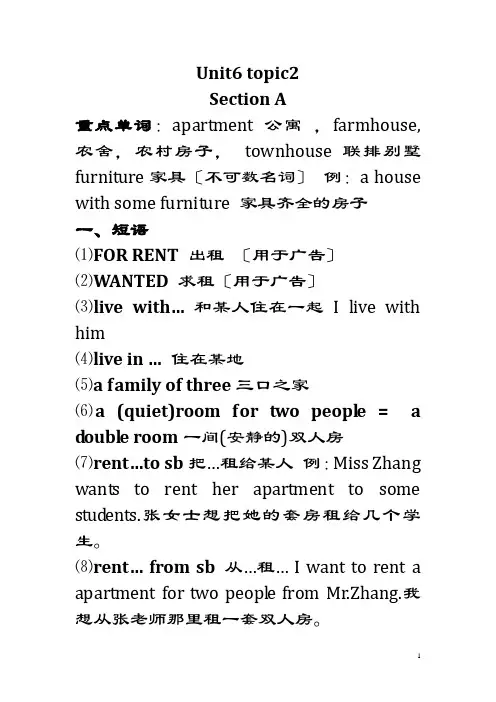
Unit6 topic2Section A重点单词:apartment 公寓,farmhouse,农舍,农村房子,townhouse 联排别墅furniture家具〔不可数名词〕例:a house with some furniture 家具齐全的房子一、短语⑴FOR RENT出租〔用于广告〕⑵WANTED求租〔用于广告〕⑶live with… 和某人住在一起I live with him⑷live in …住在某地⑸a family of three三口之家⑹a (quiet)room for two people = a double room一间(安静的)双人房⑺rent…to sb把…租给某人例:Miss Zhang wants to rent her apartment to some students.张女士想把她的套房租给几个学生。
⑻rent… from sb从…租… I want to rent a apartment for two people from Mr.Zhang.我想从张老师那里租一套双人房。
I want to rent a farmhouse from Maria⑼apartment building公寓大楼⑽be quiet安静二、重点句型⑴What kind of…?哪种…?例:What kind of home do you live in=What’s your home?I t’s a farmhouse/ an apartment注意:What kind of + 单数名词What kind of book are you reading?三、语法知识点⑴with的用法。
①有,带有例:a townhouse twofloors.一座两层的城市住宅。
two bedrooms有两间卧室的房子。
House带家具的房子,a girl with long hair有长发的女孩a boy with short hairA apartment with a bathroom②和〔某人/某物〕在一起例:I am playing football with my classmates.我在和我的同学踢足球。
仁爱英语Unit 6 Topic 2 Section C
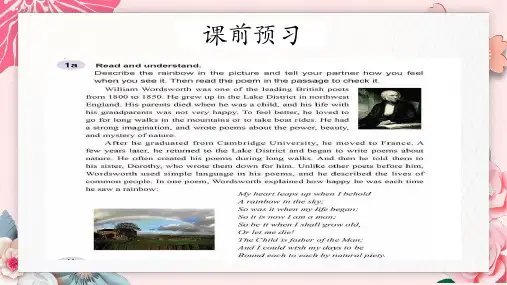
e.g. The north of China, unlike the south, is windy in spring.
He had a strong imagination, and wrote many poems about nature.
Step 02 While-reading
He grew up in_t_h_e_L__a_k_e_D__is_t_r_ic_t_ in northwest England.
十四行诗是源于意大利民间的一种抒情短 诗,文艺复兴初期时盛行于整个欧洲,其结构 十分严谨,分为上下两部分,上段为八行,下 段为六行,每行十一个音节,韵脚排列:abba abba,cdc ded。
莎士比亚的十四行诗的结构却更严谨,他 将十四个诗行分为两部分,第一部分为三个四 行,第二部分为两行,每行十个音节,韵脚为: abab,cdcd,efef,gg。这样的格式后来被称为“莎 士比亚式”或“伊丽莎白式”。
Many poets and artists have drawn their inspiration from nature.
/ˌɪnspəˈreɪʃn/ n. 灵感 When did he usually get the inspiration of writing a poem?
During long walks.
B. be held under a mountain D. be born from a magic stone F. fight against the gods
Example 添加您的分类标题
Please Add Your Text Here
单击此处输入标题
Long long ago, there was a magic stone. The Monkey King was born from it. He had a fantastic golden iron bar which could make bigger or smaller. He used the golden iron bar to fight against the gods. The king of the gods was very angry with the Monkey King, so he was held under a mountain. However, five hundred years later, he was set free by a Tang dynasty monk, Xuanzang. In the end, he helped Xuanzang travel to the West with Pigsy and Sandy.
仁爱版英语七年级下册Unit6Topic2SectionC教学设计
针对以上教学重难点,我提出以下教学设想:
1.创设情境,激发兴趣:利用多媒体课件、图片等教学资源,创设与主题相关的真实情境,让学生在情境中感知、体验英语语言,激发他们的学习兴趣。
2.分层教学,因材施教:关注学生的个体差异,对不同程度的学生进行分层教学,制定不同的学习任务和目标,使每个学生都能在原有基础上得到提高。
4.教师布置课后作业,要求学生运用所学知识进行实际运用,巩固所学。
五、作业布置
为了巩固本节课所学知识,提高学生的英语实际应用能力,特布置以下作业:
1.根据本节课所学内容,编写一段关于志愿者活动的对话,至少包含5个本节课所学的重点词汇和短语,以及3个一般现在时态的句子。
2.选择一个志愿者活动,用英语写一篇简短的介绍,包括活动目的、时间、地点等,不少于80词。
3.任务驱动,实践为主:设计多样化的课堂活动,如小组讨论、角色扮演、情景模拟等,让学生在实践中掌握知识,提高语言运用能力。
4.互动交流,合作学习:鼓励学生主动参与课堂活动,与他人进行互动交流,培养他们的合作精神和团队意识。
5.激发思维,鼓励创新:在教学过程中,教师应关注学生的思维发展,提出具有启发性的问题,引导学生进行思考和探究,激发他们的创新意识。
(二)讲授新知
1.教师呈现教材中的Section C部分,引导学生学习本节课的核心词汇和短语,如:volunteer, opportunity, patient, kindness等,并通过例句展示其用法。
2.教师讲解一般现在时态的用法,结合教材中的句子,让学生感知和理解该时态在实际语境中的应用。
3.教师通过讲解和示例,引导学生学习本节课的重点句型,如:“He/She volunteers to…”, “I have an opportunity to…”等。
仁爱版七年级英语下册课件:Unit 6 Topic 2 Section C

____________; restaurants
2) a supermarket;
3) a ___________; bookstore
4) a hospital;
5) a ___________. school
Watch and practice 1a.
There are many old people living here.
1. Memorize the new words and phrases.
2. Make sentences with the structure of
“there be + … + doing”. 3. Show the picture of your ideal community and describe it to the class..
Do you like living there? Why?
2. Write a short passage about your community. The structure in 1a may help you.
There is/are... doing... There is/are ... near/in front of/behind /next to/in/ close to/ far from... ...
1a. (2) Do you like living in this area? Why?
地区;范围
P39 1a图
There are a lot of children under the tree. (pl.) Their clothes are colorful.
adj. 五彩缤纷的
仁爱版7年级英语下册Unit6__Topic2__SectionC__参考教案
Unit6 Topic2 SectionC 参考教案I. Material analysisSection C是一节阅读、写作课,主要活动是1a,2和3a。
通过图片所创设的情景,将学生带入阅读材料的语境中,呈现一篇关于自己居住社区的周边设施的介绍,给学生提供写作的范文;还将要求学生根据1a所学内容,结合自己的实际情况写一篇介绍自己社区的短文,是一个信息输出的过程,旨在培养学生的写作能力;语音板块通过听录音完成不同的任务,来复习所学语音,培养学生的辨音能力、单词的连读、句子的升降调以及正确的朗读习惯。
本课涉及邻里关系,因此教师在教学英语知识与技能的同时,应引导学生学会和他人和谐相处,共创美好的生活氛围。
本课也是一堂阅读课,教师应该摒弃传统的满堂灌,转换为对学生阅读能力的培养,包括略读、扫读、寻找细节信息、信息转换能力等,为学生的终身英语阅读打下良好的基础。
II. Teaching aims1.Knowledge aims能根据已学语音、音标及发音规则,正确朗读并能拼写下列词汇:such as, community, child, children, a lot of, lots of, sport, close, close to, far, far from, service, area, colorful能够在篇章叙述中,熟练运用there be句型来介绍自己居住的社区、社区环境和周边设施;能够就“谈论社区环境、周边设施”等话题进行交流与陈述,如:(1)There are a lot of tall buildings and small gardens in our community.(2)There is a community service center in our area....2.Skill aims能听懂简单的课堂用语并做出适当的反应;能根据图文就居住环境和邻里关系等基本话题进行交流;能根据图文理解相关话题,并根据要求进行学习活动;能写出介绍自己居住的社区环境的短文。
仁爱版英语七年级下册Unit 6 topic 2 section D 说课稿

仁爱版英语七年级下册Unit 6 topic 2 section D 说课稿一. 教材分析仁爱版英语七年级下册Unit 6 topic 2 section D 主要讲述了一群学生在参加学校的春游活动。
通过本节课的学习,学生能够掌握一般过去时的被动语态,学会如何描述过去发生的事情。
教材内容丰富,插图清晰,练习多样,有助于提高学生的学习兴趣和积极性。
二. 学情分析七年级的学生已经掌握了基本的英语语法知识,对一般过去时有所了解。
但部分学生对被动语态的运用还不够熟练,需要在课堂上进行针对性的练习。
此外,学生的词汇量有待扩大,需要通过丰富的教学活动来提高他们的词汇水平。
三. 说教学目标1.知识目标:学生能够掌握一般过去时的被动语态,正确运用动词的过去分词形式。
2.能力目标:学生能够用英语描述过去发生的事情,提高口语表达能力。
3.情感目标:培养学生热爱生活,珍惜集体活动的情感。
四. 说教学重难点1.教学重点:一般过去时的被动语态的构成和运用。
2.教学难点:动词过去分词形式的正确运用,以及如何在实际语境中运用一般过去时的被动语态。
五. 说教学方法与手段1.采用任务型教学法,让学生在完成具体任务的过程中,自然而然地学会一般过去时的被动语态。
2.运用多媒体教学手段,如图片、视频等,激发学生的学习兴趣,提高课堂活力。
3.小组讨论,培养学生合作学习的能力。
4.进行互动式问答,引导学生主动思考,积极参与课堂活动。
六. 说教学过程1.导入:展示一组春游活动的图片,引导学生谈论自己参加过的春游活动,为新课学习做好铺垫。
2.呈现:通过展示故事插图,让学生感知一般过去时的被动语态,引出本节课的主题。
3.讲解:讲解一般过去时的被动语态的构成和用法,让学生举例练习。
4.练习:设计不同难度的练习题,让学生巩固所学知识。
5.运用:分组进行角色扮演,运用一般过去时的被动语态描述发生在过去的事情。
6.总结:对本节课所学内容进行总结,让学生复述一般过去时的被动语态的构成和用法。
仁爱初一Unit6Topic2详案(仁爱版七年级英语下册教案教学设计)
仁爱初一 Unit6 Topic 2 详案(仁爱版七年级英语下册教案教学设计)Section AMain activities: 1a, 2a and 2bTeaching periods: .1~2Teaching aims and demands:1. Talking about names and surroundings of the houses.2. Understanding the ads of renting.3. Further-studying the structure of “there be”.Teaching procedure:Step 1 Review1. The teacher shows photos/pictures to say something about his/her rooms/hours and surroundings.2. Students show their own pictures or their ideal/dreaming houses to the others. Also tell others the surroundings and rooms. Each student should say five to eight sentences for his/her picture.3. Ask students which one they prefer, apartment building, townhouse or farmhouse.Step 2 Presentation1. Give an introduction of the dialog: Wang Wei and Kangkang are talking bout their houses and their grandparents’ houses. Listen carefully and try to find out where they and their grandparents are living now, in an apartment house, in a townhouse or in a farmhouse.2. Raise questions and assign the listening tasks.Where are Wang Wei’s grandparents living?Where are Kangkang’s grandparents licing?Could Wang Wei go to play soccer with Kangkang?3. Complete the chare in 1b.4. Answer the following questions, and complete 1c.Who lives in apartment building?Who lives in townhouses?Who lives in farmhouses?Who lives in dormitories?Step 3 Consolidation1. Read the ads in 2a and make sure which ones are looking for or which ones are being let.2. Look at the ads and learn the new words: rent, furniture, quiet, single, per3. Finish 2b according to the ads.Step 4 PracticeStudents’ activities: Talk about how to write out “WANTED” or “TO LET”. The content of “WANTED” or “TO LET” includes: requirements, introduction and telephone numbers, etc.Step 5 Project1. The teacher reads out his/her own ads for renting and try to find out the suitable apartment or house among the students ads. And then write it out.2. First speak out the ads, and then write them down. Show them out on the wall. Ask each of them to find out his/her own dreaming house.Section BMain activities: 1a and 2aTeaching periods: 1~2Teaching aims and demands:1. Learning the names of facilities in the local area, such as a shop.2. Descr ibing one’s living environment.3. Making telephones for help.Teaching procedure:Step 1 Review1. Show a map of a community. Describe the facilities of the community and their functions.2. Get the students to talk about their own areas or villages.There is a small garden in front of my house.There are a lot of tall buildings in our area.Step 2 Presentation1. Hang the pictures in 1a on the wall. Introduce the pictures first in order to make the listening material easy.For example:Mike is Mary’s new neighbor. He is looking for a store. There is a store in front of their building. Also there is a bank on the street corner.2. Listen and imitate.3. Read the dialog and do pair work.4. Finish 1b and 1c.Step 3 Consolidation1. Listen to the dialog first, then read it out.2. Practice in pairs for some time.Step 4 Practice1. Finish 2b. Practice the conversation with partners, focusing on fluency.2. Students practice from mechanical exercise to meaningful exercise. Change the people, places, and things into the other ones.Step 5 ProjectMake a survey.Section CMain activities: 1 and 3aTeaching periods: 1Teaching aims and demands:1. Talking about neighbors and surroundings.2. Further-studying the structure of “there be”.3. Talk about how to get on well with neighbors.Teaching procedure:Step 1 Review1. Discuss your own area and try to answer the following questions:Is there a bank around you?Where can you buy fruits?Is there a community service centre in your area?2. Discussion:If something is broken or doesn’t work in your house, who can help you?3. Finish 1.Show posters (teaching pictures) to the students, using “there be” structure to retell the story as many as possible.Step 2 Presentation1. Present the dialog 3a with the picture. The teacher retells the story and raises questions according to the text. For example: Look! Dave is playing the piano. He is beautifully, but it is too loud. Mr. Smith is knocking at the door. Mr. Smith is talking about it to Dave. Dave is really sorry. He will try to play quietly.2. Listen and answer.Questions: what is Dave doing?Who is Dave’s neighbor?What is happening to them?3. Read the text. Ask and answer question with each other.Step 3 ConsolidationPractice 3b in pairs and then act it out.Step 4 Practice1. Discuss with your partner “How do you get on well with your neighbors? Are you a good neighbor?”2. Finish 4.First practice in pairs and then group work. At last arrange all the answers into an article.3. Song time: finish 5.Step 5 ProjectSay something about your neighbor’s family, their daily activities, then write it out. Subject: My Neighbor. Use the words in Section B as many as possible.Section DMain activities: 1and 4Teaching periods: 1Teaching aims and demands:Review the structure of “there be”.Teaching procedure:Step 1 Review1. Beginning songs Home on the Range.2. Say something about your house or building, then answer the following questions:Which type of home do you live?Where do you want to live?Do you have a good neighbor?3. Finish 1. Try to find out more words pronounced with.Step 2 Presentation1. Show the pictures and say something about them.2. Read the text and fill in the form with “suburbs” or“cities”.3. Answer the questions:Why do so many people dislike living in the cities?Why do they like living in the suburbs?Which one do you prefer, living in the cities or living in the suburbs?What’s the opinion of your classmates?4. Finish 4b.Step 3 Consolidation1. Further study 3a, 3b. Summarize the uses of the “there be” structure and useful expressions.2. Listen to the tape. Finish 4b.Step 4 Practice1. Answer the question in 5.2. Write out an article according to the answers.Step 5 Project1. Write a passage with about 50 words. The title is “I like living in the cities/suburbs”.2. Finish 6. Class activities: Let’s chant.Teaching assessment:Dictation。
仁爱版七年级下册英语课件:Unit6Topic1SectionA
garden Where is she dancing?
What’s she doing?
She is eating.
Where Biblioteka s she eating? dining room
What’s he He is dwoaintcgh?ing TV.
________n__e__x__t on.
haesrotbfoae,darodiosemsk.,
In her study, there so勇m于开e始b,o才o能k找s到a成nd so
功的路
➢Useful expressions and prepositions of position in 1a
on the second floor
There are two bedrooms on the second floor.
There is a study on the second floor.
on the first floor
3. Draw a picture of your home and then talk about your favorite room with your group members.
bedroom living room garden bathroom study
dining room kitchen
There is a kitchen on the first floor. There is a dining room on the first floor. There is a living room on the first floor. There is a bathroom on the first floor.
Unit 6 Topic 3【复习课件】七年级英语下册单元复习(仁爱版)
crosswalk
traffic lights
Anything else?
Task 8.Look at each sign and match it with its
meaning.
You can learn words and
phrases by connecting them
to signs, symbols, diagrams
2
Hospital
Bank
Post Office
Bridge Bookstore
Park
Library
Shengli Road
Zhongshan Road
School
Restaurant
Supermarket
A
A: Excuse me, how can I get to the library? B:__G__o_a_l_o_n_g_X_i_n_h_u_a_S_t_r_e_etand________________t_u_rn__right at the first
英
语
仁爱版 七年级下册
Unit 6 Our Local Area Topic 3 How can I get to the library?
仁爱版 英语七年级下册
基础知识过过过 轻轻松松进课堂 高频考点导导航 研析考题点迷津 梳理语法建支架 指导写作构思路
W基础ar知m识ing up
一、快速说出下列单词或短语。
Restaurant
Supermarket
A
A: Excuse me, how can I get to the library? B: Go along Xinhua Street and turn right at the first crossing. It's about twenty meters along on the left.
仁爱版英语七年级下册Unit 6 Topic 2 Section A课件
Key points
4. But now I’m on vacation. 但我现在在度假。 on 指“处于……情况或状态” 这种用法常见的短语有:
在度假 on holiday在线 on line 热销中 on sale 在出差 on business
•Steps(步骤) for the spring field trip
1. decide on the place to go 你计划去哪里? Where do you plan to go? 你为什么去那里? Why do you want to visit it? 去某地参观/旅游 go on a visit/trip to sp. 2. choose proper vehicles 哪一种是我们郊游的最佳方式?
I’d like to book some train tickets to Mount Tai. 去泰山的火车票价格多少?
How much does it cost to get to Mount Tai by train? What’s the price of the train tickets to Mount Tain? 4. book some rooms 5. buy enough food and drinks prepare some money…
Key points
• 1. Glad to receive your postcard.
• =I’m glad to receive your postcard.
• receive v. 收到,接到,表示客观上收到 • receive sth. from sb.从某人那获得某物 • send sth to sb. 把某物送/寄给某人 • 【链接】accept v. 接受,表示主观上接受 • I r_e_c_e_iv_e_d_ his invitation but I didn’t__a_c_ce_p_tit.