
(外研版)三年级英语下册教案 module5
Module 5 TimeUnit 1 I get up at seven o’clock主备:田小沛主讲:第一课时一、【教学目标】:a) 认知目标:掌握“整点”时间表达法,并能在实际学习和生活中运用英语交流、谈论。
b) 情感目标;在活动中培养学生的合作精神及自评、互评意识。
c) 能力目标:培养学生听、说、读、画、猜的能力和综合运用英语的能力。
二、【教学重、难点】:I get up at seven o’clock.三、【教具准备】:实物钟表一个、单词卡片三张、四、【教学程序】:1.Warming-up老师把学生已经学过的数字1——12写在黑板上,安顺时针方向成圆形摆放12个数字,连线后即组成一个钟面。
老师板书数字的同时学生快速说出该数字,说得最快速最准确得学生可以得到小贴纸。
2.presentation :热身复习后,老师在黑板上将十二个数字连线圈成一个钟面,问学生:“what’s this?”全班学生掌握该单词后,老师将事先准备好的一长一短两个指针用磁铁贴到黑板上,时间显示为七点整,教师指着钟面说:“what’s the time? It’s seven o’clock.”教授新单词:o’clock。
3.practise教师随意拨动时针,比比看全班谁认读时间最快最准确。
可以四个人一组进行活动,一个学生拨动时针,其他三个学生抢答时间,做此活动前,老师需提前布置学生准备好自制的简易时钟。
4.productiona、老师播放录音,请学生注意听课文中提到的具体时间,一遍录音过后,请学生两人一组说出所听到的具体时间。
然后请几组学生向全班说。
b、老师把本课的挂图贴在黑板上,播放录音,呈现课文内容。
听过录音后,请学生说出大明的日常活动时间表,同时,老师将相应活动的单词卡片贴在黑板上。
C、老师再次播放录音,请学生模仿跟读课文,要求学生边跟读边指向相应的图片。
其后,请学生在小组内合作背诵课文,最后请学生在全班展示背诵课文。
4.homework听录音,背诵课文。
把自己制作的时间表展示给家长看,并向他们做介绍。
为自己的家长设计制作英文时间表。
Module 5 TimeUnit 1 I get up at seven o’clock主备:田小沛主讲第二课时一、【教学目标】:a) 认知目标:掌握“整点”时间表达法,并能在实际学习和生活中运用英语交流、谈论。
b) 情感目标;在活动中培养学生的合作精神及自评、互评意识。
c) 能力目标:培养学生听、说、读、画、猜的能力和综合运用英语的能力。
二【教学重、难点】I get up at seven o’clock.三、【教具准备】:实物钟表、单词卡片四、【教学程序】:21.review the text1)教师指生读课文。
2)开火车读课文。
2.Act out the text.例如:I get up at seven o’clock. 学生边说课文内容,边做动作。
talk about youselfthe teacher ask :what time do you get up/ go to school/have lunch /go to bed ?the students ansewer:practise in pairs .3.learn activity 3老师讲活动3 的挂图展示给学生,请学生根据挂图内容说出相关的动词词组。
然后,老师拿出小鸟的头饰。
请学生扮演小鸟,并说出小鸟一天的日常活动安排。
完成课堂活动用书第一单元练习3请一个能力较强的学生到前面来,讲述盼盼的日常生活安排。
然后,学生在小组内进行联系,对于能力较弱的学生,可通过小组称愿合作完成任务。
4.再次听录音,跟读课文。
5.homework.背诵课文教学反思:来源于:苏科全科网Module 5 TimeUnit 2 What’s the time, please?主备:马向聪主讲:第一课时【教学目标】:1.让学生学会珍惜时间,培养学生的礼貌习惯。
2.学习询问和说明时间。
3.学习两个英语字母。
培养学生听、说、读、写的能力以及用英语做事的能力。
【教学重点】:1.单词:time, half, past, have breakfast, have dinner2.语言结构:What’s the time,please? It’s half past four. You have dinner at half pastfive.【教学难点】:1.What’s the time,please?2.It’s half past four.教具准备:录音机、磁带、钟表、词组卡片(have breakfast, have dinner)。
【教学过程】:I.Warming up:Free talk:When do you get up?When do you go to school?When do you have lunch?When do you watch TV?When do you go to bed?II、Revision:1.请学生将书翻到第一单元,放录音让学生听一遍。
2.学生读课文。
3.教师分别指着每幅图上的时间问What’s the time, please?III、Presentation:41. 出示钟,将时间拨到一点整,问学生What’s the time, please? 学生回答后,请一名学生到前面拨至一个整点,启发这名学生问What’s the time, please?多做几次这样的示范后将句子What’s the time, please?写在黑板上并领读。
请学生读,并指出please在西方国家是最常用的单词,不论事情大小,please应常挂嘴边。
2.教师将整点的表示法写在黑板上:It’s ….o’clock. 写后教师领读。
学生间使用自带的钟设定不同的整点来进行问答练习。
3.教师将时间调到一点半,问学生What’s the time, please? 学生回答后教师板书It’shalf past one. 并领读。
学生间使用自带的钟设定不同的半点来进行问答练习。
4.听录音,指图。
5.教师通过图片领学生学习词组have breakfast, have dinner6.听录音,跟读。
7.学生两人指图问答。
B1. 学生读出书上表演部分的对话。
2. 学生两人一组轮流画时间,画出后A问B“What’s the time, please?”,B答出时间并猜测A在这个时间做什么事情。
提醒学生在生活中要珍惜时间。
C学习chant1.教师请学生听钟摆走动的声音,让学生模仿。
2.教师放录音,学生先听两遍。
3.再放录音,学生跟读数遍。
D游戏1.学生两人一组。
2.其中一人用手臂作钟的长短指针摆出一个时间,另一人要说出相应的时间并说明自己在这个时间内做什么事情。
E学习字母来源于:苏科全科网1.将Aa到Jj的字母卡片贴在黑板上。
让学生背字母表,背到Jj时,教师手指字母Jj请学生读出字母。
请学生分别指出大写字母J,小写字母j。
请学生观察字母Jj在四线格中的位置。
教师在黑板上打四线格,分笔划写出大写J,要求学生用手指在空中跟着写。
再叫几名学生在空中写大写字母J。
教师在黑板上写出小写字母j,要求学生用手指在空中跟着写,然后请几名学生在空中写。
请学生在自己的练习本上写五遍Jj。
2.问学生是否知道以Jj字母开头的单词,鼓励知道的同学来说。
告诉学生一起看一个以字母Jj开头的单词。
用单词卡片出示jigsaw请学生读出。
告诉学生Jj for jigsaw。
3.以同样方式学习字母Kk。
告诉学生Kk for kite。
4.教师请学生从Aa说到Kk,巩固已学过的字母。
IV、Practice:1.猜时间:教师将一面镜子对着学生,告诉学生一会他们会从镜子里看到钟上的时间,然后他们要告诉老师钟上是什么时间。
教师先设定时间,然后将钟面对着镜子,学生会从镜子中看到时间,请学生猜What’s the time?。
2.听问答设时间:活动前每组准备一个钟。
学生可以三人一组来互相询问时间。
一人问What’s the time? 一人答出一个时间,第三个人则根据第二个人所说调整钟上的时间。
几轮问答后,三人可以互换角色接着练习。
3.介绍自己的作息时间安排。
学生互相介绍自己的作息时间安排,然后请几名同学在全班同学面前说一说。
V、Summary:1.请学生自己总结整点与半点的表达方法。
2.告诉学生要学会珍惜时间。
VI、Homework assignment:6MODULE 5 TimeUnit 2 What's the time, please?主备:马向聪主讲第二课时【教学目标:】(一)知识教学点:歌曲及字母D,E,F的书写。
(二)能力训练点: 训练学生的口语表达能力。
(三)德育目标: 培养学生对外语的积极态度,发现外语学习中的New words: time give【教学重点】:歌曲及字母D,E,F的书写【教学难点】:歌曲的学习【教具准备】多媒体、录音机Useful expressions: Give… to Mr Hu. Thanks very much.You must look after/ What’s the time, please ?It’s about four thirty.Teaching Steps:StepⅠRevision1. Revise the names of clothes, classroom objects and colours.2. Revise the meaning of the word new. Ask questions like Is that yours ? (Yes, it is.) Is it new ? etc. Practise in an action chain.3. Revise the possessive pronouns.StepⅡPresentation1. Look at the clock and say What’s the time ? It’s (the time ). Write the time in numbers on the Bb. Point to the clock and say That is a clock. Now point to your watch and say This is a watch. If anyone has a watch, say That’s a nice watch.. Is it new ? You must look after it.2. Write watch on the Bb and have the class practise pronouncing it .Teaching this new word.3. Ask a student to give you his/her watch. Then say Whose watch is this ? (It’s hers /his /Wei Hua’s.) Turn to another student and ask him or her to return the watch to i ts owner. Say Please give it to…Write the phrase Give it to on the Bb and explain the meaning.StepⅢListen, read and say1. SB Page 71, Part 1. Ss look at the picture. Then ask these questions: What can you see in the picture ?2. Ss listen to the tape and answer What is the teacher’s name ?3. Play the tape again and get the class to listen and repeat. Let the students read the dialogue in groups of three.来源于:苏科全科网4. Ss work in three, then ask some groups to act their dialogue.StepⅣListen, read and say1. SB Page 71, Part2. Ss listen to the tape and answer these questions: What colour is Li Lei’s watch ? Whose watch is at home ? What’s the time, please ?2. Write the phrase It’s about on the Bb and explain the meaning. As well, explain that in 4:30, the 4 refers to the hour and 30 refers to the number of minutes after the hour. Give more examples: 12:30, 6:30, 5:20, 5:15, 4:40, 4:45, 2:50, etc.3. Ss listen to the tape and repeat. Then Ss work in fours.4. Ask some groups to act out their dialogues. They should act, not just say!StepⅤPracticeWrite down times like 7:10, 7:25, 8:30, 9:45, etc. on the Bb or use a clock. Ask the students What’s the time, please ? And help the students to answer. Get the students to practisse asking each other What’s t he time, please ?StepⅥWorkbookDo Ex.1 in class. The teacher gives them an example. Do Exx.2 & 3 after class.StepⅦHomework教学反思:8。
三年级下册英语教学设计-Module 5 Unit 1 She goes to school on
三年级下册英语教学设计-Module 5 Unit 1 She goes to schoolon Mondays∣外研版(三起)一、教学背景Module 5 Unit 1是三年级下册英语中的一节课,教学内容围绕着日常生活中的行动与时间展开,让学生学会表述每个人在一周里的活动安排,以及简单的时间概念。
本节课设计的适用对象是三年级的学生,在教学过程中充分考虑学生的学习兴趣与特点,做到能够激发他们的学习动力,增加英语学习的乐趣。
此外,本教学设计以外研版(三起)为教材,符合浙江省教育教学改革的要求,有利于促进学生的全面发展。
二、教学目标1.语言技能目标:–能够准确理解并表述一周内每个人的活动安排。
–能够熟练掌握一些时间词汇,如:weekdays, weekends, Monday至Sunday 等。
–能够初步理解并熟练表述简单的时间概念,如:morning, afternoon, evening等。
2.情感目标:–培养学生的观察力和分析能力。
–提高学生的自信心,敢于用英语表述自己的活动安排。
–加强学生的团队合作和沟通交流能力。
三、教学重点1.能够准确理解并表述一周内每个人的活动安排。
2.能够熟练掌握一些时间词汇,如:weekdays, weekends, Monday至Sunday 等。
四、教学难点1.能够初步理解并熟练表述简单的时间概念,如:morning, afternoon, evening等。
2.能够较好地处理复杂的时间表达,如:What day is it today? It’s Wednesday. What do you do on Wednesdays? I go to school.五、教学过程设计5.1 新课导入根据学生的学习特点进行教学,我采用如下方式展开新课导入:1.引入新词汇及活动:weekdays, weekends, Monday至Sunday等。
2.展示一份时间表,让学生看一看并大声读出每天的活动。
Module5Unit1ShegoestoschoolonMondays.(教案)-英语三年级下册
外研版三年级下册英语Module 5《Unit 1 She goes to school on Mondays.》教案一、教材分析:本课是外研版三年级下册英语Module 5《Unit 1 She goes to school on Mondays.》的教材,主要围绕日常活动展开,学生将学习描述第三人称日常活动的句型"He/She goes to school on Mondays.",并学习相关的词汇和短语。
通过听、说、认读,学生能够理解并运用这些句型和词汇,从而能够描述他人的日常活动。
二、教学目标:1. 能够听、说、认读Monday, play, friend, go to school, on the phone, at home 等单词和短语。
2. 听懂、理解课文对话大意,能够运用正确的语音语调朗读并表演对话。
三、3. 理解并使用句型"He/She goes to school on Mondays."谈论第三人的日常活动。
四、教学重难点教学重点:1. 理解、识记本课词汇。
2. 听说并运用句型"He/She goes to school on Mondays."教学难点:理解并掌握动词第三人称单数的变化: gogoes; playplays四、学情分析:学生已经学过一些基础的英语词汇和句型,但对于动词第三人称单数的变化可能还不太熟悉。
他们具有一定的听说能力,但需要更多的练习和巩固。
因此,本节课的教学重点是帮助学生掌握新的词汇和句型,并加强对动词第三人称单数变化的理解和运用。
五、教学过程:Step 1: Warmup1. 教师与学生互动,用英语进行日常活动的问答:Teacher: "What day is it today?"Student: "Today is Monday."Teacher: "What do you do on Mondays?"Student: "I go to school on Mondays."Step 2: Presentation1. 教师展示图片或实物,教授词汇的发音和意思:Teacher: "This is Monday. Can you say 'Monday'?"Students: "Monday."Teacher: "Good! What day es after Sunday?"Students: "Monday."Teacher: "Correct! Now let's learn another word. This is 'play'. Can you say 'play'?"Students: "Play."Teacher: "Excellent! 'Play' means to have fun or engage in a game or activity. Can you give me an example sentence with 'play'?"Students: "I like to play soccer."Step 3: Practice1. 教师播放课文对话录音,让学生跟读。
外研版小学英语(三起点)三年级下册教案(全册)

外研版小学英语(三起点)三年级下册教案(全册)第一单元教学目标- 掌握单词:pen, pencil, book, bag, ruler, eraser, pencil case- 熟练掌握日常用语:What's in your bag? It's a book.- 能够正确理解和运用句型:What's in your bag? It's a pen.- 通过练培养学生的听说能力和基础词汇的记忆能力。
教学内容1. 单词和短语- pen: 钢笔- pencil: 铅笔- book: 书- bag: 书包- ruler: 尺子- eraser: 橡皮擦- pencil case: 铅笔盒- What's in your bag?: 你的书包里有什么?2. 句型- What's in your bag? It's a pen.: 你的书包里有什么?是一个钢笔。
教学步骤1. 导入新知- 通过展示相关图片或实物,向学生介绍新学的单词和短语。
读几遍单词,让学生跟读。
2. 研究新知- 引导学生边听边读单词和短语。
师生互动,让学生理解词义。
- 模仿老师的提问,让学生回答"What's in your bag?"的问题,然后用"It's a pen."来回答。
3. 基础练- 让学生分组,互相询问"What's in your bag?",并用"It's a..."来回答。
4. 巩固练- 给学生发放练册,让学生完成相关练题。
- 老师巡视课堂,确认学生的练情况。
5. 综合运用- 制作一份课堂道具箱,里面放入各种与单词和短语相关的物品,如钢笔、铅笔、书等。
- 让学生一个接一个地从道具箱里取出物品,并回答"What's in your bag?"的问题和对应的答案。
(三起点)外研版三年级英语下册《Module5_Unit2_名师教案【海南三亚】》
外研社新标准英语(三年级起始)三年级下册Module5 Unit2 Does your mum go to work on Saturdays? 教案一、教学目标1. 知识目标:(1)要求学生掌握新词汇:work, go to work, Saturday, go shopping(2)能够正确运用句型:Does she/he ... on Saturdays?来询问他人在周末做什么。
2. 技能目标:(1)能读懂,理解对话内容并回答相关问题,并有感情的表演或复述课文。
(2)能够运用所学句型Does she/he ...on Saturdays?来询问和关心他人在周末做什么。
3. 情感目标:在创设语境下,增强学生学习英语的积极性,让学生乐于开口,培养学生乐于交流,并且懂得关心他人。
二、教学重点难点:能够运用所学句型Does she/he ... on Saturdays?来询问和关心他人在周末的活动。
三、教学辅助:单词卡、多媒体课件、课堂评价四、教学过程:(一)Warm up1. Greeting.2. Play a game.(设计意图:老师以小游戏我做你说来展来进行热身,激活学生动词词组,为后面的学习做好铺垫,同时激发学生的学习兴趣。
)(二)Pre-listening由学生周日做的事自然过渡到Miss Smart和Mr Smart 会做什么,询问学生What does Miss Smart do on Saturdays? Does she go to work on Saturdays?自然引到while-listening 环节。
(三)While-listening1. Watch, listen and choose.1). Does Miss Smart go to work on Saturdays?A. She does.B. No, she doesn’t.2). Does Mrs Smart go to work on Saturdays?A. He doesn’t.B. Yes, he does.(设计意图:通过第一边整体听音,得出课文的General idea)。
三年级英语下册知识讲义-说一说(Module 5 )-外研版(三起)
学习目标能够谈论自己的喜好并询问和谈论他人的喜好。
重点:句型:1. She goes to school on Mondays.2. —Does Tom go to school on Mondays?—No, he doesn’t.3. Tom doesn’t go to school on Mondays.难点:第三人称单数在句子中的运用。
考点精讲【课文朗读】1. Cat: Do you like football?Do you play football on Mondays?Oh, you don’t!2. A: Is Amy at home?B: No, she isn’t. She goes to school on Mondays.A: Is Sam at home?B: No, he isn’t. He goes to school on Mondays too.A: Who’s that?B: It’s Tom.A: Does Tom go to school on Mondays?B: No, he doesn’t. He’s only two years old!A: Ha ha...B: Ha ha...3.Amy goes to school on Mondays.Tom doesn’t go to school on Mondays.4.Daming: The dog likes meat. The cat likes fish.Sam: Does the cat like meat?Daming: Yes, she does.5. Lingling: Does your mum go to work on Saturdays?Amy: No, she doesn’t. She goes shopping on Saturdays.Lingling: Does your dad go to work on Saturdays?Amy: No, he doesn’t. He plays football on Saturdays.6. I go to school on Mondays.My sister goes too.She goes to school on Tuesdays.And so do you.7. Mum goes to work on Mondays.And Dad goes too.He goes to work on Tuesdays.But not you.【句型赏析】1. She goes to school on Mondays. 她在星期一去上学。
外研版小学英语(三起)三年级下册全册教案
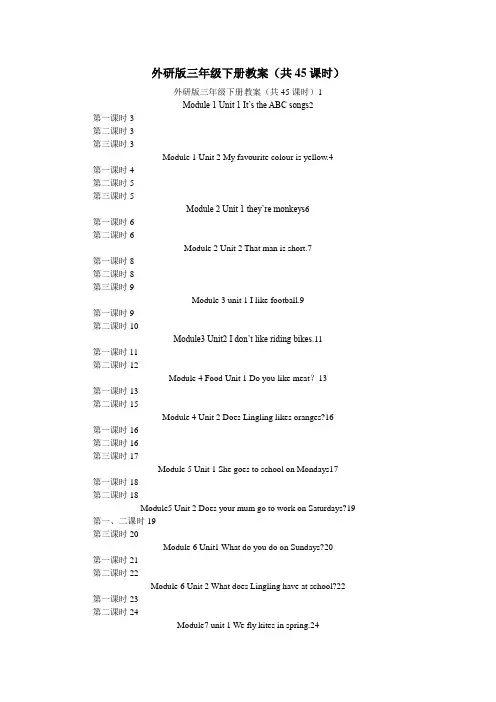
外研版三年级下册教案(共45课时)外研版三年级下册教案(共45课时)1Module 1 Unit 1 It’s the ABC songs2第一课时3第二课时3第三课时3Module 1 Unit 2 My favourite colour is yellow.4第一课时4第二课时5第三课时5Module 2 Unit 1 they’re monkeys6第一课时6第二课时6Module 2 Unit 2 That man is short.7第一课时8第二课时8第三课时9Module 3 unit 1 I like football.9第一课时9第二课时10Module3 Unit2 I don’t like riding bikes.11第一课时11第二课时12Module 4 Food Unit 1 Do you like meat?13第一课时13第二课时15Module 4 Unit 2 Does Lingling likes oranges?16第一课时16第二课时16第三课时17Module 5 Unit 1 She goes to school on Mondays17第一课时18第二课时18Module5 Unit 2 Does your mum go to work on Saturdays?19 第一、二课时19第三课时20Module 6 Unit1 What do you do on Sundays?20第一课时21第二课时22Module 6 Unit 2 What does Lingling have at school?22第一课时23第二课时24Module7 unit 1 We fly kites in spring.24第一课时25第二课时26Mo dule7 Unit 2 It’s warm today26第一课时27第二课时28Module8 Unit1 It’s on you r desk.28第一课时29第二课时30Module8 Unit 2 Daming flies a kite in the park.30第一课时31第二课时32Module9 Unit1 I’ve got a new book.32第一课时33第二课时34Module 9 Unit 2 Has Amy got a bike?34第一课时35第二课时36Module10 unit 1 Here is a red hat.37第一课时38第二课时38Module10 unit 2 She’s got an orange sweater.39第一课时40第二课时40Module 1 Unit 1 It’s the ABC songs.教学目标1.知识技能目标:能听说读写26个英文字母。
Module 5(说课稿)外研版(三起)英语三年级下册
Module 5 (说课稿)外研版(三起)英语三年级下册教学目标1.学生能够听、说、认读单词“sweater”、“skirt”、“shirt”、“jeans”、“socks”、“shoes”、“T-shirt”、“hat”、“coat”、“shorts”;2.学生能够掌握句型“What are you wearing?” “I am wearing a_____.”;3.提高学生的听力理解能力和口语表达能力;4.提高学生的英语学习兴趣,培养学生的自信心和合作精神。
教学重难点1.教学重点:掌握单词和句型;2.教学难点:掌握发音及正确使用句型。
教学方法本节课采用任务型教学法,通过与学生实际互动营造英语语境,提高学生的语言运用能力和交际能力。
同时,也采用多媒体教学手段,丰富多样的教学内容和教学方式,使学习变得更加生动有趣。
教学过程本节课以学生读音习得单词并用句型进行问答的任务显示为主线,以下为具体教学流程。
Warm-up1.利用 PPT 展示服装图片,引导学生依次快速说出图片上所示的对应英语单词。
Presentation2.利用 PPT 展示动态图片,引导学生准确读音,模仿跟读,重点讲解单词的拼写与发音。
3.将学会的单词依次展示到 PPT 上,引导学生逐一复述单词,帮助学生牢记单词并巩固发音。
Practice4.利用教师化身各种人物进行问答练习,比如教师用 What are you wearing? 提问,学生回答 I am wearing a sweater.等等。
同时,利用人物的戏剧性质,提高学生的语言表达能力。
Production5.利用多媒体教学手段展示英语歌曲,启发学生积极参与不仅丰富学生的英语知识,同时培养学生合作意识。
教学反思通过该课的教学活动,发现本节课的教学任务都是围绕任务型教学法展开的,其中的重点和难点也是我们在教学实践中需要重点把握的情况。
同时,也要注意采用了多媒体教学手段能够高效地准确地达成教学目标。
外研版小学三年级英语下册教案全册
序号
小学教案设计
集体备 授课时间
课 年月 日
names\things car doll ship Computer kite bear game
Xiao wei
Байду номын сангаас
个人备课
Play the game what’s missing? Step 5: Chant Play the tape. Help the students with the chant. Step 6: Homework Ask your family or friends’ favourite toy and colour.
小学教案设计
序号
集体备 授课时间
课 年月 日
Step5: Homework Sing the ABC Song to your family.
个人备课
Unit 2 My favourite toy is a car. Teaching aims and demands (1) My\His\Her favourite toy is a car. (2) Vocabulary: toy car ship doll computer game Teaching Functions: Talk about your favourite objects. Key points: My favourite toy is… Difficult point: His\Her\favourite… Teaching methods: Task-based; Games Teaching procedures: Step 1: warm up Sing the ABC Song and A Rainbow Step2: Leading Have the students draw a picture of the rainbow. Then ask: What’s your favourite colour? Step 3: New Concepts (1) Hold up some markers and choose one of them , Say: My favourite
外研版小学三年级下册英语教案全册教案
教学课 题 教学课 时 教学目 标
Module 1 Alphabet Unit 1 It's the ABCsong
主备教师
陈宇星
教学重 点与难 点 教学准 备及手 段 教 学 流 程
教学目 标
教学பைடு நூலகம் 点与难 点 教学准 备及手 段 教 学 流 程
复读机、配套磁带、玩具(小汽车、洋娃娃、轮船、电 脑游戏、风筝、熊)
课
型
新授课 修改部 分
初
备
一、组织引入 1、Sing "ABC song" 2、Ask and answer:What's your name? ——My name is ... 二、引入:出示玩具car, doll, ship, computer game, kite,让学生说说其中自己 最喜欢的玩具(中文)。
三、活动一:Listen and point. 1、单词学习(car, doll, ship, computer game) ①逐一出示单词卡片和相应玩具学说单词; ②传玩具说相应的单词。 ③操练单词:游戏——猜玩具 2、句子学习(My favourite toy is a ...) ①示范句子教句子:My favourite toy is a computer game. 在教读句子的时候加上节拍和动作一起帮助学生记住意思和发音。 ②学生仿照学过的句子自己选择喜欢的玩具(提供有的)进行说话练 习。 ③请说得好的孩子做小老师教其他的孩子做动作说句子。 ④小组练习角色扮演:小组里的五位孩子分别扮演书中的五个角色说 话。 ⑤检查小组练习情况,评比出表现最棒的小组,给予英语小标志奖励。 ⑥听磁带齐读句子。 四、活动二、三整合练习 1、Point and say. 2、Act it out. 五、活动四:Listen and say, then chant. 1、欣赏一遍,并根据图理解意思。 2、拍手打节奏逐一学说句子。 3、跟磁带一起打节奏Chant. 六、《活动手册》练习 1、Listen and match. 2、Now point and say. 3、Now say. 4、Ask and answer, then match. 七、布置作业:课后跟同学相互用英语交流,说说自己喜欢的玩具。
外研版三年级英语下册Module 5 谈论他人的日常活动 附答案
外研版三年级英语下册Module 5 谈论他人的日常活动一、重点字母。
抄写字母及以其为首字母的单词。
Jj jigsaw Kk kite二、重点词汇。
(英汉互译)(一)星期类1. 星期一2. 星期六(二) 动词1. 参加(体育活动、比赛等); 玩, 玩耍2. 去, 到(第三人称单数形式)(三)名词1. 电话; 电话机2. 家3. 年龄, 岁数4. 工作地点5. shopping ___________(四)短语1. go to school ______________________2. on the phone ______________________3. at home ______________________4. go to work ______________________5. go shopping ______________________(五)其他1. 在……的时候; 通过……, 以…… 的方式2. 与……在一起, 同, 跟, 和3. 在……4. only ___________三、重点句型。
(英汉互译)(一)介绍他人的日常活动1. 她每周一都去上学。
2. Mum goes shopping on Saturdays._______________________________________________________(二) 询问他人日常是否从事某项活动及答语1. ——你妈妈星期六去购物吗?——是的, 她去。
2. — Does your dad go to work on Saturdays?_______________________________________________________ —No, he doesn’t._______________________________________________________ 四、重点语法。
(一) 选词填空。