
人教版高中英语必修3精品教案
人教版高中英语必修3精品教案Unit 1 Festivals around the world语言要点(模块)Ⅰ.词语辨析(旨在提供完形填空所需材料)Ⅱ.词性变化(旨在提供语法填空所需材料)Ⅲ.重点词汇(旨在提供词汇综合运用所需材料)1. mean (meant, meant) vt.&vi. 意思是;意味着;打算;预定[典例]1). The sign means that the road is blocked. 这个标志表示此路不通。
2). What do you mean to do with it? 你打算把它怎样处理?3). I mean you to work as our spokesman. 我想请你当我们的代言人。
[重点用法](sth.) mean doing sth. 意味着… (sb) mean to do sth. 打算做…had meant to do sth. 本来打算做某事be meant for 打算作……用;打算给…(sth.) be meant to do sth. 被预定/指定/认为做某事What do/did you mean by...? “你……是什么意思?”[练习] 按要求填空或翻译。
1). Can you tell me what this sentence______ (mean)?2). Your friendship ______ (mean) a great deal ______ (介词) me.3). In some parts of London, missing a bus means ______ (wait) for another hour.4). What did he mean ______ (介词) saying that remark?5). I ______ ______ ______ ______(本来打算来)yesterday, but I had an unexpected visitor.6). 这些房间是打算用作少年活动中心的。
_______________________________________________________________________________ ___答案:1). mean 2). means; to 3). waiting 4). by 5). had meant to come6).These rooms are meant for the children’s centre.2. starve vi.&vt. (使)饿死;饿得要死starvation n.[u] 饿死[典例]1). The enemy is trying to starve us to death. 敌人正在企图饿死我们。
2). I’ m starving; let’ s have a big dinner. 我饿得要死了,让我们吃一顿丰盛的晚餐吧。
3). He said he would starve rather than beg for food. 他说他宁愿挨饿也不要饭吃。
[重点用法]starve to death = die of starvation/hunger饿死starve sb to death 把某人饿死starve for sth. = be starved of sth. = hope/long for sth. 希望/渴望得到某物[练习] 用starve的短语的适当形式填空。
1). Thousands of people ________ ________ ________ in Africa.2). These children are ________ ________ love.3). The people on the island _______ _______ _______ fresh water since it h adn’t rained fornearly half a year.Keys: 1). starved to death/died of starvation 2). starving for 3). were starved of3. belief n. [c,u] 信任;信仰;信心believe vt.&vi. 相信[典例]1). He has great belief in his doctor. 他对那位医生无比信赖。
2). She has lost her belief in God. 她已不相信上帝(不相信真有上帝)。
[重点用法]have belief in sth/sb 对某事物/人的真实性和正确性所具有的信心beyond belief 难以置信in the belief that... 相信……It is my belief that... 我相信……[练习] 用belief的短语填空。
1). He came to me ________ ________ ________ ________ I could help him.2). ________ ________ ________ ________ that nuclear weapons are immoral.3). The cruelty of the murders was ________ ________.答案:1). in the belief that 2). It is my belief 3). beyond belief4. gain vt. 获得;得到n.[c,u] 收获;获利[典例] 该词有三种含义:1). 表示经过努力一点一点地获得自己渴望的东西He has gained rich experience in these years. 这些年他已获取了丰富的经验。
2). 表示速度、重量等慢慢增加He gained weight after recovery from his illness. 康复后他的体重增加了。
3).(钟,表)走快This clock gains five minutes a day. 这只钟每天快5分钟。
[重点用法]gain experience / fame / independence 获得经验/名望/独立gain sth. from 从……处获得某物gain other’ s respect / love / trust 获得别人的尊敬/爱戴/信任No pains, no gains. 一分耕耘,一分收获。
5. admire vt. 赞美;钦佩;羡慕admiration n.[u] 钦佩;羡慕[典例]1). I admire your courage and wisdom. 我钦佩你的勇气和智慧。
2). I admired the way she had coped with life. 我钦佩她面对生活的方式。
[重点用法]admire sb. for sth./ doing sth. 在某方面钦佩某人in admiration赞美地/钦佩地[练习] 中译英。
1). 我们都钦佩他的勇气和胆识。
_______________________________________________________________________________ ___2). 所有认识他的人都羡慕他取得诺贝尔化学奖。
_______________________________________________________________________________ ___3). 我钦佩地看着那小女孩弹钢琴。
_______________________________________________________________________________ ___答案:1). We all admire him for his courage and bravery.2). All those who knew him admired him for winning the Nobel Prize for chemistry.3). I watched the girl playing the piano in admiration.6. permission n.[u] 许可;允许permit vt. /'/准许;许可;允许permit n./:/许可(证);执照[典例]You have my permission to leave. 我准你离开。
[重点用法]with/w ithout (one’ s) permission得到允许/未经允许ask sb. for permission 征求某人的许可give sb. permission to do sth.: permit sb. to do sth.允许某人做某事have one’ s permission得到某人的同意[练习] 完成句子或用括号内所提供词的适当形式填空。
1). They entered the area _______ _______ (未经允许).2). The prison authorities permit _______ (visit) only once a month.3). We have arranged to play tennis on Saturday, weather _______ (permit).4). You will need to obtain planning _______ (permit) if you want to extend your house.答案:1). without permission 2). visiting 3). permitting 4). permission7. remind vt. 提醒;使想起[典例]1). This story reminds me of my childhood. 这个故事让我想起了我的童年。
2). I reminded Gerald of his promise. 我提醒吉罗德他曾许下的诺言。
3). Please remind me to write to my mother tomorrow. 请提醒我明天给我母亲写信。
[重点用法]remind sb. of sth. 使某人想起某事remind sb. of / about sth. 提醒某人记住某事remind sb. to do sth. 提醒某人做某事remind sb. that... 提醒某人/使某人想起……[练习] 中译英。
新人教高中英语必修三Unit3 DiverseCultures-Readingforwrting教案

2019新人教高中英语必修三Unit3 Diverse CulturesReading for writing 公开课教案Teaching aims:1.Enable students to acquire some basic information about San Francisco’s Chinatown.2.Enable students to figure out the organisation and language feature of the text.3.Help students to identify the cultural characteristics of Chinatown and the relationship between Chinese culture and American multiculturalism.4.Guide students to write an introduction to your city/town and write an outline of your introduction.Teaching key points:1.Analyse the organisation and language feature of the text.2.Cultivate students to write an introduction to your city/ town properly and concisely according to an actual situation.Teaching difficult points:1.Enable students to figure out the organisation and language feature of the text.2.Guide students to introduce their city or town in a comprehensive,accurate and organised way.Teaching procedures:StepⅠBefore readingTalk about your travel experience and ask students to give you some advice and information as you plan to travel to San Francisco’s Chinatown.T:Class, I plan to travel to America and my destination will be Chinatown in San Francisco. How do you know about Chinatown? Can you give me some advice and information to help me know more about Chinatown?Ss: Firstly, it is the place where the Chinese immigrants live. Secondly, you canexplore the interesting sights,experience traditional Chinese culture, go shopping, eat Chinese food, and so on.Step ⅠWhile readingCultural NoteThe Dragon Gate is the most photographed site in San Francisco’s Chinatown.The gate was designed by three Chinese-American architects in 1967 using traditional Chinese village gates for inspiration.The Tin How Temple is the oldest Taoist temple in Chinatown,and one of the oldest Chinese temples in the United States.The temple was built in 1852,but then destroyed by the 1906 earthquake.The image of the goddess Mazu was preserved,as well as part of the altar and the bell.These were relocated to the top floor of a building constructed on the site of the old temple.The Bank of Canton is actually the old Chinese Telephone Exchange,a traditional Chinese-style building constructed in 1894.When the telephone was first introduced,there was no way to dial a number.Instead,you would have to talk to a switchboard operator (nearly always a woman),tell her the telephone number of the person you wanted to talk to,and she would manually connect you to the person you wanted to call using an electric plug.However,Chinese residents thought it was impolite to use a number to refer to a person,so the switchboard operators in Chinatown had to know all the names and addresses of everyone in Chinatown so they would know who to connect people to.They also had to know five dialects of Chinese and speak English.Like many buildings in Chinatown,the Chinese Telephone Exchange was destroyed by the 1906 earthquake,but it was quickly rebuilt.However,in 1949 it was closed when dial telephones made switchboards unnecessary.Portsmouth Square,now a public park,is the site of San Francisco’s first public square,built in the early 19th century.While many important historical events related to California and San Francisco occurred in the square before Chinatown was established or grew in size,the site is now very much considered an integral part of Chinatown.The Scottish novelist Robert Louis Stevenson (1850—1894) lived in San Francisco briefly between 1879—1880,and spent much time in Portsmouth Square during his stay there.There is a monument in his honour in the park.Activity 1Prediction1.Look at the title and picture and predict what kind of article is this?2.Who are the target readers?3.What is the writer’s purpose of writing this text?Suggested answers:1.This is an introduction to Chinatown in San Francisco.2.Visitors.3.To introduce a diverse cultural Chinatown in San Francisco to visitors.Activity 2 Reading for main ideaRead the text quickly and match the main idea of the passage.Para.1 A.The characteristic of Chinatown.Para.2 B.The history of Chinatown.Para.3 C.The introduction of Chinatown’s shops and products.Para.4 D.The origin of Chinatown.Para.5 E.The existence value of Chinatown.Para.6 F.The famous food and drinks of Chinatown.Suggested answers:Para.1:A Para.2:D Para.3:B Para.4:C Para.5:F Para.6:EActivity 3 Reading for detailsRead the passage again and answer the questions.1.What are the famous tourist sites in the Chinatown of San Francisco?2.Which is the best season to visit the Chinatown in San Francisco?3.What else can you do there?Suggested answers:1.Dragon Gate,Tin How Temple,Bank of Canton,and Portsmouth Square.2.All year round.3.We can explore the interesting sights,experience traditional Chinese culture,goshopping,eat Chinese food,and so on.Activity 4Reading for organisation and language featuresRead the text again and study the organisation and language feature.1.What information is included in the introduction? Tick the items that are mentioned.2.Underline the sentences that are used to describe the items above.Location:______________________Climate:________________________________History:_____________________________________Ethnic groups:____________________________________Languages:_____________________________________________Famous figures:_____________________________________________Famous food/drink:_______________________________________________ Tourist attractions:_________________________________________________ Businesses and industries:_____________________________________________3.Fill in the blanks to show the structure of the text.Paragraph(s)Main ideaDetails Expressions1 Introductionsh ortintrodu ction to San Francisc o’s Chinato wn2—5 Bodywhat youcan findand doin San Francisco’sChina-town23456 Summaryim portanc e of Chinato wnSuggested answers: 1.2.Location:in San FranciscoClimate:mild all year roundHistory:Chinese immigrants settled in the area during the railroad construction and gold rush periodEthnic groups:the majority of residents in Chinatown are still ethnic ChineseLanguages:many of whom do not speak English fluentlyFamous figures:Robert LouisFamous food/drink:traditional dishes from all over ChinaTourist attractions:Dragon Gate,Tin How Temple,Bank of Canton,Portsmouth SquareBusinesses and industries:souvenirs,goods,and clothing;all kinds of traditional Chinese herbal medicine;Chinese tea stores3.Pa ragraph (s)MainideaDetails Expressions1Int roducti onshortintroduction toSanFrancisco’sChinatownlocation,features,climatebiggest,oldest,very popular tourist draw,mild allyear round2—5what you2history,ethnichistorically...what started as...then turnedinto...the majority of residents...a real taste of ChinaBo dy canfindand doin SanFrancisco’sChinatowngroups,language3attractions,famous figuresfamous sites include....to name but a few,spendhours just exploring the interesting sights,smells,andsounds of China,a key site.a great place to...4storesand goodsoffer a unique range of...all kinds of...can befound,varieties of5foodtreasure,suit everyone’s taste,traditional dishesfrom all over China6 Summa ryimportance ofChinatownuniquecultureallow...to...experience...first handStepⅠ Describing a place with distinctive cultural identity1.In groups,brainstorm as much information as possible about your city/town and its culture.Then write an outline of your introduction.①What is unique about your city/town?②Is it a city/town with diverse cultures?③What examples can you give to illustrate its feature?2.Write an introduction to your city/town.The following phrases and expressions may help you.·is located in/on·has a history of...years·is divided up into·has a population of·is...in size·is home to...ethnic groups·the most popular/greatest/largest·popular festivals/foods/tourist sights include...Suggested answers:1.①My city is distinctive cultural identity.②Yes,it is a city/town with diverse cultures.③I will give examples such as history,population...to illustrate its features.2.Lijiang is an ancient city high up in the mountains of Yunnan,near the borders of Sichuan and Tibet.It was an important stop on the Ancient Tea and Horse Road,which connected central China with Myanmar and India,transporting not just tea but also silk and other goods.Lijiang’s Old Town,with a history of over 800 years,is a UNESCO World Heritage Site.Today,Lijiang is mostly known for its ethnic minority culture,especially the culture of the Naxi ethnic group.The Naxi are famous for their Dongba culture.They have their own unique written language that uses pictures and symbols.They also create beautiful arts and crafts,and are well known for their singing and dancing.Strolling around the Old Town,one can witness Naxi life much as it was hundreds of years ago.One can also try traditional Naxi food,including the air-dried pork liver,Naxi baba (a kind of flat bread),and Naxi hot pot.But if you really want to see Naxi traditional culture,it is best to visit during the Torch Festival,which usually occurs in the summer.During the festival,the streets are full of torches,bonfires,and lots of people singing and dancing.While the main ethnic group living in the area is the Naxi,there are also at least 19 other ethnic groups,including Yi,Lisu,Bai,Tibetan,and Pumi.It is easy to arrange a short homestay with an ethnic minority family to learn more about their way of life.Just outside the city,there are beautiful mountains,meadows,lakes,rivers,and gorges,offering plenty of opportunities to go hiking,kayaking,or rafting.Like much of Yunnan,the weather is always fairly mild in Lijiang,so it is fine to visit throughout the year.Lijiang can be easily reached by airplane or train,and visitors can hire bikes or cars to explore the area.It is the perfect place for tourists to experience the colourful culture of China’s ethnic minorities.StepⅠEvaluating and polishing the draft1.Exchange drafts with a e the checklist to give feedback on your partner’s draft.2.Get your draft back and revise it.3.Put up your introduction in your classroom or share it with the class.StepⅠHomework书面表达:请阅读下面有关中国题材纪录片(documentary)的对话,并按照要求用英语写一篇150个词左右的文章。
人教版高中英语必修3教案(全套)
U n it 1 F estiva l s a r ou n d th e w or ldT ea ch in g g oa l s1.. To help students learn to ta lk about festivals2.. To help students learn to read festivals and celebrations.3.. To help students learn to make phone calls, invitations and express “tha nks”4 . To help students learn to use some important w ords and ex pressions5 . To help students identify ex amples of “T he m odal verbs ”in the tex tT op i cFestivals; how festivals beg an; how festivals are celebratedV oca b u la r ybeauty , harvest, celebration, starve, orig in, relig ious, ancestor, M ex ico, feast, bone, belief, trick , poet, a rrival, g a in, independence, independent, g a ther, ag riculture, ag ricultural, aw a rd, rooster, adm ire, energ etic, Easter, c lothing , C hristian, custom, w orldw ide, fool, permission, parking , apolog ize, drow n, sadness, obvious, w ipe, w eep, remind, forg iveE x p r ession stake place, in m emory of, dress up, play a trick on, look forw a rd to, day and nig ht, as thoug h, have fun w i th, parking lot, turn up , keep one ’s w ord, hold one ’s breath, set off, remind --- of--- F u n c tion1.. M aking phone calls: M a y I speak to ---? C an I ring / call back la ter? Hold / Hang on,please. I’l l ring him / her up ag a in. J ust a m oment, please. S orry , he / she i sn’t here rig htnow .2.. Invitations: I w onder if y ou a re inerested in--- I’d like to invite y ou to --- W ould you l i ke---? C ould/ W ould y ou please ---? I’m looking forw ard to--- I’d love to, but----3.. Thanks: Thank y ou so m uch. Thanks a lot. That’s very k ind of y ou. Y ou ’rem ost w e lcom e. Don’t m ention i t. It’s a pleasure.G r a m m a rThe modal verbs ( can,could, ma y , m ig ht, w i l l , w ould, shall, should, must, can’t)T ea ch in g A id sM ultim edia facilities, tape-recorder, photos, tape-recorder, photos, diag ram sP er iod On eP r oced u r eS tep 1 W a r m in g u p⑴ W a r m in g u p b y B r a in stor m in g h olid a y s a r ou n d th e w or ld .⑵ W a r m in g u p b y g u essin g w h ich p ictu r e m a tch es w ith w h ich festiva l .⑶ W a r m in g u p b y d iscu ssin g a n d l i st in gS tudents a re required to w ork in g roups and list three m ore C hinese festivals that they know . Discuss w hen they take place, w hat they celebrate and w hat people do a t that time. Then tell the g roup w hich festival i s his/ her favourite and w hy .S tep 2 P r e-r ea d in gDiscu ssin g a n d a n sw er in gA sk students to discuss and answ er the tw o questions on P11)) It i s intended to help students bring their personal experience into the discussion of festiva l s.2)) S tudents are directed to predict the content of the reading passag e , based on the ti tle and pictures.S tep 3 R ea d in g1 .S k im m in gA sk students to read the Ex 1 on P3 , have them understand four k inds of festivals, and then ask them to sk im the reading passag e . A fter reading , ask the w hole c la ss to fil l the first l ine of the chart tog ether. Then g et them to finish the chart by them selves. A t last, have three students tell the class his/ her answ ers.2 . S ca n n in g for th e d eta iled in for m a t ion1) ) A sk students to S can the passag e and finish the true and fa lse exercise.1. The ancient people needn ’t w orry about their food. F2. Hallow een used to be a festival intended to honour the dead. T3 . Qu Y uan w as a g reat poet w ho people honour a lot in C hina.T 4 . M id-autumn Festival i s held to celebrate the end of autum n.F 5 . Easter celebrates the birth of J esus. F2 ) A sk students to scan the passag e ag a in to find out the answ ers to the first three questions of the Ex 2 on P3 . A nd then ask one student to answ er the questions and check w i th the w hole c l ass. S ug g ested answ ers:1. .Festivals of the dead a re for honouring or satisfy ing dead ancesters ancestors or others, w ho some people believe m ig ht return to help or harm liv ing people.2. .A uturn festivals a re happy events because people a re thankful that food i s ready for w inter and the hard farm w ork i s finished.3. . A t spring festivals, people usually have dances, carnivals and other activities to celebrate the end of w inter and the coming of spring .3 . Discu ssion ( g r ou p w or k )A sk students to discuss Question 4 and 5 in Ex 2 on P3 .Question 4enjoy l i f eforg et our w ork for a l ittle w hile -------R easons to festivalsand celebrationsB e proud of our customs ------Question 5The similarities:①The C hinese, J apanese and M exican festivals of the dead a l l have custom s to honour the dead.② The C hinese and J apanese g o to clean their ancestors ’g raves, and the M exicans offer food, flow ers and g ifts to the dead.TheDifference:The M ex icans eat special food that looks lik e bones, som ething the C hinese and J apanese do not do.S tep 4 . P ost r ea d in g1.. S u m m a r ize a n d fi l l in th e ch a r tHave students discuss in pairs w hich k inds of festival they think are the m ost importa nt and w hich a re the most fun.P er iod Tw o & P er iod T h r eeL a n g u a g e focu s1 . b e m ea n t to : 应该 , 得要,必须 , 应做Y ou are meant to leave a tip. 你得留下小费。
英语必修3人教版新课标unit1教案(usinglanguage)
英语必修3⼈教版新课标unit1教案(usinglanguage)英语必修3⼈教版新课标 Unit1教案(Using language)Unit 1 Using language1.教材分析(analysis of teaching material)This is the second passage of this unit. It is a narrative story about Li Fang and Hu Jin, Niulang and Zhinu also mentioned in the story. The words and sentences are simple and easy, students can get the basic meaning by themselves.2.学情分析(analysis of the students)Our students are familiar with the story of Niulang and Zhinu, that they can understand the whole story easily. There are also some new words and difficult sentences in the passage, teacher should encourage students solve them and guide them to learn more.3.教学⽬标(Teaching aims)知识⽬标(Knowledge aims)A. Words and expressions:turn up; keep one’s word; hold one’s breath; apologize; drown; obvious; wipe; weep; set off; remind…of…; forgive.B. Sentences:a. Well, he was not going to hold his breath for her to apologize. He would drown his sadness in coffee.b. It was obvious that the manager of the coffee shop was waiting for Li Fang to leave---- he wiped the tables, then sat down and turned on the TV---- just what Li fang needed!c. Magpies make a bridge of their wings so the couple can cross the river to meet on the seventh day of the seventh lunar month.能⼒⽬标(Ability aims):a.Students can get the basic meaning of the passage and can summary the whole story,then can finish the exercise on the blackboard---- the structure of the narrative story.b.Students can express their opinion about the festivals; students can say thedifferences between Valentine’s Day and Chinese valentine’s Day in English.情感⽬标(Emotional aims)Students can understand the story of Niulang and Zhinu, encourage them to learn more traditional story about our country. Raise students’ interests about the trandition.4.教学重点和难点(teaching important points and difficult points)#Teaching important points:The news words and sentences in this passage; the story of the passage.#Teaching difficult points:The structure of narrative story: introduction---- developing----climax----ending5.教学过程(Teaching procedures)Step 1 warming upPart 1 Qs:1. What do people do on Valentine’s Day?2. Have you ever received any gifts on Valentine’s Day?3. Do you think only lovers send gifts to each other on that day?Part 2 : Do we have our own Valentine’s Day in China?Qiqiaojie (乞巧节) ---- the seventh day of the seventh lunar monthWell-known poem: Eternal love between us two, Shall withstand the time apart (两情若是久长时,⼜岂在朝朝暮暮。
人教版高二年级英语必修三教案

人教版高二年级英语必修三教案【导语】高二年级有两大特点:一、教学进度快。
一年要完成二年的课程。
二、高一的新鲜过了,距离高考尚远,最容易玩的疯、走的远的时候。
导致:心理上的迷茫期,学业上进的缓慢期,自我束缚的疏松期,易误入歧路,大浪淘沙的挑选期。
因此,直面高二的挑战,认清高二,认清高二的自己,认清高二的任务,显中意义十分重大而迫切。
作者高二频道为你整理了《人教版高二年级英语必修三教案》,期望对你的学习有所帮助!【教案一】教学准备教学目标Teaching AimsKnowledge a nd Skills:1. Ge t to know about Canada.2.Grasp some reading skills.3.Stimulate the Ss’ interest and love for learning about foreign countries.Strategy and Method:1.Train the students’fast-reading ability.2.Train the students’ ability to co operate with others.教学重难点Main points :1. Introduce the information of Canada to the students.2.Train the students’reading ability —skimming,and listening abilityDifficult point :Learn different reading skil ls for different reading purposes.Teaching procedures and ways教学进程Step1. Readin g&Greeting (2`)Step2. Leading in and Warming Up (5`)1.Free talk: Do you like to go sightseeing?Which country do you like to visit?What can you see in these countries?2.QuizStep3. Fast- reading (10`)1.what is“the true north”?It refers to “the cross-Canada train.”2.Draw the route of the two girls’ traveling across CanadaStep4. Careful- reading(T&F) (15`)Step5. Consoli dation (7`)Listening & SummaryFill in the blank and retell the story课后习题HomeworkSurf the Internet to find more information about CanadaChalkboard DesigningUnit5Canada –the “the true north”-----A thip “ on the true north”Vancouver Rocky Mountains Thunder BayCalgary Lake Superior Toronto【教案二】教学准备教学目标1. 教学目标(1)知识目标:学生能掌控下列重点单词和短语的意义和用法:greet, represent, approach, expression, defend, misunderstand, adult, cheek, major, likely, in general。
人教版高中英语必修三全套教案

Module3 Unit 1 Festivals around the worldTeaching aims and demands1.topic: 1>Festivals2> how festivals begin3>how to celebrate festivals2.function: 1>RequestEg: Could you please…?Could I have …? I look forward to doing…2>ThanksEg: It’s a pleasure. /Don’t mention it.It’s very kind of you to…I’d love to …Thank you very much./Thanks a lot.You are most welcome.3.vocabulary:4.grammar:Jin can speak English well. (ability)Could you please show me the way to …? (request)May we see the awards for the team? (permission)She might give you … (possibility)The whole family will come for dinner. (promise)Often he would dress up like a rich man. (pass habit)We would be there with our friends. (promise)II.Key pointsPeriod 1-2 Warming up and fast reading1.Greetings2.Warming upStep 1 discussing the following questionsa.How was your holiday/spring festival?b.Did you go traveling?c.How much pocket money did you get?Step 2 talking1). Name some festivalsSpring Festival Dragon Boat Festival Lantam Festival Mid-Autumn Festival Army Day May Day Teachers’ Day New Year National Day Mother’s Day Children’s Day Father’s D ay Christmas Day Halloween carnival Easter Valentine Day Oben2).Ss work in groups of four and list five Chinese festivals and siscuss when theytake place , what they celevrate and one thing that people do at that time. Festivals Time of year/date Celebrate for Things to do Mid-Autumn DaySpring FestivalDragon Boat DayTomb sweeping DayLantern Festival3.Pre-reading1) What’s your favourite holiday of the year? Why?2) What festivals or celebration do you enjoy in your city or town? Do you likespending festivals with your family or with friends? What part of a festival do you like best—the music, the things to see, the visits or the food?4. Fast reading and find the answers to the following questions.A.What did ancient festivals celebrate?B.What are festivals of the dead for ?C.Why are autumn festivals happy events ? three things people do at spring festival ?Period 3-4 Intensive reading1.Read the passage paragraph and find the main ideas of each paragraphParagraph 1: All kinds of celebration in ancient time.Paragraph 2: The purpose to honour the dead and three examplesFestivals Time Things people doObenDay of the DeadHalloweenParagraph 3: The reasons Why we honour peopleFestivals Who does it celebrate ?Dragon Boat FestivalsClumbus DayIndian National FestivalParagraph 4: Autumn festivals are happy eventsParagraph 5: How people celebrate in spring festivals2.Language pointsa.They would starve if food was difficult to find…starve (v.)饿死;挨饿eg. Millions of people starved to death during the war.Starve for sth 渴望…Eg. The homeless children starve for love.Starvation (n.) 饿死Eg. Die of starvationStarvation wages 不够维持基本生活的工资b.The most ancient festivals would celebrate the end of the cold weather, plantingin spring and harvest in autumn.Celebrate (vt./vi.) 庆祝,赞颂,赞美,举行(仪式)Eg.We celebrate the new year with a party.Their courage was celebrated in all the newspaper.Celebrated (adj.) = famous 著名的,驰名的c. …because they thought these festivals would bring a year of plenty.days/years/…of plenty :富裕(尤指事物和钱)的日子,年月,生活等。
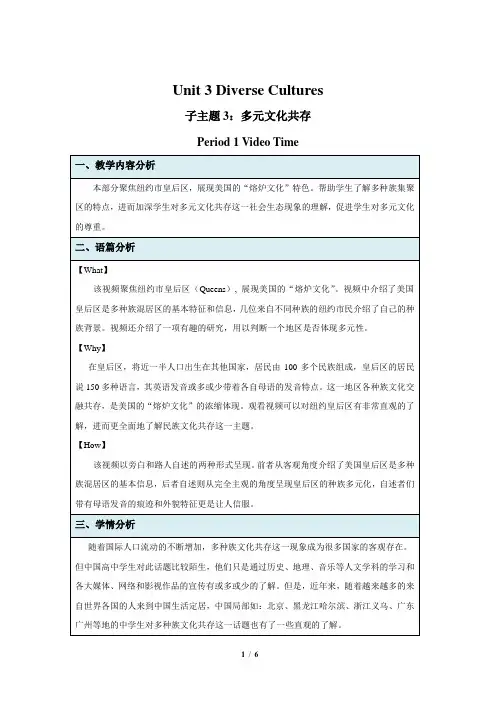
Unit 3 Diverse Cultures Video Time 精品教案【英语人教必修第三册】
Unit 3 Diverse Cultures 子主题3:多元文化共存Period 1 Video TimeWorksheetUnit 3 Video TimeActivity 1: Look and thinkStep 1: Look at the picture and think about the question.➢What kind of community do you think it is?Step 2: Look at the title and think about the question.➢What is your understanding of “melting pot”?Activity 2: Read and answerRead the introduction of the video and answer the questions.➢Where is this place?➢Why is this place considered the world’s biggest melting pot?Activity 3: Match each word or phrase with the correct definition(教材第36页BEFORE YOU WA TCH活动)Activity 4: Watch and find outWatch the video to find out the main idea.Activity 5: Watch and answer➢Who are those speakers in the video?➢What are they talking about?Activity 6: Watch and completeComplete the sentences with the correct words.(教材第36页WHILE YOU WATCH活动)Activity 7: Discuss in groups➢What kind of community do you think Queens is? Why?➢Do you think it would be easy to live in Queens if you were an immigrant? Why or why not?Activity 8: Watch and finish the tasksStep 1: Watch the video and answer the question.➢What information does the video want to convey?Step 2: Discuss the following question in pairs.➢Do you think China is a diverse country? Why or why not?Homework:1.Make a short speech titled World’s Biggest Melting Pot to introduce Queens.2.Make a short speech titled China, a diverse country to introduce China. (Optional)。
人教版英语必修三教案
人教版英语必修三教案【篇一:人教版英语必修3全套教案】人教版英语必修3 unit1-5 教案unit 1 festivals around the worldteaching aims and demands1.topic: 1festivals2 how festivals begin3how to celebrate festivals2.function: 1requesteg: could you please…?could i have …?i look forward to doing…2thankseg: it?s a pleasure. /don?t mention it.it?s very kind of you to…i?d love to …thank you very much./thanks a lot.you are most welcome.3.vocabulary:4.grammar: 情态动词的用法jin can speak english well. (ability)coul d you please show me the way to …? (request)may we see the awards for the team? (permission)she might give you … (possibility)the whole family will come for dinner. (promise)often he would dress up like a rich man. (pass habit)we would be there with our friends. (promise)ii.key pointsperiod 1 warming up and fast reading1.greetings2.warming upstep 1 discussing the following questionsa.how was your holiday/spring festival?b.did you go traveling?c.how much pocket money did you get?step 2 talking1). name some festivalsspring festival dragon boat festival lantam festival mid-autumn festivalarmy day may day teachers? daynew year national day mother?s daychildren?s day father?s daychristmas day halloween carnivaleaster valentine day oben2).ss work in groups of four and list five chinese festivals and siscuss when they take place , what they celevrate and one thing that people do at that time. then fill in the blanks.festivals time of year/date celebrate for things to domid-autumn dayspring festivaldragon boat daytomb sweeping daylantern festival3.pre-reading1) what?s your favourite holiday of the year? why?2) what festivals or celebration do you enjoy in your city or town? do you like spending festivals with your family or with friends? what part of a festival do you like best—the music, the things to see, the visits or the food?4. fast reading and find the answers to the following questions.a.what did ancient festivals celebrate?b.what are festivals of the dead for ?c.why are autumn festivals happy events ? three things people do at spring festival ?period 2-3 intensive reading1.read the passage paragraph by paragraph and find the main ideas of each paragraphparagraph 1: all kinds of celebration in ancient time.paragraph 2: the purpose to honour the dead and three examplesfestivals time things people doobenday of the deadhalloweenparagraph 3: the reasons why we honour peoplefestivals who does it celebrate ?dragon boat festivalsclumbus dayindian national festivalparagraph 4: autumn festivals are happy eventsparagraph 5: how people celebrate in spring festivals2.language pointsa.they would starve if food was difficult to find…starve 〔v.〕饿死;挨饿eg. millions of people starved to death during the war.starve for sth 渴望?eg. the homeless children starve for love.starvation (n.) 饿死eg. die of starvationstarvation wages 不够维持基本生活的工资b.the most ancient festivals would celebrate the end of the cold weather, planting in spring and harvest in autumn.celebrate (vt./vi.) 庆祝,赞颂,赞美,举行〔仪式〕eg.we celebrate the new year with a party.their courage was celebrated in all the newspaper.celebrated (adj.) = famous 著名的,著名的c. …because they thought these festivals would bring a yearof plenty.days/years/?of plenty :富裕〔尤指事物和钱〕的日子,年月,生活等。
人教版高中英语选择性必修三全册教案
人教版高中英语选择性必修三全册教案一、教材简介《人教版高中英语选择性必修三全册》是高中英语课程的一部分。
本教材适用于高中三年级选修课程。
本教材由人教版编写,内容涵盖了语法、写作、阅读、听力和口语等方面。
教材内容丰富,有趣,注重培养学生的综合语言运用能力。
二、教学目标本教案的教学目标主要包括以下几点:1.培养学生的英语语法知识和写作能力;2.提高学生的阅读理解能力;3.培养学生的听力和口语交流能力;4.帮助学生积累英语词汇和表达能力。
三、教学内容本教案的教学内容包括以下几个模块:1. 语法本模块主要包括以下几个知识点:•动词时态和语态•名词性从句•宾语从句•定语从句2. 写作本模块主要包括以下几个写作任务:•以某一主题为背景写一篇读后感•写一篇对某一事件的评论•写一篇简要说明某一原理或现象3. 阅读本模块主要包括以下几个阅读理解任务:•阅读一篇短文并回答相关问题•阅读一篇长文并总结并归纳文章的主要观点•阅读一篇对某一问题的分析,并写一篇观点陈述4. 听力本模块主要包括以下几个听力任务:•听一段对话并回答相关问题•听一段独白并回答相关问题•听一篇短文并完成相关填空任务5. 口语本模块主要包括以下几个口语任务:•情景对话练习•辩论练习•随机话题演讲四、教学方法为了达到教学目标,本教案将采用以下教学方法:1.教师讲授法:教师通过讲解语法知识点、写作要点、阅读技巧和听力技巧等内容,引导学生掌握相关知识和技能。
2.组织讨论:教师组织学生分组讨论,让学生在小组内交流和讨论教材内容,提高学生的口语表达能力。
3.实践活动:教师组织学生进行实践活动,如写作练习、口语演练和阅读小组讨论等,提高学生的综合语言运用能力。
4.自主学习:教师鼓励学生自主学习,通过阅读、听力和写作等活动,拓展学生的英语知识和能力。
五、教学评估为了评估学生的学习效果,本教案将采用以下评估方法:1.课堂小测:教师每节课后进行课堂小测,检验学生对当堂课的理解程度。
新人教版高中英语必修三Unit 3 Reading and Thinking教案
-Clear the tackle ofthenext step.
Reading
Step 6
Pair work
Teacher encourages students to use the key words and phrases learnt to discuss with their partner about the following topics:
4.Encourage students to learn more about gold rush.
重点
1.Master the usage of key words and phrases.
2.Improve the students’ ability to classify and organize information.
教学目标与核心素养
1.Learn and master the key words and phrases.
2.Train the students’ ability to organize the information.
3.Enable the students know about cultural diversity
After acknowledgingthe information and the meaning of the new words, answer the questions.
-Use video to catch students’ attention.
-Expand their horizons and spark their interest.
claim-deny
人教版高中英语必修三教案三DescribingaPerson
人教版高中英语必修三教案三DescribingaPersonTo describe someone's physical appearance, students first need to learn some basic vocabulary related to the body parts and their colors. For example, they need to master the use of adjectives such as tall, short, slim, fat, muscular, fair, dark, wavy, straight, curly, etc. They also need to learn more complex adjectives such as striking, elegant, charming, stunning, gorgeous, and so on. In this part of the lesson, students can practice their skills by describing famous people or pictures of people.The next part of the lesson covers personality and character traits. Students need to learn more adjectives such as friendly, kind, mean, selfish, stubborn, generous, honest, dishonest, etc. They also need to learn the difference between positive and negative traits. For example, a person who is determined and ambitious can be seen as positive,while someone who is bossy and domineering can be seen as negative. The students can practice their skills by asking each other and their teacher about their own and others' personalities and sharing their opinions.Finally, students need to learn how to describe someone's interests and hobbies. This part of the lesson focuses on theuse of verbs and nouns related to activities, such as swimming, dancing, painting, reading, traveling, etc. They also need to learn how to express their likes and dislikes by using adjectives such as enjoyable, fun, boring, and so on. This part of the lesson can be practiced by having the students describe their own interests and hobbies or asking other people about their hobbies and interests.In conclusion, the teaching plan of Describing a Person in the People's Education Press high school English textbook is a useful resource for students to acquire the skills needed to describe others effectively. By mastering these skills, students can improve their vocabulary, communication skills and express their ideas more vividly. Furthermore, the lessons also provide a good opportunity for students to learn more about their own and others' personalities, interests, and hobbies, which can help them to build stronger relationships with people.。