
人教版必修3高中英语 必修3 Unit 5 Using language 、
必修三 Unit 5 Canada—“The True North”Period 5 Using language: “The True North”From Toronto toMontreal学习目标:1. 阅读课文,学习相关地理知识,了解加拿大的两个城市:多伦多和曼彻斯特,欣赏这两个城市的自然美景。
2. 掌握重点单词和短语的用法。
课前预习案Previewing Case使用说明及学法指导:1. 自我学习课本38页里的内容,完成预习案。
2. 完成时间25-30分钟。
Task1 Write down the words and expressions according to the following Chinese meaning.I. 单词巩固1. v. 混合_________ 证实_________ 使惊吓___________ 使印象深刻___________2. n. 混合物__________ 灌木___________ 枫树____________ 传统__________霜_________距离_________ 薄雾__________ 同学__________货摊_________珍珠_________ 黎明__________ 自助餐__________ 3. adj.富有的___________ 有薄雾的___________市区的_________ 接近;大约__________ 宽阔的________ 附近的________恐惧的________欣喜的_______给人印象深刻的____ ___II. 短语记忆1. 在远处______________2.大约黄昏时分_______________3. 一直走到____________________4.和……闲聊_______________5. 去市中心_______________6. 讲法语____________________7. 用法语做的广告_______________ 8. 在附近的大学____________________Task 2 根据课文内容(P38)用适当的介词或副词填空。
1. Have you got any idea when we shall leave ______ Rome?2. This may occur in areas of high rainfall or in coastal areas where rivers flow ______ the ocean.3. I usually walk along the path in the countryside __________ dusk.4. We set sail ________dawn and headed straight for Shanghai.5. Do you mind if we discuss a little business ________ dinner?6. My parents often chat _________ me after supper.7. Write these words ________ small letters, not capital letters.8. Will you please go _______________ with me to do some shopping?9. Can’t you look ________ your examination exercises again?10. We used to walk ________ the river when we lived in this village.课堂探究案 Exploring CaseStep 1: Warming-upEnjoy some pictures and get some information about Torontal and Monstreal. Step 2: Reading ComprehensionⅠFast ReadingPlease find out the time mentioned in this text and all the places they have been to or they have seen. Then fill in the following chart.Time Eventsarrived in Toronto.late that nightthey spend the afternoonthe train was speeding down to theEast Coast.Ⅱ Careful ReadingRead the text carefully and answer the questions.G1:What can sometimes be seen from the CN Tower in Toronto?G2:Why is there good Cantonese food in Toronto?G3:Which direction is the train going from Toronto?G4:What three things show that Montreal is a French city?Read the text carefully again and fill in the blanks.Para.1-4 ---In Toronto1. Toronto is the ______ and______ ______ city in Canada.2. They knew fall had arrived in Canada, for they saw the red _____ _____ and ____ on the ground.3. In Toronto, they went up the tall ___ _____. On top of it they saw the misty cloud that rose from the _____ _______ ____.4. Then they saw the covered _______ and had dinner in downtown ___________, one of the _____ in Toronto.5. There is good Cantonese food in Toronto, because most of the ________ people there came from the ______ of China, especially___________. Para.5-7 ---In Montreal1. Old Montreal is close to the ______.2. There are some lovely ______ and workplaces of _______ beside the water.3. They looked over the broad__________________ in a buffet restaurant.4. Montreal is a city with wonderful _________ and ______.5. Most people speak both ______ and ______, but the city has French _______ and ________.Ⅲ SummaryThey knew fall had arrived in Canada, for they saw the red _____ _____ and ____ on the ground. In Toronto, they went up the tall ___ _____. On top of it they saw the misty cloud that rose from the _____ _______ ______ . As they walked north from the harbour, Li Daiyu phoned one of her mother’s friends from a ________ _____. It was a pity that they couldn’t go __ __ __ Ottawa. The train _______ ____ Montreal __ _____the next morning. They found Montreal is a _______________ country because there were signs and ads in French.Step 3: Language Points1.confirmThe next morning the bushes and maple trees outside their windows were red,gold and orange, and there was frost on the ground,______ that fall had arrived in Canada. (课本P38)【观察思考】What you say confirms my opinion.你的话证实了我的看法。
The expression on her face confirmed our worst fears.她脸上的表情证实了我们对发生最坏情况的忧虑。
The new evidence has confirmed the first witness’s story.新证据证明了第一个证人的说法。
He was confirmed as captain for the rest of the season.他被正式任命在这个赛季剩下的一段时间内担任队长。
【归纳总结】 confirm v.(1)________________,后加sth., that从句或wh-从句。
confirm a theory 证实一种理论(2)___________________ confirm one’s belief坚定信念confirm sb. in one’s belief/opinion/view使信念/意见/观点更加坚定(3)_________________confirm sb. in office/be confirmed in office批准某人就职 confirm a contract批准合同【拓展】 n. 证实、确认书、证明书adj. 确定的、已被证实的【即学即用】1)经过6个月的试用期之后,她获准正式担任该职。
高中英语必修3(通用)课件:unit 5 第3课时Using Language
课前新知预习
Unit 5
第三课时
成才之路 · 高中新课程 · 学习指导 · 人教版 · 英语 · 必修3 (通用本)
Ⅰ.单词速记 mix vt. & vi. 混合;调配→________ mixture n. 1.________
confirm vt. 证实;证明;批准 2.________ wealthy adj. 富有的→________ wealth n. 3.________ distant adj. distance n. 距离;远方→________ 4.________ approximately adv. 接近;大约 5.______________ broad adj. 宽阔的;广泛的 6.________ tradition n. 传统;风俗→traditional 7.________ ________ adj. impress vt. 使 铭 记 ; 使 印 象 深 刻 → ___________ impressive 8 . ________ impression n. 印象 adj.→___________
lake.(that和which引导的定语从句)
2 .她们看到了加顶的大型运动场,那是几支著名的篮球 队的驻地。 They saw the covered stadium,_________________.(home of...„„的驻地,在句中作同位语)
Unit 5 第三课时
成才之路 · 高中新课程 · 学习指导 · 人教版 · 英语 · 必修3 (通用本)
Unit 5
第三课时
成才之路 · 高中新课程 · 学习指导 · 人教版 · 英语 · 必修3 (通用本)
Ⅲ.完成句子
1 .远处,她们可以看到在湖的南边尼亚加拉大瀑布上方 升腾着的雾霭。 In the distance,they could see the misty cloud ________ rose from the great Niagara Falls,________ is on the south side of the
高中英语必修3(通用)同步练习:unit 5 第3课时Using Language
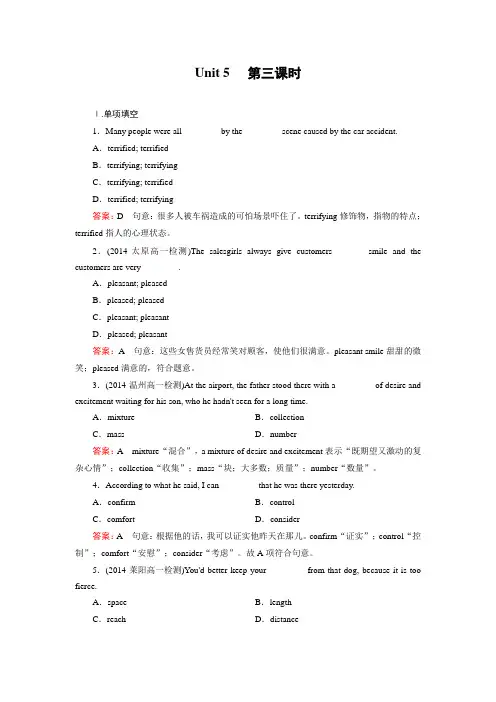
Unit 5第三课时Ⅰ.单项填空1.Many people were all ________ by the ________ scene caused by the car accident.A.terrified; terrifiedB.terrifying; terrifyingC.terrifying; terrifiedD.terrified; terrifying答案:D句意:很多人被车祸造成的可怕场景吓住了。
terrifying修饰物,指物的特点;terrified指人的心理状态。
2.(2014·太原高一检测)The salesgirls always give customers ______ smile and the customers are very ________.A.pleasant; pleasedB.pleased; pleasedC.pleasant; pleasantD.pleased; pleasant答案:A句意:这些女售货员经常笑对顾客,使他们很满意。
pleasant smile甜甜的微笑;pleased满意的,符合题意。
3.(2014·温州高一检测)At the airport, the father stood there with a ________ of desire and excitement waiting for his son, who he hadn't seen for a long time.A.mixture B.collectionC.mass D.number答案:A mixture“混合”,a mixture of desire and excitement表示“既期望又激动的复杂心情”;collection“收集”;mass“块;大多数;质量”;number“数量”。
4.According to what he said, I can ________ that he was there yesterday.A.confirm B.controlC.comfort D.consider答案:A句意:根据他的话,我可以证实他昨天在那儿。
人教课标版必修3英语Unit5_Using_Language_公开课课件(共35张PPT)
Atlantic coast. Rather than take the aeroplane
athlletnhetawkaey,tthheeytrdaeincwidfhreodamttowfleysttotwVoahneecaroseut vaecrraonsds
Canada. The thought that they could cross the
amazed t一o s般ee 过wil去d s时cenery, two cute grizzly bears, some mountain
goats and even an eagle. In Calgary, I took part in the Calgary
Stampede. Unfortunately, I didn't have a gift for riding horses and
Mountains,..Their next stop was Calgary, which is
famous for...
Part 2 The trip
Para.4-5
feelings
After two days' travel , the girls began to realize
that.... they were amazed to see ... The girls were
surprised at ...
Part 3 Feelings /Conclusion
a title
Part 1 Introduction Part 2 The trip
Part 3 Feelings
The structure of a travel journal
人教版(2023) 选择性必修第三册 Unit 5 Poems Using Language教

人教版(2023)选择性必修第三册Unit 5 Poems Using Language教案人教版(2023)选择性必修第三册Unit 5 PoemsUsing Language本节课的教材分析:《人教版(2023)选择性必修第三册Unit 5 Poems Using Language》是高二英语课本的一节课。
本单元主要介绍了诗歌的形式和韵律,如押韵、诗歌的音乐感和节奏感等。
本课程包含了两首诗歌《A Dream within a Dream》和《Daffodils》。
教学目标:1.了解和理解不同的诗歌形式和韵律。
2.掌握诗歌的音乐感和节奏感。
3.提高学生的朗读和解析诗歌的能力。
4.鼓励学生通过诗歌表达内心的情感和思考。
5.培养学生欣赏和赏析诗歌的兴趣。
教学重点:1.识别和理解不同的诗歌形式和韵律。
2.掌握诗歌的音乐感和节奏感。
3.培养学生欣赏和赏析诗歌的能力。
教学难点:1.帮助学生理解深度诗歌的内涵和意义。
2.引导学生通过诗歌表达内心的情感和思考。
学情分析:学生们已经接触过一些基本的英文诗歌,对于押韵和节奏已经有一定的了解。
他们对诗歌的欣赏和理解还比较表面,需要提高他们的解析能力和深度思考能力。
教学策略:1.激发学生的兴趣:通过多媒体展示和介绍一些优秀的诗歌作品,激发学生对诗歌的兴趣。
2.创设情境:通过图片和视频展示,创设逼真的情境,让学生更好地理解诗歌的意境和内涵。
3.启发思考:通过提问和讨论,引导学生自己去思考和解析诗歌的意义。
教学方法:1.导入新课:通过一些引人入胜的视频或音频,激发学生对诗歌的兴趣,并导入本节课的主题。
2.理论讲解:讲解诗歌的形式和韵律,并通过例子进行解释和演示。
3.师生互动:通过一些教学活动和练习,创造互动的氛围,让学生更好地理解和运用所学内容。
4.课堂合作:组织学生进行小组活动,共同分析和解析诗歌,并进行展示分享。
5.课堂展示:学生进行朗诵、表演等方式,展示他们对诗歌的理解和感受。
2019新人教高中英语选择性必修三Unit5 Poems--Using Language公开课教案

2019新人教高中英语选择性必修三Unit5Music--Using Language公开课教案Using Language1--Talk about attending a poetry contest Teaching aims:1.Enable students to master some words and expressions about preparing a poetry contest.2.Guide students to know the expressions that are used to praise and encourage somebody.3.Help students to express your own ideas on the given topics about attending a poetry contest and develop your interest in writing poems.Teaching key points:1.Master the words and expressions about preparing a poetry contest.2.Learn and use the expressions in the listening text to describe attending a poetry contest.Teaching difficult points:1.Enable students to catch the key information of the listening text.2.Enable students to express themselves on the given topics about attending a poetry contest.Teaching procedures:StepⅠLead-inBefore the class,let’s have a free talk.Design:T:Dear class, have you ever written a poem before?Ss;Yes.T:Oh,really?What did you write about?S:Love, I have written a poem before for my mother on her birthday to tell her how much I love and appreciate her.T:Wow, good for you.So, what might inspire you to write the poem?S:I might be inspired to write poems by seeing something beautiful or by beingin love,etc.I think many different things could inspire me.OrT:Dear class,have you ever written a poem before?Ss:No.T:OK,well, have you read poems?Ss:Yes.T:So,what do you think poets usually write about?Ss:Nature,love,dream,etc.T:How do they get inspired/find inspiration to write poetry? Do you know the meaning of inspire? It means to give sb the idea for sth,especially sth artistic or that shows imagination.Ss:Um, go for a walk, hike in the countryside,climb to the top of the mountain,lose a loved one,etc.StepⅠ While-listeningActivity 1Listen to Part 1 and choose the best answers1.When is the deadline for the poetry contest?A.20th.B.22nd.C.24th.2.What does Nora mean by saying that she needs time to polish her writing?A.She still needs time to change it and make it better.B.She plans to do it this weekend.C.She has finished it.3.Why doesn’t Pitt want to enter a poem contest?A.Because he thought it is meaningless.B.Because he plans to go for a hike.C.Because he can’t think of anything to write about.4.What does George plan to do?A.He plans to polish his writing.B.He plans to write his poem this weekend.C.He plans to skip the contest this year.Suggested answers:1. B2.A3.C4.BActivity 2Listen to Part 2 and find out how the students will inspire themselves to write poetryGeorgeplans to and ,so all sorts of may come into his mindNora writes best whenPittwhile working and writing poetrySuggested answers:Georgeplans to go for a hike in the countryside and sit quietly somewhere,so all sorts of interesting thoughts and words may come into his mindNora writes best when surrounded by familiar thingsPitt listens to music while working and writing poetryActivity 3Listen to the two parts again and tick the expressions you hear that are used to praise and encourage somebodyPraising and encouraging¨That’s a good idea.¨I like that idea.¨That’s a good effort.¨You are doing well.¨What a great idea!¨Your ideas sound very encouraging to me.¨Keep up the good work.¨Do your best.¨I think that’s a fantastic idea.¨You know what?That’s a good idea.¨Come on,you can do it.¨Give it your best shot. Suggested answers:√.That’s a good idea.√.What a great idea!√Keep up the good work. √Give it your best shot.StepⅠPost-listeningActivity Work in pairs and write a short conversation using the expressions that are not included in the listening materialSuggested answers:S1:I am so anxious because I think I cannot finish writing my poem before the deadline.S2:Why?You haven’t written it yet?S1:I have already written one poem but I need more time to polish it.And I don’t know what to do.S2:Eh,I think you can turn to Eric—the exchange student for help.S1:You know What?That’s a good idea.Thank you very much.S2:It’s a e on,you can do it.StepⅠSpeakingActivity 1Work in groups.Discuss entering a poem contest like the one in the listening section.The expressions in Activity 4 and the following questions may help youDiscuss entering a poem contestActivity 2Role-playMake a dialogue about entering a poem contest.One student act as the teacher and one student act as the student.Example:T:Our school is going to hold it’s yearly poem contest.Are you going to take part in it?S:Yes,I’m going to enter the yearly poem contest.T:Good for you.What kind of poem are you going to write?S:I am going to write haiku.T:That sounds great.What are the topics you would love to write about?S:I would like to write about nature and wildlife.T:What a great idea! How will you inspire yourself to write the poem?S:I will inspire myself to write the poem by visiting an ancient temple and forest in the countryside.T:You know what?That’s a good idea.Keep up the good work.S:Thank you.T:Will you use rhyming words in your poem?Why?S:I won’t use rhyming words in my poem as haiku doesn’t usually have rhyming words.T:Good job.Just give it your best shot and then you will get a good grade.StepⅠ HomeworkListen and practise reading the following poems aloud.Pay attention to the rhyming words and the rhythm of the poems.Activity Listen and circle the words you think are stressedTHE ARROW AND THE SONGI shot an arrow into the air,It fell to earth,I knew not where;For,so swiftly it flew,the sightCould not follow it in its flight.I breathed a song into the air,It fell to earth,I knew not where;For who has sight so keen and strong,That it can follow the flight of song?Long,long afterwards,in an oakI found the arrow,still unbroke;And the song,from beginning to end,I found again in the heart of a friend.H.W.LongfellowNIGHTThe sun descending in the west,The evening star does shine;The birds are silent in their nest,And I must seek for mine.The moon,like a flower,In heaven’s high bower,With silent delight,Sits and smiles on the night.Farewell,green fields and happy groves,Where flocks have took delight.Where lambs have nibbled,silent movesThe feet of angels bright;Unseen,they pour blessing,And joy without ceasing,On each bud and blossom,And each sleeping bosom.William BlakeUsing Language2--Write a poemTeaching aims:1.Enable students to assess subject,images,rhyming words and rhetorical devices of poems.2.Guide students to analyse and write an essay about a poem.3.Help students to write an original poem based on what has been learnt.Teaching key points:1.Help students to assess subjects,images,rhyming words and rhetorical device of poems.2.Help students to write an original poem based on what has been learnt.Teaching difficult points:1.Enable students to recognize subjects, images,rhyming words and rhetorical devices of poems.2.Enable students to write an original poem based on what has been learnt.Teaching procedures:StepⅠPre-reading1.Do you remember any poems you have read,either in Chinese or in English?2.Do you know how to understand a poem?Make a list of questions that the readers should consider while reading poems.The following points may help you.Tips:Tone: a quality in the writer’s voice or writing showing his/her feelings or thinking.Rhetorical devices:repetition,figurative language, smile, metaphor...Suggested answers:1.The answers vary.2.What is the subject of the poem?What is the poem about?What images does the poet use?What is the tone of the poem?What feelings and emotions does the poet try to make the reader feel?How does the poem make you feel?Which emotions is the poet trying to convey to the reader?Does the poet use rhyming words?Which rhetorical devices are used in the poem?Does the poet use alliteration(头韵)?Metaphor or simile?Repetition of words or phrases?StepⅠ While-readingActivity 1Read for the general information1.What’s the topic of each poem?2.What picture comes to your mind after you read them?3.What inspiration have you got from the poems?Suggested answers:1.Wind,dream,love.2.The answers vary.For example:I can see wind blowing across the hill and kites flying in the wind.I can even see the poet running after wind.3.The answers vary.For example:know the importance of dream,etc.Activity 2Read for the detailed informationRead the poems again and complete the table.①Wind on the hill②Dream③A MatchSubjectImagesRhymingwordsRhetoricaldevicesSuggested answers:Subject:①the wind②the dreams③loveImages:①kite,person②broken-winged bird,barren field frozen with snow ③rose,leaf,fieldsRhyming words:①knows/goes can/ran kite/night blew/too goes/knows ②die/fly go/snow ③together/weather closes/is grief/leafRhetorical devices:①repetition,alliteration②repetition,metaphor③repetition,metaphor,simileStepⅠAnalyse and write an essay about a poemActivity 1Read the example in activity 3 and answer the questionsHow does the author analyse the poem?From which aspects?aspects{Para.1Theofthepoem.{What’sthetopicofthepoem?Whatkindofpoemisit?Howdosomesentencesrhyme?Para.2The ofthepoem. Para.3The ofthepoem. Para.4The ofthepoem.Suggested answers:1.form2.image/picturenguage/expressions4.meaning/inspirationActivity 2Read for language expressions1.Read the essay again and find out the useful expressions. Para.1_________________________________________Para.2____________________________________________Para.3I learnt a new ...Para.4I think the poet is ...He wants to ...Suggested answers:Para.1The poem ... by ... is ... with ... lines.When I read the poem aloud I can hear that ...These rhyming words sound ...Para.2When I close my eyes,I can see ... from the poem.For example...2.Brainstorming—Think other useful expressions that you can use when analysing a poem.Suggested answers:Here is a poem titled ...by ...This poem isabout ...It is popular with Chinese readers.It rhymes at ...The language of the poem is ...In my opinion,.../As far as I’m concerned,...Activity 3Choose one of the poems and write a short essay about itSuggested answers:The poem WIND ON THE HILL by ne is a poem with 20 lines.When I read the poem aloud I can hear that the ends of some sentences rhyme—“knows” and“goes”,“kite” and “night”.These rhyming words sound nice and make the poem pleasing to read.When I close my eyes,I can see vivid pictures from the poem.For example,I can see wind blowing across the hill and kites flying in the wind.I can even see the poet running after wind.The language of the poem is descriptive and vivid.I learnt a new phrase “keep up with”,which means to catch something.As far as I’m concerned,the poet is describing the beauty of wind and nature for us.Activity 4Exchange your work with your partner and show your workStep ⅠWrite an original poemActivity 1Follow these stepsSuggested answers:The answers vary.Activity 2Write your poem_________________________________________________________________ _____________________________________________________________________ _____________________________________________________________________ _____________________________________________________________________ ________________________________________Step Ⅰ Presentation□Is the theme/subject of the poem clear?□Are the words and phrases related to the theme?□Does the poem paint a picture in your head?□Does the poem have a proper title?□Does the poem rhyme?StepⅠ HomeworkRead aloud your poem to the class or put it up in the classroom.。
2022版新教材高中英语UNIT3ⅢUsingLanguage课件新人教版选择性必修第三册ppt
因之一。船上的厨房大量 用油, 并且这些油经常被 倾倒进水里。
续表
教材原文
教材译文
The growth in tourism also meant the local 旅游业的增长也意味着当
population rose rapidly, as well as the 地人口以及工商企业数量
number of commercial and industrial
polluting enterprises were closed or moved. 或迁走。
续表教材原文教材源自文The local government set up strict
当地政府制定了有关工业
regulations regarding further industrial 进一步发展的严格规定,
之前, 漓江的水质因 游客数量的增长遭到了严 重破坏, 很多游客频繁将 垃圾扔入江中。众多的游 船也是造成这一问题的原
problem too. Kitchens on board were using lots of oil, which was often thrown into the water.
2.
句型 with复合句
公式
教材 原句
Water pollution levels increased, with more household and commercial waste ending up in the river. 更多的生活和商业垃 圾最终流入江中, 加重了水污染的程度。
中文 冬天快到了, 该买一些保暖的衣服了。
Ⅱ. 情境词块
1. contribute to __是__…_…__的__原__因___之__一__;_做__出__贡___献__;_捐__献____ 2. on board _在__船__(_火__车___、__飞__机__)_上___ 3. end up __以_…__…__结__束____ 4. dozens of __许_多__;__很__多____ 5. set up _建__立____ 6. carry out _实__施____ 7. in effect __实_际__上__;__有__效__;__在__实__施__中____
Unit 5 Poems 课件-2022-2023学年高中英语人教版(2019)选择性必修第三册
练习:
1.I was just too tired and not __i_n____ the mood.
9.tease v.取消(某人);揶揄;逗弄
1.I used to correspond __w_i_t_h__ my relatives by letters.
19.dominant adj.首要的;占支配地位的;显著的 dominate v.支配;统治 be dominated by被……统治
20.polish vt.修改;润色;抛光 n.上光剂;抛光;擦亮
Unit 5 Poems
1 Words and Expressions 2 Reading and Thinking 3 Using Language 4 Discover Useful Structures
1 Words and Expressions
1.drama n.戏;剧;戏剧艺术 dramatic adj.戏剧的;有关戏剧的
1.Face-to-face communication makes ___c_o_m__p_r_e_h_e_n__s_io_n___(comprehend)
much easier.
15.civilian n.平民;老百姓 civil adj.公民的;国内的 civilize v.教化;使开化 civilized adj.文明的;开化的 civilization n.文明
英文诗歌的几种简单形式
Para.3 1. 清单诗 2. v.包含;容纳 3. ……的清单 4. adj.灵活的
人教版高中英语必修3课文翻译
人教版高中英语必修3课文翻译(Reading 部分和Using language两部分)导读: 人教版高中英语必修3课文翻译(Reading部分和Usinglanguage两部, 人教版高中英语必修3课文翻译(Reading部分和Usinglanguage两部分)Unit1FestivalsaroundtheworldReading节日和庆典自古以来, 世界各地就有各种各样的节目和庆典。
大多数古老的节日总是庆祝严寒的结束, 春季的种植和秋天的收割。
有时, 在猎人捕获猎物后, 也举行庆祝活动。
在那个人教版高中英语必修3课文翻译(Reading部分和Using language两部分)Unit 1Festivals around the worldReading节日和庆典自古以来, 世界各地就有各种各样的节目和庆典。
大多数古老的节日总是庆祝严寒的结束, 春季的种植和秋天的收割。
有时, 在猎人捕获猎物后, 也举行庆祝活动。
在那个时代, 如果食物难以找到, 特别是在寒冷的冬月, 人们就会挨饿, 现在的节日有很多由来, 一些是宗教上的, 一些是季节性的, 一些是纪念特殊的人和事件的。
亡灵节些节目是为了纪念死者, 或使祖先得到满足, 因为祖先们有可能回到世上(给人们)提供帮助, 也有可能带来危害。
在日本盂兰盆节, 人们要扫墓、烧香, 以缅怀祖先。
人们还点起灯笼, 奏响乐曲, 因为他们一位这样做可以把祖先引到世上。
在墨西哥, 亡灵节是在月初。
在这个重要的节日里, 人们会吃制成颅骨形状的食物, 和装点有“骨头”的蛋糕。
他们向亡者祭献食物、鲜花和礼品。
西方的万圣节也源自人们古老的信念, 以为亡者的灵魂会返回人间。
万圣节如今成了孩子们的节目, 这天他们可以乔装打扮上邻居家要糖吃。
如果邻居什么糖也不给, 那么孩子们就可以捉弄他们了。
纪念名人的节目也有纪念名人的节目。
中国的端午节(龙舟节), 是纪念古代著名诗人屈原的。
人教版高中英语必修三 Unit5_Canada—“The_True_North”教案
Unit 5 Canada----“The True North”教学内容分析本单元的中心话题是加拿大——李黛予等人在加拿大的旅游经历。
学生通过本单元学习,可以初步了解加拿大的一些基本情况,包括地理环境,各大城市特点以及人文活动等。
“热身”(Warming Up)部分是一个小测验,看看学生对加拿大这个国家了解多少。
采用小测验活动,一来是为了激起学生的学习兴趣,另一目的是让学生联系自己已有知识,为整个单元的学习做准备,温故而知新。
“读前”(Pre-reading)部分是三个问题,设计自身的旅行经历和对加拿大的了解,这些问题与文章紧密相关。
学生通过谈论这些问题,为更好的理解这篇文章打好铺垫。
“阅读”(Reading)部分是篇游记,记述了李黛予和刘倩去加拿大看望表兄妹的旅途见闻。
乘火车横穿加拿大之前,他们的朋友林丹尼向他们介绍了加拿大的概况,包括面积、地貌、城市、人口、生态环境等。
一路上,他们看到了加拿大的自然美景和野生动物。
她们中途停靠卡尔加里(Calgary),谈到卡尔加里大赛马会(Calgary Stampede)。
加拿大地广人稀,多数人住在美加两国边境。
本文还提到了桑德湾(Thunder Bay),五大湖(the Great Lakes),温哥华(Vancouver),多伦多(Toronto),还介绍了加拿大的淡水资源。
“理解”(Comprehending)部分又三个练习。
考查学生找文章具体信息的能力.语言学习”(Learning about Language)部分包括“词汇学习”和“语法学习”这两部分内容。
“词汇学习”部分首先介绍构词法,加前缀或后缀而组成派生词;然后通过各种有意义的练习形式,帮助学生更好的记住和运用单词。
“语法学习”部分呈现了大量的例子,让学生归纳同位语从句的特点。
“语言应用”(Using Language)部分综合训练听说读写的能力。
“小结”(Summing Up)部分让学生归纳、梳理本单元所学内容,包括有关加拿大的信息,基本的语言知识和语法内容。
新课标人教版必修三Book3 Unit5 Using Language
I. 用括号内所给单词的适当形式填空。
1. He confirmed (confirm) everything _________ you said. 2. Early to bed and early to rise makes a man healthy, wealthy (wealth), and ______ wise. 3. The old man lives alone in that ______ distant (distance) little village.
the south side of the lake.
[考点] distance距离、远方, in the
distance 在远方、在远处。
[考例] The faces of four famous American presidents on Mount Rushmore can be seen from a ___ of 60 miles. (2004全国卷 IV) A. length B. distance C. way D. space [点拨] 选B。题意: Rushmore山上四位 美国著名总统的头像从相距60英里的 地方就能看到。“a distance of + 数 字”表示“……的距离”。
[考例1] _____ I can see, there is only one possible way to keep away from the danger. (北京2004春) A. As long as B. B As far as C. Just as D. Even if [点拨] as far as I can see, 据我所知。as long as 只要,表示条件;just as就 像……,表示方式;even if 即使,表示 让步;皆不符合语境。