
手机对讲机使用方法
T26手机POC手机对讲机使用方法
1.登陆手机POC
如果是第一次使用手机登陆POC对讲机,手机开机后会出现下面的画面:在“请输入用户号码”框中输入手机的手机号码,在“请输入用户密码”框中输入密码。
点击左下角的“确定”键,进入手机对讲。
如果不是第一次登陆POC手机对讲,手机开机时会自动进入手机对讲,进入手机对讲后出现下面的画面:
如果想要更换登陆手机对讲的登录名,首先按下面的步骤设置:左下角主菜单确定进入下一界面,选择屏幕中央的设置确定进入下一界面,选择第8行POC设置确定进入下一个界面,选择第1行自动登录确定进入下一界面,选择第1行关闭确定设置。
返回到第2步,选择POC对讲进入登陆界面。
注意:登陆完成后需要将上面的变更的设置修改回来。
自动登录界面中,选择第2行开启确定设置。
2.使用手机对讲
进入到手机对讲后,看到的是手机所在的群组,按中间圆形按键,进入下一界面。
亮的人形表示这个人在线,能听到对讲,灰的人形表示这个人不在线,不能听到对讲。
回到向一个界面,按返回。
要关闭群组对讲,不收听群组对讲,按结束对讲。
如果想要1对1,或者1对多个人,按下面第一张图中左下角菜单键,弹出菜单,如第2张图,选择第3行群组成员,按左下角确定键,进入人员选择界面,使用上下方向键选择要对讲的人,按中间圆形键,效果见第4图,人员选定后,按左下角选项,选择呼叫。
3.按挂机键返回主界面。
对讲机使用

电源/音量开关 耳机插孔 发 射 按 键 省 电 模 式 开 关
编号
对讲机分为: 专业机和民用机两大类 。
对讲机的正确使用方法 (一)按下发射键(也叫PTT键)并开 始讲话,讲话完毕松开PTT键。 (二)对讲机发射时,距离头部或身体 至少2.5厘米。 (三)讲话时不必大声,只需在距对讲 机5—10厘米处以正常音量讲话即可。
对讲机使用 项目概况、定位、团队组织架构
李万旭
培训人:
2008.04.05 2008.1
下列图片 中分别是 什么物品?
1
2
3 式对讲机 2、楼宇可视对讲机 3、手表式对讲机 4、专用对讲机 5、车载式对讲机 6、楼宇对讲机。 7、窗口对讲机
功能名称
指示灯 调频开关 天线
(二)不可将对讲机放在极度多尘、潮湿环境。 (三)不可让对讲机受长时间的阳光直射及放置在加热装置附近。 (四)严格按规定频率正确使用对讲机。
(五)如果发现对讲机发生异常气味和 冒烟,应立即关闭电源,并取出电池, 然后送保安部维修处理。
操作行为管理
微喇对讲操作方法
微喇对讲操作方法微喇对讲是一种便捷的通讯工具,它可以帮助用户在不同地点之间进行实时的通讯和交流。
使用微喇对讲可以提高工作效率,促进团队合作,是许多行业和领域中常见的通讯工具。
下面将介绍微喇对讲的操作方法。
首先,需要明确的是微喇对讲的使用前提是需要有相应的设备支持,比如对讲机或者手机APP。
对讲机是专门用来进行对讲的设备,而手机APP则是通过手机网络来实现对讲功能。
在使用对讲机时,需要先打开对讲机的电源开关,并调整好音量和频道。
在使用手机APP时,首先需要确认是否已经安装了对应的对讲软件。
一般来说,可以通过应用商店搜索并下载安装,安装完成后需要注册登录一个账号并设置相关信息。
在注册登录成功后,通常可以看到对讲软件的主界面,这个界面上通常会显示有对讲按钮和频道选择等功能。
接下来就是进行对讲操作了。
对讲操作是非常简单的,只需要按住对讲按钮并说话,松开按钮就可以听到别人的回应。
当然,要保持良好的通讯效果,对讲时需要注意一些细节。
比如在使用对讲机时,要将机身贴近嘴巴并保持清晰的发声,这样才能确保别人可以听到你说的话。
在使用手机APP时,需要保持手机网络畅通,不要处于信号不好的地方。
另外,在使用对讲时,也可以通过选择不同的频道来进行通讯。
有时候,不同的频道可以用来进行不同的交流,在团队协作或者工作环境中,可以根据需要设置不同的频道,这样可以提高通讯的效率。
此外,对于一些高端的对讲机,还可能会有更多的功能和操作。
比如可以设置群组通讯、位置共享、短信发送等功能,这些功能可以根据实际需求来选择使用。
总的来说,微喇对讲的操作方法是非常简单的,只需要按住对讲按钮并说话就可以了。
当然,要想在工作和生活中更好的使用对讲,也需要了解更多关于对讲设备的知识,并根据实际需求来进行应用。
希望这些信息可以对你有所帮助,让你更好的使用微喇对讲进行通讯和交流。
对讲机使用操作方法及对讲功能操作步骤
对讲机使用操作方法及对讲功能操作步骤对讲机是一种可以进行无线通信的便携式设备,广泛应用于军队、工地、旅行以及其他需要远程通信的场合。
接下来,我将详细介绍对讲机的使用操作方法以及对讲功能的操作步骤。
一、对讲机的使用操作方法:1.手机开关:通常对讲机的开关位于机身顶部或侧面,通过将其推到ON或OFF位置来分别打开或关闭对讲机。
2.通道选择:对讲机通常配备多个频道,用于避免频道间的干扰。
通常情况下,对讲机的频道选择按钮位于机身顶部或侧面。
通过按下频道选择按钮,然后使用向上或向下按钮来选择需要的频道。
3.语音功能:对讲机通常具备语音功能,允许您通过话筒发送声音。
当你想要用对讲机和其他人进行通话时,只需按住对讲按钮,然后说话。
放开对讲按钮后,你就可以听到其他人的回应。
4.音量调节:对讲机通常也提供音量调节功能,以便你能够根据需要调整音量大小。
音量按钮通常位于机身顶部或侧面。
通过按下音量按钮,然后使用向上或向下按钮来调整音量。
5.电池管理:对讲机通常使用可充电电池。
在使用对讲机之前,确保电池已经装入并充满电。
如果对讲机的电池电量变低,可以使用充电器将其连接到电源进行充电。
二、对讲功能的操作步骤:1.打开对讲机:将对讲机的开关推到ON位置。
2.选择频道:按下频道选择按钮,然后使用向上或向下按钮选择所需的频道。
3.调整音量:按下音量按钮,然后使用向上或向下按钮调整需要的音量大小。
4.调用对讲功能:按住对讲按钮,并说话。
当你松开对讲按钮后,你可以听到其他人的回应。
5.结束对讲:松开对讲按钮即可结束对讲。
6.监听功能:一些对讲机具有监听功能,允许你听取其他频道的信息。
按下监听按钮以激活此功能。
7.通话确认功能:在有些对讲机中,当你按下对讲按钮时,它会发出一声“滴滴”声用于确认你正在发送通话。
8.通信范围:了解对讲机的通信范围很重要。
通常情况下,对讲机的通信范围在一定范围内有效。
在使用对讲机时,确保你和其他人不要超出通信范围。
好易通手持对讲机的操作与使用说明
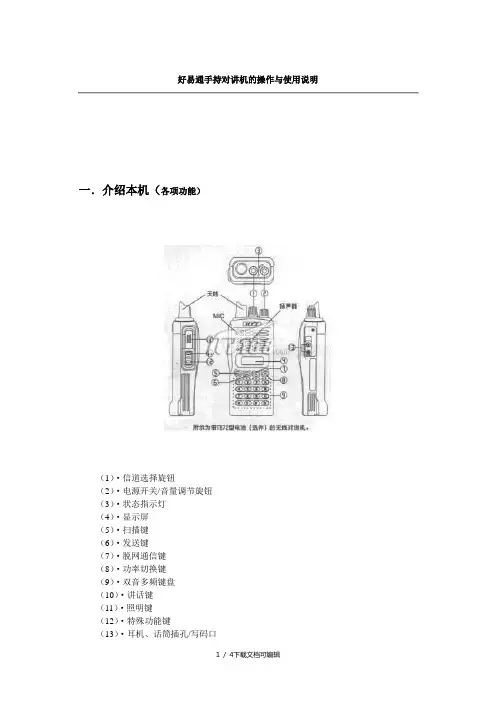
好易通手持对讲机的操作与使用说明一.介绍本机(各项功能)(1)·信道选择旋钮(2)·电源开关/音量调节旋钮(3)·状态指示灯(4)·显示屏(5)·扫描键(6)·发送键(7)·脱网通信键(8)·功率切换键(9)·双音多频键盘(10)·讲话键(11)·照明键(12)·特殊功能键(13)·耳机、话筒插孔/写码口二·手机键盘功能SCN 扫描键DIAL发送键TA脱网通信键LO功率切换键A 清除/挂机C查询上次呼叫主叫号码键 D 重拨键三.基本操作与使用说明(内容中的序号对应以上内容)(1)·开/关机顺时针方向旋转按钮2,听到“嘟”声,表示对讲机打开,同时显示屏上有字符显示。
逆时针旋转按钮直到听到“嘟”声,表示对讲机已关闭,同时显示屏上的字符消失。
(2)·调节音量旋转2调节旋钮把音量调整到合适的程度。
当您接收到适当的信号时,扬声器会传出声音。
(3)·选择工作信道旋转信道旋钮1改变信道,显示屏上的信道号码、频率、或者信道名称随之改变。
顺时针方向旋转,信道号码递增;逆时针方向旋转,信道号码递减。
(4)·发送(进行呼叫时)输入所用的号码,如“***”,输入“***”按 6 DIAL键发送。
要进行呼叫时,在按住10讲话键按钮的同时用平常的声调对着麦克风讲话。
请保持麦克风于距离嘴唇3至5cm处。
(4)·状态指示灯发射期间红色灯亮。
电池电压变低到临界电平时红色灯闪烁。
接收其它电台信号时。
绿色灯亮。
在使用编码静噪、信息选呼的情况下,接收到正确信号而静噪打开时橙色灯闪烁。
四·LCD显示屏介绍①当选择了低功率状态时出现。
②当所选择的信道被占用(繁忙)时出现。
③通过按moni键使qt、dtmf无效时出现。
④通过按下moni键使静噪打开时出现。
手机对讲机功能
手机对讲机功能手机对讲机是一种集手机通话、实时对讲、定位等多功能于一体的无线通信设备。
它通过无线通信网络,使用户能够进行实时的语音对讲,实现即时互动与沟通。
那么,手机对讲机具体有哪些功能呢?下面将为您介绍。
首先,手机对讲机具备语音对讲功能。
用户可以通过按下对讲键,进行实时的语音通信。
与传统的手机通话相比,手机对讲机的语音对讲更加方便快捷,可以实现多人群组通话和广播通知等功能。
无需输入号码或拨打电话,只需按下对讲键,即可与需要通话的人进行双向语音对讲。
其次,手机对讲机具备定位功能。
手机对讲机可以通过GPS 或基站定位等技术,实时获取用户的位置信息,并在地图上显示。
这对于需要实时了解用户位置的工作人员来说非常重要,比如配送员、抢险救援人员等。
通过手机对讲机的定位功能,可以大大提高工作效率和安全性。
再次,手机对讲机具备多群组通话功能。
手机对讲机支持多个用户同时参与的群组通话,比如公司内部的不同部门、不同地区的用户等。
这样,用户可以根据需要随时加入或退出群组,实现多人之间的实时互动和协作。
无需通过拨打电话或发送短信,即可与群组成员快速进行通信,提高工作效率。
此外,手机对讲机还具备消息通知功能。
用户可以通过手机对讲机接收和发送短信、语音信息等。
当用户无法进行语音通话时,可以选择发送短信或语音信息进行沟通。
这样,即使在特殊情况下无法进行实时对讲,用户仍然可以通过消息通知实现与他人的沟通和交流。
最后,手机对讲机还具备一些其他的功能。
比如,手机对讲机可以支持录音功能,用户可以随时录制重要的对讲内容。
手机对讲机还可以支持电话簿功能,方便用户保存和管理联系人信息。
同时,手机对讲机还可以支持蓝牙连接和无线耳机等外部设备,提升用户的使用体验。
总之,手机对讲机作为一种多功能的无线通信设备,具备语音对讲、定位、多群组通话、消息通知等多种功能。
它的出现,不仅可以满足用户多样化的通信需求,还能提高工作效率和沟通效果。
随着技术的不断发展,手机对讲机的功能还将进一步丰富和扩展,为用户提供更加便捷高效的通信体验。
火灾中的紧急通信正确使用对讲机和手机进行通信
火灾中的紧急通信正确使用对讲机和手机进行通信火灾中的紧急通信:正确使用对讲机和手机进行通信火灾是一种突发的灾害,对人们的生命和财产造成了严重的威胁。
在火灾中,紧急通信是关键,能够及时的传递信息,调度救援力量,直接影响着火灾事态的控制和扑灭效果。
对讲机和手机作为火灾中常用的通信工具,正确地使用它们能够发挥出最大的效能。
本文将介绍在火灾中正确使用对讲机和手机进行通信的方法。
一、对讲机的正确使用方法对讲机是一种便携式无线电通信设备,适用于短距离的通信。
在火灾中,正确使用对讲机可以快速有效地传递信息。
1. 预留频道并保持通畅在火灾前,预留对讲机的频道,确保通畅并能够及时使用。
对讲机一般有多个频道可供选择,应根据实际需要选择合适的频道。
在火灾中,应及时调整频道,避免与其他通信干扰。
2. 按键发言并讲清楚信息在使用对讲机时,按下发言键并清晰地说出要传达的信息。
语言应简洁明了,内容包含火灾地点、火势情况、人员伤亡情况等。
同时,要保持呼叫期间的耐心等待,确保信息能够被接收方接收到。
3. 确认收到信息并及时回复当发出信息后,要等待接收方的回复。
确认信息是否被正确地接收到,并及时回复对方。
这样可以确保信息的准确传达和理解。
二、手机的正确使用方法手机在现代社会已经成为人们生活中必不可少的通信工具。
在火灾中,正确使用手机能够及时与外界取得联系,寻求救援。
1. 保持良好的通信信号在火灾现场,往往存在信号不稳定、被干扰的情况。
为了保持手机的通信信号,应尽量避开阻挡物,如高楼大厦或厚重的墙壁。
同时,选择合适的通信运营商和合适的套餐,以确保通信畅通。
2. 拨打紧急救援电话在火灾中,如果遇到紧急情况,应立即拨打火警电话和急救电话。
火警电话是火灾报警的专用号码,拨打后应简明扼要地告知火灾情况和具体位置,以便救援人员快速到达。
急救电话是指拨打120,紧急求救、救治伤员时使用。
3. 利用短信功能进行通信在信号较弱或通话受阻的情况下,可以使用手机短信功能进行通信。
MOTO对讲机使用说明
MOTO对讲机使用说明MOTO对讲机是一种非常实用的通讯工具,广泛应用于户外探险、建筑工地、物流配送、采矿等行业。
它使用无线电频率进行通讯,可以实现多人、多组的组呼和私聊功能,具有通话清晰、信号稳定、耐用耗能低等优点。
下面就是MOTO对讲机的使用说明:一、开关机1.开关机按键位于对讲机顶部或侧面,长按按键即可实现开机或关机。
2.开机后,对讲机会发出开机提示音,屏幕显示当前频道和信号强度。
二、频道设置1.对讲机一般拥有多个频道,可以通过频道切换键或数字键选择需要使用的频道。
2.同一频道的对讲机可以进行组呼或私聊,不同频道之间无法通讯。
三、组呼功能1.如果需要和所有在同一频道的对讲机用户通话,可以选择组呼功能。
2.按住组呼键,讲话后释放按键即可进行组呼通话。
四、私聊功能1.如果需要和特定的对讲机用户进行私密通话,可以选择私聊功能。
2.按住私聊键,同时按住需要私聊的用户频道键,讲话后释放按键即可进行私聊通话。
五、音量调节1.对讲机的音量一般可以通过音量调节键进行调节,可以根据环境噪音的大小来调整音量大小。
2.需要注意的是,过大或过小的音量会影响通话效果。
六、静音功能1.如果需要暂时关闭音频输入,可以选择静音功能。
2.按住静音键即可实现静音,再次按下静音键取消静音状态。
七、手持对讲1.对讲机一般使用手持方式进行通话,需要注意保持对讲机离口鼻一定距离,确保通话效果清晰。
2.如果通话距离较远或有障碍物阻挡,可以考虑使用耳机插入对讲机进行通话。
八、电池更换1.如果对讲机电量不足,需要更换电池。
2.一般对讲机电池位于背部,打开电池仓盖即可取出电池更换。
九、充电1.对讲机一般提供电池充电器,将对讲机放入充电座即可开始充电。
2.充电时需要注意使用原装充电器,防止充电电流过大损坏对讲机。
十、保养与维护1.对讲机是一种电子设备,需要定期清洁和保养。
2.避免长时间暴露在高温、潮湿等环境中,避免碰撞摔落,可延长对讲机的使用寿命。
Honda HandsFreeLink 手机对讲系统用户指南说明书
Restriction Level While Driving
Restricted Restricted Not restricted Restricted Not restricted Not restricted Not restricted Restricted Not restricted Restricted Restricted Not restricted
2. Say “Call” or “Dial” to continue.
Receiving a Call
A notification is heard and the following screen appears on the MID.
Press the HFL Talk button to accept the call.
*not available on all phones
Driver Distraction
To reduce the potential for driver distraction, certain functions may be inoperable or grayed out while the vehicle is moving. You may have to use voice commands, stop or pull over to perform the function. The chart below shows a list of some operations that are restricted while the vehicle is moving.
Making a Call
Press and release the HFL Talk button before you say a command.
诺基亚无线汽车手机对讲机HF-33W使用说明书
Nokia Wireless Plug-in Car Handsfree HF-33WIssue 1DECLARATION OF CONFORMITY Hereby, NOKIA CORPORATION declares that this HF-33W product is in compliance with the essential requirements and other relevant provisions of Directive 1999/5/EC. The product is in conformity with the limits defined in Directive 2004/104/EC (amending Directive 72/245/EEC), Annex I, paragraph 6.5, 6.6, 6.8 and 6.9.A copy of the Declaration of Conformity can be found at: / phones/declaration_of_conformity/.© 2006 Nokia. All rights reserved. Reproduction, transfer, distribution or storage of part or all of the contents in this document in any form without the prior written permission of Nokia is prohibited.Nokia and Nokia Connecting People are registered trademarks of Nokia Corporation. Other product and company names mentioned herein may be trademarks or tradenames of their respective owners.Bluetooth is a registered trademark of Bluetooth SIG, Inc.Nokia operates a policy of continuous development. Nokia reserves the right to make changes and improvements to any of the products described in this document without prior notice.Under no circumstances shall Nokia be responsible for any loss of data or income or any special, incidental, consequential or indirect damages howsoever caused.The contents of this document are provided "as is". Except as required by applicable law, no warranties of any kind, either express or implied, including, butnot limited to, the implied warranties ofmerchantability and fitness for a particular purpose, are made in relation to the accuracy, reliability or contents of this document. Nokia reserves the right to revise this document or withdraw it at any time without prior notice.The availability of particular products may vary by region. Please check with the Nokia dealer nearest to you.Unauthorized changes or modifications to this device may void the user's authority to operate the equipment. Export ControlsThis device may contain commodities, technology or software subject to export laws and regulations from the US and other countries. Diversion contrary to law is prohibited.For your safetyRead these simple guidelines. Not following them may be dangerous or illegal.ROAD SAFETY COMESFIRSTObey all local laws. Alwayskeep your hands free tooperate the vehicle whiledriving. Your firstconsideration while drivingshould be road safety.INTERFERENCEAll wireless devices may be susceptible to interference, which could affectperformance.IntroductionThe Nokia Wireless Plug-in Car Handsfree HF-33W allows you to make and receive hands-free calls in your car. You can connect the handsfree to a compatible phone that supports Bluetooth wireless technology.Read this user guide carefully before using the handsfree. Also read the user guide for your phone, which provides important safety and maintenance information. Keep the handsfree out of reach of small children.Bluetooth wireless technology Bluetooth wireless technology allows you to connect compatible devices without cables. In a Bluetooth connection, the phone and the handsfree should be within 10 meters (30 feet) of each other. Connections can be subject to interference from obstructions, such as other electronic devices. The handsfree is compliant with the Bluetooth Specification 1.2 supporting the Handsfree Profile 1.5. Check with the manufacturers of other devices to determine their compatibility with this device. There may be restrictions on using Bluetooth technology in some locations. Check with your local authorities or service provider.Get startedBefore using the handsfree, you must install it in the car, and pair it with a compatible phone.The handsfree contains the following parts shown at the start of this guide: tiltable cigarette lighter plug (1), microphone (2), indicator light (3), volume up key (4), volume down key (5), call key (6), and speaker (7).Install the handsfreeTo function properly, the handsfree must be connected to the cigarette lighter socket of the car, and power must be supplied by the 12-volt car battery.Insert the handsfree into the cigarette lighter socket. The cigarette lighter plug is provided with a removable cap. If the plug does not fit in the socket, remove the cap by sliding it from the plug. You can tilt the cigarette lighter plug to the desired angle (up to 100 degrees). Do not try to force the plug to tilt more.Ensure that the handsfree is properly inserted in the cigarette lighter socket, and does not interfere with the normal operation of the car.In some car models, the cigarette lighter socket is powered by the car battery even when you remove the ignition key. In those cases, the car battery might be discharged even if the handsfree is not used. Contactthe vehicle manufacturer for more information.Switch on or offTo switch on, plug the handsfree into the cigarette lighter socket. The indicator light turns on.To switch off, pull the handsfree out from the cigarette lighter socket.Pair the handsfree1.Switch on your phone.2.Ensure that the handsfree isplugged properly into thecigarette lighter socket.3.Activate the Bluetooth featureon the phone, and set the phone to search for Bluetooth devices.4.Select the handsfree from thelist of found devices.5.Enter the Bluetooth passcode0000 to pair and connect thehandsfree to your phone. Insome phones you may need tomake the connection separately after pairing.If the pairing is successful, the handsfree sounds a beep and appears in the phone menu where you can view the currently paired Bluetooth devices. When the handsfree is connected with your phone, the blue indicator light is displayed.You can set your phone to connect with the handsfree automatically when the handsfree is switched on. To do this in Nokia phones, change your paired device settings in the Bluetooth menu.To disconnect the handsfree from your phone, pull the handsfree out from the cigarette lighter socket,or disconnect the handsfree in the Bluetooth menu of the phone.To reconnect the paired handsfree to your phone, plug the handsfree into the cigarette lighter socket.To pair and connect the handsfree with a new phone, first disconnect the handsfree in the Bluetooth menu of the currently connected phone, and then pair and connect the new phone.Call handlingTo adjust the volume during a call, use the volume keys on the handsfree.To make a call, use your phone in the normal way when the handsfree is connected to your phone. Speak toward the handsfree microphone. For optimal performance, check that there are no objects in front of the microphone and that the microphone is in front of the user, not beneath or behind. The green indicator light is displayed during a call.If your phone supports last number redial with the handsfree, press the call key twice when no call is in progress.If your phone supports voice dialing with the handsfree, press and hold the call key when no call is in progress, and proceed as described in the user guide of your phone. When you receive a call, you hear a ringing tone through the handsfreespeaker and the green indicator light flashes. To answer the call, press the call key, or use the phone keys. To reject the call, press the call key twice. To transfer the active call between the handsfree and your phone, press and hold the call key.To end a call, press the call key, or use the phone keys.Care and maintenanceYour device is a product of superior design and craftsmanship and should be treated with care. The suggestions below will help you protect your warranty coverage.•Keep all accessories andenhancements out of the reach of small children.•Keep the device dry. Precipitation, humidity, and all types of liquidsor moisture can contain mineralsthat will corrode electroniccircuits. If your device does getwet, allow it to dry completely.•Do not use or store the device in dusty, dirty areas. Its moving parts and electronic components can be damaged.•Do not store the device in hot areas. High temperatures canshorten the life of electronicdevices, damage batteries, andwarp or melt certain plastics.•Do not store the device in cold areas. When the device returns toits normal temperature, moisturecan form inside the device anddamage electronic circuit boards.•Do not attempt to open the device.•Do not drop, knock, or shake the device. Rough handling can breakinternal circuit boards and finemechanics.•Do not use harsh chemicals,cleaning solvents, or strongdetergents to clean the device.•Do not paint the device. Paint can clog the moving parts,microphone, or speaker, andprevent proper operation.If the device is not working properly, take it to the nearest authorized service facility for service.Additional safety information■VehiclesRF signals may affect improperly installed or inadequately shielded electronic systems in motor vehicles such as electronic fuel injection systems, electronic antiskid (antilock) braking systems, electronic speed control systems, and air bag systems. For more information, check with the manufacturer or its representative of your vehicle or any equipment that has been added.Faulty installation or service may be dangerous and may invalidate any warranty that may apply to the device. Check regularly that all wireless device equipment in your vehicle is mounted and operating properly. Do not store or carry flammable liquids, gases, or explosive materials in the same compartment asthe device, its parts, or enhancements. For vehicles equipped with an air bag, remember that air bags inflate with great force. Do not place objects, including installed or portable wireless equipment in the area over the air bag or in the air bag deployment area. If in-vehicle wireless equipment is improperly installed and the air bag inflates, serious injury could result.。
对讲机操作说明书
与QChat功能相关的还有设置—通话设置—速拨号码菜单
PTT键绑定的 快捷号码 2~9键也可以 绑定QChat快 捷呼叫 可以绑定的 QChat呼叫类型
QChat提供您及时的简单对话和群组沟通的
电话新打法!
ViewSonic 优派
优派
QChat天翼对讲手机 使用 说明
操作
天翼3G对讲功能手机产品定义
天翼对讲是中国电信推出的基于手机的对讲业务,有别于传统 的对讲机,天翼对讲使用的设备是CDMA手机,它具有以下几 种主要优点:
覆盖区域广,能漫游,只要手机有信号就能实现对讲 携带方便,重量和体积与普通手机相当 一机多用,既为对讲机也为普通手机,能拨打电话和收发短信息 健康,无线电发射功率是传统手持对讲机的1/10左右 语音延迟小,能实现中继台的传送速度
QChat功能设置
系统设置—高级设置
开机自动登录:开机是否QChat自动登录
开机自动更新:开始时是否自动更新帐户信息
QOS设置:在网络支持的情况下,设置了 QOS 可以提高QChat服务质量
帮助
– – – –
我的号码 我的状态 手动更新 版本信息
QChat功能设置
帮助
速拨号码设置
PTT键和2~9数字键都可以设置类型为单呼、预定组呼、 临 时组呼的快捷呼叫 具体设置方式为主菜单-设置-通话设置-速拨号码
短按PTT
进入通话记录界面
长按PTT
呼叫预先设定的一个快捷号码
选择联系人或者组,按PTT 键发起呼叫
按PTT 接通基本在1 秒内
按PTT
通话中按PTT键可以取得话权,松开PTT键则释放话权
按PTT
松开PTT
按PTT
当话权被占用时, 按PTT键将不能取 得话权