
2017年最新陕旅版 四年级英语上册全册教案
四年级英语上册教学进度表Unit 1 What is your father? 单元总目标本单元教学共分为4课时。
第一课时以词汇教学为主,主要是对家庭成员的名称进行复习并学习有关职业的词汇,“词不离句”是本课时教学要遵循的原则。
第二课时为会话教学,要求学生在学习重点词汇的基础上能够理解和运用对话What is your father? He is a...Is your mother a worker? No,she is not.She is a nurse.学习怎样对某人的职业进行回答。
第三课时以PartB中的Let`s learn more为主,让学生拓展学习更多有关职业职业的表达,理解和运用句型I want to be a...表达个人理想。
第四课时在综合复习本单元重难点的基础上,通过练习检测学生的学习效果。
单元知识目标:一、复习单词:Grangpa,grandma,father,mother,brother,sister,teacher,student.二、能听、说、读、写有关职业的单词:Cook,doctor,driver,policeman,nurse,worker,famer.三、能听懂、会说、会读、会用与家庭成员和职业有关的交际用语:1.-What is your...?-He/She is a...-What about...?-He/She is a...2.-Is your mother a...?-No,shen`t.She is a...3.-What is he/she?-She/He is a...4.I want to be a...情感目标:1、通过复习谈论家庭成员,培养学生热爱家庭的情感。
2、在学习和讨论职业话题中帮助学生树立正确的职业观。
第一课时教学内容:Part A Let’s talk(主)Think and matchLet’s learnComplete your family tree教学目标:1、复习有关家庭成员的单词:grandpa,grangma,father,mother,brother,sister.2、学习有关职业的单词:cook,doctor,driver,policeman,nurse,worker,famer.教学重点:能听懂、会说“What is your father/mother?He/She is a...”日常用语。
教学难点:能在日常生活中灵活运用这些句型。
教学方法:高效课堂模式学习方法:教学准备:1、教师准备:(1)一张自己的全家福,一张Anne(或其他名字)的全家福和表现cook,doctor,driver,policeman,nurse,worker,famer职业的人物图片。
(2)录音机、磁带。
(3)农场、医院等图片或课件。
培优辅差:教学过程:一、课程导入1、课前问答教师出示自己的全家福,向学生逐一介绍自己的家人。
2、新课导入教师拿着书作讲课状、作开车状、作在田间劳动状,向学生边演示边说:I am a teacher.I can teach.ABCDEFG.I am a driver.I can drive.滴滴滴,滴滴滴。
I am a farmer.I can farm.嗨呦呦,嗨呦呦。
二、Let’s learn1、学习单词farmer.教授单词farmer的读音,并将其在四线三格中板书出来。
2、教师通过介绍Anne的家人引出单词doctor和nurse.3、学习单词driver.4、学习单词policeman,worker,cook.5、教师播放录音,让学生听并跟读Let`s learn部分的单词,注意纠正学生的错误读音。
三、你来表演我来猜1、教师先和一名学生做示范。
教师做动作表现出职业特点,学生说出职业的名称。
2、学生分成若干组,进行限时比赛。
在30秒内说出最多职业名称的组获胜,教师进行奖励。
四、补全单词,让学生口述出所缺字母。
Dirv_ _ work_ _ doct_ _ farm_ _课后作业:板书设计:课后反思:第二课时教学内容:Part B Let’s talk 的对话。
教学目标:1、能听懂Let`s talk对话中表示职业的词汇。
2、能用下列对话谈论家庭成员的职业。
(1)—What is your...?—He/She is a...—What about...?—He/She is a...(2)—Is your mother a...?—No,she isn`t,She is a...(3)—What is she/he?—She/He is a...教学重点:1、能够听、说、认读对话,语言语调自然。
2、通过对对话的学习,培养学生的会话能力,增加学生的学习兴趣。
教学难点:Let`s learn more的熟练运用。
教学方法:高效课堂模式。
学习方法;教学准备:1、教师准备:(1)有关职业的图片。
(2)录音机、磁带。
2、学生准备家庭成员的照片。
培优辅差:教学过程:一、课程导入教师在学生完成Part A Warming-up部分的第二个活动之后,让学生根据各自家庭成员的职业在班上介绍各自的家人,教师可在学生介绍的过程中不断与学生交流,引入特殊疑问句What is your mother? What is she?及回答She is a...二、课程展示活动和过程。
1、Let`s talk(1)教师播放本部分的录音,在学生听这两段对话之前,教师可以建议学生在听的过程中将听力中两位主人公的姓名及家庭成员记录在练习本上。
(2)学生再听一遍录音,这一遍教师可以在每句话后进行停顿,给学生时间思考并核对答案。
(3)教师找学生来回答问题,检测他们对对话的理解。
(4)教师引导学生用完整的句子说出问题的答案。
2、教师再次播放录音,让学生听并跟读Let`s talk部分的对话,期间注意纠正学生的错误读音。
三、游戏(看关键词表演对话):1、教师先出示一些关键词写在黑板上,带领学生一起练习对话。
2、教师和一位学生看关键词进行对话练习。
3、学生分组看关键词进行对话练习。
四、Let’s chant1、教师展示PartB Let`s chant部分的内容,学生一起表演。
2、学生分组表演。
3、根据本节课所学内容改编chant。
课后作业:板书设计:课后反思:第三课时教学内容:Let`s learn more的对话,运用What is he/she?He/She is a...来表达各自的理想,能运用I want to be a...来表达各自的理想。
教学目标:1、能听懂Let`s learn more对话中表示职业的词汇和句型。
2、能运用What is he/she?He/She is a...谈论其他人员的职业。
3、能运用I want to be a...来表达各自的理想。
教学重点:1、能听、说、认读对话,语言语调准确。
2、通过对对话的学习,培养学生的会话能力,增加学生的学习兴趣。
教学难点:1、Let`s learn more的掌握及充分运用。
2、能听、说、认读对话,语音语调准确。
教学方法:高效课堂模式学习方法:教学准备:1.教师准备(1)有关家庭成员及职业的卡片。
(2)录音机,磁带。
2.学生准备家庭成员的照片。
培优辅差:教学过程:一、课程导入(Leading In)1.课前复习。
(1)复习单词教师快速闪动所准备的有关家庭成员及职业的卡片,请学生说出单词。
该活动可以训练学生的反应能力,有效集中学生的注意力。
教师可增加难度,每次闪过两张图片,请学生一次说出两个单词。
(2)猜谜语教师编几个谜语,请同学来猜。
教师把谜语分别写在小卡片上,然后贴在教室里。
每次请一位同学选取一张卡片,读给全班同学听,看看谁能够猜出答案。
最快猜出答案的学生继续选取卡片,读出谜面,请大家继续猜谜。
2.新课导人教师通过师生互动引入I want to be a...对话1:T:What is your grandpa?S1:He is a policeman.T:(模仿警察的样子)I want to be a policeman,too.对话2:(模仿护士造句)…对话3:(模仿教师造句)…二、课程展示活动和过程Part B:Let`s learn more1、Talk about the pictures。
教师引导学生讨论第四页Let`s learn more部分的图片,教师可以提出以下问题,也可以用Is he/she...和学生进行回答。
2、听力理解(1)教师播放录音,让学生带着问题听对话,理解对话大意。
(2)再次播放录音,并随机挑选学生回答问题,检测他们对对话的理解。
(3)教师要求学生用完整的句子回答问题。
(4)教师可以为学生扩充词汇,如:a bus driver,a taxi driver,a train driver.2.教师播放录音,让学生听并跟读Let`s learn more部分的对话。
(1)学生集体听磁带跟读对话,要求指读。
(2)学生分组听磁带跟读对话,要求指读。
(3)学生分角色朗读对话,教师及时进行评价。
三、操练活动的设计与实施建议(Practice Activities)1、击鼓传卡片(1)教师拿出所准备的职业单词卡片,将班级学生分成两组。
(2)教师发指令,第一组学生传来一张卡片,当教师叫停后,先由拿到卡片的同学自我介绍:I am a...第二组学生集体说He/She is a...2、Part B:Guess and say教师任选一名同学做动作,然后将班级学生分成两组,每组各选一名同学来猜,猜对的组加分奖励。
猜出的答案要用完整的句子表达:He/She is a...3、Part B:Look and match(1)将图片和单词连线,教师提醒学生要将单词和第一行及第三行的图片连线。
建议教师找学生来读单词,其他学生按照他读单词的顺序连线。
课后作业:板书设计:课后反思:第四课时教学内容:复习本单元的单词和句型。
教学目标1、通过Part C部分的练习,对本单元所学的有关职业的单词和句型进行全面复习和检查。
教学重点:能够在具体情景中谈论所学的家庭成员及职业。
教学难点:能够在实际交际中询问和回答有关职业的问题。
教学方法:高效课堂模式。
学习方法:教学准备1.教师准备:(1) 录音机、磁带。
(2)本单元单词卡片。
培优辅差:教学过程一、课程导入(Leading In)1、全班学生一起说唱Part B中的chant.2、值日生报告教师挑选学生进行值日生报告。
检查学生是否能尽可能多地将三年级所学的内容用在各自的报告中,并可从本节课开始,要求学生在每节课前轮流做值日生报告。
二、课程展示活动和过程1、复习本单元的单词(1)教师出示本单元所有的单词,全班同学齐读。
陕旅版四年级上册英语全册教案
陕旅版四年级上册英语全册教案Unit 1: Where Is My Schoolbag?Part A:Step 1: Warm-up- Greet the students and start with a quick review of the previous lesson about classroom objects.- Sing the "Hello, Hello" song together.Step 2: Presentation- Introduce the new vocabulary: schoolbag, book, pen, pencil, ruler, eraser, and sharpener.- Use flashcards and real objects to demonstrate the meaning of each word.- Teach the question "Where is my schoolbag?" and the responses "It's on the desk" and "It's under the chair."Step 3: Practice- Role-play the dialogue with a few students, using the new vocabulary and question.- Have students work in pairs to practice the dialogue, switching roles to take turns.Step 4: Consolidation- Play a "Find the Object" game where students have to listen to a description and find the corresponding object in the classroom.Step 5: Wrap-up- Review the new vocabulary and sentence structures before moving on to the next activity.Part B:Step 1: Listening- Play the audio recording of the dialogue and have students follow along in their books.Step 2: Speaking- Have students practice the dialogue in pairs, using the audio recording as a reference.Step 3: Reading- Ask students to read the dialogue aloud, focusing on pronunciation and intonation.Step 4: Writing- In their workbooks, have students write the dialogue using the correct punctuation and capitalization.Step 5: Group Activity- Divide the class into groups and have them create a similar dialogue using the new vocabulary. Each group will then perform their dialogue for the class.Step 6: Review- Review the key vocabulary and grammar points covered in this lesson.Step 7: Homework- Assign the students to write a short paragraph describing the items in their schoolbag.。
【陕旅版】小学英语四年级上册:全册教案共64页

Unit 1It’s time to play the violin学习目标1.复习用“What do you do every day?2.复习用do表示“做和作助动词的用法”。
3.复习How many…do you have?4.学习运动的词play the violin do eye exercises play sports learn English have a rest take out the book。
5.学习用特殊疑问句提问及其应答。
教具准备:图片课时安排:五课时第一课时Learn aims:1. 复习What do you do every day?2.复习用have表示“(人)有”。
3.复习What time do you get up?教学过程:Step 1: Show the subject and the aims.1. Greetings.2. Show the subject and the aims.T: Boys and girls, do you like make a friend? Today we’re going to learn Module 1 Unit 1 My family tree(板书)Here are our aims, they are…(利用小黑板出示学习目标)Step2:第一次先学后教1.先学:Show the learn guide one: Learn “look and circle” this part,find you can’t read words and don’t understand of sentences. I’ll give you about five minutes read, five minutes later, we’ll check up.2.后教:1.请同学们说出自己不会读的单词。
2.指名的同学读课文。
四年级英语上册 全册教案 陕旅版
四年级英语上册全册教案(陕旅版)第一章:Unit 1 Good morning教学目标:1. 能听懂、会说、会读“Good morning”,“Good afternoon”,“Good evening”,“How are you?”等问候语。
2. 能听懂、会说、会读“I'm fine, thank you. And you?”等回答。
3. 能听懂、会说、会读“See you tomorrow”等告别语。
教学内容:1. 单词:morning, afternoon, evening, how, you, fine, see, tomorrow。
2. 句型:Good morning/afternoon/evening. How are you?I'm fine, thank you. And you?See you tomorrow。
教学步骤:1. 热身活动:让学生用中文进行问候,如“早上好”,“下午好”,“晚上好”。
2. 引入新课:展示图片,引导学生说出“morning”,“afternoon”,“evening”。
3. 教授单词:教授单词“morning”,“afternoon”,“evening”,“how”,“you”,“fine”,“see”,“tomorrow”。
4. 句型练习:让学生练习说“Good morning/afternoon/evening. How are you?I'm fine, thank you. And you?See you tomorrow”。
5. 课堂活动:让学生分组进行角色扮演,模拟日常问候和告别场景。
第二章:Unit 2 Hello, my name is教学目标:1. 能听懂、会说、会读“Hello, my name is”,“What's your name?”等问候和自我介绍用语。
2. 能听懂、会说、会读“I'm Tom.”等自我介绍。
四年级英语上册 全册教案 陕旅版
教案:四年级英语上册(陕旅版)一、教学目标:1. 知识目标:(1)能够听懂、会说、会读本节课的生词和重点句子。
(2)能够运用所学知识进行简单的日常交流。
2. 能力目标:(1)能够正确书写字母A-H。
(2)能够根据图片或情景,正确使用所学词汇和句子进行描述。
3. 情感目标:(1)培养学生对英语学习的兴趣和积极性。
二、教学内容:1. 生词:family, mother, father, brother, sister, grandmother, grandfather2. 重点句子:(1)What's your family like?(2)My family is small. My mother is a teacher. My father is a doctor. (3)I have a brother and a sister. They are in primary school.三、教学重点与难点:1. 重点:生词的认读和运用,重点句子的表达。
2. 难点:字母A-H的书写,家庭成员的描述。
四、教学方法:1. 情境教学法:通过创设情境,让学生在实际环境中运用所学知识。
2. 互动教学法:引导学生参与课堂互动,提高学生的口语表达能力。
3. 游戏教学法:通过趣味游戏,激发学生的学习兴趣。
五、教学步骤:1. 热身(5分钟)(1)和学生打招呼,询问他们昨天做了什么。
(2)引导学生用英语回答,复习已学的日常用语。
2. 引入(10分钟)(1)展示图片,引导学生描述家庭成员。
(2)引导学生用英语介绍自己的家庭成员。
3. 生词学习(10分钟)(1)教授生词:family, mother, father, brother, sister, grandmother, grandfather。
(2)让学生跟读,巩固记忆。
4. 句子学习(10分钟)(1)教授重点句子:What's your family like? My family is small. My mother is a teacher. My father is a doctor. I have a brother and a sister. They are in primary school.(2)让学生跟读,并进行角色扮演。
陕旅版小学英语四年级上册教学设计全册
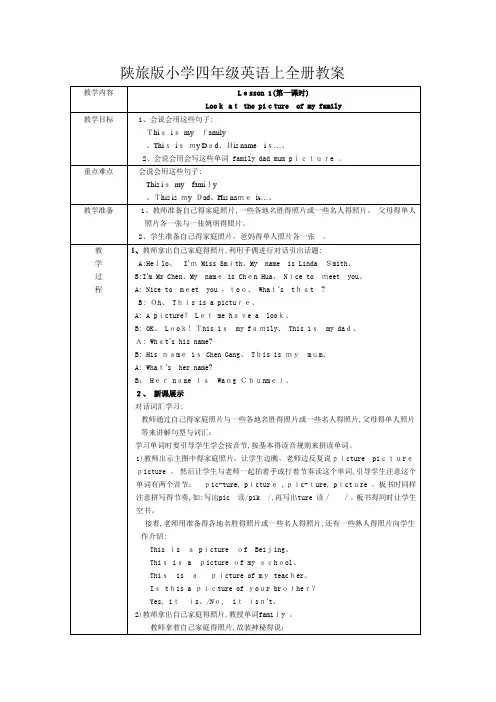
陕旅版小学四年级英语上全册教案期中测试题一、写出下列字母得相邻字母。
(10分)__Dd____Ii __ __Pp____Tt __ __Ww ____Ff__ __Kk __ __Qq ____Mm __ __Uu __二、填入所缺得字母,就就是单词完整正确。
(10分)( )1、p ___ple A、eo B、oe C、ou()2、b ___ch A、ea B、ae C、ee( )3、gr___dma A、eaB、anC、oa( )4、ci____ma A、en B、ne C、nu() 5、fam____lyA、a B、i C、ir()6、engin___r A、ee B、er C、ea() 7、h ____sewifeA、or B、uo C、ou( ) 8、fri ____dly A、neB、enC、ee( ) 9、g____l A、ur B、irC、ri()10、k____d A、ieB、ni C、in(10分)( )1、A、uncle B、whoC、auntD、cousin()2、A、dadB、mum C、love D、grandpa ()3、A、barberB、doctorC、photo D、nurse()4、A、my B、his C、her D、taxi( )5、A、pandaB、hippo C、monkey D、doll()1、a taxidriver A、互相( )2、ahappy familyB、一位家庭主妇( )3、a little dog C、一个幸福得家庭( )4、a housewife D、一位出租车司机()5、eachother E、一只小狗( )6、an engineerF、好朋友()7、on the beach G、在树上()8、good friend H、一位工程师( )9、in the treeI、在电影院里( )10、inthecinema J、在沙滩上() 1、He is ___engineerA.an B 、a C、the()2、I___abag、A.at B、in C、have( )3、This___my father、A.is B、amC、are( ) 4、e ___ see my uncle’s family!A.forB、to C、on( )5、How manypeople are there ___your family?A、atB、inC、for( ) 6、There___three peopleinTom’s family、A.have B、are C、be( ) 7、Howold___she?A.is B、are C、am( ) 8、Look___the picture of my family、A.onB、at C、in( ) 9、I am___ pupil、A.the B、anC、 a( )10、A photo ___my room、A、ofB、forC、in1、your/the/is/father/man/(?)___________________________________________ 2、there/your/family/in/are/many/people/how/(?)___________________________________________3、they/who/are/(?)___________________________________________4、is/how/she/old/(?)___________________________________________5、they/kind/are/(、)___________________________________________() 1、She is sister 、A、她就就是我妹妹。
陕旅版四年级上册英语全册教案完整版

陕旅版四年级上册英语全册教案完整版一、教学内容1. Chapter 1: My School详细内容:学习描述学校场所和设施的词汇,如library, classroom, playground等,以及相关句型,如What's this? It's a2. Chapter 2: My Family详细内容:学习家庭成员的词汇,如mother, father, sister 等,以及介绍家庭成员的句型,如This is my3. Chapter 3: My Body详细内容:学习身体部位的词汇,如head, eyes, ears等,以及描述身体不适的句型,如My head hurts.二、教学目标1. 让学生掌握本册书中的词汇和句型,能运用所学知识进行简单的英语对话。
2. 培养学生的英语听力、口语表达能力,提高他们的英语学习兴趣。
3. 培养学生的团队合作意识,提高他们的课堂参与度。
三、教学难点与重点1. 教学难点:词汇的掌握和句型的运用。
2. 教学重点:培养学生的英语听说能力,提高他们的语言实际运用能力。
四、教具与学具准备1. 教具:PPT、卡片、录音机、磁带等。
2. 学具:英语课本、练习本、彩色笔等。
五、教学过程1. 导入:通过展示与课题相关的图片,引导学生用英语进行讨论,激发学生的学习兴趣。
2. 新课内容展示:讲解新词汇和句型,配合PPT和实物展示,让学生直观地理解和学习。
3. 例题讲解:针对新课内容,设计典型例题,引导学生分析和解答。
4. 随堂练习:设计相关练习题,让学生巩固所学知识,提高实际运用能力。
5. 小组活动:分组进行角色扮演,用所学知识进行英语对话,培养学生的团队合作意识。
六、板书设计1. 板书内容:包括新课词汇、句型、典型例题等。
2. 板书布局:左侧列出词汇,右侧列出句型,中间展示例题和解答。
七、作业设计1. 作业题目:(1)抄写新课词汇,每个词汇写5遍。
(2)根据所学句型,编写一段关于自己学校的英语对话。
陕旅版四年级上册英语全册教案完整版
陕旅版四年级上册英语全册教案完整版一、教学内容1. Unit 1 My School:学习描述学校设施和位置的词汇,掌握一般现在时的用法。
2. Unit 2 My Family:学习家庭成员及职业的词汇,运用一般现在时描述家庭成员。
3. Unit 3 My Friends:学习描述朋友特征的词汇,运用一般现在时介绍朋友。
4. Unit 4 Time:学习时间表达,掌握询问和回答时间的句型。
5. Unit 5 My Clothes:学习衣物类词汇,运用一般现在时描述衣物。
6. Unit 6 Shopping:学习购物场景的用语,掌握一般现在时在购物场景中的应用。
二、教学目标1. 掌握本册书中的词汇和句型,能够运用一般现在时进行简单描述。
3. 培养学生的合作意识和团队精神,激发学习英语的兴趣。
三、教学难点与重点1. 教学难点:一般现在时的运用,词汇的拓展和运用。
2. 教学重点:词汇、句型的掌握,口语表达能力的提高。
四、教具与学具准备1. 教具:PPT、卡片、录音机、磁带等。
2. 学具:练习本、彩笔、单词卡片等。
五、教学过程1. 导入:通过创设情境,引导学生复习旧知识,为新课学习做好铺垫。
2. 新课呈现:展示PPT,讲解新词汇和句型,让学生跟读和模仿。
3. 例题讲解:通过实例讲解,让学生了解一般现在时的用法,并进行实际操作。
4. 随堂练习:设计各种练习题,巩固所学知识,提高学生的运用能力。
5. 小组活动:分组进行角色扮演,练习口语表达能力,培养合作精神。
六、板书设计1. 陕旅版四年级上册英语教案2. 内容:各单元主题、重点词汇、句型、一般现在时的用法等。
七、作业设计1. 作业题目:a. 抄写并默写本节课所学词汇。
b. 根据所给情景,用一般现在时完成句子。
c. 编写一段关于自己学校、家庭或朋友的介绍,运用所学词汇和句型。
2. 答案:见附件。
八、课后反思及拓展延伸2. 拓展延伸:a. 布置拓展阅读任务,提高学生的阅读能力。
陕旅版小学英语四年级上册全册教案
陕西旅游版四年级英语上册教案学校:教师:日期:陕旅版小学四年级《英语》上册教材分析1. 陕旅版小学四年级《英语》上册教育理念教材是实施课标的手段之一,是对课标的具体细化,在实际教学中是主要的教学资料,科学地对教材定位就是用教材教,而不是教教材。
修订后的陕旅版小学四年级《英语》上册教材依据国家教育部颁布的2011版英语课程标准,严格遵循新课标的教育理念和教学目标,以“话题—功能—结构—任务”为基本思路编写设计而成的。
该书以Alice、Su Nan、Kitty、Wu Chen、Colin、Kevin、Li Shan、Liu Zhaoyang 以及活泼可爱、滑稽有趣的Toby和Aggie为主线形象;由他们带领同学们,在真实自然的情景中,通过参与各种内容丰富、形式多样的语言活动,来感知和体验语言,并逐渐学会运用语言进行简单交流,从而达到新课标提出的小学英语教学的各项目标。
同时,该书以学生为本,注重小学四年级学生的年龄特点和心理特征,从调动和激发其对英语的学习兴趣入手,通过大量贴近生活实际、富有时代气息的形式灵活多样的主题和内容和朗朗上口、富有韵律感的英语歌曲和歌谣以及生动有趣的卡通图片画面,让学生在听、说、唱、演、玩中主动汲取新知,为以后的英语学习奠定扎实的基础。
2. 陕旅版小学四年级《英语》上册内容特色a. 生动性:教材版式设计图文相间,比例适度,疏密有致;插图新颖活泼,符合儿童审美情趣,努力营造轻松、活泼的教材面貌,从直觉和感知层面激发学生学习兴趣。
如部分单元中Part B的Read astory部分,教材中的图画与磁带中的故事紧密结合,构成立体的视听结构,以更形象化的语言和场景相结合让学生巩固所学知识内容,以培养学生学英语的兴趣、信心、策略和习惯为根本出发点,为学生英语能力的持续发展打下坚实的基础。
b. 趣味性:教材中安排了节奏明快的chant、具有较强感染力的英文歌曲、走迷宫、涂颜色等教学内容,听、说、做、玩、唱、演的内容安排,使表现形式丰富多样,既富于情趣,又能开发学生智力。
四年级英语上册 全册教案 陕旅版
教案:四年级英语上册(陕旅版)第一章:Unit 1 My Classroom1.1 Teaching objectivesStudents can understand and use the words: desk, chr, window, blackboard, door.Students can understand and use the sentence pattern: "What's this? It's a/an".Students can municate with others about their classroom.1.2 Teaching key and difficult pointsNew words: desk, chr, window, blackboard, door.Sentence pattern: "What's this? It's a/an"1.3 Teaching proceduresStep 1: Lead-inGreeting and introduction.Step 2: PresentationShow pictures of a classroom and ask students what they see. Introduce the new words: desk, chr, window, blackboard, door. Practice the sentence pattern: "What's this? It's a/an"Step 3: PracticeDivide students into groups and ask them to describe their classroom in prs.Role-play the conversation with the new words and sentence pattern.Step 4: ConsolidationAsk students to draw their classroom and label the objects with the new words.Present and pare the drawings with the class.1.4 HomeworkPractice the sentence pattern: "What's this? It's a/an" with parents. Write a short description of their classroom.第二章:Unit 2 My Body2.1 Teaching objectivesStudents can understand and use the words: head, eyes, nose, mouth, ears, arm, leg.Students can understand and use the sentence pattern: "Point to your". Students can municate with others about their body.2.2 Teaching key and difficult pointsNew words: head, eyes, nose, mouth, ears, arm, leg.Sentence pattern: "Point to your"2.3 Teaching proceduresStep 1: Lead-inGreeting and introduction.Step 2: PresentationShow pictures of different body parts and ask students what they are. Introduce the new words: head, eyes, nose, mouth, ears, arm, leg.Practice the sentence pattern: "Point to your"Step 3: PracticeAsk students to point to their body parts and say the words.Role-play the conversation with the new words and sentence pattern. Step 4: ConsolidationAsk students to work in groups and create a poem about their body parts.Present and share the poems with the class.2.4 HomeworkPractice the sentence pattern: "Point to your" with parents.Draw a picture of their body and label the body parts.第三章:Unit 3 My Family3.1 Teaching objectivesStudents can understand and use the words: father, mother, brother, sister, grandmother, grandfather.Students can understand and use the sentence pattern: "This is my". Students can municate with others about their family.3.2 Teaching key and difficult pointsNew words: father, mother, brother, sister, grandmother, grandfather. Sentence pattern: "This is my"3.3 Teaching proceduresStep 1: Lead-inGreeting and introduction.Step 2: PresentationShow pictures of different family members and ask students who they are.Introduce the new words: father, mother, brother, sister, grandmother, grandfather.Practice the sentence pattern: "This is my"Step 3: PracticeAsk students to introduce their family members using the new words and sentence pattern.Role-play the conversation with the new words and sentence pattern. Step 4: ConsolidationAsk students to work in groups and create a short story about their family.Present and share the stories with the class.3.4 HomeworkPractice the sentence pattern: "This is my" with parents.Draw a picture of their family and label the family members.第四章:Unit 4 My Home4.1 Teaching objectivesStudents can understand and use the words: house, door, window, floor, roof, bed, chr.Students can understand and use the sentence pattern: "What's in your home?".Students can municate with others about their home.4.2 Teaching key and difficult pointsNew words: house, door, window, floor, roof, bed, chr.Sent第六章:Unit 5 My School6.1 Teaching objectivesStudents can understand and use the words: school, classroom, teacher, desk, chr, blackboard.Students can understand and use the sentence pattern: "I go to school ". Students can municate with others about their school life.6.2 Teaching key and difficult pointsNew words: school, classroom, teacher, desk, chr, blackboard. Sentence pattern: "I go to school "6.3 Teaching proceduresStep 1: Lead-inGreeting and introduction.Step 2: PresentationShow pictures of a school and ask students what they see.Introduce the new words: school, classroom, teacher, desk, chr, blackboard.Practice the sentence pattern: "I go to school "Step 3: PracticeAsk students to talk about their way to school.Role-play the conversation with the new words and sentence pattern. Step 4: ConsolidationAsk students to write a short story about their school day.Share the stories with the class.6.4 HomeworkPractice the sentence pattern: "I go to school " with parents.Draw a picture of their school and label the objects.第七章:Unit 6 My Clothes7.1 Teaching objectivesStudents can understand and use the words: clothes, shirt, pants, skirt, shoes, hat.Students can understand and use the sentence pattern: "What's this? It's a/an".Students can municate with others about their clothes.7.2 Teaching key and difficult pointsNew words: clothes, shirt, pants, skirt, shoes, hat.Sentence pattern: "What's this? It's a/an"7.3 Teaching proceduresStep 1: Lead-inGreeting and introduction.Step 2: PresentationShow pictures of different clothes and ask students what they are. Introduce the new words: clothes, shirt, pants, skirt, shoes, hat. Practice the sentence pattern: "What's this? It's a/an"Step 3: PracticeAsk students to point to their clothes and say the words.Role-play the conversation with the new words and sentence pattern. Step 4: ConsolidationAsk students to work in groups and create a poem about clothes. Present and share the poems with the class.7.4 HomeworkPractice the sentence pattern: "What's this? It's a/an" with parents. Draw a picture of their clothes and label the items.第八章:Unit 7 Food8.1 Teaching objectivesStudents can understand and use the words: food, rice, noodles, meat, vegetable, fruit.Students can understand and use the sentence pattern: "I like". Students can municate with others about their favorite food.8.2 Teaching key and difficult pointsNew words: food, rice, noodles, meat, vegetable, fruit.Sentence pattern: "I like"8.3 Teaching proceduresStep 1: Lead-inGreeting and introduction.Step 2: PresentationShow pictures of different food items and ask students what they are. Introduce the new words: food, rice, noodles, meat, vegetable, fruit. Practice the sentence pattern: "I like"Step 3: PracticeAsk students to talk about their favorite food.Role-play the conversation with the new words and sentence pattern. Step 4: ConsolidationAsk students to work in groups and create a list of healthy foods. Present and share the lists with the class.8.4 HomeworkPractice the sentence pattern: "I like" with parents.Write a short paragraph about their favorite food.第九章:Unit 8 Colors9.1 Teaching objectivesStudents can understand and use the words: colors, red, yellow, blue, green, black, white.Students can understand and use the sentence pattern: "What color is it?It's".Students can municate with others about colors.9第十章:Unit 9 Animals10.1 Teaching objectivesStudents can understand and use the words: animals, cat, dog, fish, bird, mouse.Students can understand and use the sentence pattern: "What's this? It's a/an".Students can municate with others about animals.10.2 Teaching key and difficult pointsNew words: animals, cat, dog, fish, bird, mouse.Sentence pattern: "What's this? It's a/an"10.3 Teaching proceduresStep 1: Lead-inGreeting and introduction.Step 2: PresentationShow pictures of different animals and ask students what they are. Introduce the new words: animals, cat, dog, fish, bird, mouse. Practice the sentence pattern: "What's this? It's a/an"Step 3: PracticeAsk students to point to the animals and say the words.Role-play the conversation with the new words and sentence pattern. Step 4: ConsolidationAsk students to work in groups and create a poem about animals. Present and share the poems with the class.10.4 HomeworkPractice the sentence pattern: "What's this? It's a/an" with parents. Draw a picture of their favorite animal and label it.第十一章:Unit 10 Seasons11.1 Teaching objectivesStudents can understand and use the words: seasons, spring, summer, autumn, winter.Students can understand and use the sentence pattern: "What's the weather like? It's".Students can municate with others about the weather and seasons. 11.2 Teaching key and difficult pointsNew words: seasons, spring, summer, autumn, winter.Sentence pattern: "What's the weather like? It's"11.3 Teaching proceduresStep 1: Lead-inGreeting and introduction.Step 2: PresentationShow pictures of different seasons and ask students what they are.Introduce the new words: seasons, spring, summer, autumn, winter. Practice the sentence pattern: "What's the weather like? It's"Step 3: PracticeAsk students to talk about the weather in different seasons.Role-play the conversation with the new words and sentence pattern. Step 4: ConsolidationAsk students to work in groups and create a chart about the weather in different seasons.Present and share the charts with the class.11.4 HomeworkPractice the sentence pattern: "What's the weather like? It's" with parents.Write a short paragraph about their favorite season and why.第十二章:Unit 11 Numbers12.1 Teaching objectivesStudents can understand and use the words: numbers, one, two, three, four, five.Students can understand and use the sentence pattern: "How many? There are".Students can count and municate with others about numbers.12.2 Teaching key and difficult pointsNew words: numbers, one, two, three, four, five.Sentence pattern: "How many? There are"12.3 Teaching proceduresStep 1: Lead-inGreeting and introduction.Step 2: PresentationShow pictures of different objects and ask students how many there are. Introduce the new words: numbers, one, two, three, four, five. Practice the sentence pattern: "How many? There are"Step 3: PracticeAsk students to count objects in the classroom.Role-play the conversation with the new words and sentence pattern. Step 4: ConsolidationAsk students to work in groups and create a poster about numbers. Present and share the posters with the class.12.4 HomeworkPractice the sentence pattern: "How many? There are" with parents. Count objects at home and write a short story about what they counted. 第十三章:Unit 12 Family and Friends13.1 Teaching objectivesStudents can understand and use the words: family, friends, mother, father, sister, brother.Students can understand and use the sentence pattern: "This is my".Students can municate with others about their family and friends.13.2 Teaching key and difficult points重点和难点解析。
[陕旅版四年级上册英语全册教案(含单元知识点总结)]
[陕旅版四年级上册英语全册教案(含单元知识点总结)][陕旅版四年级上册英语全册教案(含单元知识点总结)] What is your father? 一、知识也能力目标。
1、掌握本节课中出现的新单词。
2、掌握本节课中的句型What is your father/mother?及其回答。
二、过程与方法1、用PPT、歌曲引入,营造氛围,让学生对所学单词进行初步感知,在教师的引导下能自主学习、合作学习,提高学习能力。
2、能够掌握运用所学句型,自主对话。
三、情感态度与价值观通过对单词学习,让学生了解各项职业。
通过学习让学生感知各项职业都非常辛苦,让他们能体会父母工作的艰辛,并爱自己的父母。
教学目标:1、掌握本课的职业单词,并能正确、流利的拼读,理解词义。
2、掌握本课的句型What is your father/mother?询问他人职业的用语及其正确回答。
3、能正确流利读小诗。
教学重点:1. 1.能听懂、会说、会拼写,认读职业单词,并对单词teacher 进行复习巩固。
2. 2.能听懂What’s your …?并能根据实际情况用He’s/she’sa …回答。
3. 3.能听懂、会说What’s he/she ? 并能根据实际情况用He’s/she’s a …回答。
4. 4.能读小诗歌What is your father\mother? 教学难点1.能听懂What’s your …?并能根据实际情况用He’s/she’s a …回答。
2.能听懂、会说What’s he/she ? 并能根据实际情况用He’s/she’s a …回答。
3.能配动作诵读小诗歌What is your father\mother ? 教学准备:PPT 教学过程:Step1:T:1、greeting 2、sing a song T:Today is sunny。
Are you happy?S:Yes。
T:Now,let′s sing a song。