
仁爱版七年级下unit8 topic2 sectionD
1. arrive v. 到达 e.g. When did you arrive? 你什么时候到的? arrive in与arrive at arrive in后一般接表示国家、城 市等相对较大地点的词;arrive at后一般接表示车站、学校等相 对较小地点的词。
get可以表示“到达”,但它们的用法有 所区别。 get是不及物动词,其后若跟地点名词, 需要借助于介词to,即get to + 地点名词 如: Please call me when you get to England.
热情友好的人
a friendly smile
亲切的微笑
3. gift n. 礼物; 天赋
e.g. The watch was a gift from
my mum.这块表是妈妈源自我的礼物。She has a great gift for music.
她极有音乐天赋。
根据句意用括号内所给单词的适当形式 填空。 likes 1. In our class, each of us ______(like)
动词不定式属于非谓语动词的一种形式。 want, plan, wish, hope, would like to这 些谓语动词后面接 “to + 动词原形”这 一结构, 在英语中我们把这样的结构称 作“动词不定式”,这里的to没有词义。 今天我们重点学习一下hope, wish, would like to的用法。
3. You _______________( 最好) not go out had better
at night on weekdays. 4. We stayed in Hangzhou ______________ for two days (两天) last week.
根据短文内容从方框中选择恰当的单词并 用其适当形式填空,每个限用一次。 have, get, delicious, farmer, ride I went to a farm last Saturday with my friend Amy. We got up early on Saturday morning and then we (1)________ our rode bikes there. It took us 30 minutes (2)________ there. to get
learning English.
2. Tom is a new student, but his classmates are all ________(friend) to friendly him.
3. Tina got many ________(gift) at her gifts eleventh birthday party. 4. It’s cloudy now. You should _______(take) an umbrella with you. take 5. It’s a good place ________(have) a rest. to have
Make your own postcard. Suppose you are on the summer holiday and travel to a very interesting place. Send your postcard to your best friend and tell him/her your trip.
根据句子或对话意思及括号内所给汉语提
示完成下列英语句子。 arrived in / got to 到 1. Mr. Liu __________________( 达) Shanghai at 9:00 yesterday morning. 2. —Is your watch different from __________________( 与……不同) mine? —No. They’re the same.
On the farm, we saw many animals and played with dogs. It was so interesting. We had lunch at a (3)________ farmer’s home. The food was (4)________. delicious In the afternoon, we took some pictures. We really (5)_____ had a great time there.
D: No, I wish to ________ travel (travel) around
the country and take pictures.
to get (get) together E: No, I hope ______ with my grandparents. F: No, I’d like to ______ visit (visit) some places of interest in Canada.
◆ 在简略句中, 表示希望某事发生, 用I hope so; 表示希望某事不会发生, 用I hope not; 而wish无此用法。例如: 1) —Will it be fine this weekend? —I hope so. I’m going hiking this weekend. 2) —Will it rain tomorrow? —I hope not. We’re having a sports meeting.
两者都表示“希望”, 其后都可接动词不 定式作宾语, 即hope / wish to do sth., 但它们也有很多不同点: ◆ wish后可接双宾语表示祝愿, hope则 不能。例如: I wish you success. ◆ wish后可接接动词不定式作宾语补足语, 即wish sb. to do sth., 而hope不能。 例如: Jim wishes Linda to stay.
would like to表示意愿, 后接动词原形。 ◆ would like to等同于would love to, 在 意思上相当于want to。如: I would like/love to buy a blue bike. = I want to buy a blue bike.
◆ would like / love to可缩写为“’d like / love to”,没有人称和数的变化。 如: I / Sam / They would like / love to take a walk.
Mr. smith will arrive in New York
tomorrow morning.
She arrived at the train station at
3:00 p.m.
2. friendly adj. 友好的; 亲切的
e.g. a warm and friendly person
【运用】根据单词的适当形式填空。
go (go) to Australia A: Do you plan to _____ this summer holiday?
B: Yes. I do.
go (go) to Shanghai C: No, I want to _____
with my parents.
2021仁爱版七年级下册英语习题 Unit8 Topic1--3同步学案(无答案)
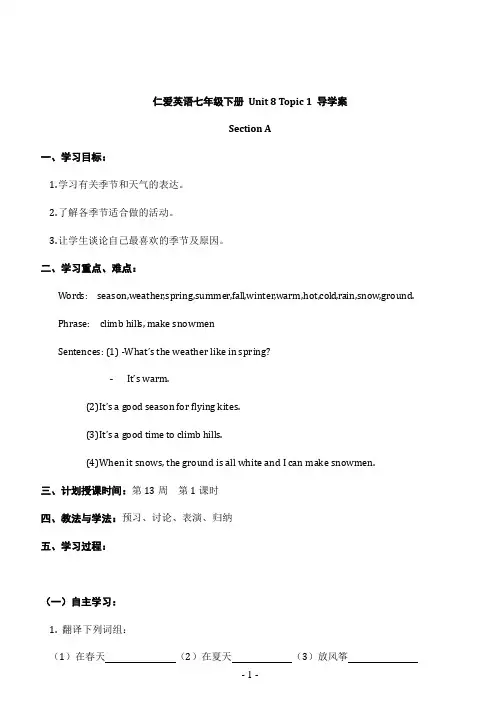
仁爱英语七年级下册Unit 8 Topic 1 导学案Section A一、学习目标:1.学习有关季节和天气的表达。
2.了解各季节适合做的活动。
3.让学生谈论自己最喜欢的季节及原因。
二、学习重点、难点:Words: season,weather,spring,summer,fall,winter,warm,hot,cold,rain,snow,ground.Phrase: climb hills, make snowmenSentences: (1) -What’s the weather like in spring?-It’s warm.(2)It’s a good season for flying kites.(3)It’s a good time to climb hills.(4)When it snows, the ground is all white and I can make snowmen.三、计划授课时间:第13周第1课时四、教法与学法:预习、讨论、表演、归纳五、学习过程:(一)自主学习:1. 翻译下列词组:(4)去游泳(5)堆雪人(6)爬山(7)学做某事2. 翻译下列句子:(1)-你最喜爱的季节是哪一个?-我最喜爱夏天。
因为我可以去游泳。
(2)在冬天我们可以堆雪人。
(3)那是放风筝的好季节。
(4)这是爬山的好时节。
(5)去年,我学会了游泳。
(二)合作交流与展示:1.两人一组谈论1a.2.和你的同伴练习2a.3.根据2b的图片,和你的同伴仿照例子演练对话.(三) 质疑探究:1.用来询问天气状况的句型是:=2. “这是做……的好季节/时间”的句型:翻译(1) 这是爬山的好季节。
(2)这很难说。
3.学做某事:翻译:她正在学跳迪斯科。
(四)反馈检测:1、用方框中所给的单词适当形式填空。
(1) It here last night, and the children mad e many snowmen this morning.(2) –Tom, it’s outside(在外面). Put on your coat when you go out.–OK, Mum.(3) There was a heavy snow last night and the was all white.(4) There are four in a year. They’re spring, summer, fall winter.(5) Don’t go out. It hard outside.2、句型转换。
仁爱版英语七年级下册Unit8topic2sectionA说课稿

仁爱版英语七年级下册Unit 8 topic 2 section A 说课稿一. 教材分析仁爱版英语七年级下册Unit 8 topic 2 section A的主题是“保护环境”,主要讨论了环境问题以及我们应该如何保护环境。
通过本节课的学习,学生能够掌握关于环境问题的相关词汇和表达方式,提高他们的环保意识。
二. 学情分析七年级的学生已经具备了一定的英语基础,能够进行简单的英语交流。
但是,他们的英语听说能力和阅读写作能力还需要进一步的提高。
此外,他们对环保这个话题有一定的了解,但可能缺乏深入的思考和实践。
三. 说教学目标1.知识目标:学生能够掌握本节课的生词和短语,理解文章的主旨大意,能够用英语简单介绍环境问题以及保护环境的方法。
2.能力目标:学生能够通过阅读和听力活动,提高他们的信息获取和处理能力,能够用英语进行简单的讨论和表达。
3.情感目标:学生能够增强环保意识,认识到保护环境的重要性,积极参与环保活动。
四. 说教学重难点1.重点:学生能够掌握本节课的生词和短语,理解文章的主旨大意,能够用英语简单介绍环境问题以及保护环境的方法。
2.难点:学生能够运用所学知识,用英语进行讨论和表达,提高他们的语言运用能力。
五. 说教学方法与手段本节课采用任务型教学法,通过各种活动和任务,激发学生的学习兴趣,提高他们的参与度。
同时,利用多媒体手段,如图片、视频等,帮助学生更好地理解和记忆所学内容。
六. 说教学过程1.导入:通过展示一些环境问题的图片,引导学生思考环境问题的严重性,激发他们的学习兴趣。
2.阅读理解:学生阅读文章,回答相关问题,帮助他们理解文章的主旨大意。
3.听力活动:学生听录音,回答相关问题,提高他们的听力技能。
4.小组讨论:学生分组讨论,用英语表达自己的观点,培养他们的语言运用能力。
5.总结和展示:学生总结本节课所学内容,并进行展示,检验他们的学习效果。
七. 说板书设计板书设计主要包括本节课的主题、生词和短语、以及教学流程。
仁爱版英语七年级下册Unit 8 课后练习题含答案
Unit 8 The Seasons and the WeatherTopic 3 Let’s celebrate!Section B一、单项选择。
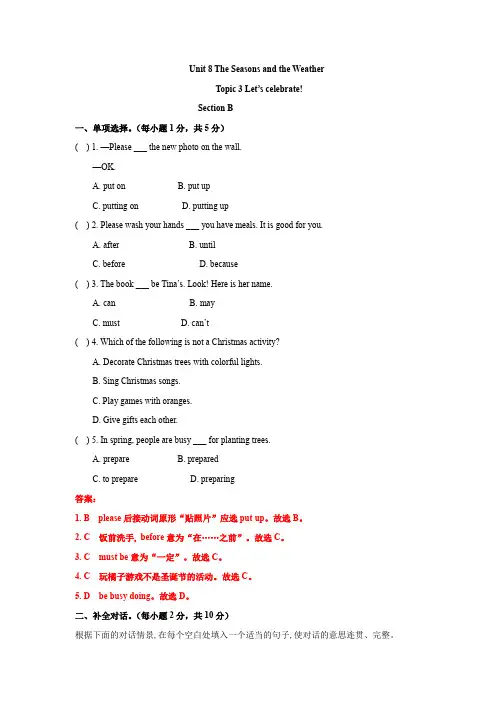
(每小题1分,共5分)( ) 1. —Please ___ the new photo on the wall.—OK.A. put onB. put upC. putting onD. putting up( ) 2. Please wash your hands ___ you have meals. It is good for you.A. afterB. untilC. beforeD. because( ) 3. The book ___ be Tina’s. Look! Here is her name.A. canB. mayC. mustD. can’t( ) 4. Which of the following is not a Christmas activity?A. Decorate Christmas trees with colorful lights.B. Sing Christmas songs.C. Play games with oranges.D. Give gifts each other.( ) 5. In spring, people are busy ___ for planting trees.A. prepareB. preparedC. to prepareD. preparing答案:1. B please后接动词原形“贴照片”应选put up。
故选B。
2. C 饭前洗手, before意为“在……之前”。
故选C。
3. C must be意为“一定”。
故选C。
4. C 玩橘子游戏不是圣诞节的活动。
故选C。
5. D be busy doing。
故选D。
二、补全对话。
(每小题2分,共10分)根据下面的对话情景,在每个空白处填入一个适当的句子,使对话的意思连贯、完整。
Unit 8 Topic 2 课时作业题2022-2023学年仁爱版七年级英语下册
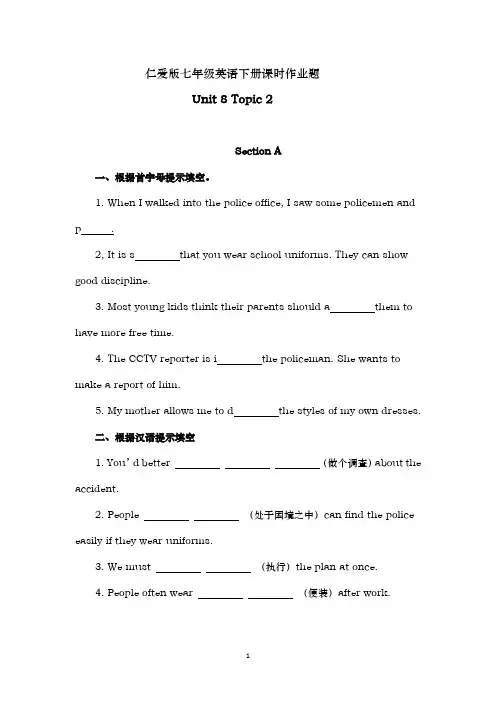
仁爱版七年级英语下册课时作业题Unit 8 Topic 2Section A一、根据首字母提示填空。
1. When I walked into the police office, I saw some policemen and二、根据汉语提示填空三、补全对话。
根据下面的对话情景,在每个空白处填入一个适当的句子,使对话的意思连贯、完整。
(Mary is talking with her friend Jack on the phone.)A: Hello, this is Jack. 1. _________________B: This is Mary. I want to visit some places of interest in China on my holiday. 2. _________________A: I plan to go to Shenzhen to see my parents. They work there.B: That sounds great! 3. _________________A: I’ll go with my sister. Where would you like to visit?B: The Great wall. What is the weather like Shenzhen? Do you know?A: Yes, I do. 4. _________________B: You’d better take an umbrella.A: Thanks a lot. 5. _________________B: The same to you.参考答案一、1. policewomen2. suitable3. allow4. interviewing5. design二、1. make a survey2. in trouble3. carry out4. plain clothes5. with a tie三、1. Who’s that?2. What about you?3. Who will you go with?4. It often rains.5. Enjoy your holiday trip!Section B一、根据首字母提示填空。
2021仁爱版七年级下册英语:Unit8Topic1 SectionABCD学案
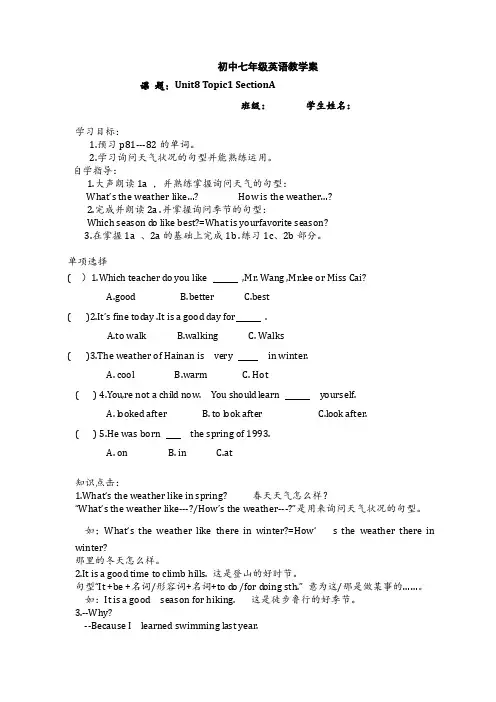
初中七年级英语教学案课题:Unit8 Topic1 SectionA班级:学生姓名:学习目标:1.预习p81---82的单词。
2.学习询问天气状况的句型并能熟练运用。
自学指导:1.大声朗读1a ,并熟练掌握询问天气的句型:What’s the weather like…? How is the weather…?2.完成并朗读2a .并掌握询问季节的句型:Which season d o like best?=What is yourfavorite season?3.在掌握1a 、2a的基础上完成1b .练习1c、2b部分。
单项选择( )1.Which teacher do you like ,Mr. Wang ,Mr.l ee or Miss Cai?A.goodB.betterC.best( )2.It’s fine today .It is a good day for .A.to walkB.walkingC. Walks( )3.The weather of Hainan is very in winter.A. coolB.warmC. Hot( ) 4.You,re not a child now. You shoul d l earn yourself.A. l ooked afterB. to l ook afterC.l ook after.( ) 5.He was born the spring of 1993.A. onB. inC.at知识点击:1.What‘s the weather li ke in spring? 春天天气怎么样?“What‘s the weather like---?/How’s the weather---?”是用来询问天气状况的句型。
如;What‘s the weather like there in winter?=How‘s the weather there in winter?那里的冬天怎么样。
仁爱英语七年级下册unit8知识点

仁爱英语七年级下册unit8知识点仁爱英语七年级下册unit8主要包括了四个知识点:爱好、频度副词、现在进行时和以be动词为主语的句子。
一、爱好关于爱好,我们可以用动词+ing形式的结构来描述,例如:- I like playing basketball.- She enjoys listening to music.- He hates watching horror movies.二、频度副词频度副词是用来描述某个动作发生的次数的。
常见的频度副词有:always、usually、often、sometimes、rarely和never。
我们可以将频度副词放在句首或者句末,例如:- He always brushes his teeth before going to bed.- I usually eat breakfast at 7 o'clock in the morning.- They sometimes go to the park on weekends.- She rarely drinks coffee because it makes her nervous.- We never miss our English class.三、现在进行时现在进行时用来描述正在进行的动作,其结构为:be动词+现在分词。
例如:- He is playing basketball with his friends now.- They are watching TV in the living room.- She is studying English at the library.- We are listening to music in the classroom.需要注意的是,某些动词不宜用于现在进行时,例如感官动词(see、hear、smell、notice、feel、taste)和状态动词(be、seem、appear、look、feel、sound、taste)。
仁爱版七年级下册 Unit 8 Topic 2 课文翻译
仁爱版七年级下册Unit 8 Topic 2 课文翻译I want to go back to Cuba.我想回古巴。
My grandparents miss me very much.我的祖父母非常想念我。
I hope to get together with them.我希望和他们欢聚一堂。
My birthday is next month.我的生日在下个月。
I want to celebrate it with my family and old friends.我想与家人和老朋友一起庆祝。
I'd like to visit some places of interest in China.我想游览一些中国的名胜古迹。
Great! Each of you has a good plan for the holidays.好极了!你们每人都有一个美好的假期计划。
I hope you all have a wonderful time.我希望你们都玩得愉快。
You, too.你也一样。
Section B1aJane plans to go to Yunnan for her holidays. 简计划去云南度假。
Weilun, can you tell me something about your hometown, Yunnan?伟伦,你能告诉我一些关于你的家乡——云南的情况吗?Sure. What would you like to know?当然可以。
你想知道些什么?What's the best time to go there?去那里的最佳时间是什么时候?I think you can go anytime.我认为你随时去都可以。
You know, Kunming is the Spring City.你知道,昆明是“春城”。
The weather there is always fine all year round.那里的天气一年到头都很好。
Unit 1 Topic 2 Section D 示范教案(仁爱版七上)
Unit 1 Making New FriendsTopic 2 Where are you from?Section D教学设计一、教学目标1. 引导学生自主总结be动词am, is, are的一般现在时在不同情况下形式上的变化及缩写形式I’m = I am, they’re = they are, what’s = what is, aren’t = are not, isn’t = is not。
2. 引导学生复习用英语表达询问姓名、国籍、电话号码的方式:What’s your name? Where are you from? What’s your telephone number?3. 引导学生总结本话题特殊疑问词what, where, who引导的特殊疑问句及缩写形式。
4. 能运用图文就表示询问姓名、国籍、电话号码等的基本情况的话题进行简单的交流。
5. 能根据已学音标尝试拼读单词。
6. 能够与同学积极合作,参与课堂活动,大胆实践,培养友好互助的精神;二、教学重点及难点重点:1. 引导学生复习询问姓名、国籍、电话号码等的表达方法。
2. 引导学生复习人称代词:I, you, they, we, she, he , it; 物主代词:my, your, her。
3. 引导学生复习be动词am, is, are的一般现在时在不同情况下形式上的变化。
4. 引导学生复习缩写形式I’m = I am, they’re = they are, what’s = what is, aren’t = are not, isn’t = is not。
难点:1. 正确使用特殊疑问词what, where, who引导的特殊疑问句;2. 正确使用be动词am, is, are;三、教学准备录音机、多媒体、黑板和闪卡。
四、教学过程Step 1 Warming-up1. Greet with students, “Hello! Good morning. Nice to meet you.”2. Let students introduce themselves using what we have learned.Hello. Nice to meet you. My name is… I am from… My telephone number is…设计意图:通过同伴对话介绍自己的情况,巩固前面所学的同时,也活跃了课堂气氛,为新课学习作铺垫。
仁爱版七年级下册英语Unit8Topic2SectionB优秀教学案例
1.采用任务型教学法,让学生分组完成各种任务,如讨论、展示、调查等,培养他的团队合作精神和合作能力。
2.设计一些与节日相关的小组活动,如制作节日海报、举办节日主题派对等,让学生在实际操作中运用所学语言知识,提高他们的实践能力。
3.鼓励学生相互交流、讨论和合作,培养他们的沟通能力和团队协作能力。
2.通过问题驱动法,激发学生的思维能力和批判性思维,培养他们独立思考和解决问题的能力。
3.引导学生关注节日与文化、社会的关系,提高他们的文化意识和跨文化交际能力。例如,提问:“How do Western festivals reflect the values and customs of their society?”等。
在教学过程中,我充分发挥学生的主体作用,采用任务型教学法,让学生在完成各种任务的过程中,自然的习得语言知识,提高他们的语言运用能力。同时,我还注重培养学生的文化意识,让他们了解中外节日的差异,提高他们的跨文化交际能力。
二、教学目标
(一)知识与技能
1.学生能够掌握关于感恩节和万圣节的起源、习俗和活动的相关词汇和句型,如“Thanksgiving is a traditional American holiday celebrated on the fourth Thursday of November.”和“People usually dress up as ghosts or witches on Halloween and go trick-or-treating.”等。
3.培养学生的团队合作精神和合作能力。通过小组讨论、合作完成任务等方式,让学生学会与他人合作,培养他们的团队合作精神和合作能力。
4.培养学生的批判性思维能力。通过引导学生思考和探讨节日的文化内涵,鼓励他们提出自己的观点和看法,培养他们的批判性思维能力。
仁爱版英语七年级下册Unit 6 topic 2 section D 说课稿
仁爱版英语七年级下册Unit 6 topic 2 section D 说课稿一. 教材分析仁爱版英语七年级下册Unit 6 topic 2 section D 主要讲述了一群学生在参加学校的春游活动。
通过本节课的学习,学生能够掌握一般过去时的被动语态,学会如何描述过去发生的事情。
教材内容丰富,插图清晰,练习多样,有助于提高学生的学习兴趣和积极性。
二. 学情分析七年级的学生已经掌握了基本的英语语法知识,对一般过去时有所了解。
但部分学生对被动语态的运用还不够熟练,需要在课堂上进行针对性的练习。
此外,学生的词汇量有待扩大,需要通过丰富的教学活动来提高他们的词汇水平。
三. 说教学目标1.知识目标:学生能够掌握一般过去时的被动语态,正确运用动词的过去分词形式。
2.能力目标:学生能够用英语描述过去发生的事情,提高口语表达能力。
3.情感目标:培养学生热爱生活,珍惜集体活动的情感。
四. 说教学重难点1.教学重点:一般过去时的被动语态的构成和运用。
2.教学难点:动词过去分词形式的正确运用,以及如何在实际语境中运用一般过去时的被动语态。
五. 说教学方法与手段1.采用任务型教学法,让学生在完成具体任务的过程中,自然而然地学会一般过去时的被动语态。
2.运用多媒体教学手段,如图片、视频等,激发学生的学习兴趣,提高课堂活力。
3.小组讨论,培养学生合作学习的能力。
4.进行互动式问答,引导学生主动思考,积极参与课堂活动。
六. 说教学过程1.导入:展示一组春游活动的图片,引导学生谈论自己参加过的春游活动,为新课学习做好铺垫。
2.呈现:通过展示故事插图,让学生感知一般过去时的被动语态,引出本节课的主题。
3.讲解:讲解一般过去时的被动语态的构成和用法,让学生举例练习。
4.练习:设计不同难度的练习题,让学生巩固所学知识。
5.运用:分组进行角色扮演,运用一般过去时的被动语态描述发生在过去的事情。
6.总结:对本节课所学内容进行总结,让学生复述一般过去时的被动语态的构成和用法。