
测控技术与仪器专业英语(韩建国)Unit6翻译
Unit6 引言
1、控制系统概述
在我们周围和体内,控制系统无处不在。
人体器官机能包括许多复杂的控制系统。
在下丘脑中心有一个精细的控制系统,在身体活动和外部环境变化的时候维持体温在37℃。
在一个控制系统——眼睛中,瞳孔直径自动的适应对到达视网膜的通光量的控制。
另一个控制系统维持细胞液钠离子浓度水平。
在穿针和驾驶这两项活动中,人体机能是一个复杂的控制器。
眼睛是检测针线位置或者汽车和道路中心的位置的传感器。
一个复杂的控制器,大脑,能够比较两个位置并决定那种行为被采取来得到期望的结果。
身体通过移动线或转动方向盘执行控制行为;一名有经验的司机能够预料各种类型对系统的干扰,比如一段粗糙的公路或者前方缓慢移动的车辆。
在一个自动控制器中再现一般人每天无意识的判断是十分困难的。
控制系统能够调整家里、学校和各种建筑物里的温度。
它们也通过保证我们所吃食物的纯度和均一度,以及维持造纸厂、炼钢厂、化工厂、精炼厂和其他类型制造工厂的产品质量来影响商品生产和服务。
控制系统通过最小化必须废弃的废旧材料量来保护我们的环境,从而减少制造成本和最小化废物处理问题。
污水和废物处理同样要求借助于自动控制系统。
一个控制系统是维持期望结果和数值的任意一组元件。
从之前的例子可以清楚地看出,大量的元件只是一个单一控制系统的组成部分,无论它们是电的,电子的,机械的,液压的,气动的,手动的,或者它们的组合。
期望的结果是在系统中某个变量的值,比如说,汽车方向,室内温度,水槽中液位或者管道压力。
这个值被控制的变量被称作被控量。
为了实现控制,在系统中必须有另外一个能够影响被控量的值的量。
大多数的系统有许多这样的量。
控制系统通过操纵这些有影响的变量之一的值来维持期望的结果。
汽车方向盘的方位角是被操纵的一个例子。
这个被操作的变量被称为被操作量。
在我们生活中控制系统持续的变得越来越重要。
我们依赖它们达到如此程度以至于生活没有它们便不可想象。
自动控制通过将有经验的操作工人从常规任务释放出来,以及增加每个工人的工作量,已经提高了每个工人的工作效率。
控制系统提高了所制造商品的质量和服务的均一性;如果没有自动控制,许多我们所享用的产品将变得不可能生产。
伺服系统在任我们处理上起到了极大的力量,使我们能够控制大的设备,比如喷气式飞机和轮船。
控制系统通过减少原料和能源的浪费(这是一个不断增加的优势像我们寻求保护环境的方法)来提高效率。
安全是自动控制的另一个好处。
最后,像家庭取暖系统和自动驾驶的控制系统为我们提供了更多的舒适和便利。
总之,自动控制的好处分为以下六个主要类型。
(1)提高的生产力;(2)改善的质量和均一性;(3)增加的效率;(4)动力辅助;(5)安全;(6)舒适和便利。
控制系统用一些不同的方法被分为不同类别。
根据是否使用反馈分为闭环或开环。
根据信号分散或离散的特性分为模拟的或数字的。
根据设定值是常量还是变量分为调节系统和随动系统。
根据他们运用的工艺——连续过程或离散的零件制造分为过程控制系统或机械控制系统。
连续过程指的是生产食品,石油,化学产品,电力能源这些产品所用的工艺。
离散的零件制造指的是制造汽车,飞机,器具和电脑的部件和装配产品的工艺。
根据生产流是来自连续过程还是间隙的和周期的,分为连续的或批量的(或离散的)系统。
最后,根据控制器所处位置——在中心控制室或者传感器和执行器附近,分为集中式或分布式。
另外的分类包括伺服机构,数字控制,机器人,分组控制,连续控制,时间序列控制,时间预定控制,事件序列控制以及可编程控制器。
它们通常总结如下。
2、控制系统分类略
3、方框图和传递函数
虽然,在单一控制系统中在两个拥有完全不同种类元件系统中找出多种不同元件是寻常的,但是,任意的控制系统都能用一组定义各元件特性的数学方程来描述。
一个较大范围内的控制问题,包括加工过程,机床,伺服机构,航天器,交通,甚至能用同样的数学方法分析的经济学问题。
每个元件的重要特征在于它对这个系统产生的影响。
方框图是一种仅仅保留元件重要特征来表述一个控制系统的方法。
信号线表示元件的输入和输出信号。
如图6.1所示。
每个元件从系统的某一部分得到一个输入信号并为系统的另一部分产生一个输出信号。
信号可以是电流,电压,气压,液体流速,液压,温度,速度,加速度,位置,方向,或者其他的方式。
信号传输路径可以是电线,气动导管,液压管路,机械连接体或者将信号从一个元件传到另一个元件的任何东西。
这个元件可以使用
一些能量源来增加输出信号的能量。
一个方框图包括一个代表控制系统中每个元件,并由代表信号路径的线相互连接的框图。
司机的视觉感知提供了两个输入信号,汽车的位置和道路中心的位置。
司机比较这两个位置并确定使汽车保持在合适的位置的方向盘的位置。
为力实现这个决定,司机的手和手臂调节方向盘到新的位置,用相应的行驶位置的改变响应方向盘的位置。
短暂的时间后,新的方向使汽车达到新的位置。
因此,在汽车位置变化和方向盘位置变化之间有一个时间延迟。
这个时间延迟被包括在代表汽车方框的数学方程式中。
方框图的环路表明了控制的基本概念。
汽车实际位置被用来决定所必须的修正来保持期望的位置。
这个概念被称作反馈,带有反馈的控制系统被称为反馈控制系统。
不带反馈的控制系统被称为开环控制系统,因为它们的方框图没有回路。
一个元件最重要的特性是它的输入信号与输出信号的关系。
这种关系用以组件输出信号对输入信号的比例定义的传递函数来表示。
(大部分是输出信号的拉氏变换除以输入信号的拉氏变换)。
4、开环控制
一个开环控制系统不通过比较真实值与期望值来决定控制动作,换句话说,先前通过标定程序或计算决定的校准装置,被用来获取期望值。
图6.2所示一个带有已校准刻度盘的针阀,这就是开环系统的一个例子。
通过测量许多刻度盘设置的流速来获取校准曲线。
正如校准曲线所示,不同的压降有不同的校准曲线。
假定F2的流速是期望的并使用S的设定值。
只要保持穿过阀的压降等于P2,流速就保持在F2,如果压降变为P1,流速就变为F1,这个开环控制不能校正压降中不可预测的改变。
步枪子弹的发射是开环控制系统的另一个例子。
期望的结果是把子弹打入靶心。
实际的结果是子弹从枪发射后的方向。
开环控制发生在步枪瞄准靶心并扣动扳机的时候。
一旦子弹离开枪膛,它就是独立的:如果突然出现一阵风,方向就会改变,并且没有可能校正
开环控制最主要的优势是比闭环控制系统便宜:不需要来测量实际结果。
另外,由于不需要基于误差的校正行为,控制器简单得多。
开环控制的缺点是由未知干扰所引起的误差不能校正,通常一个人工操作员必须通过手动调整来缓慢地校正干扰。
在这个例子中,操作者实际上通过提供反馈信号闭合了环路。
5、闭环控制,反馈
反馈就是测量实际结果与期望值之间的差值的行为并且利用这些差值来驱使实际结果趋向于期望值。
反馈这个术语来自于被测量信号在框图中移动的方向。
信号从被控系统的输出端开始,在控制器的输入端结束。
控制器的输出就是被控系统的输入。
这样,被测信号从被控系统的输出端反馈到输入端。
闭环这个术语指的是反馈路径闭合的环路。
6、变量名
被控量c是被控制的过程输出变量,在过程控制系统中,被控量通常是产品质量的很好度量的一个输出变量。
最常见的被控量有位移、速度、温度、压力、液位和流速
设定值(sp)是被控量的期望值
被测量(cm)是被控量的测量结果,它是测量装置的输出并且通常和被控量的实际值有一个小范围的误差误差(e)是被控量的设定值和被控量的测量值之间的差值,它是按照等式E=SP-Cm来计算的
控制器输出(v)是被控量的测量值向设定值变化的控制行为,控制行为的依据是误差信号和控制器中所使用的控制模型。
被操作量(m)是通过末级控制单元进行调节的变量以获得被控量的期望值。
显然,操作量必须能够在被控变量里影响一个变化。
过程中负载变化迫使被操作量变化来维持一个平横条件。
由于这个原因,操作量的值被用来作为过程负载的一种测量值。
干扰量(D)是过程输入变量,它影响被控量,但不受控制系统控制。
干扰量能够改变过程负载,这也是使用闭环系统的主要原因。
闭环控制的主要优点是具有获得更加精确控制过程的潜力。
闭环控制有两个缺点:(1)闭环控制比开环控制贵得多(2)闭环控制系统的反馈特性可能使系统变得不稳定。
一个不稳定的系统将会产生被控量的震荡,经常伴随一个非常大的幅度。
专业英语Lesson 6 Dynamic Performance 《测控技术与仪器英语教程》

《测控技术与仪器英语教程》
6
6.2 First-order Systems
• a) step response
ideal response
output
actual response
time
Figure 6.4 The step response of a first-order system
2020/6/30
2020/6/30
《测控技术与仪器英语教程》
4
6.2 First-order Systems
• A first-order differential equation :
ad0
dt
b0
ci
a b
ddt0
bci
a , Kc
b
b
2020/6/30
《测控技术与仪器英语教程》
5
6.2 First-order Systems
Lesson 6 Dynamic Performance
• Backgrounds • Text tour • Language in use
– Vocabulary – Structure – Reading/writing techniques
2020/6/30
《测控技术与仪器英语教程》
1
6.1 Zero-order Systems
2020/6/30
《测控技术与仪器英语教程》
16
6.4 Step-response Specification
output
105% 100% 95%
90%
tr t res
ts
t r rise time t res response time t s 5 % settling time
测控专业英语课后单词及翻译
P1U1A Electrical Networks 电路network n. 网络,电路resistor n. 电阻器inductor n. 电感器capacitor n. 电容器passive network 无源网络active network 有源网络characteristic adj. 特性(的);n. 特性曲线Ohm n. 欧姆Faraday n. 法拉第electric charge 电荷integral n. 积分increment n. 增量armature n. 电枢,衔铁,加固aforementioned adj. 上述的,前面提到的represent v. 代表,表示,阐明amplify v. 放大symbolic adj. 符号的,记号的mesh n. 网孔Kirchhoff’s first law 基尔霍夫第一定律loop current 回路电流voltage drop 电压降in series 串联differential adj. 微分的;n. 微分variable n. 变量outline n. 轮廓;v. 提出……的要点eliminate v. 消除,对消[1] In the case of a resistor, the voltage-current relationship is given by Ohm’s law, which states that the voltage across the resistor is equal to the current through the resistor multiplied by the value of the resistance.就电阻来说,电压—电流的关系由欧姆定律决定。
欧姆定律指出:电阻两端的电压等于电阻上流过的电流乘以电阻值。
Which做关系代词,以引出非限制性定语从句。
[2]It may be that the inductor voltage rather than the current is the variable of interest in the circuit.或许在电路中,人们感兴趣的变量是电感电压而不是电感电流。
测控专业英语韩建国课文翻译
CHAPTER.1Introduction to Measurement Unit1Definition of Measurement and Measurement Theory1.Definition of Measurment一个可能的操作的描述术语,同意我们的直觉测量是以下,测量是获取信息”,外表的信息收集是其中最重要的方面进行测量,测量学习对象的测量,测量。
这意味着一个测量必须描述关于该状态,或者在世界的现象——围绕我们,我们是测量。
必须有一个关系状态或现象和测量的结果。
尽管方面获得信息是小学它仅仅是一个必要的和非充分方面的测量:当一个人阅读一本教科书、一个收集信息,但是一个不执行一个测量。
第二个方面是,它的测量须有选择性的。
它可能只提供有关我们希望测量(测量),而不是任何其他的许多州或现象在我们周围。
这方面也是必要的,但不足以方面的测量。
欣赏一幅画在一个空荡荡的房间将提供信息只有这幅画,但不构成测量。
第三个和必要的方面在于它必须测量的目的。
测量的结果必须独立于一个任意的观察者。
每个观察者必须提取相同的信息从测量和必须得出了同样的结论。
然而,这几乎是不可能的,一个观察者只使用他/她的感官,观察和我们的感官是高度主观的。
我们的意义上的温度,例如,很大程度上取决于任何感觉热或冷前测量。
这是证明了试图确定一壶水温度用手。
如果手首先浸泡在冷水,壶里的水会觉得相对温暖的手,而如果是第一个浸泡在温水,水在壶会觉得相对冷。
除了我们的观察”知道,我们人类观察员也残疾的事实有许多州或现象在现实世界的我们,我们不能观察(e.g.磁场),或者只差(e、g、极低的温度下或高速运动)。
为了保证测量的客观性因此,我们必须使用文物(工具或工具)。
这些工具的任务是把国家或现象受到观察到一个不同的状态或现象,不能被误解的观察者。
换句话说,该仪器将初始观察到一个表示,所有的观察者可以观察并将同意。
为测量仪器的输出,因此*客观可观察到的输出如数字应该使用一个字母数字显示,而不是主观评估诸如颜色等。
测控技术与仪器专业英语词汇

Lesson 1Accuracy 精确性、精度Amplitude 振幅,幅度Channel 信道,频道Coefficient 系数Convergence 收敛Differentiate 求……的微分Expansion 展开式Harmonic 谐波的Instant 瞬时,时间Integrate 求……的积分Linear 线性的Order 次序,阶Peak 最高的,最高峰Periodicity 周期Phase 相位Polynomial 多项式的,多项式Resistor 电阻器Series 展成级数,级数Taylor series 泰勒级数Set 集合Sinusoidal 正弦的Time domain 时域frequency-domain 频域integrand 被积函数Lesson 2decay 衰减duration 持续时间exponential 指数的multiplier 乘数,乘法器oscillatory 振荡的frequency density function 频率密度函数Fourier series 傅立叶级数Spectrum 频谱Imaginary part of complex 复数的虚部Real part of complex 复数的实部Conjugate pairs 共轭对Lesson 3algorithm 算法decaying oscillatory function 衰减振荡函数power series 幂级数shift operator 移位算子product 乘积electrical disturbance 电干扰sampled-data signal 数据采样信号be proportional to 与…成正比Lesson 5dead-band 死区hysteresis 滞后linearity 线性度measurand 被测量oscilloscope 示波器performance 特性precision 精确度resolution 分辨率static friction 静态摩擦sensitivity 灵敏度calibration 校准loading effect 负载效应slop 斜率platinum 铂thermometer 温度计in cascade with 与…串联in parallel with 与…并联lever 杠杆displacement 位移indicated value示值true value 真值deflection 偏转possible error 可能误差probable error 概率误差root-sum-square error 方和根误差Lesson 6overshoot 过调量,超调量transient response 瞬态响应variable 变量ramp 斜坡resonance 共振step input 阶跃输入step response 阶跃响应transient 瞬态的first-order system 一阶系统static error 静态误差dynamic error 动态误差time constant 时间常数frequency response 频率响应damping ratio 阻尼比under-damp 欠阻尼over-damp 过阻尼mass-spring system 质量-弹簧系统steady-state 稳态rise time 上升时间settling time 建立时间(过渡过程时间)specification 性能指标tolerance 容差Lesson 7capacitance 电容deformation 变形distortion 变形,扭曲electromagnetic 电磁的gauge 表,仪器,计strain gauge 应变计crystalline material 晶体材料voltage 电压current 电流harmonics 谐波inductance 电感,感应infrared 红外的linearize 线性化natural frequency 固有频率mutual-inductance 互感photoconductive cell 光电导管photoelectric effect 光电效应piezo-electric 压电的potential divider 分压器potentiometer 电位计,电位器精品文库resistance 电阻thermistor 热敏电阻transducer 转换器,传感器cross-sectional area 截面积excitation voltage 激励电压full-scale 满量程rotary 旋转的translational 平移的mechanical wear 机械磨损inertia 惯性power dissipation 功耗illumination 照度transparent 透明的Lesson 8coupling 耦合flux 磁通impedance 阻抗permeability 磁导率permittivity 电容率,介电系数reluctance 磁阻variable-distance capacitive transducer 变间距式电容式传感器oscillation circuit 振荡电路l.v.d.t 线性差动变压器piezo-electric transducer 压电式传感器charge amplifier 电荷放大器parallel-plate capacitor 平板电容器variable-reluctance transducer 变磁阻传感器liquid level 液位Lesson 9apparatus 仪器attenuator 衰减器bandwidth 带宽battery 电池be inversely proportional to 与成反比be proportional to 与成正比capacitor 电容feedback 反馈gain 增益operational amplifier 运算放大器semiconductor 半导体terminal 终端test probe 探针voltmeter 电压表multirange 多量程variable resistor 可变电阻Lesson 10duty cycle 占空比timerbase 时基register 寄存器signal conditioning 信号调理threshold 阈值trigger 触发器Lesson 11adapter boarder 适配板analog-to-digital conversion模数转换desktop 工作平台distortion 失真dynamic 动态的expansion slot 扩展槽generator 发生器interface 接口local area network LAN 局域网motherboard 母板scale 刻度slot 长槽workbench 工作台computer-aided testing(CAT)计算机辅助测试desktop personal computer台式个人计算机knob 旋钮16-channel analog-to-digitalconversion board 16通道模/数转换板12-bit resolution 12位分辨率buffer 缓冲器interface 接口data-gathering device 数据采集装置Lesson 12active element 有源元件bias 偏差,偏置current intensity 电流electrode 电极field-effect transistor FET场效应管grid 格子,栅极integrated circuit 集成电路magnetic field 磁场passive component 无源元件photocell 光电管sensor 传感器,敏感元件thermocouple 热电偶transducer 变换器,换能器,传感器vacuum tube 真空管,电子管Lesson 13cache memory 高速缓冲存储器,高速缓存control unit 控制器,控制部件drain 场效应管的漏集dynamic RAM (DRAM)动态随机存取存储器gate 门(电路),管子的栅极local memory 局部存储器,本地存储器metal-oxide-semiconductorfield effect transistor(MOSFET)金属氧化物半导体场效应管microcontroller 微控制器microprocessor微处理器monitor 监视器mouse 鼠标精品文库printer打印机static RAM (SRAM)静态RAMultra-large-scale integratedcircuit 超大规模集成电路。
测控技术与仪器专业英语翻译
Selected from “Introduction to Control System technology , 4th Ed. , by Robert N. Bateson, Macmillan Publishing Co., 1933”. 选自“控制系统技术,第四版的介绍,罗伯特N.贝特森,麦克米兰出版有限公司,1933。
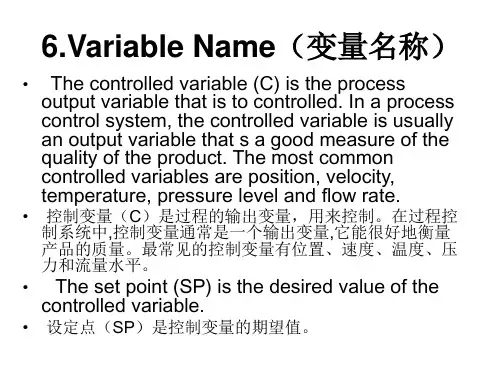
• 测量变量(CM)是衡量价值的控制变量。这是输出的测 量手段和通常不同于实际的控制变量的一小部分。
• The error (E) is the difference between the setpoint and the measured value of the controlled variable . It is computed according to the equation E=SP-.
控制变量(C)是过程的输出变量,用来出变量,它能很好地衡量 产品的质量。最常见的控制变量有位置、速度、温度、压 力和流量水平。
•
•
The set point (SP) is the desired value of the controlled variable.
6.Variable Name(变量名称)
•
The controlled variable (C) is the process output variable that is to controlled. In a process control system, the controlled variable is usually an output variable that s a good measure of the quality of the product. The most common controlled variables are position, velocity, temperature, pressure level and flow rate.
最新-测控技术与仪器专业英语阅读翻译 精品

测控技术与仪器专业英语阅读翻译篇一:测控技术与仪器专业英语课后阅读翻译(1,5~10)第1章课后,,,???,,,?,,??,?,,(1950),,??,,??,;,,,(,),,,,,,=(2),,,(),水下声波信号在声纳操作过程中,操作员经常需要对受噪声干扰的信号进行检波。
干扰信号可能来自操作员发出信号的反射波或者外部声源的信号。
这两种类型的干扰对主动声纳和被动声纳都会造成很大影响。
类似的情况在雷达监测、工程类和图像类专业的基本原理都会涉及到。
当你想到信号检测时有多种方法,那么定义一个术语来表示特殊情况便是可行的。
当问题的答案是“当前有一个还是一个多个信号?”时,检波一词将被使用。
一个系统被设计来为这种问题提供答案--无论是必然性还是偶然性,这就需要谈及假设检验;当一个信号反复出现的情况下,许多系统只被设计提供两个答案:“是的,当前有一个信号”或“不,当前没有信号”。
力图将信号分类会使问题复杂化,因为后者的结论将涉及到目标分类。
一般来说,一种检波仪器只被设计在固定的类型和参数下工作,不容易被改变,例如时间积分检波电路和光学检测的辉光示波管。
当出现不明信号时,观察者在拒绝或接收信号方面有所迟疑。
在这种情况下,操作员会有种感觉如果检波电路或者示波管能够延长时间那么他就能下结论该信号是否存在。
沃尔德(1950)在他的检波理论系统阐述了这种直觉。
如果(一个检测检测方法)能够主动去改变时间间隔并在接收系统里储存数据以便达到确定的某一水平,这就是顺序检测。
一般不仅能够确定信号存在与否,而且还能确定一个或多个与信号关联的参数。
在还原完整波形时我们所感兴趣的参数在各简单分量间有很大差别,例如信号的到达时间和相位。
当一个系统被设计来提取一个或多个信号参数时,这就是信号抽取。
信号一词并没有明确的定义,只是在读者对它有直观了解时的一种假设。
有些较为详细的解释为了对信号一词进定义可能导致是比较主观的或者狭隘与所应用的条件。
测控技术与仪器专业英语单词翻译
测控技术与仪器专业英语单词翻译If a measurement is slightly off the mark,we have the tendency to compensate for the error by allowing the recorded eeading to creep closer to our perceived impression of the true value.如果测量值有轻微的偏差,我们综合室倾向于补偿误差将记录值向感觉的真值靠拢。
更糟的是事实上两次测量中仪器本身不会一直指向相同的位置,由于指针的移动的。
Aggravating the situation is the fact that the meter itself does not always register identical values the same way twice,depending on which way the pointer happens to be moving. .大多数的误差来自视差,即观察仪器指针的角度不垂直造成的视差,即使我们已经解释了这种生理特性,却还是想从自身逃避责任While the main gate is open,the conditioned input signal pulses are passer through to the counting register,where they are tallied and then scaled for output by the display circuitry.当主控门打开时,经过转换的输入脉冲通过其进入计数寄存器,并在此统计,然后通过读书屏输出。
Because the frequency counter must accommodate a wide range of input signals,with vary degrees of voltage,noise component,and DCoffset,the input must pass through many conditioning circuits before it is fully conditioned.由于频率计数器必须提供一个宽范围的输入信号,使之能够适用于不同伏特,噪声成分和直流偏移,所以输入信号在充分变换前必须经过许多转换电路。
Unit 6 Introduction2012
1 An Overview for Control System
– A complex controller, the brain, compares the two positions 2.3 and determines which actions must be performed to accomplish the desired result. – 复杂控制器大脑比较两者位置,并决策完成期望效果所 采取的动作。 2.5 – The body implements the control action by moving the thread or turning the steeling wheel; an experienced driver will anticipate all types of disturbances to the system such as a rough section of pavement or a slow-moving vehicle ahead. – 人体通过移动线和转动方向盘完成控制动作;一个有经 验的司机将预期这个系统所有类型的干扰,如人行路段 或有慢行车在前方时。
2
Words and Expressions
– – – – – – – – – – – continuous 连续的 discrete 离散的 regulator system 调节系统 follow-up system 随动系统 setpoint 给定值 actuator 执行器 programmable controller 可编程控制器 central control room 中央控制室 block diagram 方框图 response to 响应 time delay 延时 Laplace transform 拉普拉斯变换
测控技术与仪器专业英语全书翻译
jug will feel relatively cold. Besides the subjectivity of our observation ,we human observers are also handicapped by the fact that there are many states or phenomena in the real world around us which we
观察者。换句话说,仪器将最初的观察到任何观测者都表示会同意能封锁。For the measurement instrument’s output ,therefore ,objectively observable output such as numbers on an alpha-numerical display should be used rather than subjective assessment of such things as colour ,etc.. Designing such instruments ,which are referred to as measurement systems ,is the field of (measurement) instrumentation.用来测量仪器的输出,因此,客观观察的输 出如数字显示 alpha-numerical 应使用而不是主观评价诸如色彩,等。设计这样 的仪器都被称为量测系统,域(计量仪表。In the following ,we will define measurement as the acquisition of information in the form of measurement
测控技术与仪器专业 英语
测控技术与仪器专业英语Measurement and Control Technology and Instruments Measurement and control technology plays a crucial role in various industries, including manufacturing, research, and development.As a specialized field, it requires professionals with excellent skills and knowledge in areas such as sensors, data acquisition, signal conditioning, and control systems. The Measurement and Control Technology and Instruments program trains students to become proficient in all aspects of this field. In this article, we will explore the key subjects and skills covered in this program.1. Sensor Technology:Sensors are vital components in measurement and control systems. Students in this program learn about different types of sensors, such as temperature sensors, pressure sensors, and position sensors. They study how sensors work, how to select the appropriate sensor for a specific application, and how to calibrate and maintain sensors.2. Data Acquisition:Collecting accurate and reliable data is crucial for measurement and control systems. Students learn various data acquisition techniques, including analog-to-digital conversion, digital signal processing, and sampling theory. They gain hands-on experience with data acquisition systems and software tools used for data analysis and visualization.3. Signal Conditioning:In order to obtain accurate measurements, signals from sensorsneed to be conditioned and processed. Students learn about techniques for amplification, filtering, linearization, and noise reduction. They understand the importance of signal conditioning in maintaining data integrity and accuracy.4. Control Systems:Control systems are central to measurement and automation processes. Students study different types of control systems, such as feedback control, feedforward control, and proportional-integral-derivative (PID) control. They learn about system modeling, stability analysis, and controller tuning. They gain practical experience in designing and implementing control systems for various applications.5. Measurement Techniques:This program emphasizes different measurement techniques used in industrial and scientific settings. Students gain knowledge of measurement principles, uncertainty analysis, and standards. They learn about techniques such as calibration, metrology, and error analysis. They also study measurement instruments and their applications, including oscilloscopes, multimeters, spectrometers, and chromatographs.6. Instrumentation and Automation:Instrumentation and automation are integral parts of measurement and control technology. Students learn about different instruments used in industrial processes and research laboratories. They study automation techniques, including programmable logic controllers (PLCs), distributed control systems (DCS), and supervisory control and data acquisition (SCADA) systems. They become proficient indesigning and implementing modern instrumentation and automation solutions.7. Industrial Applications:Measurement and control technology has wide application in various industries, such as manufacturing, aerospace, energy, and medicine. Students learn about the specialized requirements and challenges of different industries. They study case studies and real-world projects to gain practical insights into applying measurement and control techniques to solve industrial problems.In conclusion, the Measurement and Control Technology and Instruments program covers a comprehensive range of subjects and skills necessary for professionals in this field. From sensor technology to control systems and from data acquisition to instrumentation and automation, students gain a solid foundation in measurement and control principles. With this knowledge, they can contribute to improving the efficiency, reliability, and safety of industrial processes and scientific research.。