
2014 pep小学英语四年级下册第三单元
It’s cool.
Guess: What’s the weather like?
It’s hot.
Guess: What’s the weather like?
It’s cold.
warm
Kunming
Dalian Shanghai Shenzhen Changchun Tianjin
hot
Is it windy in Hainan?
Yes! It is !
Is it rainy in Harbin?
No, it’s snowy.
Yes! It is !
Is it cloudy in Singapore?
Is it cloudy in Xinjiang?
No, it isn’t.
Is it warm in Yunnan?
Yes! It is !
Is it cold in Guangzhou?
No! It is warm!
Is it rainy in Chongqing?
Yes, it is.
Is it rainy in Macao?
No! It is cloudy!
5.——Is it +天气类形容词(+in+地点)? (。。。的)天气。。。吗? ——Yes, it is.是的。/No, it’s not.不。 例句: Is it cold? 天冷吗? No, it's not. 不,不冷。
.
hot
对 应 词
cool
warm
cold
看图片,说单词。
连
warm
连
看
It’s… I like …
cold
cool
hot
What’s the weather like today?
It’s________.
warm
What’s the weather like today?
cool It’s________.
What’s the weather like today?
cold It’s________.
What’s the weather like today?
It’s________. hot
Let’s chant!
(合)Weather, weather, weather report. (合)This is the weather report. (1)Cold, cold, it’s cold in Harbin. (2)Warm, warm, it’s warm in Beijing. (3)Hot, hot, it’s hot in HongKong. (4)Cool, cool, it’s cool in Lhasa. (合)Thank you .
Goodmoring. This is the weather report. It’s....in..... Thank you. Urumqi
Lanzhou
Harbin
Beijing
Lhasa
Shang Hai Chengdu Hong Kong
Guess: What’s the weather like?(天气 怎么样?)
cold
cool
sunny
cloudy
windy
rainy
snowy
What’s the weather like in Beijing?
It’s sunny.
What ’s the weather like in New York?
It’s cloudy.
What ’s the weather like in Sydney?
4月23日20时—4月24日20时
father
weather
(天气)
mother
brother
weather report 天气预报
warm
Beijing
Hong Kong
hot
cool
Lhasa
Harbin
cold
It’s warm.
It’s hot.
It’s cold. It’s warm.
4.How about…? ….怎么样?(用来提 出建议或请求,或征求对方的看法和意 见,语气较委婉。后加名词、代词、动 名词) How about New York? 纽约怎么样? How about it? 它怎么样? How about jumping? 跳怎么样? How about… 同义句是 what about…
Yes, it is.
Is it snowy in Harbin? Yes, it is.
Is it rainy in Beijing?
No, it isn’t.
Is it rainy in Urumqi? No, it isn’t.
Is it rainy in Hong Kong? No, it isn’t.
It’s rainy.
What’s the weather like Harbin?
It’s snowy.
What’s the weather like in Hainan?
It’s windy.
It’s cool .↘
天气凉爽。
Is it cool?↗
天气凉爽吗?
Is it sunny in Beijing?
Is it sunny in Lhasa?
No, it isn’t.
如何描述天气
What’s the weather like today? It’s warm today.
四会句型: 1.——What’s the weather like (+in+地点)? (。。。的)天气怎么样? ——It’s + 天气类形容词(+in+地点)。。。 (。。。)天气。。。 例如:—— What’s the weather like in New York? 纽约的天气怎么样? ——It’s snowy in New York. 纽约下雪了。
Hong Kong 香港ห้องสมุดไป่ตู้
35℃ hot
It‘s hot
Hong Kong . in
Lhasa
拉萨
14℃
cool
cool It‘s
in
Lhasa
.
Beijing 北京
25℃ warm
It‘s warm
in Beijing
.
Harbin 哈尔滨
- 13℃ cold
cold It‘s
Harbin in
PEP小学四年级英语下册课文及翻译
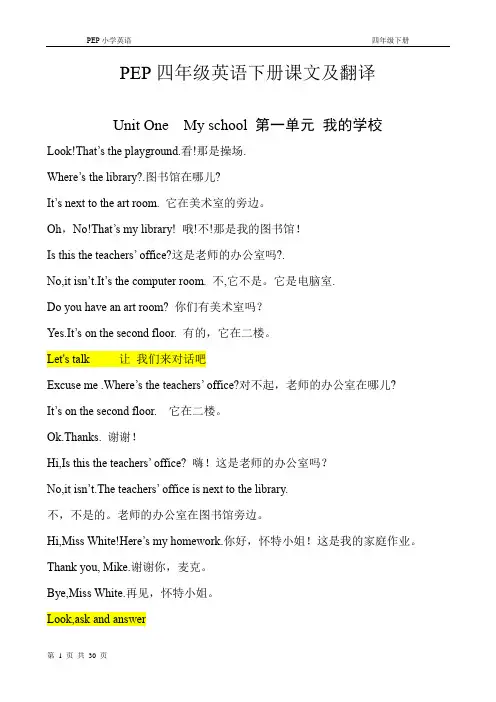
PEP四年级英语下册课文及翻译Unit One My school 第一单元我的学校Look!That’s the playground.看!那是操场.Where’s the library?.图书馆在哪儿?It’s next to the art room. 它在美术室的旁边。
Oh,No!That’s my library! 哦!不!那是我的图书馆!Is this the teachers’ office?这是老师的办公室吗?.No,it isn’t.It’s the computer room. 不,它不是。
它是电脑室.Do you have an art room? 你们有美术室吗?Yes.It’s on the second floor. 有的,它在二楼。
Let's talk 让我们来对话吧Excuse me .Where’s the teachers’ office?对不起,老师的办公室在哪儿?It’s on the second floor. 它在二楼。
Ok.Thanks. 谢谢!Hi,Is this the teachers’ office? 嗨!这是老师的办公室吗?No,it isn’t.The teachers’ office is next to the library.不,不是的。
老师的办公室在图书馆旁边。
Hi,Miss White!Here’s my homework.你好,怀特小姐!这是我的家庭作业。
Thank you, Mike.谢谢你,麦克。
Bye,Miss White.再见,怀特小姐。
Look,ask and answerWhere’s the library? 图书馆在哪里?It’s on the second floor. 它在二楼。
Is it next to classroom 3? 它是在三班的旁边吗?Yes,it is. 是的。
Let's learnWhere’s the library?【teachers’ office】图书馆在哪里?/老师的办公室It’s on the first floor.【second floor】它在一楼。
四年级下册英语第三单元story time
四年级下册英语第三单元story time一、故事背景介绍本单元的Story Time 讲述了发生在动物王国的故事。
动物王国中的小动物们要举办一场盛大的音乐会,他们各自准备自己的节目,最终在音乐会上展示出来。
二、角色介绍1. 小兔Rabbit:故事的主人公,活泼可爱,梦想成为一名音乐家。
2. 小熊Bear:Rabbit 的好朋友,喜欢吹喇叭。
3. 小猫Cat:善于弹奏吉他,是Rabbit 的音乐导师。
4. 小狗Dog:喜欢跳舞,为音乐会编排了舞蹈。
5. 小鸟Bird:歌声优美,是音乐会上的主唱。
三、故事情节概述1. Rabbit 立志成为一名音乐家,向Cat 学习吉他。
2. Bear 学习吹喇叭,Dog 编排舞蹈,Bird 练习唱歌。
3. 音乐会当天,动物们表演各自的节目,观众热烈欢迎。
4. Rabbit 的吉他表演获得好评,实现了成为音乐家的梦想。
四、重点词汇解释1. musician:音乐家2. guitar:吉他3. trumpet:喇叭4. dance:跳舞5. singing:唱歌6. program:节目单7. stage:舞台8. audience:观众9.评价: praise10. 梦想: dream五、语法点解析本单元主要涉及一般现在时态和现在进行时态的用法。
在故事中,动物们进行活动时使用了现在进行时态,例如“Rabbit is playing the guitar”。
此外,描述动物们日常活动时使用了一般现在时态,例如“Bear likes playing the trumpet”。
学生需要掌握这两种时态的基本用法和规则。
六、文化背景解析本故事以动物王国为背景,展现了动物们丰富多彩的生活和兴趣爱好。
通过这个故事,学生可以了解到不同动物的特点和生活习性,以及它们之间的友谊和合作。
同时,故事也传递了友谊、梦想和努力的价值观念。
七、学习策略建议1. 听力训练:学生可以听故事录音,了解故事情节和角色的特点。
pep人教版四年级下册英语第三单元教案含教学反思
pep人教版四年级下册英语第三单元教案含教学反思1.学生需要掌握“Can I。
”这个句型,并且能在适当的情境中运用。
2.学生需要理解单词“___”“hot”“outside”以及短语“be careful”,并能够听懂和说出来。
3.在教师和图片的帮助下,学生需要理解对话的意思,并且能够用正确的语音表达出来。
4.学生需要掌握句型“Can I go outside/have some soup?”,并且能够征求对方的许可,并用“Yes,you can/No,you can’t.”进行回答。
5.在研究对话的过程中,学生需要感受到父母的关爱。
在口语练中,学生可以复上一单元所学的“Whattimeisit?It,s。
o’clock.”。
同时,可以讨论今天的天气,引出“___”和“hot”这两个单词。
教师可以通过问“Where am I?”这个问题,教授学生单词“outside”。
同时,通过出示危险项目的图片,提醒学生在玩的时候要小心,引出“Be careful”这个短语的使用情景。
在教学“Can I。
”这个句型时,教师可以引导学生回答“Yes,you can/No,you can’t.”。
同时,教师可以介绍对话的情景,并播放对话录音,让学生跟着录音对话并回答问题。
最后,学生可以通过合作练和上台表演来巩固所学内容。
In Step 4.students are assigned to practice the language point of asking for n and ___。
They are asked to write a dialogue using the sentence pattern “Can I。
Yes。
you can。
No。
you can’t.” The ___ “Can I。
”In Step 1.students are asked to perform a dialogue from the “Let's talk” n with their partner。
PEP小学四年级英语下册课文翻译

PEP四年级英语下册课文及翻译Unit One My school 第一单元我的学校Look!That’s the playground.看!那是操场.Where’s the library?.图书馆在哪儿?It’s next to the art room. 它在美术室的旁边。
Oh,No!That’s my library! 哦!不!那是我的图书馆!Is this the teachers’ office?这是老师的办公室吗?.No,it isn’t.It’s the computer room. 不,它不是。
它是电脑室.Do you have an art room? 你们有美术室吗?Yes.It’s on the second floor. 有的,它在二楼。
Let's talk 让我们来对话吧Excuse me .Where’s the teachers’ office?对不起,老师的办公室在哪儿? It’s on the second floor. 它在二楼。
Ok.Thanks. 谢谢!Hi,Is this the teachers’ office? 嗨!这是老师的办公室吗?No,it isn’t.The teachers’ office is next to the library.不,不是的。
老师的办公室在图书馆旁边。
Hi,Miss White!Here’s my homework.你好,怀特小姐!这是我的家庭作业。
Thank you, Mike.谢谢你,麦克。
Bye,Miss White.再见,怀特小姐。
Look,ask and answerWhere’s the library? 图书馆在哪里?It’s on the second fl oor. 它在二楼。
Is it next to classroom 3? 它是在三班的旁边吗?Yes,it is. 是的。
Let's learnWhere’s the library?【teachers’ office】图书馆在哪里?/老师的办公室It’s on the first floor.【second floor】它在一楼。
人教PEP版四年级下册英语教案-Unit3 Weather
Unit 3 Weather教学设计课题Unit 3 Weather Part B Let’s learn教学内容人民教育出版社小学英语四年级下册第三单元教法游戏教学法、情境教学法等。
教材依据义务教育课程标准实验教科书人教版(PEP)小学《英语》设计思想一、设计理念本节课的设计依据《义务教育英语课程标准(2011年版)》倡导的教学理念:1. 面向全体学生,关注语言学习者的不同特点和个体差异。
2. 整体设计目标,充分考虑语言学习的渐进性和持续性。
3. 强调学习过程,重视语言学习的实践性和应用性。
4. 注重语篇教学。
采用语篇整体输入法,力求做到“词不离句,句不离篇,篇不离境”。
5. 优化评价方式,着重评价学生的综合语言运用能力。
6. 丰富课程资源,拓展英语学习渠道。
二、教材分析学生在本册本单元中已经学习并较好地掌握讨论有关天气的单词和句型,能够根据话题进行交流;同时学生已经在三年级下册Unit2 & Unit4以及四年级上册Unit4 & Unit6和本单元学习了一般疑问句的用法。
这些背景知识为本课目标语言的学习和使用打下了良好的基础,丰富目标语的操练和应用。
三、学情分析大部分四年级的孩子有一定的英语基础,积极活泼。
乐于表现自己,对英语学习也很感兴趣,已了解基本的学习方法,并具备了简单的听、说、读、写的能力。
因此,本课采用任务型教学法,以学生为中心,让学生带着任务,带着兴趣来在语境中接触、体验和理解真实语言,并在此基础上学习和运用语言。
教学知识/技能目标1.能够在有意义的语境中能听懂、会说、会认单词:sunny, windy, cloudy,rainy, snowy。
2.能在具体情境中正确运用What’s the weather like? It’s...3.培养学生英语综合运用能力。
情感目标1. 能在不同学习活动中感受到英语学习的乐趣,乐于学习和使用英语。
2. 培养学生的观察力和注意力。
PEP四年级下册人教版小学英语 《Unit 3 Weather》B read and write 教案
四年级下册Unit 3 Weather B Read and write教学设计课前欣赏:Boys and girls, let’s enjoy a weather song.Step1.Warm-up.1.Greeting:Hello,boys and girls.How are you? Ss:...Now look,What’s the weather like today? Ss: It’s...Yes,it’s....So today we have 4 weather groups:Sunny group,rainy group,windy group and snowy group.If you do well,you can get a weather card from the e on!2.Boys and girls,My name is Linda.Today I’m your English teacher.I like travelling.And I want to travel around the world. Do you want to go? Ss:... But wherever we go, we should pay attention to the weather. Because different places, different weather. Now,let’s watch the weather forecast and tell me “What weather can you find?”(1)T:What’s the weather like in London?Ss: It’s cloudy.(2)T:What’s the weather like in Moscow?Ss: It’s snowy.(3)T:What’s the weather like in New York?Ss: It’s windy.(4)T:What’s the weather like in Singapore?Ss: It’s rainy.(5)T:What’s the weather like in Sydney?Ss: It’s sunny.T: so what’s the weather can you find? For example: I can find “sunny”,what can you find?S1:... S2:... S3:...T:Now,let’s see together.( Ss read the weather words. )Step2. Presentation.1.T:You did a good job.Boys and girls. I like travelling. My friend John’s dad like travelling,too.(贴板书dad头像)He write a postcard to John.So where is he?Look, this is the postcard from John’s dad to John. Here is a tip: Picture is a good helper. We can look at the pictures carefully and get someinformation. Now,let’s look and guess.You can speak in Chinese.(1)Where is John’s dad?S1:... S2:...T:Maybe.(2)What’s the weather like there?S3:...T:Maybe.2.T:Now,boys and girls. Fast reading tip for you: We can circle and underline the key words from fast reading.Now,let’s read the postcard quickly and circle the key words,then answer the questions.(1)Where is John’s dad?(2)What’s the weather like there?Ss read 30’s.T:Have you finished?Now,let’s check.(1)Where is John’s dad?S1: Sydney. T:Yes,He’s in Sydney.(出词卡教读,sunny group-snowy group-S1、S2,贴板书)Can you read this?出句子”I’m in Sydney now.”(录音一遍,教读一遍)T:Great.Sydney is the biggest city in Australia,and the kangaroos are famous in Australia,too. Now,let’s watch a video about Sydney. Ss:...T:Wow!Sydney is so beautiful.So what’s the weather like in Sydney?(贴weather)S2:hot and sunny.T:Yes,it’s hot and sunny.(出词卡,教读,操练,贴板书)Ss:...T:Can you read this?出句子”It’s hot and sunny here.”(录音一遍,教读一遍)3.T:Now,detail reading.let’s read carefully and underline the key words ,then answer the questions.(1)Is the water cold in Sydney? Yes or No.(2)Can John’s dad swim in Sydney? Yes or No.Here is a tip for you,when you find the key words,you can slow down and underline the key words.Now,let’s go. Ss read the postcard.T:let’s check.(1)Is the water cold in Sydney? A or B. S3:BT:How do you know that? S3说依据.T:Yes,the water is warm.(教读2遍)Look,(T引导)the water is hot. And the water is cold.(2)Can John’s dad swim in Sydney? Yes or No. S4: Yes.T:How do you know that? S4说依据.T:(引导)I can swim outside.Do you know swim?(出词卡,动作,教读i,i /i,i,i/,操练G-G,S1、S2...,贴板书)can you read this? Ss:I can swim . T:How about this one?now listen carefully.”I can swim outside.”教读一遍T:You must swim safely with adult protection.4.T:Boys and girls,from the postcard we know John’s dad is in Sydney. The weather is hot and sunny. The water is warm. He can swim outside. So can you finish this chart? For example: Where is he? He’s in Sydney. Now,what’s the weather like in Sydney? Who can try?S5: It’s hot and sunny.T:What can he do?S6:He can swim.T:You did a good job.Now let’s read again and underline what does John’s dad want to know about John?T:Now let’s check.who find the answer?S7:Is it cool and windy in Beijing?(不会读的话找出位置即可)T:you’re so clever.Now listen.(听录音跟读,T 教读)T:what else?S8:Can you fly your kite?T:Great!Do you know fly? Look! The birds can fly, the butterflies can fly.so follow me ,fly ,fly.教读操练. can you read this?”fly you kite”教读。
Unit3Weather大单元整体教学设计-小学英语四年级下册(人教PEP版)
单元整体教学设计四下Unit 3 Weather一、单元整体分析本单元是人教版英语四年级下册的第三单元,单元话题是“Weather”本单元重点学习天气的表达法。
共三个版块:A 部分,B部分和C 部分。
A、B部分呈现新知识点,C部分是以讲故事形式巩固或延展知识面。
共分六课时来学习。
本单元A,B部分的Let’s learn 主要学习描述天气的形容词:cold,cool,warm,hot,sunny,windy,cloudy ,snowy,rainy。
本单元A Let’s talk 部分以“Weather”为话题,由Mike询问时间,引出句子:Can I go outside now? 接着妈妈以“It’s cold outside.”拒绝了Mike 的请求。
午餐时Mike 提出要喝汤“Can I have some soup?”妈妈同意并提醒“Be careful! It’s very hot”B 部分则展示了陈洁和Mark 的一段越洋通话,通话的主要内容则是围绕着两地的天气。
先由陈洁询问纽约的天气展开:“What’s the weather like in New York?”然后通过进一步的问答呈现描述天气的句子:“It’s 26 degrees .It’s warm!本单元Let’s spell 部分,要求学生听、说、读、写单词:arm ,car,card,ball ,tall,wall。
Let’s do ,Let’s play ,Let’s sing 部分则是通过各种形式让学生在玩中学,在学中玩,从而在轻松,愉悦的环境中学习语言,运用语言。
学生们的日常生活丰富多彩,同时也是很有规律的,建议教师在教授新知识的同时,紧密结合学生的生活实际,引导他们用英语表达自己的日常生活。
二、单元教学目标(一)知识目标1.能够听懂、会说A、B中Let’s learn ;Let’s talk中呈现的对话,并能在实际情景中加以运用。
英语人教版四年级下册第三单元C部分 Story time
课题名称:人教版(PEP)小学英语四年级下册第三单元C部分Story time教学设计执教、设计人:广东省韶关市乳源瑶族自治县第一小学钟萍英一、教学设计(一)教学目标1、语言目标通过阅读趣味故事复习巩固本单元所学的语言,增加学生语言的输入。
能理解并朗读故事内容。
2、语言技能能理解并表演故事,还能恰当运用故事中的语言,同时在表达语言的过程中体会说话者惊讶、苦恼、遗憾等不同的情绪状态。
3、文化意识不同国家、不同地区的天气及其影响,西方国家的关心、礼貌用语。
4、情感态度珍惜友谊5、学习策略听、说、读、演、玩、运用、科干部引领(二)教学内容分析本单元的话题是weather, 而作为本单元的最后一个学习内容story,正是本单元主题内容得到理解、运用及情感渗透的好题材,同时,通过趣味故事的学习可增加学生学习英语的兴趣和了解一些英语语言的背景文化。
(三)教学对象分析(学情分析)1、学生对本单元有关weather的内容掌握较好,听说能力较强,表演能力较强,在上本课前已经训练了一些能力较强的英语科干部,他们有较强的学习引领能力,可极大地发挥他们的作用。
2、学生们通过三年级和四年级以来的学习,已经有了听说读演玩及运用已知语言的能力,同时他们有很强的同伴互助学习和学科干部的引领能力。
3、学生在学习中可发展自身的特长,如组织能力、表演才能、想象能力等,全班学生也在共同学习中共同进步、语言知识和语言技能、良好的情感都得到发展,同时增强了集体主义精神。
(四)教学策略与过程1、教学设计思路:通过复习运用已经掌握的有关weather的重点句型,过渡到故事学习、表演,且在表演中渗透运用语言、渗透关心、礼貌、珍惜友谊的情感,同时也运用趣味语言和表演愉悦学生身心,为学生继续学习英语打下良好的语言和良好的情感态度基础。
2、教学过程步骤(一)师生问候师:Good moring, boys and girls. I’m your new friend. You can call me miss Zhong.生:Good moring, miss Zhong.(设计意图:礼貌示范、拉近师生距离。
小学英语四年级Unit3说课稿
一、说教材(一)说课内容我说课的内容是PEP小学英语四年级下册第三单元A部分Let’s learn和Let’s do(二)教材分析本单元主要学习有关服装的名称及其单、复数的使用,并且学会用不同的颜色来形容不同的服装。
本节课为《Unit 3 Is This Your Skirt?》的第一课时,内容包括A部分的Let’s learn 和Let’s do。
本节课是本单元的第一课时主要学习的是服装的名称,所以先让学生初步学习日常生活中接触到的服装的英语单词,这些东西都是学生非常熟悉而且和我们的生活息息相关,学生也乐于学习,并易于在生活中进行运用。
A部分的Let’s learn主要让学生学习和掌握6个词组。
而通过Let’s do等TPR活动进行巩固操练。
此部分是为培养学生语感、复习前面所学内容及运用语言表达的能力、为活跃课堂和培养兴趣而设置的。
(三)教学目标1、知识目标:能听、说、认读本课时的主要词组:white sweater, green skirt, brown jacket, blue dress, yellow T-shirt,和red shirt;能够听懂指示语,并按要求做出相应动作,如:“Put on your T-shirt. Take off your jacket.”等。
2、能力目标:能运用简单的句子表达自己喜欢的服饰,如“I like the white sweater with the green skirt.”3、情感目标:,培养学生用英语表达自己的思想,积极参与课堂的交流合作的良好习惯;培养学生的美感,能穿衣得体;(四)教学重难点:重点:能听、说、认读本课时的主要词组:white sweater, green skirt, brown jacket, blue dress, yellow T-shirt,和red shirt;能够听懂指示语,并按要求做出相应动作。
难点:单词skirt和shirt的区别;表示服装的名词与表示颜色的形容词的连用及其读法。
小学PEP英语四年级下册Unit 3第三课时Read and write
小学PEP英语四年级下册Unit 3第三课时Read and write .一、教学目标A.语言知识目标:1)五个颜色单词red yellow green blue white 的掌握和运用。
2)能对所属衣物进行提问及回答Is this your T-shirt? No , it isn’t . 3)能在图文和场景下进行简单的交流和表演。
4)正确在四线三格中书写单词和句子。
B.情感态度目标通过本课的学习使学生达到初步运用英语交际的能力,培养学生的合作精神和良好的书写习惯。
二、教学重、难点1)颜色单词及句型在交际中的运用2)五个单词及句子在四线三格中的正确书写。
三、教学准备T恤衫、卡片、录音机、磁带和课件四、教学过程Step1 warm up1.Free talk2.Let’s sing: colour songStep2 pre-reading1.展示颜色单词T:Great! You sing very well! In this song, can you see any colours? Yes, I can see so many colours! 教学so many colours依次展示:red blue yellow green white并让学生以各种形式拼读,书空,教师板书在黑板上。
2.Is this your T-shirt? No, it’s not.教师拿出一件T-恤衫,问学生Is this your T-shirt?引导学生回答No, it isn’t.反复问几个同学,并让学生书空,教师板书句子。
同时强调还可以用No, it’s not.来回答。
3.Pass me my T-shirt接上一环节,教师说:It’s my T-shirt. Please pass me my T-shirt.并教学Step3 in-reading1.教师说:There are many T-shirt in the tree. Do you want to knowwhose T-shirt? 出示问题,让生带问题听录音。