
外研版(一起)二年级英语下册教案Module6Unit2(2)
T: On Sundays,Iusually read books. Whatabout you?
Ss say something about their weekends.
Review and read: I usually help myfather. / I usually ride my bike. / I usually do my homework. / I usually cook.
Teaching Aids
Cards, pictures, wall chart
Teaching Procedures
Step 1 Warming up
Sing to greeting.
T: Look, it’s going to raining. I don’t like raining. Do you like raining? (No.) So, let’s sing the song: <Rain, rain, go away!>.
Learn to say: cook, go shopping
Drilling those words.
Point game: cook, cooks, cooking; go, goes, going. (Listen to teacher and point the right words.)
Page 24: Activity one
Describe the pictures.
Number these pictures 1 to 4. And then listen to T, show the correct number.
Read after T.
Page 23: Activity three
Ask several Ss to describe these pictures.
Say it together.
Read after T.
Readtheactivity 2 on page 23.
Learn to say: cook, go shopping.
Page 24: activity 1 and 2
Page 23: activity 2 and 3
Teaching difficult points
Distinguishthese words: cook, cooks, cooking; go, goes, going.
Students Analysis
Help them to review important sentence patterns. Distinguishthe three forms: do, does, doing.They may not understand, but canrecognizethem is ok.
外研版(一起)二年级英语下册教案
Module 6Байду номын сангаасnit2We are helping her.
Teaching Aims
Review the sentence pattern: I usually…ButnowI’m…
Learn the module 2 unit 2.
Teaching important points
Watch the CD-ROM.
Get thechildrentounderstandit.
Listenandrepeat.
Step 3 Practice
Page 24: Activity two
Review the sentence pattern: I usually…But nowI’m….
外研版(一起)二年级英语下册教案Module6Unit1(1)
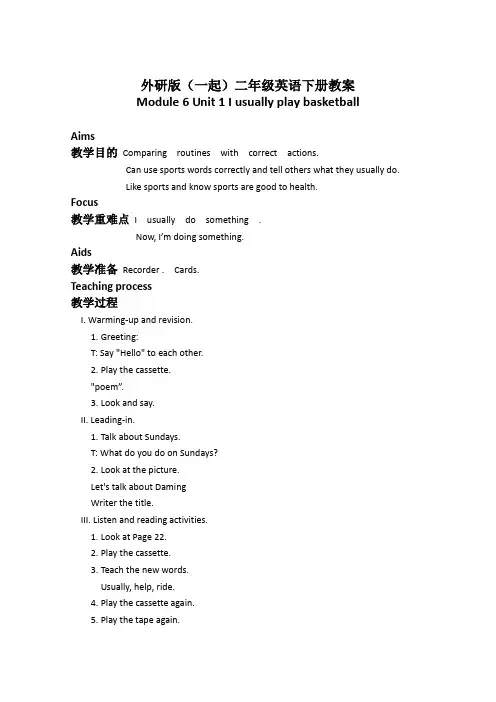
外研版(一起)二年级英语下册教案Module 6 Unit 1 I usually play basketballAims教学目的Comparing routines with correct actions.Can use sports words correctly and tell others what they usually do.Like sports and know sports are good to health.Focus教学重难点I usually do something .Now, I’m doing something.Aids教学准备Recorder . Cards.Teaching process教学过程I. Warming-up and revision.1. Greeting:T: Say "Hello" to each other.2. Play the cassette."poem”.3. Look and say.II. Leading-in.1. Talk about Sundays.T: What do you do on Sundays?2. Look at the picture.Let's talk about DamingWriter the title.III. Listen and reading activities.1. Look at Page 22.2. Play the cassette.3. Teach the new words.Usually, help, ride.4. Play the cassette again.5. Play the tape again.IV. Further development1. Listen and say.2. Play the cassette.3. Game.4. Action.5. Exercise.(1). Copy wordse.g.: play-----playinghelp----- ( )do------ ( )watch--- ( )ride----- ( )(2). Listen and match.UsuallyPlay footballRead bookFly kitesHelp my fatherV. Homework.Recite the text.Prepare next lesson.Say "Hello" to teacher.Ss: "We're play in the playground " .Clap hand and do the actions.Ss: I'm reading a book.What are you doing?Do the actions and say. "I play football …”Read the title together.Understand the meaning of the text.Circle the new words.Spell and read the words. Say it out correctly.Learn the main drills. I usually help my father. But, I'm not helping him today. Make sentences according do the actions.Listen and repeat. In each picture, ask and answer.Listen and say.Do and say.--- I usually …, But I'm not …ing.--- You’re …ing.Read the text in group, and then act it out. Nowswimmingriding my bikewatching TVdoing my homeworkFeedback教学反馈。
二年级下册英语教案Module6Unit2Mygrandmausuallycooks2外研社
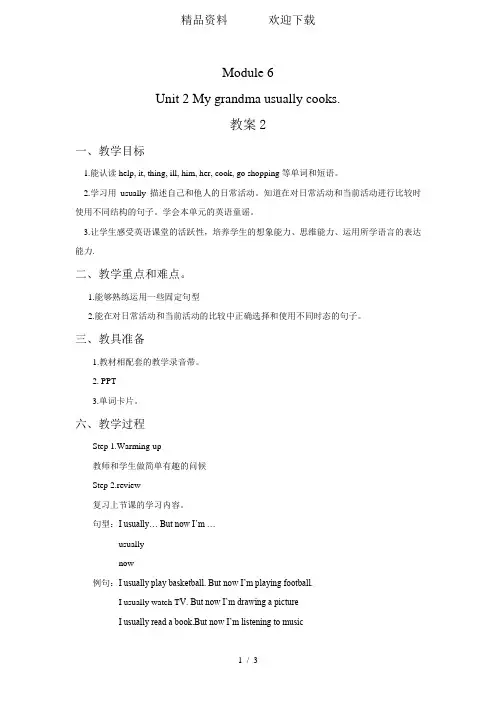
Module 6Unit 2 My grandma usually cooks.教案2一、教学目标1.能认读help, it, thing, ill, him, her, cook, go shopping等单词和短语。
2.学习用usually描述自己和他人的日常活动。
知道在对日常活动和当前活动进行比较时使用不同结构的句子。
学会本单元的英语童谣。
3.让学生感受英语课堂的活跃性,培养学生的想象能力、思维能力、运用所学语言的表达能力.二、教学重点和难点。
1.能够熟练运用一些固定句型2.能在对日常活动和当前活动的比较中正确选择和使用不同时态的句子。
三、教具准备1.教材相配套的教学录音带。
2. PPT3.单词卡片。
六、教学过程Step 1.Warming-up教师和学生做简单有趣的问候Step 2.review复习上节课的学习内容。
句型:I usually… But now I’m …usuallynow例句:I usually play basketball. But now I’m playing football.I usually watch T V. But now I’m drawing a pictureI usually read a book.But now I’m listening to musicI usually do my homework. But now I’m riding my bike.Step3. Presentation1. New word:cook---做饭;烧菜句型:What’s she doing?She’s cooking.What’s this?Kitchen---厨房句型:It’s a kitchen.My mother usually cooks.But today she’s not cooking. She’s ill. I’m cooking for herill---生病的;有病的What are they doing?They’re going shopping.go shopping----去购物句型:What’s she doing?She’s going shopping.2.掌握基本单词和句型后,教师带领学生一起学习新课文内容,了解文章故事内容3.让学生们分组练习对话内容,然后抽同学用自己的话讲述文章故事。
二年级下册英语Module2Unit6AnimalsIlikeLetstalkLetslearn教案
本节课是二年级下册英语教材中的Module 2 Unit 6,主要内容为“Animals I like”,旨在通过对一些小学生感兴趣的动物和宠物进行学习,让学生能够学会表达自己喜欢的动物的英语表达方式,学会区分动物的名称和种类,从而不断提高学生的英语听、说、读、写能力。
一、教学目标1. 能听懂、讲述、朗读、认读单词cat, dog, turtle, parrot, fish, panda, horse。
2. 能运用所掌握的生词及句型表达对不同动物的喜爱。
3. 在老师指导下,独立完成如下任务:a. 配对图片和词汇;b. 口头呈现喜欢或不喜欢的动物;c. 通过朗读、表演、写作方式融会贯通。
二、教学重点1. 通过图片和口头交流,学生能够认识和掌握不同种类的动物(cat, dog, turtle, parrot, fish, panda, horse)。
2. 通过与同学和老师的互动,学生能够自如地表达自己喜欢或不喜欢的动物。
三、教学难点1. 通过提问、呈现、板书等多种教学方式,学生能够融会贯通各种信息。
2. 学生能够在复杂环境下适应英语交流,敢于尝试表达自己的意见和想法。
四、教学方法1. 任务法。
在设计教学环节和流程时,根据学生的认知心理和吸收能力,有针对性地开展各个教学任务。
2. 互动法。
采用多种互动方式,如小组讨论、游戏化教学、角色扮演等,建立学生与老师和同学之间的互信关系,激发学生的学习兴趣和动力。
五、教学步骤1. Warming-up:通过图片呈现、音乐播放、问答等形式,让学生自然地进入课堂气氛。
2. Presentation:呈现所需要学习的单词和图片,让学生掌握与之相关的知识和信息。
3. Practice:通过游戏化或多种角色扮演方式,让学生互相交流和掌握相应的生词和句型。
4. Production:通过角色扮演、写作、朗读、表演等形式,让学生融会贯通,产出符合自身的英语表达方式。
5. Conclusion:通过巩固、复习、总结等方式,让学生真正掌握所学知识和技能,提高学生的英语听、说、读、写能力。
二年级英语下册 Module 2 Unit 1(6)教案 外研版(一起)

外研版(一起)二年级英语下册教案Module 2 Unit 1 She is listening to the radio.教学内容:She is listening to the radio. He is reading a newspaperShe is writing a letter. He is playing with his train.教学目标:知识目标:掌握以下重点词句:new, camera, radio, newspaper, letterShe is listening to the radio.He is reading a newspaper.She is writing a letter.He is playing with his train.能力目标:能够用英语描述一个人现在正在做什么事情。
情感目标:培养学生合作精神和爱家庭、爱家人、爱集体的情感。
教学重点及难点:教学重点:用现在进行时态来描述一个人现在正在进行的动作。
教学难点:理解和感知现在进行时的意义。
教具准备:录音机、CD-ROM、头饰、多媒体课件、实物教学过程:Warming-up:T: Hello, boys and girls. Nice to meet you.Let’s sing a song. Ok?S: sing a song.(Arouse interest and create a favorable atmosphere for learning)Review and show the taskListen and do some actionsChilren! Look at the screen. What is he /she doing? (课件出示图片)Presentation:1. T: (take out some head ornaments) Look, Who is he?S: He is Daming.T: Yes, you are right! Daming is coming; he is your teacher today, listen, what he said? (师生观看课文动画)Today Daming brings some presents .Let’s look. Point and say: This is my book. This is my radio. This is my camera.(Review the old words, lead in the new words)Look at the picture and ask: What is your mother doing? What is your father doing? What is your grandma doing?Look and the screen. 找同学比较两组单词有什么共同点,表达什么意思。
外研版(一起)二年级英语下册教案Module6Unit1(4)
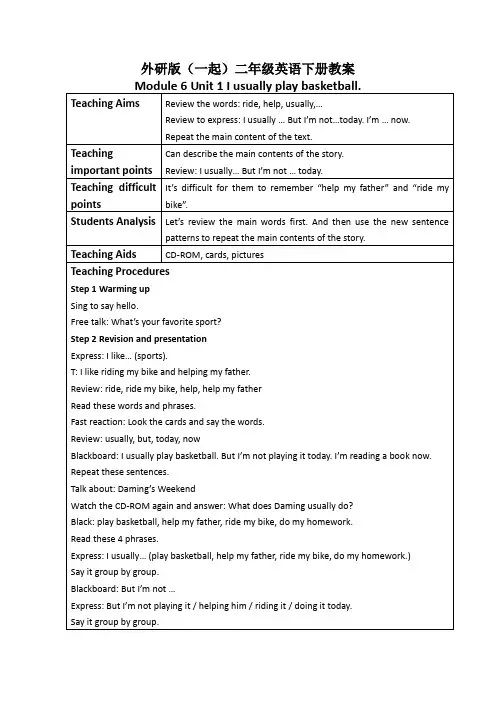
Teaching important points
Candescribethe main contents of the story.
Review: I usually…ButI’m not…today.
Teaching difficult points
press: Ilike…(sports).
T:Ilike riding my bike and helping my father.
Review: ride, ride my bike, help, help my father
Readthese words and phrases.
Fast reaction: Look the cards and say the words.
It’sdifficultfor them to remember“help my father”and“ride my bike”.
Students Analysis
Let’s review the main words first. And then use the new sentence patterns to repeatthemain contents of the story.
Watch the CD-ROM again and answer: What does Daming usually do?
Black: play basketball, help my father, ride my bike, do my homework.
Read these 4 phrases.
Express: I usually…(play basketball, help myfather, ride my bike, do my homework.)
外研版(一起)二年级英语下册教案Module2Unit2(2)
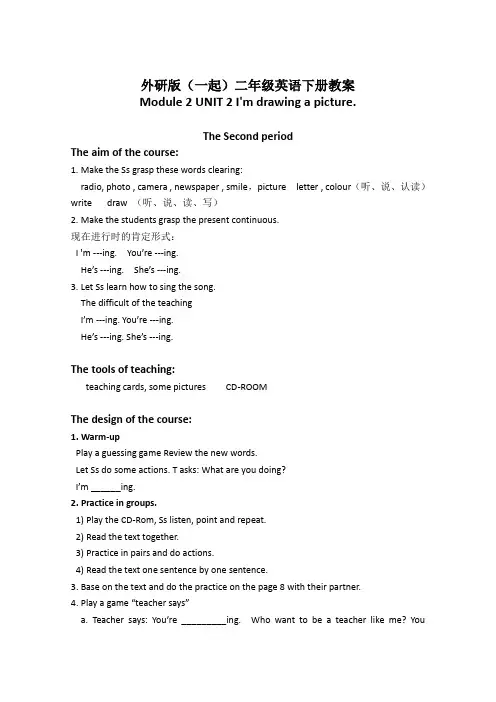
外研版(一起)二年级英语下册教案Module 2 UNIT 2 I'm drawing a picture.The Second periodThe aim of the course:1. Make the Ss grasp these words clearing:radio, photo , camera , newspaper , smile,picture letter , colour(听、说、认读)write draw (听、说、读、写)2. Make the students grasp the present continuous.现在进行时的肯定形式:I 'm ---ing. You’re ---ing.He’s ---ing. She’s ---ing.3. Let Ss learn how to sing the song.The difficult of the teachingI’m ---ing. You’re ---ing.He’s ---ing. She’s ---ing.The tools of teaching:teaching cards, some pictures CD-ROOMThe design of the course:1. Warm-upPlay a guessing game Review the new words.Let Ss do some actions. T asks: What are you doing?I’m ______ing.2. Practice in groups.1) Play the CD-Rom, Ss listen, point and repeat.2) Read the text together.3) Practice in pairs and do actions.4) Read the text one sentence by one sentence.3. Base on the text and do the practice on the page 8 with their partner.4. Play a game “teacher says”a. Teacher says: You’re _________ing. Who want to be a teacher like me? Youshould say: You’re ___ing.b. Make more sentences. You’re ____ing.c. Practice in group.5. Have a rest.Sing the song “I’m listening to the music”6. Do activity book on page8--9.a. Listen and writeb. Read and match. Then sing the song.7. Do more practice.1) P9 game Let S1 does action in front of the blackboard. The others guess: You’re ____ing. S1 answer: “Yes, I am ____ing.” or “No, I’m not.”Practice in pairs like this.2) 连锁游戏S1: I’m dancing. S2: I’m reading newspaper. You’re dancing.S3: I’m eating. You’re reading newspaper. She/He’s dancing….、8. SummeryHomework:1) Listen to the tape 3 times, and repeat 3 times from 6 to 9.2) Make a dialogue and talk about activities taking place now.3) Know all the words of M2 and recite 2 words.4) Prepare for Module3Notes:。
外研版二年级英语下册 Module6 Unit 2 My grandma usually cooks. 教案
Unit2Aims教学目的Comparing routines with current actionsFocus教学重难点Language:Today is gandma’s birthday and we are helping her.Function:Comparing routines with current actionsAids教学准备Word-cardsTeaching processTeacher‘s activityStudent’s activityRe-preparation教学过程一.Warming up and revisionSay hello to the students. 二.leading-inDraw two circles on the board. In one write “usually” and in the other write “now”三.Listening and reading activitiesActivity1. Listen and repeatShow the picture about the text. Play the tape.Play the tape,again.Write the words on the board.Play the tape,sentence by sentence.Draw the table on the board.UsuallyNowGrandmaFatherGirlActivity 2 look and sayChoose four students to come to the front of the class to do some mimes.Look at the picture,talk about it. Teach the sentence:I usually ... but now I am ...Activity 3.listen and say then say the poem.Before saying the poem:1. Have the students describe the picture2.play the tape. Teach the poem sentence by sentence.3.choose eight students to come to the front. Write out the eight partsof the poem and give one to each person at the front in a jumbled up order.Here are the eight parts of the poem:1) What do you usually do on Sundays?6) What are you doing now?3) I usually play all of the day5) And what are you doing now this Sunday7) I am lying in bed with a pain in my head.2) What do you usually do?8)That is what I am doing now!3) That is what I usually do.四.Further Development Activity 4.game,find five differences say them.Before doing activity4Tell the students that I am going to describe things from the pictures.Now one the board writes these verbs.wearing eatingholding readingDo activity 4.五.HomeworkMake a dialogue with your partners.Sing the song “I am listening to music.The student suggests activities and writes them around the circles. Then they can pick one activity from each circle and make sentences.Look at the picture. Guess what happen in this girl‘s home?Listen and find the words don’t understand.Read after the tape.And do some mime.Look at the table then ask and answer.Each student should perform two mimes. The first mime is what usually happens. The second mime is what is happening now. Other students answer what are they doing.Say it one by one.Then say it togetherLook at the picture and talk. (A girl is sick in bed and she is thinking about playing with her friends)Listen to the tape,do some mimes.The eight students should hold up their pieces of paper so the class can read them. The student holding the first parts of the poem should be on the left and the student holding the last part of the poem should be on the right.The students have to say if it is from picture 1 or picture 2.Look at the two pictures and write all the objects that go with each word.Play the game.Feedback。
外研版(一起)二年级英语下册教案Module6Unit1(3)
外研版(一起)二年级英语下册教案Module 6Unit1 I usually play basketball教学目标(一)知识目标:1.学习usually, Sunday等单词和短语。
2.学习用usually描述自己的日常活动。
3.知道在对日常活动和当前活动进行比较时使用不同结构的句子。
(二)能力目标:1.能用I usually来介绍自己的日常活动。
2.能在对日常活动和当前活动的比较中正确选择和使用不同时态的句子。
(三)情感目标:1.培养学生积极参加运动的意识。
2.通过学习,对国外小朋友的通常的周末活动有所了解。
教学重点1.能听懂、会说、会读以下句子:I usually help my father. But I’m not helping him today.I usually ride my bike. But I’m not riding it today.2.能用usually描述自己的日常活动。
教学难点1.能在对日常活动和当前活动的比较中正确选择和使用不同时态的句子。
在比较中学习总结两种时态句子的运用规律2.学习新词汇和新句型,能用I usually来介绍自己的日常活动。
教学意图1.培养学生对重点词汇和句子的认读能力。
2.培养学生的听说能力,读写活动作为听说训练的补充,活动具有一定的灵活性。
3.通过多种形式的活动激发学生的学习兴趣。
教具准备1.教材相配套的教学录音带。
2.教学挂图。
3.学生的照片。
教学过程Step 1 Warming-up1.教师热情和学生打招呼,相互问好,然后师生一起说唱上个模块所学的英语童谣《We are playing in the playground.》要求学生边说唱边拍手做动作。
(设计说明:只有通过师生,生生间大量的语言交流,才能培养学生用英语交际的能力,唱英文歌曲是培养学生听说能力的有效方式,选用与本单元有关的歌曲不仅使学生的能力得到锻炼,同时也为整堂课的进行做了很好的铺垫。
小学英语新外研版(一起)二年级上册《Module 6 Unit 2》教……教案
小学英语新外研版(一起)二年级上册Module 6 Unit 2题目Does he play the flute?题材(主要)内容Amy告诉Lingling和 Fangfang她的弟弟Sam 喜欢音乐,并告诉她们Sam 喜欢的具体项目——既不是吹笛子,也不是听CD,而是打爵士鼓;学唱儿歌:Mm is for monkey.教学目标语言知识目标功能询问及谈论他人经常进行的活动。
语法(结构、句子)Does he play the flute/ listen to CDs?Yes, he does. / No, he doesn’t.词汇听能在听录音的过程中辨别出单词:listen, does, doesn’t 说能在句子中正确使用单词:listen, does, doesn’t读能在图片或动作的帮助下正确朗读单词:listen写字母:Mm, Nn, Oo语言技能目标听能听懂Amy和好友Lingling及Fangfang关于Sam喜欢何种音乐项目的谈论:My brother likes music. Does he playthe flute/…? Yes, he does. / No, he doesn’t.说会用Does he / she play the flute /…? Yes, he / shedoes. / No, he / she doesn’t. 询问和谈论他人经常进行的活动;能说唱儿歌:Mm is for monkey.读能认读课文中谈论Sam 对音乐喜好的句子:Does he play the flute/listen to CDs/…? Yes, he does. / No, hedoesn’t.写能抄写字母:Mm,Nn,Oo学习策略通过游戏和竞赛活动,体验英语学习的乐趣并感知如何正确、高效地处理信息。
文化意识了解英美国家小朋友们的周末生活。
情感态度在问答训练及Guessing game中,学会合作并乐于合作。
小学英语新外研版(一起)二年级上册教案 Module 6 Unit 2……
小学英语新外研版(一起)二年级上册外研版(一起)二年级英语上册教案Module 6 Unit 2 Does he play the flute?一、教学目标(一)知识技能目标:1.懂、会读、会说、单词listen, music, flute, drum。
2.能听懂、会读、会写句子Does he play football at the weekend?Yes, he does. /No, he doesn’t.3.会读、会正确书写Mm, Nn, Oo。
(二)运用能力目标:1.学习怎样用英语陈述和询问某人经常做的事情,掌握相关单词和句型,并能综合运用新、旧知识组织对话完成一定的交际任务。
2.增加已学知识的复现率,培养学生对重点单词和句子的认读能力(三)素质教育目标:1.培养学生浓厚的英语学习兴趣,积极参与说英语、做游戏等实践活动。
2.帮助学生树立较强的自信心,培养学生乐于与他人合作的精神与竞争意识。
二、教学重点1.能够用英语陈述和询问某人经常做的事情。
2.能听懂、会说、会读以下句子:Does he play football at the weekend?Yes, he does. /No, he doesn’t.并能进行扩展,在实际生活中灵活运用。
三、教学难点1.熟练掌握本单元的单词和句型,能在实际生活中灵活运用。
2.创设英语情景,使学生正确运用所学知识用英语描述和询问某人经常做的事情。
四、教学意图1.培养学生对重点词汇和句子的认读能力。
2.培养学生的听说能力。
3.激发学生的求知欲,创设各种真实或接近真实的语言环境,让学生积极参与体验。
五、教具准备1.教材相配套的教学挂图,录音。
2.上个单元的单词卡片。
3.准备小奖品。
六、教学过程Step 1.Warming-up1.教师热情地和学生打招呼,做简单的Free Talk.(设计说明:只有通过师生、生生间大量的语言交流,才能培养学生用英语交际的能力。