
外研版高中英语必修四module 3《body language and non》ppt课件
• on guard 提防, 值班 • be on guard against sth.提防着…… • 我们大家都要提防小偷。 • eg. Everyone must be on guard against thieves. • off guard 不当班,不戒备 • keep guard 放哨,守望 • on watch 在值班 • off watch 不值班
module3
Body language
• • • •
(1) in the distance在远方 (2)at a distance稍远一点; at a distance of two miles 在2英里的距离处 (3)What is the distance from…to …? 哪离哪 有远? • (4)make a long distance call打长途电话 • (5)distance的形容词是distant
• • • • •
unconscious adj. 无意识的,不知不觉的 conscious adj. 有意识的 be (un)conscious of/that (未)意识到, (未)觉察 ⑴他似乎没觉察到自己把大家逗乐了。 He seems unconscious of making others laugh. • ⑵我意识到有人在注视我。 • I became conscious that someone fixed an eye on me.
•• • •
Can you give reasons for your choice? the reason for sth. / sb.’s doing is that… the reason why…is that… 我要去北京逛的原因是那里有许多名胜古迹。 (两种说法) • The reason for my visiting Beijing is that there are many places of interests. • The reason why I will visit Beijing is that ……
• • • • • •
vary v.变化 variety n.变化,多样性 a variety of 各种各样的 =various adj. ⑴ vary with 随……而变化 物价随季节而变化。 eg. The price of the goods varies with seasons. • ⑵ vary from…to…由……到……情况不等 • 地区与地区之间,气候总是变化不同。 • eg. Climate varies from regions to regions.
• make/do a deal with sb. • 与某人作成一笔交易, 和……达成协议 • 他正设法和他们达成一项协议。 • eg. He was trying to make a deal with them.
• We shake hands when we make a deal. 1. He spent a great deal of money on his experiment. 他把大量的钱花在他的实验上。 2. How would you deal with an armed burglar? 你怎样对付持有武器的强盗? 3. Haven’t you dealt with that letter yet? 那封信你答复了么? 4. We made a deal with the management on overtime. 在加班问题上我们与管理部门达成协议。
• • • • • • • • • •
at all 用于否定句:not at all 根本不,一点也不 我一点都不在乎别人怎么想。 eg. I don’t care about what others thought at all. 用于疑问句:“究竟,到底” 你到底在想些什么? eg. What are you thinking of at all? 用于条件状语从句:“确实” 如果你确实了解这件事,就说出来吧。 eg. If you know about the matter at all, please speak out.
• • • • • • • • • • •
When in Rome, do as the Romans do. 入乡随俗。 shake-shook-shaken v. 摇动,发抖,震动,握手 风把树上的一些叶子吹了下来。 eg. The wind shook some leaves from the tree. 他撒谎动摇了我对他的信任。 eg. His lying shook my trust in him. 他气得发抖。 eg. He was shaking with anger. 与…握手 shake hands with sb
• • • • • •
communicate vt. 交流, communication (n). tele-communication 电信 communicate with sb. 与某人交流 用互联网,我们就可以直接与联合国联系。 we can communicate with the United States directly through the internet. • communicate sth to sb告知某事给某人 • 他把我们的秘密告诉给其他人。 • He communicated our secret to others.
• • •
• • • • • • • •
see a friend in the distance 在漆黑的夜晚,我们在海上能看到远处的灯光。 In the dark night, we could see a light in the distance at sea. 这幅油画站稍远一点看很美。 This oil-painting looks beautiful at a distance. 北京离上海有多远? What is the distance from Beijing to Shanghai? 他想打长途电话。 He wanted to make a long distance call. 外国游客来自一个遥远的国度。 The foreign visitors came from a distant country.
外研版高中英语必修4《Module 3 Body Language and Non-Verbal Communication》ppt参赛课件
Body parts involved the right hand
meaning of the greeting
I trust you…
the hands show respect
hand , heart mouth and forhead
• Choose the best title.
1 Saying It Without Words
2 When in Rome, Do as the Romans
Do
3 Greeting Around the World
4 Read My Mind
Read the text carefully, then decide whether the following statements are true (T) or false (F).
---
----
--or written language.
• Read the passage by yourself and fill in the form with the details.
Fill in the form with the details.
Countries Way of greeting or areas Europe, shake America hands put the right hand China over the left and bow slightly or shake hands
Module 3 Body Language and Non-verbal Communication
Module 3 Body Language and Non详细解析 外研版必修4

必修4 Module 3 Body Language and Non verbal CommunicationⅠ. 单词拼写1. The children were f by the toys in the shop window.2. The woman was badly injured in the accident but she is still c .3. Deaf people use gestures to c with each other.4. The French president will make a f visit to our country next month.5. A good driver v the speed of his car according to the condition of roads.6. The patient is (轻微地,稍微地) better today.7. There are also many people who are interested in Chinese (传统的) medicine, painting and calligraphy.8. These dogs are trained to be (有进攻性的〕.9. The dog growled(狂吠) at me (恐吓地).10. The gunfire (使……受惊) the horses.Ⅱ. 辨析填空A. however/but/while/though1. My brother likes reading books I like singing.2. So far, I haven’t had any success. , I’ll keep trying.3. I can not play basketball, I can play the violin, not very well, .B. hold up/hold on/hold back/hold out1. Nobody can the wheel of history.2. During the rush hour they were in the heavy traffic.3. We can stay here for as long as our supplies .4. —Hello. May I speak to John?—Yes, but he is not here, please and wait a minute.C. give out/give off/give in/give up/give away1. People much more by their gestures than by their words.2. As time goes by, all the cars and buses will not be allowed to poisonous smoke.3. After such a long journey, both my strength and money .4. In the crowded bus the young people their seats to the old men.5. The heroic girl would rather die than .Ⅲ. 用括号内所给单词的适当形式填空1. Since he took over the case, he always receives (threat) e-mails.2. The fire (spread) very rapidly because of the strong wind.3. Chuck sat quietly for hours (stare) in the distance, thinking of what might have been.4. Television is an increasingly important means of (communicate).5. She was hit on the head by a stone and knocked (conscious).Ⅳ. 翻译句子1. 他很愿意去帮助困境中的人。
外研高中英语必修4教案Module 3 Body language and Nonverbal Communication教案
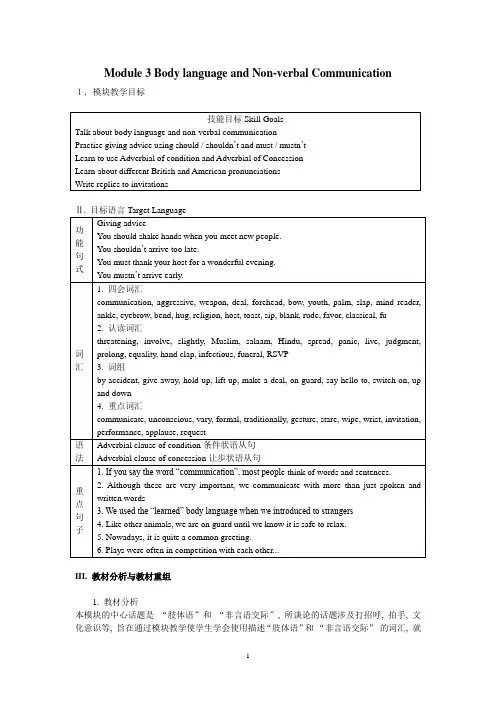
Module 3 Body language and Non-verbal Communication I.模块教学目标III. 教材分析与教材重组1. 教材分析本模块的中心话题是“肢体语”和“非言语交际”, 所谈论的话题涉及打招呼, 拍手, 文化意识等, 旨在通过模块教学使学生学会使用描述“肢体语”和“非言语交际”的词汇, 就“肢体语”和“非言语交际”这一话题发表建议、观点, 并能写出合乎规范的请柬和回复。
1.1 INTRODUCTION 通过设置的四幅图片和听力训练, 谈论各种情况下的肢体语, 这一部分呈现了本模块的中心话题,学生可以复习巩固有关体态的词汇。
1.2 READING AND VOCABULARY是有关世界各地打招呼的体态语,在这一部分中,学生除学习新的词汇、句型和训练阅读技巧外,对打招呼的体态语也有更深刻的认识。
1.3 GRAMMAR 1 呈现了条件状语从句并辅以练习,使学生对条件状语从句有初步认识。
1.4 LISTENING AND VOCABULARY 分两部分,一部分是学习有关身体部位的词汇,另一部分是听力训练。
这两部分不仅使学生学习新词、也训练其听力。
1.5 FUNCTION 呈现了用SHOULD和SHOULDN’T、MUST和MUSTN’T提建议并辅以练习,使学生掌握用SHOULD和SHOULDN’T、MUST和MUSTN’T提建议这一用法。
1.6 GRAMMAR 2 再次呈现了条件状语从句,同时辅以练习,使学生在GRAMMAR 1的基础上,进一步了解条件状语从句的用法。
至此,学生对条件状语从句有一个整体的认识。
1.7 PRONOUCIATION 通过听英语、美语两种不同的方言,让学生辨别英、美语在发音上的一些差异。
1.8 SPEAKING 是让学生谈论有关中国的风俗习惯,并练习条件状语从句以及SHOULD和SHOULDN’T、MUST和MUSTN’T的用法。
同时培养学生的合作精神。
外研版高中英语必修四Module 3Body Language and Nonverbal Communication教案1

Teaching PlanModule 3Reading Body Language and Non-verbal Communications Teaching content:Module 3 of Book 4 Body Language and Non-verbal Communication introduces us different body languages in different cultures. In this module, students should learn some useful words and phases about the common gestures. At the same time, students not only can know the importance of body language and non-verbal communications but also can get some basic communicational skills.Teaching goals1. Learn some useful words and expressions about body language.2.To learn to read with some reading strategies3. Use proper body language to communicate with each otherTeaching important points:1.To master some words and phrases about body language. Such as: bow, slap, hold up, make a deal and so on.2.To develop students reading ability of skimming and scanningTeaching difficult points:How to make students fully understand the textTeaching methods :Brain storm ;task-based teaching ;communicative teaching,individual work;pair work ;group work .Learning strategies :Summarize words and phrases related to body language ;get and process important information in the course of reading by using the reading abilities of skimming ,scanning and guessing new words from the context .Teaching aids:Multimedia ,a play recorder ,blackboardTeaching procedures:Step 1 Lead in1.Arouse students’ interest in the topic Body Language and Non-verbal Communication by showing them some pictures of different gestures of Yao Ming.2.Brainstorm means of non-verb communication, and then show some pictures of communication means to review and learn some words related to body language and gesturesStep 2 Listening1. Improve students’ listening ability by listening to the tape, with the task of finding out what the meaning of these gestures are mentioned in the tape in mind. (Individual work)2. Check answers with students by showing the pictures of transport means mentioned in the text.Step 3 Scan readingFind the main idea of the passage by skimming (individual work)Question1: Which is the best title of the passage?Question2: Get the main idea of each paragraph and then finish the exercise.Step 4 carefully reading to find some specific information(First individual then pair work; then check answers with whole class)Read the text again and say if the following statements are true (T) or false (F)1. Not all body language is conscious. (T)2. Europeans shake hands with their left hand. (F)3. In Asia, people touch each other when they meet. (F)4. In the US a “high five” is a way of saying hello. (T)5. A “high five” is a formal gesture. (F)6. Body language is less communicative than spoken or written language. (F)7. “Learned” body language is universal. (F)8. We shake hands only with strangers. (F)Step 5 Language pointsDealing with some difficult point by explanation so that students can learn how to use some new words and phrases.Step 6 Practice (individual & pair work)Complete the sentences with the words given (p. 23 Activity 3)Step 7 Group workFind how to greet in different countries in the text by reading the text again.Step 8 DiscussionChoose one of the following situation to act out,using the proper body language to help you.1. Meet a friend and talk to each other.2. Show someone the way in the street.3. See a friend in the distance and greet him/her.4. Enter a friend’s house and talk with him/her.Step 9 Summery & HomeworkFinish activity 2-3 after classFind out the difficult sentences in the passage.Retell the phrases in the passage。
高中英语新课标外研版必修4教案Period2(Module3BodyLanguageandNon-verbalCommunication)

passageD.QPqEjZoD5 Teaching Methods Discussion to lead in the reading class. Fast reading to get the main idea of the text. Intensive reading to understand the passage bettDeQrP.qEjZoD5 Explanation to help the students master some Language
Points.DQPqEjZoD5 Teaching Aids A tape recorder A multimedia Three Dimensional Teaching Aims Knowledge and Skills Train the students’reading ability. Learn some useful words and expressions. Learn some facts about body language. Process and Strategies Make the students know more about body language and
2 / 15
ቤተ መጻሕፍቲ ባይዱ
Inspire their interest in different customs and cultures of different countries and areasD.QPqEjZoD5
Encourage the students to learn and use such body language to communicate with each other through their actionD.QPqEjZoD5
外研版高中英语必修4《Module 3 Body Language and Non-Verbal Communication》word教案
Teaching PlanModule 3Reading Body Language and Non-verbal Communications Teaching content:Module 3 of Book 4 Body Language and Non-verbal Communication introduces us different body languages in different cultures. In this module, students should learn some useful words and phases about the common gestures. At the same time, students not only can know the importance of body language and non-verbal communications but also can get some basic communicational skills.Teaching goals1. Learn some useful words and expressions about body language.2.To learn to read with some reading strategies3. Use proper body language to communicate with each otherTeaching important points:1.To master some words and phrases about body language. Such as: bow, slap, hold up, make a deal and so on.2.To develop students reading ability of skimming and scanningTeaching difficult points:How to make students fully understand the textTeaching methods :Brain storm ;task-based teaching ;communicative teaching,individual work;pair work ;group work .Learning strategies :Summarize words and phrases related to body language ;get and process important information in the course of reading by using the reading abilities of skimming ,scanning and guessing new words from the context .Teaching aids:Multimedia ,a play recorder ,blackboardTeaching procedures:Step 1 Lead in1.Arouse students’ interest in the topic Body Language and Non-verbal Communication by showing them some pictures of different gestures of Yao Ming.2.Brainstorm means of non-verb communication, and then show some pictures of communication means to review and learn some words related to body language and gesturesStep 2 Listening1. Improve students’ listening ability by listening to the tape, with the task of finding out what the meaning of these gestures are mentioned in the tape in mind. (Individual work)2. Check answers with students by showing the pictures of transport means mentioned in the text.Step 3 Scan readingFind the main idea of the passage by skimming (individual work)Question1: Which is the best title of the passage?Question2: Get the main idea of each paragraph and then finish the exercise.Step 4 carefully reading to find some specific information(First individual then pair work; then check answers with whole class)Read the text again and say if the following statements are true (T) or false (F)1. Not all body language is conscious. (T)2. Europeans shake hands with their left hand. (F)3. In Asia, people touch each other when they meet. (F)4. In the US a “high five” is a way of saying hello. (T)5. A “high five” is a formal gesture. (F)6. Body language is less communicative than spoken or written language. (F)7. “Learned” body language is universal. (F)8. We shake hands only with strangers. (F)Step 5 Language pointsDealing with some difficult point by explanation so that students can learn how to use some new words and phrases.Step 6 Practice (individual & pair work)Complete the sentences with the words given (p. 23 Activity 3)Step 7 Group workFind how to greet in different countries in the text by reading the text again.Step 8 DiscussionChoose one of the following situation to act out,using the proper body language to help you.1. Meet a friend and talk to each other.2. Show someone the way in the street.3. See a friend in the distance and greet him/her.4. Enter a friend’s house and talk with him/her.Step 9 Summery & HomeworkFinish activity 2-3 after classFind out the difficult sentences in the passage.Retell the phrases in the passageTeaching PlanModule 3 of Book 4Reading Body Language and Non-verbal Communications高一英语组朱一丹。
外研版高中英语必修四Module3BodylanguageandNon-verbalCommunication(答案)
高中英语学习材料madeofjingetiejiModule 3 Body language and Non-verbal CommunicationSectionⅠIntroduction, Reading and Vocabulary &Function点金测评·创新训练【基础巩固全面训练】Ⅰ.单词拼写1. pointedmunication3. Indeed4. conscious5. vary6. relaxed7. aggressive8. threatens9. involved10. slightly11.respect12. traditionalⅡ.短语翻译13.与……进行交流14.给出支持的理由15.变化的范围是从……到……16.站岗,值班17.与……握手18.举起,耽搁,抢劫19.携手,齐心协力20.成交,达成交易21.分发,赠送,泄露(秘密等)22.rely on23.lift up24.up and down25.by accident26.make a toast to27.take a sip28.feel lonely29.switch on30.add…to…31.make a list of32.choose fromⅢ.单项选择33. B 句意:每天我们每个人都要做出决定,这些决定包含碰机遇的成分。
考查involve doing 是固定搭配,故答案是B。
34. D 本题考查give off发出或放出(蒸汽、光、热、气味等)的意思。
give up放弃,投降;give in让步,屈服;give away放弃,白白送掉。
句意:发动机释放出烟和蒸汽。
35. D 考查让步状语从句。
句意为:无论我多么饿,我好像永远不能吃完这块面包。
此处however引导让步状语从句,相当于no matter how。
36. A 本题考查动词的用法。
句意:他们要我出席明天的会议。
英语:Module 3《Body Language and Non-verbal Communication》课件(外研版必修4)
In some Ascian countries.
In Britain, How do the older people greet each other when they first meet? The older people usually shake hands when they first meet each other.
eyebrow lip
forehead nose
cheek
elbow waist finger
palm ankle
neck wrist knee
bend bow nod raise
clap kiss stare wipe
Example: You use your arms to hug someone.
2. In Britain, How do the older people greet each other when they first meet? 3. When and Where are the French People used to shaking hands?
Questions
Listen again!
Questions:
What should Lihong do when she is invited to dinner?
She should bring a gift for host, for example, some flowers or a bottle of wine.
Listening
Listen to a conversation between an American and a Chinese student who is going to the US.
外研版英语必修四Module 3 Body Language and Non-verbal Comm
Module 3 Body Language and Non-verbal CommunicationIntroduction :Speaking and WritingⅠ.Learning Aims1.To learn the ability of speaking and writing.2.To learn some words about body language.3.Try to find some words and phrases about body language with your partners and explain what you do when you say something to others.Ⅰ.Learning importanceIt is important for students to find more words and phrases ( brain storming) and learn more about body language.Ⅰ.Learning difficultiesStudents may feel it shy to express the body language and role-playing.Ⅰ.Learning Methods1.Individual or group work to get all students involved.2.Role-playing method may encourage students to have a better understandingwhat they have learned.Ⅰ.Learning Procedures1.自学:Matching and guessing what the speakers may talk about.point; shake; smile; wave.: picture a: The girl:The boy:: picture b: The madam:: picture c: Mr blue :Mr white:_ :picture d: Mr long hair:The other gentleman:2.小组合作: Group work and ActingExample: when you are introduced to someone, you shakes hands andWriting: When I meet a friend, I will __________ and say ______.When I show someone the way, I will and say .3. Brain Storming:Find more words and phrases about body language and make a role-play dialogue.4. Homework and reflection.Find some expressions about body language in the passage on P22 and try to greet your partner.What I have learned today?。