
牛津译林版英语八年级上册8AUnit5 Grammar课件
Pandas may not have a place to live or food to eat.
Lead in
What will happen to giant pandas if we do nothing? If we do nothing, there may be none left.
New Knowledge
Try to find “verb+to-infinitives” in the passage.
Last month, Nick visited Uncle Wang in the country with his parents. At first, his father planned to drive his car there. However, the traffic was so busy that they decided to take a bus there. Uncle Wang has a big farm, and there are many apple trees in it. Nick couldn't wait to get there to help Uncle Wang pick apples.
New Knowledge
Now they can live happily in the zoo.
New Knowledge
A trip to the zoo
The person you plan to go there with. The things you want to take with. The way you decide to get there. The activities you hope to do there. The time you want to stay there.
New Knowledge
Exercises
Dad: Do you know anything special about wild animals?
Amy: Yes, Dad. For example, dolphins are clever. They can
_l_e_a_r_n_t_o_w__o_r_k_o_u_t__ (learn, work out) easy Maths problems.
New Knowledge
Talk about Mr Yang’s plan
A: Who does Mr Yang plan to go out with? B: He (plan/go out with his family). A: What does he want to take? B: He (want/take a camera and some food). A: How does he decide to get there? B: He (decide/get there by bus). A: What does he hope to do there? B: He (hope/take some photos of animals). A: How long does he want to stay there? B: He (want/stay there for about three hours).
Lead in
Revision
1. Why do people call the panda “Xi Wang”?
They may hope it will bring them a hope.
2. What will happen to the pandas if the bamboo forests disappear?
In the farm he tried to pick the apples in a tall tree, but he wasn’t tall enough and failed to reach one. Two hours later, he felt thirsty and stopped to choose a big and red apple.
New Knowledge
No feeding.
New Knowledge
Discussion
Using may + verb and verb + to-infinitives to talk about theear the tigers? 2. Can we feed the animals? 3. Can we take photos of animals? 4. Can we …
New Knowledge
Exercises
1. The elephant is going towards the water. It ___m_a_y__n_e_e_d_____ (need) a bath.
2. The little boy is crying because he sees the tigers. He __m_a_y__b_e_______ (be) afraid of them.
New Knowledge
We often use to-infinitives after these verbs.
agree learn like wish
choose decide hope
plan prepare want
start begin
fail
try remember forget
New Knowledge
Chat with my son using may.
A: The baby panda is waving to us. B: It … (be saying) hello to us. A: The pandas are going towards the water. B: They … (be) thirsty. A: The monkeys are jumping around. B: They … (be playing) with each other.
Learn about Wild animals and learn to protect them.
Lead in
Revision
1. Why do people call the panda “Xi Wang”? 2. What will happen to the pandas if the bamboo forests disappear?
New Knowledge
Tips
◊ Remember not to feed the animals because they may get sick.
◊ Don't forget to stay away from dangerous animals like tigers because they may hurt you.
5. The monkeys are jumping around. They m__a_y__b_e_p_l_a_y_in_g_ (be playing) with each other.
6. The horse is standing with its eyes closed. It _m__a_y_b_e__s_le_e_p_i_n_g_ (be sleeping)
Unit 5 Wild animals Grammar
Teaching objectives
Knowledge and ability
Process
and
method
EAV
e “may” to say that something is possible; e “verbs + to-infinitives” correctly; 3. Understand the rules in the zoo. Work while you work, Group work
Amy: Yes. Bees always_r_e_m_e_m__b_e_r_t_o__co_m__e_b__a_ck_(remember, come back) the same way as they go. Dad: What do you know about squirrels? Amy: They always __b_e_g_in__to__s_a_v_e__ (begin, save) some food before winter comes. Dad: Yes, but sometimes they forget where to find the food.
3. I cannot go near the lions and tigers. They __m__a_y_h_u__rt____ (hurt) me.
4. The baby panda is not drinking its mum’s milk. It___m_a_y__n_o_t_b_e___ (not be) hungry.
He was just beginning to eat it when his mother said to him,“Remember to wash it before eating. You should learn to form a good habit of cleaning fruits before eating them.”
New Knowledge
My son: Dad, the monkey looks so sad in the cage. I: It may want to play outside.
New Knowledge
My son: Dad,the bear is standing up! I: It may want to ask for some food.
合集下载
牛津译林英语八年级上册unit5 Grammar(共25张PPT)
(1) I tried to search fot Suqian on the Internet.
(2)I planned to go there with my friends. (3)I wanted to enjoy Yuji park. (4)I wanted to visit Overlord Xiang Yu’s Hometown (5)I chose to get there by car. (6)I would like to visit some other places of interest.
as +adj.+ as...= the same +noun+as
与......一样......
Our school is as big as his.
= Our school is the same _s_i_ze__ as his.
His school uniforms are as expensive as ours. = His school uniforms are _t_he__s_a_m_e__pr_i_ce__a_s ours.
Task Three Reading comprehension
1.can’t wait 2.wonder 3. large 4. take the bus 5.reach 6.choose to walk 7. plan
As we know, Luoma Lake is the 4th _la_r_g_e_s_t__ lake in Jiangsu
4.How much will you pay for the tickets if you go to the Old House of
牛津译林版初二英语上册Unit5 Grammar课件
Pandas may not have a place to live or food to eat.
Lead in
What will happen to giant pandas if we do nothing? If we do nothing, there may be none left.
New Knowledge
Exercises
1. The elephant is going towards the water. It ___m_a_y__n_e_e_d_____ (need) a bath.
2. The little boy is crying because he sees the tigers. He __m_a_y__b_e_______ (be) afraid of them.
New Knowledge
Chat with my son using may.
A: The baby panda is waving to us. B: It … (be saying) hello to us. A: The pandas are going towards the water. B: They … (be) thirsty. A: The monkeys are jumping around. B: They … (be playing) with each other.
Learn about Wild animals and learn to protect them.
Lead in
Revision
1. Why do people call the panda “Xi Wang”? 2. What will happen to the pandas if the bamboo forests disappear?
牛津译林八年级上册Unit5 Grammar (共28张PPT)

It may be climbing the.tree/....
It may be a (an) a m.onkey.
It may not
.
It may be riding a bik.e/….
It may be a (an) an e.lephant. It may drawing a pictu.re/….
学 生 的 反 馈 和成绩 的终端 显示来 看,还是 初见成 效的。 二 、 第 二 学 期的工 作计划 1.夯 实 基 础
基 础 知 识 是 高考的 “本” 和“源 ”。所 以我们 第一轮 的复习 紧扣教 材,将基 础知识 的 整 理 、 归 纳、和 运用作 为根本 出发点 。我们 计划从 寒假补 课开始 到三月 底结束 高 一 到 高 三 书本知 识的输 理。输 理的重 点放在 高考大 纲所要 求学生 掌握的 单词、 短 语的用 法、辨 析 ;常用 句型的 使用及 转换 ;语法点 的再现 。所用 材料以 《导与 练》 为 主。要 求学生 读、背 基本词 汇 ,老师 每天或 每两天 进行检 测 ,逐个 过关。 在这期 间,
Monkeys can help each other. They are trying to save (save) their friend.
On the Monkey island, squirrels and bats are Monkeys’ neighbours.
They begin to save (save) food before winter comes but sometimes they forget where to find it.
THANK YOU !
It may not be sleeping .
It may be a (an) a m.onkey.
It may not
.
It may be riding a bik.e/….
It may be a (an) an e.lephant. It may drawing a pictu.re/….
学 生 的 反 馈 和成绩 的终端 显示来 看,还是 初见成 效的。 二 、 第 二 学 期的工 作计划 1.夯 实 基 础
基 础 知 识 是 高考的 “本” 和“源 ”。所 以我们 第一轮 的复习 紧扣教 材,将基 础知识 的 整 理 、 归 纳、和 运用作 为根本 出发点 。我们 计划从 寒假补 课开始 到三月 底结束 高 一 到 高 三 书本知 识的输 理。输 理的重 点放在 高考大 纲所要 求学生 掌握的 单词、 短 语的用 法、辨 析 ;常用 句型的 使用及 转换 ;语法点 的再现 。所用 材料以 《导与 练》 为 主。要 求学生 读、背 基本词 汇 ,老师 每天或 每两天 进行检 测 ,逐个 过关。 在这期 间,
Monkeys can help each other. They are trying to save (save) their friend.
On the Monkey island, squirrels and bats are Monkeys’ neighbours.
They begin to save (save) food before winter comes but sometimes they forget where to find it.
THANK YOU !
It may not be sleeping .
牛津译林版8Aunit5Grammar (共27张PPT)
4. What made you___fe_e_l__ (feel) sad? 5.Mr White learned __to__r_id_e___(ride) a horse last year. 6. We will try our best __to__r_e_a_d___(read) more books.
肯定回答:Yes, you may / can. 否定回答:No, you can’t / mustn’t.
Practice
他可能非常喜欢熊猫。
He may like pandas very much.
我可以吃些东西吗?
May I have something to eat?
可能她想现在去锻炼。
She may want to go to exercise now.
2. What did Xi Wang begin to do when she was six months old? (She began to eat bamboo.)
动词不定式: verbs + ‘to’-infinitives
We can use verbs and ‘to’-infinitives together.
动词
help
短语形式 例句
说明
Kate usually help 后的 to helps (to) do 可省 , 意义
+ (to) do sth house at home. 不变。
see, watch, look at
hear , listen
to feel
let, make , have
后 不加to
Do exercises on P61.
1. The elephant is going towards the water.
肯定回答:Yes, you may / can. 否定回答:No, you can’t / mustn’t.
Practice
他可能非常喜欢熊猫。
He may like pandas very much.
我可以吃些东西吗?
May I have something to eat?
可能她想现在去锻炼。
She may want to go to exercise now.
2. What did Xi Wang begin to do when she was six months old? (She began to eat bamboo.)
动词不定式: verbs + ‘to’-infinitives
We can use verbs and ‘to’-infinitives together.
动词
help
短语形式 例句
说明
Kate usually help 后的 to helps (to) do 可省 , 意义
+ (to) do sth house at home. 不变。
see, watch, look at
hear , listen
to feel
let, make , have
后 不加to
Do exercises on P61.
1. The elephant is going towards the water.
牛津译林版初二英语上册unit5Grammar课件
I’m Nancy.
Panda House
Lion House
Tiger House
Elephant House
Lion House
Tiger House
Guide: Do you know what tigers and lions like to eat?
Students: They like to eat…
Grammar
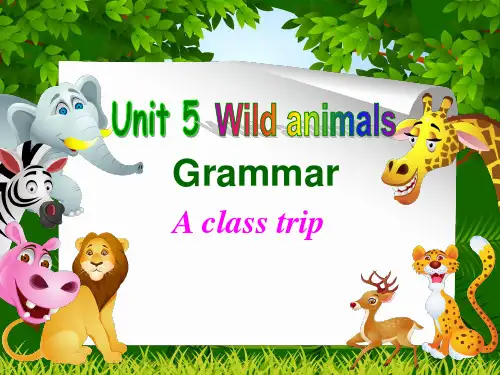
A class trip
Learning aims
1 To learn to use may for possibility. 2 To learn to use verbs + to-infinitives.
To know more about wild animals.
4 To know the ways to protect wild animals.
Bat House
Bee House
get lost=lose one’s way
Task 3: Production
Dad: Do you know anything special about wild animals? Amy: Yes, Dad. For example, dolphins are clever. They
Homework
1. Design a poster about wild animals with may and verbs + to-infinitives and ask more people to protect them. (for all students)
2. Search more information about wild animals on the Internet. (for abled students)
Panda House
Lion House
Tiger House
Elephant House
Lion House
Tiger House
Guide: Do you know what tigers and lions like to eat?
Students: They like to eat…
Grammar
A class trip
Learning aims
1 To learn to use may for possibility. 2 To learn to use verbs + to-infinitives.
To know more about wild animals.
4 To know the ways to protect wild animals.
Bat House
Bee House
get lost=lose one’s way
Task 3: Production
Dad: Do you know anything special about wild animals? Amy: Yes, Dad. For example, dolphins are clever. They
Homework
1. Design a poster about wild animals with may and verbs + to-infinitives and ask more people to protect them. (for all students)
2. Search more information about wild animals on the Internet. (for abled students)
牛津译林版英语八年级上册Unit5 Grammar 精品课件

Homework
1用may和动词不定式分别造五个句子。 2记忆本课时所学的词汇和词组。 3能力较强的学生模仿B部分编写一段对话 。
初中英语译林版八年级 Unit5 Wild animals
Grammar
学习目标
1. 掌握并能正确使用may来表示可能性和动词不定式。 2. 能够从听力材料中获取有用的信息,将一封关于野生 动物的信补充完整。 3.学会谈论如何保护野生动物。
A Using may for possibility
It’s difficult for giant pandas to live in the wild. They face serious problems. For example, the bamboo forests are becoming smaller and smaller.
动词不定式的结构: to + 动词原形
动词不定式的用法
1. 省to的不定式结构 (1) 能直接跟带to的不定式结构的动词主要有:want, ask,
tell, hope, learn, try, decide, forget, remember, like, love, stop等。 (2) 动词不定式的否定形式是在不定式前直接加not,即not to do sth。 She wants to play the piano. 她想弹钢琴。 Jim told me not to wake up Kate.吉姆告诉我不要叫醒凯特。
c I cannot go near the lions and tigers. They(3)__m__a_y_h_u_r_t____ (hurt) me.
练一练
d The baby panda is not drinking its mum’s milk. It(4)___m__ay__n_o_t_b_e___ (not be) hungry.
最新初中八年级上册牛津译林版8A Unit5 Wild animals Grammar课件(14页)精品PPT课件
1.Why should we protect wild animals?
Because they are our friends.
While-tBiblioteka sk:1.Learn Part B and finish the exercises by yourself.
I wanted to see wild animals there. wild animals are our friends. the dolphin show was long.
Because ————————————————————————— 4.Why must we protect wild animals? Because —————————————————————————
Task2:Read the passage and answer some questions. because of
用法相似:if,until ,as soon as ,when, after,before. arrive 1.Please let me know as soon as you ______(arrive) here tomorrow. won’t go (not go) to bed until his father comes 2.He _________ back. finishes 3.He will go back home when he _______ (finish) the work. arrived 4.He came to see me as soon as he _______ (arrive) here yesterday. go 5.He didn’t _______(not go) to bed until his father came back. grew (grow) into 6.When the duck grew up, it _______ a beatiful swan.
牛津译林版八年级英语上册Unit 5 Grammar示范公开课教学课件
Practice
Summary
Presentation
Production
Warming-up
Bye-bye!
Read and complete
1. The elephant is going toward the water. It __________ (need) a bath.2. The little boy is crying because he saw the tigers. He ________ (be) afraid of them.3. I cannot go near the lions and tigers. They __________ (hurt) me.
2
Think and say
What does Gary say?
We may travel by sea.
We might not go anywhere.
It may be cheaper.
We may go abroad.
Warming-up
1
1. We may go abroad. 2. We may travel by sea.3. It may be cheaper.4. They may be talking about holidays.5. We might not go anywhere.
Watch and answer
They may be talking about __________.
Martin is talking with Gary. What are they talking about? Can you guess?
Warming-up
Presentation
Summary
Presentation
Production
Warming-up
Bye-bye!
Read and complete
1. The elephant is going toward the water. It __________ (need) a bath.2. The little boy is crying because he saw the tigers. He ________ (be) afraid of them.3. I cannot go near the lions and tigers. They __________ (hurt) me.
2
Think and say
What does Gary say?
We may travel by sea.
We might not go anywhere.
It may be cheaper.
We may go abroad.
Warming-up
1
1. We may go abroad. 2. We may travel by sea.3. It may be cheaper.4. They may be talking about holidays.5. We might not go anywhere.
Watch and answer
They may be talking about __________.
Martin is talking with Gary. What are they talking about? Can you guess?
Warming-up
Presentation
牛津译林版八年级上册Unit5Grammar课件
A. must B. need C. may D.e building is! What is it for?
--It _____ a hotel. But I’m not sure.
A. must be B. have to be C. may be D. can be
stop to do sth. 停下(正在做的)事去做 (另一件)事
stop doing sth. 停止做(正在做的)事
e.g. 让我们停下来休息一下。
Let’s __s_t_op__ ___t_o__ __h_a_ve__ a rest.
不要说话, 老师来了。
_S_t_o_p__ _t_al_k_in_g_. The teacher is coming.
e.g. Tom, 记得课后和我们一起打篮球。 Tom, _r_em__e_m_b_e_r ____t_o___ play basketball with us after class. 我记得上个月写了一封信给你。 I _r_e_m_e_m_b_e_r_ ___w_ri_t_in_g__ a letter to you last month.
3. --When are we going to have a picnic?
--I’m not sure. Ask Millie, please. He _____ know.
A. need B. can
C. may D. shall
二、完成句子。
1. 他可能认识你。 He _m_a_y__k_n_o_w_ you.
B Using verbs + to-infinitives
在英语中某些及物动词后接动词 不定式作宾语, 常用的此类动词有:
新牛津译林版八年级英语上Unit 5 Grammar教学课件
Using verbs + to-infinitives
当我们要表示“想做某事、需要做某事 或决定做某事”时,就会出现两个动词 连用的情况,这时应如何表达呢? 同学们自然会想到want to do sth., need to do sth.和decide to do sth. 等表达方式。
Please go on to look at the sentences below. Pay attention to the colored words.
1. 当我们猜测某件事发生的可能性时,常 用may来表示“也许”、“可能”。 2. 当句子中已经有谓语动词,而我们又要 表达不止一个动作概念时,其余的动词 可以使用非谓语形式表达。动词不定式 就是动词的一种非谓语形式,其肯定形 式是“to + 动词原形”,其否定形式是 “not to + 动词原形”。无人称、数和时 态的变化。
3. — Excuse me, when are we going to have a picnic? — I’m not sure, Ask our monitor, please. He ______ know. A. need B. can C. may D. shall 4. — Do you have any plans for this weekend? — I'm not sure. I ______ go climbing Mount Yuntai. A. must B. need C. may D. can
什么是动词不定式 (‘to-infinitives’)?
上面例子中主要行为动词后面的动词 都采用了“to + 动词原形”的结构,我 们把这种结构称为动词不定式(有时 可以不带to)。动词不定式没有人称 和数的变化,在句子中不能单独作谓 语,其否定形式是“not to + 动词原形”。