
人教版英语八年级上册重点单词、句子知识点讲解习题
Unit 4 What’s the best movie theater ?
第一课时Section A(1a—2d)
A) 重点单词和短语
1.戏院
2.舒适的
3.座位
4.屏幕
5.接近
6.票
7.最差的8.便宜地
9. 歌曲10.选择
11.小心地12.记者
13.新鲜的14.舒适地
15.到目前为止
16. close to home
17. the biggest screens
18. the most comfortable seats
19. thanks for doing sth.
20. no problem
B) 重点句型
1.最好的戏院是哪家?
What’s the movie theater?
2.她有最大的屏幕。
It’s has the .
3.它离家最近.It’s the home.
4.你可以在那里最便宜地买衣服。
5.You can buy clothes the there. 5. 到目前为止你觉得这里怎么样?
How do you like it ?
6. -----谢谢你告诉我。
------没问题。
----Thanks for me. ----- . 新知探究
1.What’s the best movie theater?
该句译为:最好的戏院是哪家?
1. 形容词或副词的最高级的用法:
形容词或副词的最高级用于三者或三者以上的人或事(物)之间的比较。
在使用时,最高级前一般要加定冠词the,副词的最高级前面可省去定冠词the。
句中常含有表示比较范围的介词of或in;of 后面一般接表示一群人或事物的代词或名词,in后面一般接表示单位或场所的名词。
例Bill is _________ (高) boy of us.
例Jane has the (多)friends in our class.
例He runs _______(快)of all.
2.形容词、副词的最高级的构成
(1)规则变化
①a.一般情况下,在原级后加-est。
long--longest, clever--cleverest, fast--fastest, b.以不发音的字母e结尾的,直接加-st
nice--nicest, cute--cutest, late--latest
c.以辅音字母+y结尾的,变y为i,再加-est。
heavy--heaviest, friendly--friendliest,
d.重读闭音节且词尾只有一个辅音字母的,先双写这个辅音字母,再加-est。
big--biggest, thin--thinnest, hot--hottest
②多音节和部分双音节形容词、副词,在原级前加most构成最高级。
creative--most creative, popular--most popular, quickly--most quickly
(2)不规则动词
good/well--best, bad/ill/badly--worst,
many/much--most, little--least
far--farthest/furthest, old--oldest/eldest
【应用】写出下列单词的最高级
1.cheap
2. late
3. heavy
4. fat
5. popular
2.Thanks for telling me .谢谢你告诉我。
Thanks for...意为“因……而感谢”,后接名词、代词或动名词,也可说成“Thank you for...”
例:谢谢你帮助我。
Thanks a lot for
your______.=Thank you for ________me.
课堂演练
I. 根据汉语意思完成单词
1. What he said made everyone feel .(舒服)
2.It was raining heavily. Little Mary felt cold, so she stood ____ to her mother. (近)
3.Would you like _ tea?(一些)
4. Breakfast is _________ meal of the day. It provides us with energy after a long night without food.(重要)
5. Who listens _________ , Tom、Jack or Bill?(认真)
II. 用括号内所给单词的适当形式填空
1. Who was the __ (fun) actor in the play?
2. This hotel has ______ (friendly) service in town.
3. You can lie(躺) down and sleep ____ (comfortable).
4. Town Cinema is one of ______ (cheap) cinemas in town.
第二课时Section A (Grammar Focus---3c)。
新人教版八年级英语上册各单元知识点及配套习题汇总(全册)
新人教版八年级英语上册各单元知识点及配套习题汇总(全册)新人教版八年级英语上册各单元知识点及配套习题汇总(全册)Unit 1 Where did you go on vacation?短语:go on vacation stay at home go to the mountains go to the beachvisit museums go to summer camp quite a few study forgo out most of the time taste good have a good timeof course feel like go shopping in the past walk around too many because of one bowl of find out go ontake photos something important up and down come up语法:Where did you go on vacation? I went to New York City.Did you go out with anyone? No, No one was here. Everyone was on vacation. Did you buy anything special? Yes, I bought something for my father.How was the food? Everything tasted really good.Did everyone have a good time? Oh,yes. Everything was excellent.惯用法:1. buy sth for ab./ buy sb. sth 为某人买某物2. taste + adj. 尝起来……3. nothing ….but + V.(原形) 除了……之外什么都没有4. seem + (to be) + adj 看起来5. arrive in + 大地方/ arrive at + 小地方到达某地6. decide to do sth. 决定做某事7. try doing sth. 尝试做某事/ try to do sth. 尽力做某事8. enjoy doing sth. 喜欢做某事9. want to do sth. 想去做某事10. start doing sth. 开始做某事11. stop doing sth. 停止做某事12. look + adj 看起来13. dislike doing sth. 不喜欢做某事14. Why not do sth. 为什么不做…….呢?15. so + adj + that + 从句如此……以至于……16. tell sb. (not) to do sth. 告诉某人(不要)做某事17. keep doing sth. 继续做某事18. forget to do sth. 忘记去做某事/ forget doing sth 忘记做过某事词语辨析:1. anywhere 与somewhere 两者都是不定副词。
人教版八年级上册英语Units1-10单元知识点完整归纳以及练习题
人教版八年级上册英语Units1-10单元知识点完整归纳以及练习题人教版八年级上册英语Units1-10单元知识点完整归纳以及练习题Unit1 go on vacation去度假stay at home待在家里go to the mountains去爬山go to the beach去海滩visit museums 参观博物馆go to summer camp去参观夏令营quite a few相当多study for为……而学习go out 出去most of the time大部分时间taste good尝起来很好吃have a good time=have fun玩得高兴+v.ing X Kb1 .C of course当然feel like给……的感觉;感受到go shopping去购in the past在过去walk around四处走走because of因为one bowl of…一碗……the next day第二天drink tea喝茶find out找出;查明go on继续take photos照相something important重要的事up and down上上下下come up出来buy sth. for sb. / buy sb. sth.为某人买某物taste + adj. 尝起来……look+adj. 看起来……nothing…but+动词原形除了……之外什么都没有seem+(to be)+ adj. 看起来……arrive in+大地点/ arrive at+小地点到达某地decide to do sth.决定去做某事try doing sth.尝试做某事/ try to do sth.尽力去做某事forget doing sth.忘记做过某事/ forget to do sth.忘记做某事enjoy doing sth.喜欢做某事want to do sth.想去做某事start doing sth.开始做某事stop doing sth. 停止做某事dislike doing sth. 不喜欢做某事keep doing sth.继续做某事keep sth+adj.使…保持…状态Why not +v.?=Why d on’t you+v.?为什么不做……呢?so+adj.+that+从句如此……以至于……tell sb. (not) to do sth. 告诉某人(不要)做某事feel like +n./v.ing sth 想要…想要做…一、根据句意,用所给单词的适当形式填空。
人教版英语:八年级上册各单元必考知识点汇总
人教版英语:八年级上册各单元必考知识点汇总Unit1 Where did you go on vacation?【重点语法】不定代词:不指名代替任何特定名词或形容词的代词叫做不定代词。
用法注意:1. some和any +可数名/不可数名。
some多用于肯定句,any多用于否定句、疑问句和条件从句。
有些问句中用some,不用any,问话者希望得到对方肯定回答。
2.由some, any, no, every与body, one, thing构成的复合不定代词作主语时,其谓语动词用三单。
3.不定代词若有定语修饰,该定语要置于其后:如:somethinginteresting【重点短语】1. buy XXX为某人买某物2. taste + adj.尝起来……3. nothing...but + V.(真相)除……以外甚么都没有4. seem + (to be) + adj看起来5. XXX抵达某地6. XXX do XXX决定做某事7. try doing sth.测验考试做某事/ try to do sth.极力做某事8. XXX喜欢做某事9. want to do sth.想去做某事10. XXX.入手下手做某事=XXX.11. stop XXX截止做某事辨别:stop to do sth.停下往来来往做某事12.XXX XXX.不喜欢做某事14.so + adj + that +从句如此……以至于……16. tell sb. (not) to do sth.告诉某人(不要)做某事17. keep XXX继续做某事18. forget to do XXX.忘记去做某事XXX忘记做过某事【词语辨析】1.XXX拍照quite a few+名词复数“很多…”2. seem +描绘词看起来…... You seem happy today.XXX.似乎/好像做某事I seem to have a coldIt seems +从句似乎..….It XXX.seem like ...好像,似乎…..It seems like a good idea.XXX小地址(注:若后跟地点副词XXX,介词需省略,如:arrive here;get home)4. XXX感觉像…XXX.想要做某事5. wonder(想知道)+疑问词(who, what, why)引导的从句。
八年级上册英语核心知识讲练
八年级上册英语核心知识讲练一、词汇。
1. 重点单词。
- Unit 1 Where did you go on vacation?- anyone:任何人,通常用于疑问句和否定句中。
例如:Did you meet anyone interesting on your vacation?(你在假期遇到有趣的人了吗?)- anywhere:在任何地方,也是用于疑问句和否定句。
如:I didn't go anywhere special last weekend.(上周末我没去任何特别的地方。
)- wonderful:精彩的,绝妙的。
可以用来描述经历或事物。
例如:The view from the top of the mountain was wonderful.(山顶的景色很美妙。
)- Unit 2 How often do you exercise?- housework:家务劳动,是不可数名词。
例如:My mother does a lot of housework every day.(我妈妈每天做很多家务。
)- hardly:几乎不,具有否定意义。
例如:I can hardly understand what he said.(我几乎不明白他说的话。
)- ever:曾经,常用于现在完成时的疑问句中。
如:Have you ever been to Paris?(你曾经去过巴黎吗?)2. 词汇拓展。
- health (n.) - healthy (adj.) - unhealthy (adj.)- “health”是名词,意为“健康”,例如:Good health is very important.(好的健康状况很重要。
)- “healthy”是形容词,“健康的”,可以修饰名词,如:We should eat healthy food.(我们应该吃健康的食物。
)- “unhealthy”是“healthy”的反义词,“不健康的”,例如:Eating too much junk food is unhealthy.(吃太多垃圾食品是不健康的。
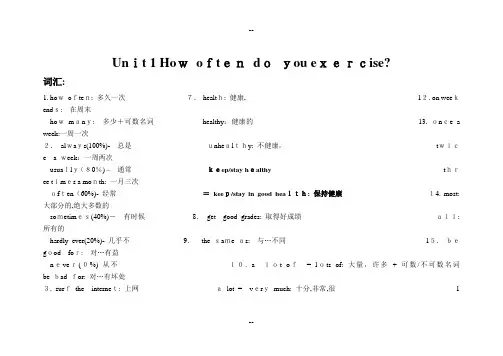
人教版八年级英语上册1-5单元知识点(词汇+句型+固定搭配)
Unit 1 Howoftendoyou exercise?词汇:1. howoften: 多久一次7.health: 健康,12. on weekends:在周末howmany:多少+可数名词healthy:健康的13. once a week:一周一次2.always(100%)-总是unhealthy: 不健康,twice a week:一周两次usually(80%) –通常keep/stay healthy three times a month: 一月三次often(60%)- 经常=keep/stay in good health: 保持健康14. most:大部分的,绝大多数的sometimes(40%)-有时候8.get good grades: 取得好成绩all:所有的hardly ever(20%)- 几乎不9.the same as:与…不同15.begood for:对…有益never(0%) 从不10. alot of= lots of: 大量,许多+ 可数/不可数名词be bad for: 对…有坏处3. surfthe internet: 上网alot =verymuch: 十分,非常,很1--6.how many:多少, +可数名词4.asfor: 至于,关于11. maybe:也许,大概how m uch: 多少,+不可数名词5. junk food: 垃圾食品maybe: 也许是,或许是(may是情态动词,be是动词原形)howmuch 多少钱,(问价格)6. look after=take care of:照顾12.little:小的,a littleboy: 一个小男孩17. of cou rse =sure 当然look for:寻找little: 少,little少→less更少→least最少(修饰不可数名词)look up:查找(单词、信息) little: 几乎没有,否定词(修饰不可数名词)look at: 看 a little:少许,有一点,肯定词(修饰不可数名词)few:几乎没有,否定词(修饰可数名词)a few少许,有一点,肯定词(修饰可数名词)句型:1.How often doyouexercise?→I exercise three timesa week.How often does sheshop?→Sheshops once amonth.2.What do you usually doon weekends?→I usually watchTV.How often doesshe watch TV? →She watchesTV everyday.3.Howmany hours do you sleepevery night? 你每晚睡几个小时?→Isleepnine hoursevery night.Howmany books do you have?你有多少本书?→I have5books.How muchis the sweater? 这件毛衣多少钱?--How muchwaterdoyou have? 你有多少水?(how much: 多少,后面+不可数名词, water是不可数名词)4.What’s your favorite program? 你最喜欢的电视节目是什么?→It’sAnimal World.固定搭配:try to do sth.: 尽力做某事,设法做某事try doingsth.: 试着做、尝试做某事help sb.(to) do sth: 帮助某人做某事(to可以省略)want sb. to do sth.: 想要某人做某事Unit 2 What’s thematter?词汇:1.have acold 感冒9.few:几乎没有,否定词(修饰可数名词)have a fever发烧 a few少许,有一点,肯定词(修饰不可数名词)have a stomachache肚子痛little: 几乎没有,否定词(修饰不可数名词)have a headache头疼a little: 少许,有一点,肯定词(修饰不可数名--词)have a toothache 牙齿疼10. at themoment= now 现在,此刻haveasorethroat 喉咙疼11. host family 寄宿家庭have a soreback 背部酸疼12. not…until…直到……时候才……2. lie downand have agood rest躺下好好休息13. should应该,情态动词,后+动词原形3.hot tea with honey加了蜂蜜的热茶should not=shouldn’t4.ill 病了的illness 疾病14. see a doctor 看医生5. advice建议(不可数名词) see a dentist 看牙医some advice(不能加”s”) 15.toomany太多…,修饰可数名词toomany students6.be stressed out 有压力的,紧张的too much太多…,修饰不可数名词too much yin7. balance 平衡balanced 平衡的much too太……,much too big太大abalanced diet平衡的饮食16. stay=keep 保持on a diet 节食keep/stay healthy8.get 变得=keep/stayin good health: 保持健康get angry变得生气get tired 变得劳累句型:1.What’s the matter with you? = What’s the trouble with you? =What’s wrong with you? 你怎么了?→Ihavea cold/ havea toothache/ have asore throat….2.Wha t’s thematter? →She hasa cold.--3. Doeshehave acold? →Yes, he does.4. A: What’s the matter?B: I’m not feeling well.(此处不能用good)I have a cold.A:When did it start?B:About two days ago.A: That’stoo bad.You shoulddrinklotsof water.B:Yes, Ithink so.A:Ihopeyou feel/getbetter soon. 我希望你尽快好起来5. A: I have a coldB: Iam sorry tohear that.(当听到对方不好的消息时使用此句)固定搭配:Itis+ 形容词+ (for sb.) todo sth.做某事对某人来说是………的例句: It is easyforme to learn(learn)English. 对我来说学英语是容易的Itis interesting to watch (watch) Animal World.看动物世界时有趣的Unit 3 What are youdoingfor vacation?→→→本单元用现在进行时态表示将来的事情现在进行时态,即be+doing:--词汇:1.go camping去野营 6. a lot = very much 十分、非常、很 2. A: What ar eyoudoing forvacation?go fishing 去钓鱼alot of=lots of许多、大量B: Iam g oing camping.go shopping去购物7. away向远处、离开A:That sounds nice.go swimming 去游泳goaway离开Who are you going with?go hiking 去远足B: I am going withmy parents.go bike riding去骑单车8.stay: 留、停留、呆go sightseeing去观光旅游 3. Linda is goingto Tibetnext summer.(划线提问)2. how long 多久、多长时间句型:→Where is Linda goingnextsummer?3. getback 回来getbacktoschool 1. What are you doingforvacation? 4.He’s going on the 12th.(划线提问)4. befamous for…以……而闻名→I amvisitingmygrandparents. →Whenishe--going?5. leavefor…离开去……地方Whatisyourbrotherdoing for vacation?leave →(过去式)left→Heisgoingcamping. 5.I’m staying there for a week.(划线提问)left:左边、离开→How long areyou staying?6.当听到对方提出的建议,如:What about playingbasketball?Howabout taking a walk withme? Why not goto the movie? 为什么不去看电影? I am going camping.等句子时,回答可用以下句型:That soundsnice/ good/interesting/.That’sa good idea./ Good idea.Thatsounds like a good ide a./Great等.7.当听到对方要去旅行或是准备出行时,如:I am going to Hongkong foraweek. I am goinghiking inthe mountains.时,回答一般用以下句型:Have a good time!8.询问天气: How isthe weather? 或是What’s the weather like?9.询问某人的职业:What do youdo?Whatareyou?What’s your job?你的工作是什么?What does yourmotherdo? What ishe?他是干什么的?10.询问某人的性格:What areyoulike? →Iam outgoing/shy/ quiet.Whatis he like? 他是个什么样的人?→Heis outgoing/ shy/ quiet. 他很外向/害羞/安静10.询问某人长的什么样子:What does he look like?他长的什么样子?→Heisofmediumbuild/height.他--中等身材/身高.What does yourfather look like?→Heis tall.他很高11. 询问某人喜欢什么:What do youlike?你喜欢什么? →I like basketball. 我喜欢篮球固定搭配:1.finish doingsth 完成做某件事例:Ifinished doing my homework.我完成了我的家庭作业Unit1-3 单元课本语法知识&在讲解畅优新课堂时补充的语法知识点与固定搭配:1.情态动词后+动词原形(do)已学情态动词:can 能够, must必须, should 应该, may 也许.would 想,会help sb(to) do sth帮助某人做某事2. 介词后若接动词,则接动词的ing形式:常见的:what about + doingsth? 做………怎么样?常接doing的固定搭配:1. like doing sth 喜欢做某事2. enjoy doingsth享受做某事3. have a good/havefunin doing sth做某事玩的很开心4. finish doing sth完成做某件事5.spend +(时间、金钱、精力)doing sth花时间、金钱、精力做某事--= spend +(时间、金钱、精力) on sth3.不定式,即:to do常接不定式的固定搭配:want sb to do sth 想要某人做某事would like to dosth想做某事tell sb to do sth 告诉某人做某事asksb to do sth要求某人做某事plan to do sth计划做某事decideto do sth决定做某事need todo sth 需要做某事forget to do sth忘记做某事tryto dosth 尽力做某事4. 不定代词+ 形容词结构例:something interesting 一些有趣的事情Unit 4 How do youget to school?词汇:1.get to: 到达arriveat:到达+小地点(学校、医院…)arrive in: 到达+大地点(城市、国家、地区…)reach: 到达2. take the bus= by bus:坐公交车8.howlong: 多久,how far:多远13. take…to…把…带到…3. take the train =by train: 坐火车9.from…to…从…到…14. from: 离…的距离4.take the subway = by subway:坐地铁10. thinkof: 认为thinkabout: 考虑15. not all: 不--是所有5. ride one’sbike = bybike:骑单车11. around theworld =allover the world: 全世界6.walk=on foot:走路12.be different from:与…不同16. more…than…:比…更…, than:比7. depend on:视……而定,决定于……,依靠……17.other 其他的,形容词18. than比others其他的人或其他的事19. more…than…比……更……,形容词比较级的用法the other两者中的另一个,单数概念theothers两部分中的另一部分,复数概念another 另外一个,另外的,第三个的句型:1. How do you getto school?→Itake the bus./ Igoto schoolbybus.How does she getto school? →She takes the bus./ She goes to school bybus.2. How long does it take?→It takesabout/around 10 minutes. →Ittakesabout25minutesto walk and 10 minutes by bus.How long doesittake youtoget from hometo school? →It takes25minutes.3. How far is itfrom your home to school? →It’s 3 miles./10 kilometers.4. Whatdo youthinkof………? = how doyou like……?你认为……怎么样?--5. Howfardo you live fromschool?你住的离学校有多远→I live 10milesfromschool.6. CanI help you? May I helpyou?→Yes,please.固定搭配:1.It takes sb.+ 时间+ to do sth. 例句:It takesme20 minutesto walk (walk)2.need todo sth.需要做某事3.more…than…比……更……,形容词比较级的用法4形容词的比较级&最高级:规则变化:比较级:形容词尾+“er”,最高级:+“est ”,例:big →bigger→the biggest不规则变化:三个音节及以上的形容词(比较长的形容词),比较级:前面+ more,最高级:前面+most,例:popular 流行的→more popular更流行的→themost popular最流行的最高级前面+“the”例:This classroom isbiggerthan that one.这件教室比那间大This classroom is thebiggest. 这间教室是最大的Unit5Can you come to my party?词汇:1. other 其他的The other 另一个(两个中的另一个)9.have to 不得不,要…The others另一部分(两部分中的另一部分) 10. babysit=look after=take care of = carefor 关心,照顾Another 另外的,另一个(三个以上中的另一个)--2.the daybefore yesterday前天句型:yesterday 昨天 1. Can you come to my party?today 今天Yes, I’d love to.(肯定回答)tomorrow 明天I’m sorry,Ican’t. I have to……(否定回答) theday after tomorrow 后天 2. What’s today? 今天星期几,几号?(星期、日期都可以问)3. onweekends在周末It’s Mondaythe 14th. 今天14号星期一。
(完整版)人教版八年级上册英语unit1知识点及习题

Unit1 Where did you go on vacation一、书本重要语法点梳理go on vacation去度假 stay at home待在家里go to the mountains去爬山 go to the beach去海滩visit museums 参观博物馆 go to summer camp去参观夏令营quite a few相当多 study for为……而学习go out出去most of the time大部分时间taste good尝起来很好吃 have a good time玩得高兴]of course当然feel like给……的感觉;感受到go shopping去购物in the past在过去walk around四处走走because of因为one bowl of…一碗…… the next day第二天drink tea喝茶find out找出;查明go on继续 take photos照相something important重要的事 up and down上上下下come up出来buy sth. for sb. / buy sb. sth.为某人买某物taste + adj. 尝起来…… look+adj. 看起来……nothing…but+动词原形除了……之外什么都没有seem+(to be)+ adj. 看起来……arrive in+大地点 / arrive at+小地点到达某地decide to do sth.决定去做某事try doing sth.尝试做某事 try to do sth.尽力去做某事forget doing sth.忘记做过某事 forget to do sth.忘记做某事enjoy doing sth.喜欢做某事 want to do sth.想去做某事start doing sth.开始做某事 stop doing sth. 停止做某事dislike doing sth. 不喜欢做某事keep doing sth.继续做某事Why not do. sth.为什么不做……呢so+adj.+that+从句如此……以至于……tell sb. (not) to do sth. 告诉某人(不要)做某事1. on vacation 度假vacation意为“假期、假日”,相当于holiday,但vacation 表示长的假期。
人教版英语八年级上册单词短语句型知识点
八上课本知识点梳理Unit1 Where did you go on vacation?【重点短语】1. go on vacation 去度假2. stay at home 呆在家3. go to the mountains 上山/进山4. go to the beach 到海边去5. visit museums 参观博物馆6. go to the summer camp 去夏令营7. quite a few 相当多8. study for为……学习,9. go out 出去10. most of the time 大部分时间/绝大多数时间11. taste good 尝起来味道好12. have a good time 玩的开心13. of course 当然可以14. feel like 感觉像……/想要15. go shopping 去购物16. in the past 在过去17. walk around 绕……走18. too many 太多(可数名词前面)19. because of 因为20. one bowl of 一碗……21. find out 查出来/发现22. go on 继续23. take photos 照相24. something important 重要的事情25. up and down 上上下下26. come up 出来【重点句型】1. ——Where did you go on vacation? 你到哪里去度假了?——I went to New York City. 我去了纽约城。
2. ——Did you go out with anyone? 你出去带人吗?——No, No one was here. Everyone was on vacation. 不,没有人在这儿。
大家都去度假了。
3. ——Did you buy anything special? 你买了什么特别的东西吗?——Yes, I bought something for my father. 对,我给父亲买了一些东西。
Unit1知识点梳理及语法讲义-2024-2025学年人教版英语八年级上册
八年级上册英语Unit 1知识点与语法精讲精练词汇梳理(一)完成单词梳理:名词:1. hen母鸡 2. pig 猪 3. diary 日记;记事簿4. activity 活动5. paragliding 滑翔伞运动6. bird 鸟7. bicycle 自行车8. building 建筑物;房子9. trader 商人10. difference 差别;差异11. top 顶部;表面12. umbrella 伞;雨伞13. hill 小山;山丘14. duck 鸭动词:1. seem 好像;似乎;看来 2. decide 决定;选定 3. wonder 想知道;琢磨4. wait 等待;等候代词:1. anyone 任何人 2. something 某事;某物 3. nothing 没有什么4. everyone 每人;人人;所有人5. myself 我自己;我本人6. yourself 你自己;您自己7. someone 某人副词:1. anywhere 在任何地方形容词:1. wonderful 精彩的;绝妙的 2. bored 厌倦的;烦闷的3. enjoyable 有乐趣的;令人愉快的4. wet 湿的;潮湿的5. hungry 饥饿的兼类词:1. few (adj/pron)不多;很少 2. most (adj/adv/pron)最多;大多数3. try (n/v)尝试;设法;努力4. below (prep/adv)在……下面5. enough (adj/adv)足够的(地)6. dislike (v/n)不喜爱(的事物)7. as (adv)像……一样(conj)当……时;如同(二) 词汇变形小结:1. wonder (v. 想知道) — wonderful (adj. 精彩的;绝妙的) — wonderfully (adv. 精彩地)2. bore (v. 使……厌烦) — bored (adj.厌倦的)— boring (adj.令人厌倦的)3. diary (n. 日记) — diaries (复数)4. enjoy (v. 喜爱) — enjoyable (adj. 有乐趣的;令人愉快的)5. activity (n. 活动) — activities (复数)6. decide (v. 决定) — decision (n. 决定)7. build (v. 建造) — building (n. 建筑物;房子)8.trade (n/v贸易;买卖) — trader (n. 商人)9. difference (n. 差别;差异) — different (adj. 不同的)10. wait(v. 等候;等待) — waiter (n. 男服务员) — waitress (n. 女服务员)11. like(v. 喜欢)— dislike 反义词(v.不喜欢)【练一练】用所给词的适当形式填空1.–Mom. I plan to wash clothes by ___myself____(I) this summer vacation.- Good girl! Go for it.2.Can you tell me some __differences___(different) between the two pictures?3.The students have quite a few activities (activity) after class. They can sing, dance and play basketball.4.I think it will be a very enjoyable (enjoy) trip for you to travel to Beijing.5.His cousin is a trader (trade), selling fruit and vegetables.6.The TV show is really boring (bore). I don’t want to watch it.7.As a teacher, Mr. Green always tries to make his lessons _enjoyable__(enjoy).8.This film is _wonderful___ (wonder). I like to see it very much.9.I can look after __myself____(my). Don’t worry about me.10.You must look after __yourself____(you) well while I'm away, Tom.(三) 短语攻关:go on vacation去度假stay at home 待在家里go out 出去quite a few 相当多;不少most of the time大部分时间of course当然have a good time=enjoy oneself 玩得高兴feel like 给……的感觉;感觉像take photos 拍照;照相keep a diary 写日记buy sth for sb 买某物给某人decide to do sth 决定做某事something important 重要的事find out 找出;查明in the past 在过去make a difference 产生影响;起作用enjoy doing sth喜欢做某事too many 太多arrive at/in 到达because of 因为;由于wait for 等待;等候start to do /doing sth开始做某事知识点梳理1.We took a few photos there.我们在那里拍了很多照片。
人教版八年级上册英语知识点及习题完整版
人教版八年级上册英语知识点及习题集团标准化办公室:[VV986T-J682P28-JP266L8-68PNN]U n i t3I'm m o r e o u t g o i n g t h a n m y s i s t e r.一、重点短语1.moreoutgoing更外向2.As…as…与…一样…3.thesingingcompetition唱歌比赛4.besimilarto与…相像的/类似的5.thesameas和…相同;与…一致6.bedifferentfrom与…不同7.careabout关心;介意8.belikeamirror像一面镜子9.themostimportant最重要的 10.aslongas只要;既然11.bringout使显现;使表现出12.getbettergrades取得更好的成绩13.reachfor伸手取14.infact事实上;实际上15.makefriends交朋友16.theother其他的17.touchone’sheart感动某人 18.betalentedinmusic有音乐天赋19.begoodat擅长…20.begoodwith善于与…相处21.havefundoingsth.享受做某事的乐趣22.begoodatdoingsth擅长做某事23.makesb.dosth.让某人做某事 24.wanttodosth.想要做某事25.as+adj./adv.的原级+as与…一样…26.It’s+adj.+for sb.todosth.对某人来说,做某事……的。
二、重点句子1.He has shorte r hair than Sam. 他的头发比萨姆的短。
1)比较级,表示“较……”或“更……”的意思(两者之间进行比较),标志词than, A or B, of the two,修饰词much,a lot, a little,even;注意:进行比较的人和物必须是同一类。
Unit 7 - Unit 8 知识点总结与运用(含答案)人教版英语八年级上册
Unit 7 〜Unit 8知识点总结与运用知识梳理一、重点单词1.污染物_____________2.将来_____________3.环境_____________4.和平_____________5.已经;早已 _____________6.相信_____________7.不同意 _____________ 8.可能的_____________ 9.摇动_____________ 10.倾倒_____________ 11.增加_____________ 12.最终_____________ 13.传统的_____________ 14.旅行者_____________ 15.庆祝_____________ 16.服务_____________17.温度_____________ 18.机器_____________二、重点短语1.发挥作用 _____________2.多次;反复地____________3.跌倒 _____________4.寻找;寻求 ___________5 .接通(水、电流、煤气等)_____________6.用……装满……7.几个;一些 ___________8.用……覆盖 _____________三、重点句型1.明天将有一场运动会。
There is_____________ _____________ _____________ a sports meeting tomorrow.2.这里的空气含有大量的污染物。
There's a lot of_________ _________ the air here.3.但是目前它们处于危险之中。
But at present they're_________ _________ .4.婴儿在学走路时经常会摔倒。
Babies often_________ _________ when they learn to walk.5.我们要尽早出发。