
牛津沪教版英语七年级上Unit2重点知识复习及强化练习
Fold折叠,合拢-----unfold打开,呈现
9.Guard v.守卫,保卫n.卫兵,看守
例:Guard the cave:守卫山洞
The soldiers guarded the prisoners.士兵看管着囚犯。
Guard the school看守学校
【拓展】social adj.社会的
Social development社会发展
Socialist社会主义者
3.Prevention
课文:it is the society for the prevention of cruelty to animals. SPCA是爱护动物协会。
【拓展】accident prevention事故预防
18. in many different ways在很多不同方面
词汇检测:
1.用词的适当形式填空
1. My father is a police________. He is very busy every day. (office)
2. Cats are________. They are my favourite animals. (love)
Blind faith盲目的信念
Be blind to sth. :对。。。视而不见,看不懂,不了解
Turn a blind eye to ….对。。。。装作看不见
11.Missing失踪的
The missing失踪者
Go missing不见,失踪
I hope I can find my missing watch.我希望能找到丢失的手表。
A closely guarded secret严守的秘密
As a guard (n.卫兵),you ought to be more careful.
10.Blind瞎的,失明的
例:blind people盲人
The blind盲人
Guide dogs for the blind people导盲犬
4.Someone
课文:someone left these puppies and their mother in the street.有人把这些小狗和他们的妈妈丢弃在街头。
Someone else别人
Some day总有一天,有朝一日,将来
【不定代词】
英语的不定代词有很多比如:all, each, both, either, neither, one, none, little, few, many, much, other, another, some, any, no, (a) few, (a) little, both, enough, every等,以及由some, any, no和every构成的合成代词也叫复合不定代词(即somebody, anyone, nothing等)。
The prevention of disease疾病预防
Prevent V.预防,防止
短语:prevent….from …..阻止,预防,防止
例:prevent the war from happening预防战争的发生
We must prevent the trouble from spreading.我们必须预防这个乱子的扩大。
例:English is the official language of Britain.
My brother is an official of the government.
2.Society n.社会
Human society人类社会
Modern society现代社会
In society在社会上
11.different (adj.) ---- _________ (n.)不同之处
12.miss (v.) ---- _________ (adj.)失踪的,不见的
13.office (n.) ---- _________ (n.)官员,办公室工作人员
2.核心词汇和短语复习
1.Officer
课文:I’m an SPCA officer.我是爱护动物协会的工作人员。
5)prefer to do sth. rather than do sth.“宁愿做...而不做...”
I prefer to watch TV rather than go out.我宁愿呆在家里也不出去。
6)prefer+that从句“宁愿”(从句一般用虚拟语气)
I prefer that you should do it.我宁愿你做这件事。
Hunt for a job :找工作
Hunt for my cat寻找我的猫
Job-hunting :求职
词组总结:
1.the Society for the Prevention of Cruelty toAnimals爱护动物协会
2.That’s right对了
That’s all right没关系
An SPCA officer爱护动物协会的工作人员
[拓展] army officers陆军军官
Officer worker办事人员;公司职员;上班族
Official adj.官方的n.官员,公务员
An official decision官方决定
A bank/company court/government official银行/公司/法院/政府要员
6.keep…as one’s pet饲养……作为宠物
7.I prefer the black one.我更喜欢黑色的那一个。
prefer=like…better
prefer A to B=like A better than B
8.look after = take care of=care for照顾
7.unkind (adj.) ---- ___________ (adj.)善良的_________ (n.)善良
8.danger (n.) ----- _________ (adj.)
9.help (v.) / (n.) ---- _________ (adj.) be helpful to
10.home (n.) ---- _________ (adj.)无家可归的
All right好的
You’re right.你是对的。
3.leave…in the street将……遗弃在街头
4.have no food or water既没有吃的,也没有喝的(or
由于否定句,and由于肯定句)
5.take /bring sb. /sth. to a place把某人/某物带到/带来某地
[拓展] miss v.漏掉,错过,想念
例:I miss my mother.我想念我的妈妈。
She missed the early bus.她错过了早班车。
12.Hunt猎取,猎杀,搜寻
Hunt animals for food :猎取动物为食
To hunt big game:猎取猛兽
【拓展】
短语:hunt for :搜寻,寻找
例:Someone is waiting for you.有人在等你。
Does anyone know where my key is?有人知道我的钥匙在哪吗?
5.Prefer
课文:I prefer the black one.我更喜欢黑色那只。
[拓展] prefer的用法主要有以下几种:
1)prefer+名词或动名词: “宁愿”,“更喜欢”。
The desk has a special lock.这书桌有一把特殊的锁。
[拓展] specialize: v.专门从事,使专门化
Specialist专家
8.Unkind
[记忆链接]:
Un+kind=unkind
Un-为否定前缀,可放在形容词,动词,名词前构成其反义词,
例如:
Like像。。。的,相似的-------unlike不同的,不相似的
4.care (n..) / (v.) ---- ___________ (adj.) ---- ___________ (adv.)反义词:___________粗心的(adj.)
5.read (v.) ---- _________ (n.)读者,读物
6.save (v.) ---- _________ (adj.)安全的---- _________ (adv.)安全第一---- _________ (n.)安全,安全性
3. The plane landed________at last. (safe)
4. These people are_________ to animals.They don't look after their pets and leave them in the street. (kind)
15.promise (not) to do承诺(不)做某事
16.keep people safe from danger使人们处于安全中不受危险
(keep…from…=prevent…from)保护……免于……
17. help blind people cross the road safely帮助盲人安全过马路
复合不定代词包括something, somebody, someone, anything, anybody, anyone, nothing, nobody, no one, everything, everybody, everyone等。它们在句中可用作主语、宾语或表语,但不能用作定语。something, someone等和anything, anyone等的区别与some和any的区别一样,前者一般用于肯定句,后者一般用于否定句、疑问句或条件句。
牛津上海版七年级英语上册Unit2知识点练习
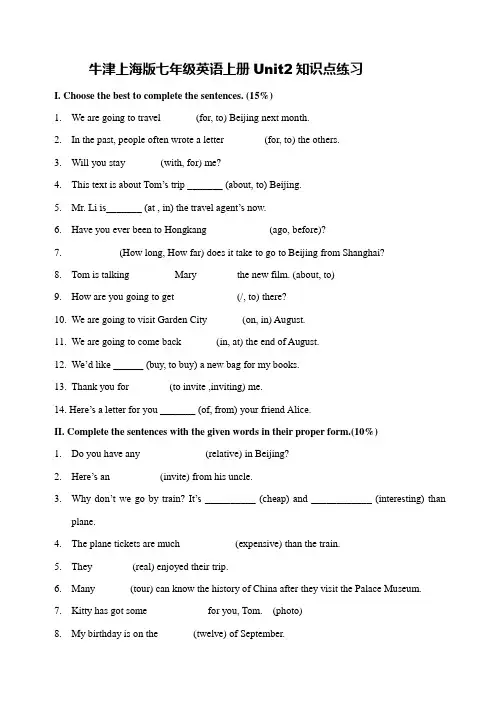
牛津上海版七年级英语上册Unit2知识点练习I. Choose the best to complete the sentences. (15%)1.We are going to travel ______ (for, to) Beijing next month.2.In the past, people often wrote a letter _______ (for, to) the others.3.Will you stay ______ (with, for) me?4.This text is about Tom’s trip _______ (about, to) Beijing.5.Mr. Li is_______ (at , in) the travel agent’s now.6.Have you ever been to Hongkang ____________(ago, before)?7._________ (How long, How far) does it take to go to Beijing from Shanghai?8.Tom is talking ________ Mary _______ the new film. (about, to)9.How are you going to get ____________(/, to) there?10.We are going to visit Garden City ______ (on, in) August.11.We are going to come back ______ (in, at) the end of August.12.We’d like ______ (buy, to buy) a new bag for my books.13.Thank you for _______ (to invite ,inviting) me.14. Here’s a letter for you _______ (of, from) your friend Alice.II. Complete the sentences with the given words in their proper form.(10%)1.Do you have any ____________ (relative) in Beijing?2.Here’s a n _________ (invite) from his uncle.3.Why don’t we go by train? It’s __________ (cheap) and ____________ (interesting) thanplane.4.The plane tickets are much __________ (expensive) than the train.5.They _______ (real) enjoyed their trip.6.Many ______ (tour) can know the history of China after they visit the Palace Museum.7.Kitty has got some ___________ for you, Tom. (photo)8.My birthday is on the ______ (twelve) of September.9.Whales are one of the ________ (large) animals in the world.10.Wearing a _________ (wool) sweater is very warm.III. Choose the best answer (15%)( ) 1. It takes me _____ hour to go to the airport.A. theB.anC. /D. a( ) 2. I’ve got a letter from Uncle Weiming. The underlined part means _______.A. wrote a letter toB. heard fromC. bought a letter forD. got from ( ) 3. I haven’t _______my cousins before.A. seeB. sawC. to seeD. seen( ) 4. I am going to _________to my mum about our holiday plan.A. speakB. sayC. talkD. tell ( ) 5. There are more than _________ students in this new school.A. two hundredB. two hundredsC. two hundred ofD. hundreds of ( ) 6. You can see that flag __________ in the sky.A. flyB. flyingC. fliesD. to fly ( ) 7. How much does this ticket __________?A. takeB. spendC. costD. need ( ) 8. It took us _____________ to take a plane to Hainan Island.A. two hours and halfB. two hours and a halfC. two and half hoursD. two and a half hour( ) 9.You can _______ a bus there. If you want to save time, you may go _______ taxi.A. take, byB. take, takeC. by, takeD. by, by( ) 10. I don’t like this shirt. Can you show me ______one?A. anotherB. otherC. the otherD. others ( )11. My friend invited me _______ the party.A. toB. inC. atD. to leave( )12. We have _______ home.A. come toB. come backC. wentD. went back( ) 13. --_________?--- I want to buy a T-shirt.A. What do you do?B. Can I help you?C. Do you want a T-shirt?D. Why do you come here?( ) 14. This CD ______ me thirty yuan.A. costB. tookC. paidD. spent( ) 15.”22 August” is read as __________.A. twenty-second of the AugustB. the twenty-second of AugustC. the twenty-second of the AugustD. twenty-second of AugustIV. Rewrite the sentences as required. (26%)1.It takes two hours to travel from Garden City to Beijing by plane.(划线提问)_________ _________ does it take to travel from Garden City to Beijing by plane?2.Uncle Weiming lives in Beijing. (划线提问)_________ _________ Uncle Weiming live?3.We are going to visit Beijing on 16 August. (划线提问)_________ __________ we going to visit Beijing?4.We are going to get there by plane. (划线提问)________ _________ we going to get there?5.Let’s travel by train. (同意转换)_______ _______ travel by train?6.We want to come back on Sunday. (同意转换)We ______ ______ to come back on Sunday.\7. His family will visit Beijing soon. (划线部分提问)____________ ____________ his family visit soon?____________ ____________ will his family visit soon?8. The Li family has already arrived in Beijing. (一般疑问句)___________ the Li family arrived in Beijing __________?9.The ticket cost us about two thousand yuan. (划线提问)________ ________ did the ticket cost us?10. The Whites went to Bangkok by plane. (同意转换)The Whites ______ ______ ______ to Bangkok.11. We’ve found some information. (一般疑问句)_______ you ________ _______information.V. Complete the sentences with the given verbs in their proper forms. (8%)1._______ you _______ (get) a letter from you father yet?2.He ________ (visit) Guilin last summer.3.He ________ (go) to see his grandfather once a week.4.Mr. Black _________ (leave) for America in a week.5.Would you like _________ (make) a kite for me?6.Kitty spends half an hour __________ (read) English everyday.7.Mary wanted to invite her friends __________ (take) part in her Birthday party.8.I ________ (see) my cousins three years ago.VI. True or False (6%)The Earth is our home. We must take care of it. Pollution is a “dirty” word. To pollute means to make things dirty. Today, the pollution is very serious. We can see it, smell it and drink it everywhere. Pollution is not only harmful(有害的) to our health but also to our life.Talking about pollution, we once only meant air pollution. It is true that air pollution is still the most serious now, but it is only one kind of pollution. Now, both water pollution and noise pollution have become two new kinds of pollution.Is there any hope that we can get rid of (消除) pollution? We are glad to say that thegovernment have made laws(法律) to fight it and more and more people know the danger of pollution and they are working hard to get rid of it.( )1. To pollute means to make things clean.( )2. Pollution is bad for our health.( )3. Three kinds of pollution are mentioned(提到)in the passage.( )4. Water pollution is the most serious pollution now.( )5. More and more people know the danger of pollution.VII. Choose the words or expressions and complete the passage.(7%)Most American families like to have a holiday in summer. Summer is a good season 1__ holiday. It is very hot in July and August. Children do not go to school during these 2___ months. Some 3 like to stay at home during the holiday. They work in the garden, visit friends, read books, or watch TV. Many families 4__ their lunch to a park or somewhere far from the city. They like to eat where there are many trees or there is a nice lake. If they live near the 5 , they often go to the beach. They can fish, swim or enjoy the sun there. America is a large country. Many families travel by 6 or by train to see interesting places. They also travel by plane to a foreign country. Many big cities have many famous buildings, theatres, shops and other places 7 travellers.( )1. A. to B. of C. for D. about( )2. A. two B. three C. four D. five( )3. A. people B. students C. man D. woman( )4. A. give B. have C. make D. take( )5. A. city B. town C. village D. sea( )6. A. car B. a car C. their car D. cars( )7. A. in B. for C. on D. atVII. Read the passage and fill in the blanks with proper words. (5%)Do you know which c is the biggest in China? It’s Shanghai. It’s 1,780kilometres from Guangzhou to Shanghai. If you travel by air, you’ll find it very i and fast enough to fly from Guangzhou to Shanghai. It only t you about 3 hours and you’ll get there easily, safely and unhurriedly (从容不迫地).But travelling by train is quite d __ . You have to stay on the train over thirty hours to arrive in Shanghai. More and more people like to travel by a____. You can see why, can’t you?VIII. Writing (作文) :(8%)Write a passage of at least 5 sentences about the topic “My holiday plan for National Day”Use the following points as a reference.1. What would you like to do on National Day?2. Which place do you plan to visit?3. How will you go there? Why?4. Who will go with you?。
沪教牛津版-英语-七上-七上Unit_2_Daily_Life单元知识小结
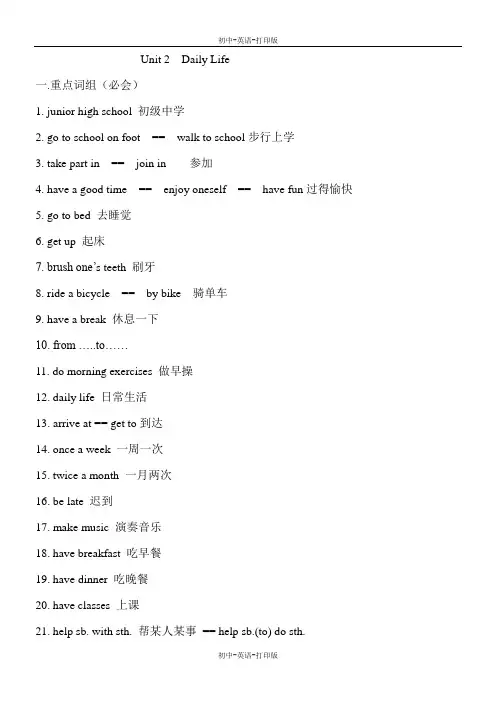
Unit 2 Daily Life一.重点词组(必会)1. junior high school 初级中学2. go to school on foot == walk to school步行上学3. take part in == join in 参加4. have a good time == enjoy oneself == have fun过得愉快5. go to bed 去睡觉6. get up 起床7. brush one’s teeth 刷牙8. ride a bicycle == by bike 骑单车9. have a break 休息一下10. from …..to……11. do morning exercises 做早操12. daily life 日常生活13. arrive at == get to到达14. once a week 一周一次15. twice a month 一月两次16. be late 迟到17. make music 演奏音乐18. have breakfast 吃早餐19. have dinner 吃晚餐20. have classes 上课21. help sb. with sth. 帮某人某事== help sb.(to) do sth.二. 同义词(了解)1. seldom = not often2. break = a short rest3. ring = make a sound4. end = stop5. together = with each other6. daily = everyday三. 本单元核心语法点:一般现在时态:一,定义:1)经常性、习惯性的动作或存在的状态。
e.g. I go to school on foot. He is very busy now.2)表示主语的特征、性格、能力、爱好等。
e.g. He can swim. I work hard. I like watching TV.3)表示客观真理。
牛津上海版七年级英语上册Unit2知识点练习

牛津上海版七年级英语上册Unit2知识点练习Exercise for VocabularyI.在下列句子中填入适当单词,首字母已给出。
1.he is out of touch with s___________. A most nobody knows him.2.To hit a weaker person is a sign of c___________.3.The deaf (聋的)children need a s__________ kind of schooling.4.Our housing estate(社区)has a v__________ to take care of pets.5.Betty saw a mouse running out from a c__________ ,and she was afraid of it.6.There ‘s coffee and tea.which would you p_________ .7.The mother f_________ milk to her baby.8.The air in the c________ is much cleaner than it in the city.Ⅱ. 用所给单词的适当形式填空。
1.The girl has a _______ voice.(love )2.Be _______ when you cross the road.(care)3.They have played football for a whole afternoon , and they are_______ now.(thirst)4.He used to have a bad habit of _______ fast.(chew )5.The police _______ are trying their best to find the criminal(罪犯)。
2024年沪教牛津版七年级英语上册 Unit2重点短语句型和知识

2024年新沪教牛津版初一上册Unit 2重点短语和知识一.重点短语compare with与...作比较would like to do sth.想要做某事be different from与...不同brush teeth刷牙go to school去学校do sports做运动do the dishes洗碗do some reading阅读go home回家do one’s homework做作业do the housework做家务wash clothes洗衣服have a lot to say about关于...有很多要说的in the morning在早上teach us by playing games通过做游戏教我们do some morning exercise做一些早间锻炼do morning exercises做早操from...to...从...到...after that在那之后take part in参与(活动)look forward to期望the answer to the question问题的答案be close to靠近be excited about对...感到激动in fact事实上in daily life在日常生活中solve problems解决问题all the time一直at times偶尔have classes上课have breakfast吃早餐get up起床on foot走路tell sb. About sth.告诉某人某事write to写信给某人full of energy精力充沛the breaks between classes课间休息get ready for准备好be ready to do sth.准备好去做某事half an hour半小时go to bed上床睡觉keep a diary记日记pick up取回;开车接hurry to充忙去某地in a hurry匆忙in time及时on time准时;按时in a good mind有好心情a happy ending一个美好的结局二.重点句型1.Which of these things do you do every day?这些事情中哪件是你每天都做的?2.What about you?你呢?3.---What do you usually do on weekends?你周末通常做什么?---I often exercise.我经常锻炼。
上海牛津版七年级上册unit2知识点讲解
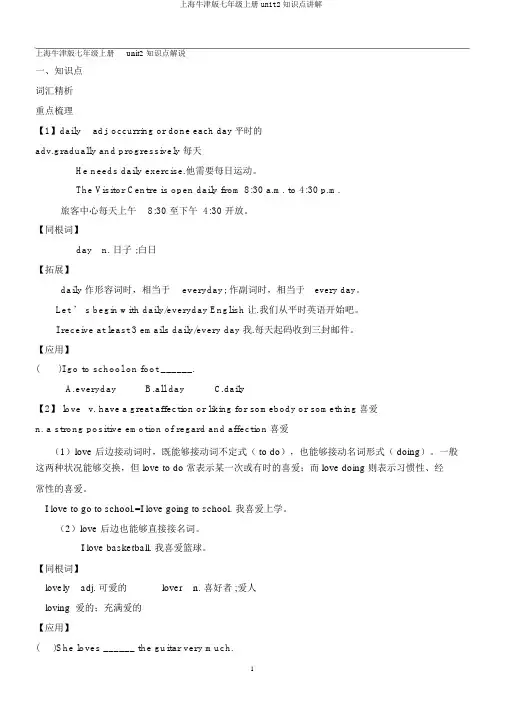
上海牛津版七年级上册unit2 知识点解说一、知识点词汇精析重点梳理【1】daily adj. occurring or done each day平时的adv.gradually and progressively每天He needs daily exercise.他需要每日运动。
The Visitor Centre is open daily from 8:30 a.m. to 4:30 p.m.旅客中心每天上午8:30 至下午 4:30 开放。
【同根词】day n. 日子 ;白日【拓展】daily 作形容词时,相当于everyday; 作副词时,相当于every day。
Let ’ s begin with daily/everyday English让.我们从平时英语开始吧。
I receive at least 3 emails daily/every day我.每天起码收到三封邮件。
【应用】()I go to school on foot ______.A.everydayB.all dayC.daily【2】 love v. have a great affection or liking for somebody or something喜爱n. a strong positive emotion of regard and affection喜爱(1)love 后边接动词时,既能够接动词不定式( to do),也能够接动名词形式( doing)。
一般这两种状况能够交换,但 love to do 常表示某一次或有时的喜爱;而 love doing 则表示习惯性、经常性的喜爱。
I love to go to school.=I love going to school. 我喜爱上学。
(2)love 后边也能够直接接名词。
I love basketball. 我喜爱篮球。
【同根词】lovely adj. 可爱的lover n. 喜好者 ;爱人loving 爱的;充满爱的【应用】()She loves ______ the guitar very much.A.playB.playingC.plays【3】 seldom adv. not often 极少;不常I seldom go to the cinema.我极少去看影。
牛津上海版七年级英语上册Unit1-2重点知识复习及强化练习
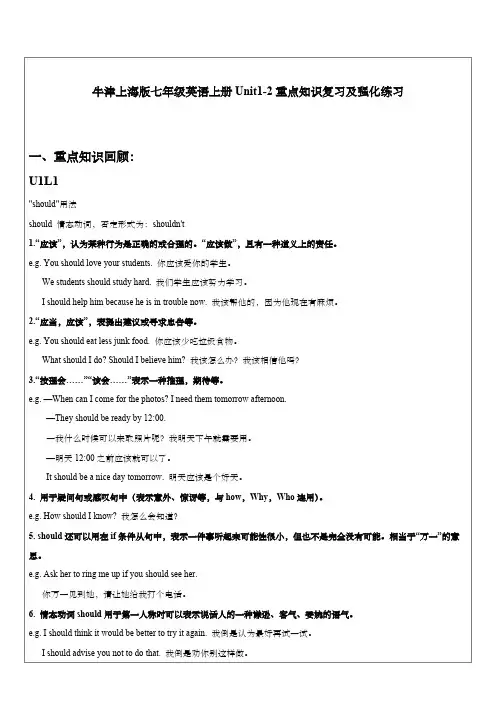
——Yes, I used to.(No,I usedn't.) 是的,经常打。(不,不常打。)
二、区分 be used to 与 used to
1、be used to 意为“习惯于”,其中的 to 是介词,所以其后要接名词或动名词(不能接动词原形);若要强调 从不习惯到习惯的过程,可用 get, become 等代替动词 get, become be。如:
He is used to looking after himself. 他已习惯于自己照顾自己。
I’m sure I’ll get used to the hard work. 我相信我会习惯这艰苦工作的。
2、used to 意为“过去经常”,其中的 to 是不定式符号,而不是介词,所以其后只接动词原形(不能接动名 词)。如: He used to live in Paris. 他过去一直住在巴黎。
Did you use to go swimming in the river when you were young? 你小时候经常在河里游泳吗?
Used he go to school by bike? 他过去骑车上学吗?
4、used to 用于省略句时,肯定式保留 to,否定式不保留 to。例如:
convenient
choose a flat in the center of have a nice view face
19. I want to ________ ________New York.
20. Let's ________ all the things we are going to buy.
牛津上海版七年级英语上册Module1 unit2知识点归纳及练习
4. These people are_________ to animals.They don't look after their pets and leave them in the street. (kind)5. The clever dog helped the police look for the________ boy. (miss)【Keys】1. officer 2. lovely 3. safely 4. unkind 5. missing词组梳理:(如果这块学校老师和家长已经检查过了的话就可以快速跳过)the SPCA=the Society for the Prevention of cruelty to Animals 爱护动物协会take…to…. 把……带到…take care of 照看;照料;照顾(=look after)be unkind to 对……不友善的be kind to 对……友善的save…from… 挽救……以免于……keep…from… 保护;使免受play with sb. 跟某人玩耍help sb. (to) do sth 帮某人做某事on the farm 在农场上1. 不定代词one用于泛指之前所提到过的人或物。
可数名词的单数形式用one,复数形式用ones。
—— Look at the two mobile phones. Do you like the pink one or the white one?看这两个手机,你喜欢粉色的还是白色的?I like the pink one. 我喜欢粉色的那个。
【活学活用】选出正确的答案1. My watch doesn’t work and I want to buy a new __________.A. oneB. onesC. itD. that【解析】:one 指代前文提到过的watch, 表示同一类但是不是同一个。
牛津上海版七年级英语上册Unit2知识点2
牛津上海版七年级英语上册Unit2知识点Unit 2 Our animal friends一、词组归纳:1. an SPCA officer 一位动物保护协会的官员2. prevent animals from danger 保护动物远离危险=save animals from danger / keep animals from danger3. at the SPCA 在动物保护协会4. be cruel to sb. 对……残忍5. leave these puppies in the street 把这些小狗遗弃在街上6. have no food or water 没有食物和水7. be hungry and thirsty 又饥又渴8. keep one as your pet 收留一只作为宠物9. prefer doing A to doing B 比起做B来更喜欢做A10. the yellow and brown one 黄褐相间的11. be in danger 处于险境12. be dangerous to 对……危险13. care for 照顾,照看= take care of /look after14. help homeless animals 帮助无家可归的动物15. give them a booklet to read 给他们一些小册子看16. Feed him/her 3-4 times every day 每天喂他/她3、4次17. special dog food for puppies 特殊的小狗粮18. Give him/her a bowl of water to drink. 给他/她一碗水喝19. Give him/her hard dog biscuits to chew. 给他/她硬的狗饼干咀嚼20. Give him/her a basket to sleep in. 给他/她篮子睡21. Give him/her a blanket to keep him/her warm. 给他/她毯子保暖22. Hold him/her carefully with both hands. 用双手小心的抱他/她23. Take him/her to a park for a walk every day. 每天带他/她去公园散步24. don’t need to do sth.不必做某事= needn’t do sth. / don’t have to do sth.25. a kitten / a young cat 小猫26. be kind/friendly to sb 对……和蔼可亲be unkind to sb. 对……不友善27. help sb. do sth. 帮助某人做某事= help sb. with sth.28. clinics for sick animals 收治生病动物的诊所29. the vets in the clinics 诊所的兽医30. play with kittens 和小猫玩31. junior members of the SPCA 动物保护协会的初级会员32. help sb. by doing sth. 通过做某事来帮助某人33. collect old blankets 收集旧毯子34. raise money for … 为……筹钱35. be useful to …对……有用36. live in a cave 住在洞穴里37. hunt for food 猎食38. life guards 救生员39. guard the houses 守卫房屋40. a blind man 一位盲人41. in different ways 用不同的方法42. on the farm 在农场43. cross the road safely 安全地过马路44. find missing people 找到失踪的人45. catch a thief 抓小偷catch thieves 抓捕小偷46. make a display 制作展板47. the SPCA 动物保护协会= the Society for the Prevention of Cruelty to Animals48. keep warm 保暖49. play with a puppy 和小狗玩50. need to do sth. 需要去做某事否定句don’t need to do51. promise to do sth 承诺做某事promise not to do sth 许诺不做某事52.take good care of 好好照顾= look after well53.the police 警方54. Do you know what the SPCA is? 你知道什么是SPCA么?55. keep one puppy as your pet 养一只小狗作为宠物56. like best = favourite 最喜欢57. prefer the black one 更喜欢黑色的一只58. a basket to sleep in 一个睡觉的篮子59. hold … carefully with both hands 用双手小心地抱着60. buy sth for sb 为某人买某物61. sometimes 有时候62. save animals from danger 拯救动物免受危险63. must do sth. 必须做某事64. sick animals 生病的动物65. keep people safe from danger 保护人们安全免受危险66. hunt animals for food 猎杀动物获取食物67. should do 应该做某事68. on their farms 在他们的农场里69. bring sth to sb 把某物带给某人70. look after sb well = take good care of sb 很好的照料某人71. in many different ways 在许多不同的方面二、新单词/词组讲解:1.mean 意为“表示…的意思”(过去式meant)【例句】What do you mean?What do you mean by…?【拓展】What’s the meaning of …?What’s the meaning of this word?2.arrive at 意为“到达”(1)arrive at 后面接小地方(如车站、影院等)(2)arrive in 后面接大地方(如国家、城市、地区等)(3)若是地点副词,则不需要介词【例句】We arrived at the airport at four o’clock.【拓展】Reach 是及物动词,后面无需介词Get 是不及物动词,后接to3.welcome 意为“受欢迎的”【拓展】welcome的特殊用法:◆“欢迎某人做某事”可以说“sb. be welcome to do sth.”【例句】Foreign friends are welcome to visit China.◆“欢迎某人来某处” 可以说“Sb. be welcome to some place.”【例句】You’re welcome to Beijing.4.allow 意为“允许”,后面可以接名词、代词,或接宾语从句“允许某人做某事” :allow sb. to do sth.【例句】Our teacher allows us to go out for a walk.5.by oneself表示“单独;独自”,相当于alone【例句】The old man lives all by himself in that big house.【常用短语】talk to oneself teach oneself enjoy oneself Dress oneself help oneself to6.apologize 意为“道歉”apologize to sb. 向某人道歉apologize for sth/ doing sth 为某事/做某事道歉【例句】He apologized to her for coming late.7.lead (sb.) to. “带着(某人)到…”【例句】The waiter lead him to his seat.【拓展】lead to 还可以表示“ 通向…”【例句】The road leads to the sea.8.fall asleep 意为“入睡”,侧重“自然而然地入睡”或“无意识地睡着”【注意】go to sleep入睡go to bed上床睡觉be asleep强调睡觉的状态9.start/begin to do【例句】Everything begins to grow in spring.10.wake up “醒来”;作及物动词表示“唤醒”【例句】I woke up at five this morning. 今天早上5点钟我就醒了。
牛津上海版七年级英语上册Unit2基础知识及语法归纳练习
Unit2基础知识及语法归纳练习Key Words1. officer ['ɔfisə] n. 官员;高级职员【词性转换】office ['ɔfis] n. 办公室A police officer came to help when our car broke down on the way.我们的汽车在路上出了魔兵,一位警官帮了我们的忙2. society [sə'saiəti] n. 社团;协会【词性转换】social ['səuʃəl] adj. 协会的;社会的The Chemical Society of China 中国化学学会3. prevention [pri'venʃən] n. 预防;防止;防范【词性转换】prevent [pri'vent] v. 预防,防止Prevention is better than cure. 预防胜于治疗。
4. cruelty ['kru:əlti] n. 残酷【词性转换】cruel ['kruəl] adj. 残酷的,悲惨的cruelty to children 虐待儿童5. someone ['sʌmwʌn] pron. 某人【近义词】somebody ['sʌmbədi] pron. 某人,有人Someone wants to talk with you. 有人想和你谈话。
6. puppy ['pʌpi] n. 小狗;幼犬【提示】dog一般用来指“成年狗”或表示狗的总称;puppy特指小狗,复数形式为puppies,类似地,cat表示“成take care of 照看;照料;照顾(=look after)be unkind to 对……不友善的be kind to 对……友善的save…from… 挽救……以免于……keep…from… 保护;使免受play with sb. 跟某人玩耍help sb. (to) do sth 帮某人做某事on the farm 在农场上Grammar1. 一般过去时:★一般过去时的构成:一般过去时用动词的过去式表示,动词的过去式有规则与不规则两种。
沪教牛津版七年级上册Unit2-Daily-life-单元归纳总结练习
沪教牛津版七年级上册U n i t2-D a i l y-l i f e-单元归纳总结练习(总5页)-CAL-FENGHAI.-(YICAI)-Company One1-CAL-本页仅作为文档封面,使用请直接删除Unit 2 Daily life (2016.12.20)班级:姓名:家长签名:一、重点短语once or twice a week 一周一两次 on foot 步行learn about 了解,知道 from...to... 从......到......take part in 参加 have a good time玩得开心,过得愉快after-school activities课外活动 talk about谈论,交谈between...and... 在......与......之间 arrive at/in 到达help sb. with sth. 帮助某人做某事 on the way to... 去......的路上around the world 世界各地 one of the best... 最好的......之一同义词1. seldom = not often2. break = a short rest3. ring = make a sound4. end = stop5. together = with each other6. daily = everyday二、重点句子1.I love going to school.我喜欢去上学。
2.My school is close to my home, so I always go to school on foot.我的学校靠近我家,所以我总是走路上学。
3.My favourite subject is Geography.我最喜欢的科目是地理。
4.I enjoy learning about different places in the world.我喜欢了解世界不同的地方。