
危险化学品安全管理条例(2011英文版)
Regulations on the Control over Safety of Dangerous Chemicals Decree No. 591 of the State Council of the People's Republic of China Regulations on the Control over Safety of Dangerous Chemicals have been revised by the 144nd Executive Meeting of the State Council on 16th February 2011.We hereby issue this revised Regulations, which shall take effect as of 1th December 2011.Premier: Wen Jiabao2nd March 2011(Decree No. 344 of the State Council of the People's Republic of China was issued on 26th January 2002, and revised by the 144nd Executive Meeting of the State Council on 16th February 2011)ContentsChapter I General Principles (2)Chapter ⅡSafety of Manufacture and Storage (6)Chapter ⅢSafety of Use (12)Chapter ⅣSafety of Operation (13)Chapter ⅤSafety of Transportation (17)Chapter VI Registration of Dangerous Chemicals and Emergency Rescue of Accidents (23)Chapter VII Legal Liability (26)Chapter VIII Supplementary Rules (38)Chapter I General PrinciplesArticle 1 In order to strengthen the control over safety of dangerous chemicals, to prevent and reduce the accidents from dangerous chemicals, to guarantee the people’s life and property safety, and to protect the environment, these Regulations are hereby enacted.Article 2 The safety administration of production, storage, use, operation and transportation of dangerous chemicals were applied to this ordinance.The disposal of the wasted dangerous chemicals shall be governed by the relevant laws, other administrative regulations and national provisions concerning about environmental safety.Article 3 “Dangerous chemicals” as referred to herein include toxic chemicals and other chemicals which have the properties of poison, corrosion, explosion, burning and combustion supporting etc., and will be harmful for human body, facilities and environment.The List of Dangerous Articles should be determined, promulgated and adjusted according with the identification and classification of their risk characteristics by the administrative department in charge of production safety supervision and management jointly with the administrative departments of industry and information technology, public security, environmental protection, health, quality supervision inspection and quarantine, transportation, railway, civil aviation and agriculture etc. of the State Council.Article 4 The management of dangerous chemicals should adhere to safety and prevention first, comprehensive treatment approach to strengthen and implement the main responsibility of enterprises.The personnel chiefly in charge of units that manufacture, store, use, deal in and transport of the dangerous chemicals (hereinafter referred to as the “units of dangerous chemicals”) must guarantee the overall safety administration.The units of dangerous chemicals shall meet the safety requirements of laws, administrative regulations, industrial standards, and establish and complete the management rules and regulations, job safety responsibility system, their employees must take part in the training for the relevant safety, legal and posts technical know-how. All employed persons shall be educated and trained, only those passing the examination may hold their posts; For qualifiedpositions, only the persons having relevant certificates may hold the posts.Article 5 Any units and personnel should not manufacture, deal in, use of the dangerous chemicals that their production, operation and use are banned by the State.For the use of the dangerous chemicals that restricted by the provisions of the State, any units and persons should not violate the restrictions to use such chemicals.Article 6 The relevant departments in charge of supervision and administration of the manufacture, storage, use, operation, transportation of dangerous chemicals (hereinafter referred to as the “departments in charge of supervision and administration of dangerous chemicals”) shall fulfill their responsibilities according to the following:(1)The administrative department in charge of safety production and supervision will be responsible for overallwork for administration and supervision of safety of dangerous chemicals, organize the determination, publishing, adjustment of the catalogue of dangerous chemicals, examine the safety conditions of construction projects for new established, reconstructed, expanded production, and storage of dangerous chemicals (including thedangerous chemicals using long pipe delivery), be responsible for issuance of the licenses for safety production of dangerous chemicals, safety usage of dangerous chemicals, and operation of dangerous chemicals, and be responsible for registration of dangerous chemicals.(2)The public security organs shall be responsible for the public security control over dangerous chemicals, beresponsible for the issuance of hyper-toxic chemical purchase licenses and road transportation passes forhyper-toxic chemicals, be responsible for supervision over the safety of the road transportation of dangerous chemicals(3)The administrative departments in charge of quality supervision, inspection and quarantine shall be responsiblefor the issuance of the manufacture licenses of dangerous chemicals and their packing materials as well ascontainers (excluding fix type large tank for dangerous chemicals, hereinafter as same ) to manufactureenterprises for industrial production, be responsible for the supervision over the quality of products, and be responsible for the inspection of import & export dangerous chemicals and their packages.(4)The administrative departments in charge of environmental protection shall be responsible for the supervisionand administration of the disposal of wasted dangerous chemicals, be responsible for the identification of the environmental hazards and risks of dangerous chemicals, determination of the implementation of keyenvironmental management of dangerous chemicals, be responsible for the environmental management ofregistration of dangerous chemicals and new chemicals; investigation of relevant chemical environmentalpollution accidents and the ecological damage incidents according to detail responsibilities, be responsible for emergency environmental monitoring of the sites of dangerous chemical accidents .(5)The transport administrative department of the State shall be responsible for the licensing of highway andwaterway transportation of dangerous chemicals, and the safety control of their means of transport, beresponsible for qualification determining of drivers, sailors, loading and unloading management personnel, transport escorts, declares, and on-site container inspector from units for highway and waterway transportation of dangerous chemicals. The railway administrative department shall be responsible for the safety management of railway transportation for dangerous chemicals, be responsible for the qualification examination of carriers, consignor for dangerous chemicals and their means of transport. The civil aviation administrative department shall be responsible for the safety management of air transportation, air transportation enterprises and their means of transport.(6)The administrative departments in charge of health shall be responsible for the management of identification oftoxicity of dangerous chemicals, and be responsible for organization and coordination of medical and health rescue of the personnel who are injured due to accidents of dangerous chemicals.(7)The administrations for industry and commerce shall, in accordance with the licenses of the relevant departments,issue the business licenses for units that manufacture, store, deal in, or transport dangerous chemicals, andinvestigate and deal with illegal acts of the procurement of dangerous chemicals for units that deal in dangerous chemicals.(8)The administrative departments in charge of post shall be responsible for the investigation and dealing with thebehavior of sending dangerous chemicals by post.Article 7 The relevant departments in charge of supervision and administration of dangerous chemicals may exercise the following powers in the course of supervision and examination according to law:(1)To enter into the operating sites of dangerous chemicals to make the spot examination, to learn the relevantinformation from the personnel concerned, and to inspect and copy relevant documents and information;(2)To order the parties concerned to eliminate the hidden risks of accidents of dangerous chemicals forthwith orwithin a specified time limit when such risks are discovered;(3)To order the parties concerned to cease forthwith the use of facilities, equipment, apparatus, and means oftransport that fails to meet the relevant laws, regulations, rules, and national standards, industrial standards based on evidence;(4)To close down the sites which illegal produce, store, use, deal in dangerous chemicals after the approval by mainresponsible person from the relevant departments, to detain the dangerous chemicals that produce, store, use, deal in, and transport illegally and the raw materials, facilities, transport tools used to illegal produce, use, and transport dangerous chemicals;(5)To make corrections on the spot, or to order the parties concerned to make corrections when finding the illegalacts.The departments in charge of supervision and administration for dangerous chemicalsshall take the works of supervision and examination according to law, the persons who responsible for supervision and examination shall not less than 2, and shall show their certificates; the relevant units and personnel shall coordinate to the supervision and examination according to law without refusal or hindrance.Article 8 The people’s governments higher than the county level shall establish the coordination systems for supervision and administration of safety of dangerous chemicals, to support, supervise the departments in charge of supervision and administration of safety of dangerous chemicals on duty according to laws, to coordinate, solve the important problems concerned in the management of supervision and administration of safety of dangerous chemicals.The departments that in charge of the responsibility of supervision and administration of safety of dangerous chemicals shall coordinate to, cooperate mutually to strengthen the administrative work of supervision and administration of safety of dangerous chemicals according to law.Article 9 Any unit and personnel may report the behaviors that against the Regulations to the departments in charge of the responsibility of supervision and administration of safety of dangerous chemicals. When the departments in charge of the responsibility of supervision and administration of safety of dangerous chemicals received the reports, they shall deal with timely; the concerns excluding with their responsibility shall be transferred to relevant departments to process timely.Article 10 The State encourage manufactures that produce dangerous chemicals and enterprises that use the dangerous chemicals to apply advanced technology, technique, facilities, and auto-control systems to benefit the improvement of the safety insurance level, the dangerous chemicals shall be encouraged to adopt special storage, uniform distribution and concentrate sales.BackⅡSafety of Manufacture and StorageChapterArticle 11 The Sate carries out the integrated management, rational distribution for manufacture and storage of dangerous chemicals.The administrative departments in charge of industry and information technology of the State Council and other relevant departments shall in accordance with their responsibilities, be responsible for making the industrial planning and distribution of manufacture and storage of dangerous chemicals.The organizers of people’s governments at local level shall make the urban and rural planning, according to the local actual situation, allocate the appropriate areas to be specialized for the manufacture and storage of dangerous chemicals in accordance with the principle of ensuring safety.Article 12 The construction projects for new established, reconstructed, expanded production, and storage of dangerous chemicals (hereinafter refer to “construction projects”) shall be checked the safety conditions by administrative departments in charge of supervision of safety of manufacture.The construction units shall proof the safety conditions of construction projects, and entrust the qualified agencies according to the State rules to evaluate the safety of construction projects, then send the reports of proofs of safety conditions and conclusions of evaluations of safety to the administrative departments for supervision of safety of manufacture setting up in local and people’s governments at higher than the municipality level; The administrative departments for supervision of safety of manufacture shall issue the examination decisions within 45 days upon the receipt of the reports, and notify the construction units in writing. The detail proceedings shall be made by administrative department for supervision of safety of manufacture of the State Council.The safety conditions of construction projects for new established, reconstructed, expanded storage and port of loadand unload dangerous chemicals shall be inspected by port administrative departments according to the regulations of transport administrative department of the State Council.Article 13 The units that manufacture, store the dangerous chemicals shall put highlight symbols for laid pipe that delivering the dangerous chemicals, and inspect, detect such pipes regularly.Before staring the constructions that may concern the dangerous chemicals, the construction units shall notify the pipes belonging units in writing 7 days before the date of starting construction, and make the emergency plan together with the pipes belonging units, take the relevant protective measures for safety. The pipes belonging units shall assign specific persons to guidance the on-site safety protections for pipes.Article 14 Before manufacturing, the manufacture enterprises for dangerous chemicals shall obtain the license of safety production permit for dangerous chemicals according to the regulation of safety production permit.Whoever manufactures the dangerous chemicals that listed in industrial products catalogue with production permit required by the State shall obtain the license of national industrial products manufacture certificate according to the regulation of administrative items on People’s Republic of China industrial products manufacture certificate.The departments in charge of issuance the license of safety production permit and industrial products manufacture certificate shall notify the conditions of issuance of licenses to the departments of industry and information technology, environment protection and public security at same level.Article 15 Whoever manufactures dangerous chemicals shall supply the technical specifications for the safety of chemicals in full accord with dangerous chemicals produced, and affix or post the safety signs for chemicals in full accord with dangerous chemicals in the packing materials on the external packaging materials. The contents of safety specifications and safety signs shall meet the requirements of National standards.When finding new hazard characteristics for dangerous chemicals manufactured, the manufacturing enterprises of dangerous chemicals shall make the public announcements forthwith, and modify the technical specifications for safety and the safety signs in time.Article 16 Whoever manufacture dangerous chemicals engaging in implementation of key environmental management shall report the relevant environmental release information of this dangerous chemical to thedepartments in charge of environmental protection in accord with the regulations of departments of environmental protection of the State Council. The departments in charge of environmental protection may adopt corresponding acts to control environmental risks accordingly.Article 17 The packaging of dangerous chemicals must accord with laws, regulations, rules and the requirements of national standards, industrial standards.The materials of the package, containers of dangerous chemicals and the models, specifications, methods and unit quantity(weight) of the packing of dangerous chemicals shall be adapted to the nature and purposes of the packaged dangerous chemicals.Article 18 Whoever manufacture packages, containers that listed in the industrial products catalogue of the State production permit for dangerous chemicals shall obtain China industrial products manufacture certificate in accord with the regulations of administrative items on People’s Republic of China industrial products manufacture certificate; The produced packages, containers must be inspected by the State Council identified departments in charge of quality supervision, inspection and quarantine, only the approved products can be sold on the market.The ships and their loading containers for shipment of dangerous chemicals shall be manufactured in accord with the regulations on National Survey of Ship, and only after checking by qualified ship inspection institutes with maritime administrative agencies, they can be put to use.The packing materials, containers for repeated use shall be inspected before being used; When safety problems are found, it should be repaired or replaced. The corresponding records made by using units shall be made; the inspection records shall be kept for 2 years at least.Article 19 The quantity of the installations manufacturing and storing dangerous chemicals constituting the serious hazard sources (excluding transport gas stations, filling stations) and the distance from the following places, facilities and areas must satisfy the national standards or the relevant provisions of the State:(1)Resident estates, commercial centers, parks, and other densely inhabited districts;(2)Schools, hospitals, cinemas, stadiums, gymnasiums, and other public facilities;(3)Water supply sources, water plants, and water source protection zones;(4)Stations, docks (excluding those authorized for loading and unloading of dangerous chemicals upon approvalaccording to the relevant provisions of the State), airports, highways, railways, waterway main lines, wind booths, entrance, and exit of underground railways;(5)The basic farmland protection zones, grasslands, animal genetic resources conservation areas, animal scalehusbandry zones (small husbandry zones), fishing waters, and bases to produce seeds, breeders, and offspring of aquatic products;(6)Rivers, lakes, places of historical interest and scenic spots, and natural protection zones;(7)Prohibited military zones and military control zones; and(8)Other areas, facilities, fields to be protected by laws and administrative regulations.In case that the quantity of installations manufacturing dangerous chemicals that have been built, and the storage facilities that constitute the serious hazard sources does not fulfill the provisions of the preceding Paragraph, the administrative departments in charge of the overall work for the supervision and administration of safety of dangerous chemicals of the people’s governments at the municipality level (with districts established within the municipality ) shall supervise the parties concerned to make rectification and improvement within the specified time limit. The change of the line of production, the stoppage of production, the move, or shutdown shall be reported to the people’s governments at the same levels for approval, and carry out such activities upon approval.The location that used to build the quantity of installations manufacturing dangerous chemicals shall avoid active earthquake fault and prone flood, geologic hazard areas.“Serious hazard sources” as referred to herein means cells (including places and installations) in which the dangerous chemicals are manufactured, transported, used, or stored, or the wasted chemicals are disposed of, and the quantity of dangerous chemicals is equal to or exceeds the threshold quantity.Article 20 Whoever manufactures, stores dangerous chemicals shall set up relevant safety facilities and equipments for inspecting, monitoring, ventilation, sun protection, temperature adjustment, fireproofing, fire control, explosion protection, pressure relief, poisoning prevention, neutralization, moisture prevention, lightening prevention, static electricity resistance, antisepsis, leak prevention, and reclamation dam protection or isolated operation in the working sites, according to the kind of the dangerous chemicals they manufactured, stored, and carry out the works of repairing, maintenance regularly to ensure the safety of the running of facilities and equipments according to National standards, industrial standards or relevant provisions of the State.Whoever manufactures, stores dangerous chemicals shall set up visible warning signs in working sites and on safetyfacilities and equipments.Article 21 Whoever manufactures, stores dangerous chemicals shall set up communication and alarm devices in working sites and ensure them in working conditions.Article 22 The enterprises that manufacture and store dangerous chemicals shall conduct safety evaluation for its safety conditions of manufacturing once 3 years by qualified institutes with the provisions of the State, the latter shall submit the safety evaluation report. The contents of the safety evaluation report shall include the reform program for existing problems of safety manufacturing.The enterprises that manufacture and store dangerous chemicals shall submit the safety evaluation report and the implementation of reform program to the administrative department in charge of work for the supervision and administration of safety of manufacturing of the people’s government at the county level for record.The enterprises that store the dangerous chemicals in port areas shall submit the safety evaluation report and the implementation of reform program to port administrative authority for record.Article 23 The units that manufacture and store hyper-toxic chemicals, and the dangerous chemicals that can be used to manufacture explosives (hereafter refer to “explosive precursor dangerous chemicals)according to the provision of public security of the State Council shall record quantity and distribution details of hyper-toxic chemicals and explosive precursor dangerous chemicals their manufactured and stored, and take necessary safety precautions, guard the lost or stolen of high toxic chemicals and explosive precursor dangerous chemicals; In case of such things happened, the local public security shall be informed immediately.The units that manufacture and store hyper-toxic chemicals shall set up the department of public security, and allocate full-time security personnel.Article 24 The dangerous chemicals shall be stored within specialized warehouse, fields or specialized rooms (hereafter refer to as the “specialized warehouse”), and be administrated by the specially assigned personnel; The hyper-toxic chemicals and the other chemicals in quantity of storage causing significant dangerous sources shall be stored separately in special warehouse, and be subject to the system of double-person receiving and dispatching and double-person safekeeping.The storage means, methods, and the quantity stored must meet the national standards or relevant national provisions.Article 25 The units storing dangerous chemicals shall establish the inspection and registration system for dangerous chemicals’ entry into, and exit from warehouses.The detail storage quantity, sites and management personnel conditions of hyper-toxic chemicals and the other chemicals in quantity of storage causing significant dangerous sources shall be submitted to the administrative department in charge of inspection at local county level (if the storage site is within port, the report shall be submitted to port administrative authority) and public security for record by storage units.Article 26 The specialized warehouses for dangerous chemicals shall meet the requirements of the national standards and industrial standards, and prominent signs shall be set up. The specialized warehouses for storage of hype-toxic chemicals and explosive precursor dangerous chemicals shall set up relevant technical preventive measures in accord with the national provisions.The units storing dangerous chemicals shall check and test regularly for the safety facilities and equipments of specialized warehouse storing dangerous chemicals.Article 27 When units that manufacture, store dangerous chemicals change the line of production, halt production, shut down, or dissolved, they shall adopt the effective measures to timely dispose the manufacturing or storage equipment for dangerous chemicals and inventory products, and shall not discard the dangerous chemicals; The disposal proposal shall be submitted to the administrative department in charge of the overall work for the supervision and administration of safety of dangerous chemicals of the local people’s government at the local county level, and the administrative department in charge of industry and information technology, environmental protection and the public security for record. The administrative department in charge of the overall work for the supervision and administration of safety of dangerous chemicals shall supervise and examine the disposal with the administrative department in charge of environmental protection and the public security. If no in compliance with the provisions was found, the disposal shall be ordered immediately.BackChapter ⅢSafety of UseArticle 28 The use conditions (including technique) for units that use dangerous chemicals shall meet the requirements of law and administrative regulations, establish and improve the regulations on safety use and process of dangerous chemicals according to the kind, hazardous characteristics, amounts and ways of dangerous chemicals used, ensure the safety use of dangerous chemicals.Article 29 The chemical enterprises that engage in manufacturing dangerous chemicals and the units that the amounts of dangerous chemicals used reach to the required number (excluding the enterprises that manufacture dangerous chemicals, the same below) shall obtain the license of safety use of dangerous chemicals in accord with this regulations.The preceding paragraph of quantity standard of use of dangerous chemicals shall be determined and issued by the administrative department in charge of inspection for safety manufacturing of the State Council jointly with the administrative departments in charge of public security and agriculture.Article 30 The chemical enterprises that apply for the license of safety use of dangerous chemicals shall meet the following conditions except meet the Article 28 provision of this regulation:(1)Having professional technical persons capable of use of dangerous chemicals;(2)Having management persons from the administrative departments for safety and specialized persons for safety;(3)Having emergency plan for hazardous chemical accidents and necessary emergency rescue equipments andfacilities in accord with the national provisions;(4)Conducting safety evaluation in accord with laws.Article 31 The applicants for the license of safety use of dangerous chemicals shall apply the application to the administrative department in charge of supervision of safety in dangerous chemicals at the municipality level (with districts), and submit the supporting documents for qualification as specified in Article 30 herein. The administrative departments in charge of supervision of safety of dangerous chemicals of the people’s government at the municipality level (with districts) shall examine the supporting documents and make out approval or un-approval decisions upon。
国务院令第591号(2011) 危险化学品安全管理条例
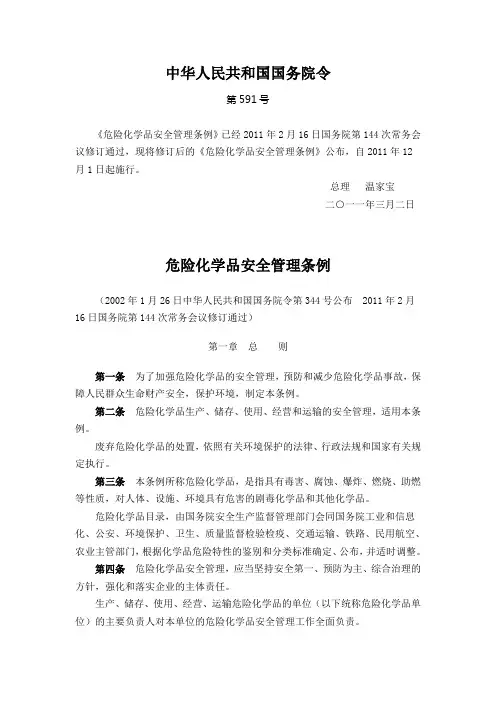
中华人民共和国国务院令第591号《危险化学品安全管理条例》已经2011年2月16日国务院第144次常务会议修订通过,现将修订后的《危险化学品安全管理条例》公布,自2011年12月1日起施行。
总理温家宝二○一一年三月二日危险化学品安全管理条例(2002年1月26日中华人民共和国国务院令第344号公布2011年2月16日国务院第144次常务会议修订通过)第一章总则第一条为了加强危险化学品的安全管理,预防和减少危险化学品事故,保障人民群众生命财产安全,保护环境,制定本条例。
第二条危险化学品生产、储存、使用、经营和运输的安全管理,适用本条例。
废弃危险化学品的处置,依照有关环境保护的法律、行政法规和国家有关规定执行。
第三条本条例所称危险化学品,是指具有毒害、腐蚀、爆炸、燃烧、助燃等性质,对人体、设施、环境具有危害的剧毒化学品和其他化学品。
危险化学品目录,由国务院安全生产监督管理部门会同国务院工业和信息化、公安、环境保护、卫生、质量监督检验检疫、交通运输、铁路、民用航空、农业主管部门,根据化学品危险特性的鉴别和分类标准确定、公布,并适时调整。
第四条危险化学品安全管理,应当坚持安全第一、预防为主、综合治理的方针,强化和落实企业的主体责任。
生产、储存、使用、经营、运输危险化学品的单位(以下统称危险化学品单位)的主要负责人对本单位的危险化学品安全管理工作全面负责。
危险化学品单位应当具备法律、行政法规规定和国家标准、行业标准要求的安全条件,建立、健全安全管理规章制度和岗位安全责任制度,对从业人员进行安全教育、法制教育和岗位技术培训。
从业人员应当接受教育和培训,考核合格后上岗作业;对有资格要求的岗位,应当配备依法取得相应资格的人员。
第五条任何单位和个人不得生产、经营、使用国家禁止生产、经营、使用的危险化学品。
国家对危险化学品的使用有限制性规定的,任何单位和个人不得违反限制性规定使用危险化学品。
第六条对危险化学品的生产、储存、使用、经营、运输实施安全监督管理的有关部门(以下统称负有危险化学品安全监督管理职责的部门),依照下列规定履行职责:(一)安全生产监督管理部门负责危险化学品安全监督管理综合工作,组织确定、公布、调整危险化学品目录,对新建、改建、扩建生产、储存危险化学品(包括使用长输管道输送危险化学品,下同)的建设项目进行安全条件审查,核发危险化学品安全生产许可证、危险化学品安全使用许可证和危险化学品经营许可证,并负责危险化学品登记工作。
危险化学品管理条例2011.12

中华人民共和国国务院令第591号《危险化学品安全管理条例》已经2011年2月16日国务院第144次常务会议修订通过,现将修订后的《危险化学品安全管理条例》公布,自2011年12月1日起施行。
总理温家宝二○一一年三月二日危险化学品安全管理条例(2002年1月26日中华人民共和国国务院令第344号公布2011年2月16日国务院第144次常务会议修订通过)第一章总则第一条为了加强危险化学品的安全管理,预防和减少危险化学品事故,保障人民群众生命财产安全,保护环境,制定本条例。
第二条危险化学品生产、储存、使用、经营和运输的安全管理,适用本条例。
废弃危险化学品的处置,依照有关环境保护的法律、行政法规和国家有关规定执行。
第三条本条例所称危险化学品,是指具有毒害、腐蚀、爆炸、燃烧、助燃等性质,对人体、设施、环境具有危害的剧毒化学品和其他化学品。
危险化学品目录,由国务院安全生产监督管理部门会同国务院工业和信息化、公安、环境保护、卫生、质量监督检验检疫、交通运输、铁路、民用航空、农业主管部门,根据化学品危险特性的鉴别和分类标准确定、公布,并适时调整。
第四条危险化学品安全管理,应当坚持安全第一、预防为主、综合治理的方针,强化和落实企业的主体责任。
生产、储存、使用、经营、运输危险化学品的单位(以下统称危险化学品单位)的主要负责人对本单位的危险化学品安全管理工作全面负责。
危险化学品单位应当具备法律、行政法规规定和国家标准、行业标准要求的安全条件,建立、健全安全管理规章制度和岗位安全责任制度,对从业人员进行安全教育、法制教育和岗位技术培训。
从业人员应当接受教育和培训,考核合格后上岗作业;对有资格要求的岗位,应当配备依法取得相应资格的人员。
第五条任何单位和个人不得生产、经营、使用国家禁止生产、经营、使用的危险化学品。
国家对危险化学品的使用有限制性规定的,任何单位和个人不得违反限制性规定使用危险化学品。
第六条对危险化学品的生产、储存、使用、经营、运输实施安全监督管理的有关部门(以下统称负有危险化学品安全监督管理职责的部门),依照下列规定履行职责:(一)安全生产监督管理部门负责危险化学品安全监督管理综合工作,组织确定、公布、调整危险化学品目录,对新建、改建、扩建生产、储存危险化学品(包括使用长输管道输送危险化学品,下同)的建设项目进行安全条件审查,核发危险化学品安全生产许可证、危险化学品安全使用许可证和危险化学品经营许可证,并负责危险化学品登记工作。
《危险化学品安全管理条例》(国务院令第591号 2011年12月1日施行)

中华人民共和国国务院令第591号《危险化学品安全管理条例》已经2011年2月16日国务院第144次常务会议修订通过,现将修订后的《危险化学品安全管理条例》公布,自2011年12月1日起施行。
总理温家宝二○一一年三月二日危险化学品安全管理条例(2002年1月26日中华人民共和国国务院令第344号公布2011年2月16日国务院第144次常务会议修订通过)第一章总则第一条为了加强危险化学品的安全管理,预防和减少危险化学品事故,保障人民群众生命财产安全,保护环境,制定本条例。
第二条危险化学品生产、储存、使用、经营和运输的安全管理,适用本条例。
废弃危险化学品的处置,依照有关环境保护的法律、行政法规和国家有关规定执行。
第三条本条例所称危险化学品,是指具有毒害、腐蚀、爆炸、燃烧、助燃等性质,对人体、设施、环境具有危害的剧毒化学品和其他化学品。
危险化学品目录,由国务院安全生产监督管理部门会同国务院工业和信息化、公安、环境保护、卫生、质量监督检验检疫、交通运输、铁路、民用航空、农业主管部门,根据化学品危险特性的鉴别和分类标准确定、公布,并适时调整。
第四条危险化学品安全管理,应当坚持安全第一、预防为主、综合治理的方针,强化和落实企业的主体责任。
生产、储存、使用、经营、运输危险化学品的单位(以下统称危险化学品单位)的主要负责人对本单位的危险化学品安全管理工作全面负责。
危险化学品单位应当具备法律、行政法规规定和国家标准、行业标准要求的安全条件,建立、健全安全管理规章制度和岗位安全责任制度,对从业人员进行安全教育、法制教育和岗位技术培训。
从业人员应当接受教育和培训,考核合格后上岗作业;对有资格要求的岗位,应当配备依法取得相应资格的人员。
第五条任何单位和个人不得生产、经营、使用国家禁止生产、经营、使用的危险化学品。
国家对危险化学品的使用有限制性规定的,任何单位和个人不得违反限制性规定使用危险化学品。
第六条对危险化学品的生产、储存、使用、经营、运输实施安全监督管理的有关部门(以下统称负有危险化学品安全监督管理职责的部门),依照下列规定履行职责:(一)安全生产监督管理部门负责危险化学品安全监督管理综合工作,组织确定、公布、调整危险化学品目录,对新建、改建、扩建生产、储存危险化学品(包括使用长输管道输送危险化学品,下同)的建设项目进行安全条件审查,核发危险化学品安全生产许可证、危险化学品安全使用许可证和危险化学品经营许可证,并负责危险化学品登记工作。
危险化学品管理条例2011年12月1日实施
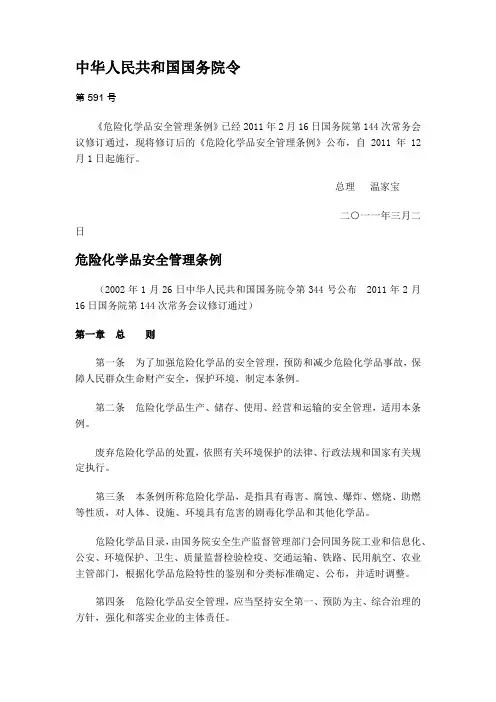
中华人民共和国国务院令第591号《危险化学品安全管理条例》已经2011年2月16日国务院第144次常务会议修订通过,现将修订后的《危险化学品安全管理条例》公布,自2011年12月1日起施行。
总理温家宝二○一一年三月二日危险化学品安全管理条例(2002年1月26日中华人民共和国国务院令第344号公布2011年2月16日国务院第144次常务会议修订通过)第一章总则第一条为了加强危险化学品的安全管理,预防和减少危险化学品事故,保障人民群众生命财产安全,保护环境,制定本条例。
第二条危险化学品生产、储存、使用、经营和运输的安全管理,适用本条例。
废弃危险化学品的处置,依照有关环境保护的法律、行政法规和国家有关规定执行。
第三条本条例所称危险化学品,是指具有毒害、腐蚀、爆炸、燃烧、助燃等性质,对人体、设施、环境具有危害的剧毒化学品和其他化学品。
危险化学品目录,由国务院安全生产监督管理部门会同国务院工业和信息化、公安、环境保护、卫生、质量监督检验检疫、交通运输、铁路、民用航空、农业主管部门,根据化学品危险特性的鉴别和分类标准确定、公布,并适时调整。
第四条危险化学品安全管理,应当坚持安全第一、预防为主、综合治理的方针,强化和落实企业的主体责任。
生产、储存、使用、经营、运输危险化学品的单位(以下统称危险化学品单位)的主要负责人对本单位的危险化学品安全管理工作全面负责。
危险化学品单位应当具备法律、行政法规规定和国家标准、行业标准要求的安全条件,建立、健全安全管理规章制度和岗位安全责任制度,对从业人员进行安全教育、法制教育和岗位技术培训。
从业人员应当接受教育和培训,考核合格后上岗作业;对有资格要求的岗位,应当配备依法取得相应资格的人员。
第五条任何单位和个人不得生产、经营、使用国家禁止生产、经营、使用的危险化学品。
国家对危险化学品的使用有限制性规定的,任何单位和个人不得违反限制性规定使用危险化学品。
第六条对危险化学品的生产、储存、使用、经营、运输实施安全监督管理的有关部门(以下统称负有危险化学品安全监督管理职责的部门),依照下列规定履行职责:(一)安全生产监督管理部门负责危险化学品安全监督管理综合工作,组织确定、公布、调整危险化学品目录,对新建、改建、扩建生产、储存危险化学品(包括使用长输管道输送危险化学品,下同)的建设项目进行安全条件审查,核发危险化学品安全生产许可证、危险化学品安全使用许可证和危险化学品经营许可证,并负责危险化学品登记工作。
FG00296-2011危险化学品安全管理条例(2013修订)

*注:本篇法规已被:国务院关于修改部分行政法规的决定(发布日期:2013年12月7日,实施日期:2013年12月7日)修改修改内容如下:第六条第五项中的“铁路主管部门负责危险化学品铁路运输的安全管理,负责危险化学品铁路运输承运人、托运人的资质审批及其运输工具的安全管理”修改为“铁路监管部门负责危险化学品铁路运输及其运输工具的安全管理”。
第五十三条第二款中的“应当经国家海事管理机构认定的机构进行评估”修改为“货物所有人或者代理人应当委托相关技术机构进行评估”。
国务院令(第591号)《危险化学品安全管理条例》已经2011年2月16日国务院第144次常务会议修订通过,现将修订后的《危险化学品安全管理条例》公布,自2011年12月1日起施行。
总理温家宝二○一一年三月二日危险化学品安全管理条例(2002年1月26日中华人民共和国国务院令第344号公布2011年2月16日国务院第144次常务会议修订通过)第一章总则第一条为了加强危险化学品的安全管理,预防和减少危险化学品事故,保障人民群众生命财产安全,保护环境,制定本条例。
第二条危险化学品生产、储存、使用、经营和运输的安全管理,适用本条例。
废弃危险化学品的处置,依照有关环境保护的法律、行政法规和国家有关规定执行。
第三条本条例所称危险化学品,是指具有毒害、腐蚀、爆炸、燃烧、助燃等性质,对人体、设施、环境具有危害的剧毒化学品和其他化学品。
危险化学品目录,由国务院安全生产监督管理部门会同国务院工业和信息化、公安、环境保护、卫生、质量监督检验检疫、交通运输、铁路、民用航空、农业主管部门,根据化学品危险特性的鉴别和分类标准确定、公布,并适时调整。
第四条危险化学品安全管理,应当坚持安全第一、预防为主、综合治理的方针,强化和落实企业的主体责任。
生产、储存、使用、经营、运输危险化学品的单位(以下统称危险化学品单位)的主要负责人对本单位的危险化学品安全管理工作全面负责。
危险化学品单位应当具备法律、行政法规规定和国家标准、行业标准要求的安全条件,建立、健全安全管理规章制度和岗位安全责任制度,对从业人员进行安全教育、法制教育和岗位技术培训。
中国GHS---危险化学品管理条例
中国GHS和危险化学品安全管理法规简介2011年5月19日,北京召开中国GHS实施国际研讨会,由此全面推进了我国危险化学品统一分类标签的管理体系。
我国是一个化学品生产和进出口大国,实施GHS有助于我国对化学品实行正确分类和标记,这不仅能有效保护我国国民健康和环境,而且有益于我国的化学品进出口贸易和对外交流。
GHS英文全称Globally Harmonized System of Classification and Labelling of Chemicals,意为“化学品统一分类和标签全球协调制度”。
GHS于2002年12月由联合国危险货物运输和全球化学品统一分类和标签制度专家委员会通过,并随着执行经验的获得定期更新和改进。
2002年在约翰内斯堡通过的《可持续发展问题世界首脑会议执行计划》鼓励各国尽快执行GHS,以便到2008年使GHS获得全面实施。
国际GHS系统旨在对世界各国不同的危险化学品分类方法进行统一,从最大限度减少危险化学品对健康和环境造成的危害,是联合国出版的指导各国化学品危害管理的规范性文件。
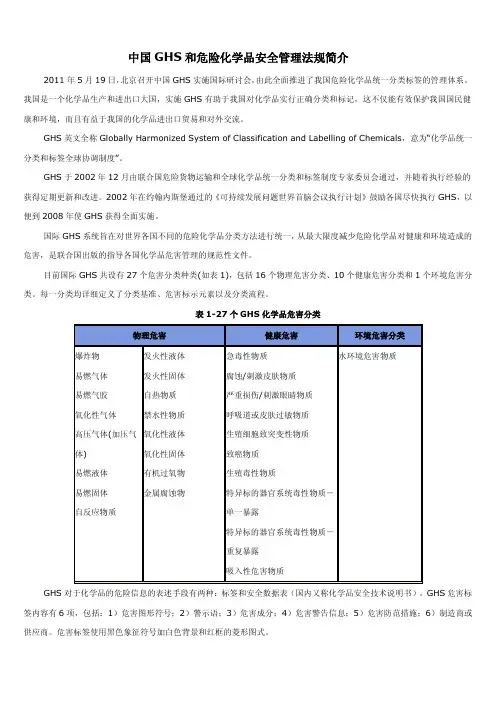
目前国际GHS共设有27个危害分类种类(如表1),包括16个物理危害分类、10个健康危害分类和1个环境危害分类。
每一分类均详细定义了分类基准、危害标示元素以及分类流程。
表1-27个GHS化学品危害分类GHS对于化学品的危险信息的表述手段有两种:标签和安全数据表(国内又称化学品安全技术说明书)。
GHS危害标签内容有6项,包括:1)危害图形符号;2)警示语;3)危害成分;4)危害警告信息;5)危害防范措施;6)制造商或供应商。
危害标签使用黑色象征符号加白色背景和红框的菱形图式。
当前各国化学品标签涉及的项目大致有35种,为进行描述,应选定主要的标签元素,这些标签元素包括产品名称、供应商名称、化学名称、表述危险的象形图、表述危险的标记字符、警示性说明和预防性措施等。
中国GHS的历程目前,我国已经初步建立了GHS国家协调机制,最先由多部委联合实施,涉及国家发改委、卫生部、环保总局等10个部门。
139 危险化学品安全管理条例(2011修订)
阅读使人充实,会谈使人敏捷,写作使人精确。
——培根危险化学品安全管理条例(2002年1月26日中华人民共和国国务院令第344号公布2011年2月16日国务院第144次常务会议修订通过)第一章总则第二条危险化学品生产、储存、使用、经营和运输的安全管理,适用本条例。
废弃危险化学品的处置,依照有关环境保护的法律、行政法规和国家有关规定执行。
第三条本条例所称危险化学品,是指具有毒害、腐蚀、爆炸、燃烧、助燃等性质,对人体、设施、环境具有危害的剧毒化学品和其他化学品。
第四条危险化学品安全管理,应当坚持安全第一、预防为主、综合治理的方针,强化和落实企业的主体责任。
生产、储存、使用、经营、运输危险化学品的单位(以下统称危险化学品单位)的主要负责人对本单位的危险化学品安全管理工作全面负责。
危险化学品单位应当具备法律、行政法规规定和国家标准、行业标准要求的安全条件,建立、健全安全管理规章制度和岗位安全责任制度,对从业人员进行安全教育、法制教育和岗位技术培训。
从业人员应当接受教育和培训,考核合格后上岗作业;对有资格要求的岗位,应当配备依法取得相应资格的人员。
第五条任何单位和个人不得生产、经营、使用国家禁止生产、经营、使用的危险化学品。
国家对危险化学品的使用有限制性规定的,任何单位和个人不得违反限制性规定使用危险化学品。
第九条任何单位和个人对违反本条例规定的行为,有权向负有危险化学品安全监督管理职责的部门举报。
负有危险化学品安全监督管理职责的部门接到举报,应当及时依法处理;对不属于本部门职责的,应当及时移送有关部门处理。
第十条国家鼓励危险化学品生产企业和使用危险化学品从事生产的企业采用有利于提高安全保障水平的先进技术、工艺、设备以及自动控制系统,鼓励对危险化学品实行专门储存、统一配送、集中销售。
第二章生产、储存安全第十二条新建、改建、扩建生产、储存危险化学品的建设项目(以下简称建设项目),应当由安全生产监督管理部门进行安全条件审查。
危险化学品安全管理条例
Set forth below are summaries of certain PRC laws and regulations applicable to our Group’s operations and business.CHEMICAL INDUSTRY REGULATIONSSupervising and Competent AuthoritiesOn January26,2002,the State Council promulgated the Regulations on the Safety Administration of Dangerous Chemicals( )(“Dangerous Chemicals Regulations”)which became effective on March15,2002.The Dangerous Chemicals Regulations apply to the production,sales,storage,transportation and usage of dangerous chemicals,as well as disposal of dangerous chemical waste.According to the Dangerous Chemicals Regulations,the production of dangerous chemicals is regulated by a number of state authorities and departments, including without limitation the economic and trade administrative authorities of the State Council and the local office at the provincial level,the administration authorities of quality supervision and inspection,the public security authorities and the environmental protection authorities,etc.These administrative authorities promulgate various rules and regulations in relation to the production, operation,storage,transportation and handling of dangerous chemicals.We are mainly supervised and regulated by the following PRC governmental authorities:1)The National Development and Reform Commission(“NDRC”),who examines andapproves investment projects exceeding certain capital limits or investment projects inspecial industry sectors in the PRC,including foreign investment projects.2)The Ministry of Industry and Information Technology of the People’s Republic of China(“MIIT”)-pursuant to the Provisions on the Main Functions,Internal Bodies and Staffingof the Ministry of Industry and Information Technology()issued by the MIIT on July11,2008,various functions of the NDRCrelating to the management of the industries and information technology of the PRC havebeen delegated to the MIIT.These functions mainly comprise studying and devisingstrategies for development of industries in the PRC,formulating and implementing plansand policies of the industrial sectors of the PRC;and guiding the formulation of technicalregulations and industry standards of the industrial sectors of the PRC.3)The State Administration of Work Safety,who manages and supervises matters relating toproduction safety.4)The Ministry of Commerce of the People’s Republic of China(“MOFCOM”),who isresponsible for managing domestic and overseas trading and cooperation with internationaleconomies.In addition,the MOFCOM and NDRC are also jointly responsible forexamining and approving major investment projects identified in the Catalogue for theGuiding of Foreign Investment Industries( ).5)The Ministry of Environmental Protection,who supervises and controls environmentalprotection matters and monitors environmental systems in the PRC.6)The State Administration of Foreign Exchange(“SAFE”),who is responsible for thesupervision and management of the foreign exchange market of the PRC;to undertakesupervision and management of the settlement and sale of foreign exchange;to cultivateand develop the foreign exchange market.Production LicensesAccording to the Dangerous Chemicals Regulations,enterprises producing dangerous chemicals shall obtain the production license for dangerous chemicals from the competent quality inspection authorities.According to the Regulations on the Administration of Production Licenses for Industrial Products( )effective as of September1,2005,and Measures for the Implementation of the Regulations of the People’s Republic of China on the Administration on Production License for Industrial Products( )effective as of November1,2005,enterprises producing the products listed in the Catalogue of Industrial Products (the“Catalogue”)shall obtain the Production License for Industrial Products( ).Since dangerous chemical products are listed in the Catalogue,enterprises producing dangerous chemical products shall obtain the Production License for Industrial Products.Operation LicensesOn October8,2002,the National Economic and Trade Commission,which was later abolished in2003and whose responsibilities were assumed by the MOFCOM and the NDRC,issued the Measures for the Administration of Operation Licenses for Dangerous Chemicals( )which came into effect on November15,2002(“Measures”).Pursuant to the Measures,the PRC government implements a licensing system for the operation and sale of dangerous chemicals.Enterprises that are engaged in the operation and sale of dangerous chemicals are required to obtain the relevant operation licenses for dangerous chemicals.Enterprises which sell dangerous chemicals that are self-produced need not obtain such operation licenses.If enterprises sell dangerous chemicals which are not self-produced or set up sales centers outside their plant,they still need to obtain the relevant operation licenses.Dangerous Chemicals RegistrationUnder the former National Economic and Trade Commission promulgated the Measures for the Administration of Registration of Dangerous Chemicals( )which came into effect on November15,2002,an enterprise engaged in the production,storage and usage of dangerous chemicals shall register the dangerous chemicals with the competent offices in charge of the registration of dangerous chemicals and obtain a Dangerous Chemical Registration Certificate ( )and a registration number.Production and Operation Permit or Record Certificate of Non-pharmaceutical Chemicals Apt to be Used in Manufacturing Narcotic DrugsAccording to the Measures for Production and Operation Permit of Non-pharmaceutical Chemicals Apt to be Used in Manufacturing Narcotic Drugs( )which took effect from April15,2006,enterprises shall obtain a permit or a record certificate for production and operation of non-pharmaceutical chemicals apt to be used in manufacturing narcotic drugs.The Group’s toluene production is subject to this requirement.COKE INDUSTRY REGULATIONSAccording to the Urgent Notice Regarding the Advices on Standardization of the Coke Industry ( )(the‘‘Notice’’)collectively issued by nine ministries including the NDRC on May27,2004,all facilities with coke ovens,a relatively low technology process that causes heavy pollution,must be closed down.Under the Notice,entities which are unable to meet the environmental requirement and energy saving standard are given a concrete and limited time period to innovate,and those which are still unable to reach the standard after such time must be closed down.The Notice also provides that a minimum annual production capacity of600,000 tonnes is an entry condition of coke production plant construction.On December16,2004,the NDRC issued the Entry Conditions of the Coke Industry( )which was revised by the Ministry of Industry and Information Technology on December 19,2008.The Entry Conditions sets out the entry requirements for the coking industry including production enterprise layout,technology and equipment,quality of major products,resources,energy consumption and integrated utilization of by-products,environmental protection,and clean production,and supervision and administration.In December2008,the Entry Conditions was revised to include a minimum production capacity of1,000,000tonnes which is applicable to certain types of coke ovens.Under the Rules Regarding the Adjustment and Revitalization Planning of the Petrochemical Industry promulgated by the General Office of the State Council in 2009,approvals for coke projects intended solely for the expansion of production capacity shall be suspended for three years starting from2009,and methanol,caustic soda,soda ash and other industries with excess production capacity shall be strictly controlled.SAFETY REGULATIONSProduction Safety Law of the PRCPursuant to the Production Safety Law of the PRC( )promulgated by the Standing Committee of the National People’s Congress in2002,the production and business operation entities shall be equipped with the conditions for safe production as provided in laws, administrative regulations,national standards and trade standards.Any entity that is not equipped with the conditions for safe production may not engage in any production and business operation activities.If a production and business operation entity fails to comply with the Production Safety Law of the PRC,the production and business operation shall be ordered to rectify within a prescribed time period.If the production and business operation fails to rectify within the prescribed time period,the entity shall be ordered to suspend its construction or production or business for rectification and may be fined.Safety Production PermitIn accordance with the PRC Production Safety Law,the State Council promulgated the Regulations on Safety Production Permits( )on January13,2004.The State Administration of Work Safety( )(“SAWS”)further issued implementation rules regarding the Measures on Implementation of Safety Production Permits for Dangerous Chemical Production Enterprises( )on May17,2004.The regulations provide that an enterprise engaged in the production of dangerous chemicals are required to obtain a Safety Production Permit( )from the SAWS or its local office at the provincial level before it commences production.The enterprises without the Production Safety Permit shall not carry on producing dangerous chemicals activities.Safety Permit of Dangerous Chemicals Construction ProjectThe SAWS issued the Measures for the Implementation of Safety Permit on Dangerous Chemicals Construction Project( )which came into effect on October1,2006.The measures provide that all enterprises shall obtain the relevant safety permit for commencement,safety facilities design and completion of safety facilities of construction project from the central offices of SAWS or from the local offices of SAWS at the provincial or municipal level.LABOR PROTECTION REGULATIONSAccording to the Labor Law of the PRC( )and the Labor Contract Law of the PRC( )effective on January1,1995and January1,2008 respectively,labor contracts shall be concluded if labor relationships are to be established between the units and the laborers.The units cannot require the laborers to work in excess of a time limit and shall provide the wages which are no lower than local standards on minimum wages to the laborers in time. The units shall establish and perfect their system for labor safety and sanitation,strictly abide by the rules and standards on labor safety and sanitation set by the State,educate laborers in labor safety and sanitation.The units shall provide laborers with labor safety and sanitation conditions meeting stipulations by the State and necessary articles of labor protection,and carry out regular health examination for laborers engaged in work with occupational hazards.As required under Regulation of Insurance for Labor Injury( ),Provisional Insurance Measures for Maternity of Employees( ),Interim Regulation on the Collection and Payment of Social Insurance Premiums( )and Interim Provisions on Registration of Social Insurance( ),enterprises are obliged to provide their employees in the PRC with welfare schemes covering pension insurance, unemployment insurance,maternity insurance,injury insurance and medical insurance.According to Regulations on Management of Housing Fund( ), enterprises should undertake registration at the competent managing center of housing fund and then, upon the examination by such managing center of housing fund,undergo the procedures of opening the account of housing fund for their employees at the relevant bank.Enterprises are also obliged to timely pay and deposit housing fund in full amount.ENVIRONMENTAL PROTECTION REGULATIONSThe Group is subject to various PRC environmental protection laws and regulations promulgated by the central and local governments.These laws and regulations set out environmental protection measures in construction projects,use,discharge and disposal of toxic and hazardous materials, discharge and disposal of waste water,solid waste and waste gases,and control of industrial noise.The Ministry of Environmental Protection is responsible for the overall supervision and management of environmental protection in the PRC.According to the Environmental Protection Law of the PRC( ) effective on December26,1989,units that cause environmental pollution and other public nuisances shall adopt effective measures to avoid and control the pollution and damage caused to the environment,such as waste gas,waste water,waste residues,dust and noises generated during manufacturing or other activities.Pollution prevention facilities in construction projects shall be designed,built and put into operation together with the main part of the project.Construction projects can only be put into operation after the environmental protection authority has examined and approved the pollution prevention facilities.Enterprises and institutions discharging pollutants shall report to and register with the relevant authorities in accordance with the provisions of the environmental protection authority under the State Council.Units which are involved in manufacture,storage, transportation,sale and use of toxic chemicals and materials containing radioactive substances shall comply with the relevant regulations to prevent environmental pollution.The relevant authorities are authorized to impose various types of penalties on the persons or entities in violation of the environmental regulations.The penalties which could be imposed include issue of warning, suspension of operation or installation which are incomplete and fail to meet the prescribed standard, reinstallation of preventive facilities which have been dismantled or left idle,administrative sanction against office-in-charge,suspension of business operations or shut-down of the enterprise or institution.Fines could also be levied together with these penalties.According to the Law of the PRC on Appraising of Environment Impacts( )which came into effect on September1,2003,the PRC government has set up a system to appraise the environmental impact from construction projects,and classify and administer the environmental impact appraisals in accordance with the degree of the environmental impact.If the construction project may result in a material impact on the environment,an environmental impact report of appraising thoroughly the potential environmental impact is required.If the construction project may result in a slight impact on the environment,an environmental impact record of analyzing or appraising the specific potential environmental impact is required;and if the construction project may result in very little impact on the environment,an environmental impact appraisal is not required but an environmental impact form shall be filed.The report is prepared by construction units and shall be approved by the relevant PRC authority before construction commences.According to the Law of the PRC on the Prevention and Control of Environmental Pollution by Solid Wastes( )effective on April1,1996and revised on December29,2004,environment impacts appraisal shall be conducted for construction of projects discharging solid wastes,store,use and disposal of solid wastes and comply with regulations by the State regarding environmental protection of construction project.According to the Law of the PRC on the Prevention and Control of Atmospheric Pollution ( )effective on June1,1988and revised on August29,1995and April29,2000,respectively,new construction projects,expansion projects or reconstruction projects which discharge atmospheric pollutants shall comply with regulations by the State regarding environmental protection of construction projects.The environmental impacts statement of the construction projects shall include an assessment of the project impact on the ecosystem.The statement shall be submitted to the environmental protection authority for approval.The construction project can only commence operation after the environmental protection authority has examined and approved the atmospheric pollution prevention facilities.According to the Law of the PRC on Prevention and Control of Environmental Noise Pollution ( )which came into on March1,1997,a construction project which is likely to produce environmental noise pollution shall prepare an environmental impact statement which includes measures to prevent and control such pollution,and submit it to the relevant environmental protection authority for approval.The construction project can commence operation only after the environmental protection authority has examined and approved the noise pollution prevention facilities.According to the Law of the PRC on Prevention and Control of Water( )effective on November1,1984and revised on May15,1996and February28,2008,new construction projects,expansion projects or reconstruction projects and other above-water facilities that directly or indirectly discharge pollutants to water shall carry out an appraisal regarding the pollutants’effects on environment according to law.Water pollution prevention facilities shall be designed,built and put into operation together with the main part of the project.The construction project can commence operation only after the environmental protection authority has examined and approved the water pollution prevention facilities.According to the Law of the PRC on Prevention and Control of Radioactive Pollution promulgated on June28,2003and effective on October1, 2003,the Administrative Department of Environmental Protection under the State Council shall have unified supervision over the work of prevention and control of radioactive pollution throughout the country in accordance with the law.An entity producing,selling or using radioisotope and ray devices shall,in accordance with the relevant provisions of the State Council on prevention of radioactivity from the radioisotope and ray devices,apply for a permit to do so,and register with the relevant authority accordingly.The Regulation on the Safety and Protection of Radioisotopes and Radiation Devices ,which came into effect on December1,2005and the Measures on Safety Permission of Radioisotopes and Radiation Devices amended on December6,2008further provide that an enterprise producing, selling or using radioisotope and radiation devices shall obtain a Radiation Safety Permit.Under such regulations,the relevant enterprise shall be prohibited to produce,sell or use radioisotopes or radiation devices without a permit or in violation of the types and scope as specified in the permit.FOREIGN CURRENCY EXCHANGEThe principal regulations governing foreign currency exchange in the PRC are the Foreign Exchange Administrative Regulations(1996),as amended.Under the Regulations,the RMB is freely convertible for current account items,including the distribution of dividends,interest payments,trade and service related foreign exchange transactions,but not for capital account items,such as direct investment,loan,repatriation of investment and investment in securities outside the PRC,unless the prior approval of the State Administration of Foreign Exchange(“SAFE”)is obtained.Under the Administration Rules of Settlement,Sale and Payment of Foreign Exchange promulgated by the People’s Bank of China on June20,1996,foreign investment enterprises in the PRC generally may purchase foreign exchange without the approval or review of SAFE,if such purchases are trade and service related foreign exchange transactions and commercial documents evidencing these transactions are produced.They may also retain foreign exchange,subject to a cap approved by SAFE, under current account items.However,the relevant PRC government authorities may limit or eliminate the ability of foreign investment enterprises to purchase and retain foreign currencies in the future. Foreign investment enterprises are permitted to remit their profits or dividends in foreign currencies out of their foreign exchange accounts or exchange Renminbi for foreign currencies through banks authorized to conduct foreign exchange business.TAXATION1.Enterprise Income TaxOn March16,2007,the Enterprises Income Tax Law(“EIT Law”)was enacted.Under the EIT Law,which has taken effect since January1,2008,the PRC adopts a uniform income tax rate of25% for all enterprises in the PRC(including foreign-invested enterprises)and revoke many of the tax exemption,reduction and preferential treatments applicable to foreign-invested enterprises before January1,2008.According to the EIT Law and the Regulation on the Implementation of the Enterprise Income Tax Law of the People’s Republic of China(the“Implementation Rules”)effective since January1,2008,there will be a transition period for enterprises,whether foreign-invested or domestic,that is currently receiving preferential tax treatments according to former applicable laws and regulations.Enterprises that are subject to an enterprise income tax rate lower than25%may continue to enjoy the lower rate and gradually transit to the new tax rate within five years after the effective date of the EIT Law.Enterprises that are currently entitled to exemptions or reductions from the standard income tax rate for a fixed term may continue to enjoy such treatment until the fixed term expires.Under the EIT Law,enterprises are classified as either resident enterprises or non-resident enterprises.A resident enterprise is an enterprise incorporated under the PRC law,or that is incorporated under the law of a jurisdiction outside the PRC with its de facto management organization located within the PRC.Under the New Implementation Rules,“de facto management organization”is defined as the organization of an enterprise through which substantial and comprehensive management and control over the manufacturing and business operations,personnel, accounting and properties of the enterprise are exercised.Non-resident enterprise refers to an enterprise incorporated under the law of a jurisdiction outside the PRC with its de facto management organization located outside of the PRC,but which has either set up institutions or establishments in the PRC or has its income originating from the PRC without setting up an institution or establishment in the PRC.2.PRC VATAccording to the Provisional Regulation of the PRC on Value-added Tax(“VAT Regulation”),all units and individuals engaged in the sale of goods,provision of processing,repair and replacement services,and the importation of goods within the territory of the PRC are taxpayers of Value-added tax(“VAT”),and shall pay VAT in accordance with the VAT Regulation.According to the VAT Regulation,a VAT tax rate of17%applies to PRC enterprises.OUR COMPLIANCE WITH APPLICABLE REGULATIONSAs confirmed by Commerce&Finance Law Offices,our PRC legal advisors,we are currently in compliance in all material respects with all relevant PRC regulatory requirements and have obtained all material permits and licenses required for our operations.To ensure compliance with all applicable PRC laws and regulations and to prevent any breaches of such laws and regulations in the future,we have already issued written policies to guide our employees.Such policies include work safety guidelines,periodic inspections of all of our production facilities to ensure compliance with applicable laws and periodic training sessions for applicable employees on regulatory compliance requirements.We will promulgate,revise,announce and/or comply with all related regulations and systems of operations,and ensure that our staff members are trained and are fully aware of all such regulations.。
《危险化学品安全管理条例》
危险化学品安全管理条例《危险化学品安全管理条例》已经2011年2月16日国务院第144次常务会议修订通过,现将修订后的《危险化学品安全管理条例》公布,自2011年12月1日起施行。
将《危险化学品安全管理条例》第六条第五项中的“铁路主管部门负责危险化学品铁路运输的安全管理,负责危险化学品铁路运输承运人、托运人的资质审批及其运输工具的安全管理”修改为“铁路监管部门负责危险化学品铁路运输及其运输工具的安全管理”。
总理温家宝2011. 3.2掌握危险化学品安全管理的基本规定,依照本条例分析危险化学品生产、储存、使用、经营、运输以及登记与事故应急救援等方面的有关法律问题,判断违法行为及应负的法律责任。
第一章总则第一条为了加强危险化学品的安全管理,预防和减少危险化学品事故,保障人民群众生命财产安全,保护环境,制定本条例。
第二条危险化学品生产、储存、使用、经营和运输的安全管理,适用本条例。
废弃危险化学品的处置,依照有关环境保护的法律、行政法规和国家有关规定执行。
笫三条本条例所称危险化学品,是指具有秦害、腐蚀、爆炸、燃烧、助燃等性质,对人体、设施、环境具有危害的剧毒化学品和其他化学品。
危险化学品目录,由国务院安全生产监督管理部门会同国务院工业和信息化、公安、环境保护、卫生、质量监督检验检疫、交通运输、铁路、民用航空、农业主管部门,根据化学品危险特性的鉴别和分类标准确定、公布,并适时调整。
笫四条危险化学品安全管理,应当坚持安全第一、预防为主、综合治理的方针,强化和落实企业的主体责任。
生产、储存、使用、经管、运输危险化学品的单位(以下统称危险化学品单位)的主要负责人对本单位的危险化学品安全管理工作全面负责。
危险化学品单位应当具备法律、行政法规规定和国家标准、行业标准要求的安全条件,建立、健全安全管理规章制度和岗位安全责任制度,对从业人员进行安全教育、法制教育和岗位技术培训。
从业人员应当接受教育和培训,考核合格后上岗作业;对有资格要求的岗位,应当配备依法取得相应资格的人员。
中华人民共和国国务院(2011)第591号 危险化学品安全管理条例
中华人民共和国国务院令(2011)第591号《危险化学品安全管理条例》已经2011年2月16日国务院第144次常务会议修订通过,现将修订后的《危险化学品安全管理条例》公布,自2011年12月1日起施行。
总理温家宝二○一一年三月二日危险化学品安全管理条例(2002年1月26日中华人民共和国国务院令第344号公布2011年2月16日国务院第144次常务会议修订通过)第一章总则第一条为了加强危险化学品的安全管理,预防和减少危险化学品事故,保障人民群众生命财产安全,保护环境,制定本条例。
第二条危险化学品生产、储存、使用、经营和运输的安全管理,适用本条例。
废弃危险化学品的处置,依照有关环境保护的法律、行政法规和国家有关规定执行。
第三条本条例所称危险化学品,是指具有毒害、腐蚀、爆炸、燃烧、助燃等性质,对人体、设施、环境具有危害的剧毒化学品和其他化学品。
危险化学品目录,由国务院安全生产监督管理部门会同国务院工业和信息化、公安、环境保护、卫生、质量监督检验检疫、交通运输、铁路、民用航空、农业主管部门,根据化学品危险特性的鉴别和分类标准确定、公布,并适时调整。
第四条危险化学品安全管理,应当坚持安全第一、预防为主、综合治理的方针,强化和落实企业的主体责任。
生产、储存、使用、经营、运输危险化学品的单位(以下统称危险化学品单位)的主要负责人对本单位的危险化学品安全管理工作全面负责。
危险化学品单位应当具备法律、行政法规规定和国家标准、行业标准要求的安全条件,建立、健全安全管理规章制度和岗位安全责任制度,对从业人员进行安全教育、法制教育和岗位技术培训。
从业人员应当接受教育和培训,考核合格后上岗作业;对有资格要求的岗位,应当配备依法取得相应资格的人员。
第五条任何单位和个人不得生产、经营、使用国家禁止生产、经营、使用的危险化学品。
国家对危险化学品的使用有限制性规定的,任何单位和个人不得违反限制性规定使用危险化学品。
第六条对危险化学品的生产、储存、使用、经营、运输实施安全监督管理的有关部门(以下统称负有危险化学品安全监督管理职责的部门),依照下列规定履行职责:(一)安全生产监督管理部门负责危险化学品安全监督管理综合工作,组织确定、公布、调整危险化学品目录,对新建、改建、扩建生产、储存危险化学品(包括使用长输管道输送危险化学品,下同)的建设项目进行安全条件审查,核发危险化学品安全生产许可证、危险化学品安全使用许可证和危险化学品经营许可证,并负责危险化学品登记工作。