
人教版八年级下册英语第四单元笔记
人教版八年级下册英语第四单元笔记-CAL-FENGHAI.-(YICAI)-Company One1八年级下册Unit 4单元笔记【词汇学习】1.mad adj.极为愤怒的;十分恼火的She was mad with me for losing my keys.她为我丢了钥匙而生我的气。
2.anymore adv.再;还(用于否定句)He doesn't come here anymore.他再也不到这儿来了。
3.however adv.无论如何He can answer the question however hard it is.不管问题有多难他都能回答。
4.suppose v.假定;认为;料想;期望What do you suppose you will do after school 你放学后想干什么5.nervous adj.紧张的;神经质的I felt very nervous when I went into his office.当我走进他的办公室时,我感到很紧张。
6.semester n.一学期;半年We will have ten subjects in this semester.这个学期我们将学十门功课。
7.disappointing adj.令人失望的Maybe this news is disappointing .也许这是一个令人失望的消息。
8.be supposed to 认为必须;认为应该You are supposed to be successful.你应该成功。
9.get mad 变疯;变得着迷She gets mad about going to dance.她对跳舞着了迷。
10.get over 恢复,克服困难Can we get over this difficulty我们能克服这个困难吗11. first of all 首先12. pass on 传递13. be supposed to 被期望或被要求……14. do better in 在......方面做得更好15. be in good health 身体健康16. report card 成绩单17. get over克服;恢复;原谅18. open up 打开;开拓;开发;开放19. care for照料;照顾20.have a party for sb.为某人举行一次聚会21.be mad at sb 对某人恼火,愤怒【重点句型分析】1. What are some soap operas you know 你所知道的有哪些肥皂剧you know是定语从句,修饰前面的名词soap operas2. What are some things that happen on soap operas? 肥皂剧里发生了些什么事That happen on soap operas 是定语从句,修饰前日面的名字something.3. Lana said she wasn’t mad at Marcia anymore. 拉娜说她不再生玛西娅的气了。
be mad at (about) sth. (doing sth.) 对某事恼火eg. Mother got mad at (with) me for watching TV for hours.(此处的got mad at = was mad at)eg. She didn’t cry anymore.她不再哭了。
4. bring some books to her house. 给她带来一些书bring sth. to 从(远处)带来,拿来(到近处)而其反义词为:take… to“从(近处)拿(走)到(远处)eg. Could you bring some water to mePlease take the chair to Jim’s room.5.pass this message to sb.将这个消息(信息)传给某人pass on sth. to sb 把某物传递给某人eg. She said she would pass the dictionary to Tom.6.You want to know why C didn’t return it and where it is.你想知道为什么C未将它还回来并想知道它在哪里。
此句中why C didn’t return it and where it is是宾语从句作know的宾语,请注意宾语从句的语序。
(陈述语序)7.You were supposed to meet at the bus stop this morning to return it. 你应该今早上在车站去见面并把它还给人家。
eg. He is supposed to be there on time.按理他应该准时到哪里。
【课文解析】1. In English, I’m better at reading than listening.在英语方面,我的阅读比听力更好。
be better at doing (than doing)是be good at ……的比较级,意思为“更擅长……”eg. Are they better at playing football than basketball2. I can do better in math.在数学方面我能做得更好。
better 是well的比较级do well in 在…方面做得好 eg. Does she do well in physics3. I finished my end –of –year exams last week. 我上周结束了期末考试。
finish doing sth eg. Did he finish doing his homework before he went to bed4. I had a really hard time with science this semester.这学期我的科学学科学得的确不好。
5. It’s not right to copy other’s homework.抄袭别人的作业是不对的。
请记住这一句型:It’s right for sb to do …6. I said I didn’t think it was a good idea for her to copy ma homework.我说我认为对她来说抄我的作业不是个好办法。
注意1:此句中的三个动词都是过去时,即时态的一致性注意 2:中英文语序(否定词的位置)的不同7. She said it was much better if she din her own work.她说如果她自己做作业就会好多了。
much +比较级,意思是“…得多”e.g. He runs much faster than I.8. Teaching high school students in a poor mountain village in Gansu Province may not sound like fun to you. 在甘肃省一个贫困的山村里教中学学生在你听起来可能不算什么有趣的事。
此句中may+ 动词原形,表示“可能……”sound like +名词,意思为“听起来像……”9. Every year they send 100 volunteers to teach in China’s rural areas.每年他们都往中国的乡村地区派100名志愿者去教书。
send …to …派,送…到…10. Her village was 2000 meters above sea level. 她的村庄位于海拔2千米。
Above 介词. “在…上面” above sea level”海平面”11. the thin air made her feel sick 稀薄的空气使她病了make sb. do 使某人干某事(此处只能用动词原形,不能+to)12.They love heaving volunteer teachers there. 他们喜爱让志愿者老师教他们。
love doing (to do)13.There often isn’t money for ed ucation. 经常没有钱来受教育。
14. I can open up my students’ eyes to the outside world.我能开阔学生们的视野,把他们带到外部世界。
15. give them a good start in life 给他们一个生活的新起点give sb. sth.给某人某物 =give sth to sb16. She said she likes being a good influence in the children’s li ves.她说她愿意给孩子们的生活中起一个好的影响。
17. Yang Lei enjoyed her time as a volunteer very much. 杨蕾很愿意做一个志愿者。
18. care for “Mother Earth”关心“地球母亲”19. care for wild animals in danger 关心处于危险中的野生动物20. I can’t do anything about that.我对于那件事无能为力。
【词语辨析】1. hard working 与work hard前者是形容词,可作表语、定语;如:a hard-working student ; He is hard-working.后者是一个动词短语,“努力工作”hard 是副词,修饰动作work.2. forget to do 与forget doing…前者是“忘记做……”(to do 表示将来的动作)e.g. Don’t forget to call me.别忘了打电话给我。
eg. I’ll never forget seeing the music al in New York.我永远忘不了在纽约看过的那出歌舞喜剧。
【重难点分析】直接引语和间接引语直接引述别人的原话,叫做直接引语;用自己话转述别人的话,叫做间接引语。
间接引语一般构成宾语从句。
直接引语必须放在引号内,间接引语则不用引号。
直接引语改为间接引语时,除将引语部分变成宾语从句外,还必须对直接引语中的人称、时态、指示代词、时间状语、地点状语等进行改变。
级人教版八年级下册英语_Unit4_第四单元笔记+练习.doc
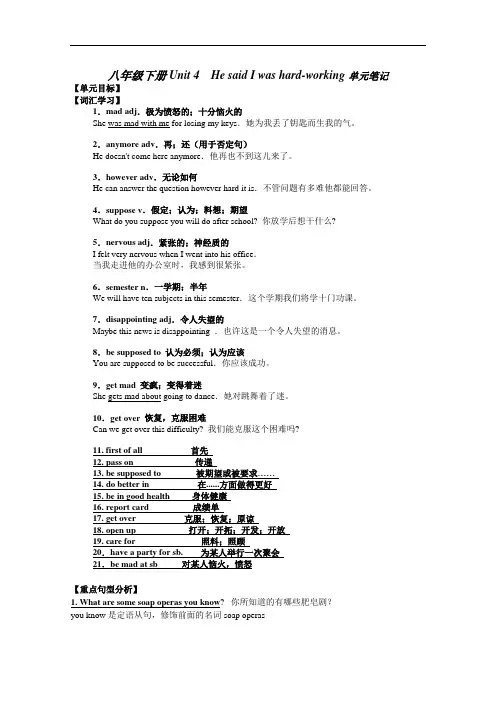
八年级下册Unit 4He said I was hard-working单元笔记【单元目标】【词汇学习】1.mad adj.极为愤怒的;十分恼火的She was mad with me for losing my keys.她为我丢了钥匙而生我的气。
2.anymore adv.再;还(用于否定句)He doesn't come here anymore.他再也不到这儿来了。
3.however adv.无论如何He can answer the question however hard it is.不管问题有多难他都能回答。
4.suppose v.假定;认为;料想;期望What do you suppose you will do after school? 你放学后想干什么?5.nervous adj.紧张的;神经质的I felt very nervous when I went into his office.当我走进他的办公室时,我感到很紧张。
6.semester n.一学期;半年We will have ten subjects in this semester.这个学期我们将学十门功课。
7.disappointing adj.令人失望的Maybe this news is disappointing .也许这是一个令人失望的消息。
8.be supposed to 认为必须;认为应该You are supposed to be successful.你应该成功。
9.get mad 变疯;变得着迷She gets mad about going to dance.她对跳舞着了迷。
10.get over 恢复,克服困难Can we get over this difficulty? 我们能克服这个困难吗?11. first of all 首先12. pass on 传递13. be supposed to 被期望或被要求……14. do better in 在......方面做得更好15. be in good health 身体健康16. report card 成绩单17. get over克服;恢复;原谅18. open up 打开;开拓;开发;开放19. care for照料;照顾20.have a party for sb.为某人举行一次聚会21.be mad at sb 对某人恼火,愤怒【重点句型分析】1. What are some soap operas you know? 你所知道的有哪些肥皂剧?you know是定语从句,修饰前面的名词soap operas2. What are some things that happen on soap operas?肥皂剧里发生了些什么事?That happen on soap operas 是定语从句,修饰前日面的名字something.拉娜说她不再生玛西娅的气了。
人教版八年级下册笔记 —— Unit 4
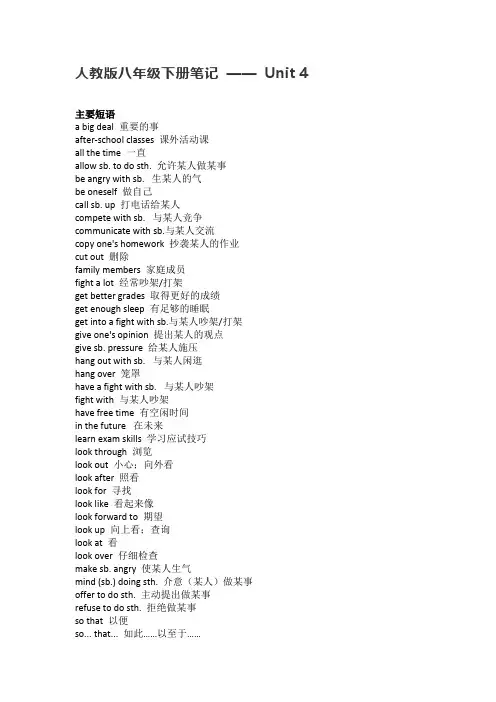
人教版八年级下册笔记——Unit 4主要短语a big deal 重要的事after-school classes 课外活动课all the time 一直allow sb. to do sth. 允许某人做某事be angry with sb. 生某人的气be oneself 做自己call sb. up 打电话给某人compete with sb. 与某人竞争communicate with sb.与某人交流copy one's homework 抄袭某人的作业cut out 删除family members 家庭成员fight a lot 经常吵架/打架get better grades 取得更好的成绩get enough sleep 有足够的睡眠get into a fight with sb.与某人吵架/打架give one's opinion 提出某人的观点give sb. pressure 给某人施压hang out with sb. 与某人闲逛hang over 笼罩have a fight with sb. 与某人吵架fight with 与某人吵架have free time 有空闲时间in the future 在未来learn exam skills 学习应试技巧look through 浏览look out 小心;向外看look after 照看look for 寻找look like 看起来像look forward to 期望look up 向上看;查询look at 看look over 仔细检查make sb. angry 使某人生气mind (sb.) doing sth. 介意(某人)做某事offer to do sth. 主动提出做某事refuse to do sth. 拒绝做某事so that 以便so... that... 如此……以至于……spend time alone 独自消磨时光study much/ a lot 学得过多talk to sb. 与某人交谈too many rules 太多规则too much homework 太多作业work out 成功地发展;解决work out the problem 算出这道题;解决问题worry about/ be worried about 担心write to sb. = write sb. a letter 给某人写信allow sb.to do 允许某人做某事allow doing 允许做某事be allow to do 被允许做某事find sb.doing 发现某人正在做某事give…back to sb.把……归还给某人forget about it 忘记它吧a copy of newspaper 一份报纸copy my homework 抄我的作业copy the article 复制文章be nice/ kind to 对……好return to school = go/ come back to school返回学校not… anymore 不再be happy with sb. 对某人高兴be stressed out 压力大think for oneself 想到某人自己push their kids so hard 对他们的孩子施加太多的压力cause a lot of stress 造成许多压力on the phone 在电话上that long 那么长get into a good high school 进入一个好的高中the Taylors 泰勒一家主要词的用法和句子讲解1.…borrow my things without returning them.借我的东西不归还without 是with的反义词,意为“没有”,后接名词、代词或动名词。
Unit4知识点总结人教版英语八年级下册

Unit 4 知识点1.建议What about doing…? Why don’t you do…? Why not do…? could do… should do…2. too much 太多水too much water 吃太多eat too much 学太多learn too muchtoo many +可数too many apples much too+adj. 太…3. get enough sleep 得到足够的睡眠4. I don’t have any free time to do (do)… have time to do have money to do.5. allow sb to do (do) sth… allow doing (do) sth…My parents don’t allow me to watch (watch) TV. We don’t allow smoking (smoke) here.6. too many after-school classes 太多课后辅导班7. 跟某人吵架、打架get into a fight with sb… fight with sb…. have a fight with sb..8. What’s the matter?=What’s the trouble?=What’s the problem?= What’s wrong?9. You need to get (get) enough sleep to stay (stay)healthy.10. write to sb 给某人写信= write a letter to sb. = write to sb. hear from…收到..来信11. say sorry to sb… say hello to sb.12. be good at doing = do well in doing..13. find sb. doing (do) sth.. 发现某人正在做… I found him crying (cry) when I passed by.14. look through浏览) 查找look up 看look at15. give sth back to sb… 归还= return sth to sb.16. be angry with sb. 生某人的气be angry about sth 为某事生气17. Although she’s wrong, it’s not a big deal.18. advice 名词,建议some advice(不可数) Could you give me some (some) advice?advise动词,建议advise sb. to do (do) sth…Thanks for your advice Thanks for advising me.19. work out 解决,成功的发展,算出I’m sure you can work out the math problem.20. get along with sb..=get on with. 和某人相处融洽get on well (good/well) with sb..21. communication 名词交流have communication with sb..communicate 动词交流communicate with sb22. argue with sb… 和… 争吵23. a big, black cloud hanging (hang) over our homeover 在…上面(中间有距离)There is a bridge over (on/over) the river.24. refuse to do (do)…. He refused to tell (tell) me the truth.25. instead of… 代替;而不是… I’ll go to Beijing instead of Shanghai.You can play basketball instead of Jim. instead of doing…I like playing soccer instead of watching (watch) TV.26. not…until 直到…才…I went to bed after my mom came back. = I didn’t go to bed until my mom came back.27.It’s not easy being your age.= Being your age is not easy.28. It’s normal to have (have) these feelings.29. offer 主动提供.. offer to do (do) sth. 主动做.. offer sth to sb.. offer sb sth..30. mind doing…介意mind one’s doing… mind not doing…. mind sb doing…31. without doing… 没做.. I went to school without eating (eat) breakfast.32. make sb adj.. make sb do (do) .. That made me angry (angrily).33. make friends (with sb)…交朋友34. be worried about…35.copy 抄袭–三单形式copies Copying (copy) others’ homework is (be) wrong.36. return (1)归还= give back . return sth to sb= give sth back to sb.He gave my books back to me yesterday.= He returned my books to me yesterday(2)回到某地return to 地点He went back home at 7. = He returned home at 7.37. You left your homework at home. 你把作业落在家里。
人教部编版八年级英语下册第4单元笔记重点汇总(可直接打印)
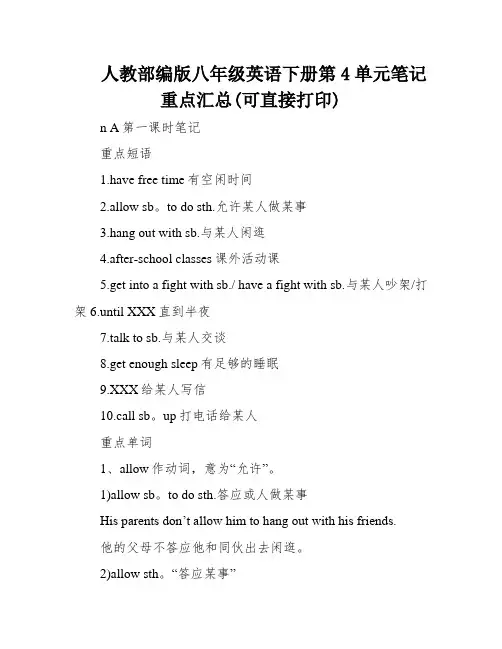
人教部编版八年级英语下册第4单元笔记重点汇总(可直接打印)n A第一课时笔记重点短语1.have free time有空闲时间2.allow sb。
to do sth.允许某人做某事3.hang out with sb.与某人闲逛4.after-school classes课外活动课5.get into a fight with sb./ have a fight with sb.与某人吵架/打架6.until XXX直到半夜7.talk to sb.与某人交谈8.get enough sleep有足够的睡眠9.XXX给某人写信10.call sb。
up打电话给某人重点单词1、allow作动词,意为“允许”。
1)allow sb。
to do sth.答应或人做某事His parents don’t allow him to hang out with his friends.他的父母不答应他和同伙出去闲逛。
2)allow sth。
“答应某事”I don't think she will allow it.我想她不会允许这件事情。
3)allow XXX.“允许做某事”XXX.在我们家不允许抽烟。
4)XXX.“被答应做某事”Passengers are not allowed to smoke on the bus.在公交车上,乘客不允许抽烟。
2、XXX.发觉或人在做某事其中的doing(现在分词)作宾语补足语。
类似的还有: XXX。
意为“看到/窥察到XXX听到XXX留意到XXX觉得或人在做某事”。
3、词语辨析:太多:too much+不可数名词例:too much homework太多功课太多:too many +可数名词复数例:too many people太多人太:much too+副词或形容词例:much too salty太咸重点句型1、What’s wrong with。
意为“……怎样了?”相当于What’s the matter with。
八年级下册英语第四单元笔记
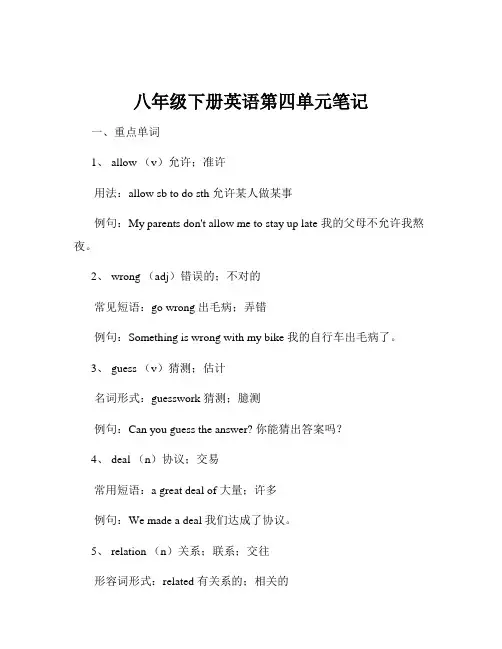
八年级下册英语第四单元笔记一、重点单词1、 allow (v)允许;准许用法:allow sb to do sth 允许某人做某事例句:My parents don't allow me to stay up late 我的父母不允许我熬夜。
2、 wrong (adj)错误的;不对的常见短语:go wrong 出毛病;弄错例句:Something is wrong with my bike 我的自行车出毛病了。
3、 guess (v)猜测;估计名词形式:guesswork 猜测;臆测例句:Can you guess the answer? 你能猜出答案吗?4、 deal (n)协议;交易常用短语:a great deal of 大量;许多例句:We made a deal 我们达成了协议。
5、 relation (n)关系;联系;交往形容词形式:related 有关系的;相关的例句:The relation between them is very good 他们之间的关系很好。
6、 communication (n)交流;沟通动词形式:communicate 交流;沟通例句:Good communication is important in a family 在一个家庭中,良好的沟通很重要。
7、 argue (v)争吵;争论名词形式:argument 争吵;争论例句:They often argue about small things 他们经常为小事争吵。
8、 cloud (n)云;云朵形容词形式:cloudy 多云的例句:There are many clouds in the sky 天空中有很多云。
9、 elder (adj)年纪较长的辨析:elder 通常用于表示家庭成员之间的长幼关系;older 则用于比较年龄大小。
例句:My elder brother is two years older than me 我哥哥比我大两岁。
人教版八年级英语下册第四单元重点知识点梳理
人教版八年级英语下册第四单元重点知识点梳理Unit 4一、重点短语1.work out成功地发展;解决2.cut out删除;删去3.be angry with sb.生某人的气4.compare…with…比较;对比5.get on with和睦相处;关系良好6.look through快速地看;浏览7.offer to help主动帮忙8.refuse to do sth.拒绝做某事9.communicate with sb.与某人交流10.in future今后;将来11.all the time总是;一直12.be worried about sth.担心某事;担忧某事13.compete with sb.与某人竞争二、重点句型1.I have to study too much so I don't get enough sleep.我要学习许多东西,因此睡眠不足。
2.I don't want to talk about it on the phone.我不想在电话里谈那件事。
3.You should explain that you don't mind him watching TV all the time. 你应该解释你不介意他总是看电视。
4.Although she's wrong,it's not a big deal.尽管她错了,但这并不是什么大事。
5.He should talk to his friend so that he can say he's sorry.他应该和他的朋友谈谈,这样他就能表示自己的歉意。
6.However,the tired children don't get home until after 7:00 p.m. 然而,疲惫不堪的孩子们直到晚上7点以后才回到家。
三、重点语法状语从句(一)一、until的用法until意为“直到”,引导时间状语从句。
八下英语人教版第四单元笔记
八下英语人教版第四单元笔记Here are some notes from Unit 4 of our English textbook for Grade 8, PEP edition. Let's dive in!First up, we talked about how to express our opinions on different topics. Like, when someone mentions their favorite movie, you can say, "I hear that movie is really good. But personally, I prefer the one with the cool action scenes." Simple, right? But it shows your unique taste.Then we learned some new vocabulary related to health and fitness. You know, things like "workout" and "nutrition." It's important to stay healthy, so we talked about how to balance our diet and include more fruits and vegetables.Oh, and we also discussed the importance of beingpolite when giving suggestions. Instead of saying, "You should do this," we learned to use phrases like, "Maybe you could try this approach?" It makes our advice sound moreconsiderate.And let's not forget about the fun part role-playing! We practiced having conversations about different scenarios, like asking for directions or making plans with friends. It was a great way to practice our speaking skills.Lastly, we touched on the topic of dealing with stress. We learned that everyone feels stressed sometimes, but it's important to find healthy ways to cope with it. Like, doing something you enjoy or talking to a friend.So that's a quick overview of what we covered in Unit 4. Hopefully, these notes will help you remember the keypoints!。
人教版英语八年级下册 Unit4 知识点总结
Unit 4 知识点Section A词组1.have free time有空闲时间2. allow sb. to do sth.允许某人做某事3. hang out with sb. 与某人闲逛4. too many after-school classes太多的课外补习班5. too much homework 太多的作业6. get into a fight with sb.与某人打架7. until midnight直到半夜 8. talk to sb.与某人交谈9. get enough sleep得到足够的睡眠 10. write sb. a letter给某人写信11. call sb. up打电话给某人 12. look through翻看;浏览13. surprise sb.使某人惊讶 14. in surprise(n.)惊讶地15. to one’s surprise令某人惊讶的是 16. be surprised at sth. 对…感到惊讶17. be surprised to do sth. 对做某事感到惊讶18. be angry with sb. 生某人的气 19. a big deal重要的事20. work out成功地发展;解决 21. get on/ along with 和睦相处;关系良好:22. fight a lot经常吵架/打架 23. hang over笼罩24. refuse to do sth. 拒绝做某事 25. feel lonely and nervous 感到孤单焦虑26. argue with sb. about sth. 为某事与某人争吵 27. have an argument with sb.28. offer sb. sth.=offer sth. to sb.向某人提供某物 29. offer to do sth. (主动)提出做某事30. communicate with sb. 与某人交流/沟通 31. 未经询问做某事 do sth. without asking32. mind sb./one’s doing sth. 介意某人做某事 33. 担心 be worried about/ worry about34. explain sth. to sb. 向某人解释某事 explain +(to sb.)+ 宾语从句。
八年级下册英语人教版第四单元笔记
八年级下册英语人教版第四单元笔记Unit 4I. 词汇1. tradition n. 传统2. custom n. 习俗3. celebrate v. 庆祝4. gather v. 聚集5. treat v. 款待6. decorate v. 装饰7. delicious adj. 美味的8. feast n. 盛宴9. admire v. 赞美10. common adj. 常见的II. 词组1. based on 以...为基础2. cook a turkey 烹饪火鸡3. give thanks to 祈谢4. fall down 跌倒5. in memory of 纪念6. make a wish 许愿III. 语法1. 被动语态:主动语态和被动语态的构成及应用。
2. 情态动词should:表示建议、规定、习俯等用法。
3. if引导的条件状语从句:if引导的条件状语从句的用法。
IV. 作文1. My Favorite FestivalWrite an article about your favorite festival, introducing its customs, traditions, and what you like the most about it.V. 阅读理解Every culture has its own set of unique traditions and customs. Here are a few customs from around the world:1. In Japan, people celebrate Hanami, which is a festival to admire cherry blossoms in the spring.2. In Mexico, Day of the Dead is a holiday where families gather to remember and honor deceased loved ones.3. In India, Diwali is a festival of lights where people decorate their homes with candles and lamps.4. In the United States, Thanksgiving is a holiday where families come together to feast and give thanks for the blessings of the past year.VI. 交际用语1. How was your weekend?2. What did you do for Christmas?3. Did you have a good time at the party?4. How do you celebrate New Year's Eve?5. Have you ever tried traditional Chinese food?VII. 课外阅读Read a short story or article about a cultural festival from another country, and write a summary of what you learned.VIII. 练习Complete the sentences with the correct form of the verbs in brackets:1. They __________ (decorate) the Christmas tree last night.2. The turkey __________ (cook) by Sarah for Thanksgiving dinner.3. Diwali __________ (celebrate) in India with fireworks and lights.4. Day of the Dead __________ (remember) loved ones who have passed away.IX. 国际交流Share with a partner about a traditional festival from your culture and ask them about a festival from their culture. Discuss the customs, traditions, and similarities/differences between the two festivals.X. 课堂表现Participate actively in class discussions, ask questions, and share your thoughts on different cultural festivals. Take notes on new vocabulary and grammar structures learned in this unit.以上为八年级下册英语人教版第四单元的笔记内容,希會能对您有所帮助。
人教部编版八年级英语下册第4单元笔记重点汇总(可直接打印)
Section A 第一课时笔记重点短语1.have free time有空闲时间2.allow sb. to do sth. 允许某人做某事3.hang out with sb. 与某人闲逛4. after-school classes课外活动课5. get into a fight with sb./ have a fight with sb. 与某人吵架/打架6. until midnight直到半夜7. talk to sb. 与某人交谈8. get enough sleep有足够的睡眠9. write sb. a letter给某人写信10. call sb. up打电话给某人重点单词1、allow作动词,意为“允许”。
(1)allow sb. to do sth. 允许某人做某事His parents don’t allow him to hang out with his friends.他的父母不允许他和朋友出去闲逛。
(2) allow sth. “允许某事”I don't think she will allow it. 我想她不会允许这件事情。
(3) allow doing sth.“允许做某事”We don't allow smoking in our house.在我们家不允许抽烟。
(4) be allowed to do sth.“被允许做某事”Passengers are not allowed to smoke on the bus.在公交车上,乘客不允许抽烟。
2、find sb. doing sth. 发现某人在做某事其中的doing(现在分词)作宾语补足语。
类似的还有: see/watch/hear/notice/feel sb. doing sth. ,意为“看到/观察到/听到/注意到/感觉某人在做某事”。
3、词语辨析:太多:too much+ 不可数名词例:too much homework太多作业太多:too many + 可数名词复数例:too many people太多人太: much too+ 副词或形容词例:much too salty 太咸重点句型1、What’s wrong with. . . ? 意为“……怎么了? ”相当于What’s the matter with. . . ?2、表建议的句型:(1)你为什么不……Why don't you +V原? = Why not +V原例:Why don’t you talk to your parents.=Why not talk to your parents.(2)你应该/可以…You should/could +v.(3)你最好(不)…You’d better (not) +v.(4)你介意….. Would you mind doing…?(5)……怎么样?What about…? =How about…?(6)你认为……怎么样?What do you think of…? = How do you like…? Section A 第二课时笔记重点短语1. look through快速查看;浏览2. be angry with sb. 生某人的气3. a big deal重要的事4. work out成功地发展;解决5. get on with = get along with和睦相处,关系良好6. fight a lot经常吵架/打架7. hang over笼罩8. refuse to do sth. 拒绝做某事9. offer to do sth. 主动提出做某事10. be nice to sb.”对某人友好”相当于be friendly/good/kind to sb.11. mind sb. doing sth. 介意某人做某事12. in future今后13. make sb. angry使某人生气14. worry about sth. 担心某事重点单词1.(1)fight做名词:get into a fight with sb.=have a fight with sb. 与某人吵架/打架(2)做fight 动词:fight with sb. 与某人吵架/打架2. argueargue作动词,意为“争论,争吵”。