
冀教版六年级英语下册 Unit 3 Lesson 17授课课件+作业
习题源于《典中点》
3. I will fly to China to play with Li Ming. cry ___f_l_y_______
4. That child is sitting by a river. fly kites ___c_h_i_ld______
5. She will cook a great meal with bread. heavy ___b__re_a_d_____
Read and tick. Then write “will ” or “will not”.
Dear Uncle Peter, I will go to a summer camp this year! I will arrive with 20 other students in early July. There will be students from China, the U.K., Australia and the U.S. We will play sports, go water skiing and go swimming. We will take trips around the forest. We will learn about some of the animals and plants in the forest. At night, we will work together to cook a meal. After dinner, we will sit around, tell stories, sing songs and watch the stars. I will make many new friends. I can't wait. It will be a great summer! Love, Freddie
点拨: last summer holiday为过去的时间,选择过去 时;this summer为将来的时间,选择将来时。
习题源于《典中点》
2. Tom is _g_o_i_n_g__to_ (going to/will) visit his cousins in five days.
点拨: be+going to表示将来。
grandmother. They live near a very big forest. Jenny: What else will you do? Danny: I will also learn to fly. Jenny: Really, Danny? Why will you do that? Danny: I will fly to China. Jenny: I will play with Li Ming. That will be fun. Danny: Very clever, Danny.
二、图文对对碰。
A. play sports B. make new friends C. go water skiing D. go swimming
习题源于《典中点》
E. send emails F. cook a meal G. watch TV H. go skating
( C)
(H)
(B)
Jenny: What will you do this summer holiday, Danny? Danny: Let's see. Last summer, I learned to swim. And I also learned
to fish. What will I do this summer? Jenny: Will you swim in the sea? Danny: No, I will not. Jenny: Will you visit your family? Danny: Yes, I will. I will visit my grandfather and
讲解来自《点拨》
例句:—Will you go there this afternoon? 今天下午你会去那里吗? —Yes, I will. 是的,我回去的。 —Will he visit his grandparents next month? 他下个月会去看他祖父母吗? —No, he won’t. 不,他不会去的。
提示: 点击
进入习题
一
二
三
四
五
六
七
习题源于《典中点》
一、核心素养练 1. Mark will go to a summer camp this year. ant __c_a_m__p______ 2. She is a clever student in the class. very __c_le_v_e_r______
B. very big a
C. a very big
习题源于《典中点》
五、读一读,根据文本内容选择恰当的单词填空。
A. January B. snow C. skating D. houses E. beaches I love winter. I love to play in the 1. ____B____. I like to make snowballs and throw them. Last winter holiday, I went to Harbin. I saw ice 2. ____D____ and ice animals there.
plants.
单项选择。
习题来自《点拨》
My sister likes to answer the questions in class. She is very ____A____.
A. clever
B. strong
C. healthy
本节课我们学习了以下知识,请同学们一定加 强巩固,以便能和同学们进行灵活交流哦! 重点词汇:clever 重点句式:—Will you visit your family?
A. play sports B. make new friends C. go water skiing D. go swimming
习题源于《典中点》
E. send emails F. cook a meal G. watch TV H. go skating
( G)
(E)
( D)
A. play sports B. make new friends C. go water skiing D. go swimming
知识点 1 —Will you visit your family?
讲解来自《点拨》
你将要看望你的家人吗?
—Yes, I will 是的 用法:问句是一个一般将来时的一般疑问句,用来
询问某人是否将要做某事。意思是“某人会
做某事吗?”
句型结构:Will +主语+动词原形+其他?
肯定回答:Yes, 主语+will. 否定回答:No, 主语+will not/won’t.
A. will
B. will not
C. are not
( A )4. What ________ will Danny do this summer?
A. else
B. other
C. each
( C )5. They live near ________ forest.
A. a big very
六、阅读短文,完成任务。
习题源于《典中点》
________________
John is a 12-year-old boy. He likes to play football
知识点2 clever/'klevə/ adj. 聪明的
讲解来自《点拨》
例句:You are a clever boy. 你是一个聪明的男孩。
对应词:foolish 笨的,愚蠢的
同义词:smart 聪明的
clever never forever 聪明的 从不 永远
3. Lisa also wants to learn _t_o_s_w_i_m__(swim/to swim) in a lake.
点拨: 学习做某事learn to+动词原形。
习题源于《典中点》
4. My grandfather ___li_v_e_s__ (lives/live) in a small village. He __l_iv_e_d___ (lives/lived) in the city three years ago.
—Yes, I will
1 熟记本节课所学的句式和单词,必须会听、说、 读、写。
2 将What will Danny do this summer? 朗读流利。 3 完成配套的课后作业,见《典中点》P37页或
课后作业课件。
Unit 3 What Will You Do This Summer
JJ 六年级下册
Unit 3 What Will You Do This Summer?
111111111111111111111111111111111111111111111111111111111111111111111111111111
11111111111111111111111J1J111六111年11级11下11册111111111111111111111111111
A. does
B. will
C. did
( A )2. —Will you learn to fly?
—________.
A. Yes, I will
B. Yes, I do
C. Yes, I am
习题源于《典中点》
( B )3. It's raining. We ________ go outside.
六年级下册英语教案-Unit3Lesson17DannysSummerHoliday|冀教版三起
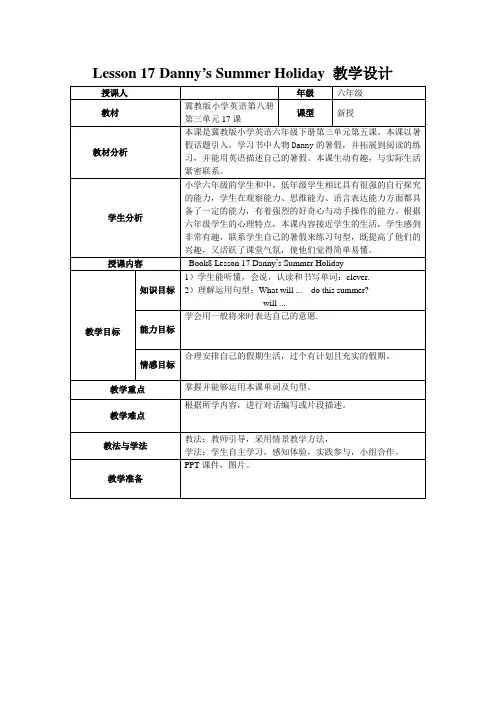
小学六年级的学生和中,低年级学生相比具有很强的自行探究的能力,学生在观察能力、思维能力、语言表达能力方面都具备了一定的能力,有着强烈的好奇心与动手操作的能力。根据六年级学生的心理特点,本课内容接近学生的生活,学生感到非常有趣,联系学生自己的暑假来练习句型,既提高了他们的兴趣,又活跃了课堂气氛,使他们觉得简单易懂。
Lesson 17 Danny’s Summer Holiday教学设计
授课人
年级
六年级
教材
冀教版小学英语第八册第三单元17课
课型
新授
教材分析
本课是冀教版小学英语六年级下册第三单元第五课。本课以暑假话题引入,学习书中人物Danny的暑假,并拓展到阅读的练习,并能用英语描述自己的暑假。本课生动有趣,与实际生活紧密联系。
教学重点
掌握并能够运用本课单词及句型。
教学难点
根据所学内容,进行对话编写或片段描述。
教法与学法
教法:教师引导,采用情景教学方法,
学法:学生自主学习,感知体验,实践参与,小组合作。
教学准备
PPT课件,图片。
教学过程
教师活动
学生活动
设计思路
一.课前交流环节
1.播放学生熟悉的英文歌曲2.与学生进行简短的英语交流
七.课堂总结,多元评价。
课堂结束价,增强学生学习积极性、自信心,并再次感受英语学习的快乐。
八.板书设计:
Lesson17 Danny’s Summer Holiday
What will Danny do this summer?
Danny will
2.在小组的分工合作中,学生学会交流和分享学习成果,培养学生的团队精神和合作意识。
六.拓展教材,提升能力。
冀教版(三起)英语六年级上册 教学课件 Unit 3 Lesson 17

It’s__h_o_t__a_n_d_s_u_n_n_y___ in summer. It’s __c_o_o_l _a_n_d_w__in_d_y___in autumn.
Lead in
河北教育出版社 六年级 | 上册
河北教育出版社 六年级 | 上册
1. What’s your favourite season?
河北教育出版社 六年级 | 上册
知识点讲解
例题: 单项选择。 —What’ s your favourite season? —___C_____. A. Swimming B. Fly kites C. Autumn
点拨: 问句句意:“你最喜欢的季节是什么?”,A项与 B项均不符合题意,故选C。
河北教育出版社 六年级 | 上册
知识点讲解
3. I like spring. I love the new leaves and flowers. 我喜欢春天。我喜欢新的叶子和花。 I like to fly a kite. And I love to eat fruits. 我喜欢放风筝。并且我喜欢吃水果。 句型结构为:I like/love (to do)sth.
冀教版六年级英语下册 Unit 3 Lesson 13授课课件+作业
A. sunny
B. snowy C. rainy
讲解来自《点拨》
知识点 3 What colour are the leaves?树叶是什么颜 色的?
用法: what colour用来询问物品的颜色。
句型结构:What colour + be动词+名词/代词?
例句:—What colour are the flowers?花是什么颜色的? —They are red. 它们是红色的。 — What colour is it?它是什么颜色的? —It’s yellow. 它是黄色的。
讲解来自《点拨》
例句:Here is a fan. How cool!
这儿有一个风扇。好凉快啊!
一词多义:fan n. 迷,爱好者
形近词:fun n.有趣
can aux. v. 能;会
man n.男人
pan n.平底锅
ran v.跑(run的过去式)
Talk and write.
seasons spring summer autumn winter
What colour are the leaves?
1 熟记本节课所学的句型、短语和单词,必须会 听、说、读、写。
2 将What season is it的内容朗读流利。 3 完成配套的课后作业,见《典中点》P29页或
课后作业课件。
Unit 3 What Will You Do This Summer
习题源于《典中点》
四、我们在使用英语时, 要根据情境, 使用恰当而得体 的句子。请大家读一读, 选出正确的句子吧。
( C )1. 当你想知道加拿大夏天的天气时, 你最好 使用哪句话来问: A. How's the weather in winter? B. What's the weather in summer? C. How's the weather in summer?
冀教版 英语六年级上册Unit 3 Lesson17 教学课件PPT小学公开课

Unit 3 Winter in Canada Lesson 17 I Like All Seasons!冀教版英语六年级上册Learning goals✔ 学生能听懂、会说、认读并书写下列词汇:why✔ 学生能认读、理解并运用下列句子:—Why?—Because I like the snow.Look and sayHow many seasons in a year?What are they?Four seasons. They are spring,summer, autumn and winter.What’s your favourite season?My favourite season is...Why?Because...Look and readIt's warm. Trees are green.The flowers bloom.What do you think about spring?This is summer. I like summer.I can swim in the sea.I have summer holiday.I can go on a trip with my family.What do you think about summer?Look and readCan you talk about these two seasons? This is...I like...I can…例句why/wa ɪ/adv .为什么New wordsWhy do you run slowly?你为什么跑得慢?你为什么喜欢夏天?Because summer holiday is in summer and I can swim in the sea.因为暑假在夏天,还有我可以去大海游泳。
Look and listenWhat are Li Ming and Jenny doing? They are making a snowman.Why does Li Ming like winter? Because he likes snow and he likes to make snowmen and he likes the Spring Festival.Free talkWhat do you know about the Spring Festival?This is the biggest holiday in China. We always put on new clothes to visit our family or friends. Children can get “the Pocket Money” from theadults. We make dumplings and eat them together. We can play happily in the Spring Festival.Why does Li Ming like spring?Because it's warm and he loves the new leaves and flowers and he loves to planttrees.Listen and answerWhat does Li Ming like do in summer?He likes to swim in the sea.Listen and answerListen and answerWhat is Li Ming doing here?He is flying the kite.What does Li Ming love to do in autumn?He loves to fly kites.He loves to eat fruits.Watch and answerWhat is Li Ming's favourite season?His favourite season is autumn.Why?Because autumn is cool and windy.He likes to fly a kite.He loves to eat fruits.Do you know?在北半球,人们把March, April, May划分为spring,把June, July, August划分为summer, 把September, October, November,划分为autumn, 把December, January, February划分为winter.Listen and followActivity每组学生分配一个季节,让学生在表格里列出那个季节可以进行的活动,有些活动不止一个季节可以进行,这样也没关系。
冀教版英语六年级下册Unit 3 Lesson 14 Tomorrow We Will Play课件
1.What _____ you do tomorrow?
A. are
B. will
C. going to
2.We will _____ to the park.
A. go
B. going
C. went
3.I will go to the park _____.
A. yesterday B. next Sunday C. last Saturday
Vocabularies: close angry
Key sentences: Tomorrow is Saturday. What will we do? We will go to the park. / I will not fly a kite. Don’t be angry.
一、单项选择。
1.听录音,读课文,试着复述第一部分的课文内容。 2.用一般将来时讨论本周末的计划。 3.完成相关练习。
_T__h_i_s__S__u_n__d_a__y_,_I__w__i_l_l_r_e__a_d__a__b__o_o__k_.________________
c
_T__h_i_s__S_a__t_u_r__d_a__y_,_I__w__i_l_l _h__a_v_e__a__p__i_c_n__ic__. ____________
Don’t be angry!
否定祈使句的常用句型结构: Don’t be+形容词。/Don’t +动词原形 +其他!
Don’t be sad. Everything will be fine.
make an assumption. Will Danny pick up the flowers in the park?
冀教版六上英语 Unit 3 Lesson 17 I Like All Seasons! 授课课件

三、情景选择。 当约翰想知道你为什么喜欢那只狗的时候,他应该怎么 问你:_____B________ A. Whatareyoudoing? B. Whydoyoulikethatdog? C. Howdoyouknowthatdog?
点拨:询问原因,用Why来引导特殊疑问句,故选B。
Unit3WinterinCanada
111111111111111111111111111111111111111111111111111111111111111111111111111111111
1111111111111111111111J1J1六11年111级11上11册111111111111111111111111111
加法记忆法:be+cause(原因)=because(因为) 短语: becauseof因为
知识点2
—What’syourfavouriteseason? 你最喜欢的季节是什么?
—Myfavouriteseasonisautumn. 我最喜欢的季节是秋天。【重点】
这是询问对方最喜欢什么的句型。 其问句结构是:What’syourfavourite+其他? 答语结构是:Myfavourite...is... 例句:—What’ syourfavouritesubject? 你最喜欢的科目是什么? —Myfavouritesubjectismath. 我最喜欢的科目是数学。
典例
单项选择。 —What’syourfavouriteseason? —____C____. A. Swimming B. Flykites C. Autumn
点拨:问句句意:“你最喜欢的季节是什么?”,A项 与B项均不符合题意,故选C。
冀教版(三起)英语六年级下册Unit 3 Lesson 15课件
(3)What will Jenny do this summer? _J_e_n_n__y_w_i_l_l _g_o_o_n__a_t_r_ip__t_o_t_h_e_s_e_a_._____________ (4)What will Jenny watch on the sea? _S_h_e_w__il_l_w_a_t_c_h__th_e__s_h_ip_s__a_n_d_b_o_a_t_s_o_n__t_h_e_s_e_a_. ___
Read and answer
What does Jenny’s family like to do in summer?
What will you do for the summer holiday, Jenny?
我夏Mttohey们天gsofau一去ommn家 旅imltyr喜 游eilrpi.欢 。ksei在sn
Work in pairs and act
What will you do for the summer holiday, Jenny?
…
My family likes to go on trips in the summer.
…
Underline the rhyming words in the song
Oh, summer’s coming, coming soon. 哦,夏天快要来了,很快就要来了。
When school is done, what will you do? 当学校放假时,你将要做什么?
In summer, summer, summertime, 在夏天,夏天,夏天,
Summer, summer, summer. 夏天,夏天,夏天。
What did Jenny do?
冀教版六年级下册英语教案:Lesson 17 Danny’s Summer Holiday
冀教版六年级下册英语教案:Lesson 17 Danny’s SummerHoliday一、教学目标1.能够听懂、会说并正确运用单词和短语:holiday, go fishing, swim,play computer games, watch TV, visit grandparents。
2.能够用what did you do…这种问句形式询问别人假期的情况,并用简单的句子来回答。
3.能够通过听、说、读、写等方式,了解英语国家孩子们的暑假活动,并运用所学进行表述。
二、教学重难点1.重点:单词和短语的听、说、读、写。
2.难点:用what did you do…这种问句进行询问,回答并使用简单的句子来表述。
三、教学过程1.Warming-up (1)Sing the song “Happy Holiday”. (2)Review the vocabulary of activities: go fishing, swim, play computer games, watch TV, visit grandparents.2.Presentation (1)Present new vocabulary: holiday•T: What do you do during your summer holiday? Ss: Go swimming. T: Good. What else do you do? Ss: Play computer games. Watch TV. Go fishing. Visit grandparents. T: It seems that you have lots of fun during the summer holiday.•Drill the new words and ask students to repeat.(2)Ask students to listen to the tape and try to catch the new words and phrases. - T: Listen to the tape carefully and try to find out what Danny did during his summer holiday.(3)Show some pictures and talk about them. - T: What is Dannydoing in this picture? Ss: He is swimming. T: What is Danny doing inthis picture? Ss: He is going fishing. - Ask students to describe the pictures in English.3.Practice (1)Listen to the tape again and fill in the blanks.•T: Listen to the tape and fill in the blanks with the right words. Danny had a great summer __________. He __________, went __________, played __________ ____________, watched ___________, and _____________________.•Check the answers with the whole class.(2)Role-play the dialogue. - T: Danny had a wonderful summer holiday. Let’s listen to his conversation with his friend Tony. Then we will act it out. Danny: Hi, Tony. What did you do during the summer holiday? Tony: I visited my grandparents and went swimming. How about you? Danny: I went fishing, played computer games, and watched TV. Tony: Wow, you had a lot of fun! - Ask some students to act it out.(3)Pair work - T: Now, turn to your partner and ask him/her what he/she did during the summer holiday. S1: What did you do during the summer holiday? S2: I visited my grandparents and went swimming. S2: What about you? S1: I went fishing, played computer games, and watched TV. S2: Wow, you had a lot of fun!4.Homework(1)Finish the exercises in the textbook.(2)Make a poster about your summer holiday and show it to the class.四、教学反思本节课是以第三单元的第十七课为主题进行讲解,主要内容是介绍Danny的暑假活动,并引导学生复述自己的暑假活动。
英语: Unit 3 Lesson 17【Summer Is Coming】1课件(冀教版六年级下)
fall
warm
hot
rainy
spring
sunny
summer
cool
windy
cold
fall snowy
winter
春天
summer
秋天 夏天
snowy
温暖的
cool
warm
春天
cold cool hot
恭喜你,答对了!
恭喜你,答对了!
恭喜你,答对了!
恭喜你,答对了!
对不起,你答错了!
It’s in summer. Trees have cool, green leaves.
In , the trees lose their leaves. What colour are fall leaves? Yellow, orange andun
对不起,你答错了!
对不起,你答错了!
对不起,你答错了!
In winter, it’s and Many trees don’t have any .
,
In spring, the weather is , trees have new leaves. Do you like spring flowers?
Unit 3 What Will You Do This Summer
Lesson 17 Summer Is Coming
Let’s review Let’s learn Let’s look Let’s do
Let’s play
Let’s say
Let’s do
winter
spring
summer
Do you like summer?
Here’s what I like to do in summer.
冀教版六年级上册英语-Unit3Lesson17ILikeAllSeasons!
教学设计一、教学目标1. 知识目标(1)能够听懂、会说、会读本课的生词和句子。
(2)能够运用所学知识谈论四季的特点。
2. 能力目标(1)能够用英语简单描述自己喜欢的季节。
(2)能够运用所学知识进行简单的日常交流。
3. 情感目标培养学生热爱生活,喜欢大自然的情感。
二、教学内容本课的主题是谈论四季的特点,主要学习与季节相关的词汇和句子。
通过本课的学习,学生能够听懂、会说、会读本课的生词和句子,并能够运用所学知识谈论四季的特点和描述自己喜欢的季节。
三、教学重点与难点1. 重点:能够听懂、会说、会读本课的生词和句子。
2. 难点:能够运用所学知识谈论四季的特点和描述自己喜欢的季节。
四、教具与学具准备1. 教具:多媒体课件、录音机、磁带。
2. 学具:课本、练习册、录音机、磁带。
五、教学过程1. 热身(5分钟)2. 导入(10分钟)教师播放本课的录音,让学生听懂、会说、会读本课的生词和句子。
在学生掌握生词和句子后,教师引导学生运用所学知识谈论四季的特点。
3. 课堂活动(15分钟)教师组织学生进行小组活动,让学生运用所学知识谈论四季的特点和描述自己喜欢的季节。
教师巡回指导,纠正学生的发音和表达错误。
4. 巩固练习(10分钟)教师出示一些关于四季的图片,让学生用英语描述图片中的内容。
然后,教师给出一些季节的句子,让学生进行听力练习,判断句子是否正确。
六、板书设计板书设计如下:四季的特点春天:温暖花儿开放夏天:炎热阳光灿烂秋天:凉爽果实丰收冬天:寒冷雪花飘飘七、作业设计1. 抄写本课的生词和句子,每个句子写两遍。
2. 运用所学知识,写一篇关于自己喜欢的季节的短文。
八、课后反思本节课通过谈论四季的特点和描述自己喜欢的季节,让学生运用所学知识进行日常交流。
在教学过程中,教师注意纠正学生的发音和表达错误,帮助学生更好地掌握所学知识。
然而,在课堂活动中,部分学生对四季的特点表达不够准确,需要在今后的教学中加强练习。
总体来说,本节课达到了预期的教学目标,学生对四季的特点和描述自己喜欢的季节有了更深入的了解。