
身体部位英文短语
1. Head. The head is thought to be the most important part of the human body. So a leader is often compared to a head (首脑). Thus we have Head of State or the head of a delegation.The head is where the brain is located. It is naturally associated with ideas and intelligence. Very often, we need other people's ideas and opinions when we want to do something well. The is because two heads are better than one (三个臭皮匠顶个诸葛亮).2. Eye. The eyes are extremely precious to us. That is why we say" Mind your eye (当心)! When we reminding someone to be careful.Not only human beings and animals have eyes, many things also have" eyes"- the eyes of a ship, the eye of a needle, the eye of a typhoon, and so on.3. Ear. The ear is the organ of hearing. A piece of light music is easy on the ear(悦耳动听). We are usually all ears (专心聆听) for bit news.When they think somebody is overhearing, English people use either of the two proverbs: Walls have ears (隔墙有耳) and Pitchers have ears (壶罐有耳). They also think that little pitchers have big ears(小孩子耳朵尖). Nice boys and girls respect other people. They will not secretly listen to others' private conversations.4. Nose. The English phrase "face to face (面对面)" and its Chinese counterpart(对应)are exactly the same. But English people, to express the same idea, can say nose to nose instead. There is no such substitute in Chinese.The word nose appears in many idioms. Here are two which are quite similar to their Chinese equivalents: lead somebody by the nose (牵着某人的鼻子走) and turn up one's nose at somebody or something (对某人或某物嗤之以鼻).English people can say as plain as the nose in one's face (一清二楚) to mean "very obvious". May be to them, the nose is the most conspicuous part of the face.5. Lip. We have two lips: the upper lip and the lower lip. If one's two lips are closed, one cannot speak. So it goes without saying that "don't open your lips(不要开口)" means " don't speak".His lips are sealed. Are his lips really stuck together by wax or glue? No, his lips are sealed when asked about something that he must keep secret. Sometimes a top secret is betrayed because it has escaped someone's lips (脱口而出). Then the incident may become a piece of news that is on everybody's lips (众口相传).6. Tongue. We all know we cannot speak without the tongue. So the tongue is closely related to speech. To hold one's tongue (保持沉默) means "to keep silent". A person whohas too much tongue (太多嘴) is disliked by all, for he is too talkative. Mother tongue is not the tongue of a mother: it is a person's native language."Don't you have a moth below your nose (你鼻子底下不是有张嘴吗)?" The Chinese say so to blame a person who did not say what he should have said. But this not the right way to express the idea in English. English people would say, "You have a tongue in your head, haven't you?"7. Face. Face has to do with the idea of respect and dignity both in Chinese and English. You lose your face (丢面子) if you fail again and again, but a decisive victory will save your face (挽回面子) after all your failures.When you feel unhappy, you pull a long face (拉长脸). The idea is conveyed in Chinese in the same way. But "about face (向后转)" does not refer to the face. It is a military order to turn round and face in the opposite direction. It is the exact equivalent of " about turn".8. Shoulder. The shoulders can bear heavy things. Your father has a great responsibility for the family on his shoulder. When faced with difficulty, the family should stand shoulder to shoulder (肩并肩) to overcome it. You should not turn a cold shoulder (不理睬) to your family members. Nor should you give your friends the cold shoulder (冷落朋友). Both expressions mean treating others coldly.9. Back. A good host is hospitable to his guests. But, if guest is tiresome, the host is glad to see his back (他离开).If your friend has done something really well, you may give him a pat on the back (轻轻拍背部) to show your appreciation.If you turn your back on somebody (不理睬他人), you mean you do not like making friends with that person.10. Heart. The heart is an extremely important organ inside the chest. It usually stands for something important or the centre of something, for example, the heart of the matter (问题的核心) or the heart of mystery.Many other expressions make use of the word heart. A lover can be called a sweet heart (情人). The Purple Heart (紫心徽章) is a medal given as an honor to American soldiers wounded in battle.If your friend is in trouble, you may encourage him by saying "Don't lose heart (不要灰心)."11. Stomach. The stomach is naturally related to one's appetite. If you dislike heavy food, you have no stomach for it (反胃). The word is also related to one's interests or likings. If you find something boring or vulgar, you have no stomach for it, either. Bad food turnsyour stomach. Similarly, your stomach turns at a bad joke.Stomach can also be a verb. Look at this example: "How could you stomach (忍受) such rude words?" Apparently, stomach here can be replaced by "tolerate".12. Arm. Every person has two arms: the right arm and the left arm. The right arm is usually stronger, so we call a good helper the right arm (得力助手).We all know an arm is not very long. But when you keep someone at arm's length (保持距离), the distance is long enough. For that means you don not like that person and you try your best to avoid him or her. We should indeed keep the bad friends at arm's length.13. Hand. Quite a number of phrases formed form the word hand are very similar to their Chinese counterparts. Here are some obvious examples: a fresh hand (新手), short of hands (人手短缺), hand in hand (手拉手) and wash one's hands of something (洗手不干了). But do not always take this for granted. Study these examples and you will understand.He lives from hand to mouth (He has just enough money to live on). We gave them a big hand (We gave them lots of applause).14. Finger. How many fingers does each of your hands have? Now let's name them in English from the smallest: the little finger, the ring finger, the middle finger, the index finger and thumb.Each finger has its own part to play. If your fingers are all thumbs (笨拙), that is too bad. That means you are very clumsy.15. Thumb. Chinese people turn up their thumbs to express appreciation. English peopled so to express not only appreciation but also approval. Chinese people never turn their thumbs down to mean anything. But English people do. They do so to show depreciation disapproval. Thus in English you can say, "We turn thumbs up (赞成) to Jack's suggestion but they turn thumbs down (不赞成) to it." Similarly, you can warmly praise someone by saying "Thumbs up (真棒)!" and show your dissatisfaction by saying "Thumbs down (差劲)!"16. Nail. If you see two of your classmates fighting tooth and nail (又抓又咬), you must stop them at once. Otherwise, at least one of them would be hurt.Nail also means a thin pointed piece of metal for hammering into something.But it is related to the body in this sentence: "Peter is as hard as nails (结实的象铁打的)." We all hope that we are as strong and healthy as he is.Then if I say you have hit the nail on the head (中肯,一针见血), I don not mean that you have done something cruel. I mean that you have said exactly the right thing.17. Leg. The word leg appears in many colloquial expressions. At a party, when you feel like dancing, you can say to a good friend of yours, "Let's shake a leg." Obviously, it means " Let's dance." When you want your fiend to hurry, you can also "shake a leg". In American English it means "hurry".The arms and legs are very important to us. Therefore when asked why you are not going to buy something expensive, you may answer, "It costs an arm and a leg!" You mean that it is really expensive. If you pull one's leg, it means you make fun of someone.18. Toe. To convey the idea "from head to foot", English people san say from top to toe. But Chinese people don't.Some people turn their toes out (八字脚) when they walk. Some turn their toes in.When faced with danger, we must be alert and ready for action, that is to say, we must be on our toes (保持警惕).19. Skin. Human beings have skin. So have animals and plants. The skin can be think or thin. A think-skinned person, or a person who has a thin skin, is easily upset or offended while a thick-skinned person, or a person who has a think skin, is quite the contrary. Both expressions are sometimes derogatory (贬义).That is to say, sometimes the former refers to a person who is too sensitive; the latter a person who has little sense of shame.20. Hair. Most people will only think of the hair on our head when the word hair is mentioned. In fact, some animals and plants also have hair.A horrible scene may make a person's hair stand on end (毛骨悚然). But a courageous person will not turn a hair (不畏惧) even though he is in face of danger.Sometimes, a friend of yours may be so angry that he may act foolishly. Then you had better give him this advice: "Keep your hair on (别发脾气)".。
最新身体部位英语习语50句

身体部位英语习语50句1.That puzzle was over my head.我无法理解这个谜。
2.She could pass the exam standing on her head.她不费吹灰之力就可以考及格。
3.Two heads are better than one.三个臭皮匠胜过诸葛亮。
4. Just off the top of my head ,I think he didn’t tell the truth .我的第一反应是他没说实话。
5.Plesase keep your head.请保持冷静。
7.He talked my head off .他对我唠叨个没完。
6.He is the brains of the family.他是全家最聪明的人。
8.Hard as I cudgeled my brains,I couldn’t remember her name.尽管我苦思冥想,还是想不起她的名字。
9.The death penalty for murder works on the principle of an eye for an eye .犯谋杀罪处以极刑,原则上是一命抵一命。
10.He certainly did his colleagues in the eye when he got the boss’s approval.他得到老板的夸奖,却也得罪了同事11.The baby cried her eyes/heart out.这个小孩哭得很伤心。
12.He has an eye for art.他有艺术眼光。
13.He has a nose for danger.他对危险很敏感。
14.He always has his nose up .他总是很高傲。
15.I got there at 7 a.m on the nose .我早上7点整到达那里16.If you refuse her help because you are angry with her,you are cutting your nose to spite your face.你要是因为跟她赌气而拒绝她的帮助,那你是自讨苦吃。
身体功能英语
身体功能英语
身体功能英语是指用英语表达身体各部位的名称、特征和功能。
学习身体功能英语可以帮助我们更好地理解健康知识和医学常识,也有助于与英语为母语的人交流和沟通。
以下是一些常用的身体功能英语词汇:
1. Head:头部,包括头顶、眉毛、眼睛、鼻子、嘴巴等部位。
2. Neck:脖子,连接头部和身体的部位。
3. Shoulder:肩膀,连接上臂和身体的部位。
4. Arm:手臂,从肩膀到手腕的部位。
5. Hand:手,包括手掌、手指和指甲。
6. Chest:胸部,包括胸骨、肋骨等部位。
7. Stomach:胃,位于腹部的消化器官。
8. Back:背部,包括脊柱、肩胛骨等部位。
9. Hip:臀部,连接腰部和腿部的部位。
10. Leg:腿,从臀部到脚踝的部位。
11. Foot:脚,包括脚底、脚趾和脚跟等部位。
除了以上部位的名称外,我们还需要掌握一些常见的身体状况和症状的英语表达,例如:
1. Fever:发烧
2. Cough:咳嗽
3. Sore throat:喉咙痛
4. Headache:头痛
5. Stomachache:腹痛
6. Nausea:恶心
7. Dizziness:头晕
8. Fatigue:疲劳
9. Rash:皮疹
10. Swelling:肿胀
学习身体功能英语是非常重要的,无论是在日常生活中还是在医疗场合中,都会用到相关的词汇和表达。
希望大家可以重视身体健康,学好身体功能英语,更好地保护自己和他人的健康。
关于人体部位的英语
关于人体部位的英语
有关身体的英语单词有:头head,脸face,眼睛eye,耳朵ear,手hand,腿leg,脚foot,膝盖knee,肩膀shoulder,胸部chest,腹部abdomen,腰waist,臀部hip。
1、face
读音:英[feɪs]美[feɪs]
释义:
n.脸;面孔;面部表情;有…面容的;有…表情的。
v.面对;面向;正对;面临,必须对付(某情况);承认,正视(现实)。
其他:第三人称单数:faces 复数:faces 现在分词:facing 过去式:faced 过去分词:faced。
2、leg
读音:英[leɡ]美[leɡ]
释义:
n.腿;(尤指供食用的)动物的腿,腿肉;裤腿。
vi. <口>走;跑。
其他:第三人称单数:legs 复数:legs 现在分词:legging 过去式:legged。
3、knee
读音:英[niː]美[niː]
释义:
n.膝;膝盖;膝关节;(裤子的)膝部;(坐下时)大腿朝上的面。
v.用膝盖顶(或撞)。
其他:第三人称单数:knees 复数:knees 现在分词:kneeing 过去式:kneed 过去分词:kneed。
4、chest
读音:英[tʃest]美[tʃest]
释义:n.胸部;胸膛;有…胸的;胸部…的;(常为木制的)大箱子。
其他:复数:chests
5、waist
读音:英[weɪst]美[weɪst]
释义:n.腰;腰部;(衣服的)腰部;有…腰身的;腰身…的。
其他:复数:waists。
身体部位英语表达

Legs1.be all legs(derog) :have legs that are disproportionately long and thin.2.walk one’s legs off : walk until one is exhausted3.walk sb off his feet: tire sb by making him walk too far or too fast4.leg it: go on footeg: it’s on use, the car won’t start—we will have to leg it.5.leg-rest: (病人坐时)搁脚的凳或架6.leg-room:space available for a seated person’s legseg: There’s not much leg-room in there aircraft.7.leg work: 跑腿活,外勤eg:Being a detective involves a lot of leg work.8.leggings: protective outer coverings for the legs 绑腿,裹腿foot1.Be on one’s foot: be standingEg: I have been on my feet all day.2.have one’s /both feet on the ground:be sensible, realistic, practical实事求是,脚踏实地3.have a foot in both camps: have an interest in two different parties, sides,without a commitment脚踏两只船4.have one foot in the grave: be so old or ill that one is not likely to livemuch longer 一只脚已踏入坟墓;行将就木;死期不远5.on one’s feet: completely recovered from an illness or a set-back(患病或遭挫折后)完全复原eg: After his wife’s death, it took him two years to get back on his feet. Only our party’s policies will put our country on it feet again.6.put one’s foot down: be very firm in opposing sth which sb wishes todo 坚决反对某人向做某事eg:Mother let us go to the party, but when it came to staying oveernight, she put her foot down firmly.7.put a foot wrong: (esp in negative sentences)make a mistake做错事eg:I’ve never known him to put a foot wrong, no matter how delicate the issue.8.rush/run sb (clean) off his feet: make sb work very hard or moveabouta lot, so making him exhausted 把某人累坏了,使某人疲于奔命eg:Before Christmas the shop assitants are rushed off their feet.9.stand on one’s own (two) feet: be independend and be able to take careof oneself独立自主,自立eg:Now that you’re growing up you must learn to stand on your own two feet.10.f ind one’s feet:(1)能够站稳,能够走稳eg: After six-week illness ittook me some time to find my feet again.(2)能够独立而有信心地行动:I only recently joined the firm, so I am still finding my feet.11.t en feet tall: be pleased and proud of oneself 沾沾自喜,自鸣得意eg:be/feel/seem/look ten feet tall12.u nder one’s feet : disturbing one and being a nuisance 碍手碍脚,讨厌eg:The children are under my feet all day.13.g et/have cold feet: become/be afraid or reluctant to do sth 临阵退缩或胆怯eg: He got cold feet at the last feet.14.(not) let the grass grow under one’s feet: (not) delay in getting sth done做事(不)拖拉15.h ave/get itchy feet: feel a restless desire to travel or move from placeto place16.foot-bridge 步行桥,人行桥17.f ootlights:row lights along the front of the stage in a theare脚灯(舞台前面的一排灯)18.f ootsore:脚酸的,脚疼的(尤指因走长路而引起的)arm1.at arm’s length : with the arm fully extended away from the body 以一臂之距2.the (long) arm of the law: (extent of ) the authority or power of the law法律的权利或力量的限度eg: He fled to Brazil trying to escape the long arm of the law.3.fold sb/sth in one’s arms 抱住某人某物eg: Father folded the tinychild in his arms.4.have a long arm: be able to make one’s power or authority felt even ata distance 有深远的影响力或势力5.keep sb at arm’s length 与某人保持距离,不使自己太亲近某人6.with arms akimbo 双手叉腰7.arm-band 臂环,臂章,袖章8.armpit 腋窝head1.Over/above one’s head too difficult to understand 难以理解,eg:The lecture went/was away above my head2.bang,etc one’s head against a brick wall continue vainly trying to achieve sth in spite of several unsuccessful attempts 以头撞墙(尽管屡次失败,仍然枉费心机地试图做成某事);徒劳无益3.be/stand head and shoulders above sb/sth be very much better, cleverer,etc than (others) 比他人好,聪明…得多;鹤立鸡群4.Bring sth/ come to a head bring sth to/reach a climax 使某事物达到顶点eg: The atmosphere in the office had been tense for some time but this ltest dismissal brought matters to a head.5. by a short head (a) (in horse-racing) by a distance of less than the lengthof a horse’s head:win /lose by a short head (b)by only a little 以极少的量:I got 96, he got 94, so I beat him by a short head.6. drive sth into one’s head make sb remember sth, esp with difficulty 尤指费力地让某人记住某事7.from head to foot/toe 从头到脚,全身The children were covered in mud from head to toe.8. get it into one’s head that…understand fully…; realize…成分了解到;认识到:I wish he’d get it into his head that exams are important.9.give sb his head let sb move or act freely 让某人随意而为10.g o to one’s head (a) (of alcoholic drink ) make one dizzy or slightlydrunk 指酒上头,使人有醉意:The whisky went straight to my head.(b) of success make one conceited or too confident指成功使人自负或过于自信:All that praise has really gone to my head.11.h ave a good, etc head of hair 有一头浓密的头发12.h ave a good head on one’s shoulders 有实际能力,常识等13.h ave one’s head in the cleouds have one’s thought far away; beday-dreaming 想入非非,做白日梦14.h ead first (a) (of plunging, etc)with one’s head before the rest ofone’s body (跳水等)头在前:She fell head first down the stairs.她摔倒了,一头栽下楼梯。
英语分类词集:身体部位the human body
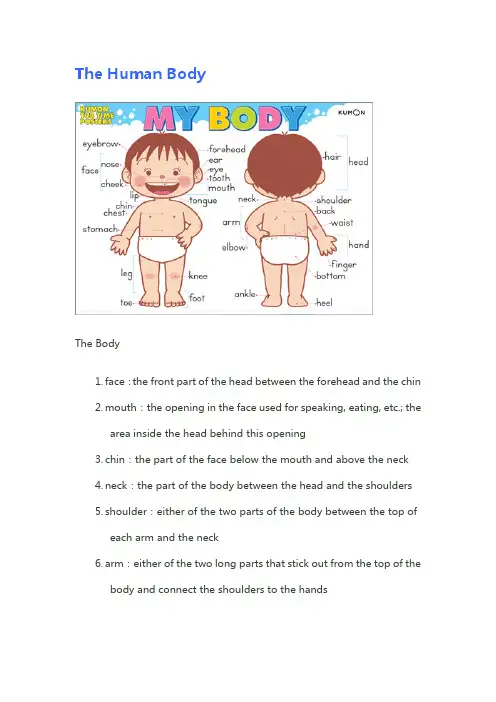
The Human BodyThe Body1.face:the front part of the head between the forehead and the chin2.mouth:the opening in the face used for speaking, eating, etc.; thearea inside the head behind this opening3.chin:the part of the face below the mouth and above the neck4.neck:the part of the body between the head and the shoulders5.shoulder:either of the two parts of the body between the top ofeach arm and the neck6.arm:either of the two long parts that stick out from the top of thebody and connect the shoulders to the hands7.upper arm 上臂:The section of an arm from the elbow to theshoulder8.elbow 肘部:the joint between the upper and lower parts of thearm where it bends in the middle9.forearm 前臂:the part of the arm between the elbow and the wrist10.a rmpit 腋窝:the part of the body under the arm where it joins theshoulder11.b ack:the part of the human body that is on the opposite side tothe chest, between the neck and the tops of the legs; the part of an animal's body that corresponds to this12.c hest:the top part of the front of the body, between the neck andthe stomach13.w aist:the area around the middle of the body between the ribsand the hips, often narrower than the areas above and below 14.a bdomen 腹部:the part of the body below the chest thatcontains the stomach, bowels, etc.15.b uttocks ['bʌtək]半边臀部:either of the two round soft parts atthe top of a person's legs16.h ip 臀部:the area at either side of the body between the top ofthe leg and the waist; the joint at the top of the leg17.l eg:one of the long parts that connect the feet to the rest of thebody - countable18.t high:the top part of the leg between the knee and the hip19.k nee:the joint between the top and bottom parts of the legwhere it bends in the middle20.c alf 小腿:the back part of the leg between the ankle and the knee -countableThe Hand1.wrist 手腕:2.knuckle /(k)-nu-ckle/指节:any of the joints in the fingers,especially those connecting the fingers to the rest of the hand -countable3.fingernail:the thin hard layer that covers the outer tip of eachfinger4.thumb:the short thick finger at the side of the hand, slightly apartfrom the other four5.(index)finger:the finger next to the thumb6.middle finger:the longest finger in the middle of each hand7.ring finger:the finger next to the smallest one, especially on theleft hand, on which a wedding ring is traditionally worn8.little finger:the smallest finger of the hand9.palm:the inner surface of the hand between the wrist and thefingers10.l unula lu-nu-la 甲半月,小太阳:The white area at the base of afingernailThe Head1.hair2.part (头发的)分份儿3.forehead4.sideburn 鬓角5.ear6.cheek7.nose8.nostril ['nɔstril] 鼻孔9.jaw 下巴10.b eard 胡须11.m ustache 胡子12.t ongue13.t ooth14.l ipThe Eye1.eyebrow ['aibrau] 眉毛2.eyelid 眼皮3.eyelashes 睫毛4.iris ['aiəris] 虹膜5.pupil ['pjupəl] 瞳孔The Foot1.ankle2.heel3.instep4.ball5.big toe6.toe7.little toe8.toenailThe Internal Organs1.brain2.spinal cord ['spainəl] 脊髓3.throat4.windpipe/trachea 气管5.esophagus [i:'sɔfəɡəs] e-so-pha-gus 食道/gullet6.muscle7.lung8.heart9.liver10.s tomach11.i ntestines 肠12.v ein 血管13.a rtery ['ɑ:təri] ar-te-ry 动脉14.k idney15.p ancreas ['pænkriəs] pan-cre-a-s 胰腺16.b ladder ['blædə] b-la-dder 膀胱。
英语含有身体部位名称的短语
英语含有身体部位名称的短语英语含有身体部位名称的短语:1、waist, 腰部waist circumference, 腰围beam waist, 束腰waist line, 腰围线2、head, 头head on, 迎头,正面地head office, 总公司head for, 前往3、organ, 器官organization, 组织,机构learning organization, 学习型组织,学习机构WTO=World Trade Organization, 世界贸易组织WHO=World Health Organization, 世界卫生组织4、face, 脸face to face, 面对面Poker Face, 扑克脸,无动于衷the face of, 在....面前,即使in the face, 面对5、brain, 大脑brain drain, 人才外流,人才流失brain death, 脑死亡,脑死human brain, 人脑brain injury, 脑损伤brain damage, 脑损伤6、stomach, 胃stomach cancer, 胃瘤stomach flu,胃感冒,肠炎癌empty stomach, 空腹stomach trouble, 胃病7、hair, 头发red hair, 红发black hair, 黑发human hair, 人发long hair, 长发hair conditioner, 护发素8、liver, 肝脏liver cancer, 肝癌liver cirrhosis, 肝硬化liver transplantation, 肝移植liver function, 肝功能9、eye, 眼睛eye shadow, 眼影London Eye, 伦敦眼,摩天轮,伦敦眼摩天轮in the eye of , 在....心目中,从....来看to the eye, 从表面上看来,公然an eye for , 对....有兴趣eye to eye, 四目相对,心有灵犀10、palm, 手掌palm (tree),棕榈树palm oil,棕榈油Palm Beach, 棕榈滩bear the palm, 获胜,获奖bear the palm11、nose, 鼻子aquiline nose, 鹰钩鼻nose cone, 鼻锥on the nose, 正好,恰恰running nose, 流鼻涕by a nose, 几乎,以微弱只差12、fist, 拳头Fist of Fury, 精武门Dragon Fist, 龙拳,银龙少爷hand over fist, 平稳快捷地,不费力的clenched fist, 紧握拳make a fist, 握拳13、ear, 耳朵ear, 听力inner ear, 内耳,出版者middle ear, 中耳in the ear, 正在结穗by ear, 凭听觉,不看乐谱on one's ear, 震惊,激动14、wrist, 手腕wrist watch, 手表,腕表wrist strap, 腕带15、mouth, 嘴巴foot-and-mouth disease, 口蹄疫Word of Mouth, 口碑,口头语mouth on sb, 告发某人river mouth, 河口from mouth to mouth, 广泛流传16、elbow,手肘elbow, 弯头Tennis Elbow, 网球肘,网球精英base elbow,底承肘管,带支座弯头elbow joint, 肘关节elbow piece, 弯头,肘形配件17、lip, 嘴唇lip balm, 润唇膏lip care, 护唇cleft lip, 唇裂,兔唇upper lip, 上嘴唇on the lips of , 在... 中流传18、armpit, 腋窝armpit, 腋下,腋窝,脏而令人不舒服的地方armpit odor, 狐臭,腋臭armpit hair, 腋毛19、tongue,舌头mother tongue, 母语native tongue, 母语Tongue Twister, 绕口令ice tongue, 冰舌tongue in cheek, 挖苦地,不是认真的20、thigh, 大腿thigh boot, 长靴contusion of thigh, 大腿挫伤thigh bone, 股骨21、tooth, 牙齿canine tooth, 犬牙,大牙tooth surface, 齿面,tooth profile, 齿形long in the tooth, 年迈的,年老的tooth for tooth, 以牙还牙22、knee, 膝盖knee joint , 膝关节on one's knee, 跪着knee pad, 护膝knee pad23、chin, 下巴chin oneself, 引体向上动作chin up, 振奋起来,引体向上double chin, 双下巴24、foot, 脚on foot, 步行,在进行中square foot, 平方英尺,平方尺at the foot of , 在 ...(山)脚下of foot, 在行走25、beard, 胡子Red Beard, 红胡子full beard, 大胡子26、toe, 脚趾toe socks, 五趾袜toe spring, 鞋头翘度,鞋尖高度from head to toe, 从头到脚,遍布全身big toe, 大脚趾heel and toe, 踵趾动作,脚跟与脚尖双脚旋转27、neck, 脖子neck and neck, 并驾齐驱,不相上下,肩并肩Great Neck, 大颈bottle neck, 瓶颈pain in the neck, 极讨厌的人或事28、ankle, 脚踝ankle boots, 短靴ankle sprain, 踝部扭伤ankle joint , 踝关节29、shoulder, 肩膀shoulder to shoulder, 便并肩cold shoulder, 冷遇,冷淡对待should joint, 肩关节30、heel, 脚跟Achille's heel, 致命要害,致命的弱点tar heel, 柏油脚跟high heel, 高跟鞋31、arm, 胳膊arm in arm, 手挽手,挽手upper arm, 上臂in arms, 怀抱着,武装起来的on one's arm,由手臂支撑着up in arms, 竭力反对,进行武装斗争32、thumb,母指rule of thumb,经验法则Tom Thomb, 汤姆历险记thumb down, 拇指向下,责备thumb up, 拇指向上,赞扬,给(个)赞!33、hand, 手invisible hand, 无形之手on hand, 在手边,在场,现有on the other hand, 另一方面in hand, 在手头,在进行中,在控制中hand in hand, 手拉手34、finger, 手指middle finger, 中指index finger,食指little finger,小指。
foot的用法与搭配
foot的用法与搭配一、foot的基本含义及用法(引言段)Foot是一个常见且多功能的英语单词,它既可以作为名词使用,表示人体下部和动物四肢末端等;同时也可以作为动词的第三人称单数形式,“过去时”和“过去分词”都是footed。
在日常生活中,我们可以发现许多与foot相关的短语搭配和习惯用法。
本文将全面介绍foot的不同用法及其搭配。
二、身体部位与解释性短语(一级标题)1. Body part(身体部位)作为名词, foot表示人类或动物身体下部分,包括脚底、足背和五个脚趾。
它是支撑我们整个身体重量并使我们行走、奔跑等活动成为可能的一个重要身体组件。
2. Be on one's feet(站立)这个短语经常用于描述人们站立的状态,尤其是长时间站立。
无论是在工作场合还是日常生活中,保持站立姿势对于人们的身体健康至关重要。
3. Get cold feet(失去勇气)当某人即将实施某项行动或采取某种决策时,却因紧张或焦虑而迟疑不前,我们可以说他们在感到紧张时“get cold feet”。
这个短语常用于非正式场合,描绘当事人的情绪状态。
三、测量单位与搭配短语(一级标题)1. Length measurement(长度测量)Foot作为英制计量单位之一,等于12英寸或30.48厘米。
在某些情景中,我们使用foot来衡量或描述物体的长度、高度和距离等。
2. By foot(步行)在交通工具不便或者远足旅行时,人们常常选择“by foot”这种方式来完成旅程。
步行是一种健康而环保的出行方式,使人们能够更好地欣赏沿途的风景和文化。
3. Put one's best foot forward(全力以赴)这个短语常用于鼓励人们竭尽全力去做某件事情。
当我们获得机会展示自己能力的时候,我们需要发挥最佳水平并充分利用机会。
四、其他习语及谚语表达(一级标题)1. Keep one's feet on the ground(保持理智、实际)有时候成功会使人产生傲慢和轻敌心态,但是“keep one's feet on the ground”这个谚语告诉我们要保持头脑冷静、保持实际,以免失去正确判断力。
一张图学会身体各个部位的英语表达,值得永久收藏!
一张图学会身体各个部位的英语表达,值得永久收藏!Jimmy s Note吉米老师前言:我们最熟悉的身体,它们的英语表达也要get起来,不然容易闹笑话哦~身体各部位英语表达内容来源于网络,版权归原作者所有好多宝贝和我说,不知道怎样用英语说出自己身体,各个部位的名称,有时候会很尴尬。
今天就教大家一起人体部位英语单词,包括头部胸部等各部位英文名称哦~1、头部及颈部的人体部位英语单词和英文名称head 头brain 脑skull 颅骨, 头盖骨hair 头发forehead 额temple 太阳穴eyebrow 眉毛eyelash眼睫毛ophryon印堂eye 眼睛ear 耳朵nose 鼻子cheek 面颊dimple 酒涡mole 痣philtrum人中lip 嘴唇mouth 口cavity口腔tooth 牙齿uvual 小舌tonsil 扁桃腺tongue 舌vocal cords声带decayed tooth 龋齿gum 牙龈palate 上牙膛incisors 切齿, 门齿canine tooth 大齿premolars 前齿molars 后牙denlture 假齿chin 下巴mustache 小胡子beard 山羊胡whiskers 络腮胡sidebums 鬓角Adams apple 喉throat 喉咙, 咽喉neck 脖子cervical vertebra颈椎2、手和手掌个不稳英文单词和英语名称elbow joint 肘关节hand 手arm 手臂palm 手掌finger 手指thumb 大拇指forefinger 食指middle finger 中指third finger 无名指little finger 小指ball 拇指腕掌half moon 甲晕fist 拳头knuckle 指关节back 手背wrist 手腕elbow 肘3、人体胸部和下半身各部位英语单词和英文名称collarbone 锁骨shoulder 肩shoulder blade 肩胛骨shoulder joint 肩关节pit 胸口breastbone 胸骨joint 关节rib 肋骨chest 胸部nipple 乳头armpit 腋下armpit hair 腋毛abdomen 腹部navel 肚脐waist 腰lumbar vertebrae腰椎backbone 脊骨, 脊柱blood vessel 血管vein 静脉artery 动脉capillary 毛细血管nerve 神经windpipe 气管spinal marrow 脊髓internal organs 内脏heart 心脏diaphragm 隔膜lung 肺kidney 肾脏stomach 胃gullet 食管liver 肝脏gall bladder 胆囊pancreas 胰腺spleen 脾duodenum 12指肠small intestine 小肠large intestine 大肠blind gut 盲肠vermiform appendix 阑尾rectum 直肠anus 肛门hip 臀部buttock 屁股pelvis 骨盆bladder 膀胱bone 骨skeleton 骨骼thigh 大腿kneecap 膝盖骨sinew 腱muscle 肌肉knee 膝盖leg 腿shank 小腿calf 小腿肚foot 脚instep 脚背toes 脚趾ankle 脚踝Achilless tendon 跟腱heel 脚后跟sole 脚底arch 脚掌心编辑|Vijun。
身体部位的英语 -回复
身体部位的英语 -回复1. Head -头部- Please turn your head and cough during the physical examination.请在体检时转头咳嗽。
- Annie's head is aching, so she decided to take a rest.安妮头疼,所以她决定休息一下。
2. Neck -颈部- The doctor advised James to do neck exercises torelieve muscle tension.医生建议詹姆斯进行颈部锻炼以缓解肌肉紧张。
- She bought a new necklace to match her pretty dress and show off her slender neck.她买了一条新项链来搭配漂亮的裙子,展示她纤细的脖子。
3. Shoulder -肩膀- Tom injured his shoulder while playing football and had to wear a sling.汤姆在踢足球时受伤,不得不戴上绷带。
- The heavy backpack made her shoulders ache, so she decided to take it off.沉重的背包让她的肩膀疼痛,所以她决定把它卸下来。
4. Arm -手臂- She showed off her new tattoo on her arm to her friends.她向朋友们展示她胳膊上的新纹身。
- The nurse gently tied a tourniquet around his arm to find a suitable vein for the blood test.护士温柔地在他的手臂上绑了一个止血带,以找到适合进行血液检查的静脉。
5. Elbow -手肘- He bumped his elbow on the table, causing a bruise.他撞到了桌子上的手肘,导致了一块淤青。
人体各部位英语单词及其他汇总
人体各部位英语单词一、头部及颈部的人体部位英语单词1.、head 头[hed]2、brain 脑[breɪn]3、skull 颅骨, 头盖骨(骷髅头) [skʌl]4、hair 头发[hɛə]5、forehead 额[ˈfɔ:hed]6、nerve 神经[nə:v]7、eye 眼睛[aɪ]8、eyebrow 眉毛[ˈaɪbraʊ]9、ear 耳朵[ɪə(r)]10、nose 鼻子[nəuz]11、cheek 面颊[tʃi:k]12、dimple 酒涡[ˈdɪmpl13、mole 痣[məʊl]14、lips 嘴唇(upper lip上唇,lower17、lip下唇) [lɪps] [ˈʌpəlip] [ˈləuə lip]15、mouth 口[maʊθ]16、cavity口腔[ˈkævəti]17、tooth 牙齿(众数teeth) [tu:θ] [ti:θ]18、tongue 舌[tʌŋ]19、chin 下巴[tʃɪn]20、whiskers 络腮胡[ˌwɪskəs]21、throat 喉咙, 咽喉[θrəʊt]22、neck 脖子[nek]二、手和脚的人体部位英文单词1、hand 手[hænd]2、arm 手臂[ɑ:m]3、palm 手掌[pɑ:m]4、finger 手指[ˈfɪŋgə(r)]5、nail 指甲[neɪl]6、fist 拳头[fɪst]7、back 手背[bæk]8、wrist 手腕[rɪst]9、elbow 肘[ˈelbəu]10、bone 骨[bəʊn]11、skeleton 骨骼[ˈskelɪtn]12、thigh 大腿[θaɪ]13、muscle 肌肉[ˈmʌsl] 14、knee 膝盖[ni:]15、leg 腿[leg]16、shank 小腿[ʃæŋk]17、foot 脚[fut]三、人体胸部和下半身各部位英语单词1、shoulder 肩[ˈʃəuldə]2、pit 胸口[pɪt]3、joint 关节[dʒɔɪnt]4、chest 胸部[tʃest]5、abdomen 腹部[ˈæbdəmən]6、navel 肚脐[ˈneɪvl]7、waist 腰[weɪst]8、back 背[bæk]9、backbone 脊柱[ˈbækbəʊn]10、hip 臀部[hɪp]11、bottom 屁股[ˈbɔtəm]四、内脏各部位英语单词1、vein 静脉[veɪn]2、artery 动脉[ˈɑ:təri]3、capillary 毛细血管[kəˈpɪləri]4、nerve 神经[nɜ:v]5、spinal marrow 脊髓[ˈspaɪnəl ˈmærəʊ]6、internal organs 内脏[ɪnˈtɜ:nl] [ˈɔ:ɡənz]7、heart 心脏[hɑ:t]8、blood vessel 血管[blʌd ˈvesəl]9、lung 肺[lʌŋ]10、kidney 肾脏[ˈkɪdni]11、stomach 胃[ˈstʌmək]12、gullet 食管[ˈgʌlɪt]13、liver 肝脏[ˈlɪvə(r)]14、pancreas 胰腺[ˈpæŋkriəs]15、spleen 脾[spli:n]16、small intestine 小肠[smɔ:l ɪnˈtestɪn] 17、large intestine 大肠[lɑ:dʒɪnˈtestɪn]18、anus 肛门[ˈeɪnəs]19、bladder 膀胱[ˈblædə(r)]20、urine 尿道[ˈjʊərɪn]常见蔬菜1 tomato [tə'mɑ:təʊ] 西红柿2、lettuce ['letɪs] 莴苣3 cucumber ['kju:kʌmbə] 黄瓜4 aubergine ['əʊbəʒi:n], eggplant ['egplɑ:nt] ]茄子5 celery ['selərɪ] 芹菜6 onion ['ʌnjən ]洋葱7 pea [pi:] 豌豆8 mushroom ['mʌʃru:m]蘑菇9 pumpkin ['pʌm(p)kɪn]南瓜10 rape [reɪp] 油菜11 spinach [ˈspɪnɪtʃ] 菠菜12 beet, beetroot ['bi:tru:t]甜菜13 potato [pə'teɪtəʊ] 马铃薯14 radish ['rædɪʃ] 萝卜15 carrot ['kærət] 胡萝卜16 cabbage ['kæbɪdʒ] 卷心菜17 Chinese cabbage 大白菜18 chilli ['tʃɪlɪ] 辣椒19 garlic ['gɑ:lɪk] 蒜20 chive [tʃaiv] 葱常见动物类1 horse [hɔ:s] 马2 mare [meə] 母马3 colt [kəʊlt] foal [fəʊl]小马4 mustang ['mʌstæŋ]野马5 hippopotamus[,hɪpə'pɒtəməs] 河马6 zebra ['zebrə] 斑马7 ox [ɑks] 牛8 buffalo ['bʌfələʊ] 水牛9 Bulls、[bulz] 公牛10 cow [kaʊ] 母牛11 calf [kɑ:f] 小牛12 heifer ['hefə] 小母牛13 rhinoceros [raɪ'nɒs(ə)rəs]犀牛14 yak [jæk] 牦牛15 eagle ['i:g(ə)l] 鹰16 mule [mju:l] 骡17 ass, donkey 驴18 cock [kɒk] 公鸡19 hen [hen] 母鸡20 chicken ['tʃɪkɪn] 小鸡21 peacock ['pi:kɒk] 孔雀22 duck [dʌk] 鸭23 pig, swine [swaɪn] 猪24 gilt [gɪlt] 小母猪25 piglet ['pɪɡlət] 猪崽26 hog [hɒg] 肥猪27 goose[gu:s] 鹅28 sheep [ʃi:p] 羊29 ewe [ju:] 母羊30 goat [gəʊt] 山羊31 lamb [læm] 羊羔,羔羊32 antilope ['æntilɔp] 羚羊33 swan [swɒn] 天鹅34 deer [dɪə] 鹿35 giraffe [dʒɪ'rɑ:f] 长颈鹿36 camel ['kæm(ə)l] 骆驼37 ostrich ['ɒstrɪtʃ] 鸵鸟38 elephant ['elɪf(ə)nt] 象39 gull [gʌl] seagull ['si:gʌl] 海鸥40 woodpecker ['wʊdpekə]啄木鸟41 cat 猫42 parrot ['pærət] 鹦鹉43 lion ['laɪən] 狮44 cuckoo ['kʊku:] 杜鹃45 leopard ['lepəd] 豹46 crow [krəʊ] 乌鸦47 tiger ['taɪgə] 虎48 blackbird ['blækbɜ:d]画眉49 thrush [θrʌʃ] 画眉50 magpie ['mægpaɪ] 喜鹊51 swallow ['swɒləʊ] 燕子52 sparrow ['spærəʊ] 麻雀53 dog 狗54 fox [fɒks] 狐55 wolf [wʊlf] 狼56 squirrel ['skwɪr(ə)l] 松鼠57 bear [beə] 熊58 penguin ['peŋgwɪn] 企鹅59 rabbit ['ræbɪt] 兔子60 hare [heə] 野兔61 rat [ræt] 鼠62 vole [vəʊl] 田鼠63 snake [sneɪk] 蛇64 boa ['bəʊə] 王蛇,蟒蛇65 monkey ['mʌŋkɪ] 猴子66 python ['paiθən] 蟒蛇67 orangutan [ɔ:,ræŋu:'tæn]猩猩68 chimpanzee [tʃɪmpæn'zi:] 黑猩猩69 lizard ['lɪzəd] 蜥蜴70 chameleon [kə'mi:lɪən] 变色龙71 wall lizard ['lizəd] 壁虎72 duckbill ['dʌkbɪl] platypus ['plætɪpəs] 鸭嘴兽73 kangaroo [,kæŋgə'ru:]袋鼠74 giant salamander ['dʒaɪənt] ['sælə,mændə] 娃娃鱼75 koala [kəʊ'ɑ:lə] 考拉76 crocodile ['krɒkədaɪl]鳄鱼77 hedgehog ['pɔ:kjʊpaɪn]刺猬78 porcupine['pɔ:kjʊpaɪn]豪猪79 bat [bæt] 蝙蝠80 turtle ['tɜ:t(ə)l] 龟81 whale [weɪl 鲸82 dolphin ['dɒlfɪn] 河豚83 sea turtle ['tɜ:t(ə)l] 海龟84 frog [frɒg] 青蛙85 seal [si:l] 海豹86 toad [təʊd] 蟾蜍常见水果apple 苹果2、banana 香蕉3、cherry 樱桃4.Chinese、gooseberry、猕猴桃5、coconut椰子6、plum李子7、date枣8、fig无花果9、litchi 荔枝10、gingko白果,银杏11、grape葡萄12、cantaloupe哈密瓜13、hawthorn山楂14、honey peach水蜜桃15、juicy peach水蜜桃16、jujube枣17、lemon柠檬18、longan 桂圆,龙眼19、loquat 枇杷20、mandarin 柑桔21、mango 芒果22、muskmelon甜瓜23、navel orange脐橙24、nut 坚果25、oleaster 沙枣26、olive橄榄27、orange柑桔28 tangerine 柑桔29、papaya 木瓜30、peach 桃子31、pear梨32、pineapple 菠萝33、pomegranate石榴34、pomelo 柚子,文旦35、red bayberry杨梅36、strawberry 草莓37、watermelon西瓜常见乐器1.钢琴Piano、[piˈænəʊ]2.小提琴Violin、[ˌvaɪəˈlɪn]3.大提琴Cello、[ˈtʃeləʊ]3.吉他、Guitar、[gɪˈtɑ:(r)]4.竖琴Harp、[hɑ:p]5. 竖笛Recorder、[rɪˈkɔ:də(r)]6.长笛Flute、[flu:t]7.短笛piccolo、[ˈpɪkələʊ]8.萨克斯Saxophone[ˈsæksəfəʊn]9.大号Tuba、[ˈtju:bə]10.小号Trumpet、[ˈtrʌmpɪt]11.手风琴accordion、[əˈkɔ:diən] 12.小鼓side drum、[said drʌm]13. 大鼓bass drum、[beis drʌm]14. 口琴harmonica、[hɑ:ˈmɒnɪkə]15. 手风琴accordion [əˈkɔ:diən]16、电子琴keyboard [ˈki:bɔ:d]17. 鼓drum、[drʌm]18. 二胡urheen ['ɜ:hi:n]19. 琵琶lute [lu:t]20. 筝zither [ˈzɪðə(r)交通工具1. bus公共汽车[bʌs]2.car小汽车[kɑ:(r)]3.bike自行车[baɪk]、4.bicycle自行车[ˈbaɪsɪkl]5.motobike 摩托车[ˈməʊtəbaɪk]6.saloon 轿车[səˈlu:n]7 notchback 客货两用车['nɒtʃbæk]8.truck 卡车[trʌk]pact car 小型汽车[kəmˈpækt kɑ:]10.light-van 小型货车['laɪtv'æn]11.garbage truck 垃圾车[ˈɡɑ:bidʒ trʌk]12.automobile carrier 货运卡车[ˈɔ:təməbi:l ˈkæriə]13.fire engine 消防车[ˈfaiəˈendʒin]14.ambulance 救护车[ˈæmbjələns]15.taxi 出租车, 计程车[ˈtæksi]16.jeep 吉普车[dʒi:p]17.police car 警车[pəˈli:s kɑ:]18.wrecker 清障车[ˈrekə(r)]19.ambulance 急救车[ˈæmbjələns] 20.highway公路[ˈhaɪweɪ] road公路[rəʊd]21.Express way高速公路[iksˈpres wei]22.aeroplane飞机[ˈeərəpleɪn]23.plane飞机[pleɪn]24.aircraf 飞机[ˈeəkrɑ:ft]25.airplane飞机[ˈeəpleɪn]26.spaceship 宇宙飞船[ˈspeɪsʃɪp]27.space shuttle 航天飞机[speis ˈʃʌtl]28.helicopter 直升飞机[ˈhelɪkɒptə(r)]29.double decker bus 双层公共汽车[ˈdʌbl ˈdekə bʌs]30.coach 长途客运汽车[kəʊtʃ],31 motor coach大客车[ˈməutə kəutʃ]32.trolleybus 无轨电车[ˈtrɒlibʌs]33.tramcar有轨电车['træmkɑ:],34.streetcar [ˈstri:tkɑ:(r)]有轨电车35.underground地铁[ˈʌndəgraʊnd]36 tube地铁[tju:b]37 subway [ˈsʌbweɪ] 地铁38.train 火车[treɪn] 39.warship 军舰[ˈwɔ:ʃɪp]40.ferry渡船[ˈferi]41.tanker油轮[ˈtæŋkə(r)]42.liner邮轮[ˈlaɪnə(r)]43.speedboat快艇[ˈspi:dbəʊt]44.yacht游艇[jɒt]45.freighter货船[ˈfreɪtə(r)]46.submarine潜艇[ˌsʌbməˈri:n]校园词汇1.上学go to school[ɡəu tu: sku:l][kʌm tu: sku:l] [kʌm tu: sku:l]2.放学回家leave school leave school3.回家return home [riˈtə:n həum]/ come back home [kʌm bæk həum]/ get home [ɡet həum]4.校门school gate [sku:l ɡeit]5.操场playground [ˈpleɪgraʊnd]/sports ground [spɔ:ts ɡraund]/ drill ground [dril ɡraund]6.运动场sports ground [spɔ:ts ɡraund]/playground [ˈpleɪgraʊnd]/schoolyard [ˈsku:ljɑ:d]7.篮球场basketball court [ˈbɑ:skitbɔ:l kɔ:t]8.排球场volleyball court [ˈvɔlibɔ:l kɔ:t]9.足球场football court [ˈfutbɔ:l kɔ:t]10.假山rockery [ˈrɒkəri]11.喷水池spray fountain[sprei ˈfauntin]12.林荫小道alameda [ˌælə'meɪdə]13. 花坛parterre [pɑ:ˈteə(r)]14.旗杆flagstaff [ˈflægstɑ:f]15.国旗national flag [ˈnæʃənəl flæɡ]16.保安员Security Officer [si`kjuəriti] [ `ɔfisə]ˈ17.宿管员dormitory managing clerk[ˈdɔ:mətri] ['mænɪdʒɪŋ] [klɑ:k]18.清洁工cleaner [ˈkli:nə(r)]19小卖部canteen [kænˈti:n]20.食堂mess hall [mes hɔ:l]/mess [mes]/ canteen [kænˈti:n]21.食堂工人The canteen workers [ðə] [kænˈti:n]['wɜ:kəz]22.厨师cook [kʊk]23.服务员waiter [ˈweɪtə(r)]24.图书馆、图书室library [ˈlaɪbrəri]25. 图书管理员library [ˈlaɪbrəri]26.教室classroom/ school room27.书桌desk [desk]28.椅子chair [tʃeə(r)]29.讲台dais [ˈdeɪɪs]30.黑板blackboard [ˈblækbɔ:d]31.粉笔chalk tʃɔ:k]32.美术室art room[ɑ:t ru:m]33.音乐室music room [ˈmju:zik ru:m]34.阅览室Reading Room [ˈri:diŋ ru:m]35.实验室laboratory [ləˈbɒrətri]36.物理实验室physics laboratory [ˈfiziks ləˈbɔrətəri]37.化学实验室chemical laboratory [ˈkemikəl ləˈbɔrətəri]38. 生物实验室biology laboratory [baiˈɔlədʒi ləˈbɔrətəri]39.游泳池swimming pool [ˈswɪmɪŋ pu:l]40.宿舍dormitory [ˈdɔ:mitri]/dorm [dɔ:m]/42.校长schoolmaster [ˈsku:lmɑ:stə(r)]/president [ˈprezɪdənt]/43.老师teacher [ˈti:tʃə(r)]/schoolmaster [ˈsku:lmɑ:stə(r)]44.语文老师language teacher [ˈlæŋɡwidʒ ˈti:tʃə]45.数学老师maths teacher[mæθs] ˈti:tʃə46.英语老师English teacher47.物理老师physics teacher[ˈfɪzɪks]48.化学老师chemistry teacher[ˈkemɪstri]49.生物老师biology teacher[baɪˈɒlədʒi]50.地理老师geography teacher[dʒiˈɔɡrəfi]51.历史老师history teacher [ˈhɪstri]52.政治老师politics teacher [ˈpɒlətɪks]53.信息老师computer teacher [kəmˈpju:tə]54.体育老师physical education teacher [ˈfizikəl ˌedju:ˈkeiʃən]55.音乐老师music teacher[ˈmju:zik]56.美术老师art teacher [ɑ:t]57.学生student [ˈstju:dnt]/pupil[ˈpju:pl]/58.同学schoolmate [ˈsku:lmeɪt]/ condisciple [ˌkɒndɪ'saɪpl]59.同班同学classmate [ˈklɑ:smeit]60.班长monitor [ˈmɒnɪtə(r)]/ class monitor [klɑ:s ˈmɔnitə]61.学习委员commissary in charge of studies [ˈkɒmɪsəri] [tʃɑ:dʒ] ['stʌdɪz]62.劳动委员commissary in charge of labour [ˈleibə]63.体育委员commissary in charge of physical culture [ˈfizikəl ˈkʌltʃə]64.文娱委员commissary in charge of recreational activities [ˌrekriˈeɪʃənl] [ækˈtivitiz]65.组长headman [ˈhedmæn]66.小组长gang boss [ɡæŋ bɔs]67.上课attend class [əˈtend klɑ:s]/ go to class[ɡəu tu: klɑ:s]68.听课attend a lecture [əˈtend ei ˈlektʃə]/ sit in on a class[sit in ɔn ei klɑ:s]69.作笔记take notes [nəuts]70.记录record [ˈrekɔ:d]71.听写dictation [dɪkˈteɪʃn]72.默写write from memory [rait frɔm ˈmeməri]73.讨论discuss [dɪˈskʌs]/talk over [tɔ:k ˈəuvə]74.听老师讲课listening to the teacher['lɪsənɪŋ]75.帮助assist [əˈsɪst]76.听录音listen to recording[ˈlisn] [rɪˈkɔ:dɪŋ]77.做作业do the homework [ˈhəʊmwɜ:k]78.做练习do exercise [du: ˈeksə]79.下课get out of class/ finish class/come off from class[kʌm ɔf frʌm klæs]80.画图picture [ˈpɪktʃə(r)]81.画vt.draw82.起立stand up/ uprise ['ʌpraɪz]/n standing [ˈstændɪŋ]83.坐下sit down [sit daun]/squat down[skwɔt daun]84.举手raise your hand[reɪz][hænd]85.回答answer [ˈɑ:nsə(r)]/ reply [rɪˈplaɪ]/ rejoin [ˌri:ˈdʒɔɪn]86.回答问题answer the question [ˈɑ:nsə ðə ˈkwestʃən]87.交头接耳bill and coo [bil ænd ku:]88.搞小动作make petty moves[meɪk][ˈpeti] [mu:v]89.认真听讲listen carefully [ˈlisn] ['keəfəlɪ]90.嘲笑ridicule [ˈrɪdɪkju:l]91.打架fight [faɪt]/ fray[freɪ]/ scrap[skræp]92.辱骂vt. abuse [əˈbju:s]93.欺骗v. hoax [həʊks]94.听音乐listen to music [ˈlisn tu: ˈmju:zik]95.看书read a book [ri:d ə buk]96.书法handwriting [ˈhændraɪtɪŋ]97.打篮球play basketball[pleɪ] [ˈbɑ:skɪtbɔ:l]98.打乒乓球playtable tennis[ˈteibl ˈtenis]/playtable tennis ball[ˈteibl ˈtenis bɔ:l]99.打羽毛球play shuttlecock[ˈʃʌtlkɒk]100.打排球playvolleyball[ˈvɒlibɔ:l]101.踢足球play football [plei ˈfutbɔ:l]102.游泳swim [swɪm]103.播音broadcast [ˈbrɔ:dkɑ:s t]104.播音员broadcaster [ˈbrɔ:dkɑ:stə(r)]105.唱歌sing [sɪŋ]106.跳舞dance [dɑ:ns]107.表演perform [pəˈfɔ:m]/ act[ækt]108.排练节目rehearsing a play [rɪˈhɜ:sɪŋ] [ə] [pleɪ]109.排练舞蹈rehearsing dance [rɪˈhɜ:sɪŋ] [dɑ:ns]110.演小品act short sketch [ækt][ʃɔ:t sketʃ]111.说相声perform crosstalk [pəˈfɔ:m][ˈkrɒstɔ:k]。