
牛津译林版八年级英语下册8BUnit2《Travelling》GrammarB课件
wakeup
have(has)beenawake
1.Howlong___aPartymember?
A.haveyoubeenB.areyou
C.haveyoubecomeD.didyoubecome
2.--____you___yourbreakfast? -Yes,Ihave. -When___you___it? -Twentyminutesago. A.Have;had;have;had
C.hadbeendeadD.died
5.Tom___Londonfortwoyears. A.hadleftB.hasgoneaway C.hasbeenawayfrom
D.hadbeenawayfrom
arrived
havebeen borrowed
havekept
began hasbeen
Changethesentencesusingthelongactions:
beon
end,finish getmarried
beover bemarried
PutthefollowingsentencesintoEnglish.
(1)我两小时前就在这儿了。 Ihavebeenheresincetwohoursago.
(2)他已睡了十个小时了。 Hehassleptherefor10hours.
20
30
短暂动词延续性动词
buyhave/hashad borrowhave/haskept arrivehave/hasbeenin/at leavehave/hasbeenaway joinhave/hasbeenamemberof
短暂动词延续性动词
diehave/hasbeendead getmarriedhave/hasbeenmarried come/gohave/hasbeenin/at begin/starthave/hasbeenon stop/finish/endhave/hasbeenover
(3)李先生从2005年起就住在这套公寓里了。 MrLihaslivedinthisflatsince2005.
(4)这些工人已经工作七个小时了。 Theseworkershaveworkedfor7hours.
Weonlyuseforandsincewithverbslik ewait,work,sleepandteach,becaus ethey’relongactions.Wecan’tuseforo rsincewithverbslikecome,go,buyan dleave,becausetheyareshortactions.
for+一段时间 since+过去的时间点since1970 +一段时间+agosince2yearsago +从句(过去时)sincehelefthere
TrueorFalse?
(1)Ihaveseenmanyinterestingfilmssince2012.() √
(2)Tom’sdoghasdiedfortwoyears.() ×
for/since
1.Theyhavelearned1,000Englishwords ___f_othr reeyears. 2.Theoldmanhaslivedhere_____s_inhcee wasborn. 3.Hehascollectedquiteafewstamps ___s_i_n_cthereeyearsago. 4.Ihaveknownyou____si_n2c0e09. 5.ShehastaughtEnglish____ffoivr eyears.
2. 20分钟前会议就已经结束了。
Theconferencehasbeenoversince20minut esago.
3. 我两年前来到了这个学校。
Icametothisschooltwoyearsago.
4. 他离开家已经10年了。
Hehasbeenawayfromhomefortenyears.
B.Did;have;did;have C.Have;had;do;have
D.Have;had;did;have
3.Theyarelate.Thefilm___forfiveminutes. A.hasbegunB.hasstarted
C.hasbeenonD.began
4.Hergrandpa___forthreeyears. A.hasbeendeadB.hasdied
瞬间性动词
延续性动词
catchacold have(has)hadacold
getup puton
have(has)beenup have(has)worn
becomeinter have(has)beeninterested
estedin
in
have(has)beenopen/hav open/close e(has)beenclosed
(1)Iboughtthiscomputersixmonthsago.
I___h_a_v_e_h_a_d___thiscomputer____f_o_r _sixmonths.
(2)Sheborrowedthemagazineyesterday.
She___h_a_s_k_ep__t __themagazine____s_in_c_e_yestehometownwhenhewasseven.
MrWang_____________hishometown________hewass
even. hasbeenaway
since
汉译英
1. 篮球赛已经开始15分钟了。
Thebasketballmatchhasbeenonfor15mi nutes.
空白演示
在此输入您的封面副标题
8BUnit2Travelling GrammarB
Verbswith“for”,”since”or“ago”
预习检测
完成下列表格:
非延续性动词
与一段时间连用时的表达方法
buy
have
borrow come,go
leave start,begin
keep
bein/at beawayfrom
5. 她已经到达公司半个小时了。
Shehasbeeninthecompanyforhalfanhour.
Homework
• 复习for和since的用法。 • 复习延续性动词和非延续性动词的用法。 • 预习Integratedskills。
hasbeendead
(3)TheyhavebeeninGuilinforaweek.() √
(4)KittyhasleftBeijingsincelastMonday.() ×
hasbeenaway
(5)Danielhasboughthisglovesforayear.() ×
hashad
0
10
(3)UncleSamarrivedinNanjingthreedaysago.
UncleSam_h_a_s_b_e_e_n____inNanjing___fo_r_threedays.
(4)Judyandmarkgotmarriedlastmonth.
JudyandMark___h_a_s_b_e_e_n_m_a_r_ri_e_d_s_in_c_e______lastmonth.
译林版英语八年级下册Unit2Travelling教案

Travelling课题课题Unit 2 Travelling Welcome to the unit课型课型新授新授授课日期授课日期月 日 第1课时课时教学目标教学目标1.To introduce well-known attractions in foreign cities and popularplaces of interest2.To activate general knowledge about the world .3.To identify activities which people do on holiday.教学重难点教学重难点1. To learn some popular tourist attractions .2.To talk about traveling to some famous places.课前准备课前准备多媒体多媒体教学活动教学活动二次备课二次备课Check pre-exerciseStep1 Leading - inDiscussion:1. Each country has its places of interest. Forexample:(Show a picture of Great Wall)In China,there is Great Wall. At this time, write Great Walland China on the Bb.2. Let the Ss tell more places of interest inforeign countries and write them on the Bb.3. Ask them what people can do if they are in thefamous places.Step2 Pre – task 11.Show the pictures of other five places ofinterest on the page 21. Ask Ss read the wordsand do the exercise below.Lead them to read the names of places andcountries.2. Show the picture of little Mermaid.T: It’s little Mermaid in Denmark . it’s famous inthe world.S1: Really ?.S2:That’s from the story by hans ChristianAndersen. .Step3 While - taskTask 1 .After reading the new words fluently, let Ssmatch the three parts with lines on theirexercise book.Task 2.Make dialogues. Show the picture of Mount Fuji.T: What’s this?Ss: It’s Mount Fuji in Japan.T: What can people do there?S1: They can climb hills/ take photos.Make dialogue about other five pictures in pairs. Step4 Post - task1Practice the dialogue before the whole class. Step5 Pre - task 2T: Travelling is fun. Before your parents take you out to go on a trip, you should pack your things. Write the phrases on the Bb. Teach them the meaning and the pronunciation.Step6 Whole task 2T: Now Eddie is going on a trip. Let’s look at the pictures one by one.Task 1.Show Picture 1. Act as Hobo. Ask: Hey, Eddie. Where are you going?Ss: I’m going on a trip. ( help them answer.) Practise again.Task 2.Show Picture 2.T: You know, Eddie is going on a trip alone. But the trip must be fun. So Hobo asks: I have been there before. Can I join you ?Practise again.Task 3. Show Picture 3. Ask and answer with present continue tense.Ss: What are you doing, Hobo?T: I’m getti ng all my things .Task 4.Show Picture 4. Show the difference between P 2 and P4.Try to get their two thoughts. Present the dialogue between them.Step7 Homework:Preview the new words in Reading教后记Unit 2 Travelling 教案教案课题课题Unit 2 Travelling Reading(1) 课 型 新 授 授课日期授课日期 月 日 第2课时课时 教学目标教学目标 1.To read a letter about a holiday in Hong Kong 2.To expand vocabulary to talk about traveling3.To expand vocabulary to talk about traveling.4.To identify specific details by answering questions.教学重难点教学重难点 1.The understanding of the main idea of Reading. 2.To analyze the sentences for the students to get a better understanding.课前准备课前准备多媒体多媒体 教学活动教学活动 二次备课二次备课Check pre-exerciseStep1 Leading – in1. Show the pictures of places of interests indifferent countries to review.2. The last place is Mount Fuji. Talk more aboutHong Kong . Show a picture of Hong Kong. Describe Hello Kitty’s appearance.Step2 PresentationIf the students have been there .T: you have been to Hong Kong Disneyland. When did you go there ?Can you tell us something about it.if necessary ,the students can use some Chinese words in their description. or the teacher can give some key words.e.g. roller coaster, at high speed a parade of Disney characters a 4-D film ,watch the fireworks ,fantasticIf t he students haven’t been ,the teacher can showthe picture of Disney and make a brief instruction. T: This is a picture of Hong Kong Disneyland.it’s a wonderful place for both children and adults. Space Mountain is exciting .The parade of Disney land character is fantastic . you can enjoy a4-D film there. It’s like magic. there are many shops inside the park .you can do some shopping. You can also watch the fireworks in the evening ..They are very beautiful.Step3 Reading1 Students scan the reading materials and find the main 5 elements, and outline the reading.T: Today we’re going to learn about Hong Kong Disneyland from Kitty’s letter. Remember to findthe five paints: when ,who, where , what, and how. Look at the questions in part B1 and find the answers as quickly as you can.The students finish t B1 after scanning para1,22 Teach the students how to find the details and finish B2.Now we’re found out that Kitty went toHong Kong Disneyland with her parents byunderground .They spent a whole day there and afantastic time. But what did they do there? Let’sread the rest of the letter and complete partB2.check the answersStep4 Activities T: Millie is still in Hainan and she hasn’t receivedKitty’s letter yet . One day, Millie called Kitty andasked Kitty about her trip to Hong KongDisneyland .Let’s make a conversation betweenMillie and Kitty. It should have at least five questions.The students act it . Step5 Homework1.Recite the new words2.Find out useful words and phrases in Reading3.Do B3 and B4 on Page 25教后记课题课题8B Unit 2 Travelling Reading(2) 课 型 新 授 授课日期授课日期 第三课时第三课时教学目标教学目标 1.To practise the main language points of the context2.To speak out the passage in their own words3.To understand and use the expressions in the text教学重难点教学重难点 2.To speak out the passage in their own words, following the structure of thepassages.课前准备课前准备 多媒体多媒体教学活动教学活动 二次备课二次备课Check pre-exerciseTranslate some phrases into English.1非常想念你非常想念你 2 玩的开心玩的开心3 快速行驶快速行驶 4 急忙去餐馆快速的吃饭急忙去餐馆快速的吃饭5忍不住不停的拍照忍不住不停的拍照 6 买一对耳环买一对耳环Step1 RevisionT: Ask the following questions1) Where did Kitty go ?2)When did she go there ?3)Who did she go with ?4)How did she go there ?5)What did she do there ?6)How long did she spend there ?Step 2 Presentation1 Discussion in group of 4.Finish Kitty’s activity form with ten vocabulary thatdescribe the time in the text2 Find the time vocabulary and fill in the place andactivity.Step 3 Explaining the language pointsI am going to explain the important words, phrases andsentences in the passage.Step 4 Practising and Sum upAmy went to Kitty’s house for supper. Kitty showedAmy her photo album. Amy was very excited and askeda lot of questions. Finish Part B3 on page 25, and thenwork in pairs to make the similar conversation. Forstronger class, students can add more questions.Ask the students to sum up the passage.Step 5当堂检测、及时反馈Kitty_____ (已经去) Hong Kong for two days. She andher parents had a great time there. They spent the wholeday in Disneyland.It is _____ (世界文明的主题公园) and it’s reallyfantastic. It is one big park, but it actually has four parks.They got to Disneyland from their hotel _____ (乘地铁).They took photos _____(在鲸鱼喷泉前) at theentrance, then they went to Space Mountain. They tookthe roller coaster, it _____ (高速移动). In the afternoon,there was a parade of Disney characters. The _____ (演出者) all wore different costumes and waved to people while they marched across the park. The children _____ (鼓掌) and screamed with joy.教后记课题课题Unit 2 Travelling Grammar 课型课型新授新授 授课日期授课日期 课时课时 第4/5课时课时 教学目标教学目标 1.To recognize contexts for the use of the present perfect tense. 2.To understand the verbs with ‘for’, ‘since’ or ‘ago’3.To consolidate the present perfect tense4.To understand the verbs with continuous time adverbials教学重难点教学重难点 1.‘have/has been’ and ‘have/has gone’ 2. Verbs with ‘for’, ‘since’ or ‘ago’课前准备课前准备 多媒体多媒体教学活动教学活动 二次备课二次备课Check pre-exerciseStep1.Lead-inT: Now, I am teaching you. You are listening to me carefully.Ask the students to give me more sentenceswritten in present continuous tense.Write the structure of present continuous tenseon the Bb.T: But yesterday at this time, I was sitting in my office. (Write the structure of past continuous tenseon the blackboard). Underline the different verbs‘BE’.Step2. PresentationWe use ‘have /has been to’ express the ideathat someone went to someplace and hasalready come back.I have been to England twice.(Where am I now/Am I still in England? )Millie, can you go to office to bring me thechair?W here’s Millie? She is on the way to the office,or maybe she is in the office.She has gone to the office. And she will comeback in a few minutes.We use ‘have /has gone to’ express the ideathat someone went to someplace and is nothere.Step3. PractisingDaniel is asking Millie about traveling.Complete the conversation on page 27 with thecorrect forms of the verbs in brackets.Step4 PresentationWe use for when we talk about a period of time, and we use since when we talk about a time point in the past.e.g. Mr Dong has lived here for many years.Mr Dong has lived her since he was born.Some verbs, such as come, go, buy and leave, canbe used in the present perfect sense, but they cannotbe used with for or since in positive statements. Step 5 since和for的区别If we want to express a continuous state, we can use another way like this.Verb Used for a continuous stateExample : begin/start have/has been onThe film has been on for 20 minutes.finish/stop have/has been overThe parade has been over for hours.come/go/arrive have/has been in/atKitty has been in Hongkong for two days. Leave have/has been awayShe has been away from home since last Tuesday.borrow have/has keptShe has kept this book since last week.join have/has been in or have/has been a member ofSimon has been a member of the Football Club since last year.marry have/has been marriedThey have been married for 15 years.die have/has been deadThe fish have been dead for some time.Step6 PracticeStep7 Homework1. 复习for和since的用法。
牛津译林版英语八年级下册8B Unit 2 Grammar(2)课件
现在完成时和一般过去时
He _h_a_s__w_o_r_k_e_d__(work) in our school for one
year.
He _c_a_m_e__(come) to our school last year/in
her husband to open the door. • I can’t find the way to the railway station
because I have lost my map.
用法: 二. for + 时间段
since + 时间点 present perfect tense
• in the past(last/ recent)three years
• recently,over / during the past century
• how long, all one’s life
2. 上下文提示结果 • He’s crying. He hasn’t passed the exam. • She has lost her key so she has to wait for
3. Tommy has had this motorcycle ___f_o_r___ three years.
4. I have been in Jiangyin __f_o_r____ forty years.
5. My parents has been married since twenty years __a_g_o____.
• buy → have • open → be open • close →be closed • join →be in / be a member of… • go to school → be at / in school • borrow → keep • catch a cold → have a cold • get to know → know • begin to study → study • get married → be married • wake up → be awake
Unit2知识点和考点2021-2022学年牛津译林版八年级英语下册
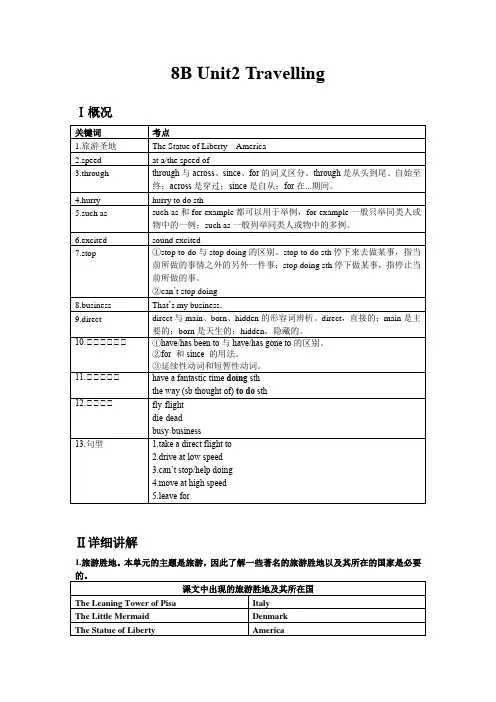
8B Unit2 TravellingⅠ概况Ⅱ详细讲解1.旅游胜地。
本单元的主题是旅游,因此了解一些著名的旅游胜地以及其所在的国家是必要【2020年五中】I will go on a trip to the USA to visit ______ this summer holiday.A. the Sydney Opera HouseB. the Little MermaidC. Tower BridgeD. the Statue of Liberty答案DI miss you so much.21.【2022年树中】—Is anything worth seeing in Nanjing?—Yes. Don’t __________ Zhongshan Mountain National Park with lots of cultural relics and natural beauty.A.forgetB. missC. avoidD. prevent答案BWe’re having a fantastic time here.【2022年十二】10. great fun it is to fly kites! fantastic time the children are having!A. What; What aB. What; WhatC. How; How aD. What a; What【答案】A2.It moved at high speed and was really exciting.(1)speed的基本含义作名词,意思是速度(2)speed的核心考点,考察speed的固定搭配at a/the speed of,以...样的速度,介词用at,speed前用冠词。
而搭配at high speed中没有冠词。
2. The train is running the speed of 200 kilometers per hour.A. withB. atC. inD. for答案B3.We were screaming and laughing through the ride.(1)through的基本含义作介词,意思是从头到尾,自始至终(2)through的核心考点考察through与across、since、for的词义区分。
8B Unit 2 GrammarA教案
8B Unit 2 TravelingGrammar鲁河中学陈寿红1.To recognize and use the past continuous tenseTeaching procedures:Step 1 Review the use of the present continuous tense. Give a few examples talking about what students are doing at the present moment. Remind students how we form the present continuous tense: verb ‘be’ + the ‘-ing’ form of the verb.Step 2 Give some examples using the past continuous tense. Explain the difference between the simple past tense and the past continuous tense. Tell students that the simple past tense is used for a completed action in the past. The past continuous tense is used to describe an ongoing situation in the past. Explain that we form the past continuous tense by putting ‘was’ or ‘were’ before the ‘-ing’ form of the ve rb.Step 3 Explain the context of Part A1. Kitty is asking Simon what was happening in the computer room yesterday. Ask students to complete it on their own. Tell less able students that they have to put the verbs in brackets into the past continuous tense. When students have finished the exercise, select two more able students to role-play the conversation. Write the correct forms of the verbs on the board.Step 4 Tell students that when we ask questions about what people were doing, we use the past cont inuous tense, e.g., ‘Were you watching TV?’.Step 5 Go through the tables on page 28, focusing on question forms. Ask a few questions to check understanding.Step 6 Explain the context of Part A2. Daniel is asking Millie about her holiday. Ask students to complete the exercise on their own. When students have finished, ask tow more able students to role-play the conversation. Write the correct forms of the verbs on the board..一用所给词的适当形式填空1 They _______________ (plan) a day out for Nancy at that time.2 ---What were you doing?—I ______________(drive) my sister to school.3 ---What ______Kitty ________(do) at 10 a.m. yesterday?---She ______________(dance) in that room.4Your cousin _________________(not play) football when I saw him.5Later I found my friend ___________(work) on the Internet.二改写句子1 Sandy was writing a letter to Millie.(改为一般疑问句,并作肯定回答)__________________________________________________________________________2 My mother was making a birthday cake at this time yesterday.(否定句)_______________________________________________________3 Amy is drawing a picture of Beijing Zoo. I saw Amy just now.(用when连成一句)________________________________________________________________4 Mary was cleaning her bedroom at 8 p.m. yesterday.(划线提问)_______________________________________________5 About 40 students were searching the Internet in the computer room at that time last Friday.(同上)_______________________________________________________________________________ 三完成对话A: What______ your mother ________ when you came back?B: She ______ _______ the meal in the kitchen.A: ________ your sister _______ the piano?B: No, she ______ _______ an apple.A: What about your father?B: He _______ _______ on the sofa, listening to the music.A: That means you _______ back home latest in your family yesterday.B: Yes. I always ________ back home latest.。
苏教版译林牛津英语8B单词表(含音标精编版)

n.形式,情况
19
in some ways
在某种程度上
20
however
haʊˈevə(r)
adv.然而
21
impossible
ɪmˈpɒsəbl
adj.不可能的
22
before
bɪˈfɔ:(r)
adv.以前,过去,已经
23
lonely
'ləʊnlɪ
adj.孤独的,寂寞的
24
from time to time
vt.归还
31
on time
准时
32
refuse
rɪ'fju:z
vi.&vt.拒绝,回绝
33
so far
到目前为止
34
success
sək'ses
n.成功
35
translate
træns'leɪt
vi.&vt.翻译
36
sales
seɪlz
n.销售量(复)
37
copy
'kɒpɪ
n.一本(份,册);副本
adj.过去的
32
environment
ɪn'vaɪrənmənt
n.环境
33
condition
kənˈdɪʃn
n.环境,条件,状况
34
return
rɪ'tɜ:n
vi.返回
35
last
lɑ:st
adv.最近,上一次,最后
36
abroad
əˈbrɔ:d
adv.在(到)国外去
37
primary
牛津译林版八年级下册Unit2《Travelling》说课稿
牛津译林版八年级下册Unit 2《Travelling》说课稿一. 教材分析《牛津译林版八年级下册Unit 2 Travelling》是一篇关于旅行的文章,通过描述不同人的旅行经历和目的,让学生了解和掌握与旅行相关的词汇和表达方式。
本篇文章题材贴近学生的生活,能够激发学生的学习兴趣,同时培养学生的阅读能力和语言运用能力。
二. 学情分析八年级的学生已经具备了一定的英语基础,能够理解和运用一些基本的英语知识。
但是,对于一些与旅行相关的词汇和表达方式,他们可能还比较陌生。
因此,在教学过程中,需要注重引导学生理解和运用这些新词汇和表达方式。
三. 说教学目标1.知识目标:学生能够掌握本课的生词和短语,理解文章的主旨大意,能够运用所学知识进行简单的英语交流。
2.能力目标:学生能够提高阅读理解能力,能够运用所学知识进行写作和口语表达。
3.情感目标:学生能够培养对旅行的兴趣,增强对不同文化的认识和理解。
四. 说教学重难点1.重点:学生能够掌握本课的生词和短语,理解文章的主旨大意。
2.难点:学生能够运用所学知识进行写作和口语表达,以及对文章中一些细节内容的理解。
五. 说教学方法与手段1.交际法:通过小组讨论、角色扮演等形式,让学生在实际语境中运用所学知识,提高口语表达能力。
2.任务型教学法:通过完成各种任务,让学生在实践中学习和发展语言能力。
3.情境教学法:通过创设各种情境,让学生在真实的语境中学习和运用语言。
六. 说教学过程1.导入:通过展示一些旅行图片,引导学生谈论自己的旅行经历,激发学生的学习兴趣。
2.阅读理解:学生独立阅读文章,回答相关问题,检查学生对文章内容的理解。
3.新课导入:讲解本课的生词和短语,让学生通过例句理解并运用这些词汇。
4.课堂活动:通过小组讨论、角色扮演等形式,让学生运用所学知识进行实际操作。
5.写作练习:让学生根据文章内容,写一篇关于自己旅行的作文。
6.总结:对学生的学习情况进行总结,对学生的表现进行评价。
牛津译林版英语八下Unit2《Travelling》说课稿
牛津译林版英语八下Unit 2《Travelling》说课稿一. 教材分析牛津译林版英语八下Unit 2《Travelling》主要讲述了关于旅行的相关话题。
本单元通过介绍不同类型的旅行方式、旅行计划、旅行中的注意事项等,帮助学生掌握与旅行相关的词汇和表达方式,提高学生的听说读写能力。
教材内容丰富,贴近学生生活,有利于激发学生的学习兴趣。
二. 学情分析八年级的学生已经具备了一定的英语基础,对于日常生活中的基本表达已经能够熟练运用。
但是,对于一些关于旅行的专业词汇和表达方式可能较为陌生。
因此,在教学过程中,需要关注学生的个体差异,针对不同学生的学习需求进行引导和帮助。
三. 说教学目标1.知识目标:学生能够掌握与旅行相关的词汇和表达方式,如旅行方式、旅行计划、旅行注意事项等。
2.能力目标:学生能够听懂、会说、会读、会写关于旅行的句子,提高学生的听说读写能力。
3.情感目标:通过本单元的学习,学生能够培养对旅行的兴趣,提高对英语学习的热情。
四. 说教学重难点1.重点:学生能够掌握与旅行相关的词汇和表达方式。
2.难点:学生能够运用所学的词汇和表达方式进行实际交流,编写关于旅行的短文。
五. 说教学方法与手段1.交际法:通过模拟真实场景,让学生在实际交流中运用所学知识。
2.任务型教学法:通过完成各种任务,激发学生的学习兴趣,提高学生的参与度。
3.多媒体辅助教学:利用多媒体课件、图片、视频等丰富教学手段,提高学生的学习兴趣。
六. 说教学过程1.导入:以一段关于旅行的视频导入,激发学生的学习兴趣。
2.新课呈现:通过展示图片、实物等,引入本节课的主题,引导学生学习相关词汇和表达方式。
3.课堂练习:设计不同类型的练习,让学生在实际交流中运用所学知识。
4.小组活动:学生分组进行讨论,分享各自的旅行经历,促进学生之间的交流。
5.课堂小结:对本节课所学内容进行总结,帮助学生巩固记忆。
6.课后作业:布置相关任务,让学生课后进行练习,巩固所学知识。
译林版牛津英语八年级下册8bunit2travelling知识点短语以及练习
译林8B英语UNIT 2单元知识点归纳及练习题8B Unit 2一、词汇句型大汇总1. 去某地度假go to sp for a holiday在度假be on holiday2. 我以前去过那。
I have been there before.你曾经去过北京吗?Have you ever been to Beijing?去过某地(已经回来)have been to sp去了某地(还没回来)have gone to sp3. 加入某人去做某事join sb in doing sth4我正在收拾东西。
I am gett ing all my things.5来自某人写的一个故事come from a story by sb6这本书有什么特别的?What’s special about this book?7. 我是如此想念你。
I miss you so much.8. 我来香港已经两个月了。
I have been in Hongkong for two months.9. 玩得特开心have a fantastic time10. 花了一整天spend the whole day11. 一个室内过山车an indoor roller coaster12. 高速运行move at high speed以……的速度at the speed of加速speed-speeded/ sped- speeded/ sped13. 全程都在尖叫大笑scream and laugh through the ride14. 匆忙去餐馆吃了份快餐hurry to a restaurant to have a quick meal15. 匆忙去某地hurry to sp (动词)/ go to sp in a hurry(名词)匆忙做某事hurry to do sth16. 见到一些迪士尼卡通人物meet some Disney cartoon characters17. 比方说such as18. 迪士尼人物的游行 a parade of Disney characters19. 跟在他们后面跑run after them20. 忍不住拍照can’t stop taking photos忍不住做某事can’t stop doing sth21. 看了一场4D电影watch a 4-D film22. 就像是魔术be like magic (名词)23. 闻到苹果馅饼的味道smell the apple pie24. 给某人买了几个钥匙扣buy a couple of key rings for sb25. 这天快要结束的时候at the end of the day26. 看烟花watch the fireworks27. 在烟花下看上去闪亮又漂亮look bright and beautiful under the fireworks28. 在你待在那期间during your stay there (名词)29. 待在家stay at home (动词)30. 这个是送给你的。
牛津译林版八年级英语下册8B Unit2 考点语法复习归纳
8B Unit2 考点复习归纳一、核心词汇1.fantastic adj.[考点点拨]意为“极好的,美妙的”。
a fantastic beach一片极好的海滩;a fantastic achievement 一项了不起的成就;have a fantastic time=have a good/great/wonderful time玩得开心。
fantasy n.(pl. fantasies)幻想,想象。
如:Stop living in a fantasy world别再生活在幻想世界中了。
2.such det.& pron.[考点点拨] such意为“这样的(人或物)”,常用于以下结构:such+a/an+adj.+可数名词单数。
如:This is such a big house.这是一座如此大的房子。
such+adj.+可数名词复数。
如:They are such kind girls.她们是如此好心的女孩。
such+adj.+不可数名词。
如:It is such sad music.它是如此悲伤的音乐。
[辨析] so常用于以下结构:so+adj.+a/an+可数名词单数。
如:so clever a boy如此聪明的一个男孩so+adj./adv.。
如:so clever如此聪明;so quickly如此迅速so many/much/few/little+n.。
如:so many mistakes如此多的错误3.couple n.[考点点拨]意为“两人,两件事物,几个人”。
a coupleof…一对,几个,几件。
如:I saw a couple of men get out我看见有两个男人出去了。
We went there a couple of years ago.我们几年前去过那儿。
二、核心句型1.I don't think it'll be a holiday for me.我想这对我来说不会是个假期了。
译林版八年级下册英语unit2 travelling公开课全套单元教案设计(191页)
B Daniel and Millie are talking about
the places in Part A. Work in pairs
and talk to your partner about
different places. Use the
conversation below as a model.
Do you know any famous tourist attractions in Yancheng?
The New Fourth Army Memorial
Yancheng Nature Reserve Milu Deer Nature Reserve
1. Is Eddie happy in the first picture? Why? Yes. Because he is going on a trip.
Kitty is visiting Hong Kong during the winter holiday. She has written a letter to Millie about Hong Kong Disneyland. Here is the letter. Listen and read the letter and answer the questions.
(A:)What’s this, Millie?
()
()
B: It’s the Little Mermaid.
A: Where is it?
B: It’s in Copenhagen, the capital of Denmark.
A: What’s special about it? B: It comes from the story by Hans Christian