
2017届人教版九年级英语Unit10同步练习含答案
Unit10 You're supposed to shake hands一、单项选择(共20小题;共20分)1. In China students greet the teachers when classes begin.A. are supposed toB. are suppose toC. suppose to2. I'm glad to have a vacation.A. relaxB. relaxesC. relaxedD. relaxing3. My parents and teachers always me progress. So I have to work hard.A. hope; to makeB. wish; makeC. expect; makeD. expect; to make4. It's dangerous football in the street.A. for us to playB. of us playingC. for us playingD. of us to play5. It's possible for ordinary people on the moon in the near future.A. walkB. to walkC. walkingD. will walk6. --- Mom, Tom broke my glasses.--- Don't be angry, dear. , he is only two years old.A. First of allB. After allC. All the timeD. Not at all7. Hong Kong Disneyland is well worth .A. to visitB. visitingC. visitD. visited8. He often slept late last year, but now he is used early.A. sleepB. to sleepC. to sleepingD. sleeping9. All of them went out for a walk John, because John didn't finish his task.A. besidesB. exceptC. besideD. except for10. China is making great efforts the traditional culture.A. to developB. developingC. developedD. develop11. We are supposed the lost child at once.A. findB. to findingC. findingD. to find12. Listening to the music always makes me .A. relaxed; relaxingB. relaxed; relaxedC. relaxing; relaxingD. relaxing; relaxed13. --- You look sad. What has happened?--- Everyone us the match, but we lost.A. expect; winB. expected; to winC. expect; to winD. expected; to beat14. It is important these words.A. rememberB. to rememberC. rememberingD. remembers15. It's dangerous a close look at the tiger in the zoo.A. for us takingB. of us to takeC. of us takingD. for us to take16. Don't think of the exam. , it has been passed quite a few days.A. In allB. Not at allC. After allD. At all17. The shoes were worn out, what's more, they aren't worth .A. to mendB. mendingC. mendedD. for mending18. I used to eat a lot in the morning. However, I used to eating anything now because I alwayssleep late.A. don'tB. didn'tC. haven'tD. am not19. --- All the workers went home yesterday Mr. White. Why?--- Because he was on duty.A. exceptB. besidesC. except forD. beside20. --- Many people are worried that so many college graduates each year can't find a job.--- There is no need to worry about it as the government is now making every to provide more jobs.A. effortB. effectC. measureD. action二、单词拼写(单句首字母填空)(共20小题;共20分)21. Light music often makes people feel r (放松的).22. When you g someone, you say "Hello" or shake hands with them.23. We v the time that we spend with our family and friends.24. It's bad m to interrupt other people while they are talking.25. She wanted to e the blouse, because it didn't fit.26. As a gentleman, you should learn how to b at the dinner table.27. Can you give me some s about my plan?28. Chinese, maths and English are three b subjects for Chinese students.29. We all succeeded e Tom; he is a lazy child.30. The great Green Wall has been built across the n part of China.31. Soft music often makes us feel r .32. It's polite of you to g others by saying hello.33. The dictionary that my father bought for me many years ago is still of great v .34. It's good m to say "hello" when you meet each other.35. I will go to the USA as a foreign e student soon.36. The boy b very well at the party last night.37. --- Can you give me some s on learning English?---Yes. Read English magazines, and...38. Listening, speaking, reading and writing are four b skills of English learning.39. He goes to work every day e Monday.40. Many places in the n (北方) part of China are terribly short of water because of years of drought.三、单词拼写(根据中文提示拼写单词)(共20小题;共20分)41. My friend Jim is from Australia and he is an (交换) student in our school.42. I like soft music. It always makes me (轻松的).43. Why didn't you (敲) at the door before you came in?44. You must take your (护照) when you go abroad.45. Bob knows a lot about the (东方的) countries.46. Different countries have different (风俗).47. None of the books are of great (价值) to us teenagers.48. In order to make a good impression, you should learn to (表现) in an interview first.49. He sometimes makes a helpful (建议).50. You should make your dream come true through your own (努力).51. Does your school do an (交流) with a school in London?52. Everyone is really (放松) on the beach.53. It's polite to (敲) on the door before entering a room.54. You can't leave the country without a (护照).55. China is an old (东方的) country in Asia.56. Different people from different places have different (风俗习惯).57. Thanks for offering me some suggestions. They will be of great (价值) to me.58. She (表现) very badly at the party last night.59. I will give you some (建议). I'm sure they will be useful.60. The people in Sichuan are making a huge (努力) to rebuild their home.四、翻译(根据中文提示完成句子)(共10小题;共20分)61. 青少年应该敢于质疑。
人教版九年级全册英语 Unit 10 单元测试卷(Word版,含答案)

人教版九年级全册英语 Unit 10 单元测试卷一、听力理解(20小题,每小题1分,共20分)第一节听下面5段对话。
每段对话后有一个小题,从题中所给的A、B、C三个选项中选出最佳答案。
每段对话读两遍。
( )1.What is David learning to use?A.Chopsticks.B.A knife and fork.C.A spoon.( )2.How many points is a C worth?A.4.B.3.C.2.( )3.Where is the woman going next week?A.To France.B.To Japan.C.To Mexico.( )4.When should the man arrive at the party in the woman’s opinion?A.At 6:30 p.m.B.At 7:00 p.m.C.At 7:30 p.m.( )5.What kind of food are they talking about?A. B. C.第二节听下面几段对话或独白。
每段对话或独白后有几个小题,从题中所给的A、B、C三个选项中选出最佳答案。
每段对话或独白读两遍。
听下面一段对话,回答第6至第7两个小题。
( )6.Where is Helen now?A.In the UK.B.In China.C.In the USA.( )7.What do people in China often ask Helen?A.Nothing.B.Her family.C.Her age.听下面一段对话,回答第8至第9两个小题。
( )8.What should Laura do if her friend in Brazil invites her to dinner?A.She should arrive five minutes early.B.She should arrive fifteen minutes early.C.She should arrive half an hour late.( )9.Where does the boy advise Laura to find more information about Brazil?A.In a magazine.B.On the Internet.C.In a newspaper.听下面一段独白,回答第10至第12三个小题。
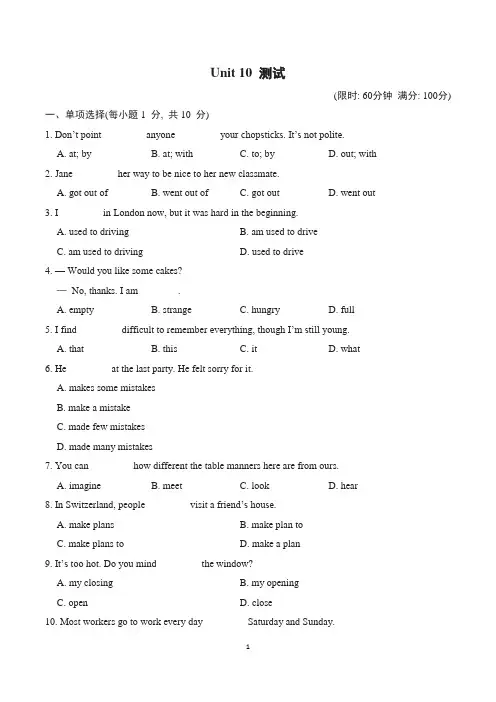
人教版九年级全一册英语同步培优Unit 10 同步检测试卷及答案
Unit 10 测试(限时: 60分钟满分: 100分)一、单项选择(每小题1 分, 共10 分)1. Don’t point ________ anyone ________ your chopsticks. It’s not polite.A. at; byB. at; withC. to; byD. out; with2. Jane ________ her way to be nice to her new classmate.A. got out ofB. went out ofC. got outD. went out3. I ________ in London now, but it was hard in the beginning.A. used to drivingB. am used to driveC. am used to drivingD. used to drive4. — Would you like some cakes?—No, thanks. I am________.A. emptyB. strangeC. hungryD. full5. I find ________ difficult to remember everything, though I’m still young.A. thatB. thisC. itD. what6. He ________ at the last party. He felt sorry for it.A. makes some mistakesB. make a mistakeC. made few mistakesD. made many mistakes7. You can ________ how different the table manners here are from ours.A. imagineB. meetC. lookD. hear8. In Switzerland, people ________ visit a friend’s house.A. make plansB. make plan toC. make plans toD. make a plan9. It’s too hot. Do you mind ________ the window?A. my closingB. my openingC. openD. close10. Most workers go to work every day ________ Saturday and Sunday.A. besideB. besidesC. exceptD. except for二、完形填空(每小题1. 5 分, 共15 分)British people are famous for apologizing (道歉)in almost every situation. Whether they are apologizing for asking a question, for the bad weather or _______11 they sneezed (打喷嚏), they are probably the number one nation for apologies.British people take pride in ________12 on their polite manners towards one another in public. As a result, they often use the word “sorry” —even when they don’t really ________13 it! Usually, if they want to ask a stranger for the time, they will ________14 by saying “Sorry to trouble you.” If th ey’re five minutes late ________15 an appointment(约会), they will generally greet the person by saying “Sorry I’m late.”If they’re 15 minutes late, they might want to be even more apologetic and say, “I’m ________16sorry I’m late!”________17 do British people use “sorry” so much? Well, in the British culture, saying “sorry” is a way to be polite, ________18to people whom they don’t know very well.It’s also a very smart way to get what they want. In recent research, an actor got close to ________19 strangers on a rainy day to ask if he could use their mobile phones. When he walked to one group of strangers and asked them without apologizing first, he was only 9 percent successful in ________20their phones. However, when he apologized to another group of strangers for the bad weather before asking, he was 47 percent successful.11. A. until B. although C. unless D. because12. A. themselves B. yourselves C. ourselves D. himself13. A. prefer B. mean C. know D. imagine14. A. stop B. leave C. finish D. start15. A. before B. for C. of D. from16. A. just B. only C. so D. ever17. A. When B. Why C. How D. What18. A. especially B. possibly C. suddenly D. hardly19. A. same B. strange C. smart D. different20. A. buying B. keeping C. borrowing D. lending三、<荣德原创> 阅读理解(每小题3 分, 共15 分)In China, young people have their coming-of-age ceremony mostly at school. They wear traditional Chinese clothing, waiting for their parents to put a hat on their head or stick a hairpin (发夹) in their hair. This comes from an old tradition—in ancient China, girls who reached 15 and boys who reached 20 would have hair-pinning or capping ceremonies(笄礼或冠礼).In the United States, turning 16 is a big deal. Most teenagers get their driver’s licenses at 16. Girls have“sweet 16”birthday parties when they turn 16 to celebrate their coming of age. They wear fancy clothes and have a special dance with their father.In Japan, Coming of Age Day is a national holiday that takes place on the second Monday in January. People who are 20 years old all officially come of age on this day. Girls do their hair in fancy styles, and put on kimonos(和服). Boys wear men’s kimonos or smart suits.In Germany, the coming-of-age ceremony is called Jugendfeier—“youth celebration”.During this ceremony, a teacher gives a speech to young adults, talking about values such as respecting others and being responsible.21. Where do most of the young Chinese have their coming-of-age ceremony?A. At school.B. At home.C. In the restaurant.D. In the neighborhood.22. Why is“turning 16”a big deal for the teenagers in the US?A. They can get their driver’s licenses.B. They can have birthday parties.C. They can do what they like.D. They can celebrate their coming of age by themselves.23. Which of the following dates may be Coming of Age Day in Japan?A. January 2nd.B. January 9th.C. January 16th.D. January 28th.24. What is Jugendfeier in Germany?A. A birthday party.B. A special present.C. A parents’ meeting.D. A youth celebration ceremony.25. What is the passage about?A. The school ceremony in different countries.B. Teenagers around the world.C. The coming-of-age ceremony in every culture.D. The relationship between the children and their parents.四、词汇运用(每小题2 分, 共10 分)用所给词的适当形式填空。
2016 2017人教版英语九年级Unit10单元练习含答案

Unit10 You're supposed to shake hands.单元练习一、听力(听力)(共20小题;共20分)一、听力部分(20分)Ⅰ.听句子,选出该句的最佳答语(5分)1. A. No, thanks. B. You are welcome. C. It doesn't matter.C. Here you are.B. I'd love to.2. A. Yes, please.A. Not at all. 3.B. I hope you have a good visit.C. With my parents.A. It doesn't matter.4.B. Good idea.C. I'm glad that you like it.C. Three years ago. A. Since 2000. B. In 2000. 5.分)Ⅱ.听对话和问题,选择正确的答案(5C. Kiss.B. Bow. 6. A. Shake hands.C. A box of chocolate. 7. A. Some flowers. B. A basketball.C. Life.A. Table manners.B. Some sayings.8.C. A. 9. B.C. Canada.10. A. China.B. South Korea.. Ⅲ听语段、对话和问题,选择正确答案(5分)11. What is David doing? A. He is visiting Beijing.B. He is writing his experiences in Beijing.C. He is writing about Beijing. 12. How long did David stay in Beijing?C. For two weeks. A. For a month. B. For a week.13. How many places of interest did David visit in Beijing? B. Three.C. We don't know.A. Two.14. Why did David make some mistakes in Beijing? A. Because of the different customs.B. Because of his carelessness.C. Because of the different languages.15. What did Lin Tao do when David made mistakes?A. Laughed at him.B. Helped him.C. Did nothing.Ⅳ.听短文填空(5分)In most Western restaurants and homes there are rules about how to talk and eat.Usually dinner is enjoyed with xvi. , and people are not allowed to talk aboutxvii. . For example, if someone wants to leave the table to use the toilet, he has to do itwithout mentioning what he is going to do.Meals are always xviii. . No eating noises are allowed. Therefore, people have to eat withtheir xix. . While xx. , coffee or wine, slurping is also not allowed.16.17.18.19.20.二、单项选择(共15小题;共15分)21. Students are not supposed at school.A. to smokeB. smokingC. smokeD. smokes22. Listening to the music always makes me .A. relaxed; relaxingB. relaxed; relaxedC. relaxing; relaxingD. relaxing; relaxed23. My parents and teachers always me progress. So I have to work hard.A. hope; to makeB. wish; makeC. expect; makeD. expect; to make24. It's too hard for him the exam. He hardly studies.A. pass D. passedB. passingC. to pass25. It is important people learn team spirit.A. of; of D. to; toB. of; toC. for; to26. --- I'm sorry. I didn't do a good job.--- That's OK. You did your best .A. after allB. in allC. at allD. first of all27. The book is useful. It is worth .D. readsB. readC. readingA. to read28. I used to eat a lot in the morning. However, I used to eating anything now because Ialways sleep late.A. don'tB. didn'tC. haven'tD. am not29. We all reached the top of the mountain Danny. He was too tired. So he stopped to restbeside the road.A. besideB. besidesC. exceptD. except for30. China is making great efforts the traditional culture.A. to developB. developingC. developedD. develop31. We are supposed the lost child at once.A. findB. to finding D. to findC. finding32. --- Did you enjoy the concert last night?--- Not very much. The soft music made me . I soon fell asleep.A. excitedB. relaxedC. surprisedD. interested33. --- You look sad. What has happened?--- Everyone us the match, but we lost.A. expect; winB. expected; to winC. expect; to winD. expected; to beat34. is really hard them to climb Mount Qomolangma.A. This; to D. It; toB. It; forC. This; for35. It's important the piano well.A. of him to playB. for him to playD. for him playingC. of him playing三、单词拼写(单句首字母填空)(共10小题;共10分)36. Please listen to some light music, and it can make you feel r .37. It's polite of you to g others by saying hello.38. The dictionary that my father bought for me many years ago is still of great v .39. It's good m to say hello when you meet each other.40. She wanted to e the blouse, because it didn't fit.41. As a gentleman, you should learn how to b at the dinner table.42. Can you give me some s about my plan?43. Chinese, maths and English are three b subjects for Chinese students.44. Everyone e Jim knows Mr. Brown. Jim is a new comer.45. In 1938, Bethune went to n China, as he knew many people were dying in the war.四、单词拼写(根据中文提示拼写单词)(共10小题;共10分)46. Our school does an (交流) with a school in America.47. I like soft music. It always makes me (轻松的).48. Why didn't you (敲) at the door before you came in?49. You must take your (护照) when you go abroad.50. China is an old (东方的) country in Asia.51. Different countries have different (风俗).52. None of the books are of great (价值) to us teenagers.53. In order to make a good impression, you should learn to (表现) in an interview first.54. I hope you can give me as many (建议) as possible, Tony. I really need your help.).努力55. You should make your dream come true through your own (五、翻译(根据中文提示完成句子)(共5小题;共10分)56. 我们应该在一份报告中来描述我们自己。
人教版九年级英语全册 Unit10 单元测试题(含答案)

人教版九年级英语全册 Unit10 单元测试题(含答案)本卷共七大题,分为第一卷(客观题)和第二卷(主观题),满分为120分。
第一卷I. 单项选择(共30分每空1分)1.–Did you see Mr Smith when you were in France ? -- No , when I _____ France , he had gone to China .A.had arrived toB. arrived toC. had got toD. got to2.–Why didn’t you give the wallet to the man at once ? -- He ______ before I realized it was his .A. had been disappearedB. has disappearedC. had disappearedD. has been disappeared3.We should return the books to the library ______ time .A. AboutB. onC. byD. For4. -- _______ you ever ______ to the United States ? -- Yes , twice .A. Have ; goneB. Have ; beenC. Do ; goD. Were ; going5.–Boys and girls ! Please ______ your compositions after class . –Oh , my God ! I ______ it at home .A. hand in ; forgotB. hand in ; leftC. hand out ; forgotD. hand out ; left6.During the seven-day holiday , ______ families went sightseeing .A. thousandB. thousandsC. thousands and thousandsD. thousands of7.–Why doesn’t Jack get his TV set repaired ? –I know _____ . He wants to buy a new one .A. why he doesn’tB. why doesn’t heC. how doesn’t heD. how he doesn’t8.–Rick ! Your jacket is wet through . Didn’t you listen to the weather report this morning ? --No , I didn’t . I was in a hurry , besides , it ______ when I left .A. hadn’t rainedB. would rainC. rainedD. wasn’t raining9.Lots of people in our city ______ the old and the disabled . They usually offer their seats to them on buses or help them cross the road .A. care forB. take careC. agree withD. take pride in10.–Did you see Tom at the party ? –No , he ______ by the time I got there .A. leftB. was leavingC. had leftD. has left11.The film _____ for ten minutes when I got to the cinema .A. had begunB. has been onC. had been onD. has begun12.By the time I reached home , my brother _______ to work .A. wentB. has goneC. had goneD. was gone13. We ______ too late last night , so we are quite exhausted now .A. showed upB. called upC. stayed upD. set up14.A quarter of the students _____ interested in English now .A. isB. areC. wasD. Were15. –Jack , how are you feeling today ? –Much _____ . I think I can go to school tomorrow .A. betterB. worseC. brighterD. Weaker16. —How much do I owe you for lunch? —______. It’s nothing.A. You’re welcomeB. Forget itC. With pleasureD. That’s right17. I felt _________ when my wife complained the food was terrible.A. embarrassingB. embarrassedC. excitedD. exciting18. —Why are you angry with Michael?—Because I waited for him for two hours last night, but he didn’t _________ at last.A. show upB. hand upC. come upD. stay up19. —What did Mr. Wang say just now?—He __________ the results of the basketball game.A .fled B. announced C. created D. developed20. —How was your English examination, my dear?—I did well, mom __________, Jason didn’t do very well .He has to study hard.A. casuallyB. probablyC. luckilyD. unfortunately21. —How many people are coming to the game next month?—It’s hard to say. _________ people, I think.A. Thousand ofB. Thousands ofC. Two thousandsD. Two thousands of22. What happened _________ your little sister _________ April Fool’s Day?A. on; inB. at; onC. by; atD. to; on23. —There goes the bell. It’s time for home.—Sorry, it’s just my alarm clock _________.A. going offB. running offC. setting offD. breaking off24. —I can see some students in Class Two playing in the playground.—Yeah, they are playing happily. But where are __________ students?A. othersB. the otherC. anotherD. the others25. There are many changes here.You can find many tall buildings on _________ sides of the streets.A. allB. eachC. bothD. either26. —Why are you so hungry?—Oh, I was reading a book at lunch time .It’s _________ interesting _________I forgot to eat.A. such; thatB. so; thatC. too; toD. enough; to27. Susan __________ her schoolbag in the library, so she had to fetch it.A. forgotB. lostC. leftD. fell28. —How long have your uncle and your aunt _________?—For three years.A. marriedB. has marriedC. got marriedD. been married29. —Did you return the book yesterday?—No, the library _________closed by the time I got there.A. would beB. isC. had beenD. has been30. —Give my best wishes to your mother.—__________.A. Thank you for your kindness.B. It doesn’t matter.C. It’s my pleasure.D. Are you kidding.II. 完形填空(共10分每空1分)The United States, Great Britain took the war(战争) on Iraq(伊拉克) in late March, 2003. 1 over twenty days, American soldiers were in Baghdad, the 2 of Iraq. They ended the government(政府) of Saddam. 3 Iraqis died in the war. Saddam is 4 . No one knows 5 he’s dead or alive.In some parts of the city, there was no light because of the war. Some oil wells were set on fire. Now the Iraqis need food, water and 6 . Many soldiers and people who were hurt in the war need hospital care. People also need 7 to find their family members.After the war, some Iraqis broke into Saddam’s palace, government buildings and stores. They 8 many things from Iraqi Museums. Other Iraqis are angry that the U.S. soldiers didn’t stop the robbers. So far there is 9 no government of Iraqis.The reason for American soldiers taking the war is that they are 10 weapons of mass destruction (大规模杀伤性武器). But by June 6, they hadn’t found any at all.( )1.A. to B. After C. By D. During( )2.A city B. town C. capital D. village( )3. A. Thousand B. Thousands C. Thousand of D. Thousands of( )4. A. tired B. run C. gone D. forgotten( )5. A. if B. when C. how D. that( )6. A. spaceships B. flowers C. peoples D. medicine( )7. A. an idea B. a way C. a plane D. a bridge( )8. A. bought B. borrowed C. stole D. brought( )9. A. still B. ever C. yet D. already( )10. A. looking at B. looking for C. giving up D. putting downIII. 阅读理解(共30分每题2分)AMy friend, a doctor at a hospital, had finished a physical exam on an eight-year-o ld boy when the mother told the doctor that his son was always having junk food. The doctor thought how he might get the child to see the light of his poor eating habit. “So ” he asked, “What do you want to be when you grow up?”“I want to be a doctor,” said the boy.“I’ve got him now, ”thought the doctor. “And what would you say to a boy when his mother complained that he was having too much junk food?”At once, the boy replied, “I also ate junk food when I was a child, and look at me now?”1. What was the boy’s problem?A. He was often ill.B. He liked junk food very much.C. He didn’t want to have a physical exam.D. He didn’t want to eat anything.2. The doctor tried .A. to let the boy understand it was bad to have too much junk foodB. to give the boy more junk foodC. to test if the boy was cleverD. to make the boy eat no junk food3. What answer did the doctor expect to hear about his second question?A. It’s not good for you to have too much junk food.B You’ll be stronger if you eat more junk food.C.It doesn’t matter to eat too much junk food.D. Listen to your mother, and you’ll have more junk food.4. The story mainly tells us that .A. boys are clever than the doctorB. junk food is bad for healthC children have their way of thinking D. boys shouldn’t eat too much junk food5. What’s the best title (标题) for this passage?A. A Clever BoyB. A Foolish DoctorC. An Unexpected (未曾料想到的) BoyD. An Unexpected AnswerBWhen you want to go shopping, decide how much money you can spend for new clothes, think about the kind of clothes you really need, then look for those clothes on sale. There are labels(标签)inside all new clothes.The labels tell you how to take care of your clothes. The label for a shirt may tell you to wash it in warm water. A sweater label may tell you to wash by washing in col d water. The label on a coat may say “dry clean only”, washing may ruin (损坏)this coat. If you do as the directions(说明)say on the label, “you can keep your clothes looking their best.”Many clothes today must be dry cleaned. Dry cleaning is expensive. When buying new clothes, check(核实)to see if they will need to be dry cleaned. You will save money if you buy clothes that can be washed.You can save money if you buy clothes that are well made. Well-made clothes last longer. They look good even after they have been washed many times.Clothes that cost more money are not always better made. They do not always fit better, Sometimes less expensive clothes look and fit better than more expensive clothes.6. If you want to save money, you can buy clothes that_______.A. don’t fit youB. don’t last longC. need to be dry cleanedD. can be washed7. The labels inside the clothes tell you_______.A. how to keep them looking their bestB. how to save moneyC. whether they fit you or notD. where to get them dry cleaned8. The first thing for you to do before you buy clothes is ______.A. to look for well-made clothesB. to see how much money you can payC. to know how to wash themD. to read the labels inside them9. We learn from the reading that cheaper clothes _______.A. are always worse madeB. must be dry cleanedC. can not be washedD. can sometimes fit you better10. The best title(标题)for the reading should be_______.A. Buying Less Expensive ClothesB. Taking Enough Money When ShoppingC. Being a Clever Clothes ShopperD. Choosing the Labels inside New ClothesCCamilla Chomp was a strange little girl. She liked to spend her time eating chocolate. Her parents were worried, so they took all the chocolate away.Camilla left her house to look for some chocolate. She found a small house full of bottles. Among the bottles, a blue bottle caught Camilla’s eyes. It was full of chocolate. In the bottle there was also a card with the words “Change tears(眼泪) into chocolate.”Camilla was very excited. She ran out of the house with the bottle to look for someone crying. First, she met a little boy crying hard and collected his tears. The tears were quickly changed into chocolate. While Camilla was collecting the tears, she comforted the boy. Finally, the boy stopped crying and they had a good time together.Later, Camilla met a woman and an old man crying. The woman had broken some bowls. And the old man’s dog had just died. Camilla collected their tears and made them happy again.Soon, Camilla knew that making people happy was much more important than finding chocolate. So she stopped collecting tears and began to help sad people. As a result, she had many friends and had a happy life.11. Camilla liked to _________.A. eat chocolateB. read booksC. collect coinsD. eat fruit12. Camilla’s parent took away all the chocolate because they were_____.A. happyB. angryC. worriedD. Hungry13. What caught Camilla’s eyes?A. A nice card.B. A black dog.C. A red cup.D. A blue bottle.14. The old man was crying because ________.A. he had broken some bottlesB. he couldn’t find his way homeC. he couldn’t find his daughterD. his dog had just died15. How many people did Camilla help before she stopped collecting tears?A. OneB. TwoC. ThreeD. Four第二卷IV. 词汇(共10分每题1分)A. 根据首字母及汉语提示完成句子1. Thomas Edison had 2000 i ___________ in his life.2. He has many ___________ (亲戚) in that city, so he chose to work there.3. She was t __________ , because she really wanted to get married.4. The UFO that the young man d __________ yesterday was not true.5. I r _________ I had made a bad mistake in the English exam.B. 用所给单词的正确形式填空。
九年级英语:unit10_You_are_supposed_to_shake_hands同步练习
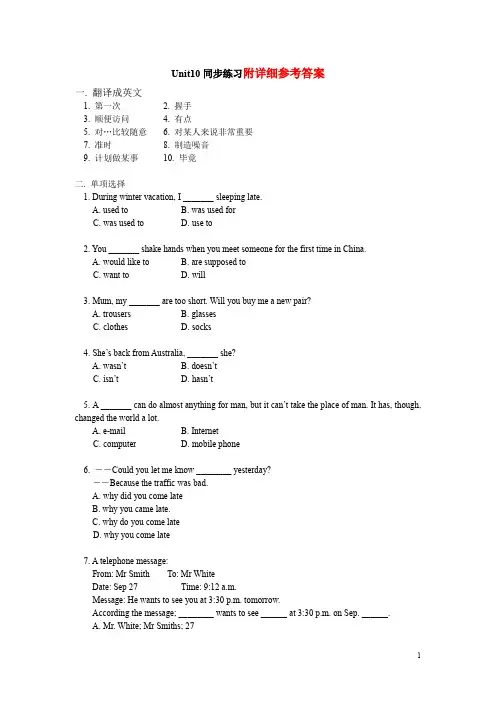
Unit10同步练习附详细参考答案一. 翻译成英文1. 第一次2. 握手3. 顺便访问4. 有点5. 对…比较随意6. 对某人来说非常重要7. 准时8. 制造噪音9. 计划做某事10. 毕竟二. 单项选择1. During winter vacation, I _______ sleeping late.A. used toB. was used forC. was used toD. use to2. You _______ shake hands when you meet someone for the first time in China.A. would like toB. are supposed toC. want toD. will3. Mum, my _______ are too short. Will you buy me a new pair?A. trousersB. glassesC. clothesD. socks4. She’s back from Australia, _______ she?A. wasn’tB. doesn’tC. isn’tD. hasn’t5. A _______ can do almost anything for man, but it can’t take the place of man. It has, though, changed the world a lot.A. e-mailB. InternetC. computerD. mobile phone6. --Could you let me know ________ yesterday?--Because the traffic was bad.A. why did you come lateB. why you came late.C. why do you come lateD. why you come late7. A telephone message:From: Mr Smith To: Mr WhiteDate: Sep 27 Time: 9:12 a.m.Message: He wants to see you at 3:30 p.m. tomorrow.According the message; ________ wants to see ______ at 3:30 p.m. on Sep. ______.A. Mr. White; Mr Smiths; 27B. Mr Smith; Mr. White; 27C. Mr White; Mr Smith; 28D. Mr Smith; Mr White ; 288. I believe scientists will _________ a way to beat SARS.A. get on withB. come up withC. go on withD. catch up with9. -Is ________ ready for dinner?-No, the table hasn’t been set yet.A. anythingB. everythingC. somethingD. nothing10. He is ________. Could you pass _______ a glass of water, please?A. tired; hisB. angry; mineC. thirsty; himD. hungry; me三. 完形填空:(A)Where I’m from, we’re protty 1 about time. If you tell a friend you’re going to their house for dinner, it’s okay if you arrive 2 late. 3 time with family and, friends 4 very important to us. We often just drop 5 our friends’ homes. We don’t usually have to 6 plans to meet our friends. Often we just walk around the town center, seeing as 7 of our friends as we can!1. A. relax B. relaxing C. relaxed2. A. a bit B. a little C. a few3. A. Spend B. Spent C. Spending4. A. is B. are C. were5. A. on B. to C. by6. A. make B. do C. did7. A. much B. many C. more(B)Manners(礼貌)are important to happy relations (关系)among people. No one 1 a person with bad manners. A 2 with good manners never laughs at people when they are in trouble. Instead, he 3 to help them. When he asks for something, he says “ 4 . ”And when he receives something, he 5 says “Thank you”. He does not interrupt(打扰) 6 people when they are talking. He does not talk loudly or laugh loudly 7 public. When he sneezes or spits(吐痰), he uses a 8 . If you are late, you 9 make an apology (道歉)to the teacher either at the time 10 after class.1. A. thinks B. likes C. hates D. loves2. A. boy B. man C. person D. give3. A. tries B. wants C. has D. enjoys4. A. Give me B. Please C. Yes D. Hello5. A. never B. sometime C. usually D. still6. A. every B. some C. his D. other7. A. on B. at C. of D. in8. A. book B. cup C. handkerchief D. hand9. A. should B. will C. could D. may10. A. or B. nor C. and D. but四. 阅读理解(A)Do as the Romans DoThe customs in different countries are rather different. If I have dinner with a Chinese host, he always puts more food onto my plates as soon as I have emptied it. That often discomforts me greatly. I have to eat the fo od even if I don’t want to, because it is considered bad manners in the West to leave one’s food on the plate. I have already noticed that when a Chinese sits at an American’s dinner party, he very often refuses the offer of food or drink though he is in f act still hungry or thirsty. This might be good manners in China, but it is not in the West at all. In the United States, it is impolite to keep asking someone again and again or insist on his accepting something. Americans have a direct way of speaking. If they want something, they will ask for it. If not, they will say, “No, thanks.”When an American is fed with beer by the host, for example, he might say, “No, thanks. I’ll take some diet, Pepsy-Cola(百事可乐)if you have it. ”That is what an American will do. So when you go to the United States, you had better remember the famous saying: When in Rome, do as the Romans do.1. From the passage, we can know that the Chinese are usually ________ to the guests.A. very hotB. rudeC. impoliteD. cold2. When a foreigner has dinner with a Chinese host, he often feels _______.A. pleasantB. uncomfortableC. satisfiedD. happy3. Why does a Chinese often refuse the offer of food or drink at a dinner party?A. He has had enough.B. He is shy.C. He is afraid that others will laugh at him.D. He thinks it’s polite to do that.4. When an American wants something to eat or drink at a dinner, he will _______.A. ask for it boldlyB. refuse the offerC. ask for it directlyD. express himself indirectly5. “When in Rome, do as the Romans do”means “________”.A. When you got to Rome, you should act as the Romans doB. When you stay in Rome, you should do as the Romans doC. When you are in a new country, you should do as the locals doD. Romans can be an example for you(B)In England, afternoon tea, taken between four and five, is the most informal (非正式)meal of the day. If you are a friend of the family, you may drop in for tea without an invitation or telling that you are coming. Very often it is not served at a table. The members of the family and visitors take tea in the sitting-room. Each person has a cup and saucer(托盘), a spoon(汤匙)and a small plate for bread-and-butter and cake. By the way, do not help yourself to cake first; bread-and-butter first, then cake if there is any. Another piece of advice: Do not put more than one piece of bread or cake on your plate at the same time.Choose the best answer according to the passage:1. Afternoon tea is usually served with ______.A. tea onlyB. tea and some foodC. tea, dessert and meatD. cake and bread2. If you want to have afternoon tea in a friend’s home, _______.A. it is necessary for you to send a messageB. you should wait for his invitationC. it is impolite for you to go there without taking anything with youD. it is unnecessary for you to call him or send a message3. In the passage, “drop in”means “_________”.A. pay an informal visitB. fall downC. drink at a friend’s homeD. break4. It’s impolite for you ______.A. help yourself to cake firstB. share a cup with your friendC. put more than one piece of bread or cake on your plate onceD. all of the above5. Which of the following is NOT true?A. Afternoon tea is often taken in the sitting-room.B. The members of the family often share a cup and saucer, a spoon, etc.C. Afternoon tea is usually taken between lunch and supper.D. Help yourself to bread-and-butter before cake if there is any.(C)Some British and American people like to invite friends for a meal at home. You should not be upset(不安的)if your English friends don’t invite you home. It doesn’t mean they don’t like you.Dinner parties usually start between 7 and 8 p.m. and end at about 11. Ask your hosts(主人)what time you should arrive. It’s polite to bring flowers, chocolates or a bottle of wine as a gift.Usually the evening starts with drinks and snacks(小吃). If you want to be extra polite, say how much you like the room, or the pictures on the wall. But remember-it’s not polite to ask how much things cost.In many families, the husband sits at one of the table and the wife sits at the other end. They eat with their guests.You’ll probably start the meal with soup or something small, then you’ll have meat or fish with vegetables, and then dessert(甜点心), followed by coffee. It’s polite to finish everything on your plate and to take more if you want it.Did you enjoy the evening? Call your hosts the next day, or write them a short “thank you”letter. British and American people like to say “thank you, thank, thank you”all the time!1. If your English friend doesn’t invite you to dinner at home, it means he or she ______.A. doesn’t like youB. likes youC. can’t afford to do soD. is too busy2. It’s impolite ______.A. to ask about the price of a certain thingB. to say “thank you”to hostsC. take nothing with you when you are invited to dinnerD. to eat up everything on your plate3. The meal ends with _______ usually.A. soupB. coffeeC. meat or fishD. dessert4. When you are invited to a dinner party, you’d better _______.A. ask what time you should arriveB. take your wife with youC. drink as more as possibleD. eat more snacks as you can5. Which of the following is true?A. The hosts like the people who sit closer to them.B. The hosts like the people who ask them time, price, age, etc.C. The husband and the wife usually sit together.D. You can call your host the next day or write a letter of thanks after that.五. 写作:请你写一篇文章来介绍一下中国一些方面的风俗习惯,可以包括以下这些方面:·Greeting·eating meals with other people·attending a party目标句型:be supposed to do【试题答案】一.1. for the first time2. shake hands3. drop by4. a bit5. be relaxed about6. be important to7. on time8. make noise9. make plans to 10. after all二. 1. C 2. B 3. A 4. C 5. C6. B7. D8. B9. B 10. C三. (A)1. C 2. A 3. C 4. A 5. C 6. A 7. B(B)[析]题1 like作为实意动词是喜欢之意,而love是爱。
人教版九年级英语全册 Unit10 测试题(含答案)

人教版九年级英语全册 Unit10 测试题(含答案)一、单项选择。
(每小题1分,共10分)1. —Jack, you should mind your ____. It is impolite to talk loudly in public.—Sorry, Mom. I'll remember what you said.A. suggestionB. directionC. mannersD. passport2. [易错题]—The competition will begin soon, but Paul looks very ____.—Oh, he has well prepared for it. He is sure of winning it.A. worriedB. interestedC. surprisedD. relaxed3. —Shall we go to the museum tomorrow morning?—I'm afraid not. The museum is open every day ____ Monday.A. likeB. duringC. exceptD. without4. We find ____ more useful for students to do new eye exercises.A. itB. thisC. oneD. that5. —How did Mike ____ in the group work?—Very well. Mr. White was very satisfied with him.A. behaveB. remainC. decideD. choose6. [易错题]—What do you think of the movie Jurassic World?—Very wonderful. It is well worth ____.A. seeingB. being seenC. to seeD. to be seen7. —What do you think I ____ buy for Maria?—I think a bunch of flowers is a good choice.A. am ready toB. am excited toC. am surprised toD. am supposed to8. —My grandma is used to ____ in the countryside.—Oh. So is my grandma.A. liveB. livesC. livingD. lived9. —This is so difficult that I want to give up.—Take it easy. ____,it takes time to learn something new.A. In that caseB. For exampleC. By the wayD. After all10. —I am sorry for being late for the party.—____ We have just started.A. What a pity!B. How come?C. You're welcome.D. It's no big deal.二、完形填空。
人教版英语九年级全册 Unit 10 单元测试题(有答案)
人教新目标英语九年级全册Unit 10 单元测试题一.单项选择。
(每小题1分,共15分)1.It’s bad for your eyes _____computer games too much.A. playsB. to playC. playD. to playing2.There is _____ milk at home, We have to buy some this afternoon.A. a littleB. littleC. a fewD. few3.Don’t waste water, Water is very important and no one can live it.A. withoutB. withC. exceptD. but4.On weekends, I have nothing to do but ________ TV.A. to watchB. watchingC. watchD. watched5.We need fifteen more people _____our team to do the job.A butB exceptC as wellD besides6.---Did you go to the movie with Lucy? --- No , I _____A .didn’t inviteB wasn’t invitedC hadn’t invitedD wasn’t inviting7.---I don’t know ______next. – You could ask your teacher for help.A how to doB what to doC . why to doD when to do8.I have ____the English club for three terms.A. joined B been in C taken part in D become a member of9. The big bowl ____wine warm in the old days.A was used for keepingB is used by keepingC was used by keepingD is used to keep10. My grandfather ___ me stories when I was young .A .was used to tellB .is used to tellingC .used to tellD .used to telling11. ____ expensive trousers!A. WhatB.What aC.HowD. What an12.--- Would you like to go there with me?--- Yes, I shall go unless I ____ too busy.A. won’t beB. will beC. am notD. am13.Because of the bad weather, we ________the meeting.A. put offB. took offC.cut offD. clean off14. ---Whose letter is that?——The letter ______in Chinese is to Li Lei.A. writesB. is writtenC. writtenD. writing15. My mother’s birthday is coming. I’m thinking about ____________.A. what present shall I get herB. how I can give her a surpriseC. where we had a big mealD. whether should I plan a party for her or not.二.完形填空。
人教版九年级英语 Unit 10单元测试题及答案
Unit10You’re supposed to shake hands.单元测试02一、听力理解(20小题,每小题1分,共20分)第一节听下面5段对话。
每段对话后有一个小题,从题中所给的A、B、C三个选项中选出最佳答案。
每段对话读两遍。
1.What are the Japanese supposed to do when they meet for the first time?A.To bow.B.To kiss.C.To shake hands.2.When do people in Colombia usually arrive if they are invited to a party at6:30?A.Just6:30.B.Before6:30.C.A little later than6:30.3.What’s Ann doing while eating noodles?A.Making a noise.B.Keeping quiet.C.Eating too slowly.4.What do girls wear in winter in Japan?A.Shirts.B.Skirts.C.Dresses.5.People should________when they meet for the first time in Mexico.A.kissB.bowC.shake hands第二节听下面几段对话或独白。
每段对话或独白后有几个小题,从题中所给的A、B、C三个选项中选出最佳答案。
每段对话或独白读两遍。
听下面一段对话,回答第6至第7两个小题。
6.What happened to John?A.He had an easy exam.B.He may fail an exam.C.He lost interest in study.7.What’s the girl’s advice for him?A.Try to change the result.B.Try to pay more attention to the exam.C.Try to pay more attention to the future study.听下面一段对话,回答第8至第10三个小题。
人教版九年级英语全册同步检测Unit 10 课后练习
Unit 10 You're supposed to shake hands课后练习题一:He said gently, held out his right hand and was ready to _______ with me.A. shake handB. shakes handsC. shake handsD. shakes handI think that a student’s life ________ be full of energy and passion.A. was supposed toB. is supposed toC. be supposed toD. are supposed to______ they supposed _______ today?A. Are , to turn them inB. Do, to turn them inC. Are , turn them inD. Do, turn them in题二:The Premier comes over to _______ with him to make him very excited.A. shake handB. shakes handsC. shake handsD. shakes handThese batteries ________ last for a year.A. was supposed toB. is supposed toC. be supposed toD. are supposed to______ he supposed _______ here tonight?A. Is; beB. Is; to beC. Does; beD. Does; to be题三:当上课迟到的时候你应该和老师道歉。
You ____ __________ ____ say sorry when you ____ _____ _____ _____.你不应该把筷子插在食物里。
(人教版)初中英语九年级 Unit 10单元测试01(含答案)
Unit 10 You’re supposed to shake hands. 单元测试第一卷听力部分(15分)Ⅰ.听句子,选择与所听句子相符合的图片(5分)1.A B C2.A B C3.A B C4.A B C5.A B C Ⅱ.听两段较长对话,选择最佳答案(5分)6. A. At 8:00. B. At 8:10. C. At 7:50.7. A. To bow. B. To kiss. C. To shake hands.8. A. Different opinions about time in different countries.B. People in Colombia like to be on time.C. People in Switzerland are relaxed about time.9. A. Visiting a factory. B. Giving a talk. C. Having a holiday.10. A. Lucy’s. B. Lily’s. C. Linda’s.Ⅲ.所短文,完成表格信息。
每空一词(5分)第二卷笔试部分(85分)Ⅳ.单项选择(10分)16.—Do you often ________ your friends’ homes on your way home?—Yes, we do.A. drop byB. visit toC. come atD. come over17. Don’t point ________ anyone _________ your chopsticks. It’s not polite.A. at; byB. at; withC. to; byD. to; with18.—All the workers went home yesterday ________ Mr White. Why?—Because he was on duty.A. besideB. besidesC. exceptD. but19. The restaurant owner ________ his way to see if all his guests are well satisfied.A. gets outB. goes outC. get out ofD. goes out of20.—The basket is ________ Will you please help me fill it with apples?—My pleasure.A. emptyB. StrangeC. brokenD. full21.—You’ve given us a wonderful Chinese dinner, Mrs Wang.—________.A. Oh, I’m afraid I didn’t cook very wellB. I’m glad you enjoyed itC. Come again when you are freeD. It’s not necessary for you to say so22. After ________ for a while, the whole building fell down.A. bowingB. bendingC. wipingD. shaking23. If you get into trouble, you can ________ your teacher ________ help.A. turn; toB. ask; forC. help; withD. look; for24. He ________ eat much junk food, but now he ________ eating lots of vegetables and fruit.A. used to; used toB. was used to; used toC. used to; is used toD. is used to; used to25.—I’ve put on ten pounds.—You should ________ to take more exercise every day.A. make sure ofB. make a plan forC. make a suggestionD. make an effortⅤ.完形填空(10分)What is rude and what is polite is different in different countries. Some things that many Chinese people do can be considered rude or not 26 in western countries. Here is some advice on what not to say or do. Let’s 27 .In business settings, one should never 28 a foreigner a cigarette. Smoking kills. Don’t kill anyone. That is true, and it smells very bad. Please don’t smoke!29 get angry at someone for going Dutch(各自付款) and 30 the bill when you eat out. In the west, it shows equal(平等的) respect. Try going Dutch. It is cheaper, and it shows equality. When eating dinner in Norway and the United States, it is polite to 31 everything on your plate to show that you enjoy the food.32 in some countries, it is polite to leave some of the food on your plate.Don’t use bad 33 at work. Even though some famous people use them, bad words are a sign of a bad education. Bad words should be used 34 or not at all.If you have to spit, clear your nose or clean your ears and do it in the bathroom where no one can 35 you. Don’t be a RUDE person at your office or in public.26. A. polite B. important C. particular D. pleased27. A. have a rest B. have a look C. have a try D. have a talk28. A. pick B. sell C. offer D. point29. A. Always B. Never C. Sometimes D. Often30. A. pay B. keep C. share D. take31. A. leave off B. take away C. put off D. eat up32. A. And B. But C. So D. Because33. A. words B. sentences C. passages D. texts34. A. as much as possible B. as little as possible C. as often as possible D. as soon as possible35. A. stop B. prevent C. see D. hurtⅥ.阅读理解(30分)ADinner customs are different around the world. If you are a guest in Ghana(加纳), this information will help you a lot.In Ghana, dinner is usually from four in the afternoon to six in the evening. But there are no strict rules about time. Whenever a guest arrives, a family offers food. When you go to a home, the person who receives guests takes you to the living room first. At this time everyone welcomes you. Then you go to the dining room. There you wash your hands in a bowl of water. All the food is on the table.In Ghana you usually eat with your fingers. You eat from the same dish as everyone else. But you eat from one side of the dish only. It is not polite to get food from the other side of the dish. After dinner, you wash your hands again in a bowl of water.Most meals in Ghana have a dish called fufu. People in Ghana make fufu from the powder(粉末) of some plants. Sometimes they cut the fufu with a saw(锯子) because it is very hard. You must chew fufu well, or you may get sick. You eat fufu with the fingers of your right hand only.36. From the passage we know that in Ghana ________.A. the rules for dinner time are not strictB. dinner is always at six in the eveningC. a family offers food only at four in the afternoonD. people usually invite their guests to dinner late in the evening37. If you are a dinner guest in Ghana, the host always takes you to ________.A. the dining room firstB. the living room. FirstC. the kitchen firstD. the garden first38. People in Ghana usually eat ________.A. from two sides of a dishB. from the other side of the dishC. with their fingersD. with their spoons39. In fact, most meals in Ghana ________.A. are cooked with the powder of some plantsB. have a dish called fufuC. are too hard to eatD. are very soft40. When you eat fufu, you’d better ________.A. cut it with a saw.B. use your right hand onlyC. chew it well.D. all of the aboveBSocial customs and ways, of behaving change all the time. Things that were considered impolite many years ago are now acceptable. Just a few years ago, it was considered to be impolite behavior for a man to smoke on the street. No. man who thought of himself as being a gentleman would make a fool of himself by smoking when a lady was in the room. .Customs also differ from country to country. Does a man walk on the left or the right of a woman in your country? Or that doesn’t matter? What about table manners?The Americans and British people not only speak the same language but also share a large number of socialcustoms. For example, in both America and England, people shake hands when they meet each other for the first time. Also most Englishmen will open a door for a woman or offer their seats to women, and so will most Americans. Promptness(准时) is important both in England and in America. That is, the dinner guest either arrives close to the time that has been made or calls up to explain his delay(耽误).The important thing to remember about social customs is not to do anything that might make other people feel uncomfortable—especially if they are your guests. There is an old story about a man who gave a very formal dinner party. When the food was served, one of the guests started to eat his peas with a knife. The other guests were amused or greatly surprised, but the host calmly picked up his knife and began eating in the same way. It would have been bad manners to make his guest feel foolish or uncomfortable.41. The underlined phrase “make a fool of himself” in the first paragraph means ________.A. make himself strongB. make himself richC. make himself comfortableD. make himself look like a fool42. According to the passage, the American people and the British people ________.A. don’t speak the same languageB. don’t have social customs in commonC. do share a lot of social customsD. do have the exactly same social customs43. If a dinner invitation is for six o’clock in England, th e guest is supposed to arrive ________ six.A. nearly or a minute or two later thanB. at a quarter pastC. at half pastD. much later than44. The last example in the passage shows ________.A. the correct way to use a knife at tableB. that it is good manners not to make your guest feel foolish or uncomfortableC. that social customs and ways of behaving change too fastD. that different-countries have different customs45. What’s the best title of the passage?A. Different CustomsB. Social CustomsC. Customs are Changing FastD. Different Countries, Different CustomsCIf you spend some time in an English-speaking country you might hear the term “etiquette”. It means normal and polite social behavior. This may seem like a difficult word at first, but it can be very useful to understand.Etiquette is not the same in every culture or in every situation. For example, standing very close to the person you are talking with is quite common in some Asian countries. However, if you do this in Europe, some people might feel uncomfortable. Even in China, we all know that etiquette is not the same in all situations. Perhaps we think that talking loudly in our own homes is fine, but there are other places where talking loudly is not allowed. For example, most people would agree that talking loudly in a library, a museum or a movie theater is impolite. Even if you are with your friends, it is better to keep your voice down in public places.If we see someone breaking the rules of etiquette, we may politely give them some suggestions. One of the politest ways is to ask someone, Would you mind doing this or Would you mind not doing that? People don’t usually like to be criticized, so we have to be careful how we do this.Although rules of etiquette can often be different, some rules are the same almost everywhere in the world! For example, dropping litter is almost never allowed. If you see someone you know doing this, you can ask him, Would you mind picking it up?46. What does the word “etiquette” mean?(根据短文内容回答问题)____________________________________________________________________________________________ 47. Find out the key sentence of Paragraph 2.(找出第二段的中心句)____________________________________________________________________________________________ 48. If your friend talks loudly in the library, what would you say to him/her?(根据你对短文的理解,写出一个委婉的建议)____________________________________________________________________________________________ 49.请将最后一段中的画线句子译成汉语。