
外研版小学英语四年级上册Module4.unit1
Do you want some rice?
(你想吃一些米饭吗?)
No,thak at that man.what is he doing?
(看那个人,他正在干什么?)
He's making noodles.
(他正在做面条)
Do you want some noddles?
课后作业
活动二 用A B对话形式, 抄写一遍(要求翻译汉语)抄写在课堂作 业上面。
Noodles and rice are very, very nice.
(面条和米饭非常美味。)
Juice with ice is also very nice.
(果汁加冰块也非常好喝。)
Look,Amy.Chinese fast food .
(艾米,你看。中国快餐!)
Chinese fast food
(西红柿鸡蛋面。)
noodles with tomato and egg
noodles with meat and potato
Mm,it's nice!
(嗯,真好吃)
Do you want some· · · ?
Yes, please.
No, thank you.
noodles
milk
Do you want some? Yes,please.
apples
pears
bananas
cakes
fish
meat
milk
eggs
tomatoes
potatoes
Module 4
unit 1
Do you want some rice ?
noodles
rice
very nice
juice
ice
juice with ice also very nice
(你想吃些面条吗?)
Yes,please.
(好的。给我一些吧!)
Here are noodles with tomato and egg,and noodles with meat and potato.what do you want?
(这里有西红柿鸡蛋面和土豆加肉面。 你想吃什么?)
Noodles with tomato and egg,please.
(外研版三起)四年级英语上册Module4《InthePark》第1课时Unit1教案

(外研版三起)四年级英语上册Module4《In the Park》第1课时 Unit1教案教学内容本课为外研版(三起)四年级英语上册Module4《In the Park》第1课时Unit1的教案。
教学内容围绕公园这一主题,通过听、说、读、写的活动,使学生能够理解和运用与公园相关的词汇和句型,如“go to the park”, “play on the swings”, “slide down the slide”等。
教学目标1. 知识与技能:学生能够理解并使用与公园活动相关的词汇和句型。
2. 过程与方法:通过听、说、读、写的练习,提高学生的英语交流能力。
3. 情感态度与价值观:培养学生对英语学习的兴趣和合作意识。
教学难点1. 正确发音和拼写公园活动相关的词汇。
2. 构建简单的句子描述在公园的活动。
教具学具准备1. 教材和练习册。
2. 与公园相关的图片和视频。
3. 白板和彩色粉笔。
4. 录音设备。
教学过程1. 课堂导入:通过展示公园的图片,引导学生讨论他们在公园喜欢做的事情。
2. 新知呈现:介绍新词汇和句型,通过视频和实物展示帮助学生理解。
3. 实践练习:进行角色扮演和小游戏,让学生在实际情境中运用所学知识。
4. 巩固提高:通过听力和阅读练习,加强学生对词汇和句型的掌握。
板书设计新词汇:go to the park, play on the swings, slide down the slide等。
句型: What do you like to do in the park? I like to公园活动的图片和简短描述。
作业设计1. 书面作业:完成练习册中与本课相关的练习题。
2. 口头作业:与家长或同伴用英语讨论在公园的活动。
3. 拓展作业:画一幅关于在公园的活动的画,并用英语描述。
课后反思课后反思应包括对教学效果的评估,如学生对新词汇和句型的掌握程度,以及课堂活动的参与情况。
同时,反思还应关注教学过程中的不足之处,如是否所有学生都有机会参与练习,以及如何改进教学方法以提高学生的学习兴趣和效果。
外研社(三起)四年级英语第四册:Module 4 Robots Unit 1 Robots will
外研社(三起)四年级英语第四册:Module 4 Robots Unit 1 Robots will do everything 教案教学目标•能够听懂并理解关于机器人的简单英文对话。
•能够用简单的英语表述机器人以及它们可以完成的任务。
•能够与同伴合作完成机器人的设计和介绍。
•通过本单元的学习,拓展学生的知识面,激发学生的创新思维,培养学生的英语交流能力和合作意识。
教学重点•能够听懂并理解关于机器人的简单英文对话。
•能够用简单的英语表述机器人以及它们可以完成的任务。
教学难点•能够与同伴合作完成机器人的设计和介绍。
教学准备•教材:外研社(三起)四年级英语第四册 Module 4 Robots Unit 1。
•大屏幕、投影仪等教学设备。
•学生们自己带来的废旧材料、未成型材料等,用于机器人的设计制作。
教学过程导入(5分钟)1.教师简单介绍机器人的发展历程,并展示一些与机器人有关的图片或视频,激发学生对机器人的兴趣和好奇心。
呈现(15分钟)1.教师放映课文 Unit 1 Robots will do everything 的视频,引导学生听视频中机器人相关的对话。
2.教师根据视频展示关键词汇:robot, do housework, do the dishes, do the laundry, cook, take care of children, walk the dog 等,并通过图片、动作等方式模拟机器人的各项任务,提高学生对这些任务的理解。
合作探究(20分钟)1.教师告知学生,他们需要分为若干小组,每组设计一个未来的机器人,并为机器人取一个英文名称。
2.学生们自己带来废旧材料等,根据小组的设计图纸开始机器人的设计和制作。
3.在制作过程中,教师为学生们提供必要的指导,督促学生们积极参与制作,呈现他们的天马行空的创意。
4.设计完成后,每个小组需要介绍他们的机器人的名称、功能、外形等英文特点。
学生可以通过图片、口语交流等方式进行展示。
Module4 Unit1 period1(说课稿及素材)外研社(三起)-四年级英语上
Module4 Unit1 period1(说课稿及素材)外研社(三起)-四年级英语上Teaching Aims(教学目标)1.能听、说、认读动物名称:elephant, lion, panda, rabbit, monkey, giraffe, camel, tiger。
2.能运用所学动物名称进行交流对话,激发学生学习英语的兴趣。
3.继续巩固和拓展数字1-10的认知和记忆。
4.继续培养学生的听力,学会通过听音识别单词。
Teaching Contents(教学内容)1.新词汇:elephant, lion, panda, rabbit, monkey, giraffe, camel, tiger。
2.数字1-10。
3.跟读、模仿练习课文,并进行角色扮演对话。
Teaching Procedures(教学过程)Step 1 Greetings and Lead-in(问候和导入,5 minutes)1.Greet the students and lead-in with greetings like “Good morning, children. How are you today?”.2.Show the students some pictures of different animals and ask them what they are. Encourage them to say the names of the animals aloud.Step 2 Presentation of New Vocabulary(新词汇呈现,10 minutes)1.Present the pictures of the new animals (elephant, lion, panda, rabbit, monkey, giraffe, camel, tiger) to the students, and introduce their names.2.Point to each animal on the picture, while saying the name of the animal, and ask the students to repeat after you.e gestures or facial expressions to help students better understand the meanings of the words.4.Ask students to try saying each animal’s name on their own.Step 3 Presentation of Numbers(数词呈现,5 minutes)1.Ask the students to show how many fingers they have.2.Introduce the numbers 1 to 10 using hand gestures.3.Write each number on the board and ask the students to repeatafter you.Step 4 Listening Comprehension(听力训练,10 minutes)1.Read aloud the vocabulary words and numbers.2.Play an audio recording of a short conversation involving the animals and numbers you have just introduced.3.Ask students to listen carefully and try to follow the conversation.4.Play the recording again, and ask students to repeat after the speaker.Step 5 Role-Playing(角色扮演,10 minutes)1.Divide the students into pairs.2.Ask one student in each pair to be the animal and the other student to be the zookeeper or visitor.3.Encourage the students to use the new vocabulary to imagine the conversation that would take place between the animal and the zookeeper or visitor.4.Walk around the classroom and monitor the students’ co nversations.Step 6 Assessment(练习和测试,10 minutes)e flashcards to test the students’ memory.2.Show a flashcard to the students and ask them what animal is on it.3.Ask students to count from 1 to 10.4.Call on individual students to read a word or a number.5.Give immediate feedback to the students.Step 7 Summary and Homework(课堂小结和作业布置,5 minutes)1.Summarize the key points of the lesson, emphasizing the new vocabulary, numbers, and listening comprehension practice.2.Ask students to review the new vocabulary and numbers and practice saying their own sentences using the new words at home.Teaching Materials(教学材料)1.Flashcards: elephant, lion, panda, rabbit, monkey, giraffe, camel, tiger.2.Audio recording of a conversation about the animals and numbers.3.Pictures of animals.Teaching Reflection(教学反思)1.The role-playing activity was effective in helping students to practice the new vocabulary in a fun way. It also gave them the chance to use the language in a real-life context, enhancing their motivation to learn.2.The assessment using flashcards and counting exercises may have been a bit too simple for some of the students. Next time, I will try to include more challenging assessment options.3.The use of gestures and facial expressions was helpful in conveying the meanings of the new words, especially for visual learners.I will continue incorporating various teaching methods to cater to diverse learning styles.。
外研版三起英语四年级上册Module 4 Unit 1 Do you want somerice课件

词汇大通关
adv.(副词)也,还
【近义词】too 也 【用法】also 和 too 表示“也”时通常用于肯定句,also
常用于句中,too 常用于句尾。 【例句】I like juice. I also like milk.
我喜欢果汁。我也喜欢牛奶。 【加法记忆】al + so 这么,那么 = also 也,还
词汇大通关
v.(动词)制作
【动词-ing形式】making 【短语】make noodles 做面条 【例句】Dad is making a kite. 爸爸正在制作风筝。 【谱系记忆】-ake: make 制作,cake 蛋糕,
lake 湖,take 拍摄
词汇大通关
n.(名词)番茄, 西红柿
【复数】tomatoes 【例句】—What’s this? 这是什么?
Module 4
Unit 1 Do you want some rice?
词汇大通关
n.(名词)食物
【形近词】good 好的 【短语】Chinese food 中餐 【例句】Let’s buy some food. 我们买一些食物吧。 【变换字母记忆】foot 脚 t改为d food 食物
词汇大通关
very nice.
Grammar Noodles and rice are very, very nice.
The noodles are very nice. 指食物“美味的”
Nice to meet you. 指心情“令人愉快的” Today is a nice day. 指天气“晴朗的” Your sister ia very nice. 指人“友好的”
【例句】I like juice. 我喜欢果汁。
小学英语新外研版(一起)四年级上册M4U1教案
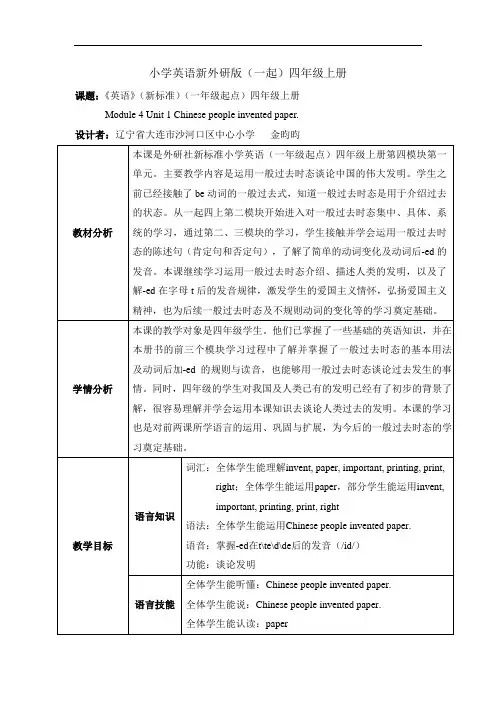
小学英语新外研版(一起)四年级上册课题:《英语》(新标准)(一年级起点)四年级上册
Module 4 Unit 1 Chinese people invented paper.
设计者:辽宁省大连市沙河口区中心小学金昀昀
2.(拓展训练)这些发明你知道吗?
教师出示“电话、收音机和篮球”这些贴近学生生活的
图片,并提问“你知道是谁(哪国人)发明的吗?”
PPT第27页
小结
与
布置作业(2分钟)1.小结
T: Now let’s look at the blackboard, what did we learn
today?
教师引导学生总结本课所学目标语句、词语及用法。
2. 布置分层作业,学生自主选做。
套餐A:抄写词汇、语句各4个;跟读课文2遍;
收集外国人的发明。
套餐B:抄写词汇、语句各2个;自读课文2遍;
收集外国人的发明。
套餐C:在本上写出你所喜欢的两种中国发明;
背诵课文;收集外国人的发明。
PPT第28页。
外研版英语四年级年级上册Module 4 Unit 1 Chinese people invente

Chinese people didn’t invent……
printed didn’t print
walked didn’t walk
played didn’t play
cleaned didn’t my homework. I helped my mum. I played basketball.
I didn’t clean my room. I didn’t paint a picture. I opened the door. I made a cake. I watched TV.
I didn’t roll a boat.
Magic eyes
Read the flashing words loudly and say out the Chinese meaning of them.
都二
能分
运浇
用灌
好,
“八
二分
八等
定待
律;
”二
,分
我管
们教
一,
起八
,分
静放
待手
花;
开二
。分
成
➢ Pure of heart, life is full of sweet and joy!
绩 ,
八
分
方
法
。
愿
全
天
下
所
有
父
母
我们,还在路上……
动词过去式的规则变化
• paint- painted
• play- played
• print- printed
• clean- cleane〔d d〕
• invent- invente〔d id〕 • phone- phoned
小学英语新外研版(一起)四年级上册Module 4 Unit 1《Chinese people invented paper》教案
小学英语新外研版(一起)四年级上册Module 4 Unit 1《Chinese people invented paper》教案第二课时教学目标1.掌握一般过去时的肯定结构和否定结构。
2. 能够运用目标语言来谈论中国发明的东西和不是中国发明的东西。
教学重点理解和掌握:Chinese people invented …… /Chinese people didn’t invented ……教学难点一般过去时的肯定结构和否定结构。
教学方法任务型教学法,小组讨论法,直观演示法。
课前准备图片,录音机课时安排1课时教学过程Step 1 Review1.Show the students some pictures .Encourage them to say out the four great inventions of ancient China :Printing ,paper ,compass ,gunpowder .e the sentence pattern to describe the pictures .Chinese people invented paper .Chinese people invented compass .Chinese people invented printing .Chinese people invented gunpowder .Step 2 Presentatione the pictures to present the new sentence pattern .Chinese people didn’t invent bicycle .Chinese people didn’t invent telephone .Chinese people didn’t invent plane .Chinese people didn’t invent computer .1.Help the students summarize the sentence pattern :主语+didn’t+动词原形+其他。
MK_外研版小学英语四年级上册Module4Unit1精讲精练
外研版小学英语四年级上册Module4Unit1精讲精练Unit 1 Do you want some rice?你想要一些米饭吗?【学习目标】1)掌握并运用单词:Chinese fast food,want,some,juice,make,ice, food,tomato,potato,egg ,, 2) 熟练运用句型:——Do you want some …?——Yes, please. / No, thank you.3)能运用所学的语言知识在创设的情境中进行熟练的交际,并在此基础上能将其应用于日常生活之中。
1.Listen and chant.听一听,读一读顺口溜。
Noodles and rice are very,very nice.面条和米饭非常非常美味。
Juice with ice is also very nice.加了冰的果汁也非常美味。
2.Listen,point and find “Do you want ,?”. 听一听,指一指,找一找“Do you want ,?”。
——Look,Amy.Chinese fast food!看,埃米。
中式快餐!——Do you want some rice?你想要些米饭吗?——No,thank you.不,谢谢你。
No,thank you.=No,thanks.☆☆noodles 面条(可数名词,常用复数)rice 米饭(不可数名词)nice 美味的,可口的;很好,不错juice with ice 加了冰块的果汁Juice with ice is also very nice.=Juice with ice is very nice,too.very ,very nice 非常非常美味fast food 快餐Chinese fast food Western fast food some 用法小结☆some 意为“一些”,常用在肯定句中。
外研版小学英语(一年级起点)四年级上册Module4 Unit1 参考教案
Module4 Unit1 参考教案一、教学内容外语教学与研究出版社(一起点)四年级上册第四模块Unit1 Chinese people invented paper.二、教学过程建议(一)热身导入1.请学生演唱SB Module3 Unit2活动4的歌曲,鼓励学生边唱边做动作。
2.播放SB Unit1活动1的动画或录音,请学生看动画或边听录音边看挂图,理解语境:小猫向小猪展示自己的新发明,是一艘脚踏船。
3.再次播放录音,请全班跟读,学习“invented”的语义,展示多个例句,并请学生造句,进行运用训练。
4.请学生小组跟读、个人跟读,然后请部分学生向全班展示。
(二)任务呈现教师告诉学生:“同学们,学校为我们班安排了一项任务,请我们制作一些海报,向外国小朋友介绍我国古代发明。
老师准备了一些材料,请大家一起来制作,好不好?我们先来学习一下怎么介绍我国古代的发明吧。
”(三)课文学习1.播放SB Unit1活动2的动画或录音,请学生看动画或边听录音边看挂图。
教师帮助学生理解课文语境。
2.再次播放录音,请学生完整听一遍课文,进一步理解语句。
播放第三遍录音,请学生逐句跟读,对于学生跟读有困难的语句,教师可按照意群、节奏重点带读,请学生注意模仿语音语调。
3.在跟读过程中,通过展示图片、做动作等方式,学习“paper,important, printing, print, right, between”的语义,并对“paper,between”进行运用训练。
4.请学生分组朗读对话,并请部分学生进行角色扮演。
5.再次展示挂图,鼓励学生看图复述课文,注意纠正学生的语音语调。
6.如果学生还没有充分掌握前一模块所学的“didn’t”的用法,教师可以在讲解课文的过程中创造巩固训练的机会,如训练“Chinese people invented paper.They didn’t invent pens. Chinese people invented printing. They didn’t invent cameras.”等语句。
外研版三起英语四年级上册Module 4 Unit 1 Do you want somerice课件
Listen and answer.
Presentation
Listen and repeat.
Listen and say
Presentation
Practise
Task one: 我为野餐出分力。
六人一组,每组在一张八开纸上制作本组的野餐食物,制作结束之后在小
Thank you!
和……一起
也,还
Presentation
Listen, read and chant.
学习:Listen and chant
Presentation
学习:Listen, point and find
Look and learn. Here is a food stall.
There is some rice an and answer.
学习:Listen and chant
Do you want some noodles? Do you want some juice?
Presentation
Listen, chant and learn.
学习:Listen and chant
Yes, please./No, thank you. He’s… I want...
Consolidation and extension
Finish the tasks
了解并学习有关中餐餐具的英文词汇,将其应用到对话中,如可询问同伴 “Do you want a spoon?” 等等。
chopsticks 筷子 spoon 勺子 bowl 碗 dish 盘,碟
... Do you want some...?