
人教版七年级英语上册Unit 1说课稿课件
3.Show the pictures and review the words we had learnt in Starter Units 1—3.
pencil notebook map
ruler
hat key schoolbag
4.Finish 1a.
Step3 Practice
Play a game.Make the whole class into 8 groups, each member ask another one a question, use the sentences we had learnt in this lesson. The others write down what they said. For exemple:
Teaching methods and Learning methods
1.“Task-based” teaching method : Students will be assigned to make a dialog in limited time. This task will make it possible for the students to pick up the language in an authentic way. 2.Game teaching method:Let the students take part in the game,strengthen their ability to make friends and improve their learning interest. 3. Cooperative inquiry method:Encourage students to communicate in English as much aspossible. Encourage students to work hard to be NO.1 in the English class.
3. Personal development : To inspire students to learn English and develop the ability to make friends.
Teaching emphasis and Teaching difficulties
Teaching emphasis : What’s your name? My name is…. Nice to meet you. what’s=what is I’m=I am name’s=name is Teaching difficulties: How to make a new dialog use the sentences we had learnt in this lesson.
Teaching procedures
Step 1 Warm-up Start class with a song, to draw student’s attention in class. Step2 Presentation Show the new words and new sentences, explain the meaning. Step3 Practice Make the whole class into 8 groups, each member ask another one a question, use the sentence we had learnt in this unit. The others write down what they said. Step 4 Consolidation The practice between teacher and students, strengthen their comprehension and the use of new lesson. Step 5 Summary Ask students to sum up the key points by themselves. Step 6 Homework To write a self introduction.
S1:What’s your name? S2:My name is …What’s your name?
S3:My name is…
S4:… The practice between students, strengthen their comprehension and the use of new lesson.
Step 5 Summary
1.New words: name [neɪm] n.名字,名称 nice [naɪs] adj.令人愉快的,宜人的 to [tuː] 常用于原形动词之前,表示该动词为不定式 meet [miːt] v.遇见,相逢 too [tuː] adv.也,又,太 your [jɔː] pron.你的,你们的 Ms.[miz] 女士(用于女子的姓氏或姓名前,不指明婚否) 2.Phrases and sentences: What’s your name? My name is…. Nice to meet you. Nice to meet you,too. what’s=what is I’m=I am name’s=name is
Step 1 Warmຫໍສະໝຸດ upListen and sing. Hi Hello How are you How are you How are you Hi Hello How are you Nice to meet you
Step2 Presentation
1.Surpose I want to know someone or I want to make friend with him/her,how can I ask his/her name? What’s your name? My name is… 2.Present the new words and learn them: name [neɪm] n.名字,名称 nice [naɪs] adj.令人愉快的,宜人的 to [tuː] 常用于原形动词之前,表示该动词为不定式 meet [miːt] v.遇见,相逢 too [tuː] adv.也,又,太 your [jɔː] pron.你的,你们的 Ms.[miz] 女士(用于女子的姓氏或姓名前, 不指明婚否)
Step 6 Homework To write a self introduction.
My name is …
Blackboard design
Teaching Reflection
My teaching plan is designed based on a principle that students are centers of the class.English is a kind of language.Students need to read more,speak more,practice more except learning in class.In this lesson,I designed different activities to arouse their interests of learning English.And the taskbased teaching method was adopted successfully.But no class is perfect.I think,as a teacher,we should pay attention to the students who are not good at English.Give them more chances to speak and use English.
Teaching aims
1. Knowledge of language: Learn the sentences“What’s your name? My name is…Nice to meet you.” Learn the new words; learn how to greet people. 2. Practical skills: To understand the passages in book and learn to immigrate knowledge from “What’s your name?” to “What’s his/her name?”
My name is Gina
Feng Shuojin Xindi School
Teaching material Analysis
Teaching Reflection
Teaching aims
Blackboard design
Instruction
Teaching emphasis and Teaching difficulties Teaching emphasis and Teaching difficulties
Teaching procedures
Teaching methods and Learning methods
Teaching material Analysis
The teaching plan I am going to present is from Unit 1. For it’s the first lesson in middle school, it’s easy to learn. In this unit,we will learn how to introduce ourselves, learn how to make friends,and learn how to greet people. This is an important and useful lesson in Book One,because it’s related to our daily life closely.If the students can learn it well,it will be helpful to improve their learning ability and arouse the interest in learning English.
人教版七年级上册英语第一单元课件1

Grammar focus
I s she Alice?
Yes, she is.
I s he Dale?
Yes, he is.
Is he Eric? No,he isn’t. He is Frank.
Is she Helen?
No,she isn’t.
She is Cindy.
Grammar Focus
His name is Eric.
Tom:
Grace:
And what’s her name?
Her name's Alice.
3
Bob: Excuse me,are you Eric? Eric: Yes, I am. Are you Mike? Bob: I’m Bob. Nice to meet you.
his 他的
询问一个男生名字的时候可以说: What’s his name? 回答时候可以说: His name is … 或者 He is …
Bob
Frank
Eric
A: What’s her name ?
B: Her name is Sun Li.
=She is Sun Li.
A: What’s her name ?
Do you remember how to greet people?
你还记得如何问候吗?
Hi! [hai] interj. (表示问候)嗨 Hello! [hə'ləu] interj.(表示问候)喂 Good morning! ['mɔ:niŋ] n. 早上好! Good afternoon! ['ɑ:ftə'nu:n] n. 中午好! Good evening! ['i:vniŋ] n. 晚上好! How are you? 你好吗? How do you do? 你好!(对话的双方 第一次见面时的礼貌用语)
Unit1SectionA课时课件人教版英语七年级上册(完整版)
2a Listen to the conversations and number the pictureisten again. Circle the names you hear.
Eric
Tom
Mike Jack
Alice Bob Mary Ms.
Miller
How do you introduce yourself?
I’m Zhou Pei.
My name’s Zhou Pei.
I’m = I am
My name’s = My name is
1b L3]ist.en是逢双aA时n方:的dW首问h次n候au见t语m’面s,b或y相oe久u当r别r于tnh重aemceo?nversations[1-
2c Practice the conversations in pairs.
A: Hello! What’s your name? B: My name’s … A: I’m … B: Nice to meet you!
A: What’s his name? B: His name’s… A: And what’s her name? B: Her name’s…
Challenge your memory
1. What are the two boys’ names in Picture 1? Are
tNhoe,ythEeryicaarennd’tM. Tihkeey? are Eric and 2.BIsobA.lice in Picture 3? What’s the boy’s name in
1a Write English words for the things in the picture. __m__a_p_ _n_o_t_e_b_o_o_k_
Unit1(单元解读课件)七年级英语上册系列(人教版)

Section A 2d 03 A complete conversation about greeting and
asking for other’s identification.
Section B 2a-2c
05 A reading passage about 3 piars of friends and their simple introduction.
思维品质
可以通过看图片来对图片中人物关系以及事
件进行相应推理和判断;可以通过比较和分 3
析认识中外名字的区;可以通过观察和模仿 语篇内容,创造出相应的对话和文章。
学习能力
能在观看各种导入视频中激发学习英语的
2
兴趣;能使用u
文化意识 能够用语言简单的语篇材料获取并归纳中 4
外文化的信息,了解中外名字的不同,并 增强增强对不同文化的包容性
教学生如何使用目
zero, one, two,
three,
字读法以及 电话号码的
答电话号码。1a- 标 语 言 询 问 电 话 号 four, five, six,seven, 读法,为下
1d呈现了真实生活 码 , 学 生 通 过 对 数 eight 中学常生见通的 过任听务说情活境动,字 的 学 习 了 解 如 何 , nine, 的训练,了解了询 阅 读 电 话 号 码 , 该 number.
Hello, Alan.I'm Ms. Brown.Nice to meet you. Are you Helen? No, I'm not.I'm Gina. What 's your telephone number? It's 281-9176.
新人教版七年级上册英语unit1课件

二、教学目标
1.能够熟练运用英语进行问候和自我介绍。
2.学会谈论个人爱好和日常活动。
3.掌握询问和给予许可的日常用语。
三、教学难点与重点
1.教学难点:正确使用动词一般现在时,表达个人爱好和日常活动。
2.教学重点:掌握问候、自我介绍和询问许可的日常用语。
新人教版七年级上册英语unit1课件
一、教学内容
本节课我们将学习新人教版七年级上册英语unit1的内容。具体包括以下章节和详细内容:
1. Section A:Greetings and introducing oneself.
2. Section B:Talking about hobbies and daily activities.
- Greetings: Hi/Hello, Good morning/afternoon/evening, Bye/Goodbye.
- Introducing oneself: My name is ..., I'm from ..., I like ...
- Talking about hobbies: I like ..., I don't like ...
一、动词一般现在时的正确使用
动词一般现在时是本节课的教学难点,它用于描述习惯性动作、普遍真理或状态。在教学中,应重点关注以下几点:
1.动词原形:一般现在时的动词使用原形,如:I like playing soccer.
2.第三人称单数:当主语为第三人称单数(he, she, it)时,动词需加-s或-es,如:She likes reading books.
人教版七年级上册《Unit1Goodmornig!1a1c》说课稿
为了帮助学生巩固所学知识并提升应用能力,我计划设计以下巩固练习和实践活动:1.小组活动:学生分小组进行角色扮演,模拟日常问候和自我介绍的场景,鼓励他们运用所学的问候语和自我介绍表达方式。2.个人练习:学生自己编写一段对话,包括日常问候和自我介绍的内容,并互相交换进行互评。3.游戏化教学:设计一个单词接龙游戏,让学生在游戏中运用所学的词汇。
2.教学难点:本节课的难点是一般疑问句的提问和回答,特别是疑问词的运用和语序的掌握。对于七年级的学生来说,这是他们初次接触英语语法,需要时间来适应和掌握。
二、学情分析导
(一)学生特点
我所教授的七年级学生正处于青少年时期,他们充满活力,好奇心强,对新事物有较高的兴趣。从认知水平来看,他们已经具备了一定的逻辑思维能力和语言表达能力,这为我们开展英语教学提供了良好的基础。在学习兴趣方面,学生们对英语学习有着积极的态度,但同时也容易对枯燥的语法教学产生抵触情绪。在学习习惯方面,学生们习惯于被动接受知识,缺乏主动探索和主动实践的能力。
(三)学习动机
为了激发学生的学习兴趣和动机,我将采取以下策略或活动:1.通过多媒体教学手段,如英文歌曲、动画等,吸引学生的注意力,提高他们的学习兴趣。2.创设情境,让学生在真实的语境中运用英语进行交流,提高他们的实践能力。3.采用游戏化的教学手段,如单词接龙、角色扮演等,让学生在轻松愉快的氛围中学习英语。4.设立奖励机制,鼓励学生积极参与课堂活动,提高他们的学习积极性。5.注重个体差异,因材施教,使每个学生都能在课堂上找到自己的价值,提高他们的自信心。
(三)互动方式
在教学过程中,我将设计多样的师生互动和生生互动环节。例如,在导入环节,我会用英语向学生问好,并邀请他们用英语回答,以激发他们的学习热情。在讲解新课时,我会组织学生进行小组讨论,鼓励他们相互交流和分享学习心得。在练习环节,我会组织学生进行角色扮演,让他们在实际语境中运用所学知识。此外,我还会设置互动游戏,如单词接龙等,让学生在轻松的氛围中巩固所学知识。这些互动方式能够促进学生的积极参与和合作,提高他们的语言运用能力和团队协作能力。
新人教版七年级英语上册第一单元 PPT课件
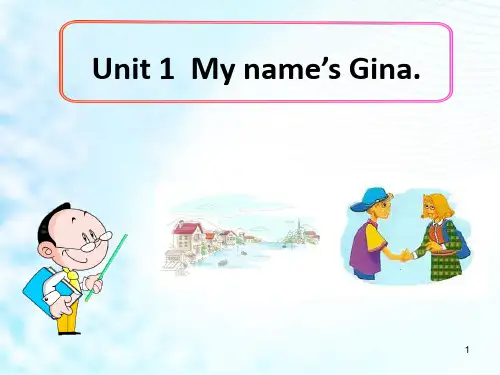
• books
• Window
• ruler • backpack • fish • fish jar(fishbowl) • Extinguisher • Basketball
• Rubish bin/trash can/dustbin/garbage can
• Glasses
• Paper
• clothes
5
Task two(任务二)
• 运用所学进行打招呼 • 学会介绍自己并询问
他人姓名: Hello, /hi, I ‘m … What’s your name? My name is …/I ‘m …
• 你好,我叫… • 你的名字叫什么? • 我的名字是…/我叫…
6
该如何打招呼呢
Do you remember how to greet people?
11
Task three(任务三)
• 能听懂对话,根据对话进行自由交际: 1.听录音,给对话编号 2.根据对话进行交际, 3.展示对话
12
1b Listen and number the conversations[1-3]. 听录音,为对话编号。
2
A: What’s your name?
B: Alan.
3
Task one(学习任务一)
• 观察图片写出你所认 识的物品,看谁写的 最多
• words掌握词汇:
name clock meet your my
n. n. v. pron. pron.
名字 时钟,闹钟 遇见,会面 你的 我的
4
Words in the picture
• clock
• Door
8
如何介绍自己呢
人教版七年级上册初一上册英语第一单元课件
人教版七年级上册初一上册英语第一单元课件一、教学内容本节课选自人教版七年级上册英语第一单元,详细内容如下:章节一:Unit 1 My name's Gina.Section A:1a1c,主要学习如何介绍自己,认识新同学,包括名字、年龄和来自哪里。
Section B:1a1d,通过听力练习,加深对人物基本信息的了解。
二、教学目标1. 能够听懂、会说、会拼写关于姓名、年龄和来自哪里的基本英语词汇和句型。
2. 能够用英语进行简单自我介绍,了解他人基本信息。
三、教学难点与重点1. 教学难点:正确拼写人名、地名和相关词汇。
2. 教学重点:熟练运用句型“My name's”和“I'm from”进行自我介绍。
四、教具与学具准备1. 教具:PPT课件、录音机、磁带、卡片。
2. 学具:英语课本、练习本、彩色笔。
五、教学过程1. 导入:通过播放英语歌曲,引导学生进入英语学习氛围。
2. 新课内容展示:展示PPT课件,讲解Section A 1a1c,引导学生学习如何用英语介绍自己。
3. 实践情景引入:分组让学生进行自我介绍,互相认识。
4. 例题讲解:讲解Section A 1d,引导学生听懂他人介绍,回答问题。
5. 随堂练习:完成Section A 2a2c,巩固所学知识。
6. Section B:展示PPT课件,讲解1a1d,让学生通过听力练习,加深对人物基本信息的了解。
7. 小组活动:分组让学生进行角色扮演,模拟介绍自己和他人。
六、板书设计1. Unit 1 My name's Gina.2. 内容:重点词汇:name, age, from, China, class, grade, school重点句型:My name's,I'm from,How old are you? I'm Section A 1a1c,1dSection B 1a1d七、作业设计1. 作业题目:(1)抄写重点词汇和句型,每个5遍。
最新人教版英语七年级上册unit1完整课件课件
最新人教版英语七年级上册unit1完整课件课件一、教学内容本节课我们将学习最新人教版英语七年级上册Unit 1《My name's Gina》的内容。
具体包括:Section A 1a2d,主要涉及自我介绍、询问他人姓名以及电话号码等日常用语。
二、教学目标1. 能够听懂并准确说出关于个人信息的英语表达,如姓名、年龄、电话号码等。
2. 能够运用所学知识进行简单的自我介绍和询问他人信息。
3. 培养学生的英语听说能力,激发他们学习英语的兴趣。
三、教学难点与重点重点:掌握关于个人信息的英语表达,如name, age, phone number等。
难点:正确运用一般疑问句和回答方式,进行自我介绍和询问他人信息。
四、教具与学具准备1. 教师准备:多媒体课件、录音机、磁带、卡片等。
2. 学生准备:英语课本、练习本、彩色笔等。
五、教学过程1. 导入:通过播放一首英文歌曲,引导学生关注歌曲中出现的关于姓名的词汇,为新课的学习做好铺垫。
步骤一:教师播放歌曲,学生聆听。
步骤二:教师提问,引导学生回答歌曲中出现的关于姓名的词汇。
2. 呈现:教师展示多媒体课件,呈现Section A 1a2d的内容。
步骤一:教师展示1a的图片,引导学生学习关于姓名的英语表达。
步骤二:教师示范1b的对话,学生跟读。
步骤三:学生两人一组进行对话练习。
3. 练习:教师设计随堂练习,巩固所学知识。
步骤一:学生完成2a的练习,教师给予反馈。
步骤二:学生两人一组,根据2b的提示进行对话练习。
4. 互动:学生进行小组活动,模拟真实场景,进行自我介绍和询问他人信息。
步骤一:教师给出场景提示,如学校、公园等。
步骤二:学生分组,进行角色扮演。
步骤三:教师选取部分小组进行展示,给予评价。
六、板书设计1. Unit 1 My name's Gina2. 内容:词汇:name, age, phone number等句型:What's your name? My name's七、作业设计1. 作业题目:请用英语写一段自我介绍,包括姓名、年龄和电话号码。
人教版七年级英语上册unit1课件
人教版七年级英语上册unit1课件My Document一、教学内容1. Section A:1a2d,通过图片和对话,学习如何用英语进行自我介绍和询问他人名字。
2. Section B:1a2e,继续学习如何询问他人名字,并学习描述人物特征。
二、教学目标1. 能够听懂、会说、会读、会写关于自我介绍和询问他人名字的英语句子。
2. 能够用英语描述人物的基本特征。
3. 培养学生的英语交际能力,增进同学之间的了解。
三、教学难点与重点1. 教学难点:如何正确使用“Hello, I'm”和“What's your name?”等句型进行自我介绍和询问他人名字。
2. 教学重点:掌握人物特征的形容词,如“tall, short, thin, fat”等。
四、教具与学具准备1. 教具:课件、图片、录音机、磁带。
2. 学具:课本、练习本、彩色笔。
五、教学过程1. 导入:通过展示一组同学们的合影,引导学生用英语进行自我介绍,激发学习兴趣。
2. 新课展示:a. 学习Section A 1a2d,通过图片和对话,让学生模仿并练习自我介绍和询问他人名字。
b. 学习Section B 1a2e,让学生用所学形容词描述人物特征。
3. 例题讲解:讲解如何用英语描述人物特征,如“Tom is tall and thin, but I'm short and fat.”4. 随堂练习:让学生分组练习,互相介绍自己和同学,并描述人物特征。
六、板书设计1. 自我介绍和询问他人名字的句型。
2. 人物特征的形容词。
七、作业设计1. 作业题目:a. 用英语写一篇自我介绍,至少包含三个句子。
b. 描述一位你最熟悉的同学,至少用三个形容词。
2. 答案示例:b. My best friend is Zhang Hong. He is tall, strong and friendly.八、课后反思及拓展延伸2. 拓展延伸:鼓励学生在课后用所学英语与同学进行交流,提高英语口语表达能力。
人教版英语七年级上册Unit1完整课件
For example:
Her name is Cindy White. We call her
Miss White.
The old man is John Smith. We can call
him Mr Smith.
2019/2/25
33
2019/2/25
34
6 9
74 35 831 35 6 74 9 786635 32194 602 4521 602 831 4521 32194 786635
2019/2/25 38
Let ’s calculate.让我们来 算算.
• • • • • • • • What’s two minus one? It’s one. What’s seven minus four? It’s three. What’s nine minus three? It’s six. What’s four minus four? It’s zero.
B: Nice/Glad to meet/see you, too!
2019/2/25 4
Nice to meet you!
Nice to meet you, too.
2019/2/25
5
“很高兴认识 你” • Nice to meet you.
• Glad to meet you. • Nice to see you. • Glad to see you.
Unit 1 My name's Gina.
2019-2-24
1ห้องสมุดไป่ตู้
冠词a, an的用法
a用在辅音音素开头的单数可数名词前, an用在元音音素开头的单数名词前。如 果名词前有修饰语, 则以其第一个因素 是元音还是辅音而决定用a或an.