
新人教版八年级上册英语Unit7-教案新部编本
教师学科教案[ 20 – 20 学年度第__学期]
任教学科:_____________
任教年级:_____________
任教老师:_____________
xx市实验学校
课时教案
课时教案
孩子们将会在家里的电脑上学习。
否定式:主语+ won’t + 动词原形
People won’t use money in 100 years.
一百年后人们将不再使用钱币。
一般疑问句式:
Will + 主语+ 其他?
肯定回答:Yes , 主语+ will.
否定回答:No, 主语+ won’t.
人们将会有更多的空闲时间吗?
是的,会。
/ 不,不会。
Will people have more free time?
Yes, they will. /No, they won’t.
二、There be 句型:
1. there be 句型表示客观存在的“有”(所有者不明确)。
例如:有湖边有很多树。
_____ _______ many trees near the lake.
be 动词有______ _______ 两种形式。
2. be 动词形式的确定要根据其后面的名词单复数形式来确定。
_____ _____ an apple tree in the park.
_____ ______ many people in the park today.
3. There be 句型的一般将来时结构:
肯定式:There + ________ + 其他
否定式:There + ___________ + 其他
一般疑问句:____________ + be + 其他?
答语:Yes, there will. / No, there won’t.
三、
可数名词
1. more +
不可数名词
课时教案
课时教案。
新人教版八年级上册英语Unit7 教案

新人教版八年级上册英语Unit7 教案Topic:Class Type:n Date: [Date]___:1. Language Knowledge Objectives:- To master the following vocabulary: paper, n, n, future, pollute, environment, , earth, plant, part, play a part.- To master the following sentence structures:1) What will the future be like?Cities will be more polluted. And there will be ___.2) Will people use money in 100 years?3) Will there be world peace?4) Kids will study at home on computers.5) They won’t go to school.- ___ the use of "will + verb" to express the simple future tense.2. Attitude and Value Objectives:- To guide students to look forward to the future and design their future lives, so as to achieve the goal of prospect ___.___:1. To learn and master the meaning and structure of the simple future tense.Teaching Difficulties:- To master the use of "more/fewer" and "more/less".___:___:___:I. Lead-in1. Show students some pictures of robots on the big screen and ask them to talk about their future jobs and plans: "What do you want to be when you grow up?"Ss: "I want to be a scientist."T: "How are you going to do that?"Ss: "I’m going to study science hard."...2. Use the pictures to guide students to the topic of robots.II. nIII. Game IV. Listening V. Pair work1. The teacher reads the first n in 1c and then has the students read it in pairs.2)掌握情态动词will来表达一般将来时态这一语法知识;教学难点:运用will来表达一般将来时态的句子构成和用法。
人教版八年级英语上册 Unit 7 will people have robots 教学设计
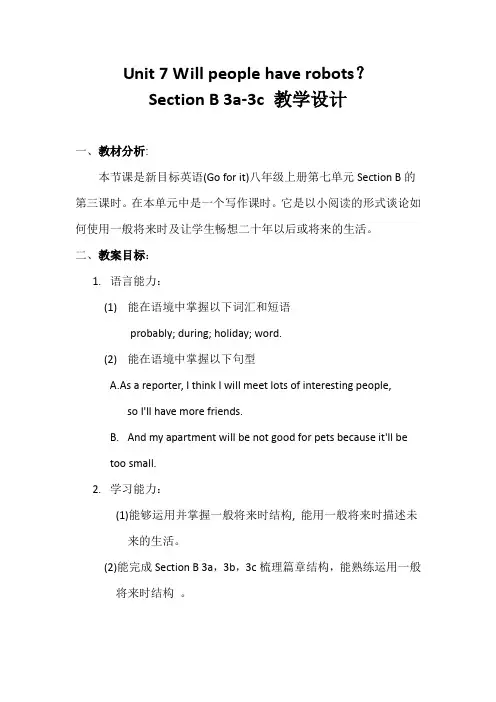
Unit 7 Will people have robots?Section B 3a-3c 教学设计一、教材分析:本节课是新目标英语(Go for it)八年级上册第七单元Section B的第三课时。
在本单元中是一个写作课时。
它是以小阅读的形式谈论如何使用一般将来时及让学生畅想二十年以后或将来的生活。
二、教案目标:1.语言能力:(1)能在语境中掌握以下词汇和短语probably; during; holiday; word.(2)能在语境中掌握以下句型A.As a reporter, I think I will meet lots of interesting people,so I'll have more friends.B.And my apartment will be not good for pets because it'll betoo small.2.学习能力:(1)能够运用并掌握一般将来时结构, 能用一般将来时描述未来的生活。
(2)能完成Section B 3a,3b,3c梳理篇章结构,能熟练运用一般将来时结构。
(3)能看懂写作范例,能掌握写作技巧,梳理成文,能写一篇关于未来的生活的短文。
3.思维品质:通过写作课的学习,能有一个思维框架,会有从开始到过程到结尾的写作思路。
能依据范例、文本结构、评分标准修改习作。
4.文化意识:能了解并掌握英语中描述未来的写作特点。
能通过写作展望未来,使自己的理想观和价值观更为科学。
三、学习内容:3a: 根据所给词汇补全范文。
3b: 运用表格收集信息。
3c: 仿照范文,利用所收集的信息写一篇有关自己未来生活的短文。
四、学习重难点: 掌握目标词汇,增强英语的阅读技巧和写作水平。
五、教学过程:Step 1 Leading in1.Greet the class2.Let’s watch a video. “What do you want to be when you grow up? ”Ask: What will you be when you grow up?Why will you be a/an...?Where will you live when you grow up? And why?What will you do on weekends? I will ……on weekends.1.Pair-workWork in pairs and talk about your future life.2.DiscussionWhat else can we say when talking about future life?Step 3 While-task Reading comprehensionFinish 3a .1. know the meanings of the words in the box2. Ask students to read the passage for the first time and fill in the chart below. Then check the answers.3.Read Jill’s answer again and answer the questions?(1) What will Jill be in 20 years?(2) Where will she live? Why?(3)What pet will she keep?(4)Where will she take a holiday?4.Discussion: How to share your future?5.Read Jill’s answer again and complete the chart?What will Jill’s future be like?6.Show a mind-map and fill in it.7.Add the beginning and ending to 3a, choose the right answers.Step 4 WritingFinish 3bComplete the chart about your life 20 years from now. You can addmore items.Finish 3c Let the students write their own passages.1.Give students writing guide2.Give some sentence patterns to students3.Show a simple example4.Show some writing methods5.Show the standard of evaluatingStep 5 Post-taskHomeworkIf you are Li Hua . Imagine what your life will be like in 20 years? 板书设计:Unit 7 Will people have robots ?Section B 3a-3cMy life in 20 yearsI’ll be.....I’ll live in...I’ll .....教学反思:。
人教版八年级英语上册Unit7单元教学设计
3.阅读作业:阅读与本单元话题相关的文章,完成以下任务:
-总结文章大意。
-列出文章中出现的现在进行时态的句子。
-回答文章后的问题。
-目的:提高学生的阅读理解能力,加强他们对时态的识别和运用。
4.听力作业:完成与本单元相关的听力练习,包括以下内容:
然而,学生在英语学习中仍存在一些问题,如对词汇的运用不够熟练,语法知识在实际语境中的应用能力有待提高,口语表达和写作能力还需加强。针对这些问题,教师在本单元的教学中应注重以下几个方面:
1.加强词汇教学,通过丰富多样的练习,帮助学生巩固和运用所学词汇。
2.注重语法知识的实际运用,设计贴近生活的语境,让学生在实际交流中掌握语法规则。
3.针对学生口语表达和写作能力较弱的问题,开展针对性的训练,提高学生的口头和书面表达能力。
4.关注学生的个体差异,因材施教,激发学生的学习兴趣,提高他们的自信心。
三、教学重难点和教学设想
(一)教学重难点
1.重点:本单元的重点在于学生对现在进行时和一般现在时的掌握,以及词汇和短语的运用。
难点:学生在实际语境中正确运用所学的时态和词汇进行表达,特别是在口语交流和写作中。
-口语练习:学生用现在进行时态和本单元词汇进行角色扮演。
-阅读练习:阅读与本单元话题相关的文章,完成练习题。
-写作练习:学生用现在进行时态和本单元词汇编写一段话。
(五)总结归纳
1.教学活动设计:
-教师引导学生回顾本节课所学内容,总结现在进行时态的用法和本单元词汇。
2.目标:
-帮助学生巩固所学知识,形成知识体系。
-听录音,回答问题。
-根据所听内容,完成表格或图片。
八年级英语上册-Unit-7-Will-people-have-robots备课教案-(新版)人教新

一、教材分析
单元教材分析:will + 动词原形 来表达一般将来时态。 学会表达自己对未来的看法;学会谈论自己未来的打算。
二、学情分析
1.八年级处于思维活跃期,对学习本单元有好处,可以进一步开阔学生视野。
2.本单元总体知识结构比较单一,内容相对比较简单。
教学重点:
教学重点:
1)学习掌握一般将来时态的意义和结构。
2) 掌握There be句型的一般将来时态的结构。
(含教法学法、媒体应用等)
教学难点
教学难点:
掌握more/fewer;more/less的用法。
情态动词will + 动词原形来表达一般将来时态。
(同属教学重难点的,在本栏书写)
五、课时安排
三、教学目标
(结合课标)
知识技能
学会表达自己对未来的看法;学会谈论自己未来的打算。。
过程方法
首先进行集中识字,为本单元的学习作好铺垫。其次,采用情景交际法和任务型教学法并充分利用听力材料和阅读材料,训练和提高学生的听力和阅读水平。在听读的基础上创设语言情景和合作探究的方式加强读写训练。培养学生的听、说、读、写综合能力。
Period 1 Se-2d 听说课
Period 3 Section A Grammar Focus-3c语法课
Period 4 Section B1a-1e 听说课
Period 5 Section B2a-2e 阅读课
Period 6 Section B3a-3c阅读课
Period 7 self check and unit review
六、知识结构
七、其它补充
情感态度价值观
人教版八上英语unit7教案和导学案

人教版八上英语unit7教案和导学案Unit 7教案Unit 7: An Ideal Summer CampObjectives:1. Understand and use Summer Camp vocabulary.2. Describe activities in a summer camp.3. Give suggestions and opinions about a summer camp.4. Write a blog post about an ideal summer camp.Language Objectives:1. Vocabulary: summer camp, hiking, swimming, canoeing, horseback riding, archery, rock climbing, campfire, tent.2. Grammar: Use of modals to give suggestions and opinions.3. Writing: Write a blog post about an ideal summer camp.Warm-up:- Begin the lesson by showing pictures of different summer camp activities. Ask students to describe the activities in the pictures.- Discuss with students what they know about summer camps and what they like to do in the summer.Introduction:- Introduce the vocabulary for this unit. Practice pronunciation and usage with students.- Introduce the grammar point of using modals to give suggestions and opinions.Listening:- Play a recording of a conversation between two students talking about their experiences at a summer camp. Ask students to listen for the activities they did and write them down.Speaking:- Pair students up and have them discuss what they would like to do at a summer camp. Encourage them to use modals to give suggestions and opinions.Reading:- Have students read a passage about an ideal summer camp. Ask comprehension questions to check understanding.Writing:- In groups, have students brainstorm ideas for their own ideal summer camp. They should write a blog post describing their camp, including activities and facilities.Homework:- Assign students to write a diary entry about a day at their ideal summer camp.- Study vocabulary and practice using modals to give suggestions and opinions.Unit 7导学案Unit 7: An Ideal Summer CampVocabulary:- Summer camp: a place where children go during the summer to participate in outdoor activities.- Hiking: the activity of walking in the countryside for pleasure.- Swimming: the sport or activity of moving through water by moving one's arms and legs.- Canoeing: the sport or activity of traveling in a canoe.- Horseback riding: the sport or activity of riding horses.- Archery: the sport or skill of shooting arrows from a bow.- Rock climbing: the sport or activity of climbing rocks or walls using ropes and other equipment.- Campfire: a fire at a campsite, used for cooking, warmth, and socializing.- Tent: a portable shelter made of cloth or other material supported by poles and stretched tight by ropes.Grammar:- Modals: can, could, should, would, might, may- Use modals to give suggestions and opinions. Example: You should try horseback riding. It's a lot of fun.Reading:- Read the passage about an ideal summer camp and answer the following questions:1. What activities are available at the camp?2. What facilities does the camp have?3. Why does the writer think it is an ideal summer camp?Writing:- Write a blog post about your ideal summer camp. Describe the activities, facilities, and why you think it would be a great place to spend the summer.Speaking:- Practice giving suggestions and opinions using modals. Discuss with a partner what activities you would like to do at a summer camp and why.Homework:- Write a diary entry about a day at your ideal summer camp.- Study vocabulary and review using modals to give suggestions and opinions.。
八年级英语上册Unit7 教案新版人教新目标版
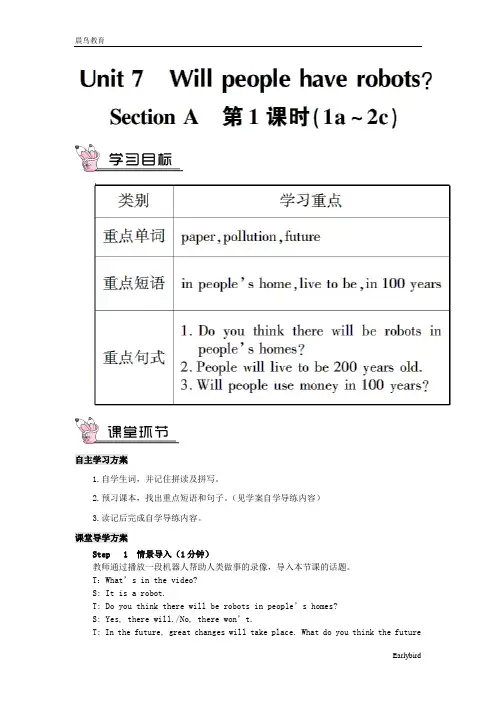
自主学习方案1.自学生词,并记住拼读及拼写。
2.预习课本,找出重点短语和句子。
(见学案自学导练内容)3.读记后完成自学导练内容。
课堂导学方案Step 1 情景导入(1分钟)教师通过播放一段机器人帮助人类做事的录像,导入本节课的话题。
T:What’s in the video?S: It is a robot.T: Do you think there will be robots in people’s homes?S: Yes, there will./No, there won’t.T: In the future, great changes will take place. What do you think the futurewill be like? (老师提示用will作答)S:(学生各抒己见)I think there will only be one country. There will no paper money. People will live to be 200 years old…教师要求学生根据自己的想法,对1a作出自己的判断。
环节说明:通过播放录像导入话题,学生的兴趣比较浓厚,告知学生本单元的语言目标,学生学习起来能够做到心中有数,可以更好地帮助学生学习新课。
Step 2 完成教材1a—1c的任务1.熟读1a中的句子,并两人一组互相背诵句子。
(5分钟)2.以小组为单位,结合图片和1a中的句子,小组讨论一般将来时态的各种句型的构成,教师点拨。
(5分钟)3.认真听录音,并在1a中圈出你所听到的预测,集体核对答案,完成课本上1b的听力任务。
(3分钟)4.再听一遍录音,并跟读对话。
(2分钟)5.仿照1c中的对话,两人一组对1a中的活动进行对话练习,并邀请一些小组表演对话。
(5分钟)6.小结练习。
(3分钟)( B )(1)I hear he will be back _________two days.A. atB. inC. afterD. for(2)There will be (be) a talk show on CCTV-2 at eight this evening.(3)There is (be) some paper on the table.(4)I often listen to music on (介词) the radio.环节说明:听说结合,第一时间向学生传达语言目标。
新人教版八年级上册英语 Unit 7 第1课时 教案(教学设计)
Unit 7 Will people have robots?Section A (1a-2d)单词paper,pollution,future,pollute,environment1.掌握一般将来时的意义和结构。
2.掌握There be句型的一般将来时的结构。
1.掌握more/fewer;more/less的用法。
2.“will +动词原形”表达一般将来时态。
Step 1以机器人相关视频来导入新课,调动学生学习的积极性。
Warming up and leading inShow Ss a video about robots and ask them some questions after watching it:What can you see in the video?Do you think it possible that every home has a robot?What can robots do for us?Step 2用形象的方式帮助学生掌握新词汇。
让学生在预测的过程中加深对词汇的理解。
1.New wordsShow Ss some pictures of the new words in this period: paper, pollution, future, planet, earth, plant.2.Work on 1a①Ask Ss to read the predictions in 1a. Let them think about how the world will be different 100 years from now.②Get Ss to check (√)A for agree or D for disagree. Then check the answers with the class together.【Keys: Answers will vary.】Step 3让学生在听的过程中掌握抓住关键信息的方法。
人教版八年级英语上册Unit 7教案
人教版八年级英语上册Unit 7教案Unit 7: Will People Have Robots?In this unit。
students will imagine what the future will be like and make ns.One of the main concerns for the future is the XXX。
we will be in great danger。
It is important to take n now to XXX.Robots will play a part in the future。
and it is possible that every home will have one。
They can help with tasks that XXX。
XXX will shape our future in a negative way.In 100 years。
it is unlikely that people will still use money。
Everything will be free。
and we will have to find new ways to measure value。
This will have a XXX.Space will also be a significant part of our future。
We may have space XXX will have to adapt to living in a new XXX.It is XXX future is not set in stone。
We can make choices now that will impact what happens in the future。
Let's work towards a future of peace。
新人教版八年级英语上册Unit7 教案
新人教版八年级英语上册Unit7 教案教学目标1. 掌握本单元的词汇和短语,并能正确运用。
2. 能够正确使用一般现在时和一般过去时进行描述。
3. 理解并能够正确运用有关时间状语从句。
4. 能够进行日常活动的对话,并能够流利地用英语表达爱好。
教学内容词汇与短语1. hobbies and interests(爱好和兴趣)2. ork(艺术品)3. museum(博物馆)4. gallery(画廊)5. on display(展出)6. n(展览)7. n(收藏)8. take photos(拍照)9. postcard(明信片)10. relax(放松)11. flight(航班)12. packed(拥挤的)13. mind(注意)14. secondhand(二手的)15. satisfied(满意的)语法1. 一般现在时:描述经常性、惯性的动作或状态。
2. 一般过去时:描述过去发生的动作或存在的状态。
3. 时间状语从句:用来表示不同时间点的事件或动作之间的关系。
教学步骤1. 导入(5分钟)- 通过展示一些图片引起学生对艺术的兴趣。
- 引导学生回忆一些艺术品或博物馆的名字。
2. 词汇与短语研究(10分钟)- 呈现并教授本单元的词汇与短语。
- 让学生进行拼读、理解和运用练。
3. 语法研究(10分钟)- 介绍一般现在时和一般过去时的用法。
- 提供相关的例句和练。
4. 练与交流(15分钟)- 学生以小组为单位进行交流,讨论自己的爱好和兴趣。
- 鼓励学生使用一般现在时进行描述,并提供必要的句子结构和词汇。
5. 时间状语从句(15分钟)- 讲解时间状语从句的概念和用法。
- 提供相关的例句和练。
6. 活动与应用(15分钟)- 学生分角色扮演,模拟在博物馆或画廊中的对话。
- 引导学生使用一般过去时进行表述,并提供必要的句子结构和词汇。
7. 小结与布置作业(5分钟)- 总结本节课的重点内容。
- 布置作业:要求学生根据自己的兴趣和爱好,写一篇短文,并使用所学的语法和词汇。
【人教版】新目标八年级英语上册:Unit7单元教学设计
【人教版】新目标八年级英语上册:Unit7单元教学设计一. 教材分析人教版新目标八年级英语上册Unit7主要围绕着“节假日”这一主题展开,通过学习本单元,学生能够掌握有关节假日的一些基本词汇和表达方式,如Christmas, New Year’s Day, Easter等,同时能够运用所学生所学知识进行简单的交流和表达。
本单元包括3个会话和3个语法练习,以及相关的阅读和写作任务。
二. 学情分析八年级的学生已经掌握了一些基本的英语知识,具备一定的听、说、读、写能力。
但是,对于一些特定的节假日词汇和表达方式可能还不够熟悉,同时也可能存在一些学生在口语表达上的困难。
因此,在教学过程中,需要注重词汇的讲解和口语的练习。
三. 教学目标1.知识目标:学生能够掌握本单元相关的节假日词汇和表达方式,如Christmas, New Year’s Day, Easter等,并能够运用所学知识进行简单的交流和表达。
2.能力目标:学生能够听、说、读、写与节假日相关的句子,提高英语综合运用能力。
3.情感目标:学生能够了解不同国家的节假日习俗,增强跨文化交际意识。
四. 教学重难点1.重点:掌握节假日词汇和表达方式,如Christmas, New Year’s Day,Easter等,以及能够运用所学知识进行简单的交流和表达。
2.难点:对于一些特定的节假日词汇和表达方式的运用,以及口语表达的流利性和准确性。
五. 教学方法1.交际法:通过模拟真实场景,让学生在实际语境中运用所学知识进行交流。
2.任务型教学法:通过完成各种任务,激发学生的学习兴趣,提高学生的参与度。
3.情境教学法:创设各种节假日情境,帮助学生理解和记忆相关词汇和表达方式。
六. 教学准备1.教师准备:准备好相关的教学材料,如PPT、单词卡片、练习册等。
2.学生准备:学生预习本单元内容,完成相关的预习任务。
七. 教学过程1.导入(5分钟)通过提问方式引导学生谈论他们喜欢的节假日,激发学生的兴趣和积极性。