
外研版必修二-模块四module4-introduction-readingPPT课件
外研版必修二-模块四module4-introd uction -readi ngPPT 课件
How many kinds of arts are there?
painting`
watercolor oil painting landscape
mural drawing
design
cartoon advertisement
外研版必修二-模块四module4-introd uction -readi ngPPT 课件
外研版必修二-模块四module4-introd uction -readi ngPPT 课件
Mona Lisa
The Last Supper
外研版必修二-模块四module4-introd uction -readi ngPPT 课件
clothes building
woodcut sculpture stone carving
外研版必修二-模块四module4-introd uction -readi ngPPT 课件
外研版必修二-模块四module4-introd uction -readi ngPPT 课件
Do you know any famous painters in the world? What do you know about them and their works?
Li Kuchan (1899 - 1983) Chinese painter He specialized in birdand-flower painting.
外研版必修二-模块四module4-introd uction -readi ngPPT 课件
外研版必修二-模块四module4-introd uction -readi ngPPT 课件
Let’s see some famous painters and their paintings.
外研版必修二-模块四module4-introd uction -readi ngPPT 课件
外研版必修二-模块四module4-introd uction -readi ngPPT 课件
shrimps
Sunflower Green Wheat Fields Starry Night
外研版必修二-模块四module4-introd uction -readi ngPP4-introd uction -readi ngPPT 课件
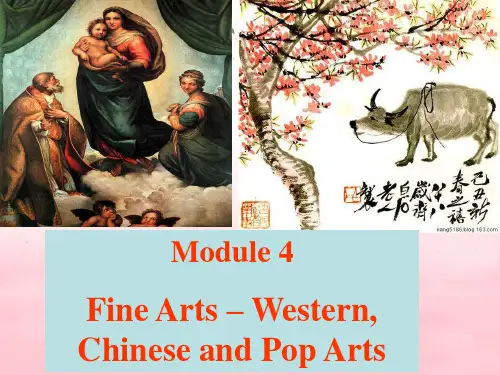
He’s a painter of Holland. He’s famous for his idea of emotional expression in painting. His great works include Starry Night, Sunflower and Green Wheat Fields. Vincent Van Gogh
外研版必修二-模块四module4-introd uction -readi ngPPT 课件
外研版必修二-模块四module4-introd uction -readi ngPPT 课件 外研版必修二-模块四module4-introd uction -readi ngPPT 课件
Qi Baishi (1864-1957)
外研版必修二-模块四module4-introd uction -readi ngPPT 课件
外研版必修二-模块四module4-introd uction -readi ngPPT 课件 外研版必修二-模块四module4-introd uction -readi ngPPT 课件
外研版必修二-模块四module4-introd uction -readi ngPPT 课件
Western arts
Chinese arts
Pop arts
Do you know what fine arts mean?
the study and creation of visual works of art, including painting, sculpture, dance, theatre, architecture, photography and printmaking.
Li Keran (1907-1989) a famous painter He developed a personal style of landscape painting.
外研版必修二-模块四module4-introd uction -readi ngPPT 课件
外研版必修二-模块四module4-introd uction -readi ngPPT 课件
外研版必修二-模块四module4-introd uction -readi ngPPT 课件
外研版必修二-模块四module4-introd uction -readi ngPPT 课件 外研版必修二-模块四module4-introd uction -readi ngPPT 课件
外研版必修二-模块四module4-introd uction -readi ngPPT 课件
外研版必修二-模块四module4-introd uction -readi ngPPT 课件 外研版必修二-模块四module4-introd uction -readi ngPPT 课件
外研版必修二-模块四module4-introd uction -readi ngPPT 课件 外研版必修二-模块四module4-introd uction -readi ngPPT 课件
外研版必修二-模块四module4-introd uction -readi ngPPT 课件
Leonardo da Vinci
He’s an Italian Painter. He lived during the 15th and 16th century. He’s well known for his works like Mona Lisa and The Last Supper.
外研版必修二Module4_Reading课件
成名作;田横五百士
Xu Beihong(1895-1953) was one of China’s best–known twentieth-century artists. He believed that artists should show reality, but not just imitate it. He is famous for his lively paintings of horses.
The following useful expSretsespio3nsSmpaeyahkeilnpg
you to express you opinions:
I think some western art is beautiful and interesting. I like pictures that show reality. I really like paintings of animals. I can’t stand modern art. I think it’s awful. I’m interested in pictures that are different in some way. I want something beautiful to put on my wall.
Chinese painting
watercolor
landscape
cartoon
oil painting
drawing
portrait
mural
1 Picasso and another painter, George Braque,Csutbairstmed _____.
2 Cubist artists painted objects and people, with different _a_s_p_e_ct_sof the object or person
[课件] 外研版必修4 第二模块
![[课件] 外研版必修4 第二模块](https://360docs-1393072327.cos.ap-beijing.myqcloud.com/8e9b1c6b1eb91a37f1115ce5.webp)
means of transport
Introduction-2. Vocabulary (2ms) Find out the
words with their definitions.
coach motorbike trolleybus
1. It’s a bus used for long distance. 2. It’s got two wheels and it’s fast. 3. This bus is connected to electric wires.
Introduction-3. Discussion (4m)
What kind of words could come into your mind?
1. Have you ever stuck in a traffic jam?
2. Where were you going?
3. How long were you in the jam?
Period 1
Module 2 Traffic Jam
Introduction Reading & Vocabulary
Introduction-1 Brainstorm(4ms) Say which means
of transport you can use to get around your town.
Minibuses Underground Pedicabs
advantages 24 hours on the street / easy to get cheap
disadvantages expensive
crowded
only in some areas terrible in rush hours
外研社必修2模块4-Reading
2.Cubist artists painted objects and people,with different aspects of the object or person showing at the same time.立体派画家所画的内容为人与 物,画面同时呈现人与物的各个面。 此句中,with引导的短语作状语, ______ 。 伴随
3. Oil painting originates from Europe while ink painting is Chinese national painting & national treasure. 4. Many famous western oil paintings are figure paintings and are closely related to religion. There is always a story behind every painting ,for example, the last supper, the lady of Shallotte.
Modern, Chinese and Pop Arts
painting
painter
Can you name some famous paintings and
painters?
Western Paintings
Guernica Picasso’s greatest painting
※
Scan & Answer
Para A:
Para B:
Para C:
Para D:
QiBaishi Picasso
1
Xv Beihong
Roy Lichtenstein 洛伊、利希滕斯坦
高中英语外研版必修2教案Module4(15页)
Module 4 Fine Art— Western, Chinese and Pop ArtsTeaching aims :Aimed at carrying out quality education, based onstudents’ development,letting students grasp the vocabulary,grammar, function in this module, strengthening students’ language skills in listening, speaking, reading and writing set in this module, developingstudents learning strategies.Through learning this module,students are expected to learn about the artists and their painting styles,be capable of introducing their favorite artists and their works, be interested in art, improve theiraesthetic consciousness,love life and develop their sense of cooperation. Aimed to cultivate students’ integrated language capability in various student-centered tasks or activities.Periods 1 : Introduction,Reading andvocabulary, FunctionTeaching aims :(multimedia courseware)Language objectives:To enable the students to grasp the new works, phrases and the structures to give opinions about likes and dislikesSkill objectives:To enable the students to match descriptions with paintings, choosingthe correct answers and filling in the form in the aspect of readingTo enable the students to give opinions about certain paintingsCulture awareness, emotions and attitudes objectives:Teaching important points:To enable the students to speak out opinions about some paintings with some expressionsTo enable the students to grasp the new works and phrases in thispart Teaching procedures: PWP Teaching ModelStep1. leading-in activityUseby daonnew brush, ink.the paintings The Smile of Mona Lisa Vinci and the works by Zheng Banqiao the screen to lead in the topic. Meanwhile, I will introduce the key words: artist, paint, traditional,Step 2.While —reading1)ScanningDuring the start of the period, let the students scan the passage tofind out the answers to the questions on Page32, which are about the topics.⑴M atch paintings 1-4 with descriptions in paragraphs A-D.⑵Say which paintings are mentioned in paragraph E and F.2)Detailed readingDuring this period, I’ll allow students enough time to read the textand then I let them work in groups to do the following two tasks:⑴Do the multiple choices on the screen.⑵F ill in the form on the screen, which is mainly about thefamous artists.3)Language points⑴c onsider 以为①T his is a painting by the Spanish artist, Pablo Picasso, and he isconsidered to be the greatest western artist of the twentieth century.This is a painting by the Spanish artist,Pablo Picasso,____ ____ ____ the greatest western artist of the twentieth century.②We consider that his advice is helpful.We consider his advice ____ ____ helpful.③She __________________(被以为是个可爱的孩子).⑵w ith 复合构造①C ubist artists painted objects and people, and different aspectsof the object or person showed at the same time.Cubist artists painted objects and people, ___ different aspects of the object or person ____ at the same time.②He had so much work to do, he was kept as busy as a bee.____ so much work ____ ____, he was kept as busy as a bee.③I felt a bit nervous because so many people were watching meso closely.I felt a bit nervous, ____ so many people ____ me so closely.④Because his homework had been finished, he went out to play.____ his homework ____, he went out to play.⑤He went to sleep, with the door open.He went to sleep, and ____ ____ ____ ____.⑥Tom came in, and there was a baseball bat in his hand.Tom came in, with a baseball ____ ____ ____.⑶aim 以⋯目;意欲;打算①Pop art (from the word“popular”) was an important modern art movement that attempted to show ordinary twentieth-century city life.Pop art (from the word “popular ”) was an important modern art movement that ____ ____ show ordinary twentieth-century city life.②Our aim is to start and run our own pany.We ____ ____ start and run our own pany.③I’m aiming at losing 4 kg before the summer holidays.I ____ ____ ____ lose 4 kg before the summer holidays.⑷stand 忍耐①I don ’ t like that picture of a golden-haired girl.I can ’t ____ that picture of a golden-haired girl.②We have to put up with her bad temper.We have to ____ her bad temper.③I can ’ t stand working in the extreme heat for several hours.(英)_________________________________________________⑸I got bored of looking at pictures all the time.I ____ ____ ____ looking at pictures all the time.⑹Tom gradually became interested in art.Tom ____ ____ ____ ____ art.Step3. Post—readingDuring this period, I’ ll let the students do the following tasks.⑴Find out the structures that can be used to giving opinions about likes and dislikes from the paragraphs E and F individually.⑵And then, along with the students, I’ll look through the sentences giving opinions, provided in the first part of Function, making sure that they know how to express likes and dislikes. Show the students a seriesof paintings on the screen, letting them in groups talk about the pictures they like and dislike, and why or why not, using the information learnedfrom the reading material(or in the form of interviewing—group work). Step4. HomeworkTry to find more paintings and artists you like through the Internet.Prepare to introduce a painting in English to your classmates nextclass.(The day students are assigned to the first task; and the rest ofthe students to the second.)Blackboard design:Module 4 Fine arts —Western, Chinese and Pop Arts Period Oneconsider: consider sb./sth. to be adj./n.with 复合构 : with+ +( adj./adv./prep. Phrase/-ing/-ed/inf. ) aim v./n. aim to do sth. aim at doing sth.stand+n./doing sth.get tired of/get bored of“ ⋯⋯”develop an interest in“养成⋯⋯的趣”Teaching reflection: In the process of leading in, students arefamiliar with the paintings and the artists, so the pictures can easilyarouse their interest and desire to participate.In the process of while-reading,pay attention to the developing of students reading strategies.In the process dealing with language points,setting the new words in a context helps the students learn and prehend the meaning andthe usage of them. In the discussion about their favorite paintings,some students are reluctant to speak, partly because of their lack of knowledge of painting; most students can municate with their partners or groupmembers after learning the reading materials. The task of assignment isset for the sake of the second period,that is,Listening and vocabulary, to some extent.Periods 2 : Listening and vocabulary,Everyday English, Speaking Teaching aims :To enable the students to grasp the new words in the listening material.To enable the students to prehend and put to use the everydayEnglish in the listening material.Skill objectives:To enable the students to follow the listening material about artistsand art works, which has similar difficulty to the reading material, and identify opinions.To enable the students to pay attention to the weak sound andread correctly.Teaching important points:To enable the students to follow the listening material about artistsand art works, which has similar difficulty to the reading material, and identify opinions.To enable the students to pay attention to the weak sound andread correctly.To enable the students to give opinions about certainpaintings Teaching procedures: PWP Teaching ModelStep1. Pre-listening⑴ Show some pictures on the screen;:that is, a watercolor, an oil painting, a portrait, a landscape, an art gallery.Through showing the pictures, I, together with the students study thenew words,( watercolor, oil painting, portrait,landscape, art gallery ), letting them pay attention to the pronunciation and the weak sounds/unstressed syllables of the words.⑵Then I ’ll let the students in pairs learn the meaning of the new words in the contexts, in the form of pleting the sentences with them (Part1,Page36), after reading after me.Step2. While-listening⑴B efore listening, ask the students to look at the two pictures onPage36 and find out some similarities and differences. Listen forthe first time, and answer the following questions:①What are the boy and girl are discussing?②Which picture is the boy painting, Picture1 or Picture2? Say how you know this.③Why does the girl say sorry at the end of the conversation?⑵D etailed listening/Pair workListen to the conversation again, and plete the following sentences.First let the students check their answers with their partners; thenI ’ll play the recording again for them to check; and then I ’ll check theanswers with the class.Then I’ll show the following sentences on the screen:①You’ve got it right.②Don’t change a thing.③I’m not half as good as you.④What do you make of it?⑤There’ s (an exhibition) on.⑥T hanks for the pliment.This time I ask the students to think about the meaning of the sentences after listening to the recording again, and then do the exercise on Page38 (Part1) in pairs. Then collect the answers from the whole class.Step3. Post-listening⑴L et the students describe the Picture2 on Page36 in pairs.⑵A ct the dialogue out in pairs.⑶Make up dialogues using the everyday English learned from the listening material.Step4. Homework⑴Look through the Cultural Corner and collect some works ofPablo Picasso or information about him on the Internet.⑵ Look through the Cultural Corner and tell which picture below belongsto the “ pink period ” , Which one do you like best? Which do you like least? And give your opinions about the pictures.12 3GuernicaThe day students are assigned to the first task; and the rest ofthe students to the second task.Teaching reflection:At the start of the period,using the picturesto introduce the someof the new words in the listening material can arouse students ’ interest and reduce the difficulty students have in listeningto the material.Similarly,letting students look at the two pictures on Page36 and find out some similarities and differences can arouse theircuriosity and reduce the difficulty of Question--Which picture is theboy painting,Picture1 or Picture2?Say how you know this.In the processof while-listening,After showing the six sentences taken from therecording on the screen, then let students listen to the recording while listening to the recording, which helps students prehend the everydayEnglish according to the context. In the process of post-listening, thetask of making up dialogues in pairs strengthen students’ cooperationin one aspect; meanwhile, students can grasp the usage of the everyday English. The task of assignment is set to make students learn more about art and artists and provides more chances for students to practice giving opinions. On the other hand, it is for the transition to the grammatical learning in the next period.Periods3 :Grammar1 & Grammar 2and VocabularyTeaching aims :To enable the students to grasp the usage of–ing form acting as subjects and objects and the infinitive acting as objects.To enable the students to grasp the usage of the new words and phrases. Skill objectives:To enable the students to understand the grammatical function of – ing form and the infinitive.Teaching important points:To enable the students to grasp the usage of–ing form acting as subjects and objects and the infinitive acting as objects.To enable the students to grasp the usage of the new words andphrases Teaching procedures: PWP Teaching ModelStep1. RevisionI’ ll let some volunteers show their works about of Pablo Picasso or information about him on the Internet.Step2. Leading-in/PresentingI’ ll show a series of sentences containing–ing form or the infinitive acting as subjects or objects on the students learning plan. And then let the students in groups discuss similarities and differences between thesentences and classify them according to their characteristics.Group One(verbs/verbal phrase + the infinitive as objects):1)attempt;2)promise; 9)aim; 10)pretend; 11)happen; 12)agreeGroup Two(verbs/ phrase + –ing form as objects): 4) suggest;7)stand;13)put off; 14).give up;3)be fond of; 8)get tired ofGroup Three(verbs/verbal phrase + –ing form as objects/ the infinitiveas objects): 15),16) go on; 17),18)mean; 19),20)likeGroup Four (-ing form as subjects): 5)painting; 6)copying a picture;17)being lateThen let the students continue discussing in groups and then give them a listing task, that is, adding as many verbs or phrases as they can toGroups1-3.Group One只好用不定式作的:refuse, promise, pretend, wish,hope, agree, ask, decide, expect, manage, offer,afford,agree, ask ,beg, care, choose, dare, desire, determine , fail, learn , prepare, plan, long, happen, seem⋯Group Two 只能用v-ing形式作的或短:admit,avoid, appreciate, keep, consider, delay, enjoy, escape, excuse, finish,imagine, mention, mind, miss, practice, permit, risk ,suggest,advise, allow, permit⋯feel like, give up, put off , can’t help (忍不住), can’ t stand (无法忍耐 ) , be busy in, be worth, lead to, look forward to,devote...to, stick to, be used to, get down to, object to, pay attention to⋯Group Three1) 能用不定式又能用v-ing形式,而且意差别不大的:prefer,continue, like, hate, love2)既可接不定式又可接 v-ing 形式,但含不一样的有: remember, forget,try, go on, mean, regret⋯Step3. Practice1.— You were brave enough to raise objections at the meeting .— Well , now I regret _____ that .A. to doB. to be doingC. to have doneD. doing2.The squirrel was so lucky that it just missed ____.A. catchingB. being caughtC. to be caughtD. to catch3.The teacher doesn’t permit ____ in class.A. shoutingB.shoutC.to shoutD.having shouted4.—What makes you so happy?— ____.A. Passing the driving testB.Because I ’ ve passed the driving testC. For passing the driving testD. Pass the driving test5.I forgot _____ (buy) the book, so I have to borrow one.6.Please remember____ (turn off) the light when you leave.7.Try _____ (knock) at the back door and see whether he is in or not.8.We must try ____ (e) here as early as possible.9.What do you mean ___ ( do) with it?10. I won ’t stay if it means ____(list en) to another dull talk.【速记口诀】赞同提出学会的打算,要求答应来帮忙。
外研版必修4 module 4 reading Yuan Longping
Advantages Chinese rice production by 47.5% and many rice fields rose ____ converted to growing vegetables were _________ Following and other ______ crops . _______ cash this, Yuan’s rice was ________ exported to other coutries.
physicist
ቤተ መጻሕፍቲ ባይዱ
mathematician
What do you know about great scientists?
Name: ____________________ Qian Xuesen Marie Curie Name: ____________________ Name: ____________________ Archimedes Albert Einstein Name: ____________________ Name: ____________________ Nationality: _______________ Yuan Longping Chinese Nationality: _______________ Polish Nationality: _______________ Sicilian Nationality: _______________ German / American Physics Nationality: _______________ Chinese Major: ___________________ Major: ___________________ Physics Physics, Mathematician Major: ___________________ Major: ___________________ Agriculture Mathematical Physics Major: ___________________ Inventions /discovers: Inventions /discovers: Inventions /discovers: Inventions /discovers: Chinese atom bomb Inventions /discovers: __________________________ Radioactivity __________________________ buoyancy 浮力 __________________________ relativity __________________________ hybrid rice they __________________________ When did invent/discover: When did they invent/discover: When did they invent/discover: When did they invent/discover: In 1964 When did they invent/discover: __________________________ __________________________ In 1898 About 240 BC __________________________ In 1905 __________________________ In 1970 __________________________
高中英语 Module4《Sandstorms in Asia》Introduction,Reading and Vocabulary课件2 外研版必修3

活学巧练: On seeing the man’s_________ face, all are _______ to run away, for he’s got a quite ugly face. A. frightening; frightened B. frightened; frightened C. frightening; frightening;
5. Sandstorms can’t be prevented . 6. The inland region has more sandstorms than the one near the sea .
( \/ ) ( \/ ) (×)
( \/ )
Reading and vocabulary
Look up these words in a dictionary . Then match the words with their definition .
Yesterday The day before yesterday
Look at these pictures .Now work in pairs . Discuss the following statements and decide which statement is false .
高中英语外研版必修2课件:Module 4-Section I
Almost all Chinese landscape paintings describe mountains and water, generally a river. The mountains stand for long life; water stands for happiness. When together, mountains and water stand for a long happy life.
理
Module 4 Fine Arts—Western, 提
基
素
础 ·
Chinese and Pop Arts
能 ·
自
语
主
篇
初
突
探
破
中国艺术源远流长,从古至今中国的艺术文化在世界上都享有盛名。这 篇文章就向我们介绍了中国古代艺术,尤其是风景画的知识。
Chinese landscape paintings For at least a thousand years, the Chinese have been painting their landscapes. Historically, it is believed that the love of nature is inherent, or a part of the soul of a Chinese artist. Guo Xi, a famous 11thcentury Chinese painter of landscapes , stated an artist should identify himself with the landscape and watch it until its significance is revealed to him.
外研版高一英语book2 module4 introduction alice
Fine Arts— Western, Chinese and Pop Arts
班级:高一 三 班 班级:高一(三)班 教师: 教师:夏梦春
Do you like art? How does art make you feel?
Let’s see a short film
Self-test
Symbolism
以感情为基础,不 以理智或客观的观 察为基础,是超越 外表的直觉的内在 力量和想象。
《俄狄浦斯和 斯芬克斯》 斯芬克斯》
克劳德·莫奈 克劳德 莫奈 Oscar Claude Monet 雾中的滑铁卢桥》 《雾中的滑铁卢桥》
在阴影的处理上, 一反传统绘画的 黑色,用有亮度 的青、紫等色。 用点取代了传统 绘画简单的线与 面,从近处观察 印象派绘画作品 时,可看到的是 许多不同的色彩 凌乱的点。
《马拉之死》 马拉之死》 达维特 Jacques Louis David
《台阶上的圣母》 台阶上的圣母》 尼古拉斯·普桑 尼古拉斯 普桑 Nicolas Poussin
Cubism
《吉他与乐谱》 吉他与乐谱》 格里斯 Gris
《地铁岔道口的缩写》 地铁岔道口的缩写》 费尔南·莱热 费尔南 莱热 Fernand Leger
晚钟
牧羊女
让·弗朗索瓦·米勒Jean-Francois Millet (1814-1875年),19世纪 法国最杰出的以表现农民题材 而著称的现实主义画家。他创 作的作品以描绘农民的劳动和 生活为主,具有浓郁的农村生 活气息。《播种》、《晚钟》、 《牧羊女》、《死神与樵夫》 和《扶锄的人》等都描绘和歌 颂农民的劳动生活和淳朴性格, 也揭露了剥削制度的残酷,曾 受到资产阶级的诋毁。
外研社英语必修二教案
外研社英语必修二教案外研社英语必修二教案【篇一:外研社必修2英语优秀教案】1. lesson plan1.1 background informationjunior or senior sectionteachersize class , gradetime type of lessonteaching1.2 contents vocabulary:words that need to be recognize: court, director, genius, harpsichord, impressed,lose, musical, peasant, piece of music, singer,successful, symphony, talent, teenager.reading: three great composers of the eighteenth century1.3 objectivesby the end of the class, students should be able to:1.3.1 instructional objectives1) recognize and know the pronunciations and meanings ofthe following vocabularies by showing pictures, situations, word-formation rules, chunks, collocation, teacher’s explaini ng and guessing though the context:court, director, genius, harpsichord, impressed, lose, musical, peasant, piece of music, singer,successful, symphony, talent, teenager.2) grasp the key words, understand the main idea of the reading materials ;3.3.2 educational objectives1) strengthen their motivation and interest in learning english through the interesting class activities;2) build up the cooperative spirit by pair working and groupworking;3) talk about some famous composers;4) use the cognitive strategies to learn new words.3.3.3 personal objectivesteacher tries to be more passionate and involved all students in my class.3.4 focal points1) students are able to use the reading skills to grasp the key words, organize information by tables.2) students are able to write a short passage to introduce their favorite musicians.3.5 difficult pointsstudents are able to use the reading skills to gain information and compare the information.3.6 procedures and time allotment3.6.1 getting students ready for learning (3 minutes)step 1 greetingsteacher greets students with simple communication.t: good morning, boys and girls. how are you today?ss: …t: shall we begin our class?ss: yes.3.6.2 revision (2minutes)review what we have learned yesterday.3.6.3 pre-reading (6 minutes)step 1 enjoy a piece of music by beethoven on ppt.step 2 vocabulary presentationteacher shows some pictures about the three great composers of the eighteenth century; at the same time, students learn some new words:court, director, genius, harpsichord,impressed, lose, musical, peasant, piece of music, singer, successful, symphony, talent, teenager.teacher pays some attention to students’ pronunciation. then teacher leads students to the text by asking questions.3.6.4 while-reading (20 minutes)step1 skimming the passage for the main idearead the passage quickly and choose the best title in ex2 on p22---three great austrian composers---three great composers of the eighteenth century---three great child composersstep 2 scanning the passage for specific information read the passage again and answer the questions. which of the composers....1. were born in austria?2. was born in germany?3. had a good singing voice?4. died before his fortieth birthday?5. became deaf?6. met each other?7. had fathers who were musicians?8. had a father who wasn’t a musician?step3 read the passage carefully and fill in the form.about haydn【篇二:外研社高一英语必修二 module 2 教案】 lesson plan practice teacher’s name: ren baiyunteaching date: nov. 28, 2012【篇三:外研版高中英语必修2---module4教案】module fourfine arts-western,chinese and pop artsperiod oneteaching content:introduction; reading and vocabularyteaching important points:1.encourage the students to talk about arts as well as the well-known artists at home and abroad;2.help the students make sense of the whole passage;3.help the students improve their reading ability.teaching difficult points:1.lead the students to talk in class actively;2.deal with some difficult language points.teaching procedures:step 1 lead-in and introduction1.lead-ini think most of us love different kinds of arts and know about some famous artists and famous art works more or less.now let`s list some famous artists and their famous art works at home and abroad,such as:qi baishi and his painting of shrimps,xu beihong and his painting of horses,zheng banqiao and his works of bamboos at home.abroad there are da vinci and his the smile of mona lisa,vincent van gogh and his the sunflowers(《向日葵》)and the starry night(《星夜》),pablo picasso and cubism(立体主义画派) and so on.this module we`ll talk about the topic-fine arts.first let`s review some words related to it.2.activity1 on p31ask the students to read through the questions and words in this part to understand;explain some of the words if necessary and then ask the students to read out them aloudtogether;if possible ask some students to give their answers to the questions(if not,the questions can be omitted.).3.activity2 on p31read through the given information to understand the requirement and appreciate the paintings by themselves.if possible ask some students to present their answers to the class.[there are no standard answers.students` own answers are ok.] step 2 pre-reading[activity1 on p32]read through the given information to understand and try to match;explain some words if necessary and then ask the class to read out the words together aloud;call back the answers from the students.step 3 reading1.fast readinglet the students scan the passage to get the main idea of each paragraph and try to find out the answers to the questions in activity2 on p32, which are about the topics.the first four paragraphs describe the four paintings and in the last two paragraphs two students talk about their opinions about two of the paintings.then call back the answers./doc/7d7236780.html,nguage points[ref:notes to the text]explain some language points to the students.3.careful readingask the students to read through the passage again carefully to get more details and understand it better.then finish activity3 on p34.call back the answers.step 4 consolidationtime permitting,let the students listen to the tape and follow it quietly to understand the text further.step 5 summary and homework1.summary: summarize what they have learned in this period.2.homework: reading on p88-89 in workbook.appendix: notes to the text1.?that aimed to show ordinary twentieth-century city life.aim to do sth. 打算做某事,目的是[aim vi. 打算]eg:they are aiming to reduce unemployment by 50%.we aim to be there around six.我们力争六点钟左右到那里。
英语必修Ⅱ外研版Module4课件(共28张)阅读
Language points:
alive, live, living, lively, lovely
1.He was _a_li_v_e__when they took him to the hospital. 2.His grandpa is still__li_v_in__g__at the age of 90. 3.Is the dog _a_l_iv_e_ or dead? 4.Although he is old, he is still very much _a_l_iv_e___
8. the way something really is
___r_e_a_li_t_y____
Words:
Cubism 立体派 , cubist artist , movement_m__o_v_i_n_g_o_r__b_e_in_g__m_oved advertisement_a_c_ti_o_n_o_f__a_d_v_e_rt_i_si_n_g_, soup cans, metal or plastic containers
齐白石
《墨虾》
渔归图
老鼠偷蛋
菊花草虫
徐悲鸿
愚公移山图 此幅《愚公移山图》极具现实意义。画家以宏 大的气势、震人心魄的力度表达了一个古老民族的决心与毅力。