
公司理财课后答案翻译
第二章
财务报表和现金流
概念回顾和批判性思考问题的答案
1。
真实的。
所有资产可以转化成现金价格。
然而,当我们是指流动资产,增加的假设资产可以迅速转换成现金或接近市场价值是很重要的。
2。
识别和匹配原则在财务会计要求收入,并与生产这些收入有关的成本,是-booked为当收入过程本质上是完整的,不一定现金支付被收集或账单。
注意,这种方法不一定是正确的,它的会计选择。
3。
底部行号显示了资产负债表上的现金余额的变化。
因此,它不是一个有用的分析一个公司的数量。
4。
主要的区别是利息费用的治疗。
会计报表的现金流将兴趣作为经营性现金流,而金融现金流把兴趣当作融资现金流。
现金流量的会计报表的逻辑是,由于利益出现在损益表,显示了时间的操作,它是一个运营现金流。
在现实中,兴趣是一个融资费用,结果从公司的债券和股票的选择。
我们会有更多关于这个在以后的章节。
当比较两个现金流量表,现金流的财务报表是一个更合适的衡量公司的业绩,因为它的治疗。
5。
市场价值不能为负数。
想象一下,一个股票售价20美元。
这就意味着如果你的订单100股,你会得到股票连同一张2000美元的支票。
你想买多少股?更普遍,因为企业和个人破产法,净资产为一个人或一个公司不能是负数,这意味着负债不能超过资产的市场价值
6。
迅速扩大为一个成功的公司,例如,资本支出将会很大,可能导致负现金流的资产。
一般来说,重要的是钱是否花了明智,不是来自资产的现金流是否积极的还是消极的。
7。
这可能不是一个好的迹象为建立公司从业务有负的现金流,但这将是相当普通的启动,所以这取决于。
8。
例如,如果一个公司在库存管理更有效率,所需的库存将会下降。
同样的可能是真的,如果公司变得更加善于收集应收账款。
一般来说,任何导致结束NWC下降相对于开始将这种效应。
负的净资本支出将意味着比购买长期资产清算。
5
9。
如果一个公司带来了更多的钱通过出售股票的股息支付在一个特定的时期,其股东的现金流将是负面的。
如果一家公司借款超过支付利息和本金,其债权人现金流将是负面的。
10。
纯粹是讨论的调整会计变化;他们没有现金流量和市场价值的后果,除非新的会计信息导致股东重估的衍生品。
第十一章
回报和风险:资本资产定价模型
概念回顾和批判性思考问题的答案
1。
的一些风险资产的持有任何资产是独一无二的问题。
通过投资于不同的资产,这一独特的部分总能以很少的成本被消除的风险。
另一方面,有一些影响所有投资的风险。
这部分的总风险的资产不能免费取消。
换句话说,系统可以控制风险,但只有一个昂贵的预期收益减少。
2。
答:系统
b .杂乱无章
c两种,可能主要是系统性的
d .杂乱无章
e .杂乱无章
f .系统
3。
没有对这两个问题。
投资组合的预期收益率是一个加权平均资产的回报,所以它必须小于最大的资产回报和大于最小的资产回报。
4。
假的。
个人资产的方差衡量的总风险。
多样化的投资组合的方差是系统性风险的函数。
5。
是的,标准偏差可以小于所有资产的投资组合。
然而,英国石油(bp)不能低于最小测试因为英国石油(bp)是一种加权平均的个人资产贝塔。
6。
是的。
它是可能的,从理论上讲,建立零贝塔投资组合风险资产的回报将等于无风险利率。
还可以有负面测试,返回将低于无风险利率。
负面测试资产将消极的风险溢价,因为它作为一个多元化的价值工具。
第十二章
风险和回报的观点:套利定价理论
概念问题的答案
1。
系统性风险是风险,不能通过成立一个投资组合多样化了。
一般来说,系统性风险因素是那些因素影响大量的公司在市场上,然而,这些因素并不一定会影响所有企业一视同仁。
非系统性风险是风险的类型,可以通过组合形成多元化了。
非系统性风险因素是特定公司或行业。
惊喜在这些因素将会影响公司的收益,你感兴趣,但他们会不会影响公司的收益在不同的行业,也许小影响其他公司在同一行业。
2。
任何返回可以解释一个足够大的系统性风险因素。
然而,对于一个因素模型是有用的作为一个实际问题,多种因素解释资产回报率必须相对有限。
3。
市场风险溢价和通货膨胀率可能是不错的选择。
小麦的价格,而超产品的一个危险因素,不是一个市场风险因素,将不可能是常见的所有股
票价格作为一个危险因素。
在这种情况下,小麦将企业特定的危险因素,而不是一个市场风险因素。
更好的模型采用宏观经济风险因素,如利率、GDP、能源价格和工业生产。
4。
一个真正的国民生产总值是高于预期。
因为返回的国民生产总值水平正相关,返回基于这个因素应该上升。
b。
通货膨胀的预期。
由于没有惊喜在这个声明,它不会影响
Lewis-Striden回报。
c。
利率低于预期。
因为回报利率负相关,低于预期利率是好消息。
回报应该由于利率上升。
d。
总统的死亡是坏消息。
尽管总统预计退休,退休不会对六个月有效。
在此期间他仍会为公司做出贡献。
他不合时宜的死亡意味着不会做出那些贡献。
因为他是通常被认为是一种资产的公司,他的死将导致收益下降。
然而,由于他的离开是预计很快就会公布),下降可能不是很大。
e。
可怜的研究成果也是坏消息。
因为Lewis-Striden必须继续测试药物,它不会早投产的预期。
延迟会影响预期的未来收益,因此现在将抑制回报。
f。
这项研究对刘易斯Striden突破是积极的消息。
因为它是意想不到的,它将导致收益上升。
g。
竞争对手的声明也意想不到,但它不是一个可喜的惊喜。
这个消息会降低Lewis-Striden回报率。
列表中的系统性因素是真实的国民生产总值,通货膨胀,利率。
总统非系统性风险因素导致公司的能力,研究成果和竞争对手。
5。
主要的区别在于,市场模型假定只有一个因素,通常是一个股市总体,就足以解释股票收益,而k系数模型依赖于k因素解释的回报。
6。
恰当的事实不给任何指导影响股票收益的因素是一个普遍使用的批评。
然而,在选择的因素
7。
假设市场投资组合适当扩展,它可以表明,单因素模型是相同的。
8。
的加权平均预期收益加上加权平均每个安全的β倍系数F和杂乱无章的加权平均单个证券的风险。
9。
选择变量,因为它们已经被证明与回报是数据挖掘。
发现一些属性之间的关系,并返回可以意外,从而夸大了。
例如,灼伤的发生和冰淇淋消费相关;然而,灼伤不一定导致冰淇淋消费,反之亦然。
相关因素真正是资产回报,应该有良好的经济推理的关系,而不是一个统计。
公司理财第二版答案英文版

Company Financial Management Second Edition Answer (EnglishVersion)IntroductionIn this document, we present the answers to the questions and exercises in the second edition of the Company Financial Management textbook. This comprehensive guide aims to provide a better understanding of financial management principles and practices for companies.Chapter 1: Introduction to Financial ManagementQuestion 1: Define financial management and explain its significance for businesses.Financial management refers to the process of planning, organizing, controlling, and monitoring a company’s financial resources to achieve its goals and objectives. It involves making strategic financial decisions that optimize the use of funds and contribute to the long-term success of the business. Financial management is essential for businesses as it allows them to:•Allocate resources efficiently•Minimize financial risks•Maximize profitability and shareholder value•Make informed investment decisions•Ensure regulatory complianceQuestion 2: Describe the three primary areas of financial management.The three primary areas of financial management are:1.Capital Budgeting: This involves evaluating andselecting the best long-term investment opportunities that align with the company’s goa ls. It includes analyzing thepotential returns, risks, and cash flows associated with each investment project.2.Capital Structure: Capital structure refers to themix of debt and equity used to finance a company’soperations. Financial managers need to determine theoptimal capital structure that balances the cost of capitaland the risk of the business. This decision affects thecompany’s ability to raise funds and its overall financialstability.3.Working Capital Management: Working capitalmanagement focu ses on managing the company’s short-term assets and liabilities to ensure smooth businessoperations. It includes managing cash flow, inventory,accounts receivable, and accounts payable effectively tomaintain a healthy liquidity position.Question 3: Explain the goal of financial management.The goal of financial management is to maximize shareholder wealth or value. Financial managers aim to make decisions that increase the market value of the company’sshares and generate higher returns for shareholders. This objective is accomplished by making sound financial decisions, such as investing in profitable projects, optimizing the capital structure, and efficiently managing working capital.Chapter 2: Financial Statements and AnalysisExercise 1: Analyzing Financial StatementsUsing the financial statements for Company XYZ provided below, answer the following questions:Income Statement:Year 1Year 2Revenue$500,000$600,000Expenses$300,000$350,000Net Income$200,000$250,000Balance Sheet:Year 1Year 2Assets$800,000$900,000Liabilities$200,000$250,000Equity$600,000$650,000a)Calculate the net profit margin for Year 1 and Year 2.Solution:Net Profit Margin (Year 1) = Net Income (Year 1) / Revenue (Year 1) * 100 = $200,000 / $500,000 * 100 = 40%Net Profit Margin (Year 2) = Net Income (Year 2) / Revenue (Year 2) * 100 = $250,000 / $600,000 * 100 = 41.67%b)Determine the return on equity (ROE) for Year 1 andYear 2.Solution:Return on Equity (Year 1) = Net Income (Year 1) / Equity (Year 1) * 100 = $200,000 / $600,000 * 100 = 33.33%Return on Equity (Year 2) = Net Income (Year 2) / Equity (Year 2) * 100 = $250,000 / $650,000 * 100 = 38.46%c)Calculate the current ratio for Year 1 and Year 2.Solution:Current Ratio (Year 1) = Assets (Year 1) / Liabilities (Year 1) = $800,000 / $200,000 = 4Current Ratio (Year 2) = Assets (Year 2) / Liabilities (Year 2) = $900,000 / $250,000 = 3.6ConclusionIn this document, we provided the answers to selected questions and exercises from the second edition of the Company Financial Management textbook. These answers should help readers enhance their understanding of financial management principles and practices for companies. It is important to note that this document covers only a fraction of the content presented in the textbook and can be used as a supplementary resource for further study.。
罗斯《公司理财》第9版英文原书课后部分章节答案
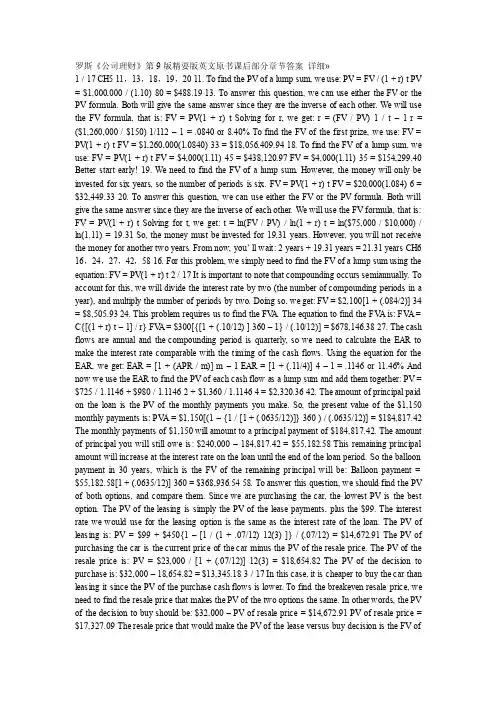
罗斯《公司理财》第9版精要版英文原书课后部分章节答案详细»1 / 17 CH5 11,13,18,19,20 11. To find the PV of a lump sum, we use: PV = FV / (1 + r) t PV = $1,000,000 / (1.10) 80 = $488.19 13. To answer this question, we can use either the FV or the PV formula. Both will give the same answer since they are the inverse of each other. We will use the FV formula, that is: FV = PV(1 + r) t Solving for r, we get: r = (FV / PV) 1 / t –1 r = ($1,260,000 / $150) 1/112 – 1 = .0840 or 8.40% To find the FV of the first prize, we use: FV = PV(1 + r) t FV = $1,260,000(1.0840) 33 = $18,056,409.94 18. To find the FV of a lump sum, we use: FV = PV(1 + r) t FV = $4,000(1.11) 45 = $438,120.97 FV = $4,000(1.11) 35 = $154,299.40 Better start early! 19. We need to find the FV of a lump sum. However, the money will only be invested for six years, so the number of periods is six. FV = PV(1 + r) t FV = $20,000(1.084)6 = $32,449.33 20. To answer this question, we can use either the FV or the PV formula. Both will give the same answer since they are the inverse of each other. We will use the FV formula, that is: FV = PV(1 + r) t Solving for t, we get: t = ln(FV / PV) / ln(1 + r) t = ln($75,000 / $10,000) / ln(1.11) = 19.31 So, the money must be invested for 19.31 years. However, you will not receive the money for another two years. From now, you’ll wait: 2 years + 19.31 years = 21.31 years CH6 16,24,27,42,58 16. For this problem, we simply need to find the FV of a lump sum using the equation: FV = PV(1 + r) t 2 / 17 It is important to note that compounding occurs semiannually. To account for this, we will divide the interest rate by two (the number of compounding periods in a year), and multiply the number of periods by two. Doing so, we get: FV = $2,100[1 + (.084/2)] 34 = $8,505.93 24. This problem requires us to find the FV A. The equation to find the FV A is: FV A = C{[(1 + r) t – 1] / r} FV A = $300[{[1 + (.10/12) ] 360 – 1} / (.10/12)] = $678,146.38 27. The cash flows are annual and the compounding period is quarterly, so we need to calculate the EAR to make the interest rate comparable with the timing of the cash flows. Using the equation for the EAR, we get: EAR = [1 + (APR / m)] m – 1 EAR = [1 + (.11/4)] 4 – 1 = .1146 or 11.46% And now we use the EAR to find the PV of each cash flow as a lump sum and add them together: PV = $725 / 1.1146 + $980 / 1.1146 2 + $1,360 / 1.1146 4 = $2,320.36 42. The amount of principal paid on the loan is the PV of the monthly payments you make. So, the present value of the $1,150 monthly payments is: PV A = $1,150[(1 – {1 / [1 + (.0635/12)]} 360 ) / (.0635/12)] = $184,817.42 The monthly payments of $1,150 will amount to a principal payment of $184,817.42. The amount of principal you will still owe is: $240,000 – 184,817.42 = $55,182.58 This remaining principal amount will increase at the interest rate on the loan until the end of the loan period. So the balloon payment in 30 years, which is the FV of the remaining principal will be: Balloon payment = $55,182.58[1 + (.0635/12)] 360 = $368,936.54 58. To answer this question, we should find the PV of both options, and compare them. Since we are purchasing the car, the lowest PV is the best option. The PV of the leasing is simply the PV of the lease payments, plus the $99. The interest rate we would use for the leasing option is the same as the interest rate of the loan. The PV of leasing is: PV = $99 + $450{1 –[1 / (1 + .07/12) 12(3) ]} / (.07/12) = $14,672.91 The PV of purchasing the car is the current price of the car minus the PV of the resale price. The PV of the resale price is: PV = $23,000 / [1 + (.07/12)] 12(3) = $18,654.82 The PV of the decision to purchase is: $32,000 – 18,654.82 = $13,345.18 3 / 17 In this case, it is cheaper to buy the car than leasing it since the PV of the purchase cash flows is lower. To find the breakeven resale price, we need to find the resale price that makes the PV of the two options the same. In other words, the PV of the decision to buy should be: $32,000 – PV of resale price = $14,672.91 PV of resale price = $17,327.09 The resale price that would make the PV of the lease versus buy decision is the FV ofthis value, so: Breakeven resale price = $17,327.09[1 + (.07/12)] 12(3) = $21,363.01 CH7 3,18,21,22,31 3. The price of any bond is the PV of the interest payment, plus the PV of the par value. Notice this problem assumes an annual coupon. The price of the bond will be: P = $75({1 – [1/(1 + .0875)] 10 } / .0875) + $1,000[1 / (1 + .0875) 10 ] = $918.89 We would like to introduce shorthand notation here. Rather than write (or type, as the case may be) the entire equation for the PV of a lump sum, or the PV A equation, it is common to abbreviate the equations as: PVIF R,t = 1 / (1 + r) t which stands for Present V alue Interest Factor PVIFA R,t = ({1 – [1/(1 + r)] t } / r ) which stands for Present V alue Interest Factor of an Annuity These abbreviations are short hand notation for the equations in which the interest rate and the number of periods are substituted into the equation and solved. We will use this shorthand notation in remainder of the solutions key. 18. The bond price equation for this bond is: P 0 = $1,068 = $46(PVIFA R%,18 ) + $1,000(PVIF R%,18 ) Using a spreadsheet, financial calculator, or trial and error we find: R = 4.06% This is thesemiannual interest rate, so the YTM is: YTM = 2 4.06% = 8.12% The current yield is:Current yield = Annual coupon payment / Price = $92 / $1,068 = .0861 or 8.61% The effective annual yield is the same as the EAR, so using the EAR equation from the previous chapter: Effective annual yield = (1 + 0.0406) 2 – 1 = .0829 or 8.29% 20. Accrued interest is the coupon payment for the period times the fraction of the period that has passed since the last coupon payment. Since we have a semiannual coupon bond, the coupon payment per six months is one-half of the annual coupon payment. There are four months until the next coupon payment, so two months have passed since the last coupon payment. The accrued interest for the bond is: Accrued interest = $74/2 × 2/6 = $12.33 And we calculate the clean price as: 4 / 17 Clean price = Dirty price –Accrued interest = $968 –12.33 = $955.67 21. Accrued interest is the coupon payment for the period times the fraction of the period that has passed since the last coupon payment. Since we have a semiannual coupon bond, the coupon payment per six months is one-half of the annual coupon payment. There are two months until the next coupon payment, so four months have passed since the last coupon payment. The accrued interest for the bond is: Accrued interest = $68/2 × 4/6 = $22.67 And we calculate the dirty price as: Dirty price = Clean price + Accrued interest = $1,073 + 22.67 = $1,095.67 22. To find the number of years to maturity for the bond, we need to find the price of the bond. Since we already have the coupon rate, we can use the bond price equation, and solve for the number of years to maturity. We are given the current yield of the bond, so we can calculate the price as: Current yield = .0755 = $80/P 0 P 0 = $80/.0755 = $1,059.60 Now that we have the price of the bond, the bond price equation is: P = $1,059.60 = $80[(1 – (1/1.072) t ) / .072 ] + $1,000/1.072 t We can solve this equation for t as follows: $1,059.60(1.072) t = $1,111.11(1.072) t –1,111.11 + 1,000 111.11 = 51.51(1.072) t2.1570 = 1.072 t t = log 2.1570 / log 1.072 = 11.06 11 years The bond has 11 years to maturity.31. The price of any bond (or financial instrument) is the PV of the future cash flows. Even though Bond M makes different coupons payments, to find the price of the bond, we just find the PV of the cash flows. The PV of the cash flows for Bond M is: P M = $1,100(PVIFA 3.5%,16 )(PVIF 3.5%,12 ) + $1,400(PVIFA3.5%,12 )(PVIF 3.5%,28 ) + $20,000(PVIF 3.5%,40 ) P M = $19,018.78 Notice that for the coupon payments of $1,400, we found the PV A for the coupon payments, and then discounted the lump sum back to today. Bond N is a zero coupon bond with a $20,000 par value, therefore, the price of the bond is the PV of the par, or: P N = $20,000(PVIF3.5%,40 ) = $5,051.45 CH8 4,18,20,22,244. Using the constant growth model, we find the price of the stock today is: P 0 = D 1 / (R – g) = $3.04 / (.11 – .038) = $42.22 5 / 17 18. The price of a share of preferred stock is the dividend payment divided by the required return. We know the dividend payment in Year 20, so we can find the price of the stock in Y ear 19, one year before the first dividend payment. Doing so, we get: P 19 = $20.00 / .064 P 19 = $312.50 The price of the stock today is the PV of the stock price in the future, so the price today will be: P 0 = $312.50 / (1.064) 19 P 0 = $96.15 20. We can use the two-stage dividend growth model for this problem, which is: P 0 = [D 0 (1 + g 1 )/(R – g 1 )]{1 – [(1 + g 1 )/(1 + R)] T }+ [(1 + g 1 )/(1 + R)] T [D 0 (1 + g 2 )/(R –g 2 )] P0 = [$1.25(1.28)/(.13 –.28)][1 –(1.28/1.13) 8 ] + [(1.28)/(1.13)] 8 [$1.25(1.06)/(.13 – .06)] P 0 = $69.55 22. We are asked to find the dividend yield and capital gains yield for each of the stocks. All of the stocks have a 15 percent required return, which is the sum of the dividend yield and the capital gains yield. To find the components of the total return, we need to find the stock price for each stock. Using this stock price and the dividend, we can calculate the dividend yield. The capital gains yield for the stock will be the total return (required return) minus the dividend yield. W: P 0 = D 0 (1 + g) / (R – g) = $4.50(1.10)/(.19 – .10) = $55.00 Dividend yield = D 1 /P 0 = $4.50(1.10)/$55.00 = .09 or 9% Capital gains yield = .19 – .09 = .10 or 10% X: P 0 = D 0 (1 + g) / (R – g) = $4.50/(.19 – 0) = $23.68 Dividend yield = D 1 /P 0 = $4.50/$23.68 = .19 or 19% Capital gains yield = .19 – .19 = 0% Y: P 0 = D 0 (1 + g) / (R – g) = $4.50(1 – .05)/(.19 + .05) = $17.81 Dividend yield = D 1 /P 0 = $4.50(0.95)/$17.81 = .24 or 24% Capital gains yield = .19 – .24 = –.05 or –5% Z: P 2 = D 2 (1 + g) / (R – g) = D 0 (1 + g 1 ) 2 (1 +g 2 )/(R – g 2 ) = $4.50(1.20) 2 (1.12)/(.19 – .12) = $103.68 P 0 = $4.50 (1.20) / (1.19) + $4.50(1.20) 2 / (1.19) 2 + $103.68 / (1.19) 2 = $82.33 Dividend yield = D 1 /P 0 = $4.50(1.20)/$82.33 = .066 or 6.6% Capital gains yield = .19 – .066 = .124 or 12.4% In all cases, the required return is 19%, but the return is distributed differently between current income and capital gains. High growth stocks have an appreciable capital gains component but a relatively small current income yield; conversely, mature, negative-growth stocks provide a high current income but also price depreciation over time. 24. Here we have a stock with supernormal growth, but the dividend growth changes every year for the first four years. We can find the price of the stock in Y ear 3 since the dividend growth rate is constant after the third dividend. The price of the stock in Y ear 3 will be the dividend in Y ear 4, divided by the required return minus the constant dividend growth rate. So, the price in Y ear 3 will be: 6 / 17 P3 = $2.45(1.20)(1.15)(1.10)(1.05) / (.11 – .05) = $65.08 The price of the stock today will be the PV of the first three dividends, plus the PV of the stock price in Y ear 3, so: P 0 = $2.45(1.20)/(1.11) + $2.45(1.20)(1.15)/1.11 2 + $2.45(1.20)(1.15)(1.10)/1.11 3 + $65.08/1.11 3 P 0 = $55.70 CH9 3,4,6,9,15 3. Project A has cash flows of $19,000 in Y ear 1, so the cash flows are short by $21,000 of recapturing the initial investment, so the payback for Project A is: Payback = 1 + ($21,000 / $25,000) = 1.84 years Project B has cash flows of: Cash flows = $14,000 + 17,000 + 24,000 = $55,000 during this first three years. The cash flows are still short by $5,000 of recapturing the initial investment, so the payback for Project B is: B: Payback = 3 + ($5,000 / $270,000) = 3.019 years Using the payback criterion and a cutoff of 3 years, accept project A and reject project B. 4. When we use discounted payback, we need to find the value of all cash flows today. The value today of the project cash flows for the first four years is: V alue today of Y ear 1 cash flow = $4,200/1.14 = $3,684.21 V alue today of Y ear 2 cash flow = $5,300/1.14 2 = $4,078.18 V alue today of Y ear 3 cash flow = $6,100/1.14 3 = $4,117.33 V alue today of Y ear 4 cash flow = $7,400/1.14 4 = $4,381.39 To findthe discounted payback, we use these values to find the payback period. The discounted first year cash flow is $3,684.21, so the discounted payback for a $7,000 initial cost is: Discounted payback = 1 + ($7,000 – 3,684.21)/$4,078.18 = 1.81 years For an initial cost of $10,000, the discounted payback is: Discounted payback = 2 + ($10,000 –3,684.21 –4,078.18)/$4,117.33 = 2.54 years Notice the calculation of discounted payback. We know the payback period is between two and three years, so we subtract the discounted values of the Y ear 1 and Y ear 2 cash flows from the initial cost. This is the numerator, which is the discounted amount we still need to make to recover our initial investment. We divide this amount by the discounted amount we will earn in Y ear 3 to get the fractional portion of the discounted payback. If the initial cost is $13,000, the discounted payback is: Discounted payback = 3 + ($13,000 – 3,684.21 – 4,078.18 – 4,117.33) / $4,381.39 = 3.26 years 7 / 17 6. Our definition of AAR is the average net income divided by the average book value. The average net income for this project is: A verage net income = ($1,938,200 + 2,201,600 + 1,876,000 + 1,329,500) / 4 = $1,836,325 And the average book value is: A verage book value = ($15,000,000 + 0) / 2 = $7,500,000 So, the AAR for this project is: AAR = A verage net income / A verage book value = $1,836,325 / $7,500,000 = .2448 or 24.48% 9. The NPV of a project is the PV of the outflows minus the PV of the inflows. Since the cash inflows are an annuity, the equation for the NPV of this project at an 8 percent required return is: NPV = –$138,000 + $28,500(PVIFA 8%, 9 ) = $40,036.31 At an 8 percent required return, the NPV is positive, so we would accept the project. The equation for the NPV of the project at a 20 percent required return is: NPV = –$138,000 + $28,500(PVIFA 20%, 9 ) = –$23,117.45 At a 20 percent required return, the NPV is negative, so we would reject the project. We would be indifferent to the project if the required return was equal to the IRR of the project, since at that required return the NPV is zero. The IRR of the project is: 0 = –$138,000 + $28,500(PVIFA IRR, 9 ) IRR = 14.59% 15. The profitability index is defined as the PV of the cash inflows divided by the PV of the cash outflows. The equation for the profitability index at a required return of 10 percent is: PI = [$7,300/1.1 + $6,900/1.1 2 + $5,700/1.1 3 ] / $14,000 = 1.187 The equation for the profitability index at a required return of 15 percent is: PI = [$7,300/1.15 + $6,900/1.15 2 + $5,700/1.15 3 ] / $14,000 = 1.094 The equation for the profitability index at a required return of 22 percent is: PI = [$7,300/1.22 + $6,900/1.22 2 + $5,700/1.22 3 ] / $14,000 = 0.983 8 / 17 We would accept the project if the required return were 10 percent or 15 percent since the PI is greater than one. We would reject the project if the required return were 22 percent since the PI。
罗斯《公司理财》英文习题答案DOCchap009

公司理财习题答案第九章Chapter 9: Capital Market Theory: An Overview9.1 a. Capital gains = $38 - $37 = $1 per shareb. Total dollar returns = Dividends + Capital Gains = $1,000 + ($1*500) = $1,500On a per share basis, this calculation is $2 + $1 = $3 per share c. On a per share basis, $3/$37 = 0.0811 = 8.11%On a total dollar basis, $1,500/(500*$37) = 0.0811 = 8.11%d. No, you do not need to sell the shares to include the capital gains in the computation of the returns. The capital gain is included whether or not you realize the gain. Since you could realize the gain if you choose, you shouldinclude it.9.2 Purchase Price = $10,400/200 = $52.00 a. Total dollar return = $600 + 200($54.25 - $52) =$1,050 b. Capital gain = 200($54.25-52) = $450 c. Percentage Return = $1050/$10400 = 10.10% d. Dividend Yield = $600/(200*52) = 5.77%9.3 ()[]2.40$31$42/42$8.60/$420.204820.48%+-=-=-=-9.4 The expected holding period return is:()[]$5.50$54.75$52/$520.1586515.865%+-== 9.5 You can find the nominal returns, I, on each of the securities in the text. The inflationrate, π, for the period is also in the text. It is 3.2%. The real return, r, is (1+I)/(1+π)-1. An approximation for the real rate is r = i - π. Notice that the approximation is good when the nominal interest rate is close to the inflation rate.Nominal Real Approximationa. Common Stocks 12.2% 8.7% 9.2%b. L/T Corp. Bonds 5.7% 2.4% 2.5%c. L/T Govt. Bonds 5.2% 1.9% 2.0%d. U.S. T-Bills3.7%0.5%0.5%9.6 E(R) = T-Bill rate + Average Excess Return = 6.2% + (12.4% -3.9%) = 14.7% 9.7 Suppose the two companies’ stock price 2 years ago were P 02 years ago 1 year ago TodayKoke P 0 1.1P 0 1.1*0.9*P 0= 0.99P 0 Pepsee P 0 0.9P 0 0.9*1.1*P 0= 0.99 P 0Both stocks have the same prices, but their prices are lower than 2 years ago.9.8 Five-year Holding Period Return = (1-0.0491)⨯(1+0.2141)⨯(1+0.2251)⨯(1+0.0627)⨯(1+0.3216)-1 = 98.64% 9.9 Risk Premium = 6.1 - 3.8 = 2.3%Expected Return on the market long term corporate bonds = 4.36% + 2.3% = 6.96%9.10 159.07199.0301.0164.0047.0438.001.0026.0R .a =+++++--=b. R R R - ()R R -2-0.026 -0.1850.03423 -0.010 -0.169 0.02856 0.438 0.279 0.07784 0.047 -0.112 0.01254 0.164 0.005 0.00003 0.301 0.142 0.02016 0.199 0.0400.00160Total 0.17496 ()σσ2=-====0.17496/710.029160.029160.170817.08%Note, because the data are historical data, the appropriate denominator in the calculation of the variance is N-1. 9.11 a. Common Treasury Realized Stocks BillsRisk Premium-7 32.4% 11.2% 21.2% -6 -4.9 14.7 -19.6 -5 21.4 10.5 10.9 -4 22.5 8.8 13.7 -3 6.3 9.9 -3.6 -2 32.2 7.7 24.5Last18.56.212.3b.The average risk premium is 8.49%.49.873.125.246.37.139.106.192.21=++-++-c.Yes, it is possible for the observed risk premium to be negative. This can happen in any single year. The average risk premium over many years should bepositive.公司理财习题答案第九章9.12 a.b.Standard deviation = 03311.0001096.0= 9.13a.b.Standard deviation = 0000984.= 0.03137 = 3.137%9.14 a. R 0.120.230.400.180.250.150.150.090.080.030.153 =15.3%m =⨯+⨯+⨯+⨯+⨯=b.()R 0.120.120.400.090.250.050.150.010.080.020.0628 = 6.28%T =⨯+⨯+⨯+⨯+⨯-=9.15 a.()()R 0.040.060.090.04/40.0575R 0.050.070.100.14/40.09p Q =+++==+++=b.R R p p -()R R p p -2-0.0175 0.00031 -0.0025 0.00001 +0.0325 0.00106 -0.0175 0.000310.00169Variance of R p ==0001694000042./.Standard Deviation of 02049.000042.0R p==()R R R R Q QQ Q--2-0.04 0.0016 -0.02 0.0004 0.01 0.0001 0.05 0.0025 0.0046Variance of R Q ==000464000115./.Standard Deviation of R Q ==000115003391..9.16 S R = Average Return on the Small Company Stocks.mR= Average Return on the Market Index. 2S S = Variance in the Returns of the Small Company Stocks.S S = Standard Deviation in the Returns of the Small Company Stocks. 2m S = Variance in the Returns of the Market Index.m S = Standard Deviation in the Returns of the Market Index.a. S R = 1542.05005.0350.0339.0477.0=--+mR=1604.05004.0328.0580.0648.0402.0=++-+公司理财习题答案第九章b. Small Company StocksMarket IndexR R s s - ()R R s s -2R R m m - ()R R m m -20.3228 0.104199840.2416 0.058370560.1848 0.03415104 0.4876 0.23775376 -0.5042 0.25421764 -0.7404 0.54819216 0.1558 0.02427364 0.1676 0.02808976 -0.1592 0.02534464 -0.1564 0.02446096Total =0.896867200.473520.2242168m s 0.332490.1105467s s 0.2242168/40.896867202ms0.1105467/40.442186802ss========Note, because the data are historical returns, the appropriate denominator in the calculation of the variance is N-1.9.17Let R cs = The Returns on Common Stocks (in %) Let R ss = The Returns on Small Stocks (in %)Let R cb = The Returns on Long-term Corporate Bonds (in %) Let R gb = The Returns on Long- term Government Bonds (in %) Let R tb = The Returns on Treasury Bills (in %) Let – over a variable denote its average valueBecause these data are historical data, the proper divisor for computing the variance is N-1. Thus, the variance of the returns of each security is the sum of the squared deviations divided by six.Var ( Rcs ) = 0.018372 SD ( Rcs) = 0.1355Var ( Rss ) = 0.029734 SD ( Rss) = 0.1724Var ( Rcb ) = 0.029522 SD ( Rcb) = 0.1718Var ( Rgb ) = 0.02868 SD ( Rgb) = 0.16935Var ( Rtb ) = 0.00075 SD ( Rtb) = 0.027479.18 a. The average return on small company stocks isRs=(6.85-9.30+22.87+10.18-21.56+44.63)%/6 = 8.95% The average return on T-bills is:()R 6.16 5.47 6.358.377.81 5.60/6 6.63%T=+++++=公司理财习题答案第九章b.c. Returns on T-bills are lower than small stock returns but their variance is muchsmaller.9.19 The range with 95% probability is: []σσ,22-+M ean M ean⇒[ 17.5-2⨯ 8.5, 17.5+2⨯8.5]⇒[ 0.5%, 34.5%]9.20 a. Expected Return on the Market:= 0.25(-8.2%)+0.5(12.3%)+0.25(25.8%)= 10.55%Expected Return on T-Bills: = 3.5%b. Expected Premium = 0.25(-8.2-3.5)+0.5(12.3-3.5)+0.25(25.8-3.5) = 7.05%。
罗斯《公司理财》英文习题答案DOCchap018

公司理财习题答案第十八章Chapter 18: Dividend Policy: Why Does It Matter?18.1February 16:Declaration date - the board of directors declares a dividend payment thatwill be made on March 14.February 24:Ex-dividend date - the shares trade ex dividend on and after this date. Sellersbefore this date receive the dividend. Purchasers on or after this date do notreceive the dividend.February 26:Record date - the declared dividends are distributable to shareholders ofrecord on this date.March 14:Payable date - the checks are mailed.18.2Based on Miller and Modigliani reasoning, the stock will sell for $8.75. This is the same price youpurchased the stock. When the stock goes ex-dividend the stock is expected to fall $0.75 a share.18.3 a.If the dividend is declared, the price of the stock will drop on the ex-dividend dateby the value of the dividend, $5. It will then trade for $95.b. If it is not declared, the price will remain at $100.c. Mann’s outflows for investments are $2,000,000. These outflows occurimmediately. One year from now, the firm will realize $1,000,000 in net incomeand it will pay $500,000 in dividends. Since the only immediate financing need isfor the investments, Mann must finance $2,000,000 through the sale of shares worth$100. It must sell $2,000,000 / $100 = 20,000 shares.d. The MM model is not realistic since it does not account for taxes, brokerage fees,uncertainty over future cash flows, investors’ preferences, signaling effects, andagency costs.18.4 a. The ex-dividend date is Feb. 27, which is two business days before the record date.b. The stock price should drop by $1.25 on the ex-dividend date.18.5 Knowing that share price can be expressed as the present value of expected futuredividends does not make dividend policy relevant. Under the growing perpetuity model, if overall corporate cash flows are unchanged, then a change in dividend policy only changes the timing of the dividends. The PV of those dividends is the same. This is true because, given that future earnings are held constant, dividend policy simply represents a transfer between current and future stockholders.In a more realistic context and assuming a finite holding period, the value of the shares should represent the future stock price as well as the dividends. Any cash flow not paid as a dividend will be reflected in the future stock price. As such the PV of the flows will not change with shifts in dividend policy; dividend policy is still irrelevant.18.6 a. The price is the PV of the dividends,$2.$17..$1511553751152+=b. The current value of your shares is ($15)(500) = $7,500. The annuity you receivemust solve ;$7,500X 1.15X 1.152=+You desire $4,613.3721 each year. You will receive $1,000 in dividends in the firstyear, so you must sell enough shares to generate $3,613.3721. The end-of-yearprice at which you will sell your shares is the PV of the liquidating dividend,$17.5375 / 1.15 = $15.25, so you must sell 236.942 shares. The remaining shareswill each earn the liquidating dividend. At the end of the second year, you willreceive $4,613.38 [= (500 - 236.942) x $17.5375]. (Rounding causes thediscrepancies).18.7 a. The value is the PV of the cash flows.Value = $32,000 + $1,545,600 / 1.12 = $1,412,000b. The current price of $141.20 per share will fall by the value of the dividend to $138.c. i. According to MM, it cannot be true that the low dividend is depressing the price.Since dividend policy is irrelevant, the level of the dividend should not matter.Any funds not distributed as dividends add to the value of the firm hence thestock price. These directors merely want to change the timing of the dividends(more now, less in the future). As the calculations below indicate, the value ofthe firm is unchanged by their proposal. Therefore, share price will beunchanged.To pay the $4.25 dividend, new shares, which total $10,500 (-$42,500 - $32,000)in value, must be sold. Those shares must also earn 12% so the value of the oldshareholders’ interest one year hence will fall $11,760 (=10,500 x 1.12). Underthis scenario, the current value of the firm is Value = $42,500 + $1,533,840 /1.12 = $1,412,000ii. The new shareholders are not entitled to receive the current dividend. They will receive only the value of the equity one year hence. The PV of those flows is$1,533,840 / 1.12 = $1,369,500, so the share price will be $136.95 and 76.67shares will be sold.18.8 a. (1.2 + 15) / 1 = $16.2Expected share price is $16.2.b. He can invest the dividends into the Gibson stock.Dividends that he gets = $1.2 million x 50% x 1,000 / 1,000,000 = $600Expected share price after dividend = (0.6 + 15) / 1 =$15.6Number of shares that Jeff needs to buy = 600 / 15.6 = 3818.9Alternative 1: Dividends are paid out to the shareholders now.2 (1-31%) (1+7% (1-31%))3 = $1.59 millionAlternative 2: NBM invests cash in the financial assets:i. T-bill2 (1+7% (1-35%))3 (1-31%) = $1.58 millionii. Preferred stock2 {1+11% [1-(1-30%) x 35%]3} (1-31%) = $1.75 millionThe after-tax cash flow for the shareholders is maximized when the firm invests the cash in the preferred stocks.公司理财习题答案第十八章18.10 You should not expect to find either low dividend, high growth stocks or tax-free municipalbonds in the University of Pennsylvania’s portfolio. Since the university does not pay taxes on investment income, it will want to invest in securities, which provide the highest pre-tax return. Since tax-free municipal bonds generally provide lower returns than taxablesecurities, there is no reason for the university to hold municipal bonds.The Litzenberger-Ramaswamy research (discussed in the section on empirical evidence) found that high dividend stocks pay higher pre-tax returns than risk comparable lowdividend stocks because of the taxes on dividend income. Since the University ofPennsylvania does not pay taxes, it would be wise to invest in high dividend stocks rather than low dividend stocks in the same risk class.18.11 a. If T C = T0 then (P e - P b) / D =1. The stock price will fall by the amount of thedividend.b. If T C = 0 and T0 0 then (P e - P b) / D =1 - T0. The stock price will fall by the after-tax proceeds from the dividend.c. In a, there was no tax disadvantage to dividends. Thus, investors are indifferentbetween buying the stock at P b and receiving the dividend or waiting, buying thestock at P e and receiving a subsequent capital gain. When only the dividend istaxed, after-tax proceeds must be equated for investors to be indifferent. Since theafter-tax proceeds from the dividend are D (1 - T0), the price will fall by thatamount.d. No, Elton and Gruber’s paper is not a prescription for dividend policy. In a worldwith taxes, a firm should never issue stock to pay a dividend, but the presence oftaxes does not imply that firms should not pay dividends from excess cash. Theprudent firm, when faced with other financial considerations and legal constraintsmay choose to pay dividends.18.12 a. Let x be the ordinary income tax rate. The individual receives an after-tax dividendof $1,000(1-x) which she invests in Treasury bonds. The T-bond will generateafter-tax cash flows to the investor of $1,000 (1 - x)[1+0.08(1-x)].If the firm invests the money, its proceeds are $1,000 [1 + 0.08 (1-0.35)]To be indifferent, the investor’s proceeds must be the same whether she invests theafter-tax dividend or receives the proceeds from the firm’s investment and paystaxes on that amount.1,000 (1 - x) [1 + 0.08 (1 - x)] = (1 - x) {1,000 [1 + 0.08 (1 - 0.35)]}x = 0.35Note: This argument does not depend upon the length of time the investment is held.b.Yes, this is a reasonable answer. She is only indifferent if the after-tax proceedsfrom the $1,000 investment in identical securities are identical; that occurs onlywhen the tax rates are identical.c. Since both investors will receive the same pre-tax return, you would expect the sameanswer as in part a. Yet, because Carlson enjoys a tax benefit from investing instock, the tax rate on ordinary income, which induces indifference, is much lower.1,000 (1 - x) [1 + 0.12(1 - x)] = (1 - x) {1,000 [1 + 0.12 (1 – 0.3) (0.35)]}x = 24.5%d. It is a compelling argument, but there are legal constraints, which deter firms frominvesting large sums in stock of other companies.18.13 The fallacy behind both groups’ arguments is that they are considering dividends the onlyreturn on a stock. They ignored capital gains. If dividends are controlled, firms are likely to decrease their dividends. When dividends are reduced, the companies retain moreincome, which causes share price to increase. That increase in share price will add to the investors’ capital gains. Since dividends and capital gains are both ways of compensating investors, if transaction costs are negligible and there are no taxes, investors will beindifferent between the two forms of compensation.18.14 a. The after-tax expected return on Grebe stock is 4 / 20 = 0.2. Since Deaton stock isin the same risk class, it will be priced to yield the same after-tax expected return.0.2(20P)(1T g)4(0.75)P;T g0P$19.170=--+= =b. If T g = 25%, the after-tax expected return on Grebe stock is (4) (1-0.25) / 20 = 0.15.Deaton’s price will be0.15(20P)(0.75)4(0.75)PP$200=-+ =c. In this MM world, when the tax rates are identical, there is no tax disadvantage tothe dividend. Investors are indifferent between $1 in capital gains and $1 individends. Hence, Deaton’s price will also be $20.18.15 P (Payall) = [100 + 25 (1-25%)] / (1 + 25%) = $95P (Payless) = [100 + 25 (50%) + 25 (50%) (1 - 25%)] / (1 + 25%) = $97.5P (Paynone) = $10018.16 a. Dividend yield: 4.5 / 50.50 = 0.0891b. The pricing of bonds was discussed in an earlier chapter. Whenever a bond isselling at par, the yield to maturity is the coupon rate. So, the yield on the DuPontbonds is 11%.c. After-tax shield = (Pre-tax yield) (1 - T)Preferred stock Debti. GM’s pension fund; T=08.91%11.00%ii. GM; T=.348.00%7.26%iii Roger Smith; T = 0.28 6.42%7.92% *GM is exempt from 70% of taxes on dividend income, therefore, its effective taxrate is (0.3) (0.34) = 0.102.d. Corporations, which are exempt from 70% of taxes on dividend income, would holdthe preferred stock.18.17 The bird-in-the-hand argument is based upon the erroneous assumption that increaseddividends make a firm less risky. If capital spending and investment spending areunchanged, the firm’s overall cash flows are not affected by the dividend policy.18.18 This argument is theoretically correct. In the real world with transaction costs of securitytrading, home-made dividends can be more expensive than dividends directly paid out by公司理财习题答案第十八章the firms. However, the existence of financial intermediaries such as mutual funds reduces the transaction costs for individuals greatly. Thus, as a whole, the desire for current income shouldn’t be a major factor favoring high-current-dividend policy.18.19 To minimize her tax burden, your aunt should divest herself of high dividend yield stocksand invest in low dividend yield stock. Or, if possible, she should keep her high dividend stocks, borrow an equivalent amount of money and invest that money in a tax deferredaccount.18.20 This is not evidence on investor preferences. A rise in stock price when the currentdividend is increased may reflect expectations that future earnings, cash flows, etc. willrise. The better performance of the 115 companies, which raised their payouts, may also reflect a signal by management through the dividends that the firms were expected to do well in the future.18.21 Virginia Power’s investors probably were not aware of the cash flow crunch. Thus, theprice drop was due to the negative information about the cost overruns. Even if they were suspicious that there were overruns, the announcement would still cause a drop in pricebecause it removed all uncertainty about overruns and indicated their magnitude.18.22 As the firm has been paying out regular dividends for more than 10 years, the currentsevere cut in dividends can cause the shareholders to lower their expectations on currentand future cash flows of the firm. It then results in the drop in the stock price.18.23 a. Cap’s past behavior suggests a preference for capital gains while Widow Jonesexhibits a preference for current income.b. Cap could show the widow how to construct homemade dividends through the saleof stock. Of course, Cap will also have to convince her that she lives in an MMworld. Remember that homemade dividends can only be constructed under the MMassumptions.c.Widow Jones may still not invest in Neotech because of the transaction costsinvolved in constructing homemade dividends. Also the Widow may desire theuncertainty resolution which comes with high dividend stocks.18.24 The capital investment needs of small, growing companies are very high. Therefore,payment of dividends could curtail their investment opportunities. Their other option is to issue stock to pay the dividend thereby incurring issuance costs. In either case, thecompanies and thus their investors are better off with a zero dividend policy during thefirms’ rapid growth phases. This fact makes these firms attractive only to low dividendclienteles.This example demonstrates that dividend policy is relevant when there are issuance costs.Indeed, it may be relevant whenever the assumptions behind the MM model are not met. 18.25 Unless there is an unsatisfied high dividend clientele, a firm cannot improve its share priceby switching policies. If the market is in equilibrium, the number of people who desirehigh dividend payout stocks should exactly equal the number of such stocks available. The supplies and demands of each clientele will be exactly met in equilibrium. If the market is not in equilibrium, the supply of high dividend payout stocks may be less than the demand.Only in such a situation could a firm benefit from a policy shift.18.26 a. Div1 = Div0 + s (t EPS1 - Div0)= 1.25 + 0.3 (0.4 x 4.5 -1.25)= 1.415b. Div1 = Div0 + s (t EPS1 - Div0)= 1.25 + 0.6 (0.4 x 4.5 - 1.25)= 1.58Note: Part “a” is more conservative since the adjustment rate is lower.18.27 This finding implies that firms use initial dividends to “signal” their potentialgrowth and positive NPV prospects to the stock market. The initiation of regularcash dividends also serves to convince the market that their high current earningsare not temporary.。
罗斯《公司理财》英文习题答案DOCchap014

公司理财习题答案第十四章Chapter 14: Long-Term Financing: An Introduction14.1 a. C om m on Stock A ccountPar V alue$135,430$267,715 shares ==b. Net capital from the sale of shares = Common Stock + Capital SurplusNet capital = $135,430 + $203,145 = $338,575Therefore, the average price is $338,575 / 67,715 = $5 per shareAlternate solution:Average price = Par value + Average capital surplus= $2 + $203,145 / 67,715= $5 per sharec. Book value = Assets - Liabilities = Equity= Common stock + Capital surplus + Retained earnings= $2,708,600Therefore, book value per share is $2,708,600 / 67,715= $40.14.2 a. Common stock = (Shares outstanding ) x (Par value)= 500 x $1= $500Total = $150,500b.Common stock (1500 shares outstanding, $1 par) $1,500Capital surplus* 79,000Retained earnings 100,000Total $180,500* Capital Surplus = Old surplus + Surplus on sale= $50,000 + ($30 - $1) x 1,000=$79,00014.3 a. Shareholders’ equityCommon stock ($5 par value; authorized 500,000shares; issued and outstanding 325,000 shares)$1,625,000 Capital in excess of par* 195,000Retained earnings** 3,794,600Total $5,614,600*Capital surplus = 12% of Common Stock= (0.12) ($1,625,000)= $195,000**Retained earnings = Old retained earnings + Net income - Dividends= $3,545,000 + $260,000 - ($260,000)(0.04)= 3,794,600b. Shareholders’ equity$1,750,000Common stock ($5 par value; authorized 500,000shares; issued and outstanding 350,000 shares)Capital in excess of par* 170,000Retained earnings 3,794,600Total $5,714,600*Capital surplus is reduced by the below par sale, i.e. $195,000 - ($1)(25,000) =$170,00014.4 a. Under straight voting, one share equals one vote. Thus, to ensure the election of onedirector you must hold a majority of the shares. Since two million shares areoutstanding, you must hold more than 1,000,000 shares to have a majority of votes.b. Cumulative voting is often more easily understood through a story. Remember thatyour goal is to elect one board member of the seven who will be chosen today.Suppose the firm has 28 shares outstanding. You own 4 of the shares and one otherperson owns the remaining 24 shares. Under cumulative voting, the total number ofvotes equals the number of shares times the number of directors being elected,(28)(7) = 196. Therefore, you have 28 votes and the other stockholder has 168 votes.Also, suppose the other shareholder does not wish to have your favorite candidateon the board. If that is true, the best you can do to try to ensure electing onemember is to place all of your votes on your favorite candidate. To keep yourcandidate off the board, the other shareholder must have enough votes to elect allseven members who will be chosen. If the other shareholder splits her votes evenlyacross her seven favorite candidates, then eight people, your one favorite and herseven favorites, will all have the same number of votes. There will be a tie! If shedoes not split her votes evenly (for example 29 28 28 28 28 28 27) then yourcandidate will win a seat. To avoid a tie and assure your candidate of victory, youmust have 29 votes which means you must own more than 4 shares.Notice what happened. If seven board members will be elected and you want to becertain that one of your favorite candidates will win, you must have more than one-eighth of the shares. That is, the percentage of the shares you must have to win ismore than1.(The num ber of m em bers being elected The num ber you w ant to select)Also notice that the number of shares you need does not change if more than oneperson owns the remaining shares. If several people owned the remaining 168shares they could form a coalition and vote together.Thus, in the Unicorn election, you will need more than 1/(7+1) = 12.5% of theshares to elect one board member. You will need more than (2,000,000) (0.125) =250,000 shares.Cumulative voting can be viewed more rigorously. Use the facts from the Unicornelection. Under cumulative voting, the total number of votes equals the number of公司理财习题答案第十四章shares times the number of directors being elected, 2,000,000 x 7 = 14,000,000. Let x be the number of shares you need. The number of shares necessary is7x14,000,0007x7x250,000.>-==>> You will need more than 250,000 shares.14.5 She can be certain to have one of her candidate friends be elected under the cumulativevoting rule. The lowest percentage of shares she needs to own to elect at least one out of 6candidates is higher than 1/7 = 14.3%. Her current ownership of 17.3% is more thanenough to ensure one seat. If the voting rule is staggered as described in the question, shewould need to own more than 1/4=25% of the shares to elect one out of the three candidatesfor certain. In this case, she will not have enough shares.14.6 a. You currently own 120 shares or 28.57% of the outstanding shares. You need to control 1/3 of the votes, which requires 140 shares. You need just over 20 additionalshares to elect yourself to the board.b. You need just over 25% of the shares, which is 250,000 shares. At $5 a share it willcost you $2,500,000 to guarantee yourself a seat on the board.14.7 The differences between preferred stock and debt are:a. The dividends of preferred stock cannot be deducted as interest expenses whendetermining taxable corporate income. From the individual investor’s point of view,preferred dividends are ordinary income for tax purposes. From corporate investors,80% of the amount they receive as dividends from preferred stock are exempt fromincome taxes.b. In liquidation, the seniority of preferred stock follows that of the debt and leads thatof the common stock.c. There is no legal obligation for firms to pay out preferred dividends as opposed tothe obligated payment of interest on bonds. Therefore, firms cannot be forced intodefault if a preferred stock dividend is not paid in a given year. Preferred dividendscan be cumulative or non-cumulative, and they can also be deferred indefinitely.14.8 Some firms can benefit from issuing preferred stock. The reasons can be:a. Public utilities can pass the tax disadvantage of issuing preferred stock on to theircustomers, so there is substantial amount of straight preferred stock issued byutilities.b. Firms reporting losses to the IRS already don’t have positive income for taxdeduction, so they are not affected by the tax disadvantage of dividend vs. interestpayment. They may be willing to issue preferred stock.c. Firms that issue preferred stock can avoid the threat of bankruptcy that exists withdebt financing because preferred dividends are not legal obligation as interestpayment on corporate debt.14.9 a. The return on non-convertible preferred stock is lower than the return on corporatebond for two reasons:i. Corporate investors receive 80% tax deductibility on dividends if they hold thestock. Therefore, they are willing to pay more for the stock; that lowers its return.ii. Issuing corporations are willing and able to offer higher returns on debt since theinterest on the debt reduces their tax liabilities. Preferred dividends are paid outof net income, hence they provide no tax shield.b. Corporate investors are the primary holders of preferred stock since, unlikeindividual investors, they can deduct 80% of the dividend when computing their taxliability. Therefore, they are willing to accept the lower return which the stockgenerates.14.10 The following table summarizes the main difference between debt and equity.Debt EquityRepayment is an obligation of the firm Yes NoGrants ownership of the firm No YesProvides a tax shield Yes NoLiquidation will result if not paid Yes NoCompanies often issue hybrid securities because of the potential tax shield and thebankruptcy advantage. If the IRS accepts the security as debt, the firm can use it as a tax shield. If the security maintains the bankruptcy and ownership advantages of equity, the firm has the best of both worlds.14.11 The trends in long-term financing in the United States were presented in the text. If CableCompany follows the trends, it will probably use 80% internal financing, net income of the project plus depreciation less dividends, and 20% external financing, long term debt and equity.。
罗斯《公司理财》英文习题答案DOCchap030

公司理财习题答案第三十章Chapter 30: Mergers and Acquisitions30.1 The new corporation issues $300,000 in new debt. The merger creates $100,000 ofgoodwill because the merger is a purchase.Balance SheetLager Brewing(in $ thousands)Current assets $480 Current liabilities $200Other assets 140 Long-term debt 400Net fixed assets 580 Equity 700Goodwill 100Total assets $1,300 Total liabilities $1,300 30.2 If the balance sheet for Philadelphia Pretzel shows assets at book value instead of marketvalue, the goodwill will be only $60,000 (=$300,000 - $240,000). Thus, the net fixed assetsare $620,000 (=$1,300,000 - $480,000 - $140,000 - $60,000).Balance SheetLager Brewing(in $ thousands)Current assets $480 Current liabilities $200Other assets 140 Long-term debt 400Net fixed assets 620 Equity 700Goodwill 60Total assets $1,300 Total liabilities $1,300 30.3Balance SheetLager Brewing(in $ thousands)Current assets $480 Current liabilities $280Other assets 140 Long-term debt 100Net fixed assets 580 Equity 820Total assets $1,200 Total liabilities $1,200 30.4 a. False. Although the reasoning seems correct, the Stillman-Eckbo data do not supportthe monopoly power theory.b. True. When managers act in their own interest, acquisitions are an important controldevice for shareholders. It appears that some acquisitions and takeovers are theconsequence of underlying conflicts between managers and shareholders.c. False. Even if markets are efficient, the presence of synergy will make the value ofthe combined firm different from the sum of the values of the separate firms.Incremental cash flows provide the positive NPV of the transaction.d. False. In an efficient market, traders will value takeovers based on “Fundamentalfactors” regardless of the time horizon. Recall that the evidence as a whole suggestsefficiency in the markets. Mergers should be no different.e. False. The tax effect of an acquisition depends on whether the merger is taxable ornon-taxable. In a taxable merger, there are two opposing factors to consider, thecapital gains effect and the write-up effect. The net effect is the sum of these twoeffects.f. True. Because of the coinsurance effect, wealth might be transferred from thestockholders to the bondholders. Acquisition analysis usually disregards this effectand considers only the total value.30.5Per share price = ($292.5-100)/5 = $38.530.6 a. The weather conditions are independent. Thus, the joint probabilities are theproducts of the individual probabilities.Possible states Joint probabilityRain Rain 0.1 x 0.1=0.01Rain Warm 0.1 x 0.4=0.04Rain Hot 0.1 x 0.5=0.05Warm Rain 0.4 x 0.1=0.04Warm Warm 0.4 x 0.4=0.16Warm Hot 0.4 x 0.5=0.20Hot Rain 0.5 x 0.1=0.05Hot Warm 0.5 x 0.4=0.20Hot Hot 0.5 x 0.5=0.25Since the state Rain Warm has the same outcome (revenue) as Warm Rain, theirprobabilities can be added. The same is true of Rain Hot, Hot Rain and Warm Hot,Hot Warm. Thus the joint probabilities areJoint probabilityPossiblestatesRain Rain 0.01Rain Warm 0.08Rain Hot 0.10Warm Warm 0.16Warm Hot 0.40Hot Hot 0.25公司理财习题答案第三十章The joint values are the sums of the values of the two companies for the particularstate.Possible states Joint valueRain Rain $200,000Rain Warm 300,000Warm Warm 400,000Rain Hot 500,000Warm Hot 600,000Hot Hot 800,000b. Recall, if a firm cannot service its debt, the bondholders receive the value of the assets.Thus, the value of the debt is the value of the company if the face value of the debt is greater than the value of the company. If the value of the company is greater than the value of the debt, the value of the debt is its face value. Here the value of the common stock is always the residual value of the firm over the value of the debt.Joint Prob. Joint Value Debt Value Stock Value0.01 $200,000 $200,000 $00.08 300,000 300,000 00.16 400,000 400,000 00.10 500,000 400,000 100,0000.40 600,000 400,000 200,0000.25 800,000 400,000 400,000c. To show that the value of the combined firm is the sum of the individual values, youmust show that the expected joint value is equal to the sum of the separate expected values.Expected joint value= 0.01($200,000) + 0.08($300,000) + 0.16($400,000) + 0.10($500,000) +0.40($600,000) + 0.25($800,000)= $580,000Since the firms are identical, the sum of the expected values is twice the expectedvalue of either.Expected individual value = 0.1($100,000) + 0.4($200,000) + 0.5($400,000) = $290,000 Expected combined value = 2($290,000) = $580,000d. The bondholders are better off if the value of the debt after the merger is greater thanthe value of the debt before the merger.Value of the debt before the merger:The value of debt for either company= 0.1($100,000) + 0.4($200,000) + 0.5($200,000) = $190,000Total value of debt before the merger = 2($190,000) = $380,000Value of debt after the merger= 0.01($200,000) + 0.08($300,000) + 0.16($400,000) + 0.10($400,000) + 0.40($400,000) +0.25($400,000) = $390,000The bondholders are $10,000 better off after the merger.30.7 The decision hinges upon the risk of surviving. The final decision should hinge on thewealth transfer from bondholders to stockholders when risky projects are undertaken. High-risk projects will reduce the expected value of the bondholders’ claims on the firm. The telecommunications business is riskier than the utilities business. If the total value of the firm does not change, the increase in risk should favor the stockholder. Hence, management should approve this transaction. Note, if the total value of the firm drops because of the transaction and the wealth effect is lower than the reduction in total value, management should reject the project.30.8 If the market is “smart,” the P/E ratio will not be constant.a. Value = $2,500 + $1,000 = $3,500b. EPS = Post-merger earnings / Total number of shares =($100 + $100)/200 =$1c. Price per share = Value/Total number of shares =$3,500/200 =$17.50d. If the market is “fooled,” the P/E ratio will be constant at $25.Value = P/E * Total number of shares= 25 * 200 = $5,000EPS = Post-merger earnings / Total number of shares=$5,000/200 = $25.0030.9 a. After the merger, Arcadia Financial will have 130,000 [=10,000 + (50,000)(6/10)]shares outstanding. The earnings of the combined firm will be $325,000. The earnings per share of the combined firm will be $2.50 (=$325,000/130,000). The acquisition will increase the EPS for the stockholders from $2.25 to $2.50.b. There will be no effect on the original Arcadia stockholders. No synergies exist in this merger since Arcadia is buying Coldran at its market price. Examining the relative values of the two firms sees the latter point.Share price of Arcadia = (16 * $225,000) / 100,000=$36 Share price of Coldran = (10.8 * $100,000) / 50,000=$21.60The relative value of these prices is $21.6/$36 = 0.6. Since Coldran’s shareholders receive 0.6 shares of Arcadia for every share of Coldran, no synergies exist.30.10 a. The synergy will be the discounted incremental cash flows. Since the cash flows areperpetual, this amount is000,500,7$08.0000,600$公司理财习题答案第三十章b. The value of Flash-in-the-Pan to Fly-by-Night is the synergy plus the current marketvalue of Flash-in-the-Pan.V = $7,500,000 + $20,000,000= $27,500,000c. Cash alternative = $15,000,000Stock alternative = 0.25($27,500,000 + $35,000,000)= $15,625,000d. NPV of cash alternative = V - Cost=$27,500,000 - $15,000,000=$12,500,000NPV of stock alternative = V - Cost=$27,500,000 - $15,625,000=$11,875,000e. Use the cash alternative, its NPV is greater.30.11 a. The value of Portland Industries before the merger is $9,000,000 (=750,000x12). Thisvalue is also the discounted value of the expected future dividends.$9,000,000 = $1.80250,000)1.05(r0.05)⨯-r = 0.1025 = 10.25%r is the risk-adjusted discount rate for Portland’s expected future dividends. the value of Portland Industries after the merger is385,815,14$) 07 .01025 .0(07.1) 000,25080.1($V =-⨯=This is the value of Portland Industries to Freeport.b. NPV = Gain - Cost= $14,815,385 - ($40x250, 000)= $4,815,385c. If Freeport offers stock, the value of Portland Industries to Freeport is the same, but thecost differs.Cost = (Fraction of combined firm owned by Portland’s st ockholders)x(Value of the combined firm)Value of the combined firm = (Value of Freeport before merger)+ (Value of Portland to Freeport)= $15x1,000,000 + $14,815,385= $29,815,385Fraction of ow nership600,0001,000,000600,0000.375 =+=Cost = 0.375x$29,815,385= $11,180,769NPV= $14,815,385 - $11,180,769=$3,634,616d. The acquisition should be attempted with a cash offer since it provides a higher NPV.e. The value of Portland Industries after the merger isV($1.80250,000)1.06(0.10250.06)$11,223,529 =⨯-=This is the value of Portland Industries to Freeport.NPV = Gain-Cost=$11,223,529 - ($40x250,000)=$1,223,529If Freeport offers stock, the value of Portland Industries to Freeport is the same, but the cost differs.Cost = (Fraction of combined firm owned by Portland’s stockholders)x(Value of the combined firm)Value of the combined firm = (Value of Freeport before merger)+ (Value of Portland to Freeport)= $15x1,000,000 + $11,223,529= $26,223,529Fraction of ow nership600,0001,000,000600,0000.375 =+=Cost = 0.375 * $26,223,529=$9,833,823NPV = $11,223,529 - $9,833,823=$1,389,706The acquisition should be attempted with a stock offer since it provides a higher NPV.30.12 a. Number of shares after acquisition=30 + 15 = 45 milStock price of Harrods after acquisition = 1,000/45=22.22 poundsb. Value of Selfridge stockholders after merger:α * 1,000 = 300α = 30%30%N ew Shares IssuedN ew Shares Issued O ld Shares N ew Shares IssuedN ew Shares Issued30=+=+New shares issued = 12.86 mil12.86:20 = 0.643:1The proper exchange ratio should be 0.643 to make the stock offer’s value to Selfridge equivalent to the cash offer.30.13 To evaluate this proposal, look at the present value of the incremental cash flows.公司理财习题答案第三十章Cash Flows to Company A(in $ million)Year 0 1 2 3 4 5 Acquisition of B -550Dividends from B 150 32 5 20 30 45 Tax-loss carryforwards 25 25Terminal value 600 Total -400 32 30 45 30 645 The additional cash flows from the tax-loss carry forwards and the proposed level of debt should be discounted at the cost of debt because they are determined with very little uncertainty.The after-tax cash flows are subject to normal business risk and must be discounted at a normal rate.Beta coefficient for the bond = 0.25 = [(8%-6%)/8%].Beta coefficient for the company = 1 = [(0.25)2 + (1.25)(0.75)]Discount rate for normal operations:r = 6% + 8% (1) = 14%Discount rate for dividends:The new beta coefficient for the company, 1, must be the weighted average of the debt beta and the stock beta.1 = 0.5(0.25) + 0.5(βs)βs = 1.75r = 6% + 8%(1.75) = 20%2. 21 $17.204$43.467$85.19$43.21$08.18$47.14$57.11$47.3$67.26$400 $)08.1(300$)14.1(900$)08.1(25$)08.1(25$)2.1(45$)2.1(30$2.1(20$)2.1(5$2.132$400$NPV5532543)2-=-++++++++-=-++++++++-=Because the NPV of the acquisition is negative, Company A should not acquireCompany B.30.14 The commonly used defensive tactics by target-firm managers include:i. corporate charter amendments like super-majority amendment or staggering theelection of board members.ii. repurchase standstill agreements.iii. exclusionary self-tenders.iv. going private and leveraged buyouts.v. other devices like golden parachutes, scorched earth strategy, poison pill, ..., etc.Mini Case: U.S.Steel’s case.You have 3 choices: tender, or do not tender or sell in the market. If you do sell your shares in the market, at some point, somebody else would need to make a decision in “tender” or “not tender” as well.It is important to recognize that the firm has about 60 million shares outstanding (since 30million shares will give US Steel 50.1% of Marathon shares). Let’s consider the possible selling prices, which you will receive for each of the following scenarios:If US Steel’s tender offer fails, you are equally well off since your share value is determined by the market price.If you choose not to tender, and 30 million shares were tendered US Steel succeeds to gain50.1% control, you will only receive $85 a share. If you do tender, the price you will receive will be no worse than $85 a share and can be as high as $125 a share. Depending on the number of shares tendered, you will receive one of the following prices.1. If only 50.1% tendered, you will get $125 per share.2. If the shares tendered exceed 50.1% but less than 100%, you will get more than $105 ashare.3. If all 60 million shares were tendered, you will get $105 per share. (which is()()85$6030125$6030+)It is clear that, in the above 3 cases, when you are not sure about whether US Steel will succeed or not, you will be better off to tender your shares than not tender. This is because at best, you will only receive $85 per share if you choose not to tender.。
(完整版)公司理财部分课后答案
Chapter 1Goal OF FirmN0.2, 3, 4, 5, 10.2. Not-for-Profit Firm Goals Suppose you were the financial manager of a not-for-profit business (anot-for-profit hospital, perhaps). What kinds of goals do you think would be appropriate?答:所有者权益的市场价值的最大化。
3.Goal of the Firm Evaluate the following statement: Managers should not focus on the current stock value because doing so will lead to an overemphasis on short-term profits at the expense of long-term profits.答:错误;因为现在的股票价值已经反应了短期和长期的的风险、时间以及未来现金流量。
4. Ethics and Firm Goals Can the goal of maximizing the value of the stock conflict with other goals, such as avoiding unethical or illegal behavior? In particular, do you think subjects like customer and employee safety, the environment, and the general good of society fit in this framework, or are they essentially ignored? Think of some specific scenarios to illustrate your answer.答:有两种极端。
罗斯《公司理财》英文习题答案DOCchap012
公司理财习题答案第十二章Chapter 12: Risk, Return, and Capital Budgeting12.1 Cost of equity R S = 5 + 0.95 (9) = 13.55% NPV of the project= -$1.2 million + $340,.0001135515tt =∑= -$20,016.52Do not undertake the project. 12.2 a. R D= (-0.05 + 0.05 + 0.08 + 0.15 + 0.10) / 5 = 0.066 R M = (-0.12 + 0.01 + 0.06 + 0.10 + 0.05) / 5 = 0.02b.DR- D R M R -R M(M R -M R )2 (D R -R D )(M R -R M )-0.116 -0.14 0.0196 0.01624 -0.016 -0.01 0.0001 0.00016 0.014 0.04 0.0016 0.00056 0.084 0.08 0.0064 0.00672 0.034 0.03 0.0009 0.001020.02860.02470Beta of Douglas = 0.02470 / 0.0286 = 0.86412.3 R S = 6% + 1.15 ⨯ 10% = 17.5% R B = 6% + 0.3 ⨯ 10% = 9% a. Cost of equity = R S = 17.5% b. B / S = 0.25 B / (B + S) = 0.2 S / (B + S) = 0.8WACC = 0.8 ⨯ 17.5% + 0.2 ⨯ 9% (1 - 0.35)= 15.17%12.4 C σ = ()2104225.0 = 0.065M σ = ()2101467.0 = 0.0383Beta of ceramics craftsman = CM ρC σ M σ / M σ2 = CM ρC σ/ M σ = (0.675) (0.065) / 0.0383 = 1.146 12.5a. To compute the beta of Mercantile Manufacturing’s stock, you need the product of the deviations of Mercantile’s returns from their mean and the deviations of the market’s returns from their mean. You also need the squares of the deviations ofthe market’s returns from their mean.The mechanics of computing the means and the deviations were presented in an earlier chapter.R T = 0.196 / 12 = 0.016333 R M = 0.236 / 12 = 0.019667 E(T R -R T ) (M R -R M ) = 0.038711 E(M R -R M )2 = 0.038588 β = 0.038711 / 0.038588= 1.0032b.The beta of the average stock is 1. Mercantile’s beta is close to 1, indicating that its stock has average risk.12.6 a.R M can have three values, 0.16, 0.18 or 0.20. The probability that M R takes one of these values is the sum of the joint probabilities of the return pair that include theparticular value of M R . For example, if M R is 0.16, R J will be 0.16, 0.18 or 0.22. The probability that M R is 0.16 and R J is 0.16 is 0.10. The probability that R M is 0.16 and R J is 0.18 is 0.06. The probability that M R is 0.16 and R J is 0.22 is 0.04. The probability that M R is 0.16 is, therefore, 0.10 + 0.06 + 0.04 = 0.20. The same procedure is used to calculate the probability that M R is 0.18 and the probability that M R is 0.20. Remember, the sum of the probability must be one.M RProbability 0.16 0.20 0.18 0.60 0.20 0.20 b. i.RM= 0.16 (0.20) + 0.18 (0.60) + 0.20 (0.20) = 0.18ii. 2M σ = (0.16 - 0.18) 2 (0.20) + (0.18 - 0.18) 2 (0.60) + (0.20 - 0.18) 2 (0.20)= 0.00016iii. M σ = ()2100016.0 = 0.01265c. R J Probability .18 .20 .20 .40 .22 .20 .24.10d. i. E j = .16 (.10) + .18 (.20) + .20 (.40) + .22 (.20) + .24(.10) = .20 ii. σj 2 = (.16 - .20)2 (.10) + (.18 - .20)2 (.20) + (.20 - .20)2 (.40)+ (.22 - .20)2 (.20) + (.24 - .20)2 (.10) = .00048公司理财习题答案第十二章iii. σj = ()21.0 = .0219100048e. Cov mj= (.16 - .18) (.16 - .20) (.10) + (.16 - .18) (.18 - .20) (.06)+ (.16 - .18) (.22 - .20) (.04) + (.20 - .18) (.18 - .20) (.02)+ (.20 - .18) (.22 - .20) (.04) + (.20 - .18) (.24 - .20) (.10)= .000176Corr mj = (0.000176) / (0.01265) (0.02191) = 0.635f. βj = (.635) (.02191) / (.01265) = 1.1012.7 i. The risk of the new project is the same as the risk of the firm without the project.ii. The firm is financed entirely with equity.12.8 a. Pacific Cosmetics should use its stock beta in the evaluation of the project only ifthe risk of the perfume project is the same as the risk of Pacific Cosmetics.b. If the risk of the project is the same as the risk of the firm, use the firm’s stock beta.If the risk differs, then use the beta of an all-equity firm with similar risk as theperfume project. A good way to estimate the beta of the project would be toaverage the betas of many perfume producing firms.12.9 E(R S) = 0.1 ⨯ 3 + 0.3 ⨯ 8 + 0.4 ⨯ 20 + 0.2 ⨯ 15 = 13.7%E(R B) = 0.1 ⨯ 8 + 0.3 ⨯ 8 + 0.4 ⨯ 10 + 0.2 ⨯ 10 = 9.2%E(R M) = 0.1 ⨯ 5 + 0.3 ⨯ 10 + 0.4 ⨯ 15 + 0.2 ⨯ 20 = 13.5%State {R S - E(R S)}{R M - E(R M)}Pr {R B - E(R B)}{R M - E(R M)}Pr1 (0.03-0.137)(0.05-0.135)⨯0.1 (0.08-0.092)(0.05-0.135)⨯0.12 (0.08-0.137)(0.10-0.135)⨯0.3 (0.08-0.092)(0.10-0.135)⨯0.33 (0.20-0.137)(0.15-0.135)⨯0.4 (0.10-0.092)(0.15-0.135)⨯0.44 (0.15-0.137)(0.20-0.135)⨯0.2 (0.10-0.092)(0.20-0.135)⨯0.2Sum 0.002056 0.00038= Cov(R S, R M) = Cov(R B, R M)σM 2= 0.1 (0.05 - 0.135)2 + 0.3 (0.10-0.135)2+ 0.4 (0.15-0.135)2 + 0.2 (0.20-0.135)2= 0.002025a. Beta of debt = Cov(R B, R M) / σM2 = 0.00038 / 0.002025= 0.188b. Beta of stock = Cov(R S, R M) / σM2 = 0.002055 / 0.002025= 1.015c. B / S = 0.5Thus, B / (S + B) = 1 / 3 = 0.3333S / (S + B) = 2 / 3 = 0.6667Beta of asset = 0.188 ⨯ 0.3333 + 1.015 ⨯ 0.6667= 0.73912.10 The discount rate for the project should be lower than the rate implied by the use ofthe Security Market Line. The appropriate discount rate for such projects is theweighted average of the interest rate on debt and the cost of equity. Since theinterest rate on the debt of a given firm is generally less than the firm’s cost ofequity, using only the stock’s beta yields a discount rate that is too high. Theconcept and practical uses of a weighted average discount rate will be in a laterchapter.12.11i. RevenuesThe gross income of the firm is an important factor in determining beta. Firmswhose revenues are cyclical (fluctuate with the business cycle) generally have highbetas. Firms whose revenues are not cyclical tend to have lower betas.ii. Operating leverageOperating leverage is the percentage change in earnings before interest and taxes(EBIT) for a percentage change in sales, [(Change in EBIT / EBIT) (Sales / Changein sales)]. Operating leverage indicates the ability of the firm to service its debt andpay stockholders.iii. Financial leverageFinancial leverage arises from the use of debt. Financial leverage indicates theability of the firm to pay stockholders. Since debt holders must be paid beforestockholders, the higher the financial leverage of the firm, the riskier its stock.The beta of common stock is a function of all three of these factors. Ultimately, theriskiness of the stock, of which beta captures a portion, is determined by thefluctuations in the income available to the stockholders. (As was discussed in thechapter, whether income is paid to the stockholders in the form of dividends or it isretained to finance projects are irrelevant as long as the projects are of similar riskas the firm.) The income available to common stock, the net income of the firm,depends initially on the revenues or sales of the firm. The operating leverageindicates how much of each dollar of revenue will become EBIT. Financialleverage indicates how much of each dollar of EBIT will become net income.12.12 a. Cost of equity for National Napkin= 7 + 1.29 (13 - 7)= 14.74%b. B / (S + B) = S / (S + B) = 0.5WACC = 0.5 ⨯ 7 ⨯ 0.65 + 0.5 ⨯ 14.74= 9.645%12.13 B = $60 million ⨯ 1.2 = $72 millionS = $20 ⨯ 5 million = $100 millionB / (S + B) = 72 / 172 = 0.4186S / (S + B) = 100 / 172 = 0.5814WACC = 0.4186 ⨯ 12% ⨯ 0.75 + 0.5814 ⨯ 18%= 14.23%12.14 S = $25 ⨯ 20 million = $500 millionB = 0.95 ⨯ $180 million = $171 million公司理财习题答案第十二章B / (S + B) = 0.2548 S / (S + B) = 0.7452 WACC = 0.7452 ⨯ 20% + 0.2548 ⨯ 10%⨯ 0.60 = 16.43%12.15 B / S = 0.75 B / (S + B) = 3 / 7 S / (S + B) = 4 / 7 WACC = (4 / 7) ⨯ 15% + (3 / 7) ⨯ 9%⨯ (1 - 0.35) = 11.08%NPV = -$25 million + $7(.)m illion tt 10110815+=∑= $819,299.04 Undertake the project.12.16 WACC = (0.5) x 28% + (0.5) x 10% x (1 - 0.35)= 17.25%NPV = - $1,000,000 + (1 - 0.35) $600,000 51725.0A = $240,608.50Mini Case: Allied ProductsAssumptionsPP&E Investment 42,000,000 Useful life of PP&E Investment (years) 7NEW GPWS price/unit (Year 1) 70,000 NEW GPWS variable cost/unit (Year 1) 50,000 UPGRADE GPWS price/unit (Year 1) 35,000 UPGRADE GPWS variable cost/unit (Year 1) 22,000Year 1 marketing and admin costs 3,000,000 Annual inflation rate 3.00% Corporate Tax rate 40.00%Beta (9/27 Valueline) 1.20 Rf (30 year U.S. Treasury Bond) 6.20%NEW GPWS Market Growth (Strong Growth) 15.00%NEW GPWS Market Growth (Moderate Growth) 10.00%NEW GPWS Market Growth (Mild Recession) 6.00%NEW GPWS Market Growth (Severe Recession state of economy) 3.00%Total Annual Market for UPGRADE GPWS (units) 2,500Allied Signal Market Share in each market 45.00%公司理财习题答案第十二章Year 0 1 2 3 4 5 SalesNEWUnits 97 107 118 130 144 Price 70,000 72,100 74,263 76,491 78,786 Total NEW 6,772,500 7,688,654 8,736,317 9,935,345 11,308,721 UPGRADEUnits 1,125 1,125 1,125 1,125 1,125 Price 35,000 36,050 37,132 38,245 39,393 Total UPGRADE 39,375,000 40,556,250 41,772,938 43,026,126 44,316,909 Total Sales 46,147,500 48,244,904 50,509,254 52,961,470 55,625,630 Variable CostsNEW 4,837,500 5,491,896 6,240,226 7,096,675 8,077,658 UPGRADE 24,750,000 25,492,500 26,257,275 27,044,993 27,856,343 Total Variable Costs 29,587,500 30,984,396 32,497,501 34,141,668 35,934,001SG&A 3,000,000 3,090,000 3,182,700 3,278,181 3,376,526 Depreciation 6,001,800 10,285,800 7,345,800 5,245,800 3,750,600EBIT 7,558,200 3,884,708 7,483,253 10,295,821 12,564,503 Interest 0 0 0 0 0 Tax 3,023,280 1,553,883 2,993,301 4,118,329 5,025,801 Net Income 4,534,920 2,330,825 4,489,952 6,177,493 7,538,702EBIT + Dep - Taxes 10,536,720 12,616,625 11,835,752 11,423,293 11,289,302 Less: Change in NWC 2,000,000 307,375 104,870 113,218 122,611 (2,648,074) Less: Captial Spending 42,000,000 (10,948,080) CF from Assets: (44,000,000) 10,229,345 12,511,755 11,722,534 11,300,682 24,885,455 Discounted CF from Assets 9,304,480 10,351,583 8,821,741 7,735,381 15,494,120Total Discounted CF from Assets 51,707,305Results。
公司理财第九版中文答案
第一章1.在所有权形式的公司中,股东是公司的所有者。
股东选举公司的董事会,董事会任命该公司的管理层。
企业的所有权和控制权分离的组织形式是导致的代理关系存在的主要原因。
管理者可能追求自身或别人的利益最大化,而不是股东的利益最大化。
在这种环境下,他们可能因为目标不一致而存在代理问题。
2.非营利公司经常追求社会或政治任务等各种目标。
非营利公司财务管理的目标是获取并有效使用资金以最大限度地实现组织的社会使命。
3.这句话是不正确的。
管理者实施财务管理的目标就是最大化现有股票的每股价值,当前的股票价值反映了短期和长期的风险、时间以及未来现金流量。
4.有两种结论。
一种极端,在市场经济中所有的东西都被定价。
因此所有目标都有一个最优水平,包括避免不道德或非法的行为,股票价值最大化。
另一种极端,我们可以认为这是非经济现象,最好的处理方式是通过政治手段。
一个经典的思考问题给出了这种争论的答案:公司估计提高某种产品安全性的成本是30美元万。
然而,该公司认为提高产品的安全性只会节省20美元万。
请问公司应该怎么做呢”5.财务管理的目标都是相同的,但实现目标的最好方式可能是不同的,因为不同的国家有不同的社会、政治环境和经济制度。
6.管理层的目标是最大化股东现有股票的每股价值。
如果管理层认为能提高公司利润,使股价超过35美元,那么他们应该展开对恶意收购的斗争。
如果管理层认为该投标人或其它未知的投标人将支付超过每股35美元的价格收购公司,那么他们也应该展开斗争。
然而,如果管理层不能增加企业的价值,并且没有其他更高的投标价格,那么管理层不是在为股东的最大化权益行事。
现在的管理层经常在公司面临这些恶意收购的情况时迷失自己的方向。
7.其他国家的代理问题并不严重,主要取决于其他国家的私人投资者占比重较小。
较少的私人投资者能减少不同的企业目标。
高比重的机构所有权导致高学历的股东和管理层讨论决策风险项目。
此外,机构投资者比私人投资者可以根据自己的资源和经验更好地对管理层实施有效的监督机制。
罗斯《公司理财》英文习题答案DOCchap030
公司理财习题答案第三十章Chapter 30: Mergers and Acquisitions30.1 The new corporation issues $300,000 in new debt. The merger creates $100,000 ofgoodwill because the merger is a purchase.Balance SheetLager Brewing(in $ thousands)Current assets$480Current liabilities$200Other assets140Long-term debt400Net fixed assets580Equity700Goodwill100Total assets$1,300Total liabilities$1,300 30.2 If the balance sheet for Philadelphia Pretzel shows assets at book value instead of marketvalue, the goodwill will be only $60,000 (=$300,000 - $240,000). Thus, the net fixed assetsare $620,000 (=$1,300,000 - $480,000 - $140,000 - $60,000).Balance SheetLager Brewing(in $ thousands)Current assets$480Current liabilities$200Other assets140Long-term debt400Net fixed assets620Equity700Goodwill60Total assets$1,300Total liabilities$1,300 30.3Balance SheetLager Brewing(in $ thousands)Current assets$480Current liabilities$280Other assets140Long-term debt100Net fixed assets580Equity820Total assets$1,200Total liabilities$1,200 30.4 a. False. Although the reasoning seems correct, the Stillman-Eckbo data do not supportthe monopoly power theory.b. True. When managers act in their own interest, acquisitions are an important controldevice for shareholders. It appears that some acquisitions and takeovers are theconsequence of underlying conflicts between managers and shareholders.c. False. Even if markets are efficient, the presence of synergy will make the value ofthe combined firm different from the sum of the values of the separate firms.Incremental cash flows provide the positive NPV of the transaction.d. False. In an efficient market, traders will value takeovers based on “Fundamentalfactors” regardless of the time horizon. Recall that the evidence as a whole suggestsefficiency in the markets. Mergers should be no different.e. False. The tax effect of an acquisition depends on whether the merger is taxable ornon-taxable. In a taxable merger, there are two opposing factors to consider, thecapital gains effect and the write-up effect. The net effect is the sum of these twoeffects.f. True. Because of the coinsurance effect, wealth might be transferred from thestockholders to the bondholders. Acquisition analysis usually disregards this effectand considers only the total value.30.5(in $ millions)Net Cash FlowPer Year(Perpetual)DiscountRate (%)ValueSmall Fry816%50Whale2010%200Benefits from Acquisition:511.76%42.5Revenue Enhancement 2.520%12.5Cost Reduction210%20Tax Shelters0.55%10Whale-Fry$3311.28%$292.5Per share price = ($292.5-100)/5 = $38.530.6 a. The weather conditions are independent. Thus, the joint probabilities are theproducts of the individual probabilities.Possible states Joint probabilityRain Rain0.1 x 0.1=0.01Rain Warm0.1 x 0.4=0.04Rain Hot0.1 x 0.5=0.05Warm Rain0.4 x 0.1=0.04Warm Warm0.4 x 0.4=0.16Warm Hot0.4 x 0.5=0.20Hot Rain0.5 x 0.1=0.05Hot Warm0.5 x 0.4=0.20Hot Hot0.5 x 0.5=0.25Since the state Rain Warm has the same outcome (revenue) as Warm Rain, theirprobabilities can be added. The same is true of Rain Hot, Hot Rain and Warm Hot,Hot Warm. Thus the joint probabilities arePossiblestatesJoint probabilityRain Rain0.01Rain Warm0.08Rain Hot0.10Warm Warm0.16Warm Hot0.40Hot Hot0.25公司理财习题答案第三十章The joint values are the sums of the values of the two companies for the particular state.Possible states Joint valueRain Rain$200,000Rain Warm300,000Warm Warm400,000Rain Hot500,000Warm Hot600,000Hot Hot800,000b. Recall, if a firm cannot service its debt, the bondholders receive the value of theassets. Thus, the value of the debt is the value of the company if the face value of the debt is greater than the value of the company. If the value of the company is greater than the value of the debt, the value of the debt is its face value. Here the value of the common stock is always the residual value of the firm over the value of the debt.Joint Prob.Joint Value Debt Value Stock Value0.01$200,000$200,000$00.08300,000300,00000.16400,000400,00000.10500,000400,000100,0000.40600,000400,000200,0000.25800,000400,000400,000c. To show that the value of the combined firm is the sum of the individual values, youmust show that the expected joint value is equal to the sum of the separate expected values.Expected joint value= 0.01($200,000) + 0.08($300,000) + 0.16($400,000) + 0.10($500,000) +0.40($600,000) + 0.25($800,000)= $580,000Since the firms are identical, the sum of the expected values is twice the expectedvalue of either.Expected individual value = 0.1($100,000) + 0.4($200,000) + 0.5($400,000) = $290,000 Expected combined value = 2($290,000) = $580,000d. The bondholders are better off if the value of the debt after the merger is greater thanthe value of the debt before the merger.Value of the debt before the merger:The value of debt for either company= 0.1($100,000) + 0.4($200,000) + 0.5($200,000) = $190,000Total value of debt before the merger = 2($190,000) = $380,000Value of debt after the merger= 0.01($200,000) + 0.08($300,000) + 0.16($400,000) + 0.10($400,000) + 0.40($400,000) +0.25($400,000) = $390,000The bondholders are $10,000 better off after the merger.30.7 The decision hinges upon the risk of surviving. The final decision should hinge on thewealth transfer from bondholders to stockholders when risky projects are undertaken. High-risk projects will reduce the expected value of the bondholders’ claims on the firm. The telecommunications business is riskier than the utilities business. If the total value of the firm does not change, the increase in risk should favor the stockholder. Hence, management should approve this transaction. Note, if the total value of the firm drops because of the transaction and the wealth effect is lower than the reduction in total value, management should reject the project.30.8 If the market is “smart,” the P/E ratio will not be constant.a. Value = $2,500 + $1,000 = $3,500b. EPS = Post-merger earnings / Total number of shares=($100 + $100)/200 =$1c. Price per share = Value/Total number of shares=$3,500/200 =$17.50d. If the market is “fooled,” the P/E ratio will be constant at $25.Value = P/E * Total number of shares= 25 * 200 = $5,000EPS = Post-merger earnings / Total number of shares=$5,000/200 = $25.0030.9 a. After the merger, Arcadia Financial will have 130,000 [=10,000 + (50,000)(6/10)]shares outstanding. The earnings of the combined firm will be $325,000. The earnings per share of the combined firm will be $2.50 (=$325,000/130,000). The acquisition will increase the EPS for the stockholders from $2.25 to $2.50.b. There will be no effect on the original Arcadia stockholders. No synergies exist in this merger since Arcadia is buying Coldran at its market price. Examining the relative values of the two firms sees the latter point.Share price of Arcadia = (16 * $225,000) / 100,000=$36Share price of Coldran = (10.8 * $100,000) / 50,000=$21.60The relative value of these prices is $21.6/$36 = 0.6. Since Coldran’s shareholders receive 0.6 shares of Arcadia for every share of Coldran, no synergies exist.30.10 a. The synergy will be the discounted incremental cash flows. Since the cash flows areperpetual, this amount is000,500,7$08.0000,600$公司理财习题答案第三十章b.The value of Flash-in-the-Pan to Fly-by-Night is the synergy plus the current marketvalue of Flash-in-the-Pan.V = $7,500,000 + $20,000,000= $27,500,000c. Cash alternative = $15,000,000Stock alternative = 0.25($27,500,000 + $35,000,000)= $15,625,000d. NPV of cash alternative = V - Cost=$27,500,000 - $15,000,000=$12,500,000NPV of stock alternative = V - Cost=$27,500,000 - $15,625,000=$11,875,000e. Use the cash alternative, its NPV is greater.30.11 a. The value of Portland Industries before the merger is $9,000,000 (=750,000x12). Thisvalue is also the discounted value of the expected future dividends.$9,000,000 = $1.80250,000)1.05(r0.05)⨯-r = 0.1025 = 10.25%r is the risk-adjusted discount rate for Portland’s expected future dividends. the value of Portland Industries after the merger is385,815,14$) 07.01025 .0(07.1) 000 ,25080.1($V =-⨯=This is the value of Portland Industries to Freeport.b. NPV= Gain - Cost= $14,815,385 - ($40x250, 000)= $4,815,385c. If Freeport offers stock, the value of Portland Industries to Freeport is the same, but thecost differs.Cost = (Fraction of combined firm owned by Portland’s stockholders)x(Value of the combined firm)Value of the combined firm = (Value of Freeport before merger)+ (Value of Portland to Freeport)= $15x1,000,000 + $14,815,385= $29,815,385Fraction of ownership600,0001,000,000600,0000.375 =+=Cost= 0.375x$29,815,385= $11,180,769NPV= $14,815,385 - $11,180,769=$3,634,616d. The acquisition should be attempted with a cash offer since it provides a higher NPV.e. The value of Portland Industries after the merger isV($1.80250,000)1.06(0.10250.06)$11,223,529 =⨯-=This is the value of Portland Industries to Freeport.NPV= Gain-Cost=$11,223,529 - ($40x250,000)=$1,223,529If Freeport offers stock, the value of Portland Industries to Freeport is the same, but the cost differs.Cost = (Fraction of combined firm owned by Portland’s stockholders)x(Value of the combined firm)Value of the combined firm = (Value of Freeport before merger)+ (Value of Portland to Freeport)= $15x1,000,000 + $11,223,529= $26,223,529Fraction of ownership600,0001,000,000600,0000.375 =+=Cost = 0.375 * $26,223,529=$9,833,823NPV = $11,223,529 - $9,833,823=$1,389,706The acquisition should be attempted with a stock offer since it provides a higher NPV.30.12a. Number of shares after acquisition=30 + 15 = 45 milStock price of Harrods after acquisition = 1,000/45=22.22 poundsb.Value of Selfridge stockholders after merger:α * 1,000 = 300α = 30%30%New Shares IssuedNew Shares Issued Old SharesNew Shares IssuedNew Shares Issued30=+=+New shares issued = 12.86 mil12.86:20 = 0.643:1The proper exchange ratio should be 0.643 to make the stock offer’s value to Selfridge equivalent to the cash offer.30.13To evaluate this proposal, look at the present value of the incremental cash flows.公司理财习题答案第三十章Cash Flows to Company A(in $ million)Year012345 Acquisition of B-550Dividends from B150325203045 Tax-loss carryforwards2525Terminal value600 Total-40032304530645 The additional cash flows from the tax-loss carry forwards and the proposed level of debt should be discounted at the cost of debt because they are determined with very little uncertainty.The after-tax cash flows are subject to normal business risk and must be discounted at a normal rate.Beta coefficient for the bond = 0.25 = [(8%-6%)/8%].Beta coefficient for the company = 1 = [(0.25)2 + (1.25)(0.75)]Discount rate for normal operations:r = 6% + 8% (1) = 14%Discount rate for dividends:The new beta coefficient for the company, 1, must be the weighted average of the debt beta and the stock beta.1 = 0.5(0.25) + 0.5(βs)βs = 1.75r = 6% + 8%(1.75) = 20%2. 21 $17.204$43.467$85.19$43.21$08.18$47.14$57.11$47.3$67.26$400 $)08.1(300$)14.1(900$)08.1(25$)08.1(25$)2.1(45$)2.1(30$2.1(20$)2.1(5$2.132$400$NPV5532543)2-=-++++++++-=-++++++++-=Because the NPV of the acquisition is negative, Company A should not acquireCompany B.30.14 The commonly used defensive tactics by target-firm managers include:i. corporate charter amendments like super-majority amendment or staggering theelection of board members.ii. repurchase standstill agreements.iii. exclusionary self-tenders.iv. going private and leveraged buyouts.v. other devices like golden parachutes, scorched earth strategy, poison pill, ..., etc.Mini Case: U.S.Steel’s case.You have 3 choices: tender, or do not tender or sell in the market. If you do sell your shares in the market, at some point, somebody else would need to make a decision in “tender” or “not tender” as well.It is important to recognize that the firm has about 60 million shares outstanding (since 30million shares will give US Steel 50.1% of Marathon shares). Let’s consider the possible selling prices, which you will receive for each of the following scenarios:US Steel Tender offerSucceeds FailsTenderA pro-ratedPrice between $125 and $85Market priceDo not Tender$85Market priceIf US Steel’s tender offer fails, you are equally well off since your share value is determined by the market price.If you choose not to tender, and 30 million shares were tendered US Steel succeeds to gain50.1% control, you will only receive $85 a share. If you do tender, the price you will receive will be no worse than $85 a share and can be as high as $125 a share. Depending on the number of shares tendered, you will receive one of the following prices.1.If only 50.1% tendered, you will get $125 per share.2.If the shares tendered exceed 50.1% but less than 100%, you will get more than $105 ashare.3.If all 60 million shares were tendered, you will get $105 per share. (which is)()()85$6030125$6030+It is clear that, in the above 3 cases, when you are not sure about whether US Steel will succeed or not, you will be better off to tender your shares than not tender. This is because at best, you will only receive $85 per share if you choose not to tender.。