
(牛津译林版)八年级下册英语课件:Unit 4Grammar
We can use a verb + object before a question word with a to-infinitive. advise, ask, say, decide, know, show, discuss learn teach wonder
find out, forget, remember, think,
e.g. We do not have to go to school at
weekends.
must 表主观的义务和必要,主要用于肯 定句和疑问句,“必须,得,要”。 e.g. You must finish your homework today. 你今天必须完成家庭作业。 must 的否定形式must not表示禁止, “不能,不行”。 e.g. You must not smoke here. 你不能在这里抽烟。
e.g. I don’t know what to say next.
我不知道接下来该说什么。
I can’t decide which to take.
我不能决定该那哪一个。
Please tell me how to go there.
请告诉我怎样到哪儿。
“疑问词+动词不定式” 结构在句子中还可 以做主语和表语。 e.g. How to deal with the problem is most important to us. 如何处理这个问题对我们来说是最 重要的。 The problem is when to leave the place. 问题是何时离开这个地方。
it is necessary to do something.
We use must when the speaker feels that
something is necessary.
e.g. “I must run away from them,”
Gulliver thought.
We use have to when the situation makes something necessary. e.g. I have to use them to reach the box on the fridge. She has to take her daughter from school in the afternoon.
We can also use an adjective like sure or
clear before a question word.
e.g. Suzy was not sure who to ask for help. Are you clear when to meet at the gate tomorrow?
Amy: Before next Friday. I’m still not what to write about in the sure (5) _________________ report. Daniel: You can write anything about your book – what the book is about, what you think of it and so on. You should read some reviews about the book before writing.
understand,
e.g. Mr Wu advised us which to choose as after-school activities. The students asked their teacher when to hand in their work. Millie showed us what to do next. Daniel taught himself how to use a computer to draw. Don’t forget to tell your mum where to meet you.
We use must not to say that something is
not allowed.
e.g. You must not smoke in the library.
We use do not have to to say that it is not
necessary to do something.
Translation.
1. 撞到岩石上 crash against the rocks
2. 筋疲力尽 4. 摔倒
be tired out fall over
3. 与…一样大 the same size as 5. 向某人大叫 shout at sb.
6. 继续做某事 continue to do sth. /
疑问词+动词不定式做动词的宾语。疑 问词也包括疑问代词what, which, who和 疑问副词how, when, where。常和此结 构连用的动词及动词短语有:know, learn, see, hear, ask, tell, decide, explain, find out, forget, remember, understand 等。
have to 表一种客观的需要,“不得不”。 have to 有人称和数的变化。 e.g. It is getting dark. He has to go home now. 天快黑了,你现在得回家了。 have to 的否定形式do not have to, 相当于 need not 。 e.g. They do not have to buy a computer at the moment. 他们目前没有必要买电脑。
We can use a noun after what, which,
whose, how many and how much.
e.g. They are discussing which color to paint the walls. You can ask your parents how much money to take with you.
continue doing sth.
7. 解开一只手 put one hand free
8. 一大群小人 a huge army of tiny people
9. 逃跑 run away
10. 逃离,离开 get away
11. 当我们的船撞到岩石损坏之后,我奋力 前游。 After our ship crashed against the rocks, I swam as far as I could. 12. 当我最终感到大地在我脚下的时候,我 筋疲力尽了。 By the time I finally felt the land under my feet, I was tired out. 13. 我的胳膊、腿和头发被拴在了地面上。 My arms, legs and hair were tied to the ground.
14. 他只有我的小手指那么大。 He was the same size as my little finger. 15. 这噪音使他们都摔倒了。 The noise made them all fall over. 16. 他们继续在我的身上走来走去。 They continue moving across my body. 17. 我也不知道说什么。 I did not know what to say either.
Amy: Thank you. Anyway, I know (6) ______________ who to ask for help with writing. Mr Wu is always there to help us.
We use must and have to to say that
how, what, ask for, find when, where, hand in, read which, who, speak, travel, write about
Amy: Mr Wu has recommended so many interesting books. Have you decided (1) ____________ which to read first, Daniel? Daniel: Yes. I want to read Black Beauty first. But I don’t know (2) ___________ where to find the book.
All question words can be used in this
way, except why.
× Suzy will explain why to recommend this book. √ Suzy will explain why she recommend this book.
“疑问词+动词不定式” 结构可以改写 成由该疑问词引导的从句。 e.g. I don’t know what to do.
= I do not know what I should do.
我不知道该做什么。
注意:所有疑问句中,只有why不可以
与动词不定式连用。
Amy and Daniel are talking about their Reading Week. Complete their conversation. Use the correct question words and to-infinitives.
Amy: You can try our school library or Sunshine Library. Oh, did you know Peter is reading Around the World in Eighty Days? He wants to find out (3) ____________ how to travel around the world in such a short time. Daniel: Wow, that’s amazing! By the way, when to hand in can you tell me (4)______________ our book report?
牛津译林版八年级下册英语《Travelling》GrammarPPT课件
B:They h__a_v_e_g_o__n_e_ to Xiamen. lie _h_a_s__b_e_e_n__ to many places of interest
My uncle has been to America twice, but I have never been there.
2.Nick 在哪里?他去了图书馆。
Where is Nick? He has gone to the library.
3.Kitty和爸爸妈妈去了香港,她们一个礼拜之后回来。
8e/go have (has) been in/at
9.begin/start have (has) been on
10.stop
have (has) been over
延续性动词特点 (have / has been )
join the Rockets six years ago
Yao Ming joined the Rockets six years ago. He h_a_s_b_e_e_n__in the Rockets since six years ago.
week. × He has bought a car since 2007.
√ He has not bought any new car since 2007.
√ He has had a car since 2007.
1.buy
have (has) had
2.borrow have (has) kept
某人去过某地,现在已经回来了。
Unit4 Grammar【课件】八年级英语下册(牛津深圳版)
Complete the article below with the correct forms of the words in brackets.
When we draw a cartoon face, some parts of the face (1) _s_h_o_u_ld__b_e_m__a_d_e__ (should/make) bigger to make the face look funny. So let’s start to draw a cartoon face for the woman!
3.含has的被动语态句型变化: This book has been translated into many languages. 这本书被翻译成多种文字。 This book hasn't been translated into many languages. 这本书没有被翻译成多种文字。 Has this book been translated into many languages? 这本书被翻译成多种文字吗? Yes, it has. / No, it hasn’t. 是的。/ 不,没有。
3. 含 should的被动语态句型变化: Your mistakes should be corrected right now. 你应该现在就改正你的错误。 Your mistakes shouldn't be corrected right now. 你不应该现在就改正你的错误。 Should my mistakes be corrected right now? 我应该现在就改正我的错误吗? Yes, they should. / No, they shouldn't. 是的。/ 不是。
牛津译林版八年级下unit4 Grammar (共27张PPT)
New words
交、递、给 hand 上交、递给 hand in and so on …等等 评论 review 归还 return give back on time 准时 renew 续借,更新,重新开始
Questions
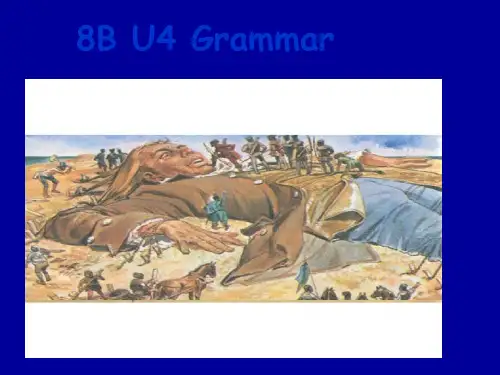
1. What did Gulliver do after their ship crashed against the rocks? 2. What did the tiny men look like? 3. Did Gulliver catch what the tiny man say? 4. Gulliver knew what to say to the tiny man, right? 5. Did Gulliver know how to get away ?
把下列句子改成简单句
1. The old lady found out where she could buy fruit cheaply. The old lady found out where ___________ to buy
fruit cheaply.
2. Will you show us how we can make a
用所给词的适当形式填空
1. Simon does not know what _____ to do (do).
2. Sandy wants to know where ______ to ask
(ask) for advice.
3. Millie does not know how _______ to solve
the two bears discuss how do wie discussing how to deal with Head Strong
牛津译林版八年级下unit4Grammar (共42张PPT)
Task1
Are you willing to bring your books and share with others at the reading week? We should know_______
a. b. c. d. how to introduce your books who to give your books to what to write down when to bring books
All question words can be used in this way, except “why” × Suzy will explain why to recommend
this book.
√ Suzy will explain why she recommends
this book.
Task3
Unit 4 A good Read
Grammar
Free talk
1.What type of books do you like? 2.Where can you see so many kinds of books?
We need some students to help us organize our Reading Week. If you are interested in it, pleases tell Miss Duan. Don’t wait any more! Come on!
and so on(等等)
……
I only care about what to eat. I just want to introduce foodie guider .
Foodie guider is a useful book. It’s all about what to eat. There is also a map at the end of the book. It tells you where to find nice food . It also shows you which bus to take.
牛津译林版英语9AUnit4Grammar课件(1)
牛津译林版英语9A Unit4 Grammar课件一、教学内容本节课选自牛津译林版英语9A Unit4 Grammar部分,详细内容包括:1.一般现在时与一般过去时的区别;2.一般现在时与一般过去时的转换;3.一般现在时与一般过去时在句子中的运用。
二、教学目标1.能够理解并运用一般现在时与一般过去时;2.掌握一般现在时与一般过去时的转换规则;3.能够在实际情景中运用一般现在时与一般过去时进行交流。
三、教学难点与重点1.教学难点:一般现在时与一般过去时的转换规则;2.教学重点:一般现在时与一般过去时在句子中的运用。
四、教具与学具准备1.课件;2.黑板;3.练习册;4.英语字典。
五、教学过程1.导入:通过展示一组图片,让学生描述图片中的人物正在做什么,引导学生运用一般现在时;2.情景引入:教师展示一段关于日常生活的视频,让学生观察并描述视频中人物的动作,引导学生运用一般过去时;3.语法讲解:详细讲解一般现在时与一般过去时的区别,以及转换规则;4.例题讲解:给出几个典型例题,讲解一般现在时与一般过去时在句子中的运用;5.随堂练习:让学生完成练习册上关于一般现在时与一般过去时的题目;6.小组讨论:学生分成小组,讨论并完成教师给出的一般现在时与一般过去时的句子转换练习;8.作业布置:布置课后作业,要求学生完成一定量的一般现在时与一般过去时的练习。
六、板书设计1.一般现在时与一般过去时的区别;2.一般现在时与一般过去时的转换规则;3.例题及答案;4.随堂练习题目。
七、作业设计1.作业题目:e.g. He goes to school bus. → He went to school bus.(2)根据图片,用一般现在时与一般过去时描述图片中的人物动作。
2.答案:(1)略;(2)略。
八、课后反思及拓展延伸1.课后反思:本节课学生掌握了基本语法知识,但在实际运用中仍存在一定问题,如时态转换不够熟练,需要加强练习;2.拓展延伸:鼓励学生在课后多进行一般现在时与一般过去时的句子转换练习,提高英语水平。
牛津译林版八年级下Unit4 Grammar 2课件(共11张ppt)

I can tell you_w_h_e_r_e_t_o_b_u_y_(_g_e_t)_t_h_is__b_o_o.k
1. ——Mum, may I watch TV now?
——No, you _____B______ finish your homework first.
D. hadn’t to
3. Yesterday it rained heavily when school was over. We
_____c____ stay in our classroom.
A. must
B. should
C. had to
D. need
4. ——I can’t stop playing computer games.
•
14、抱最大的希望,作最大的努力。2021年5月2日 星期日2021/5/22021/5/22021/5/2
•
15、一个人炫耀什么,说明他内心缺 少什么 。。2021年5月 2021/5/22021/5/22021/5/25/2/2021
•
16、业余生活要有意义,不要越轨。2021/5/22021/5/2May 2, 2021
不,你不必。/不,你不需要。
二、have to 的用法: have to 表客观的需要和义务, must表主观的认识。
他得做那件事吗?
Did he have to do it ? Must he do it?
在疑问句和否定句中, have to 多用助动词do 构成, must则直接提前或加not.
8B unit4 A good read
牛津译林版英语八下Unit 4《A good read》(Grammar)教学设计
牛津译林版英语八下Unit 4《A good read》(Grammar)教学设计一. 教材分析《A good read》是人教版牛津译林英语八年级下的一个单元,主题是关于书籍和阅读。
本课的主要内容是通过介绍两本书的评价,让学生学会如何使用过去时态和现在时态描述事件的顺序。
教材中包含了丰富的阅读材料,有助于提高学生的阅读兴趣和阅读能力。
二. 学情分析学生在学习这个单元前,已经掌握了动词的过去式和现在式的变化规则,同时也具备了一定的阅读理解能力。
但学生在阅读长篇文章时,可能会遇到生词和难句,影响阅读理解。
因此,在教学过程中,需要帮助学生克服这些困难,提高他们的阅读能力。
三. 教学目标1.知识目标:学生能够正确使用过去时态和现在时态描述事件的顺序。
2.能力目标:学生能够读懂文章,提高阅读理解能力。
3.情感目标:激发学生对阅读的兴趣,培养良好的阅读习惯。
四. 教学重难点1.重点:学生能够正确使用过去时态和现在时态描述事件的顺序。
2.难点:学生能够读懂文章,提高阅读理解能力。
五. 教学方法1.任务型教学法:通过完成各种任务,激发学生的学习兴趣,提高学生的参与度。
2.互动式教学法:教师与学生,学生与学生之间的互动,促进知识的传递和能力的培养。
3.情境教学法:创设情境,让学生在真实的环境中学习,提高学生的应用能力。
六. 教学准备1.教师准备:准备好教材、多媒体教具、教学卡片等教学资源。
2.学生准备:学生提前预习课文,了解文章大意。
七. 教学过程1.导入(5分钟)教师通过提问方式引导学生谈论他们喜欢的书籍和阅读体验,激发学生的学习兴趣。
2.呈现(10分钟)教师通过多媒体展示两本书的评价,让学生听懂并理解文章的内容。
3.操练(15分钟)学生分角色朗读文章,模仿文章中的评价语言。
教师引导学生运用过去时态和现在时态描述事件的顺序。
4.巩固(10分钟)学生分组讨论,总结文章的主旨大意,并用自己的话进行表达。
教师巡回指导,纠正学生的错误。
牛津译林版八年级英语下册Unit4重点知识点汇总
牛津译林版八年级英语下册Unit4重点知识点汇总1.使学生掌握本单元掌握Comic strip—Task 重要的短语搭配与重点词汇的意思与运用;2.对单元重点句型能够细致的理解,并能模仿句型进行写作;3.能够将每个知识点灵活地运用到单项选择和词汇运用等基础题型当中。
Comic strip —W elcome to the unit 教材知识详解1. Have you decided what to do with these books, Hobo?霍波,你决定怎样处理这些书了吗?decide 此处用作及物动词,意为“决定”,后跟名词、代词、不定式或从句等。
decide 的名词形式是decision ,意为“决定”。
make a decision (to do sth.)意为“做决定(去做某事)”。
如:She decided to live in London.她决定住在伦敦。
do with 意为“处理;处置;对待”等,常与疑问词what 连用。
如:What did you do with those newspapers?你把那些报纸怎么处理了?do with 的同义词组是deal with ,但deal with 常与疑问词how 连用。
What will you do with those books?= How will you deal with those books?你将怎样处理那些书?2. I have to use them to reach the box on the fridge.我必须用它们来够电冰箱上的盒子。
reach 此处用作及物动词,意为“接触,拿到”。
reach 作及物动词,还意为“到达,抵达”,后面跟表示地点的名词。
如:I’m too short. I can’t reach the apple.我太低了,够不着那个苹果。
They reached London last night.他们昨天晚上到达了伦敦。
牛津译林版9A Unit4 Grammar(I)课件ppt
2.How to use after
After means later than a certain time a.after引导的时间状语从句如果具有将来意义,往往 要用一般现在时来表示(有时也用现在完成时),而不能 直接用一般将来时。如: 误:I’ll tell him after you wil leave. 正:I’ll tell him after you leave (或have left). 你走了之 后我再告诉他。 b.选择一般现时或现在完成时(表示将来意义)的基本原 则是:如果强调从句 动作在主句动作之前完成,则用 现在完成时;如果强调主从句动作 同时发 生,或几 乎同时发生(尤其是当从句的谓语动词是get, arrive, see, hear, leave, return等表示迅速完成的动作的动词时),多 用一般现在时(有时 两种时态都可以)。如; I’ll leave after he comes back. 他回来后我就离开。
c. 一般说来,如果在过去某一时间内先后发生了两个动 作,那么先发生的动作用过去完成时,后发生的动作用 一般过去时。但是若用连词after 来连接这两个动作, 由于after本身已说明了两个动作的先后关系,所以两 者均可用一般过去时。如: After he (had) closed the door, he left the house. 关 了门之后,他就离开了家。 d. 有时以连词after引导的时间状语从句可以换成一个以 介词after引导介词短语或以连词after引导的分词短语, 而意义不变。如: He went to school after he had breakfast (=after breakfast). 吃了早饭之后,他就去上学了。 After l had finished (=After having finished / After finishing / Having我干完活后就去睡觉了。
Unit4Grammar教案牛津译林版英语八年级下册
A. on timeB. in timeC. at timesGrammar考点1 疑问词+动词不定式一“疑问词+动词不定式”可在句中用作宾语、主语和表语。
eg:Can you tell me how to spell the word?你能告诉我怎么拼写这个单词吗?How to go there is a question.如何去那里是个问题。
二【重点】疑问词+动词不定式"作宾语是初中阶段的重点。
在"疑问词+动词不定式”结构中,只有疑问词why不能与不定式连用。
有些疑问词,其后可先接名词再接动词不定式。
作宾语时,此结构常用于know, learn, see, hear, ask, tell,advise, decide, explain, find out, forget, remember, think, understand, wonder 等动词或动词短语中。
也可用于sure,clear等形容词之后。
eg:The teacher is telling the students what to do.老师正告诉学生们要做什么。
Have you found out what time to start?你査淸楚什么时间开始了吗?I am not sure which way to take.我不确定走哪条路。
【测一测】—I’ll have a tenday holiday. But I don’t know一How about Paris?A. what to doB. where to goC. when to go考向三:“疑问词+动词不定式”结构可以改写为该疑问词引导的从句。
eg:We do not know what to do. = We do not know what we should do.我们不知道该做什么。
考点二must和have to一【重点】:must的用法must为情态动词,后接动词原形。