
初一七年级英语下册外研版Module 3 Making plans 教案
Module 3 Making plansUnit 1 What are you going to do at the weekend?一、教学目标:1. 语言知识目标:1) 掌握本单元所学单词及短语:go over, picnic, housework, on, else, nobody, at,nothing, silly, fantastic...2) 掌握be going to do的用法。
2. 情感态度价值观目标:利用所学表达制订计划的句型有礼貌地邀请别人参加某种活动二、教学重难点:1、利用所给信息谈论周末计划2、“be going to +动词原形”句型的用法三、教学过程Step 1 Warming-up1. Show some pictures of school things. Say what they are.2. Read the words after the teacher.3. Introduce the new words.Step 2 Match1. Ask the students to read the word and expressions in Activity 1.2. Match the words and expressions from Box A with the word and expressionsfrom Box B.3. Call back the answer from the whole class and check the answer.4. Match the expressions in Activity 1 with the pictures in Activity 2.5. Read the expressions together.Step 3 Listen and read.1. Play the recording and ask the students to listen and read the conversation.2. Read the conversation again and answer the questions.1) What’s Daming going to do on Saturday morning?2) What’s Betty going to do on Saturday afternoon?3) Who is going to have a piano lesson on Saturday?4) Where are they going to have a picnic?3. Ask the students to check with a partner.4. Play the recording again .Check the answers..Step 4 Complete the conversation1. Ask the students to read the words in the box in Activity 4.2. Read through the conversation.3. Complete the conversation with the correct form of the words from the box.4. Ask the students to check with a partner.5. Check the answers.6. Read the conversation loudly.Step 5 Listen and repeat1. Play the recording once without stopping.2. Play the recording again and stop at the end of each line. Ask the whole class torepeat.3. Play the recording again and stop at the end of each line. Ask individual studentsto repeat.4. Ask the students to practice the sounds in pairs.Step 6 Work in pairs.Ask and answer questions about your plans at the weekend.1. Ask and answer like this:— What are you going to do on Saturday morning?— I’m going to check my email and do my homework.2. Read through the example with the class.3. Pair them to ask and answer.4. Circulate and monitor their production.5. Complete the diary.Step 7 Language points1. On Saturday morning, I’m going to check my email and do my homework.如果特指“在具体的某一天”或“(在具体的某一天的)上午、下午、晚上”等,须用介词on。
e.g. I’ll see you on Monday morning. 周一上午见。
She always goes to see a film on Friday evening. 她总是周五晚上去看电影。
如果我们要表达“在上午、下午、晚上”,可以说in the morning / afternoon / evening。
e.g. Don't watch TV too much in the evening. 晚上看电视不要太多。
They sometimes play games in the afternoon. 他们有时在下午做游戏。
2. …but on Sunday afternoon, Lingling and I are going to have a picnic.have a picnic“去野餐”。
在英语中,经常用have + n.组成词组.have a look at 看一看have breakfast / lunch / supper 吃早/午/晚饭have classes / lessons 上课have a meeting 开会have a rest 休息一会儿3. I’m going to stay at home alone.stay at home意为“呆在家里”。
e.g. Mary likes to stay at home on Sunday. 玛莉喜欢周日呆在家里。
将下面的汉语句子翻译为英语。
明天你打算呆在家里吗?________________________________Are you going to stay at home tomorrow?Step 8 Exercises:一、翻译下列短语1. 查电子邮件______________2. 复习功课________________3. 上钢琴课________________4. 看电影_________________5. 帮助做家务_______________6. 野炊____________________Keys:1. check one’s email2. go over lessons3. have a piano lesson4. see a movie5. help with the housework6. have a picnic二、完成句子1. 我打算在早上查看一下电子邮件。
I _____________ my email in the morning.2. 他打算在周末去野餐。
He ________________________ at the weekend.3. 我们不打算星期六去看电影。
We_____________on Saturday.4.—你打算在下午做作业吗?—是的。
—____ you __________ do your homework?—Yes , I _______.5. 他打算在周末做什么?_______ he ____________ at the weekend?6. 他们打算什么时候复习功课?_________ they ________________________?Keys:1. am going to check2. is going to have a picnic3. aren’t going to see a movie4. Are; going to; am5. What’s; going to do6. When are, going to go over lessonsStep 9 HomeworkRemember the words of Unit 1 and prepare the text of Unit 2.Unit 2 We’re going to cheer the players.一、教学目标:1. 语言知识目标:1) 掌握本单元所学单词及短语:look forward to, make friends, shirt , cheer,player, enjoy oneself, take a walk, country, collect, summer holiday, camp, go sightseeing, beach...2) 掌握课文中的相关信息。
2. 情感态度价值观目标:利用所学表达制订计划的句型有礼貌地邀请别人参加某种活动二、教学重难点:1.谈论计划的相关的话题2. 利用”be going to do”句型写一篇小短文三、教学过程Step 1 Warming-up1. Guessing game.1) Show some pictures.2) According to the information given and ask the students to guess:What are you going to do?3) Show the pictures to check the answers.2. Read the words after the teacher.Step 2 Learn new words.1. Show some pictures.2. Talk something about the pictures.3. Introduce the new words.4. Read the words after the teacher.Step 3 Reading.1. Play the recording and listen to the tape carefully.2. Ask the students to read through the passage.3. Read the passage and do Exercise 2.4. Call back the answers from the whole class.5. Learning to learn.When a passage has pictures, the pictures often contain some important information. So look at the pictures before you read, as this will make the passage easier to understand.Step 4 Work in pairs1. Ask the students to read through the passage again.2. Ask and answer the questions.1) When is Martin going to watch a football match?2) What does Martin hope?3) What is it going to be a busy holiday for Zhang Sijia?4) Why is this summer holiday going to be different for Lucy?5) Who is Lucy going to stay with?3. Call back the answers from the whole class.Step 5 Complete the passage.1. Ask the students to read the words in the box in Activity 4.2. Ask the students to read through the passage in Activity 4.3. Complete the passage with the correct form of the words from the box.4. Call back the answers from the whole class.Step 6 Writing.1. Look at the question and answer.—Why is Martin looking forward to tomorrow ?—Martin is looking forward to tomorrow because he and his friends are going to watch their favourite team play football.2. Now write answers to the questions. Use because.1) Why is Zhang Sijia going to a park near her friend’s house?2) Why is this summer holiday going to be very different for Lucy?3. Work in pairs. Ask and answer the questions.1) What are you looking forward to this weekend?2) What are you going to do?3) Why are you going to do it?Step 7 Language Points1. I’m looking forward to the football match tomorrow.look forward to “期待,盼望”,后面接名词或动名词(V-ing)。
新外研版七年级下册英语 Module 3 Unit 1 教案(教学设计)
课前热身,一是活跃气氛,把学生快速带入英语课堂;二是导入本课要学的重点语法“be going to do ”。
Step 2
Pre-listening
1.Show pictures in Activity 2 and teach the students the verb phrases.
2.Have students read the phrases together, then ask some students to read them individually. Then ask students to make sentences with “be going to do”, the pictures and the phrases help them.
1.Practise the conversations.
2.Listen to the record of the conversation and answer the questions.
3.Watch the video carefully and check Daming’s and Betty’s plans for the weekend.
2.Speaking
After reading, have students report what Daming,Betty and Lingling are going to do.
1.Read the conversation in roles.
2.Retell the conversation.
3.Show a conversation betweenPleasureSheepandBeautySheep. They are talking their plans for the weekend. Lead the students to complete the conversation according to the pictures. Then have them complete four conversations according to the example inpairs.
外研七级英语下Module3 Unit教学设计

学生通过讨论生成自己的对话,帮助他们熟练掌握“be going to〞的用法。
Classroom Assessment
分小组计分,五个学生一组。分数高的组给予奖励。
家庭作业:The home work istalking with your teachers and ask what they are going to do at the weekend.Write a passage about teacher’s plans.
2.能够用英语表达自己的方案,并且能跟同学老师进行交流。
3.培养学生做事的方案性,引导学生热爱自然热爱生活,并且喜欢跟别人交流想法,培养学生的团队合作意识。
教学重点及难点
本模块重点动词短语和“be going to〞句型
教学辅助
多媒体课件视频录音计分卡
教学方法
情景教学法任务设置法
教学过程
第一课时教学设计
使用初中英语数据库中提供的flash动画为学生播放课文对话,学生不仅能听,而且能看,能观察,对他们的英语听说读的能力都有很大的提高。
Step6:
I will ask themto do an activity and retell Betty, Daming and Tony’s weekend’s plans.
通过学生自己复述使他们能在短时间内复习本课内容,掌握知识。
七年级英语下册 Module 3 Making plans教案 (新版)外研版-(新版)外研版初中七
Module 3Making plans【复习重点】1. 领会并灵活使用下列词汇:else,nothing, look forward to, hope, win, enjoy,…2. 掌握重点句型:1) be going to2) have fun doing3) enjoy oneself4). It’s time for…一般将来时的用法模块重点语法讲解:般将来时:be going to一、be going to 的用法be going to 表示将要发生的事或打算、计划要做某事。
它是一般将来时的一种表达形式,其后常有表示将来的时间状语,如,tomorrow,next week等。
构成:be going to + 动词原形。
Be 随主语人称和数的变化而变化。
注意:1)be going to 表示说话人的意图指打算、准备做的事情,这种打算通常经过预先考虑并含有已经做好某种和准备的意思,所表的行为通常被认为很可能付诸实施。
Eg :She is going to write to him.2)表示说话人的推测。
通常指有迹象表明某件事将要发生,是指即将发生或肯定要发生的事情。
常用于be sure,be afraid, believe, think后。
Eg :I think it is going to snow.二、be going to 的句型结构肯定句否定句一般疑问句特殊疑问句三、be going to 的注意事项1)there 被句型的一般将来时结构为:There is/are going to be …(注意:此句型中going to 后面的be 不能改为have)。
常用来表示将要发生某事或将要出现某物。
Eg There is going to be a football match next Saturday inour school.2). be going to 后可接表示地点的名词,表示打算去某地,但接副词时,应省去to。
外研版七年级英语下册 Module 3 Unit 2教案
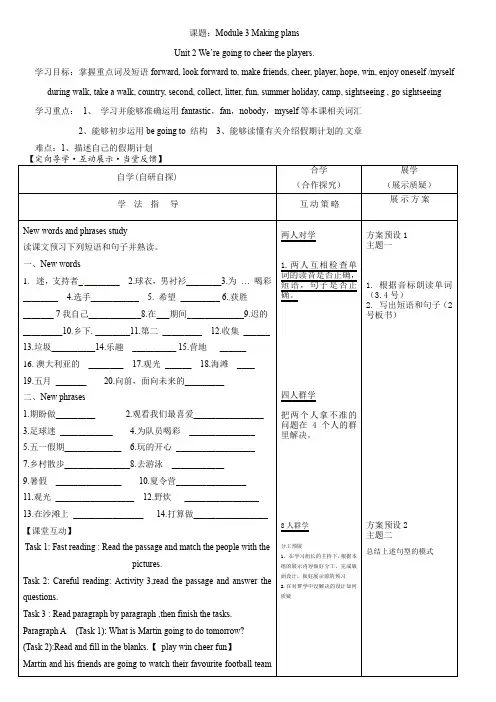
课题:Module 3 Making plansUnit 2 We’re going to cheer the players.学习目标:掌握重点词及短语forward, look forward to, make friends, cheer, player, hope, win, enjoy oneself /myself during walk, take a walk, country, second, collect, litter, fun, summer holiday, camp, sightseeing , go sightseeing 学习重点:1、学习并能够准确运用fantastic,fan,nobody,myself等本课相关词汇2、能够初步运用be going to 结构3、能够读懂有关介绍假期计划的文章难点:1、描述自己的假期计划New words and phrases study读课文预习下列短语和句子并熟读。
一、New words1.迷,支持者_________2.球衣,男衬衫________3.为… 喝彩________ 4.选手___________ 5. 希望_________ 6.获胜_______ 7我自己____________8.在___期间_____________9.迟的_________10.乡下. ________11.第二_________ 12.收集______13.垃圾__________14.乐趣__________ 15.营地______16.澳大利亚的________ 17.观光______ 18.海滩____19.五月_______ 20.向前,面向未来的_________二、New phrases1.期盼做_________2.观看我们最喜爱________________3.足球迷____________4.为队员喝彩_______________5.五一假期_____________6.玩的开心__________________7.乡村散步_______________8.去游泳____________9.暑假_______________ 10.夏令营________________11.观光__________________ 12.野炊_________________13.在沙滩上________________ 14.打算做_________________【课堂互动】Task 1: Fast reading : Read the passage and match the people with thepictures.Task 2: Careful reading: Activity 3,read the passage and answer thequestions.Task 3 : Read paragraph by paragraph ,then finish the tasks.Paragraph A(Task 1): What is Martin going to do tomorrow?(Task 2):Read and fill in the blanks.【play win cheer fun】Martin and his friends are going to watch their favourite football team趁热打铁:Paul looks forward to _____his pen pal. ( meet ) 2.wear , dress, (be)in , put on 的区别 趁热打铁: I don’t like _____ hats. The boy can ____himself.Do you know the girl ___red? 4.It’s cold.________your coat. 3.cheer 意为______. 常见短语:cheer sb.___________ cheer sb. up___________cheer sb. on_____________注意:cheer up 和cheer on ,当代词为宾语的时候,要放在cheer 与 up/on 中间.We should cheer ourselves up ._____________ They beat drums to cheer on the players.______________ The children are cheering their running classmates.________ cheer 做名词,意为:欢呼声、喝彩声,复数为______. cheers 单独使用时意为“干杯”,是感叹词。
外研版七年级英语下册Module 3 Making plans教学设计
Module3 Making Plans一、教学内容:Unit1 What are you going to do at the weekend?二、课型:Listening and speaking三、教学目标:1、能够正确使用下列单词和词组:go over, picnic, housework, on, else, nobody, at,nothing, silly, fantastic.2、能够听懂包含计划、安排的对话,并且判断出对话中人物的计划。
4、能够与人做有关计划的对话。
3、能用be going to表达自己的计划、安排,并能询问对方的计划、安排。
四、教学重难点:1、能够听懂对话中计划、安排的对话。
2、能够正确使用“ be going to” 来描述计划的相关信息。
五、教学准备:课堂整体运用任务型教学模式,培养学生独立自主的学习能力。
本课指导学生通过听说获取信息,培养学生的听说技能。
在教学过程中,采用多媒体手段辅助教学,利用各种图片和习题任务贯穿整个教学过程。
因此,本节课需准备:PPT课件、挂图、录音机、课堂练习表格、奖品六、教学过程:七、板书设计:Module 3. Making PlansUnit1. What are you going to do at the weekend?go over lessons 1) What are you going to do at the weekend? have a picnic I’m going to +V.help with the housework 2) Don’t be silly!3) Who else is going to be there?达标训练题一.翻译下列短语:1. 去野餐_____________2. 查收我的电子邮件__________________3. 复习_______________4. 在周日下午________________________5. 看电影_____________6. 上钢琴课_________________________7. 还有谁_____________ 8. 别傻了!__________________________9. 帮忙做家务_________ 10. 在周末___________________________二、选择填空。
外研版七年级下册(新)英语教案Module3Makingplans教案

外研版七年级下册(新)英语教案Module3Makingplans 教案Module 3 Making plans⼀、学习⽬标:A.单词和短语:go over, picnic, housework, on, else, nobody, at, nothing, silly, fantastic, forward, look forward to, fan, make friends, shirt, cheer, player, hope, win, enjoy oneself, during, May, May Day, late, something, walk, take a walk, country, second, collect, litter, fun, summer holiday, camp, Australian, sightseeing, go sightseeing, beach, early.B.交际⽤语:1. Sure!2. Would you like to join us?3. Don’t be silly!4.— What are you going to do on Saturday morning? — I’m going to ….5. What are you looking forward to this weekend?6. What are you going to do?7. Why are you going to do it?8. I’m going to check my email.9. Lingling and I are going to have a picnic.10. Lingling is going to have a piano lesson.11. — Are we going to meet here? — No, we aren’t.C. 教学⽬标1. Function : Talking about plans; making plans2. Structure: Be going to + verb; wh-questions and answers3. Skills: 1) Listening and understanding familiar topics (plans).2) Talking about familiar topics (plans).3) Reading and understanding simple passages.4) Composing a simple passage.4. Around the world: Weekend plans.5. Task: Talking about your weekend plans.⼆、重点及难点:be going to + verb; wh-questions and answers三、教学设计:Unit 1 What are you going to do at the weekend?ⅠTeaching modelListening and speakingⅡTeaching methodBottom-up approach to listeningⅢTeaching aims1. To understand conversations.2. Ask and answer: What are you going to do at the weekend?ⅣTeaching Objectives1. Key vocabulary: go over, picnic, housework, on, else, nobody, at, nothing, silly, fantastic2. Key structures:— What are you going to do on Saturday morning?— I’m going to ….ⅤTeaching aidsTape recorder, OHP, videoⅥTeaching StepsStep 1 Warming-up1. Show some pictures of school things. Say what they are.2. Read the words after the teacher.3. Introduce the new words.Step 2 Matching.1. Ask the students to read the word and expressions in Activity 1.AB2. Play the recording and ask the students to listen to the recording carefully.3. Match the words and expression from Box A with the word and expressions from Box B.4. Play the recording again, then they can check their answer with a partner.5. Call back the answer from the whole class and check the answer.Keys:1. check my email2. go over lessons3. have a piano lesson4. see a movie5. help with the housework6. have a picnic6. Match the expressions in Activity 1 with the pictures in Activity 2.7. Read the expressions together.Step 3 Listen and read.1. Ask the students to read the conversation silently.2. Play the recording and ask the students to listen and read the conversation.3. Read the conversation.4. Act it out.5. Learn “Everyday English”Welcome back!Please be careful with…from now on.Step 4 Answer the questions.1. Read the conversation again.2. Answer the questions.1) What’s Daming going to do on Saturday morning?2) What’s Betty going to do on Saturday afternoon?3) Who is going to have a piano lesson on Saturday?4) Where are they going to have a picnic?3. Ask the students to check with a partner.4. Play the recording again .Check the answers:Keys:1. He is going to check his email, do his homework and help with the housework on Saturday morning.2. She is going to see a movie on Saturday afternoon.3. Lingling is going to have a piano lesson on Saturday.4. They are going to meet in the park.Step 5 Complete the conversation.1. Ask the students to read the words in the box in Activity 4.2. Read through the conversation.Betty: What are your plans for next weekend, Lingling?Lingling: (1)____________. I don’t have any plans.Betty: Are you going to spend it (2)____________ at home?Lingling: Well, …what are you going to do?Betty: Tony and I are going to have a picnic in the park. We’re going to have a (3)____________ time. Are you going to come?Lingling: I’m not sure.Betty: Don’t be (4)____________! What (5)____________ are you going to do?3. Complete the conversation with the correct form of the words from the box.4. Ask the students to check with a partner.5. Check the answers:Keys: 1. Nothing 2. alone 3. fantastic 4. silly 5. else6. Read the conversation loudly.Step 6 Listen and repeat.1. Play the recording once without stopping.2. Play the recording again and stop at the end of each line. Ask the whole class to repeat.3. Play the recording again and stop at the end of each line. Ask individual students to repeat.4. Ask the students to practice the sounds in pairs.Step 7 Work in pairs.Ask and answer questions about your plants at the weekend.1. Ask and answer like this:—What are you going to do on Saturday morning?—I’m going to check my email and do my homework.2. Read through the example with the class.3. Pair them to ask and answer.4. Circulate and monitor their production.5. Complete the diary.Step 8 Guessing game.1. Show some pictures of school things.2. According to the information given and ask the students to guess what it is.3. Show the pictures to check the answers.Step 9 Language points1. On Saturday morning, I’m going to check my email and do my homework.I’m going to see a movie in the afternoon.如果我们要表达“在上午、下午、晚上”,可以说in the morning / evening / afternoon 三个词也常跟介词in连⽤。
外研版七下Module3MakingplansUnit 教学设计
外研版七下Module 3 Maki ng pIansUnit 2 We' re going to cheer the pIayers.教学设计[Teaching aims]Knowledge aim:(1)Grammar: be going to(2)Vocabulary: walk up, look forward to, do some sightseeing go sight, etc.Ability aim :(1)Speaking:Can use “be going to“ to make sentences(2)Writing: Can write plans with “be going to”Emotional aimto help students cultivate students* abilities of using the language into real life[Teaching methods]task based method and share together method[Teaching process]Step One RevisionThe students have learned the Simple Future Tense and know the usage of “be going to So get them to talk about their plans for the weekend. They can work in groups of four and do the activity like this example.Eg. SI : What're you going to do at the weekend?S2: I'm going to revise fbr my test.S3: What's he going to do at the weekend?S4: He's going to revise for his test.Meanwhile write these sentence patterns on the blackboard.Step Two Lead—inI'll talk about my birthday. Suppose that my birthday is coming. So I'H ask the students some questions.T: My birthday is coming. Tm looking forward to my birthday. I'm looking forward to eating a birthday cake. What're you looking forward to? Are you looking forward to birthday?At the same time write "be looking forward to doing sth:' on the blackboard and tell them what it means. Then get them to answer my those questions correctly.Step Three Read the passages and match them with the photos.I . Ask the students to look at the three photos first and ask them what they can see.II.Before they read the text, ask the students to follow the leaning to lean box while I read it out. Ask them to apply this principle to their reading.III.Ask them to read the three passages individually and decide which photo goes with which passage.N. Collect the answer from the class as full sentences.Step Four Read the passages and finish Activity 3.I . After Step Three, I'll play the tape fbr the students and get them to read after the tape many times till they can read them correctly.IV.Meanwhile I'll explain some key points of this text and write them on the blackboard. Remind the students to pay attention to them.III.Have the students finish Activity 3 in pairs One asks and the other answers.Step Five Answer the questions. Use the words in the box.I . Ask the students to do these exercises individually then check with a partner.II. Collect the answers from the class with one student asking and another answering.Step SixDo some exercises to consolidate the key points of the text.Step Seven Homework©Write five sentences with “be going to” and “because”.©Finish a piece of paper.[Blackboard Design]Unit 2 We're going to cheer the players.Watch a football gameSpend time with family and friendsGo on a summer campCollect litterStay with an Australian familyMeet other football fans。
七年级英语下册Module3MakingplansUnit3Languageinuse教案新版外研版
Unit 3 Language in use
be going to结构
肯定句: 主语+ be going to +动词原形
否认句: 主语+ be not going to +动词原形
一般疑问句: be+ 主语 going to +动词原形?
特殊疑问句: 疑问词+ be +主语 going to +动词原形?
2.Make a report about their best friends’ weekend plans, using the information in the form. Then share with the class.
3.Write a plan for the coming weekend.
Unit 3 Language in use
课 题
Module 3 Making plans
第三
课时
Unit 3 Language in use
课型
Revision and application
教学
目标
知识
目标
1.运用本模块的词汇:picnic, go over, housework, nobody, nothing, look forward to, make friends, enjoy oneself, litter, beach等。
Keys: 1.the Great Wall
2.May Day
3. three days
4.Canada
5.7 days/a week
Use what you have learned to write an article.
外研版英语七年级下册Module 3 Making plans Unit 1表格式教案
Module 3 Making plansUnit 1 What are you going to do at the weekend?教材分析本节课是外研版新标准七年级(下)Module 3 Unit 1 What are you going to do at the weekend?第一课时内容,本节课以对话等形式呈现,以周末计划为主题,引导学生掌握“be going to”的表达方式,使学生在掌握语言结构的同时,增强学生的计划意识。
周末计划这一话题与同学们的生活实际联系密切,易于展开,通过例句及联系实际问答,理解并熟练准确运用这一结构。
通过本节课的学习,学生能用“be going to”结构表达自己打算或计划要做的事情。
学情分析初一学生在小学已经接触一般将来时的基本用法,be going to这一句型学生基本都能脱口而出,因此,本节课秩序简单解释构成和用法,可以把重点放在掌握单词短语和使用be going to对话这两部分。
教学目标1.语言知识目标1. 识记新单词及短语2. 学习一般将来时be going to 的意义和用法2.能力目标1.通过听说练习,提高学生的听力、口语表达能力及交流合作能力。
2.能听懂包含计划的对话,判断对方的计划3.能用be going to表达自己或询问别人的计划和打算3.情感目标通过学习用英语谈论周末计划以提高学生学习英语的兴趣,培养学生有目的、有计划的去做事,并养成良好的有计划的生活和学习习惯,成为一个富有爱心的人。
重点和难点1.一般将来时be going to的构成和用法2.从短文中获取有效信息,掌握单词和表达活动的短语句子。
教学策略的选择与设计充分发挥学生主体和教师主导作用,课堂上采取生生互动、师生互动的教学策略。
精心设计课堂环节,选择既有启发性又能激起学生探讨兴趣的系列问题, 可以启迪学生动脑, 激发学生思维,培养学生主动学习的习惯。
教师设计问题时,紧扣教材, 层层推进, 要具有一定的思想梯度。
2024七年级英语下册Module3Makingplans教学设计(新版)外研版
核心素养目标
本节课的核心素养目标为:培养学生具备良好的语言素养,提高学生的跨文化交际能力,增强学生的自主学习能力,以及提升学生的合作意识。通过本节课的学习,使学生能够掌握Making plans这一主题下的相关词汇和句型,能够运用所学知识进行日常交流和表达自己的计划和安排。同时,通过小组合作、讨论等活动,培养学生的团队合作精神和自主学习能力,使学生在语言学习的过程中,增强对不同文化的理解和尊重,提高跨文化交际的能力。
③在黑板上画出一张地图,标注出不同地点,旁边写上“set goals”,让学生在地图上标出自己想去的地方。
④在黑板上画出一双眼睛和一颗心,旁边写上“look forward to”,让学生在眼睛和心上画出自己期待的事情。
⑤在黑板上画出一个小人,旁边写上“English conversation”,让学生在小人旁边画出自己喜欢的英语口语话题。
2. We _____ meeting our friends at the park this weekend.
3. He _____ studying for the exam next week.
(3)翻译题:
1.请翻译以下句子:
"他们计划在下个月去泰国旅行。"
2.请翻译以下句子:
"我期待着和你一起度过这个周末。"
③英语日常交流能力的培养
2.词句展示:
①I am going to the zoo with my family this weekend.
②She is planning to visit her grandparents in New York.
③We are looking forward to meeting our friends at the park this weekend.