
2016牛津深圳版英语七上Unit 2《Daily Life》(Reading)ppt课件
Pre-reading
(1) do every day? (2) do once or twice a week? (3) never do?
brush my teeth.
watch television.
(1) do every day? (2) do once or twice a week? (3) never do?
time
8:10 English English 9:00 10:00 Biology Biology 10:40 Chinese 12:20 Lunch 13:10 P.E.
14:00 Spanish Spanish
Look at the school timetable and
answer the questions.
1. (Sam / Sam's friend) wrote this article. 2. It is about Sam's (school day/holiday).
Pre-reading B2 Read the first sentence of each paragraph in the article on page 17. Then answer the questions below. 1. How does Sam go to school?
on foot Mandy: Yes, it is, so I go to school (1)_____.
Let’s read a cartoon picture and answer: What’s the humor in Hi and Lo’s talk?
Weekday
ห้องสมุดไป่ตู้
Rockfield High School Monday Tuesday Wednesday Thursday Maths Self-study Spanish P.E. Lunch English Biology Spanish Maths Art Biology Lunch Chinese English Maths Maths Art Lunch Chinese Friday Biology Self-study Spanish English Lunch P.E. Spanish
C1 Do you know the meanings of the words according to the article on page 17? words English meaning
WhileReading Chinese meaning
1. seldom 2. break 3. rings 4. end
ride a bicycle.
play table tennis.
(1) do every day? (2) do once or twice a week? (3) never do?
play the piano.
wash my clothes.
Pre-reading
B1 Look at the title of the article on page 17. Then circle the correct answers.
C2 Complete the conversation with the words and phrases from the box.
WhileReading
break end on foot rings take part in usually
Sam: Is your school close to your home, Mandy?
A. often 不常,很少 B. not often A. a short time between 休息 lessons B. a short holiday A. makes a sound 发出钟声 B. is quiet
A. stop B. begin 结束,终止 在一起
A. with each other 5. together B. every day
Important Phrases
1. junior high school 2. on foot 初级中学 步行
3. take part in
4. have a good time
参加
过得愉快
Exercise
1、我的家离学校很近,所以我总是走路上学。 close_____ to My home is _____ my school, so I on foot always go to school _____ _____. 2、时间多么短啊! How short ______ ______ the time is! 3、学校乐队经常在一起演奏美妙的音乐。 makes _____ great music The school band often _____ _____ together. 4、李老师在一所初级中学任教。 junior high school Miss Li teaches in a _____ _____ _____.
1. How many subjects in this timetable? Seven.
2. What lesson do they have at 10:00 on Wednesday morning? Spanish.
3. What time do they have Biology lessons on Thursday? At 10:40. Make a timetable of your classes and talk about it with your partner.
He goes to school on foot. 2. What subjects does Sam usually study in the morning?
Chinese, Maths and English. 3. How long is the school lunchtime? 40 minutes long.
沪教牛津版-英语-七上-七上Unit_2_Daily_Life单元知识小结
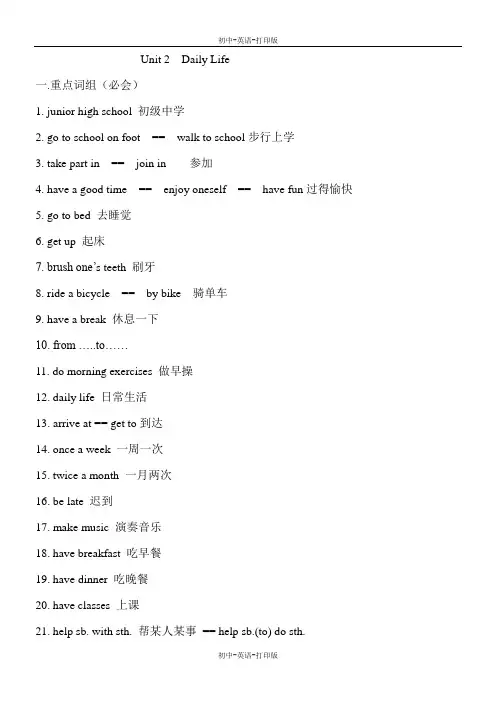
Unit 2 Daily Life一.重点词组(必会)1. junior high school 初级中学2. go to school on foot == walk to school步行上学3. take part in == join in 参加4. have a good time == enjoy oneself == have fun过得愉快5. go to bed 去睡觉6. get up 起床7. brush one’s teeth 刷牙8. ride a bicycle == by bike 骑单车9. have a break 休息一下10. from …..to……11. do morning exercises 做早操12. daily life 日常生活13. arrive at == get to到达14. once a week 一周一次15. twice a month 一月两次16. be late 迟到17. make music 演奏音乐18. have breakfast 吃早餐19. have dinner 吃晚餐20. have classes 上课21. help sb. with sth. 帮某人某事== help sb.(to) do sth.二. 同义词(了解)1. seldom = not often2. break = a short rest3. ring = make a sound4. end = stop5. together = with each other6. daily = everyday三. 本单元核心语法点:一般现在时态:一,定义:1)经常性、习惯性的动作或存在的状态。
e.g. I go to school on foot. He is very busy now.2)表示主语的特征、性格、能力、爱好等。
e.g. He can swim. I work hard. I like watching TV.3)表示客观真理。
Unit2 Daily life Reading(课件)-七年级英语上册(牛津深圳版)
Paragraph 4 Lunch is from 11:50 a.m. to 12:30 p.m.
Paragraph 5 I always have a good time at school.
Read the first sentence of each paragraph. Then answer the questions.
I love going to school.
I always have a good time at school.
2. Find two sentences in the article to show that Sam likes sports very much.
When the bell rings, I run to the playground with my best friends Tom and Jack . We often play sports.
1 Classes start at 8 a.m., and I am seldom late.
a often
b not often
2 We have our morning break at 9:50 a.m.
a a short time between lessons b a short holiday 3 When the bell rings, I run to the playground with my best friends
friends usuallyp_l_a_y_g_a_m_e_s_. Lunch time: from _11_:_5_0__a._m_._to _1_2_:_3_0_p_._m_._.
Afternoon: Classes end at _3_:_3_0_p_._m_.__ Sam takes part in _th_e__sc_h_o_o_l_b_a_n_d__p_ra_c_t_ic_ewith his friends
牛津深圳版-英语-七上-2单元 Our Daily Life 英语教案
Unit 2 Our Daily Life 英语教案Part One New words and warming upTeaching contents1. To learn by heart 18 new words in Chapter 2;2. To learn to describe people’s daily life and regular activities.Main pointsDescribe people’s daily lifeDifficult pointsTo remember the phrases about daily lifeTeaching aidsPPT and black boardTeaching proceduresStep 1: new wordslet stu. to read the new words(18) and the teacher should make some explanations when it’s necessary to help stu. learn the words by heart as soon as possible.To start with, let’s first go to page 85 to go over the vocabulary for this chapter. Read them aloud to the tape and try to learn them by heart.Words challege:Now we are going to challege one another. I’ll read some clues to you, try to tell me which word it is as quickly as you can.a. A noun— wooden musical instrument with strings and a bow violinb. A noun—a teenager or young adult who is very good or quick at doing somethingwhizz-kidc. A verb— get, receive, succeed in doing something achieved. A noun— customer; someone who buys something or uses a service cliente.A verb—talk about something discussf. A noun—a person who controls a business or part of it. managerg. A noun—the person (in a company) who looks after the money and keeps the financial records accountanth: in the morning a.m.i: in the afternoon p.m.j: help sb. do sth. assistk: go to attendl: a company businessStep 2: warming-up by looking at the picturesLook at the pictures and to know the phrases about daily life describing on the picturesThen ask the students what do they do every day, every week(use phrase)show PPT to students when they answer the questions(the phrases about daily life describing)Step 3: work in pairs to describing Ss’ daily lifelet’s Ss work in pairs to describe What kind of things do they do every day? What kind of things do they do once or twice a week? And what kind of things do they never do?write these patterns on the blackboard:I……every day.I……once or twice a week. I never ……(Encourage students to speak up their daily activities as many as possible.)e.g. A: What kind of things do you do every day?B: I clean my teeth, wash my face and hands, make a telephone to my parents, watch television, go to school, do my homework every day.A: What kind of things do you never do every day?B: I never play the piano, ride a bike, go to the supermarket, argue with other classmates, come to school late.A: What kind of things do you do once or twice a week?B: I eat fish, play tennis, play computer games, go to the concert, eat chocalates, take a bus once or twice a week.Step 4: Homework1. Preview the Reading in Chapter 2;2. Learn the new words by heart.Part Two Reading (1)Teaching contents:1.How to describe our everyday activities and how often we do things.2.The daily life of a ‘whizz-kid’ studentMain pointsRead the text and abstract the important information from the textDifficult pointsChange the information into chartTeaching aidsmultimedia, tape-recorder, PPTTeaching produceduresStep 1: leading-inAsk the students when they usually get up in the morning, when they go to school and so on . Then lead in the topic of this chapter ‘ Our Daily Life’. And show them some pictures and let them do the ‘ask and answer’ activity.Which of these things do you do every day / do once or twice a week / never do?S tep 2: pre-readingLet students talk about their daily life, and then compare with the life of Wendy (look at the picture).Step 3: while-readinga. Skim the text and use one sentence to abstract the main idea of the text.b. Scan the text and to get the main idea of each paragraph, finish this chartP1 Wendy describes her school. She finds some school work easy but boring.P2 At lunch-time she sometimes has lunc h w ith a business client.P3 Wendy describes her morning routin and the background to her familycomputer business.P4 Wendy’s driver takes her to school in her own car.P5 In the evenings she works on her computer games.P6 Wendy describes her after-school activities.c. Read the text again and find the facts. Turn to page 18 complete the list with information that Wendy gives us in her article. Write only notes (one to three words or figures) for each answer.1. What she writes computer games2. when she gets up 6 a.m.3. How she gets to school 7.30 a.m4. How she gets to school in her car5. What she does on the way makes phone calls6. Her usual grade at school A7.when she goes to Computer Club Friday8.when she has dinner 7 p.m.9.Her work after dinner writing computer games10.when she goes to bed 11 p.m.Step 4: post-readingAsk the students to read the passage again and do the exercises on page 19 in the book.Step five: summary1.how to talk about our regular activities we do every day or every week / month2.what does Wendy do every day?Step 6: homeworkExercise book page 13-14Do a survey of “how often do you…” (see in PPT)Part Three Reading (2)Teaching contentsLanguage points in the textTeachi ng aims and demandsTo find out and analysis the usage of language points (phrases and words)Main points14 phrases and 4 words usagesDifficult pointsPut on/ wear/ have on the difference among them, assist, attendTeaching aidsPPT and black boardTeaching proceduresStep 1: warming-upListen to a s ong: Here I amStep 2: language points learninga.the top studentb.must bec.businessd.put on/wear/have one.have breakfast/lunch/dinnerf.discussg.in my own carh.make a phone calli.on the way toj.enjoy doing sthk.achievel.fail an examm.twice a weekn.attendo.have computer club meetingp.assist sb with sthq.continue to do sth/continue doing sthExpain them one by oneStep 3: HomeworkExercise book page 15;Preview the Language in Chapter 2.Part Four LanguageTeaching contents1. How to use verbs in the simple present tense to talk or write about things happening all the time or a number of times.2. How to use adverbs and adverbial phrases to say how often things happen.Teaching aidsmultimedia, tape-recorder, PPTTeaching produceduresStep 1: leading-inAsk the students what Wendy usually do in his daily life. Then lead in the language of this chapter ‘ the simple present tense’. Give them some sentences of the simple present tense, and ask them to find out the structure of the tense.Step2:1.help them find out the structure of the simple present tense肯定句:主语+am/is/are+其它成分.主语(除第三人称单数)+动词原形+其它成分.否定句:主语+am/is/are not+其它成分.主语(除第三人称单数) +don’t+动词原形+其它成分.一般疑问句:Am/Is/Are+主语+其它成分?Do +主语(除第三人称单数) +动词原形+其它成分?特殊疑问句:疑问词+is/am/are +主语+(其它成分)?疑问词+do +主语+动词原形+(其它成分)?The consistent of simple past tensea. I like fish./he likes fish.I am a student.b. I don’t like swimming./they are not in the library.c. is it a tall tree?/ does the earth go around the sun?d. What time is it now?2. help them to find out the rules of ve rb changea. –sb. s, x, sh, ch, o –esc. constant songs+y -ies3. do some exercisesStep 3:1. read the sentenses in the book and find out the usage of the adverbs and adverbial phrasesFind out the difference of the words:always --- usually --- often --- sometimes --- seldom --- never2. do some exercisesStep 4: consolidationDo exercisesStep 5: summary1.How to use verbs in the simple present tense to talk or write about things happening all thetime or a number of times.2.How to use adverbs and adverbial phrases to say how often things happen.Step 6: homeworkExercise book page 15-16Part Four Listening & SpeakingTeaching contents:Get the students to know some listening skill ( make notes).Get the students to know how to describe a daily life.How to describe our everyday activities and how often we do things.Teaching aidsmultimedia, tape-recorder, PPTTeaching producedures:Step one: Lead in and pre-listeningwhat does your father or mother do every day?Predicting: where, when, whatStep two: while-listening1.play the tape for the first time. Get the students to know the general idea of the listeningmaterial with writing anything.2.students listen for the second time and work out which person is talking. Then check theanswer.3.play the recording again and ask students to complete part B.Step 3: post-listening1.hand out the tapescript and find out the words they listen to.2.read the tapescript.Step 4: speakingAsk the students about the daily life of Wendy, let them use the Yes / No to answer the questions.1. Is Wendy still a student?2. D oes Wendy drive herself to school?3. Does Wendy fail an exam?4. Can Wendy play the violin?5. Does Wendy have breakfast at 7:30 a.m.?6. Does Wendy like her school friends?Step 5: presentation1.Ask the students to pay attention to the teacher’s voices.When we ask a Yes/No question, we make our voices rise at the end. Also we make our voices rise to show politeness.2. ask them to do some practice.Step 6: speak-upWork in pairs to find out about your classmate’s habits. Ask your partner the questions and write down the answers.Step 7: homeworkExercise book page 18-19Part Five WritingTeachi ng contentsHow to write about a person’s daily life.Teaching aidsmultimedia, PPTTeaching produceduresStep 1: leading-inRetell the story of Wendy using the simple present tense.Review what we learnt in chapter 2 and arouse students interest towards the topic.Step 2: discussionGive some key words and ask them how to write them into a correct sentence.1.play basketball, her friend, from 4.00 to 4.30 p.m., at school, once a weekShe plays basketball with her friend from 4.00 to 4.30 p.m. at school once a week.2.live nearby, always walk to school, go to school, 7.45 a.m., usually arrive, 8 a.m.She lives nearby and always walks to school. She goes to school at 7.45 a.m. and usually arrives at 8 a.m.Step 3: write a sentence correctlyExercise in the book on page 27.Step 4: writing a short story about a girl’s e veryday life.Fangfang is my best friend. She lives a healthy life. Sh e gets up at six o’clock every morning…Step 5: summary1. how to write about our regular activities we do every day or every week / month2. what does Wendy do every day?Step 6: homeworkExercise in the student’s book page 27。
牛津深圳版七上Unit 2Daily life教材整合1
桃园中学英语学科整合学习教程(Unit 2----Part 1)单元说明:(对本单元的每个部分有一个整体的认识:要学些什么)1.Unit 2 is about our _________________ .2.Reading is an ___________ about a student’s daily life.3. Listening is talking about a boy’s _____________________.4.Grammar A is how to use ____________________________(一般现在时).5.Grammar B is how to use __________________________________________(频率副词和频率副词的词组).6.Speaking B is to __________________ about his/her daily life.7.Writing is to ____________________about a girl’s daily life.8.In more practice, Jason is talking about ___________________.9.Cultrue corner tells you how to ___________________.10.In this project, you will help make ________________________________________.一、词汇在爆炸:(学会归类、联想、立体记忆)1. School buildings: _________________校门:_________________ 保安室:_________________ 办公室:_________________教学楼:_________________ 教室:_________________ 实验室:_________________图书馆:_________________ 饭堂:_________________ 游泳池:_________________操场:_________________2. transportation: _________________搭地铁:________________ 坐公交:________________ 开私家车:________________骑自行车:_________________ 走路:________________ 乘飞机:_________________ 坐船:_________________2. Subjects: _________________历史:_________________ 地理:_________________ 政治:_________________体育:_________________ 科学:_________________ 美术:_________________舞蹈:_________________ 数学:_________________ 音乐:_________________语文:_________________ 英语:_________________ 自习:_________________3. Meals: _________________早餐:_________________ 午餐:_________________ 早午餐:_________________晚餐:_________________ 晚餐:_________________4.主食类:米饭:_________________ 粥:_________________ 面条:_________________饺子:_________________ 炒饭:_________________ 汤:_________________馒头:_________________ 面包:_________________ 鸡蛋:_________________5.meat:_________________猪肉:_________________ 鸡肉:_________________ 牛肉:_________________羊肉:_________________ 鱼肉:_________________ 烤鸭:_________________6.vegetables:_________________胡萝卜:_________________ 卷心菜:_________________ 蘑菇:_________________马铃薯:_________________ 西红柿:_________________ 洋葱:_________________ 7.fruit:_________________苹果:_________________ 香蕉:_________________ 梨:_________________橙子:_________________ 葡萄:_________________ 桃子:_________________ 8. drinks: _________________牛奶:_________________ 咖啡:_________________ 茶:_________________可乐:_________________ 果汁:_________________ 水:_________________9. 有关after-school activities:的动词词组:Book A Page 16只写英文共4个活动①_________________ ②_________________ ③_________________ ④_________________10.表达时间顺序的介词词组: Book A Page 17只写英文共3个介词词组+1个时间状语从句①______________________ ②______________________ ③______________________④__________________________________ Book A Page 20只写英文共3个介词词组:①______________________ ②______________________ ③______________________11. 频率副词Book A Page 22:英文+中文共6个(自己标序号)____________________________________________________________________________ 12.频率副词的词组Book A Page 23: 英文+中文共8个(自己标序号)_______________________________________________________________________________ _______________________________________________________________________________ ______________________________________________________________________13..有关daily activities的动词词组: Book A Pages 24 to 25: (Book B Page 28:有一个不一样的)只写英文好像是16个(自己标序号)_______________________________________________________________________________ ______________________________________________________________________________ ______________________________________________________________________________ _______________________________________________________________________________ ______________________________________________________________________________ ______________________________________________________________________________二、Book A中的知识点查找并标出序号写出中文意思1.这些事情中哪一件...Which of these things…2.一个星期一次或两次once or twice a week3.刷牙brush one’s teeth4.看电视watch TV5.打乒乓球play table tennis6.骑自行车ride a bike7.弹钢琴play the piano8.洗衣服wash one’s (my/our/your/his/her/its/their) clothes9.这是关于山姆的学校时光It’s about Sam’s school life10.什么科目What subjects11.学校午餐时间the school lunch time12.一个初中生a junior high school student13.喜欢做某事like doing/love doing/enjoy doing14.离...近be close to = be near (near后面不能加to)15.走路去...go to somewhere on foot= walk to somewhere.16.喜欢做某事enjoy doing sth17.了解...learn about18.不同的地方different places19.玩游戏play games20.多么短暂呀!How short it is!21.从...到...from…to…22.参加活动take part in23.演奏美妙的音乐make great music24.玩得开心,过得愉快have a good time=have fun=enjoy oneself25.课外活动after-school activities26.在晨休期间during the morning break27.课后after class 28午餐后after having lunch=after lunch29.在...之间...(两者) between…and…30.下午晚些时候later in the afternoon31.在街道市场in the street market32.弹吉他play the guitar33.做早操do morning exercises34.上课have classes35.一块面包a piece of bread36.一瓶牛奶a bottle of milk37.教某人某课程teach sb ….38.到达arrive at=get to=reach = arrive in39.打排球play volleyball40.帮助某人做某事help sb with sth= help sb to do sth41.写日记keep a diary42.他们把日记当作朋友。
牛津深圳初中英语七上Unit 2《Daily life Reading》课件
Jason _g_o_es__to_s_c_h_o_o_l _ at 7_:_2_0_a_._m_..
Helen_w_a_s_he_s_c_lo_t_h_es__ at 2:00p.m. Harry _p_la_y_s _b_as_k_e_tb_a_ll__at 2:00 p.m.
Ivy h_a_s_c_la_s_s_es_…at 5:00 p.m. Kelly _fl_y_k_it_es___ at 5:00 p.m.
Words & phrases review
end v. 结束;终止 band n. 乐队 practice n. 练习 together adv. 在一起 junior high school 初级中学 on foot 步行 take part in 参加 have a good time 过得愉快
视频欣赏
Do you know about the daily life of the students from other countries?
Answer theGfoeltlotwininggRqueeasdtiyons.
➢Where are Hi and Lo? At the school gate.
She is the singer in the _b_a_n_d_. n. 乐队
It takes a lot of p__ra_c_t_i_ce_ to play the
piano well.
n. 练习
Our family usually has dinner _to_g_e_t_h_e.r adv. 在一起
conj. 因此,所以
We usually go to school _o_n_f_o_o_t_. 步行
新版深圳牛津版英语七年级上chapter2_Daily_Life

新版深圳牛津版七年级英语上Unit 2 Daily Life一、重点词汇,短语1. article2. geography3. break4. practice5. market6. band7. daily8. end9. prepare/ready 10. arrive 11. together12. seldom 13. once or twice a week 14. three times a day15. brush teeth 16. love/enjoy/like doing sth. 17. on foot18. be late for 19. learn about 20. run to21. from…to…22. take part in = join in 参加23. have a good time / have fun / enjoy oneself 玩的开心24. between…and…在(两者)之间25. do morning exercise 做晨炼26. go to bed 27. have lunch 28. get up29. help sb. (to) do sth./help sb. with二、必背句子1. My school is close to my home, so I always go to school on foot.= My school is close to my home, so I always walk to school.2. When the bell rings, I run to the playground with my best friends Tom and Jack.3. She always arrives a t school at 7:25am.=She always gets to school at 7:25a.m.=She always reach school at 7:25a.m.三、语言点重难点1.①also: 也;常用与实意动词之前,be动词之后too: 也;常用在肯定句的句末,否定用either②like: v喜欢;prep 像2. helphelp(to)do sth帮忙做某事help sb (to) do sth帮助某人做某事help sb with sth 在某方面帮助某人四.单元语法一般现在时1. 基本用法表示经常的或习惯性的动作,常与表示频度的副词(从高到低):always、usually、often、sometimes、seldom、never等以及时间状语:every day、every morning、everyafternoon、every evening等连用。
牛津深圳初中英语七年级上册Unit 2《Daily life Reading》精品课件
every day once or twice never a week
brush my teeth
Tick a “ ” in the following watch TV form according to your own play table tseintnuisations. Then ask and
最新初中英语精品课件设计
Mandy: Yes. We have one at 11.30 a.m. Sam: When does the school day usually
_e_n_d___? Mandy: At 3.30 p.m. Most students go home
when the bell __r_in_g_s__, but some of us __t_a_k_e__p_a_r_t _in___ after-school activities. I enjoy playing basketball. Sam: When do you _u_s_u_a_l_ly_ begin your homework? Mandy: At about 5.30 p.m.
My chat room Sam: Is your school close to your home,
Mandy? Mandy: Yes, it is, so I go to school __o_n__fo_o_t_. Sam: Do you have a lunch __b_r_e_a_k__?
最新初中英语精品课件设计
p19 D1
Find out the correct answers.
1. Sam is a ______ school student. a primary b junior high c senior high 2. Sam’s favourite subject is _____. a Maths b Geography c English 3. Sam often ______ during the morning
优品课件之七年级英语上Unit2 daily life(牛津深圳版)
七年级英语上Unit2 daily life(牛津深圳版)Unit Two Daily life教案授课教师日期时间学生年级初一科目英语课题牛津深圳版 Unit Two Daily life 教学目标要求掌握本单元的单词、短语,一般现在时教学重难点分析一般现在时的变化教学过程课前准备本周学校学习内容掌握本单元的单词、短语,一般现在时存在和要解决的问题动词碰到第三人称单数时,要进行相应的变化一般现在时的功能一般现在时常用下列副词或副词短语来作时间状语:一般现在时的构成知识要点概述 Unit Two Daily life Reading 1. Look at these pictures and answer the questions about your daily life. look at= have a look at 看一看; answer the questions= reply to the questions(reply to 更强调书面回答,较正式); daily life:日常生活 2. Which of these things do you do once or twice a week? 助动词do/does/did后面要跟动词原形; once a week, twice a week, three(four/ five…)times a week 3. brush one’s teeth刷牙; watch television= watch TV看电视; play table tennis打乒乓球;ride a bicycle骑单车; play the piano弹钢琴; wash my clothes= do some washing洗衣服拓展:wash one’s face; comb one’s hair; pack one’s bag; do some cooking; go shopping= do some shopping; play computer games 4. Look at the title of the article on page 17. Then circle the correct answer. the title of…: ……的标题; on page 17:在17页在具体体一天用on; 在具体几点钟用at; 在一段时间(如上/下午、星期、月份、季节、年),则用in on Monday; at 4 o’clock; in the morning; in summer; circle:圈出,划出;the correct answer:正确的答案 5. How does Sam go to shool? 特殊疑问句:特殊疑问词+ 一般疑问句 6. a day at school 学校的一天; by Sam: 由Sam写的 at school 在上学 at the school在学校(可能是老师或家长) in hospital: 生病住院 in the hospital: 在医院(可能是护士或家属) in bed: 卧病在床;躺在床上 in the bed: 在床上(被窝里); on the bed: 在床上(如枕头) 7. I am ajunior high school student. I love going to school. junior high school 初中 senior high school 高中 primary school 小学 love doing sth.= live doing sth. = enjoy doing sth.喜欢做某事practice doing sth.练习做某事 finish doing sth. 做完某事 go to school 去上学 8. My school is close to my home, so I always go to school on foot. be close to 离……近= near =beside= not far away from family 的意思是“家庭、家庭成员”,与居住的房子无关。
沪教牛津版七年级英语UNIT2Dailylife
UNIT 2 Daily life1.junior high school 初中senior high school 高中primary school 小学2.on foot 步行3.take part in 参加4.go to bed睡觉5.get up起床6.have a good/great/wonderful time =enjoy oneself =have fun 玩得开心,愉快7.How do /does... go to school?8.How long is...9.I always have a good time...10.Is...close to...?11.Once a month, I...12.How often do you...?13.They think ...as...III详细讲解1. once or twice a week每周一两次注意:在英语中,表示一次用“once”,两次用“twice”,表示三次或者三次以上就用“基数词+times”(time在这里是可数名词,表示次数,需要加“s”)如:once a week,twice a week, three(four/ five…)times a week2. brush one’s teeth刷牙brush ①在这里是动词,表示“刷”②n.可数名词,“刷子”复数形式是“ brushes”。
如:I need some brushes for painting. tooth的复数形式是“ teeth”牙齿(因为每个人刷牙的时候不止刷一颗牙齿,所以要用复数)3.watch television= watch TV 看电视4.ride a bicycle 骑自行车动词短语,交通工具前要加限定词(如a ,the)同义词:by bicycle/bike 介词短语,交通工具前不用加限定词5.be close to 离……近= near =beside= not far away from(上节课学过)6.so在此处用作连词,表示结果“因此;所以”的意思。
牛津深圳版《Unit 2 Daily life》单元预习知识点
⑥enjoy doing ⑦different difference-differences ⑧in the morning on Monday morning on a cold morning ⑨best-good try one’s best尽最大努力
⑩end=finish=be over at the end of 在…最后 in the end,最后 end up with 以…结束 ⑪from…to…
6:30 a.m. She always ⑤arrives at school at 7:25 a.m. She usually has two lessons ⑥in the morning. In the afternoon, she has one lesson. ⑦ After school, she ⑧plays volleyball ⑨with her students.
单词学习
11.bell [bel] n.钟,铃 12.ring [rɪŋ] v.(使)发出钟声,响起铃声 13.end[end] v.结束终止 14.band [bænd] n.乐队 15.practice ['præktɪs] n.练习 16.together [tə'geðə] adv.在一起 17.market ['mɑːkɪt] n.集市,市场 18.guitar[ɡɪˈtɑː] n.吉他 19.grade[greɪd] n.年级 20.短语
⑪prepare for 为…做准备 ⑫help sb with sth.
help sb. (to) do sth. with the help of =with one’s help ⑬go to bed=fall asleep=go to sleep