
人教版七年级英语上册Unit4 单词 知识梳理 词汇句式精讲
人教版七年级英语上册Unit4单词知识梳理词汇句式精讲Unit4 单词where [wɛə] adv.在哪里;到哪里table ['teibl] n.桌子bed [bed] n.床bookcase ['bukkeis] n.书架;书柜sofa ['səufə] n.沙发chair [tʃɛə] n.椅子on [ɔn] prep.在…上under ['ʌndə] prep.在…下come [kʌm] v.来;来到come on 快点儿desk [desk] n.书桌think [θiŋk] v.认为;想;思考room [ru:m, rum] n.房间their [ðɛə] pron.他(她,它)们的hat [hæt] n.帽子head [hed] n.头yeah [jʒə] interj.是的;对know [nəu] n.知道,了解radio ['reidiəu] n.收音机;无线电广播clock [klɔk] n.时钟tape [teip] n.磁带;录音带;录像带player ['pleiə] n.播放机tape player 录音机model ['mɔdl] n.模型plane [plein] n.飞机model plane 飞机模型tidy ['taidi] adj.整洁的;井井有条的but [bʌt] conj.但是our ['auə] pron.我们的everywhere ['evriwɛə] adv.处处;到处;各个地方always ['ɔ:lweiz, 'ɔ:lwəz] adv.总是02Unit4 知识梳理Unit4 Where’s my schoolbag?【重点短语】1. my pencil box 我的铅笔盒2. on the sofa 在沙发上3. in your schoolbag 在你的书包里4. under your bed 在你的床底下5. in your grandparents’room 在你祖父母的房间里6. a tape player 一台录音机7. a model plane 一个飞机模型8. English books 英语书9. in the bookcase 在书柜里10. under the radio 在收音机下面11. on the teacher’s desk 在讲台上12. on your head 在你头上【重点句型】1.—Where’s the schoolbag? 书包在哪里?—I t ’s under the table. 在餐桌下。
2.—Where are my books?我的书在哪里?—They’re on the sofa. 在沙发上。
3.Where is your ruler?你的尺子在哪里?4.—Where’s my bag? 我的包在哪里?—Is it on your desk? 在你的书桌上吗?5.It’s not under the chair.它不在椅子下面。
6.I think it ’s in your grandparents’room.我想它在你祖父母的房间里。
7.I‘m tidy,but Gina is not.我(东西放得)整齐,但吉娜不整齐。
8.I have a clock.我有一台钟。
9.Gina’s books are everywhere.吉娜的书到处乱放。
03词汇精讲1. onon作介词可以表示(1)在……之上Your book is on the desk. 你的书在桌子上。
(2)附近,靠近He is on my right. 他在我的右边。
(3)在……的时候I get up late on Sundays. 周日我起得较晚。
(4)关于He gives us a lecture on how to learn English.他给我们做了一个关于怎么学习英语的报告。
(5)通过(某种方式)I study English on radio.我通过收音机学英语。
注意:in the tree 与on the tree的区别in the tree 表示外来的事物,不是树上长出来的。
on the tree是树上长出来的。
例如:The bird is in the tree. 鸟在树上。
There is an apple on the tree. 树上有个苹果。
2. tabletable可数名词,“桌子”,其复数形式为tables。
常用于以下短语:at table 在吃饭/ 就餐;at the table 在桌子旁。
例如:She is at table now. 她现在在吃饭。
辨析:table 和desk两者都有“桌子”之意,其区别如下:desk指“书桌、课桌、办公桌”,常指读书、写字、办公等用的桌子;通常带有抽屉(drawer)。
例如:There is a desk in his office.他的办公室里有一张桌子。
table指“饭桌、圆桌”,常指供吃饭、喝茶游戏等用的桌子,通常不带抽屉。
例如:a kitchen table 一张餐桌3. roomroom可数名词,“房间”,对应的复数是“rooms”。
例如:There are 180 rooms in this hotel. 这个酒店有180个房间。
room还可以做不可数名词,意为“空间,位置”。
例如:There is no room in the room.房间里已经没有空间了。
4. bedbed 可数名词,“床”;其复数形式为beds。
常用于以下短语中:on the bed 在床上,in bed卧床(睡觉)。
例如:My book is on the bed. 我的书在床上。
She is ill in bed. 她卧病在床。
拓展:与bed相关的常见短语go to bed 去睡觉lie in bed 躺在床上make the / one’s bed 整理床铺5. knowknow动词,“知道、了解、认识”;其后常接名词、代词或者句子作宾语,也可以承接上文,省略宾语,其同音词为no。
例如:I know his name. 我知道他的名字。
Do you know her? 你认识她吗?6. clock辨析:watch 和clockwatch作名词时,指戴在手腕上的手表,挂在胸前的怀表或者用来计时的秒表。
clock 指生活中用的钟表、挂钟、闹钟等,多用来指报时或闹响的钟。
闹钟是“alarm clock”。
例如:There is a clock on the wall. 墙上有个钟。
I have a beautiful watch. 我有一个漂亮的手表。
7. butbut是连词,意为“但是”,和and, or等一样,可以用来连接两个并列句。
but连接两个并列句时,表示前后意义的转折;此时,but的前面要有逗号。
例如:I like English, but he doesn’t.我喜欢英语,但是他不喜欢。
8. come oncome on 意为“快点”,是come组成的常用词组之一,在口语中使用很广泛,有很多不同的意思。
以下是常见的用法:(1)表示请求、鼓励、劝说等。
例如:Come on,Lucy,don’t be so shy. 来吧,露茜,别不好意思。
(2)表示催促。
例如:Come on, it’s getting dark. 快点,天要黑了。
(3)体育竞赛时鼓励队员,意为“加油”。
例如:“Come on!Come on!” shouted the audience again and again.“加油!加油!”观众一再地喊。
04句式精讲1.-Where is my schoolbag?-It’s under the sofa.询问某人或某物在哪个地方,可用句型“Where + be + 主语(人或物)?”。
where是疑问副词,意为“在哪里”,be要随着后面主语人称单复数进行变化,单数用is,复数用are。
where’s 是where is的缩写形式,回答时不能用yes或no,而是问什么就答什么。
如果主语是人,回答时用人称代词主格做主语;如果主语是物,回答时单数为“It’s + 表示地点的词”,复数用“They are + 表示地点的词”。
例如:—Where’s my radio?我的收音机在哪儿?—It’s on the desk. 在桌子上。
-Where’s your book? 你的书在哪里?-It’s in the bookcase. 在书柜里。
2. Are the keys on the sofa?这是用一般疑问句句型“Is/Are+主语+介词短语+?”来询问某物是在某处吗的意思。
比特殊疑问句少一个特殊疑问词,它可以用Yes/No来回答。
例如:-Is your schoolbag on the bed? 你的书包在床上吗?-Yes, it is./No, it isn’t. 是的,它在那里。
/不,它不在那里。
3. I don’t know.I don’t know. 可单独成句,表示“我不知道”;因此当别人向你询问的事情你不知道时,可用“I don’t know.”作答,也可以在后面跟宾语,说明我不知道的内容。
也可以在前面加上“Sorry. / I’m sorry.”,这样语气上显得更客气些。
例如:—Where is my pencil? 我的铅笔在哪儿?—Sorry, I don’t know. 对不起,我不知道。
七年级上册英语书第四单元单词

第一节:介绍1.1 单元主题:家庭与朋友在七年级上册的英语课本中,第四单元的主题是关于家庭与朋友。
这一单元主要介绍了与家人和朋友有关的词汇,以及相关的句子和语法知识。
1.2 学习目标通过学习本单元,学生将能够掌握与家庭成员、朋友和日常生活有关的词汇,能够运用所学知识进行简单的交流和表达。
也能够了解不同国家的家庭结构和文化习俗。
第二节:重点词汇及用法2.1 家庭成员在本单元中,学生将学习到关于家庭成员的词汇,如father(父亲)、mother(母亲)、parents(父母)、brother(兄弟)、sister(姐妹)等。
也会学习到如何用英语进行家庭成员的称呼和介绍,如“My father is a doctor.”(我的父亲是一名医生)。
2.2 朋友学生也将学习到关于朋友的词汇和句子,比如friend(朋友)、good friend(好朋友)、best friend(最好的朋友)、make friends with(和……交朋友)等。
通过这些词汇的学习,学生能够表达自己对朋友的看法,介绍自己的朋友以及交朋友的方法。
第三节:语法知识3.1 be动词在本单元中,学生将会学习到be动词的用法。
通过学习be动词的时态和人称变化,学生能够正确地运用be动词进行句子的构成和翻译。
比如:“My father is a doctor.”(我的父亲是一名医生)。
3.2 形容词的比较级和最高级学生还将学习到形容词的比较级和最高级的表达方式。
通过学习这一部分,学生能够形成对事物进行比较的能力,如“My father is taller than my mother.”(我的父亲比我的母亲高)。
第四节:课文学习4.1 学习内容在本单元的课文中,学生将通过阅读和理解课文内容,了解不同国家的家庭结构以及家庭成员之间的关系。
通过课文学习,学生能够扩大自己的视野,了解不同国家的文化和风俗习惯。
4.2 学习方法学生可以通过阅读课文,听老师讲解课文内容,以及与同学进行讨论、问答等方式来全面地掌握课文内容。
人教版七年级上册英语Unit 4知识点梳理及语法讲义(教师版)
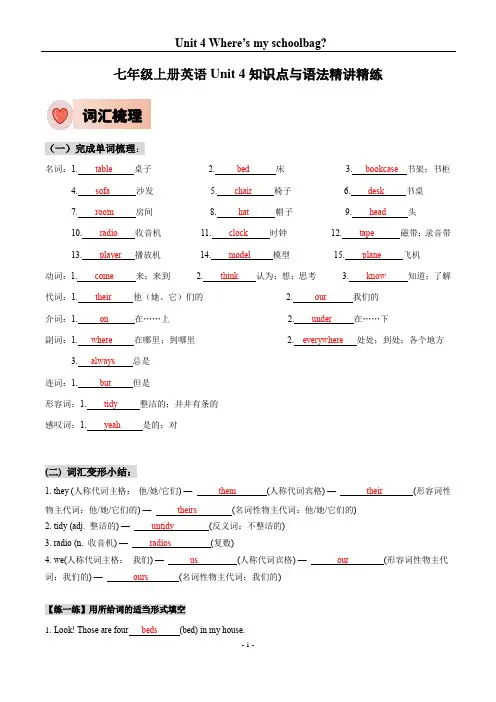
七年级上册英语Unit 4知识点与语法精讲精练词汇梳理(一)完成单词梳理:名词:1. table桌子 2. bed 床 3. bookcase 书架;书柜4. sofa 沙发5. chair 椅子6. desk 书桌7. room 房间8. hat 帽子9. head 头10. radio 收音机11. clock 时钟12. tape 磁带;录音带13. player 播放机14. model 模型15. plane 飞机动词:1. come 来;来到 2. think 认为;想;思考 3. know 知道;了解代词:1. their 他(她、它)们的 2. our 我们的介词:1. on 在……上 2. under 在……下副词:1. where 在哪里;到哪里 2. everywhere 处处;到处;各个地方3. always 总是连词:1. but 但是形容词:1. tidy 整洁的;井井有条的感叹词:1. yeah 是的;对(二) 词汇变形小结:1. they (人称代词主格:他/她/它们) — them (人称代词宾格) — their (形容词性物主代词:他/她/它们的) — theirs (名词性物主代词:他/她/它们的)2. tidy (adj. 整洁的) — untidy (反义词:不整洁的)3. radio (n. 收音机) — radios (复数)4. we(人称代词主格:我们) — us (人称代词宾格) — our (形容词性物主代词:我们的) — ours (名词性物主代词:我们的)【练一练】用所给词的适当形式填空1.Look! Those are four beds (bed) in my house.rry and I are Bill’s daughters, so Bill is our (we) father.3.Those old CD players ( player) are very nice.4.Susan and Emma thank their (they) teacher for helping them find the keys.5.Tina comes (come) to the gym and plays sports.6.These rooms (room) are too small.7.Look! Your model plane is (be) on the sofa.8.The Chinese book is his (he).9.Look at my mother’s (mother) room. It’s very clean.10.These are their (they) baseballs.(三) 短语攻关:come on快点儿tape player 磁带播放机model plane飞机模型on the sofa 在沙发上in one’s schoolbag在某人的书包里under one’s bed 在某人的床下面on one’s head在某人的头上teacher’s desk 讲桌pencil box 铅笔盒computer game电脑游戏知识点梳理1. Where are my books? 我的书在哪里?【用法详解】“Where+be动词+主语?”该句型为where引导的特殊疑问句,用来询问“某人或某物在哪里?”。
最全面人教版七年级上册英语第四单元知识点归纳总结

Unit 4 Where's my schoolbag?一、词汇与短语● 重点单词A部分1.where adv. 在哪里;到哪里2.table n. 桌子3.bed n. 床4.room n. 房间5.sofa n. 沙发6.their pron. 他(她、它)们的7.chair n. 椅子8.hat n. 帽子9.on prep. 在……上10.head n. 头11.under prep. 在……下12.know v. 知道;了解e v. 来;来到14.bookcase n. 书架;书柜15.desk n. 书桌16.yeah interj. 是的;对17.think v. 认为;想;思考B部分1.radio n. 收音机;无线电广播2.tidy adj. 整洁的;井井有条的3.clock n. 时钟4.but conj. 但是5.tape n. 磁带;录音带;录像带6.our pron. 我们的7.player n. 播放机8.everywhere adv. 处处;到处;各个地方9.model n. 模型10.always adv. 总是11.plane n. 飞机● 重点短语A部分1.on the sofa 在沙发上2.in your schoolbag 在你的书包里3.under your bed 在你的床上e on 快点儿5.on their bed 在他们的床上6.on your head 在你的头上7.under the chair 在椅子下面8.on the sofa在沙发上9.grandparents' room (外)祖父母的房间B部分1.a tape player 一个磁带播放机2.a model plane 一个飞机模型3.under the radio 在收音机下面4.in the bookcase 在书柜里5.on the teacher's desk 在老师的讲桌上6.on the desk 在书桌上7.under the desk 在书桌下8.in my room 在我的房间里● 重点句子A部分1.--Are the keys on the sofa? --No, they aren't. They are on the table.钥匙是在沙发上吗? 不,不是。
人教版七年级英语上册知识点总结

人教版七年级英语上册知识点总结人教版七年级英语上册知识点总结七年级英语上册Start Unit 1 Good morning!1、Good morning! 早上好!Good afternoon!下午好!Good evening!晚上好!其回答都是其本身。
2、Nice to meet you !回答是:Nice to meet you !或Nice to meetyou ,too!3、How do you do?答语仍然是:How do you do?4、How are you?答语是:Fine./I'm fine./I'm OK.Thanks.And you?5、动词be的一般现在时态:我(I)用am ,你(you)用are,is连着他(he)她(she)它(it)。
单数名词用is,复数名词全部都用are。
变否定,很简单,在be后把not加。
变一般疑问句,把be提句首,句末问号莫丢弃。
变特殊疑问句,特殊疑问词加上一般疑问句。
Start Unit 2 What's this in English?1、this“这,这个”指示代词,用来指代距离较近的单个的人或物。
反义是that,用来指代距离比较远的单个的人或物。
this的复数是these;that的复数是those。
含有this/that把this/that提句首,其肯定回答是:Yes,it is.否定回答是:No,it isn't.含有these/those把these/those提句首,其肯定回答是:Yes,they are.否定回答是:No,they aren't.2、in+语言\声音\方式,“用......语言(声音、方式)” 例如:in English“用英语”3、a+辅音音素开头的单词或字母(读音)an+元音音素开头的单词或字母(读音)4、What's this in English? 回答是:It's a/an+可数名词单数。
七年级英语unit4上册知识点

七年级英语unit4上册知识点Unit 4 Knowledge Points for Seventh-Grade EnglishUnit 4 of the seventh-grade English textbook introduces students to a wide range of topics. It covers everything from describing daily routines to discussing plans for the future. In this article, we will provide an overview of the key knowledge points covered in Unit 4.1. Present Simple Tense for Daily RoutinesThe present simple tense is used to describe actions that happen regularly or are true all the time. In Unit 4, students learn how to use this tense to talk about their daily routines. This includes discussing things like when they get up, what they eat for breakfast, and how they travel to school.Example: "I usually wake up at 6:30am, brush my teeth, and eat breakfast before leaving for school at 7:30am."2. Adverbs of FrequencyIn addition to learning the present simple tense, students also learn how to use adverbs of frequency to describe how often they do things. These adverbs are placed before the main verb, and include words like "always," "often," "sometimes," and "never".Example: "I always eat breakfast before school."3. Comparatives and SuperlativesComparatives and superlatives are used to compare two or more things. In Unit 4, students learn how to use these forms of adjectives to compare different activities. This includes discussing things like which sport is more popular, or which subject is the most difficult.Example: "Playing soccer is more popular than playing basketball."4. Future PlansUnit 4 also includes a section about discussing future plans. Students learn how to talk about their future goals, and how to use the simple present tense to describe future events that are scheduled to happen.Example: "I plan to go to college after I finish high school."5. Invitations and RequestsFinally, Unit 4 covers how to make invitations and requests in English. Students learn how to use polite language to ask for things, and how to make polite invitations to social events.Example: "Would you like to come to my party on Saturday?"In conclusion, the knowledge points covered in Unit 4 of the seventh-grade English textbook are varied and useful. By learning about things like present simple tense, adverbs of frequency, comparatives and superlatives, future plans, and invitations and requests, students will be well-equipped to speak and write confidently in English.。
新目标人教版七年级英语上册unit4全单元精学笔记

I don’t know the boy.我不认识这个男孩。
检测题:
I know his name. (改为否定句) Ihis name.
知识点六:tape playern. 录音机(课堂上随阶梯化步骤,会读背,会用)
(1)这是由两个名词(tape磁带,player播放器)组成的短语。其中tape作定语,修饰名词player。
1.--_____________________?我的书在哪儿?
-- _______________________.他们在沙发上。
2.--_________________________?我的铅笔盒在哪儿?
--_________________________.它在你的书包里。
3.--______________________?钥匙在沙发上吗?
(2)由两个名词组成的短语,变复数时通常把第二个名词变成复数,第一个名词不变。an alarm clock two alarm clocks
(3)两个名词组成的短语变复数时也有一些特殊的变法。
两个名词同时变成复数。
* a man teacher → two men teachersa woman doctor → two women doctors
14.头n.________15.是的,对interj._________16.知道,了解v.____________
17.收音机,无线电广播n._______18.时钟n._________ 19.磁带,录像带n._________
20.播放机n._______
21.磁带播放机n.___________ 22.模型n.____________ 23.飞机n.____________
人教版七年级上册英语Unit4知识点
常见搭配:in time 及时
3、连词but与and的用法;
1、I have a chair and desk.
and连接两个相同词性的单词有和,并且的意思。
I don’t like sofa,but my sister like it.
—No, they aren’t. They’re on the table.不,它们不在。它们在桌子上。
4.—Is it on your desk?在你的桌子上吗?
5.—It’s not under the chair.它不在你的椅子下面。
—It’s in your grandparents’room.它在你祖父母的房间。
1. on指在具体某一天
例:on Monday, on July 1st
2. 当morning, afternoon, evening前面或后面有定语限定时,就不用in而用on如:on a summer evening 在一个夏日的夜晚
on Sunday morning 在周日的早晨
Jim arrived at about seven on Sunday morning.
but表转折,但是的意思。
talane
sofa
Under the table
chair
on the bed
desk
in the schoolbag
radio
talk about
clock
tape
tape player
model plane
on
under
人教版七年级上册英语Unit4知识点
重点单词
人教新目标英语:七年级上册Unit4单词重点句型语法解析
人教新目标英语:七年级上册Unit4单词重点句型语法解析人教版新目标七年级上 Unit 4 where’s my schoolbag?where 在哪里;到哪里table 桌子bed 床bookcase 书架;书柜 =bookshelf,bookshop 书店 bookmark 书签bookstall书亭,书摊sofa 沙发chair 椅子on 在.......上under 在.......下come 来;来到come on 快点儿desk 书桌think 认为;想;思考room 房间their 他(她、它)们的hat 帽子head 头yeah 是的;对know 知道;了解radio 收音机;无线电广播clock 时钟tape 磁带;录音带;录像带player 播放机tape player 录音机model 模型plane 飞机model plane 飞机模型tidy 整洁的;井井有条的but 但是our 我们的everywhere 处处;到处;各地always 总是1.radio n.收音机;无线电广博listen to the radio 听收音机 on the radio 通过广播/收音机2.clock n. 时钟against the clock 抢时间 alarm clock 闹钟 like clock (如始终一般)准确地o’clock ……点钟(对比clock 表示“钟表”)与watch 的辨析,见七上unit33.tape n.磁带;录音带;录像带tape player 磁带播放机 CD player CD播放机player此处意为“播放机”,为可数名词,还有运动员的意思。
4.plane 飞机model plane 飞机模型 on a plane 在飞机上catch a plane 赶飞机 by plane 乘飞机5.tidy adj.整洁的;井井有条的 v.使……保持整洁;整理;收拾untidy 不整洁的;凌乱的近义词:neat adj.整洁的 clean adj.干净的;v.打扫keep tidy 保持整洁 neat and tidy 干净整齐6.but conj.但是用于连接两个并列的成分,表示前后意义上的转折或两种情况的对比,意为“但是”。
(完整版)人教版七年级上册英语知识点全第四单元unit4知识点
(完整版)⼈教版七年级上册英语知识点全第四单元unit4知识点Unit4重点词汇:where、table、bed、bookcase、sofa、chair、on、under、come、desk、tidy、always...1、重点短语:on the sofa 在沙发上 on the table 在桌上on your head 在你的头上 under the chair在椅⼦下under the bed 在床下 under the table 在桌下in your schoolbag 在你的书包⾥ in the bookcase 在书柜⾥in your grandparents’ room 在你爷爷奶奶的房间⾥come on 快点2、where引导的特殊疑问句,⽤于询问“某⼈或某物在哪⾥”,若谓语动词为be动词,其结构为“Where + be + 主语?”,be动词要与后⾯的主语保持⼀致。
其答语,⽤“主语+be+表⽰地点的的介词短语”为避免重复,句中的主语⼀般⽤代词代替。
----Where is/are...?----It’s/They’re on /in/under...----Where is my English book?----It’s on the desk.1)My clock is on the table?(就画线部分提问)________ ________ your clock?2)你的爸爸在哪?(翻译下列句⼦)______________________________________________3、on 在……的上⾯(接触) on the sofa/desk/table/bed on the tree 在树上(本⾝固有的)in 在……的⾥⾯ in your schoolbag/room in the tree 在树上(外来的事物)under 在……的下⾯(正下⽅) under your bed/desk若表⽰“某物在某地”则⽤“物 + be + 介词短语”结构。
2024年人教版新教材七年级英语上册Unit 4单词精讲课件
2024新人教版七年级下册
01 02 03 04 05
Starter Unit1
Starter Unit2
Starter Unit 3 Unit 1
Section A , Section B Unit 2
Section A , Section B
06
Unit 3 Section A , Section B
➢ 辨析形容词:boring /bored "bored" 通常用来形容人,强调的是人的内心感受。 He felt bored during the long meeting.他在冗长的会议中感到厌倦。 "boring" 则可以用来形容人或事物,但更多的是用来形容事物。 Her speech was boring. 他的演讲是无聊的。 ➢ 趁热打铁: Peter is so _______ at such a ______ book. A. bore; bore B. boring; boring C. bored; boring D. boring; bored
remember to do sth. ✓ 记得做过某事(已做过)
remember doing sth.
➢ 趁热打铁: I remember ___ the door, but it's open now. A. to lock B. locking C. locked Please remember ___ the book to the library. A.to return B. returning C. return He couldn't remember ___ he had put his keys. A. where B. when C. why