
人教PEP版六年级下册英语说课稿--Unit 3 A Let's learn
PEP小学英语六年级下Unit 3 A.Let’s learn说课稿
我说课的内容是PEP小学英语六年级下Unit3 What did you do?
A.Let’s learn,这个单元我刚刚上完,针对课中所出现的一些问题,我进行了反思,并认真写下了以下这个说课稿。
一、教材分析:本课出自于《PEP小学英语》六年级下册Unit 3 What did you do? Part A第一课时。
这是一节运用所学知识表达在过去时间内所做事情的课时。
二、学情分析:六年级的学生对于英语已经有了一定的自主学习能力,同时,学生已经掌握了较多的动词短语,为本课时的学习打下了基础。
本课时,学生将在已学动词短语的基础上,掌握一般动词过去时的构成时以及部分不规则动词的过去式,同时,谈论过去时间内所干的事情。
三、教学目标:
根据本教材的特点及新课标对六年级学生学习英语的要求,我制定了以下教学目标.
1)认知目标:能够听、说、读、写短语watched TV、washed the clothes、cleaned the room、played football、visited grandparents,掌握规则动词一般过去式的构成,以及部分不规则动词的过去式形式;同时,能听懂问句What did you do last weekend?并做出正确回答;能运用所学语言知识完成Let’s find out的任务.
2)能力目标:能够用一般过去时描述自己在过去时间里所做的
事情.
3)情感目标:通过本课语言知识的学习,教育学生多熟悉身边的人所做的事情,并能做到经常关心他人.
四、教学重难点
1)重点:听说读写短语watched TV、washed the clothes、cleaned the room、played football、visited grandparents;能听说句子What did you do last weekend?并能就过去时间所做的事情进行简单回答.
2)难点:学生对本课的几个短语都比较熟悉,但动词的过去式第一次出现,因此,这几个短语的动词过去式的构成及其发音是本课时的难点。
五、教学准备:多媒体课件
六、教法、学法
1.教法设计
在应用任务型教学法的大前提下,我利用情景教学法,以学生为中心,以交际为主线,通过一系列的教学活动吸引学生的注意力。
2.学法指导
在本课的学习活动中,我用多媒体课件辅助教学,以多种合作学习的方式来帮助学生自己去探索、发现和解决问题,让学生在互动和交流中建立自信,感受学习的快乐.
3.教学手段
用多媒体辅助教学,将英语学习和游戏结合,引导学生积极主动地投入到学习活动中去.
七、教学过程
1.导入设计
(1)Preparation
安排两个chant:Book 6 Unit1 what do you do on the weekend?朗朗上口的chant,不仅能激发学生学习的兴趣,而且复习了五年级所学过的一些动词短语,起到了一举两得的效果。
(2)Free talk
从上一chant引出Guessing game,让学生看动词猜动词短语,例如:教师出示动词
play,让学生组词play the piano, play the violin, play football…使学生进一步回忆、巩固以前所学的单词。
接着教师说I usually play sports on the weekend.
What do you usually do on the weekend?让学生谈谈平时自己的周末都会做哪些事情。
设计意图:这一环节让学生在一个平等尊重的氛围中,敢于说、敢于参与教学,给学生多一点表现自己的机会,这样不仅复习了旧知识,还渲染了学习英语的良好气氛,使课堂氛围在一开始便充满活力。
2.新课呈现
教师紧接上一环节:I usually play sports on the weekend. I played sports with my friends last weekend.教师边说边出示自己做运动的照片,同时在照片旁打印出句子,I played sports last weekend.played中ed 和last用红色注明,让学生明白动词随着时态
的变化而变化,并让学生跟读这一句子。
接着教师把由played 这一动词组成的动词词组的图片展示在屏幕上,询问并板书What did you do last weekend?请学生看图片造句,拓展学生思维。
注意板书What did you do last weekend?中did 要用红色,并让生明白did 由do 变化而来。
接下去我呈现短语watched TV、washed the clothes等.通过对比强化,引导学生掌握动词短语过去式形式,同时辨别发音的规律:watched/t/,washed/t/,cleaned/d/,played/d/,visited/id/因为平时我对清辅音、浊辅音已有所渗透,所以我向学生点明:清辅音后加ed发/t/音,浊辅音和元音后加ed发/d/音,/t/和/d/后加ed发/id/音.学生通过比较,逐渐掌握动词过去式的构成方法和读音规律,为学生的自主学习打下基础.
设计意图:借助教师的生活实际,自然地引入一般过去时,使学生了解last weekend是过去的时间点,使学生在讲述周末活动的情景中展开学习,为过去时的学习埋下伏笔.老师还有意识地对过去时地几种读音加以渗透,引导学生通过比较,逐渐掌握动词过去式的构成方法和读音规律,为学生的自主学习打下基础,呈现新知,合作互动。
在呈现新知时,我尤其注意了小学生形象思维优于抽象思维的特点,通过对比,听音,看动作等不同的方式引出新词,给学生以深刻的第一印象。
3.操练巩固
(1)填空练习,巩固理解.
为了巩固学生对动词过去式的理解,我设计了一些强化训练,如填空:
Last weekend,I homework at eight in the morning。
I football with my friends at ten….
设计思路:针对高段学生的实际,让学生对动词的过去式进行运用,更加深了学生对动词的一般过去时的印象,同时帮助学生掌握正确规范的书写,为将来进一步的学习做了很好的铺垫.
(2)学习Let’s find out部分.
先设计一个记忆游戏,多媒体课件出示Let’s find out 中的图片并快速遮住,提问:What did Zoom do last weekend?引入到谈论第三者,学生根据图片回答:He watched TV…接着利用图片,同桌合作,看图片操练对话。
通过这个练习,学生再一次加深了对动词短语过去式的印象.
(3)补充拓展练习
课件出示几幅情景图,让学生根据图画中的情景,运用学过的句型进行问答.这一环节进一步训练了学生听、说英语的能力,培养了学生初步的阅读能力,也为下一步拓展活动的开展打下了基础。
这里要注意在学生说完后,教师要及时评价。
设计意图:这一部分,通过对知识的小结,帮助学生将本课的信息进行加工、储存,从而明确教学目标、重点和难点;同时,对学生的表现进行总结评价,以评价促发展,培养小组团队精神,激励学生大胆开口,积极活动,为小组争得荣誉。
八.Production
Make a surve y: … - A: What did you do last weekend?
- B: I ______...
Name What did he/she do last weekend?
Words groups:
watched TV、washed the clothes、cleaned the room、played football/basketball/the piano/violin、visited grandparents 、planted trees、listened to music、climbed mountains、cooked meals、did(do) homework
设计意图:让学生运用所学语句进行问答,这里的省略号表示提醒学生在进行调查活动时一定要有最基本的问候语,在这里我提供了一些动词词组供学生操练和书写时用语,动词短语中,除了文中的五个动词短语外,还有其他一些学生在周末可能会做的、规则动词的过去式短语供学生选择,这样就不会将学生的思路局限在书中要求的几个单词而已。
同时,四线格的设计更让学生的书写得到了进一步的操练,达到了语言、书写同发展的目的。
九、教学总结
在设计这堂课时,我尽可能地采用听、说、游戏的方式,通过各个有趣、实用、轻松、活泼的活动,让学生在玩中学,学中用,逐步解决本课的重、难点,提高了课堂实效,培养了学生学习的兴趣。
我相信通过让学生主体参与、体验感悟、游戏巩固,是一定能圆满实现
课堂教学任务的。
当然,由于自己水平有限,各个环节之间还存在着很多缺点和不足,愿各位专家提出宝贵的意见和建议。
谢谢大家!。
人教版PEp英语六年级下册Unit 3 Part A Let's learn.英文说课稿
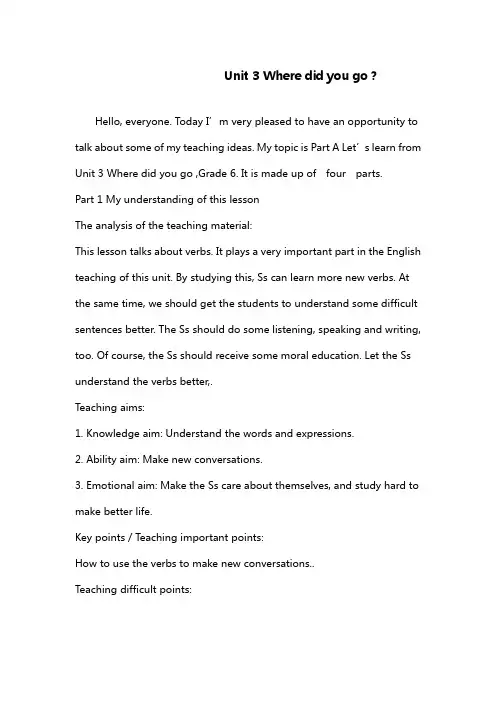
Unit 3 Where did you go ?Hello, everyone. Today I’m very pleased to have an opportunity to talk about some of my teaching ideas. My topic is Part A Let’s learn from Unit 3 Where did you go ,Grade 6. It is made up of four parts.Part 1 My understanding of this lessonThe analysis of the teaching material:This lesson talks about verbs. It plays a very important part in the English teaching of this unit. By studying this, Ss can learn more new verbs. At the same time, we should get the students to understand some difficult sentences better. The Ss should do some listening, speaking and writing, too. Of course, the Ss should receive some moral education. Let the Ss understand the verbs better,.Teaching aims:1. Knowledge aim: Understand the words and expressions.2. Ability aim: Make new conversations.3. Emotional aim: Make the Ss care about themselves, and study hard to make better life.Key points / Teaching important points:How to use the verbs to make new conversations..Teaching difficult points:1. Use your own words to make new conversations..2. Discuss where they went and what they did.Something about the Ss:1.The Ss have known something about what sb did in the past.2. They don’t often use English to express themselves and communicate with others.3. Some Ss are not active in the class because they are afraid of making mistakes.Part 2 My teaching theories, methods and aidsBefore dealing with this lesson, I’ll do my best to carry out the following theories: Make the Ss the real masters in class while the teacher himself acts as director; Combine the language structures with the language functions; Let the students receive some moral education while they are learning the English language.Teaching method:Double activities teaching methodQuestion-and-answer activity teaching methodWatch-and-listen activityFree discussion methodTeaching aids:1.some cards2.some objects3. a tape recorder4. the blackboardPart 3. Teaching steps / proceduresI have designed the following steps to train their ability of listening, speaking, reading and writing.The entire steps are:Greetings, Revision, Lead-in and reading, Preparation for details of the lesson, Consolidation, Discussion, Homework.Step 1 GreetingsGreet the whole class as usual.Step 2. Revision1. T: Act,let the Ss guess.2.Ask students some questions to revise the last lesson(show them on the screen).a. What did you do last Saturday?b. What did he do last Sunday?c. What did he do yesterday?d.What did you do last Monday?Step 3. Lead-in and preparationShow them some pictures and let them talk each other, and then use the pictures about places and the things we or they did in the past . Purpose: Arouse the students’interest of study.Bring in new subject: Where we or they went and what we or they did there.Method: Talk about the pictures , read the words and expressions and act.Purpose: Help the Ss remember the words and expressions best.Step 5. Play a game.Look, act and guess.Purpose: Make the Ss learn the expressions best and feel interesting. Step 6. ConsolidationRead the words and expressions , finish the conversation. Purpose: Let the Ss can communicate better.Step 7. DiscussionShow them some words and expressions, let the Ss talk freely. Purpose: Give the Ss much ,they can give us more.Step 8. Listening and exercise.Purpose:Improve the Ss listening and writing ability .Step 9. SummaryLet the Ss make a summary.Purpose:Let the Ss remember the lesson better.Step 10. HomeworkRead the words and expressions and make new conversations.Part 4. Blackboard designUnit 3 Where did you go?A: Where did you go_____? go went camping / fishing B: I went to ____________. ride rode a horseA:What did you do there? rode a bikeB: I ___________________. hurt hurt my footThat’s all , Thank you for listening!。
pep小学英语六年级下册Unit 3 A Let1 哦

小学英语六年级下册Unit 3 A Let’s learn说课稿胡世英一、说教学内容我今天讲课的内容是pep小学英语六年级下册Unit 3 A Let’s learn.二、说教材简析本节主要让学生掌握五个动词短语的过去式,让学生能够利用这些短语进行描述自己过去的时间里所做的事情,运用主要句型询问他人在过去的时间里做过什么?在前面学生已经学习了这些短语,并且掌握了一般现在时,现在进行时,一般将来时的用法,教学时我主要采用了以旧引新的教学方法。
三、说教学目标根据教材内容特点和新课程标准的要求,我确定了本节的教学目标为:1、能够听说读写动词短语以及它们的过去式:watched TV, washed clothes, cleaned the room, played football, visted my grandparents; 并初步了解一般动词过去式的变化规律及其发音规则。
2、能够听懂问句:What did you do last weekend? 并能够做出正确的回答。
3、在学习过程中培养学生学习英语的兴趣,并教育学生要合理安排周末时间。
四、说教学重点掌握动词短语的过去式以及就过去时间所做的事情进行简单回答。
五、说教学难点动词过去式的拼写和发音。
七、说教学过程(一)热身、导入(warm-up)1、猜词游戏。
2、Let's chant 。
设计意图:通过说唱和游戏的方式复习娱乐周末有关的动词短语,为新课学习做铺垫。
(二)新课呈现(presentation)1、老师出示日历,圈出今天的日子是Sunday(weekend) ,问学生:What's the date today ? What day is it ?2、老师说:On the weekend ,I usually watchTV , wash the clothes , clean the room ,play football , visit grandparents 。
pep(人教)六年级英语下册 Unit3 Where did you go A Let’s learn说课稿.doc
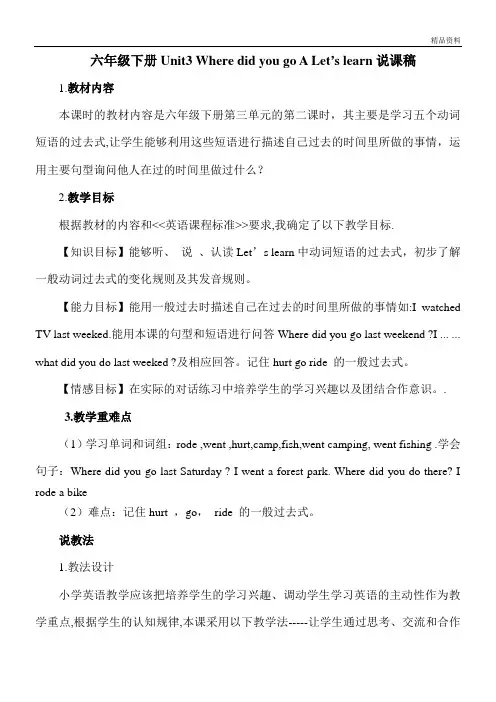
六年级下册Unit3 Where did you go A Let’s learn说课稿1.教材内容本课时的教材内容是六年级下册第三单元的第二课时,其主要是学习五个动词短语的过去式,让学生能够利用这些短语进行描述自己过去的时间里所做的事情,运用主要句型询问他人在过的时间里做过什么?2.教学目标根据教材的内容和<<英语课程标准>>要求,我确定了以下教学目标.【知识目标】能够听、说、认读Let’s learn中动词短语的过去式,初步了解一般动词过去式的变化规则及其发音规则。
【能力目标】能用一般过去时描述自己在过去的时间里所做的事情如:I watched TV last weeked.能用本课的句型和短语进行问答Where did you go last weekend ?I ... ... what did you do last weeked ?及相应回答。
记住hurt go ride 的一般过去式。
【情感目标】在实际的对话练习中培养学生的学习兴趣以及团结合作意识。
.3.教学重难点(1)学习单词和词组:rode ,went ,hurt,camp,fish,went camping, went fishing .学会句子:Where did you go last Saturday ? I went a forest park. Where did you do there? I rode a bike(2)难点:记住hurt ,go,ride 的一般过去式。
说教法1.教法设计小学英语教学应该把培养学生的学习兴趣、调动学生学习英语的主动性作为教学重点,根据学生的认知规律,本课采用以下教学法-----让学生通过思考、交流和合作等方式学习和使用英语完成本课学习任务.2.学法指导在学习过程中,从学生的学习兴趣、生活经验和认知水平出发,倡导体验、实践、参与和交流的学习方式,培养学生的英语综合语言运用能力,主动思维,大胆实践,形成自主学习的能力.3.教学手段单词卡,PPT,教学挂图等说设计1.导入设计(1)warm upLet’s chant在热身时让学生一起做动作说短语让学生进入到学习英语的氛围中,同时复习与周末相关的动词短语。
PEP六年级下册Unit 3 Part A Let's learn.说课稿
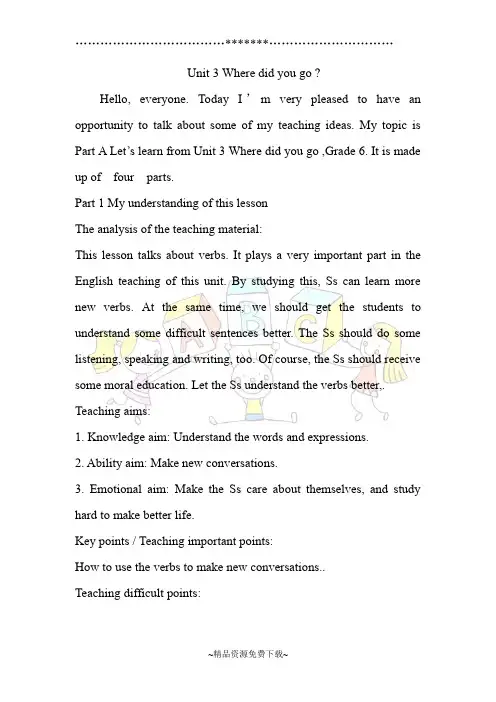
Unit 3 Where did you go ?Hello, everyone. Today I’m very pleased to have an opportunity to talk about some of my teaching ideas. My topic is Part A Let’s learn from Unit 3 Where did you go ,Grade 6. It is made up of four parts.Part 1 My understanding of this lessonThe analysis of the teaching material:This lesson talks about verbs. It plays a very important part in the English teaching of this unit. By studying this, Ss can learn more new verbs. At the same time, we should get the students to understand some difficult sentences better. The Ss should do some listening, speaking and writing, too. Of course, the Ss should receive some moral education. Let the Ss understand the verbs better,. Teaching aims:1. Knowledge aim: Understand the words and expressions.2. Ability aim: Make new conversations.3. Emotional aim: Make the Ss care about themselves, and study hard to make better life.Key points / Teaching important points:How to use the verbs to make new conversations..Teaching difficult points:1. Use your own words to make new conversations..2. Discuss where they went and what they did.Something about the Ss:1.The Ss have known something about what sb did in the past.2. They don’t often use English to express themselves and communicate with others.3. Some Ss are not active in the class because they are afraid of making mistakes.Part 2 My teaching theories, methods and aidsBefore dealing with this lesson, I’ll do my best to carry out the following theories: Make the Ss the real masters in class while the teacher himself acts as director;Combine the language structures with the language functions; Let the students receive some moral education while they are learning the English language.Teaching method:Double activities teaching methodQuestion-and-answer activity teaching methodWatch-and-listen activityFree discussion methodTeaching aids:1.some cards2.some objects3. a tape recorder4. the blackboardPart 3. Teaching steps / proceduresI have designed the following steps to train their ability of listening, speaking, reading and writing.The entire steps are:Greetings, Revision, Lead-in and reading, Preparation for details of the lesson, Consolidation, Discussion, Homework.Step 1 GreetingsGreet the whole class as usual.Step 2. Revision1. T: Act,let the Ss guess.2.Ask students some questions to revise the last lesson(show them on the screen).a. What did you do last Saturday?b. What did he do last Sunday?c. What did he do yesterday?d.What did you do last Monday?Step 3. Lead-in and preparationShow them some pictures and let them talk each other, and then use the pictures about places and the things we or they did in the past . Purpose: Arouse the students’interest of study.Bring in new subject: Where we or they went and what we or they did there.Method: Talk about the pictures , read the words and expressions and act.Purpose: Help the Ss remember the words and expressions best. Step 5. Play a game.Look, act and guess.Purpose: Make the Ss learn the expressions best and feel interesting. Step 6. ConsolidationRead the words and expressions , finish the conversation. Purpose: Let the Ss can communicate better.Step 7. DiscussionShow them some words and expressions, let the Ss talk freely. Purpose: Give the Ss much ,they can give us more.Step 8. Listening and exercise.Purpose:Improve the Ss listening and writing ability .Step 9. SummaryLet the Ss make a summary.Purpose:Let the Ss remember the lesson better.Step 10. HomeworkRead the words and expressions and make new conversations.Part 4. Blackboard designUnit 3 Where did you go?A: Where did you go_____? go went camping / fishing B: I went to ____________. ride rode a horseA:What did you do there? rode a bikeB: I ___________________. hurt hurt my footThat’s all , Thank you for listening!。
人教版PEP 小学六年级英语-Unit 3 Part A Let's learn.说课稿
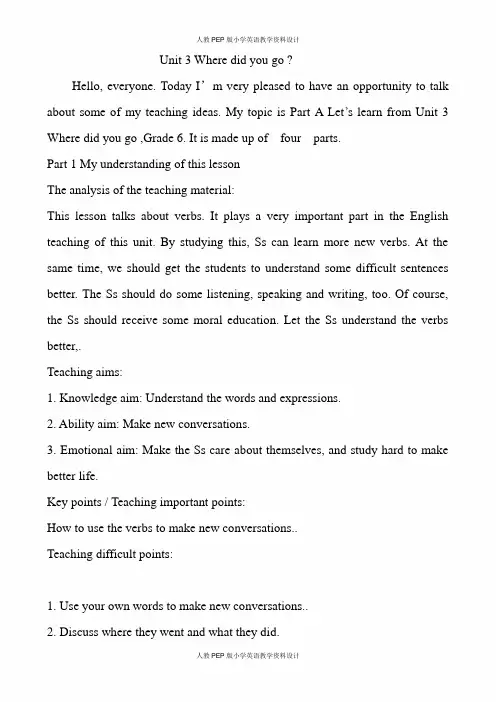
Unit 3 Where did you go ?Hello, everyone. Today I’m very pleased to have an opportunity to talk about some of my teaching ideas. My topic is Part A Let’s learn from Unit 3 Where did you go ,Grade 6. It is made up of four parts.Part 1 My understanding of this lessonThe analysis of the teaching material:This lesson talks about verbs. It plays a very important part in the English teaching of this unit. By studying this, Ss can learn more new verbs. At the same time, we should get the students to understand some difficult sentences better. The Ss should do some listening, speaking and writing, too. Of course, the Ss should receive some moral education. Let the Ss understand the verbs better,.Teaching aims:1. Knowledge aim: Understand the words and expressions.2. Ability aim: Make new conversations.3. Emotional aim: Make the Ss care about themselves, and study hard to make better life.Key points / Teaching important points:How to use the verbs to make new conversations..Teaching difficult points:1. Use your own words to make new conversations..2. Discuss where they went and what they did.Something about the Ss:1.The Ss have known something about what sb did in the past.2. They don’t often use English to express themselves and communicate with others.3. Some Ss are not active in the class because they are afraid of making mistakes.Part 2 My teaching theories, methods and aidsBefore dealing with this lesson, I’ll do my best to carry out the following theories: Make the Ss the real masters in class while the teacher himself acts as director;Combine the language structures with the language functions; Let the students receive some moral education while they are learning the English language.Teaching method:Double activities teaching methodQuestion-and-answer activity teaching methodWatch-and-listen activityFree discussion methodTeaching aids:1.some cards2.some objects3. a tape recorder4. the blackboardPart 3. Teaching steps / proceduresI have designed the following steps to train their ability of listening, speaking, reading and writing.The entire steps are:Greetings, Revision, Lead-in and reading, Preparation for details of the lesson, Consolidation, Discussion, Homework.Step 1 GreetingsGreet the whole class as usual.Step 2. Revision1. T: Act,let the Ss guess.2.Ask students some questions to revise the last lesson(show them on the screen).a. What did you do last Saturday?b. What did he do last Sunday?c. What did he do yesterday?d.What did you do last Monday?Step 3. Lead-in and preparationShow them some pictures and let them talk each other, and then use the pictures about places and the things we or they did in the past .Purpose: Arouse the students’interest of study.Bring in new subject: Where we or they went and what we or they did there. Method: Talk about the pictures , read the words and expressions and act. Purpose: Help the Ss remember the words and expressions best.Step 5. Play a game.Look, act and guess.Purpose: Make the Ss learn the expressions best and feel interesting. Step 6. ConsolidationRead the words and expressions , finish the conversation. Purpose: Let the Ss can communicate better.Step 7. DiscussionShow them some words and expressions, let the Ss talk freely. Purpose: Give the Ss much ,they can give us more.Step 8. Listening and exercise.Purpose:Improve the Ss listening and writing ability .Step 9. SummaryLet the Ss make a summary.Purpose:Let the Ss remember the lesson better.Step 10. HomeworkRead the words and expressions and make new conversations.Part 4. Blackboard designUnit 3 Where did you go?A: Where did you go_____? go went camping / fishing B: I went to ____________. ride rode a horseA:What did you do there? rode a bikeB: I ___________________. hurt hurt my footThat’s all , Thank you for listening!。
pep3 Unit3 let’s learn 说课稿

Unit 3 A let’s learn说课稿我说课的内容是pep3 Unit3 let’s learn A部分的单词教学。
一、说教材。
PEP小学英语采用以“话题——功能——结构——任务”体系编写,以素质教育为根本指导思想,着重培养学生运用英语的能力。
课文内容新颖、实用,有趣味性、有时代感。
所选课文内容涉及文化、学习、日常生活等多方面内容。
以活动、游戏为载体,符合学生的年龄特点。
本单元的重点以能够简单地说一说,并描述家里的房间以及物品等,开展学习一些相关的单词,以及一些相关的对话。
本课要求掌握的三会单词为本单元后面的内容的教学。
通过这节课,能让学生扩充原有的词汇量,并提高用英语进行交流的能力。
因此,我确立本课的教学目标为:1、教学目标:(1)能力目标能听说、认读long hair, short hair,strong,thin,quiet,friends(2)知识目标能描述人物相貌特征,如:He has short hair,big eyes and a smallnose.She has long hair and small eyes.等(3)情感目标对学生进行关心朋友,朋友间要互相帮助的思想教育2、教学重难点:描述人物相貌特征的词汇及quiet的发音3、教具准备:多媒体,头饰等二、说教法:根据《英语课程标准》、学生的认知规律,以及《PEP小学英语》以素质教育为本的指导思想,依照学生的认知理论和特征. 教学应该引起学生的注意而且唤起他们学习英语的兴趣.本课我采用如下教法:1、多媒体教学。
利用多媒体等为学生创设良好的学习条件,激发学生的好奇心和求知欲。
2、游戏教学。
通过chant、游戏启发诱导学生完成本课任务。
三、说教学过程。
(一)Warm up教师发命令,学生边说边表演。
T:Make yourself tall. Ss:Tall ,tall ,tallMake yourself short. Short, short, shortMake your arms long. Long, long, longMake your eyes big. Big, big, bigMake your eyes small. Small, small, small从复习已有知识入手,唤醒学生对学习内容的记忆,使学生快速地进入英语学习的氛围;歌曲能充分调动学生的积极性,活跃课堂气氛。
人教版六年级下册英语Unit 3 Part A Let's learn.说课稿
Unit 3 Where did you go ?Hello, everyone. Today I’m very pleased to have an opportunity to talk about some of my teaching ideas. My topic is Part A Let’s learn from Unit 3 Where did you go ,Grade 6. It is made up of four parts.Part 1 My understanding of this lessonThe analysis of the teaching material:This lesson talks about verbs. It plays a very important part in the English teaching of this unit. By studying this, Ss can learn more new verbs. At the same time, we should get the students to understand some difficult sentences better. The Ss should do some listening, speaking and writing, too. Of course, the Ss should receive some moral education. Let the Ss understand the verbs better,. Teaching aims:1. Knowledge aim: Understand the words and expressions.2. Ability aim: Make new conversations.3. Emotional aim: Make the Ss care about themselves, and study hard to make better life.Key points / Teaching important points:How to use the verbs to make new conversations..Teaching difficult points:1. Use your own words to make new conversations..2. Discuss where they went and what they did.Something about the Ss:1.The Ss have known something about what sb did in the past.2. They don’t often use English to express themselves and communicate with others.3. Some Ss are not active in the class because they are afraid of making mistakes.Part 2 My teaching theories, methods and aidsBefore dealing with this lesson, I’ll do my best to carry out the following theories: Make the Ss the real masters in class while the teacher himself acts as director;Combine the language structures with the language functions; Let the students receive some moral education while they are learning the English language.Teaching method:Double activities teaching methodQuestion-and-answer activity teaching methodWatch-and-listen activityFree discussion methodTeaching aids:1.some cards2.some objects3. a tape recorder4. the blackboardPart 3. Teaching steps / proceduresI have designed the following steps to train their ability of listening, speaking, reading and writing.The entire steps are:Greetings, Revision, Lead-in and reading, Preparation for details of the lesson, Consolidation, Discussion, Homework.Step 1 GreetingsGreet the whole class as usual.Step 2. Revision1. T: Act,let the Ss guess.2.Ask students some questions to revise the last lesson(show them on the screen).a. What did you do last Saturday?b. What did he do last Sunday?c. What did he do yesterday?d.What did you do last Monday?Step 3. Lead-in and preparationShow them some pictures and let them talk each other, and then use the pictures about places and the things we or they did in the past . Purpose: Arouse the students’interest of study.Bring in new subject: Where we or they went and what we or they did there.Method: Talk about the pictures , read the words and expressions and act.Purpose: Help the Ss remember the words and expressions best. Step 5. Play a game.Look, act and guess.Purpose: Make the Ss learn the expressions best and feel interesting. Step 6. ConsolidationRead the words and expressions , finish the conversation. Purpose: Let the Ss can communicate better.Step 7. DiscussionShow them some words and expressions, let the Ss talk freely. Purpose: Give the Ss much ,they can give us more.Step 8. Listening and exercise.Purpose:Improve the Ss listening and writing ability .Step 9. SummaryLet the Ss make a summary.Purpose:Let the Ss remember the lesson better.Step 10. HomeworkRead the words and expressions and make new conversations.Part 4. Blackboard designUnit 3 Where did you go?A: Where did you go_____? go went camping / fishing B: I went to ____________. ride rode a horseA:What did you do there? rode a bikeB: I ___________________. hurt hurt my footThat’s all , Thank you for listening!。
人教pep版六年级英语下册配套说课设计:unit_3_a_let's_learn说课稿【精品】
PEP小学英语六年级下Unit 3 A.Let’s learn说课稿我说课的内容是PEP小学英语六年级下Unit3 What did you do? A.Let’s learn,这个单元我刚刚上完,针对课中所出现的一些问题,我进行了反思,并认真写下了以下这个说课稿。
一、教材分析:本课出自于《PEP小学英语》六年级下册Unit 3 What did you do? Part A第一课时。
这是一节运用所学知识表达在过去时间内所做事情的课时。
二、学情分析:六年级的学生对于英语已经有了一定的自主学习能力,同时,学生已经掌握了较多的动词短语,为本课时的学习打下了基础。
本课时,学生将在已学动词短语的基础上,掌握一般动词过去时的构成时以及部分不规则动词的过去式,同时,谈论过去时间内所干的事情。
三、教学目标:根据本教材的特点及新课标对六年级学生学习英语的要求,我制定了以下教学目标.1)认知目标:能够听、说、读、写短语watched TV、washed the clothes、cleaned the room、played football、visited grandparents,掌握规则动词一般过去式的构成,以及部分不规则动词的过去式形式;同时,能听懂问句What did you do last weeend?并做出正确回答;能运用所学语言知识完成Let’s find out的任务.2)能力目标:能够用一般过去时描述自己在过去时间里所做的事情.3)情感目标:通过本课语言知识的学习,教育学生多熟悉身边的人所做的事情,并能做到经常关心他人.四、教学重难点1)重点听说读写短语watched TV、washed the clothes、cleaned the room、playedfootball、visited grandparents;能听说句子What did you do last weeend?并能就过去时间所做的事情进行简单回答.2)难点学生对本课的几个短语都比较熟悉,但动词的过去式第一次出现,因此,这几个短语的动词过去式的构成及其发音是本课时的难点。
2018年人教版PEP最新版小学六年级英语下册:Unit 3 Part A Let's learn.说课稿(Word版)
Unit 3 Where did you go ?Hello, everyone. Today I’m very pleased to have an opportunity to talk about some of my teaching ideas. My topic is Part A Let’s learn from Unit 3 Where did you go ,Grade 6. It is made up of four parts.Part 1 My understanding of this lessonThe analysis of the teaching material:This lesson talks about verbs. It plays a very important part in the English teaching of this unit. By studying this, Ss can learn more new verbs. At the same time, we should get the students to understand some difficult sentences better. The Ss should do some listening, speaking and writing, too. Of course, the Ss should receive some moral education. Let the Ss understand the verbs better,. Teaching aims:1. Knowledge aim: Understand the words and expressions.2. Ability aim: Make new conversations.3. Emotional aim: Make the Ss care about themselves, and study hard to make better life.Key points / Teaching important points:How to use the verbs to make new conversations.. Teaching difficult points:1. Use your own words to make new conversations..2. Discuss where they went and what they did. Something about the Ss:1.The Ss have known something about what sb did in the past.2. They don’t often use English to express themselves and communicate with others.3. Some Ss are not active in the class because they are afraid of making mistakes.Part 2 My teaching theories, methods and aidsBefore dealing with this lesson, I’ll do my best to carry out the following theories: Make the Ss the real masters in class while the teacher himself acts as director;Combine the language structures with the language functions; Let the students receive some moral education while they are learning the English language.Teaching method:Double activities teaching methodQuestion-and-answer activity teaching methodWatch-and-listen activityFree discussion method。
PEP小学英语六年级下Unit 3 A Let’s learn说课稿
PEP小学英语六年级下Unit 3 A Let’slearn说课稿我会采用多种学法指导,包括听说读写四种技能的综合训练,以及小组合作和角色扮演等活动,让学生在轻松愉快的氛围中研究英语,提高英语研究的兴趣和积极性。
本课时的教学重点是让学生掌握动词过去式的构成和发音,难点是学生第一次接触动词过去式,需要花费一定的时间和精力进行训练。
因此,我会采用情景教学法和交际法,通过多种教学活动来激发学生的兴趣,提高学生的英语应用能力。
最后,我相信通过我的精心设计和教学实践,学生们一定会在本节课中取得良好的研究成果,掌握动词过去式的构成和发音,提高英语应用能力,同时也增强对身边人的关心和关注。
在这次课堂中,我使用了多媒体课件来辅助教学,并采用了多种合作研究的方式,帮助学生自主探索、发现和解决问题,让学生在互动和交流中建立自信,感受研究的快乐。
在教学过程中,我运用了多媒体辅助教学,将英语研究和游戏结合起来,引导学生积极主动地投入到研究活动中去。
在导入环节中,我安排了两个朗朗上口的chant,不仅能激发学生研究的兴趣,而且复了五年级所学过的一些动词短语。
接着,我通过Guessing game的方式,让学生看动词猜动词短语,进一步回忆、巩固以前所学的单词。
这样的设计让学生在一个平等尊重的氛围中,敢于说、敢于参与教学,给学生多一点表现自己的机会,复了旧知识,渲染了研究英语的良好气氛,使课堂氛围在一开始便充满活力。
在新课呈现环节中,我紧接上一环节,通过展示自己做运动的照片和相应的句子,让学生明白动词随着时态的变化而变化,并让学生跟读这一句子。
接着,我展示了由XXX这一动词组成的动词词组的图片,询问并板书What did you do last weekend?请学生看图片造句,拓展学生思维。
注意板书XXX?XXX要用红色,并让生明白did由do变化而来。
In this lesson。
XXX "watched TV" and "washed the XXX: "watched/t/"。