
15春学期《会计专业英语》在线作业 满分答案
B. the bank has not recorded all of its transactions
C. any differences between the depositor's records and the bank's
A. supplies expense
B. cost of merchandise sold
C. merchandise inventory
D. sales
?
正确答案:B
14. The two most common specialized fields of accounting in practice are( )
B. total of the accountsreceivables written-off during the year
C. total estimated uncollectible accounts
正确案:C
11. Cash dividends are usually not paid on which of the following?
正确答案:C
9. Which statement below is not a reason for a corporation to buy back its own stock.
A. resale to employees
B. bonus to employees
C. for supporting the marketprice of the stock
B. proprietorship
C. partnership
D. corporation
?
正确答案:A
5. Cashinvestments made by the owner to the business are reported on the statement of cash flows in the
?
正确答案:D
7. The measurement bases exclude( )
A. Historical cost
B. Current cost
C. Sale price
D. Present value
?
正确答案:C
8. A bank reconciliation should be prepared periodically because()
A. account payable
B. account receivable
C. asset
D. expense payable
?
正确答案:A
3. When the corporation issuing the bonds has the right to repurchase the bonds prior to the maturity date for a specific price, the bonds are
一,单选题
1. A capital expenditure results in a debit to()
A. an expense account
B. a capital account
C. a liability account
D. an asset account
?
正确答案:D
2. The debt created by a business when it makes a purchase on account is referred toas an
A. due, but not receivable for more than one year
B. due, but not payable for more than one year
C. due and receivable within one year
D. due and payable within one year
A. convertible bonds
B. unsecured bonds
C. debenture bonds
D. callable bonds
?
正确答案:D
4. Which of the items below is not a business organization form?()
A. entrepreneurship
B. reduce the market price of the stock per share
C. increase the market price of the stock per share
D. increase retained earnings
?
正确答案:B
13. When the perpetual inventory system is used, the inventory sold is debited to ( )
A. financing activities section
B. investing activities section
C. operating activities section
D. supplemental statement
?
正确答案:A
6. Current liabilities are()
A. class B common stock
B. preferred stock
C. treasury stock
D. class A common stock
?
正确答案:C
12. The primary purpose of a stock split is to()
A. increase paid-in capital
D. to increase the shares outstanding
?
正确答案:D
10. On the balance sheet, the amount shown for the Allowance for Doubtful Accounts is equal to the()
A. Uncollectible accounts expense for the year
会计专业英语课后答案 Answer for lesson6
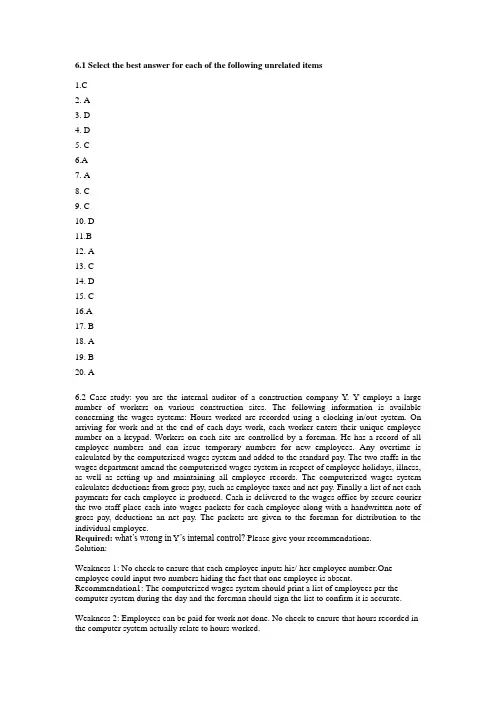
6.1 Select the best answer for each of the following unrelated items1.C2. A3. D4. D5. C6.A7. A8. C9. C10. D11.B12. A13. C14. D15. C16.A17. B18. A19. B20. A6.2 Case study: you are the internal auditor of a construction company Y. Y employs a large number of workers on various construction sites. The following information is available concerning the wages systems: Hours worked are recorded using a clocking in/out system. On arriving for work and at the end of each days work, each worker enters their unique employee number on a keypad. Workers on each site are controlled by a foreman. He has a record of all employee numbers and can issue temporary numbers for new employees. Any overtime is calculated by the computerized wages system and added to the standard pay. The two staffs in the wages department amend the computerized wages system in respect of employee holidays, illness, as well as setting up and maintaining all employee records. The computerized wages system calculates deductions from gross pay, such as employee taxes and net pay. Finally a list of net cash payments for each employee is produced. Cash is delivered to the wages office by secure courier the two staff place cash into wages packets for each employee along with a handwritten note of gross pay, deductions an net pay. The packets are given to the foreman for distribution to the individual employee.Required: w hat’s wrong in Y’s internal control? Please give your recommendations.Solution:Weakness 1: No check to ensure that each employee inputs his/ her employee number.One employee could input two numbers hiding the fact that one employee is absent. Recommendation1: The computerized wages system should print a list of employees per the computer system during the day and the foreman should sign the list to confirm it is accurate. Weakness 2: Employees can be paid for work not done. No check to ensure that hours recorded in the computer system actually relate to hours worked.Recommendation2: A record of hours worked by each employee should be printed from the computerized wages system and signed by the site foreman to confirm that the hours are accurate. Weakness 3 : Fake or dummy employees can be put onto the payroll. The foreman can set up employee records for worker who do not exist. As payment is made automatically from the record of hours workedRecommendation3: The wages office should check the list of employees against personnel records of authorized employees. Any new employees particularly should be verified in this way before payment is madeWeakness 4:The staff in the wages office could collude by setting up fake employees records in a similar way to the site foreman.Recommendation4: The list of employees on the payroll should be checked by a person outside of the wages department, for example the personnel department or the chief accountant. The list of net payments should be signed by this person to show it is correct.Weakness 5: Gross pay inflated by wages department staff. The staff in the wages office could add extra hours to the records of some employees and remove the net pay from the payment received from the courier prior to making up the pay packets.Recommendation5: The computerized payroll system should be programmed to produce a list of all amendment made to the payroll. This list should be reviewed by a responsible official outside the wages department prior to wages being paid. The computerized payroll system should produce payslips for each employees showing the hours worked ,gross and net pay etc. Employees should then check that the cash paid agree to the net payment recorded on the payslip.6.3 Case study: you have been asked by the board of trustees of a local church to review its accounting procedures. As part of this review, you have prepared the following comments relating to the collections made at weekly services and recordkeeping for members’ pledges and contributions:a. The church’s board of trustees had delegated responsibility for financial management andinternal audit of the financial records to the finance committee. This group prepares theannual forecast and approves major disbursements, but is not involved in collections orrecordkeeping. No internal or independent audit has been considered necessary in recent years because the same trusted employee has kept church records and served as financial secretary for 15 years.b. The offering at the weekly service is taken by a team of ushers. The head usher counts theoffering, and the offering, along with a notation of the amount counted, is placed in the church safe. The next morning, the financial secretary opens the safe and recounts the offering. The financial secretary withholds about $100 to meet cash expenditures during the coming week and deposits the remainder of the offering intact. In order to facilitate the deposit, members who contribute by cheque are asked to draw their cheques to cash.c. At their request, a few members are furnished with prenumbered, predated envelopes in whichto insert their weekly contributions. The head usher removes the cash from the envelopes to be counted, combines it with the loose cash included in the offering and discards theenvelopes. No record is maintained of issuance or return of the envelopes, and the envelope system is not encouraged.d. Each member is asked to prepare a contribution pledge card annually. The pledge is regarded asa moral commitment by the member to contribute a stated weekly amount. Upon request,based upon the amounts shown on the pledge cards, the financial secretary prepares a tax receipt for members to support the amount of their annual contributions.RequiredDescribe the weaknesses and recommend improvements in procedures for each of:1. Offerings given at weekly services.2. Recordkeeping for members’ pledges and contributions.Organize your answer as follows:Weakness Recommended improvement1.Weakness Recommended improvement1) Financial secretary exercises too muchcontrol over collections. To the extent possible, the financial secretary’s responsibilities should be confined to recordkeeping.2) Finance committee is not exercising itsassigned responsibility for collections. Finance committee should assume a more active supervisory role.3) The internal auditing function has beenassigned to the finance committee, whichalso has responsibility for theadministration of the cash function.Moreover, the finance committee has notperformed the internal auditing function. An internal auditor reporting to the audit committee should be appointed to perform periodic internal auditing procedures, or outside auditors should be engaged.4) The head usher has sole access to cashduring the period of the count. Oneperson should not be left alone with thecash until the amount has been recordedor control established in some other way. The number of cash counters should be increased to at least two, and cash should remain under joint surveillance until counted and recorded so that any discrepancy will be brought to attention.5) The collection is vulnerable to theft ormisappropriation while it is beingcounted and from the church safe prior toits deposit in the bank. The collection should be deposited in the bank’s night depository immediately after the count. Physical safeguards, such as locking and bolting the door during the period of the count, should be instituted. Vulnerability to robbery will also be reduced by increasing the number of cash counters.6) The head usher’s count lacks usef ulnessfrom a control standpoint because he orshe surrenders custody of both the cashand the record of the count. The financial secretary should receive a copy of the collection report for posting to the financial records. The head usher should maintain a copy of the report for use by the audit committee.7) Contributions are not deposited intactdaily. There is no assurance that amountswithheld by the financial secretary forexpenditure will be properly accountedfor. Contributions should be deposited intact daily. If it is considered necessary for the financial secretary to make cash expenditures, he or she should be provided with a cash working fund. The fund should be replenished by cheque based upon a properly approved reimbursement request and satisfactory support.8) No mention is made of bonding. Key employees and members involved inreceiving and disbursing cash should be bonded.9) Written instructions for handling cashcollections apparently have not beenprepared. Particularly because much of the work involved in cash collections is performed by unpaid, untrained church members, often on a short-term basis, detailed written instructions should be prepared.10) Cheques are made out to cash. Cheques should be made payable to the church.2.Weakness Recommended improvement1) The envelope system has not beenencouraged. Control features which itcould provide have been ignored. The envelope system should be encouraged. Donors should indicate on the outside of each envelope the amount contributed. Envelope contributions should be reported separately and supported by the empty collection envelopes. Prenumbered envelopes will permit ready identification of the donor by authorized personswithout general loss of confidentiality.2) The church maintains no permanent recordof amounts pledged and contributed. Theserecords are needed to 1) provide validsupport for tax deductibility of members’contributions, 2) permit better planning forfund drives, and 3) provide a basis fordirect confirmation of amounts contributed. A members’ contribution record should be prepared by the financial secretary from the pledge cards and collection envelopes.3) No investigation is made of differencesbetween the amounts pledged andcontributed. All members should be furnished with periodic written advice of the amounts pledged and contributed. If properly handled by the audit committee, this procedure can be combined with direct confirmation of the amount contributed. Not only will control be better, but members more likely will fulfill their pledges.4) Receipts for the amounts contributed arebeing furnished to members based upon theamounts shown on pledge cards. This isimproper because actual contributions maynot equal pledges. The maintenance of members’ co ntribution records and the furnishing of periodic advice to members will correct this weakness.5) No provision is made for the receipt ofcontributions by mail. This method ofgiving should be encouraged. Mail should be opened by a church employee other than the financial secretary. This employee should list the receipts, maintain a copy of this listing, and deposit the receipts.Cheques should be stamped with the restrictive endorsement when received.6.4 Case study: Paula & Peter, professional accountants, have audited the financial statements of Columbia Furniture Limited (CFL) for several years. In connection with the audit of CFL’s financial statements for the year ended December 31, 20X8, Tom, a senior auditor was assigned to assist in the audit engagement planning and in the audit of inventory. Tom has become very knowledgeable about this industry and about CFL in particular over the past few years.CFL took the physical inventory on December 31, 20X8. Tom attended and test counted inventory. He kept a record of all test counts. After the physical inventory taking was over, he obtained•a list of used and unused physical inventory tag numbers,•the last several receiving reports used for receiving material from suppliers, and•the last several shipping reports for goods shipped to customers.CFL stored excess inventory (that is, furniture and other material not immediately required for operating activities) in a public warehouse. CFL maintains a record of these inventory items. Tom reviewed CFL’s recor ds relating to inventory stored in the public warehouse.In early Jan 20X9 CFL prepared a list of inventory quantity and cost summary based on physical inventory taken at December 31, 20X8. The list provided relevant data for each item, such as item number, description, quantity, unit cost, cost extension, and total amount for all inventory items. Tom tested the cost accounting system, the cost of inventory items, and the arithmetic accuracy of the inventory list.Required1. Sale cut-offIdentify some audit procedures that Tom could undertake to obtain evidence of CFL’s sales cutoff at December 31 as part of annual audit of the company’s financial statements.2. Capital assetsExplain what substantive tests Tom could perform in order to obtain sufficient audit evidence about the capital assets of CFL and give the reason for the tests.3. InventoryAssume that the inventory amount as per the inventory list prepared by CFL is correct.Describe two additional auditing procedures (that is, procedures not completed by Tom) that should be performed during the inventory count. For each auditing procedure you provide, identify the reason of the test.Solution:1.(1) Determine what CFL’s cutoff policy is, review the policy for reasonableness, and compare it to the prior year for consistency.(2)Select a sample of sales invoices (including the last serial invoice number) from those recorded in the last few days of Dec and the first few days of Jan.(3)Trace these sales invoices to shipping documents and determine that sales have been recorded in the proper period in accordance with company cutoff policy.(4)Determine that the cost of goods sold has been recorded in the period of sale.(5)Select a sample of shipping documents for the same period and trace these to the sales invoice. Determine that the sale and the cost of goods sold have been recorded in the proper period.(6)Review the cutoff for sales returns and allowances, determine that it has been based upon a consistent policy and that there have not been abnormal sales returns and allowances in Jan; this might indicate either an overstatement of sales during the audit period or the need for a valuation account at Dec 31 to provide for future returns and allowances.2·Analytical procedures used in connection with capital assets from an affiliated firm include: •comparing capital asset balances to prior years•comparing the amortization expense/capital assets ratio to prior years•comparing the balance of repairs and maintenance expense to prior years•comparing total additions to capital budgets•obtain a continuity schedule for capital assets and vouch additions and disposals to supporting documentation•review the details of repairs and maintenance for large or unusual items to see if they should be reclassified as capital assets•tour the plant and other facilities to physically inspect the existence of capital assets •Review the title documents for significant assets purchased during the year.•Enquire of management about liens on capital assets, and review the terms of mortgages, bond indentures, and equipment trust certificates.•Review insurance policies to ensure that recorded assets are properly insured (if a client does not own an asset, it would not be insured although there are some exceptions for leased assets). •Review invoices and contracts to ensure that the recorded value of assets corresponds to the costs and prices shown on the documents.•Determine if disposed assets are properly removed from the records.Existence:Obtain confirmation from the public warehouse manager to verify the existence of inventory, or observe inventory at the warehouse if inventory in the warehouse is significant.ii) Measurement:Credit and debit variances should be appropriately allocated to cost of sales and inventory (for example, through the use of supplementary rates) in order that inventory is measuredsubstantially at actual cost.iii) Valuation:•Determine that the inventory is valued using the lower of cost or market rule.•Review slow-moving and obsolete items (particularly items not in use that are stored in a public warehouse) to determine if adequate provision is made to report inventory at lower of cost or market.iv) Completeness:Determine that the public warehouse inventory owned by CFL is included in the inventory list.v) All assertions (overall reasonableness) — analytical reviews:Compare inventory quantity, cost, and total amounts by product line with prior year’s balances and extend audit procedures appropriately.。
会计专业英语答案.doc

会计专业英语答案【篇一:15 春学期《会计专业英语》在线作业满分答案】a. an expense accountb. a capital accountc. a liability accountd. an asset account?正确答案:d2. the debt created by a business when it makes a purchase on account is referred to asana. account payableb. account receivablec. assetd. expense payable ?正确答案:a3. when the corporation issuing the bonds has the right to repurchase the bonds prior tothe maturity date for a specific price, the bonds area. convertible bondsb.unsecured bonds c. debenturebonds d. callable bonds?正确答案:d4. which of the items below is not a business organization form? ()a. entrepreneurshipb.proprietorshipc. partnershipd.corporation ?正确答案:a5. cash investments made by the owner to the business arereported on the statement of cash flows in thea. financing activities sectionb. investing activities sectionc. operating activities sectiond. supplemental statement?【篇二:《会计专业英语》期末试题(a 卷)答案】txt>1. (1) journal entry —a chronological record of transactions,showing for each transaction the debits and credits to beentered in specific ledger accounts.(2) going concern ——an assumption that a business entitywill continue in operation indefinitely and thus will carry out itsexisting commitments.(3) matching principle ——the revenue earned druing anaccounting period is offset with the expenses incurred ingenerating this revenue.(4) working capital ——current assets minus current liabilities(5) revenue expenditure ——any expenditure that will benefitonly the current accounting period.2. 每空1 分,其中两个debit 合计1 分(1) (two). (debit). (debit). (equal). (2) (adjusting). (assign). (end).(prior) (3) (liquid). (that). (at)3.题一10 分,第一小段 6 分,第二小段 4 分。
会计专业英语复习题答案

会计专业英语复习题答案《会计专业英语》复习题参考答案Keys to ExercisesLesson 1Word and Term Study1. eReview Exercises &ProblemsA. 1. F 2. FB. (略)C. 参考译文:由一人拥有和控制的企业被称为个人独资企业。
这种企业形式比较简单,而且通常投资额较小。
个人独资企业的所有者对企业内所有的事务制定决策并拥有企业的全部利润。
合伙企业是由两个或以上的人(合伙人)共同拥有和控制的企业组织形式。
一般在合伙企业中,每个合伙人对企业债务都承担无限责任。
同时,合伙企业的寿命也是有限的,企业可能因为某个合伙人死亡或退休而终止。
公司是依照法律规定成立的独立法人组织。
公司由股东拥有,股东通过购买公司的股份为公司提供资本。
股东个人对公司的债务不承担无限责任。
大多数公司的经营业务由股东选出的董事会实施控制。
Lesson 2Word and Term Study1. dReview Exercises& ProblemsA. 1. F 2. TC. 参考译文:在会计恒等式中,资产必须等于负债和所有者权益之和。
因为债权人的财产要求权在企业清算时是优先于所有者支付的,所以在会计基本等式中,负债是排列在所有者权益前面的。
会计恒等式适用于所有的经济实体,无论其大小、业务性质或组织形式。
该等式适用于小型私人经济实体,如街边的杂货店,同样也适用于大公司。
这一等式为记录和总结企业的经济活动提供了基本框架。
Lesson 3Word and Term Study1. c2. e 4. b 5. aReview Exercises &ProblemsA. 1. d 4. c 5. cB. 2. Each transaction must be entered in two or more accounts with equal debit and credit amounts. The normal balances of the three account groups are as follows:Account group Normal BalanceAssets DebitLiabilities CreditOwner’s equity CreditC. Case Problem1.(1)June 2 Asset account debited and Owner’s equity account credited.5 An asset account debited, another asset account credited.7 An asset account debited, a liability account credited.15 An asset account debited, an owner’s equity account credited.20 An expenses account debited, an asset account credited.26 An asset account debited, another asset account credited.28 A liability account debited, an asset account credited.31 An owner’s equity account debited, an asset account credited.(2) June 2 Debit Cash, increased; Credit Capital, increased5 Debit Vehicle, increased; Credit Cash, decreased7 Debit Supplies, increased; Credit Accounts Payable, decreased15 Debit Accounts Receivable, increased; Credit Service Revenue, decreased20 Debit Advertising Expenses, increased; Credit Cash, decreased26 Debit Cash, increased; Credit Accounts Receivable, decreased28 Debit Accounts Payable, decreased; Credit Cash, decreased31 Debit O. Wilson, Drawings, increased(owner’s equity decreased); Credit Cash,decreasedD.参考译文:试算平衡表并不能证明所有的经济业务都已经入账,也不表明分类账的记录是正确的。
会计英语线上考试题库及答案

会计英语线上考试题库及答案一、选择题(每题2分,共20分)1. What is the basic equation of accounting?A. Assets = Liabilities + EquityB. Revenue - Expenses = ProfitC. Assets - Liabilities = EquityD. All of the above答案:A2. Which of the following is not a type of financial statement?A. Balance SheetB. Income StatementC. Cash Flow StatementD. Budget Report答案:D3. What does the term "Depreciation" refer to?A. The increase in value of an assetB. The decrease in value of an asset over timeC. The sale of an assetD. The purchase of an asset答案:B4. What is the purpose of an "Adjusting Entry"?A. To close the booksB. To record transactions that occurred in the next periodC. To allocate revenues and expenses to the appropriate accounting periodD. To correct errors in previous entries答案:C5. What does "GAAP" stand for?A. Generally Accepted Accounting PrinciplesB. Government Accounting and Auditing PrinciplesC. Globally Accepted Accounting PracticesD. Global Accounting and Auditing Principles答案:A6. What is the main purpose of a "Trial Balance"?A. To calculate the net profit of a companyB. To ensure that the total debits equal the total creditsC. To list all the accounts of a companyD. To prepare the final financial statements答案:B7. In accounting, what is the term "Retained Earnings"?A. Earnings that are kept for future useB. Earnings that are distributed to shareholdersC. Earnings that are reinvested in the companyD. Earnings that are taxed by the government答案:A8. What is the accounting term for the process of estimating the cost of completing a project?A. BudgetingB. Cost EstimationC. Cost AllocationD. Cost Variance答案:B9. Which of the following is a non-current liability?A. Accounts PayableB. Wages PayableC. Long-term DebtD. Income Tax Payable答案:C10. What is the purpose of "Internal Controls" in an organization?A. To increase salesB. To improve employee moraleC. To ensure the accuracy and reliability of financial reportingD. To reduce the cost of production答案:C二、填空题(每空1分,共10分)11. The __________ is the accounting process of recording, classifying, and summarizing financial transactions.答案:Journalizing12. The __________ is the accounting process of transferring journal entries to the general ledger.答案:Posting13. __________ is the accounting principle that requires financial statements to be prepared on a timely basis.答案:Timeliness14. __________ is the accounting principle that requires financial statements to be presented clearly and understandably.答案:Clarity15. __________ is the accounting principle that requires financial statements to be presented without bias.答案:Objectivity16. The __________ is the accounting process of adjusting the accounts at the end of an accounting period to reflect the proper allocation of revenues and expenses.答案:Adjustment Process17. __________ is the accounting process of preparing financial statements from the adjusted trial balance.答案:Closing Process18. __________ is the accounting principle that requires financial statements to be based on actual transactions and events.答案:Historical Cost19. __________ is the accounting principle that requires financial statements to be presented fairly and in all material respects.答案:Fair Presentation20. __________ is the accounting principle that requires financial statements to be consistent from one period to another.答案:Consistency三、简答题(每题5分,共30分)21. Explain the difference between "Revenue Recognition" and "Expense Recognition" in accounting.答案:Revenue recognition is the process of recognizing revenues in the accounting records when they are earned, not necessarily when cash is received. Expense recognition, on the other hand, is the process of recognizing expenses in the accounting records when they are incurred, regardless of when payment is made.22. What is the purpose of "Accounting Policies" and why are they important?答案:Accounting policies are the specific principles and rules adopted by an entity that govern the process of financial reporting. They are important because they provide consistency and comparability in financial statements, ensuring that the financial information。
会计专业英语习题答案

会计专业英语习题答案Chapter. 11-1As in many ethics issues, there is no one right answer. The local newspaper reported on this issue in these terms: "The company covered up the first report, and the local newspaper uncovered the company's secret. The company was forced to not locate here (Collier County). It became patently clear that doing the least that is legally allowed is not enough."1-21. B2. B3. E4. F5. B6. F7. X 8. E 9. X 10. B1-3a. $96,500 ($25,000 + $71,500)b. $67,750 ($82,750 – $15,000)c. $19,500 ($37,000 – $17,500)1-4a. $275,000 ($475,000 – $200,000)b. $310,000 ($275,000 + $75,000 – $40,000)c. $233,000 ($275,000 – $15,000 – $27,000)d. $465,000 ($275,000 + $125,000 + $65,000)e. Net income: $45,000 ($425,000 – $105,000 – $275,000) 1-5a. owner's equityb.liabilityc.assetd.assete.owner'sequity f. asset1-6a. Increases assets and increases owner’s equity.b. Increases assets and increases owner’s equity.c. Decreases assets and decreases owner’s equity.d. Increases assets and increases liabilities.e. Increases assets and decreases assets.1-71. increase2. decrease3.increase4. decrease1-8a. (1) Sale of catering services for cash, $25,000.(2) Purchase of land for cash, $10,000.(3) Payment of expenses, $16,000.(4) Purchase of supplies on account, $800.(5) Withdrawal of cash by owner, $2,000.(6) Payment of cash to creditors, $10,600.(7) Recognition of cost of supplies used, $1,400.b. $13,600 ($18,000 – $4,400)c. $5,600 ($64,100 – $58,500)d. $7,600 ($25,000 – $16,000 – $1,400)e. $5,600 ($7,600 – $2,000)1-9It would be incorrect to say that the business had incurred a net loss of $21,750. The excess of the withdrawals over the net income for the period is a decrease in the amount of owner’s equity in the business.1-10Balance sheet items: 1, 3, 4, 8, 9, 101-11Income statement items: 2, 5, 6, 71-12MADRAS COMPANYStatement of Owner’s EquityFor the Month Ended April 30, 2006Leo Perkins, capital, April 1, 2006 ...... $297,200 Net income for the month ................ $73,000Less withdrawals ........................... 12,000Increase in owner’s equity................ 61,000 Leo Perkins, capital, April 30, 2006 .... $358,2001-13HERCULES SERVICESIncome StatementFor the Month Ended November 30, 2006Fees earned ................................ $232,120 Operating expenses:Wages expense .......................... $100,100Rent expense ............................. 35,000Supplies expense ........................ 4,550Miscellaneous expense.................. 3,150Total operating expenses ............. 142,800 Net income .................................. $89,3201-14Balance sheet: b, c, e, f, h, i, j, l, m, n, oIncome statement: a, d, g, k1-151. b–investing activity2.a–operating activity3. c–financing activity4.a–operating activity1-16a. 2003: $10,209 ($30,011 – $19,802)2002: $8,312 ($26,394 – $18,082)b. 2003: 0.52 ($10,209 ÷ $19,802)2002: 0.46 ($8,312 ÷ $18,082)c. The ratio of liabilities to stockholders’ equity increased from2002 to 2003, indicating an increase in risk for creditors.However, the assets of The Home Depot are more than sufficient to satisfy creditor claims.Chapter. 22-1AccountAccount NumberAccounts Payable 21Accounts Receivable 12Cash 11Corey Krum, Capital 31Corey Krum, Drawing 32Fees Earned 41Land 13Miscellaneous Expense 53Supplies Expense 52Wages Expense 512-2Balance Sheet Accounts Income Statement Accounts1. Assets11 Cash12 Accounts Receivable13 Supplies14 Prepaid Insurance15Equipment2. Liabilities21 Accounts Payable22Unearned Rent3. Owner's Equity31 Millard Fillmore, Capital32 Millard Fillmore, Drawing4. Revenue41Fees Earned5. Expenses51 Wages Expense52 Rent Expense53 Supplies Expense59 Miscellaneous Expense2-3a. andb.Account Debited Account Credited Transaction T ype Effect Type Effect(1) asset + owner's equity +(2) asset + asset –(3) asset + asset –liability +(4) expense + asset –(5) asset + revenue +(6) liability –asset –(7) asset + asset –(8) drawing + asset –(9) expense + asset –Ex. 2–4(1) Cash...................................... 40,000Ira Janke, Capital ................... 40,000 (2) Supplies ................................. 1,800Cash................................... 1,800 (3) Equipment ............................... 24,000Accounts Payable ................... 15,000Cash................................... 9,000 (4) Operating Expenses ................... 3,050Cash................................... 3,050 (5) Accounts Receivable .................. 12,000Service Revenue ..................... 12,000 (6) Accounts Payable ...................... 7,500Cash................................... 7,500 (7) Cash...................................... 9,500Accounts Receivable ............... 9,500 (8) Ira Janke, Drawing ..................... 5,000Cash................................... 5,000 (9) Operating Expenses ................... 1,050Supplies .............................. 1,0502-51. debit and credit (c)2. debit and credit (c)3. debit and credit (c)4. credit only (b)5. debit only (a)6. debit only (a)7. debit only (a)2-6a. Liability—credit f. Revenue—creditb. Asset—debit g. Asset—debitc. Asset—debit h. Expense—debitd. Owner's equity i. Asset—debit(Cindy Yost, Capital)—credit j. Expense—debite. Owner's equity(Cindy Yost, Drawing)—debit2-7a. credit g. debitb. credit h. debitc. debit i. debitd. credit j. credite. debit k. debitf. credit l. credit2-8a. Debit (negative) balance of $1,500 ($10,500 – $4,000– $8,000). Such a negative balance means that the liabilities of Seth’s business exceed the assets.b. Y es. The balance sheet prepared at December 31will balance, with Seth Fite, Capital, being reported in the owner’s equity section as a negative $1,500.2-9a. T he increase of $28,750 in the cash accountdoes not indicate earnings of that amount.Earnings will represent the net change in allassets and liabilities from operatingtransactions.b. $7,550 ($36,300 – $28,750)2-10a. $40,550 ($7,850 + $41,850 – $9,150)b. $63,000 ($61,000 + $17,500 – $15,500)c. $20,800 ($40,500 – $57,700 + $38,000)2-112005Aug.1 Rent Expense ........................... 1,500Cash................................... 1,5002 Advertising Expense (700)Cash (700)4 Supplies ................................. 1,050Cash................................... 1,0506 Office Equipment ....................... 7,500Accounts Payable ................... 7,5008 Cash...................................... 3,600Accounts Receivable ............... 3,60012 Accounts Payable ...................... 1,150Cash................................... 1,15020 Gayle McCall, Drawing ................ 1,000Cash................................... 1,00025 Miscellaneous Expense (500)Cash (500)30 Utilities Expense (195)Cash (195)31 Accounts Receivable .................. 10,150Fees Earned ......................... 10,15031 Utilities Expense (380)Cash (380)2-12a.JOURNAL Page 43Post.Date Description Ref. Debit Credit 2006Oct.27 Supplies .......................... 15 1,320Accounts Payable ............ 21 1,320Purchased supplies on account.b.,c.,d.Supplies 15Post.BalanceDate Item Ref. Dr. Cr.Dr. Cr.2006Oct. 1 Balance ................ ✓...... ...... 585 ......27 .......................... 43 1,320 ...... 1,905 ...... Accounts Payable 21 2006Oct. 1 Balance ................ ✓...... ...... ..... 6,15027 .......................... 43 ...... 1,320 ..... 7,4702-13Inequality of trial balance totals would be caused by errors described in (b) and (d).2-14ESCALADE CO.Trial BalanceDecember 31, 2006Cash ........................................... 13,375 Accounts Receivable .......................... 24,600Prepaid Insurance .............................. 8,000 Equipment ...................................... 75,000 Accounts Payable .............................. 11,180 Unearned Rent ................................. 4,250 Erin Capelli, Capital ........................... 82,420 Erin Capelli, Drawing .......................... 10,000Service Revenue ................................ 83,750 Wages Expense ................................ 42,000 Advertising Expense ........................... 7,200 Miscellaneous Expense ....................... 1,425 181,600 181,6002-15a. Gerald Owen, Drawing ................ 15,000Wages Expense ..................... 15,000b. Prepaid Rent ............................ 4,500Cash................................... 4,5002-16题目的资料不全, 答案略.2-17a. KMART CORPORATIONIncome StatementFor the Years Ending January 31, 2000 and 1999(in millions)Increase (Decrease)2000 1999 Amount Percent1. Sales .......................... $37,028 $35,925 .......................... $ 1,1033.1%2. Cost of sales ................ (29,658)(28,111) ......................... 1,5475.5%3. Selling, general, and admin.expenses ..................... (7,415) (6,514) 901 13.8%4. Operating income (loss)before taxes ................. $ (45) $1,300$(1,345)(103.5%)b. The horizontal analysis of Kmart Corporation revealsdeteriorating operating results from 1999 to 2000.While sales increased by $1,103 million, a 3.1%increase, cost of sales increased by $1,547 million, a5.5% increase. Selling, general, and administrativeexpenses also increased by $901 million, a 13.8%increase. The end result was that operating incomedecreased by $1,345 million, over a 100% decrease,and created a $45 million loss in 2000. Little over ayear later, Kmart filed for bankruptcy protection. It hasnow emerged from bankruptcy, hoping to return toprofitability.3-11. Accrued expense (accrued liability)2. Deferred expense (prepaid expense)3. Deferred revenue (unearned revenue)4. Accrued revenue (accrued asset)5. Accrued expense (accrued liability)6. Accrued expense (accrued liability)7. Deferred expense (prepaid expense)8. Deferred revenue (unearned revenue)3-2Supplies Expense (801)Supplies (801)3-3$1,067 ($118 + $949)3-4a. Insurance expense (or expenses) will be understated.Net income will be overstated.b. Prepaid insurance (or assets) will be overstated.Owner’s equity will be overstated.3-5a.Insurance Expense ............................ 1,215Prepaid Insurance ...................... 1,215 b.Insurance Expense ............................ 1,215Prepaid Insurance ...................... 1,2153-6Unearned Fees ................................... 9,570Fees Earned ............................ 9,5703-7a.Salary Expense ................................ 9,360Salaries Payable ........................ 9,360 b.Salary Expense ................................ 12,480Salaries Payable ........................ 12,480 3-8$59,850 ($63,000 – $3,150)3-9$195,816,000 ($128,776,000 + $67,040,000)3-10Error (a) Error (b)Over- Under- Over-Under-stated stated stated stated1. Revenue for the year would be $ 0 $6,900 $ 0 $ 02. Expenses for the year would be 0 0 0 3,7403. Net income for the year would be 0 6,900 3,740 04. Assets at December 31 would be 0 0 0 05. Liabilities at December 31 would be 6,900 0 0 3,7406. Own er’s equity at December 31would be ......................... 0 6,900 3,740 03-11$175,840 ($172,680 + $6,900 – $3,740)3-12a.Accounts Receivable .......................... 11,500Fees Earned ............................ 11,500b. No. If the cash basis of accounting is used, revenuesare recognized only when the cash is received.Therefore, earned but unbilled revenues would not berecognized in the accounts, and no adjusting entrywould be necessary.3-13a. Fees earned (or revenues) will be understated. Netincome will be understated.b. Accounts (fees) receivable (or assets) will beunderstated. Owner’s equity will be understated.3-14Depreciation Expense ........................... 5,200Accumulated Depreciation ............ 5,200 3-15a. $204,600 ($318,500 – $113,900)b. No. Depreciation is an allocation of the cost of theequipment to the periods benefiting from its use. Itdoes not necessarily relate to value or loss of value.3-16a. $2,268,000,000 ($5,891,000,000 – $3,623,000,000)b. No. Depreciation is an allocation method, not avaluation method. That is, depreciation allocates thecost of a fixed asset over its useful life. Depreciationdoes not attempt to measure market values, whichmay vary significantly from year to year.3-17a.Depreciation Expense ......................... 7,500Accumulated Depreciation ............ 7,500 b. (1) D epreciation expense would be understated. Netincome would be overstated.(2) A ccumulated depreciation would be understated,and total assets would be overstated. Owner’sequity would be overstated.3-181.Accounts Receivable (4)Fees Earned (4)2.Supplies Expense (3)Supplies (3)3.Insurance Expense (8)Prepaid Insurance (8)4.Depreciation Expense (5)Accumulated Depreciation—Equipment 5 5.Wages Expense (1)Wages Payable (1)3-19a. Dell Computer CorporationAmount Percent Net sales $35,404,000 100.0Cost of goods sold (29,055,000) 82.1Operating expenses (3,505,000) 9.9Operating income (loss) $2,844,000 8.0b. Gateway Inc.Amount Percent Net sales $4,171,325 100.0Cost of goods sold (3,605,120) 86.4Operating expenses (1,077,447) 25.8Operating income (loss) $(511,242)(12.2)c. Dell is more profitable than Gateway. Specifically,Dell’s cost of goods sold of 82.1% is significantly less(4.3%) than Gateway’s cost of goods sold of 86.4%.In addition, Gateway’s operating expenses are over one-fourth of sales, while Dell’s operating expenses are 9.9% of sales. The result is that Dell generates an operating income of 8.0% of sales, while Gateway generates a loss of 12.2% of sales. Obviously, Gateway must improve its operations if it is to remain in business and remain competitive with Dell.4-1e, c, g, b, f, a, d4-2a. Income statement: 3, 8, 9b. Balance sheet: 1, 2, 4, 5, 6, 7, 104-3a. Asset: 1, 4, 5, 6, 10b. Liability: 9, 12c. Revenue: 2, 7d. Expense: 3, 8, 114-41. f2. c3. b4. h5. g6. j7. a8. i9. d10. e4–5ITHACA SERVICES CO.Work SheetFor the Year Ended January 31, 2006AdjustedTrial Balance Adjustments TrialBalanceAccount Title Dr. Cr. Dr. Cr. Dr. Cr.1 Cash 8 8 12 Accounts Receivable50 (a) 7 57 23 Supplies 8 (b) 5 3 34 Prepaid Insurance 12 (c) 6 6 45 Land 50 50 56 Equipment 32 32 67 Accum. Depr.—Equip. 2 (d) 5 7 78 Accounts Payable 26 26 89 Wages Payable 0 (e) 1 1 910 Terry Dagley, Capital 112 112 1011 Terry Dagley, Drawing8 8 1112 Fees Earned 60 (a) 7 67 1213 Wages Expense 16 (e) 1 17 1314 Rent Expense 8 8 1415 Insurance Expense 0 (c) 6 6 1516 Utilities Expense 6 6 1617 Depreciation Expense0 (d) 5 5 1718 Supplies Expense 0 (b) 5 5 1819 Miscellaneous Expense 2 2 120 Totals 200 200 24 24213 213 20ContinueITHACA SERVICES CO.Work SheetFor the Year Ended January 31, 2006Adjusted Income BalanceTrial Balance StatementSheetAccount Title Dr. Cr. Dr. Cr. Dr. Cr.1 Cash 8 8 12 Accounts Receivable57 57 23 Supplies 3 3 34 Prepaid Insurance 6 6 45 Land 50 50 56 Equipment 32 32 67 Accum. Depr.—Equip. 7 7 78 Accounts Payable 26 26 89 Wages Payable 1 1 910 Terry Dagley, Capital 112 112 1011 Terry Dagley, Drawing8 8 1112 Fees Earned 67 67 1213 Wages Expense 17 17 1314 Rent Expense 8 8 1415 Insurance Expense 6 6 1516 Utilities Expense 6 6 1617 Depreciation Expense5 5 1718 Supplies Expense 5 5 1819 Miscellaneous Expense 2 2 120 Totals 213 213 49 67 164 146 2021 Net income (loss) 18 18 2122 67 67 164 164 224-6ITHACA SERVICES CO.Income StatementFor the Year Ended January 31, 2006Fees earned .................................... $67Expenses:Wages expense ............................ $17Rent expense (8)Insurance expense (6)Utilities expense (6)Depreciation expense (5)Supplies expense (5)Miscellaneous expense (2)Total expenses ...........................49Net income ...................................... $18ITHACA SERVICES CO.Statement of Owner’s EquityFor the Year Ended January 31, 2006 Terry Dagley, capital, February 1, 2005 .... $112 Net income for the year ....................... $18 Less withdrawals . (8)Increase in owner’s equity....................10Terry Dagley, capital, January 31, 2006 ... $122ITHACA SERVICES CO.Balance SheetJanuary 31, 2006Assets LiabilitiesCurrent assets: Current liabilities:Cash ............... $ 8 Accounts payable $26 Accounts receivable 57 .. Wages payable 1 Supplies ........... 3 Total liabilities . $ 27 Prepaid insurance 6Total current assets $ 74Property, plant, and Owner’s Equityequipment: Terry Dagley, capital (12)Land ............... $50Equipment ........ $32Less accum. depr. 7 25Total property, plant,and equipment 75 Total liabilities andTotal assets ......... $149 owner’s equity .. $1494-72006Jan.31 Accounts Receivable (7)Fees Earned (7)31 Supplies Expense (5)Supplies (5)31 Insurance Expense (6)Prepaid Insurance (6)31 Depreciation Expense (5)Accumulated Depreciation—Equipment 531 Wages Expense (1)Wages Payable (1)4-82006Jan.31 Fees Earned (67)Income Summary (67)31 Income Summary (49)Wages Expense (17)Rent Expense (8)Insurance Expense (6)Utilities Expense (6)Depreciation Expense (5)Supplies Expense (5)Miscellaneous Expense (2)31 Income Summary (18)Terry Dagley, Capital (18)31 Terry Dagley, Capital (8)Terry Dagley, Drawing (8)4-9SIROCCO SERVICES CO.Income StatementFor the Year Ended March 31, 2006Service revenue ................................$103,850Operating expenses:Wages expense ............................ $56,800Rent expense ............................... 21,270Utilities expense ............................ 11,500Depreciation expense ..................... 8,000Insurance expense ......................... 4,100Supplies expense .......................... 3,100Miscellaneous expense .................... 2,250Total operating expenses ....... 107,020Net loss ..........................................$ (3,170)4-10SYNTHESIS SYSTEMS CO.Statement of Owner’s EquityFor the Year Ended October 31, 2006 Suzanne Jacob, capital, November 1, 2005$173,750Net income for year ........................... $44,250 Less withdrawals ............................... 12,000 Increase in owner’s equity....................32,250Suzanne Jacob, capital, October 31, 2006 $206,0004-11a. Current asset: 1, 3, 5, 6b. Property, plant, and equipment: 2, 44-12Since current liabilities are usually due within one year, $165,000 ($13,750 × 12 months) would be reported as a current liability on the balance sheet. The remainder of $335,000 ($500,000 – $165,000) would be reported as a long-term liability on the balance sheet.4-13TUDOR CO.Balance SheetApril 30, 2006AssetsLiabilitiesCurrent assetsCurrent liabilities:Cash $31,500Accounts payable ........... $9,500Accounts receivable 21,850 Salaries payable1,750Supplies ............ 1,800 Unearned fees ............... Prepaid insurance 7,200 Total liabilitiesPrepaid rent ....... 4,800Total current assets $67,150 Owner’s E Property, plant, and equipment: Vernon Posey,capital 114,200Equipment ....... $80,600Less accumulated depreciation 21,100 59,500Total liabilities andTotal assets $126,650 owner’s equity ...............4-14Accounts Receivable ............................ 4,100Fees Earned ......................... 4,100 Supplies Expense ...................... 1,300Supplies .............................. 1,300 Insurance Expense ..................... 2,000Prepaid Insurance ................... 2,000 Depreciation Expense ................. 2,800Accumulated Depreciation—Equipment 2,800 Wages Expense ........................ 1,000Wages Payable ...................... 1,000 Unearned Rent .......................... 2,500Rent Revenue ........................ 2,5004-15c. Depreciation Expense—Equipmentg. Fees Earnedi. Salaries Expensel. Supplies Expense4-16The income summary account is used to close the revenue and expense accounts, and it aids in detectingand correcting errors. The $450,750 represents expense account balances, and the $712,500 represents revenue account balances that have been closed.4-17a.Income Summary ............................. 167,550Sue Alewine, Capital ................... 167,550 Sue Alewine, Capital ............................ 25,000Sue Alewine, Drawing ................. 25,000b. $284,900 ($142,350 + $167,550 – $25,000)4-18a. Accounts Receivableb. Accumulated Depreciationc. Cashe. Equipmentf. Estella Hall, Capitali. Suppliesk. Wages Payable4-19a. 2002 2001Working capital ($143,034)($159,453)Current ratio 0.81 0.80b. 7 Eleven has negative working capital as of December31, 2002 and 2001. In addition, the current ratio is below one at the end of both years. While the working capital and current ratios have improved from 2001 to 2002, creditors would likely be concerned about the ability of 7 Eleven to meet its short-term credit obligations. This concern would warrant further investigation to determine whether this is a temporaryissue (for example, an end-of-the-periodphenomenon) and the company’s plans to address itsworking capital shortcomings.4-20a. (1) Sales Salaries Expense ................ 6,480Salaries Payable ........................ 6,480(2) Accounts Receivable ................... 10,250Fees Earned ............................. 10,250b. (1) Salaries Payable ........................ 6,480Sales Salaries Expense ................ 6,480(2) Fees Earned ............................. 10,250Accounts Receivable ................... 10,2504-21a. (1) Payment (last payday in year)(2) Adjusting (accrual of wages at end of year)(3) Closing(4) Reversing(5) Payment (first payday in following year)b. (1) W ages Expense ........................ 45,000Cash ...................................... 45,000(2) Wages Expense ......................... 18,000Wages Payable .......................... 18,000(3) Income Summary .......................1,120,800Wages Expense ......................... 1,120,800(4) Wages Payable .......................... 18,000Wages Expense ......................... 18,000(5) Wages Expense ......................... 43,000Cash ...................................... 43,000 Chapter6(找不到答案,自己处理了哦)Ex. 8–1a. Inappropriate. Since Fridley has a large number ofcredit sales supported by promissory notes, a notesreceivable ledger should be maintained. Failure tomaintain a subsidiary ledger when there are asignificant number of notes receivable transactionsviolates the internal control procedure that mandates proofs and security. Maintaining a notes receivable ledger will allow Fridley to operate more efficiently and will increase the chance that Fridley will detect accounting errors related to the notes receivable. (The total of the accounts in the notes receivable ledger must match the balance of notes receivable in the general ledger.)b. Inappropriate. The procedure of proper separation ofduties is violated. The accounts receivable clerk is responsible for too many related operations. The clerk also has both custody of assets (cash receipts) and accounting responsibilities for those assets.c. Appropriate. The functions of maintaining theaccounts receivable account in the general ledger should be performed by someone other than the accounts receivable clerk.d. Appropriate. Salespersons should not be responsiblefor approving credit.e. Appropriate. A promissory note is a formal creditinstrument that is frequently used for credit periods over 45 days.Ex. 8–2-aa.Customer Due Date Number of DaysPast DueJanzen Industries August 29 93 days (2 + 30+ 31 + 30)Kuehn Company September 3 88 days (27 + 31+ 30)Mauer Inc. October 21 40 days (10 +30)Pollack Company November 23 7 daysSimrill Company December 3 Not past dueEx. 8–3Nov.30 Uncollectible Accounts Expense ..... 53,315*Allowances for Doubtful Accounts 53, *$60,495 – $7,180 = $53,315Ex. 8–4Estimated Uncollectible AccountsAge Interval Balance Percent AmountNot past due .............. $450,000 2% $9,0001–30 days past due...... 110,000 4 4,40031–60 days past due .... 51,000 6 3,06061–90 days past due .... 12,500 20 2,50091–180 days past due .. 7,500 60 4,500Over 180 days past due 5,500 80 4,400 Total .................... $636,500 $27,860Ex. 8–52006Dec. 31 Uncollectible Accounts Expense ..... 29,435*.A llowance for Doubtful Accounts 29,435 *$27,860 + $1,575 = $29,435Ex. 8–6a. $17,875 c. $35,750b. $13,600 d. $41,450Ex. 8–7a.Allowance for Doubtful Accounts ........... 7,130Accounts Receivable .................. 7,130b.Uncollectible Accounts Expense ............ 7,130Accounts Receivable .................. 7,130Ex. 8–8Feb.20 Accounts Receivable—Darlene Brogan 12,100 Sales .................................. 12,10020 Cost of Merchandise Sold ............ 7,260Merchandise Inventory .............. 7,260May30 Cash...................................... 6,000Accounts Receivable—Darlene Brogan 6,030 Allowance for Doubtful Accounts .... 6,100Accounts Receivable—Darlene Brogan 6,1Aug. 3Accounts Receivable—Darlene Brogan 6,100 Allowance for Doubtful Accounts . 6,1003 Cash...................................... 6,100Accounts Receivable—Darlene Brogan 6,1$223,900 [$212,800 + $112,350 –($4,050,000 × 21/2%)]Ex. 8–10Due Date Interesta. Aug. 31 $120b. Dec. 28 480c. Nov. 30 250d. May 5 150e. July 19 100Ex. 8–11a. August 8b. $24,480c. (1) N otes Receivable .......................... 24,000Accounts Rec.—Magpie Interior Decorators 24,(2) C ash......................................... 24,480Notes Receivable ....................... 24,000Interest Revenue (480)1. Sale on account.2. Cost of merchandise sold for the sale on account.3. A sales return or allowance.4. Cost of merchandise returned.5. Note received from customer on account.6. Note dishonored and charged maturity value of note tocustomer’s account receivable.7. Payment received from customer for dishonored noteplus interest earned after due date.Ex. 8–132005Dec.13 Notes Receivable ....................... 25,000Accounts Receivable—Visage Co. 25,31 Interest Receivable ..................... 75*Interest Revenue (75)31 Interest Revenue (75)Income Summary (75)2006。
会计专业英语教程-练习参考答案

会计专业英语教程课后练习参考答案Chapter 1Solutions to Self-TestST1-1 ABCDST1-2 BCDST1-3 CDSolutions to Questions for DiscussionOmittedSolutions to ExercisesOmittedChapter 2Solutions to Self-TestST2-1 CST2-2 CST2-3 AST2-4 DST2-5 BST2-6 BST2-7 ABDSolutions to ExercisesEx2-1 A.S B.W C.W D.W E.S F.W G.W H.SEx2-2A. Allowance for Doubtful Accounts 51,840Accounts Receivable 51,840B. Allowance for Doubtful Accounts 15,660Accounts Receivable 14,850Interest Receivable 810C. Accounts Receivable 7,020Allowance for Doubtful Accounts 7,020Cash 7,020Accounts Receivable 7,020D. Bad Debts Expense 20,520Allowance for Doubtful Accounts 20,520Ex2-3A. Jan. 4, Inventory 23,900Accounts Payable 23,900Jan. 9, Accounts Receivable 36,800Sales 36,800Cost of Goods Sold 27,200Inventory 27,200B. 124,600+23,900-27, 200=121,300C. Omitted.Chapter 3Solutions to Self-TestST3-1 CST3-2 CST3-3 DChapter 4Solutions to Self-TestST4-1 ABST4-2 ACST4-3 ABCDSolutions to Questions for DiscussionOmittedSolutions to ExercisesEx4-1 OmittedEx4-2 OmittedEx4-3A. 1,000,000×7.2%×5=360,000B. 1,000,000×7.2%=72,000C. 1,000,000×7.2%×1/12=6,000Ex4-4A. June 1, Cash 20,000Notes Payable (Holden Investments) 20,000 July 19, Office Equipment 18,000Notes Payable (Western Supply) 18,000 Sept. 1, Cash 240,000Discount on Notes Payable 4,800Notes Payable (Midwest Bank) 244,800 Oct. 1, Inventory 162,000Discount on Notes Payable 405Notes Payable (Earthware Imports) 162,405Oct. 19, Interest Payable 350Interest Expense 100Cash 450For the replacement of an old note with a new one, the company needs to take notes in the memo records.B. Oct. 31, Interest Expense 195Discount on Notes Payable 135Interest Payable 60Oct. 31, Interest Expense 3,200Discount on Notes Payable 3,200Ex4-5 20,000,000×12%-(20,000,000×12%×35%)=2,400,000-840,000=1,560,000 Or 20,000,000×12%×(1-35%)=1,560,000Chapter 5Solutions to Self-TestST5-1 CST5-2 BST5-3 BST5-4 CST5-5 DST5-6 CST5-7 AST5-8 DST5-9 DSolutions to Questions for DiscussionOmittedSolutions to ExercisesEx5-1 BEx5-2 AEx5-3 CEx5-4 DEx5-5 AEx5-6 DEx5-7 CEx5-8 BEx5-9 AEx5-10 BEx5-11 CEx5-12 BEx5-13 CEx5-14 DEx5-15 CChapter 6Solutions to Self-TestST6-1 AST6-2 CSolutions to Questions for DiscussionOmittedSolutions to ExercisesEx6-1a. The balance sheetThe balance sheetAssets LiabilitiesCash 100,000 Accounts payable 55,000 Buildings and equipment 600,000 Notes payable 400,000Owner’s EquityShare capital 150,000Retained earnings 95,000 Total assets 700,000 Total liabilities and owner’s equity 700,000 b. No, because most businesses have more transactions.Ex6-2Pale CompanyIncome StatementItem Amount of this periodI. Total sales 591,762 Including: Sales 591,762 II. Total cost of salesIncluding: Cost of sales 482,355 Taxes and associate chargesSelling expenses and distribution 98,576 Administrative expenses 1,257 Financial expenseImpairment lossGain/(loss) from investment (“-” means loss)11,218III. Business pr ofit (“-” means loss) 20,792 Add: non-business income 9,033 Less: non-business expenseIV. Total profit (“-” means loss) 29,825 Less: Tax expense 522 V. Net profit (“-” means loss) 29,303Chapter 7Solutions to Self-TestST7-1 Direct-labor-hour basisOverhead recovery rate = £12000/1,600=£7.50 per direct-labor-hourMachine-hour basisOverhead recovery rate = £8000/1,000=£8.00 per direct-labor-hourOverheads charged to jobsJob 1 Job 2££Direct-labor-hour basis£7.5×800 6,000£7.5×800 6,000Machine-hour basis£8.0×700 5,600£8.0×300 2,400Total 11,600 8,400Solutions to Questions for DiscussionOmittedSolutions to ExercisesEx7-1 (a) Direct-labor-hour baissOverhead recovery rate=£50,000/2000=£25 per machine-hour.A £25×1500=£37500B £25×500=£12500(b) Machine-hour basisOverhead recovery rate=£50,000/1200=£41.6667 per machine-hour.A £41.6667×800=£33333B £41.6667×400=£16667Ex7-2The budget may be summarized as:Sales revenue £196,000Direct materials £38,000Direct labor £32,000Total overheads £77,000 (2,400+3,000+27,600+36,000+8,000)Profit £49,000The job may be priced on the basis that both overheads and profit should be apportioned to it on the basis of direct labor cost, as follows:Direct materials £4,000Direct labor £3,600Overheads £8,663 (£77,000×3,600/32,000)Profit £5,513 (£49,000×3,600/32,000)£21,776This answer assumes that variable overheads vary in proportion to direct labor cost.Various other bases of charging overheads and profit loading the job could have been adopted. For example, materials cost could have been included (with direct labor) as the basis for profit-loading, or even apportioning overheads.Ex7-3Sales price per unitAunit OutputB£Total sales revenueC=A×B£Variable costD=B×£20£Total costE=£2500+D£Profit/lossH£100 0 0 0 2500 -250095 10 950 200 2700 -175090 20 1800 400 2900 -110085 30 2550 600 3100 -55080 40 3200 800 3300 -10075 50 3750 1000 3500 25070 60 4200 1200 3700 50065 70 4550 1400 3900 65060 80 4800 1600 4100 70055 90 4950 1800 4300 65050 100 5000 2000 4500 500 An output of 80 units each week will maximize profit at £700 a week. The sales price per units is £60.Chapter 8Solutions to Self-TestST8-1The minimum price is:£Opportunity cost of the car 3,500Cost of the reconditioned engine 300Total 3,800The original cost of the car is irrelevant. The cost of the new engine is relevant because, if thework is done, the garage will have to pay £300 for the engine.The labor cost 15 irrelevant because the same cost will be incurred whether the mechanic undertakes the work or not. This is because the mechanic is being paid to do nothing if this job is not undertaken; thus the additional labor cost arising from this job is zero.ST8-2Product (code name) B14 B17 B22 (£)Selling price per unit 25 20 23Variable cost per unit (10) (8) (12)Contribution per unit 15 12 11Machine time per unit(hours) 4 3 4Contribution per machine-hour 3.75 4.00 2.75Order of priority 2nd1st3rdLabor time per unit (hours) 5 3 6Therefore:Produce 20 unit of product B17 using 60 hours22unit of product B14 using 88 hours148 hoursSolutions to Questions for DiscussionOmittedSolutions to ExercisesEx8-1The minimum price is:Opportunity cost of the car £3,500Cost of the reconditioned engine £300Labor cost (7×£20)£140Total £3,940Ex8-2The relevant costs to be included in the minimum price are:Stock item: A1 £6×500=£3,000B2 £8×800=£6,400We are told that the stock of item A1 is in frequent use and so, if it is used on the contract, it will need to be replaced. We are told the stock of item B2 will never be used by the business unless the contract is undertaken. Thus, if the contract is not undertaken, the only reasonable thing for the business to do is sell the stock. This means that the opportunity cost is £8 a unit.Ex8-3(a) Estimated monthly profit from basket making:Without the machine With the machine££Sales (500×£14) 7,000 7000 Less Materials (500×£2)1000 1000 Labor(500×2×£5) 5000 (500×1×£5) 2500 Fix costs 500 3000 Profit 500500(b) The BEP with the machine:unitper ts Variable unit per revenus Sales tsFixed - =cos cos=)+-(5214000,3=429 baskets per month.There seems to be nothing to choose between the two manufacturing strategies regarding profit, at the estimated sales volume. There is, however, a distinct difference between the two strategies regarding the BEP. Without the machine, the actual volume of sales could fall by a half of that which is expected (from 500 to 250) before the business would fail to make a profit. With the machine, however, a 14 per cent fall (from 500 to 429) would be enough to cause the business to fail to make a profit.Ex8-4 (a) BEP =unitper ts Variable unit per revenus Sales tsFixed - =cos cos==++++)3121420(60)000,60000,80(-=12,127 radiosSales value is £763,620 (12,127×£60).(b) The margin of safety is 7,273 radios (that is, 20,000-12,727).The margin would have a sales value of £436,380 (that is, 7,273×£60).Chapter 9Solutions to Self-TestST9-1 (a) and (b)(c) Feasible explanations include the following:Sales volumeSales priceMaterials usageLabor rateLabor efficiencyOverheads(d)£Planning variance(10%×4000) ×£2.24 896 ‘New’ sales volume variance[4000-(10%×4000)-3500] ×£2.24224 Original sales volume variance 1120Solutions to Questions for DiscussionOmittedSolutions to ExercisesEx9-1The original budget, the flexed budget and the actual re as follows:Budget Actual Flexed budgetOutput (production and sales) 1,000 units 1050 units 1050 units£££Sale revenue 100,000 104,300 105,000Raw materials 40,000 41,200 42,000Labor 20,000 12,300 21,000Fixed overheads 20,000 19,400 20,000Operating profit 20,000 22,400 22,000 Reconciliation of the budgeted and actual operating profits for JulyBudgeted profit 20,000Add favorable variances:Sales volume (22,000-20,000) 2,000Direct materials usage {[(1050×40)-40,500]×£1} 1,500Direct labor efficiency{[(1050×2.5)-2,600]×£8} 200Fixed overhead spending (20,000-19,400) 60024,300Less Adverse variances:Sales price variance (105,000-104,300) 700Direct materials price[(40,500×£1)-41,200] 700Direct labor rate[(2,600×£8) -21,300] 500Actual profit 22,400Ex9-2Pilot Ltd(a)and (b)BudgetActualOriginal FlexedOutput (units)(production and sales)5,000 5,400 5,400£££Sales revenue 25,000 27,000 26,460Raw materials (7,500) (8,100) (2,700 kg) (8,770) (2,830 kg) Labor (6,250) (6,750) (1,350 hr) 6,885 (1,300 hr) Fixed overheads (6,000) (6,000) (6,350)Operating profit 5,250 6,150 4,455£Manager accountableSales volume varianceSales price variance Materials usage variance Materials price variance Labor efficiency variance Labor rate variance Fixed overhead variance5250-615027000-26460[(5400×0.5)-2830]×£3(2830×3)-8770[(5400×0.25)-1300]×£5(1300×5)-68856000-6350900 (F)(540) (A)(280) (A)(390) (A)(385) (A)250(F)(350) (A)SalesSalesBuyerProductionPersonnelProductionDepends on the natureof the overheadsTotal net variances 795(A)Note: F-favorable; A-adverseChapter 10Solutions to Self-TestST10-1A. stock price ¥112.00-5% underpricing 5.60Issue price ¥106.40-6% spread 7.45Net to company ¥98.95Number of shares=¥200 million/¥98.95=2.02 millionB. Investment bankers’ revenue=¥7.45×2.02 million=¥15.01 millionC. Underpricing is not a cash flow. It is, however, an opportunity cost to current owners because it means that more shares must be sold to raise ¥200 million and each share will represent a smaller ownership interest in the company.ST10-2Let X equals the end-of-year payment. ¥100,000=X(3.791); X=¥26,378.26. With this annual payment, the NPV on the loan from the bank’s perspective is 0, so its IRR is 10 percent.Solutions to Questions for DiscussionOmittedSolutions to ExercisesEx10-1A.The holding period return is -2.9 percent.B.The bond’s price might have fallen because investor perceptions of its risk rose or becauseinterest rates rose.Ex10-2A.PV=1,000(0.507)=¥507B.PV=1,000(0.257)=¥257. Present value is less because the present sum has more time togrow into ¥1,000.C.PV=5,000(0.893)+3,000(0.797)+10,000(0.322)=¥10,076D.PV=80(6.628)+1,000(0.205)=¥735.24Chapter 11Solutions to Self-TestST11-1 TrueST11-2 TrueST11-3 FalseST11-4 TrueST11-5 FalseST11-6 FalseSolutions to Questions for DiscussionOmittedSolutions to ExercisesEX11-1A.ROE will undoubtedly fall. The numerator of the ratio, net income, will decline because theacquired company is losing money.B.This, however, is not important to the decision. This is another example of the timing problem.If the Internet company has great promise, it may make complete sense to acquire the business even though it is currently losing money. The proper way to evaluate the acquisition is to calculate a time-adjusted figure of merit that takes into account the company’s future performance.EX11-2Leverage ratios provide information about the degree of financial risk management faces in levering the business. Liquidity ratios offer information about the ready financial reserves the company has available to meet unanticipated needs. Control ratios provide insight into the management of important operating assets and liabilities. Finally, the fixed-asset turnover ratio indicates the degree of operating leverage the firm employs and its vulnerability to sales declines. Largely missing from this list is information about the business risks inherent in the markets in which the firm competes.EX11-3Collection period=Accounts receivable/Sales per dayAccounts receivable= Collection perio d×Sales per day=45×¥52 million/365=¥6.4 millio nChapter 12Solutions to Self-TestOmittedSolutions to ExercisesEx12-1A.(3)B.dC.bD.bEx12-2A.dB.dEx12-3A.bB.cC.aChapter 13Solutions to Self-TestOmittedSolutions to ExercisesEx13-1 OmittedEx13-2 OmittedEx13-3 OmittedEx13-4 OmittedEx13-5A.aB.aC.bD.cE.aF.cChapter 14Solutions to Self-TestOmittedSolutions to ExercisesEx14-1A.dB.cC.aD.cEx14-2A.aB.cC.d。
会计专业英语习题答案共73页word资料
Chapter. 11-1As in many ethics issues, there is no one right answer. The local newspaper reported on this issue in these terms: "The company covered up the first report, and the local newspaper uncovered the company's secret. The company was forced to not locate here (Collier County). It became patently clear that doing the least that is legally allowed is not enough."1-21. B2. B3. E4. F5. B6. F7. X 8. E 9. X 10. B1-3a. $96,500 ($25,000 + $71,500)b. $67,750 ($82,750 – $15,000)c. $19,500 ($37,000 – $17,500)1-4a. $275,000 ($475,000 – $200,000)b. $310,000 ($275,000 + $75,000 – $40,000)c. $233,000 ($275,000 – $15,000 – $27,000)d. $465,000 ($275,000 + $125,000 + $65,000)e. Net income: $45,000 ($425,000 – $105,000 – $275,000)1-5a. owner's equityb.liabilityc.assetd.assete.owner's equityf. asset1-6a. Increases assets and increases owner’s equity.b. Increases assets and increases owner’s equity.c. Decreases assets and decreases owner’s equity.d. Increases assets and increases liabilities.e. Increases assets and decreases assets.1-71. increase2. decrease3.increase4.decrease1-8a. (1) Sale of catering services for cash, $25,000.(2) Purchase of land for cash, $10,000.(3) Payment of expenses, $16,000.(4) Purchase of supplies on account, $800.(5) Withdrawal of cash by owner, $2,000.(6) Payment of cash to creditors, $10,600.(7) Recognition of cost of supplies used, $1,400.b. $13,600 ($18,000 – $4,400)c. $5,600 ($64,100 – $58,500)d. $7,600 ($25,000 – $16,000 – $1,400)e. $5,600 ($7,600 – $2,000)1-9It would be incorrect to say that the business had incurred a net loss of $21,750. The excess of the withdrawals over the net income for the period is a decrease in the amount of owner’s equity in the business.1-10Balance sheet items: 1, 3, 4, 8, 9, 101-11Income statement items: 2, 5, 6, 71-12MADRAS COMPANYStatement of Owner’s EquityFor the Month Ended April 30, 2006Leo Perkins, capital, April 1, 2006 ........ $297,200Net income for the month ................... $73,000Less withdrawals ........................... 12,000Increase in owner’s equity................ 61,000Leo Perkins, capital, April 30, 2006 ....... $358,2001-13HERCULES SERVICESIncome StatementFor the Month Ended November 30, 2006Fees earned ................................ $232,120Operating expenses:Wages expense ............................ $100,100Rent expense ............................. 35,000Supplies expense ......................... 4,550Miscellaneous expense .................... 3,150Total operating expenses ............... 142,800 Net income ................................. $ 89,3201-14Balance sheet: b, c, e, f, h, i, j, l, m, n, oIncome statement: a, d, g, k1-151. b–investing activity2.a–operating activity3. c–financing activity4.a–operating activity1-16a. 2003: $10,209 ($30,011 – $19,802)2002: $8,312 ($26,394 – $18,082)b. 2003: 0.52 ($10,209 ÷ $19,802)2002: 0.46 ($8,312 ÷ $18,082)c. T he ratio of liabilities to stockholders’ equity increased from 2002to 2003, indicating an increase in risk for creditors. However, the assets of The Home Depot are more than sufficient to satisfy creditor claims.Chapter. 22-1AccountAccount NumberAccounts Payable 21Accounts Receivable 12Cash 11Corey Krum, Capital 31Corey Krum, Drawing 32Fees Earned 41Land 13Miscellaneous Expense 53Supplies Expense 52Wages Expense 512-2Balance Sheet Accounts Income Statement Accounts1. Assets11 Cash12 Accounts Receivable13 Supplies14 Prepaid Insurance15Equipment2. Liabilities21 Accounts Payable22Unearned Rent3. Owner's Equity31 Millard Fillmore, Capital32 Millard Fillmore, Drawing4. Revenue41Fees Earned5. Expenses51 Wages Expense52 Rent Expense53 Supplies Expense59 Miscellaneous Expense2-3a. andb.Account Debited Account Credited Transaction Type Effect Type Effect(1) asset + owner's equity +(2) asset + asset –(3) asset + asset –liability +(4) expense + asset –(5) asset + revenue +(6) liability –asset –(7) asset + asset –(8) drawing + asset –(9) expense + asset –Ex. 2–4(1) Cash ................................... 40,000Ira Janke, Capital .................. 40,000(2) Supplies ............................... 1,800Cash ................................ 1,800(3) Equipment .............................. 24,000Accounts Payable .................... 15,000Cash ................................ 9,000(4) Operating Expenses ..................... 3,050Cash ................................ 3,050(5) Accounts Receivable .................... 12,000Service Revenue ..................... 12,000(6) Accounts Payable ....................... 7,500Cash ................................ 7,500(7) Cash ................................... 9,500Accounts Receivable ................. 9,500(8) Ira Janke, Drawing ..................... 5,000Cash ................................ 5,000(9) Operating Expenses ..................... 1,050Supplies ............................ 1,050 2-51. debit and credit (c)2. debit and credit (c)3. debit and credit (c)4. credit only (b)5. debit only (a)6. debit only (a)7. debit only (a)2-6a. Liability—credit f. Revenue—creditb. Asset—debit g. Asset—debitc. Asset—debit h. Expense—debitd. Owner's equity i. Asset—debit(Cindy Yost, Capital)—credit j. Expense—debite. Owner's equity(Cindy Yost, Drawing)—debit2-7a. credit g. debitb. credit h. debitc. debit i. debitd. credit j. credite. debit k. debitf. credit l. credit2-8a. Debit (negative) balance of $1,500 ($10,500 –$4,000 –$8,000).Such a nega tive balance means that the liabilities of Seth’s business exceed the assets.b. Yes. The balance sheet prepared at December 31 will balance,with Seth Fite, Capital, being reported in the owner’s equity section as a negative $1,500.2-9a. The increase of $28,750 in the cash account does not indicateearnings of that amount. Earnings will represent the net change in all assets and liabilities from operating transactions.b. $7,550 ($36,300 – $28,750)2-10a. $40,550 ($7,850 + $41,850 – $9,150)b. $63,000 ($61,000 + $17,500 – $15,500)c. $20,800 ($40,500 – $57,700 + $38,000)2-112005Aug. 1 Rent Expense ........................... 1,500Cash ................................ 1,5002 Advertising Expense (700)Cash (700)4 Supplies ............................... 1,050Cash ................................ 1,0506 Office Equipment ....................... 7,500Accounts Payable .................... 7,5008 Cash ................................... 3,600Accounts Receivable ................. 3,60012 Accounts Payable ....................... 1,150Cash ................................ 1,15020 Gayle McCall, Drawing .................. 1,000Cash ................................ 1,00025 Miscellaneous Expense (500)Cash (500)30 Utilities Expense (195)Cash (195)31 Accounts Receivable .................... 10,150Fees Earned ......................... 10,15031 Utilities Expense (380)Cash (380)2-12a.JOURNAL Page 43Post.Date Description Ref. Debit Credit 2006Oct. 27 Supplies ........................ 15 1,320Accounts Payable .............. 21 1,320 Purchased supplies on account.b.,c.,d.Supplies 15Post.BalanceDate Item Ref. Dr. Cr.Dr. Cr.2006Oct. 1 Balance ................ ..... ..... 585 .....27 ....................... 43 1,320 ..... 1,905 ..... Accounts Payable 21 2006Oct. 1 Balance ................ ..... ..... ..... 6,15027 ....................... 43 ..... 1,320 ..... 7,4702-13Inequality of trial balance totals would be caused by errors described in (b) and (d).2-14ESCALADE CO.Trial BalanceDecember 31, 2006Cash ................................. 13,375Accounts Receivable ............................ 24,600Prepaid Insurance .............................. 8,000 Equipment ...................................... 75,000Accounts Payable ............................... 11,180 Unearned Rent .................................. 4,250 Erin Capelli, Capital .......................... 82,420 Erin Capelli, Drawing .......................... 10,000Service Revenue ................................ 83,750 Wages Expense .................................. 42,000 Advertising Expense ............................ 7,200 Miscellaneous Expense .......................... 1,425 181,600 181,6002-15a. Gerald Owen, Drawing ................... 15,000Wages Expense ....................... 15,000b. Prepaid Rent ........................... 4,500Cash ................................ 4,500 2-16题目的资料不全, 答案略.2-17a. KMART CORPORATIONIncome StatementFor the Years Ending January 31, 2000 and 1999(in millions)Increase (Decrease)2000 1999 Amount Percent1. Sales ........................ $37,028 $35,925 $ 1,103 3.1%2. Cost of sales................. (29,658) (28,111) 1,547 5.5%3. Selling, general, and admin.expenses ..................... (7,415) (6,514) 901 13.8%4. Operating income (loss)before taxes.................. $ (45) $ 1,300 $(1,345) (103.5%) b. The horizontal analysis of Kmart Corporation revealsdeteriorating operating results from 1999 to 2000. While salesincreased by $1,103 million, a 3.1% increase, cost of salesincreased by $1,547 million, a 5.5% increase. Selling, general,and administrative expenses also increased by $901 million, a13.8% increase. The end result was that operating incomedecreased by $1,345 million, over a 100% decrease, and createda $45 million loss in 2000. Little over a year later, Kmart filedfor bankruptcy protection. It has now emerged from bankruptcy,hoping to return to profitability.3-11. Accrued expense (accrued liability)2. Deferred expense (prepaid expense)3. Deferred revenue (unearned revenue)4. Accrued revenue (accrued asset)5. Accrued expense (accrued liability)6. Accrued expense (accrued liability)7. Deferred expense (prepaid expense)8. Deferred revenue (unearned revenue)3-2Supplies Expense (801)Supplies (801)3-3$1,067 ($118 + $949)3-4a. Insurance expense (or expenses) will be understated. Net incomewill be overstated.b. Prepaid insurance (or assets) will be overstated. Owner’sequity will be overstated.3-5a.Insurance Expense ............................. 1,215Prepaid Insurance ...................... 1,215 b.Insurance Expense ............................. 1,215Prepaid Insurance ...................... 1,215 3-6Unearned Fees ................................... 9,570Fees Earned ............................ 9,570 3-7a.Salary Expense ................................ 9,360Salaries Payable ....................... 9,360 b.Salary Expense ................................ 12,480Salaries Payable ....................... 12,480 3-8$59,850 ($63,000 – $3,150)3-9$195,816,000 ($128,776,000 + $67,040,000)3-10Error (a) Error (b)Over- Under- Over- Under-stated stated stated stated1. Revenue for the year would be .... $ 0 $6,900 $ 0 $ 02. Expenses for the year would be ... 0 0 0 3,7403. Net income for the year would be . 0 6,900 3,740 04. Assets at December 31 would be ... 0 0 0 05. Liabilities at December 31 would be 6,900 0 0 3,7406. Owner’s equity at December 31would be ......................... 0 6,900 3,740 03-11$175,840 ($172,680 + $6,900 – $3,740)3-12a.Accounts Receivable ........................... 11,500Fees Earned ............................ 11,500b. No. If the cash basis of accounting is used, revenues arerecognized only when the cash is received. Therefore, earned butunbilled revenues would not be recognized in the accounts, andno adjusting entry would be necessary.3-13a. Fees earned (or revenues) will be understated. Net income willbe understated.b. Accounts (fees) receivable (or assets) will be understated.Owner’s equity will be unde rstated.3-14Depreciation Expense ............................ 5,200Accumulated Depreciation ............... 5,200 3-15a. $204,600 ($318,500 – $113,900)b. No. Depreciation is an allocation of the cost of the equipmentto the periods benefiting from its use. It does not necessarilyrelate to value or loss of value.3-16a. $2,268,000,000 ($5,891,000,000 – $3,623,000,000)b. No. Depreciation is an allocation method, not a valuationmethod. That is, depreciation allocates the cost of a fixed assetover its useful life. Depreciation does not attempt to measuremarket values, which may vary significantly from year to year.3-17a.Depreciation Expense .......................... 7,500Accumulated Depreciation ............... 7,500b. (1) Depreciation expense would be understated. Net income wouldbe overstated.(2) Accumulated depreciation would be understated, and totalassets would be overstated. Owner’s equity would beoverstated.3-181.Accounts Receivable (4)Fees Earned (4)2.Supplies Expense (3)Supplies (3)3.Insurance Expense (8)Prepaid Insurance (8)4.Depreciation Expense (5)Accumulated Depreciation—Equipment (5)5.Wages Expense (1)Wages Payable (1)3-19a. Dell Computer CorporationAmount Percent Net sales $35,404,000 100.0Cost of goods sold (29,055,000) 82.1Operating expenses (3,505,000) 9.9Operating income (loss) $ 2,844,000 8.0 b. Gateway Inc.Amount Percent Net sales $4,171,325 100.0 Cost of goods sold (3,605,120) 86.4 Operating expenses (1,077,447) 25.8 Operating income (loss) $ (511,242) (12.2) c. Dell is more profitable than Gateway. Specifically, Dell’s costof goods sold of 82.1% is significantly less (4.3%) than Gateway’s cost of goods sold of 86.4%. In addition, Gateway’s operating expenses are over one-fourth of sales, while Dell’s operating expenses are 9.9% of sales. The result is that Dell generates an operating income of 8.0% of sales, while Gateway generates a loss of 12.2% of sales. Obviously, Gateway must improve its operations if it is to remain in business and remain competitive with Dell.4-1e, c, g, b, f, a, d4-2a. Income statement: 3, 8, 9b. Balance sheet: 1, 2, 4, 5, 6, 7, 104-3a. Asset: 1, 4, 5, 6, 10b. Liability: 9, 12c. Revenue: 2, 7d. Expense: 3, 8, 114-41. f2. c3. b4. h5. g6. j7. a8. i9. d10. e4–5ITHACA SERVICES CO.Work SheetFor the Year Ended January 31, 2006AdjustedTrial Balance Adjustments Trial BalanceAccount Title Dr. Cr. Dr. Cr. Dr. Cr.1 Cash 8 8 12 Accounts Receivable 50 (a) 7 57 23 Supplies 8 (b) 5 3 34 Prepaid Insurance 12 (c) 6 6 45 Land 50 50 56 Equipment 32 32 67 Accum. Depr.—Equip. 2 (d) 5 7 78 Accounts Payable 26 26 89 Wages Payable 0 (e) 1 1 910 Terry Dagley, Capital 112 112 1011 Terry Dagley, Drawing 8 8 1112 Fees Earned 60 (a) 7 67 1213 Wages Expense 16 (e) 1 17 1314 Rent Expense 8 8 1415 Insurance Expense 0 (c) 6 6 1516 Utilities Expense 6 6 1617 Depreciation Expense 0 (d) 5 5 1718 Supplies Expense 0 (b) 5 5 1819 Miscellaneous Expense 2 2 1920 Totals 200 200 24 24 213 213 20 ContinueITHACA SERVICES CO.Work SheetFor the Year Ended January 31, 2006Adjusted Income BalanceTrial Balance StatementSheetAccount Title Dr. Cr. Dr. Cr. Dr. Cr.1 Cash 8 8 12 Accounts Receivable 57 57 23 Supplies 3 3 34 Prepaid Insurance 6 6 45 Land 50 50 56 Equipment 32 32 67 Accum. Depr.—Equip. 7 7 78 Accounts Payable 26 26 89 Wages Payable 1 1 910 Terry Dagley, Capital 112 112 1011 Terry Dagley, Drawing 8 8 1112 Fees Earned 67 67 1213 Wages Expense 17 17 1314 Rent Expense 8 8 1415 Insurance Expense 6 6 1516 Utilities Expense 6 6 1617 Depreciation Expense 5 5 1718 Supplies Expense 5 5 1819 Miscellaneous Expense 2 2 1920 Totals 213 213 49 67 164 146 2021 Net income (loss) 18 182122 67 67 164 164 22 4-6ITHACA SERVICES CO.Income StatementFor the Year Ended January 31, 2006Fees earned .................................... $67Expenses:Wages expense .............................. $17Rent expense (8)Insurance expense (6)Utilities expense (6)Depreciation expense (5)Supplies expense (5)Miscellaneous expense (2)Total expenses ............................49Net income ..................................... $18ITHACA SERVICES CO.Statemen t of Owner’s EquityFor the Year Ended January 31, 2006Terry Dagley, capital, February 1, 2005 ........ $112Net income for the year ........................ $18Less withdrawals (8)Increase in owner’s equity....................10Terry Dagley, capital, January 31, 2006 ........ $122ITHACA SERVICES CO.Balance SheetJanuary 31, 2006Assets LiabilitiesCurrent assets: Current liabilities: Cash ............... $ 8 Accounts payable ... $26Accounts receivable 57 Wages payable (1)Supplies ........... 3 Total liabilities $ 27 Prepaid insurance .. 6Total current assets $ 74Property, plant, and Owner’s E quity equipment: Terry Dagley, capital 122 Land ............... $50Equipment .......... $32Less accum. depr. .. 7 25Total property, plant,and equipment 75 Total liabilities andTotal assets ......... $149 owner’s equity .. $149 4-72006Jan. 31 Accounts Receivable (7)Fees Earned (7)31 Supplies Expense (5)Supplies (5)31 Insurance Expense (6)Prepaid Insurance (6)31 Depreciation Expense (5)Accumulated Depreciation—Equipment .. 531 Wages Expense (1)Wages Payable (1)4-82006Jan. 31 Fees Earned (67)Income Summary (67)31 Income Summary (49)Wages Expense (17)Rent Expense (8)Insurance Expense (6)Utilities Expense (6)Depreciation Expense (5)Supplies Expense (5)Miscellaneous Expense (2)31 Income Summary (18)Terry Dagley, Capital (18)31 Terry Dagley, Capital (8)Terry Dagley, Drawing (8)4-9SIROCCO SERVICES CO.Income StatementFor the Year Ended March 31, 2006Service revenue ................................$103,850Operating expenses:Wages expense .............................. $56,800Rent expense ............................... 21,270Utilities expense .......................... 11,500Depreciation expense ....................... 8,000Insurance expense .......................... 4,100Supplies expense ........................... 3,100Miscellaneous expense ...................... 2,250Total operating expenses ............ 107,020 Net loss ....................................... $ (3,170) 4-10SYNTHESIS SYSTEMS CO.Statement of Owner’s EquityFor the Year Ended October 31, 2006Suzanne Jacob, capital, November 1, 2005 ....... $173,750 Net income for year ............................ $44,250 Less withdrawals ............................... 12,000 Increase in owner’s equity....................32,250Suzanne Jacob, capital, October 31, 2006 ....... $206,0004-11a. Current asset: 1, 3, 5, 6b. Property, plant, and equipment: 2, 44-12Since current liabilities are usually due within one year, $165,000($13,750 × 12 months) would be reported as a current liability onthe balance sheet. The remainder of $335,000 ($500,000 –$165,000)would be reported as a long-term liability on the balance sheet.4-13TUDOR CO.Balance SheetApril 30, 2006Assets LiabilitiesCurrent assets Current liabilities:Cash $31,500 Accountspayable ...................... $9,500Accounts receivable 21,850 Salaries payable1,750Supplies .............. 1,800 Unearned fees .................Prepaid insurance ..... 7,200 Total liabilities Prepaid rent .......... 4,800Total current assets $67,150Owner’s EquityProperty, plant, and equipment: Vernon Posey, capital .............Equipment ........... $80,600Less accumulated depreciation 21,100 59,500 Totalliabilities andTotal assets $126,650 owner’s equity......... $126 4-14Accounts Receivable ............................. 4,100Fees Earned ......................... 4,100 Supplies Expense ....................... 1,300Supplies ............................ 1,300 Insurance Expense ...................... 2,000Prepaid Insurance ................... 2,000 Depreciation Expense ................... 2,800Accumulated Depreciation—Equipment .. 2,800 Wages Expense .......................... 1,000Wages Payable ....................... 1,000 Unearned Rent .......................... 2,500Rent Revenue ........................ 2,5004-15c. Depreciation Expense—Equipmentg. Fees Earnedi. Salaries Expensel. Supplies Expense4-16The income summary account is used to close the revenue and expense accounts, and it aids in detecting and correcting errors. The $450,750 represents expense account balances, and the $712,500 represents revenue account balances that have been closed.4-17a.Income Summary ................................ 167,550Sue Alewine, Capital ................... 167,550 Sue Alewine, Capital ............................ 25,000Sue Alewine, Drawing ................... 25,000 b. $284,900 ($142,350 + $167,550 – $25,000)4-18a. Accounts Receivableb. Accumulated Depreciationc. Cashe. Equipmentf. Estella Hall, Capitali. Suppliesk. Wages Payable4-19a. 2002 2001Working capital ($143,034) ($159,453)Current ratio 0.81 0.80b. 7 Eleven has negative working capital as of December 31, 2002and 2001. In addition, the current ratio is below one at the endof both years. While the working capital and current ratios haveimproved from 2001 to 2002, creditors would likely be concernedabout the ability of 7 Eleven to meet its short-term creditobligations. This concern would warrant further investigationto determine whether this is a temporary issue (for example, anend-of-the-period phenomenon) and the company’s plans toaddress its working capital shortcomings.4-20a. (1) Sales Salaries Expense .................. 6,480Salaries Payable ........................ 6,480(2) Accounts Receivable ..................... 10,250Fees Earned ............................. 10,250 b. (1) Salaries Payable ........................ 6,480Sales Salaries Expense .................. 6,480(2) Fees Earned ............................. 10,250Accounts Receivable ..................... 10,250 4-21a. (1) Payment (last payday in year)(2) Adjusting (accrual of wages at end of year)(3) Closing(4) Reversing(5) Payment (first payday in following year)b. (1) Wages Expense .......................... 45,000Cash .................................... 45,000(2) Wages Expense ........................... 18,000Wages Payable ........................... 18,000(3) Income Summary .......................... 1,120,800Wages Expense ........................... 1,120,800(4) Wages Payable ........................... 18,000Wages Expense ........................... 18,000(5) Wages Expense ........................... 43,000Cash .................................... 43,000 Chapter6(找不到答案,自己处理了哦)Ex. 8–1a. Inappropriate. Since Fridley has a large number of credit salessupported by promissory notes, a notes receivable ledger shouldbe maintained. Failure to maintain a subsidiary ledger whenthere are a significant number of notes receivable transactionsviolates the internal control procedure that mandates proofs and security. Maintaining a notes receivable ledger will allow Fridley to operate more efficiently and will increase the chance that Fridley will detect accounting errors related to the notes receivable. (The total of the accounts in the notes receivable ledger must match the balance of notes receivable in the general ledger.)b. Inappropriate. The procedure of proper separation of duties isviolated. The accounts receivable clerk is responsible for too many related operations. The clerk also has both custody of assets (cash receipts) and accounting responsibilities for those assets.c. Appropriate. The functions of maintaining the accountsreceivable account in the general ledger should be performed by someone other than the accounts receivable clerk.d. Appropriate. Salespersons should not be responsible forapproving credit.e. Appropriate. A promissory note is a formal credit instrumentthat is frequently used for credit periods over 45 days.Ex. 8–2-aa.Customer Due Date Number of Days PastDueJanzen Industries August 29 93 days (2 + 30 + 31+ 30)Kuehn Company September 3 88 days (27 + 31 + 30)Mauer Inc. October 21 40 days (10 + 30)Pollack Company November 23 7 daysSimrill Company December 3 Not past dueEx. 8–3Nov. 30 Uncollectible Accounts Expense ......... 53,315*Allowances for Doubtful Accounts..... 53,315 *$60,495 – $7,180 = $53,315Ex. 8–4Estimated Uncollectible Accounts Age Interval Balance Percent AmountNot past due .............. $450,000 2% $ 9,0001–30 days past due ....... 110,000 4 4,40031–60 days past due ...... 51,000 6 3,06061–90 days past due ...... 12,500 20 2,50091–180 days past due ..... 7,500 60 4,500Over 180 days past due .... 5,500 80 4,400 Total .................. $636,500 $27,860Ex. 8–52006Dec. 31 Uncollectible Accounts Expense ......... 29,435*..... Allowance for Doubtful Accounts 29,435 *$27,860 + $1,575 = $29,435Ex. 8–6a. $17,875 c. $35,750b. $13,600 d. $41,450Ex. 8–7a.Allowance for Doubtful Accounts ............... 7,130Accounts Receivable .................... 7,130b.Uncollectible Accounts Expense ................ 7,130Accounts Receivable .................... 7,130Ex. 8–8Feb. 20 Accounts Receivable—Darlene Brogan .... 12,100Sales ............................... 12,10020 Cost of Merchandise Sold ............... 7,260Merchandise Inventory ............... 7,260 May 30 Cash ................................... 6,000Accounts Receivable—Darlene Brogan .. 6,00030 Allowance for Doubtful Accounts ........ 6,100Accounts Receivable—Darlene Brogan .. 6,100 Aug. 3 Accounts Receivable—Darlene Brogan .... 6,100Allowance for Doubtful Accounts ..... 6,1003 Cash ................................... 6,100Accounts Receivable—Darlene Brogan .. 6,100 Ex. 8–9$223,900 [$212,800 + $112,350 –($4,050,000 × 2 1/2%)]Ex. 8–10Due Date Interesta. Aug. 31 $120b. Dec. 28 480c. Nov. 30 250d. May 5 150e. July 19 100a. August 8b. $24,480c. (1) Notes Receivable .......................... 24,000Accounts Rec.—Magpie Interior Decorators 24,0(2) Cash ...................................... 24,480Notes Receivable ....................... 24,000Interest Revenue (480)Ex. 8–121. Sale on account.2. Cost of merchandise sold for the sale on account.3. A sales return or allowance.4. Cost of merchandise returned.5. Note received from customer on account.6. Note dishonored and charged maturity value of note tocustomer’s account recei vable.7. Payment received from customer for dishonored note plus interestearned after due date.。
会计英语线上考试题及答案
会计英语线上考试题及答案一、选择题(每题2分,共20分)1. What is the primary purpose of financial accounting?A. To provide information for internal management decisionsB. To provide information for external usersC. To prepare tax returnsD. To forecast future financial performance答案:B2. Which of the following is not a fundamental accounting principle?A. Going concernB. Accrual basis of accountingC. ConsistencyD. Cash basis of accounting答案:D3. The term "depreciation" refers to:A. The increase in value of an asset over timeB. The systematic allocation of the cost of a tangible asset over its useful lifeC. The decrease in value due to market conditionsD. The disposal of an asset答案:B4. Which of the following is an example of a current liability?A. Equipment purchased for future useB. Accounts payableC. Land acquired for expansionD. Bonds payable in 10 years答案:B5. The accounting equation is:A. Assets = Liabilities + EquityB. Assets - Liabilities = EquityC. Equity = Assets - LiabilitiesD. Both A and C are correct答案:D6. What is the purpose of adjusting entries at the end of an accounting period?A. To close out the accountsB. To match revenues and expensesC. To provide a basis for budgetingD. To calculate the final profit答案:B7. Which of the following is a non-current asset?A. InventoryB. Cash on handC. LandD. Office supplies答案:C8. The term "revenue recognition" refers to:A. When cash is received for goods or servicesB. When goods or services are provided to a customerC. When a sale is made on creditD. When a sale is recorded in the sales journal答案:B9. What is the purpose of a trial balance?A. To ensure all transactions are recordedB. To prove the accuracy of the accounting equationC. To calculate the company's net incomeD. To prepare financial statements答案:B10. Which of the following is a type of inventory valuation method?A. FIFOB. LIFOC. Both A and BD. None of the above答案:C二、简答题(每题5分,共30分)1. Explain the difference between "historical cost" and "fairvalue" in accounting.答案:Historical cost refers to the original purchase price of an asset or the original amount of a liability at the time of acquisition. Fair value, on the other hand, is the estimated amount for which an asset could be exchanged or a liability settled between knowledgeable, willing parties in an arm's length transaction.2. What are the main components of a balance sheet?答案:The main components of a balance sheet include assets, liabilities, and equity. Assets are what the company owns, liabilities are what the company owes, and equity represents the residual interest in the assets after deducting liabilities.3. Describe the accounting cycle.答案:The accounting cycle involves a series of steps that accountants follow to produce financial statements. These steps include journalizing transactions, posting to the ledger, preparing a trial balance, adjusting entries, posting adjustments, preparing a post-closing trial balance, and finally, closing entries.4. What is the purpose of a depreciation schedule?答案:A depreciation schedule is used to systematically allocate the cost of a long-lived asset over its useful life. It helps in matching the expense of using the asset with therevenue it generates over the same period.5. Explain the concept of "materiality" in financial reporting.答案:Materiality refers to the significance of an item in the context of the financial statements. An item is considered material if its omission or misstatement could influence the decisions of users of the financial statements.6. What is the difference between "cash basis" and "accrual basis" accounting?答案:Cash basis accounting records transactions when cash is received or paid. Accrual basis accounting records transactions when they occur, regardless of when cash is received or paid. Accrual basis provides a more accurate representation of a company's operations over a period of time.三、案例分析题(每题25分,共50分)1. Assume you are the accountant for a company that has just sold goods on credit. The sale is for $10,000. Prepare the journal entry to record this transaction under both cash and accrual。
会计专业英语试题及答案
会计专业英语试题及答案一、选择题(每题2分,共20分)1. Which of the following is not an accounting principle?A. Accrual BasisB. Going ConcernC. ConsistencyD. Cash BasisAnswer: D2. The process of summarizing, analyzing, and reporting financial data is known as:A. BudgetingB. AccountingC. AuditingD. TaxationAnswer: B3. What is the term used to describe the systematic and periodic recording of financial transactions?A. BookkeepingB. PayrollC. TaxationD. AuditingAnswer: A4. Which of the following is not a component of the balance sheet?A. AssetsB. LiabilitiesC. EquityD. RevenueAnswer: D5. The matching principle requires that:A. Expenses are recognized when incurredB. Expenses are recognized when paidC. Expenses are recognized in the same period as the revenue they generateD. Expenses are recognized when the cash is received Answer: C6. The accounting equation is:A. Assets = Liabilities + EquityB. Assets - Liabilities = EquityC. Assets + Equity = LiabilitiesD. Assets = Equity - LiabilitiesAnswer: A7. The term "double-entry bookkeeping" refers to the practice of:A. Recording transactions twiceB. Recording transactions in two accountsC. Recording debits and credits for every transactionD. Recording transactions in two different booksAnswer: C8. Which of the following is not a type of intangible asset?A. PatentsB. TrademarksC. GoodwillD. InventoryAnswer: D9. The purpose of an income statement is to show:A. The financial position of a company at a point in timeB. The changes in equity over a period of timeC. The financial performance of a company over a period of timeD. The cash flows of a company over a period of time Answer: C10. The statement of cash flows is used to report:A. How cash is generated and used during a periodB. The net income of a company for a periodC. The changes in equity for a periodD. The changes in assets and liabilities for a period Answer: A二、填空题(每题2分,共20分)1. The accounting cycle includes the following steps:journalizing, posting, __________, adjusting entries, and closing entries.Answer: trial balance2. The __________ principle requires that all business transactions should be recorded at their fair value in the accounting records.Answer: Fair Value3. The __________ is a summary of all the journal entries fora period, listed in date order.Answer: General Journal4. __________ are expenses that have been incurred but not yet paid.Answer: Accrued Expenses5. The __________ is a report that shows the beginning cash balance, cash receipts, cash payments, and the ending cash balance for a period.Answer: Cash Flow Statement6. The __________ ratio is calculated by dividing current assets by current liabilities.Answer: Current Ratio7. __________ are assets that are expected to be converted into cash or used up within one year or one operating cycle. Answer: Current Assets8. __________ is the process of determining the cost of goodssold and the value of ending inventory.Answer: Costing9. __________ is the process of estimating the useful life of an asset and allocating its cost over that period.Answer: Depreciation10. __________ is the process of adjusting the accounts to reflect the proper revenue and expenses for the period. Answer: Accrual Accounting三、简答题(每题10分,共20分)1. Explain the difference between revenue and profit. Answer: Revenue is the income generated from the normal business activities of an entity during a specific period, before deducting expenses. Profit, on the other hand, is the excess of revenues and gains over expenses and losses for a period. It represents the net income or net earnings of a business.2. What are the main components of a balance sheet?Answer: The main components of a balance sheet are assets, liabilities, and equity. Assets represent what a company owns or controls with future economic benefit. Liabilities are obligations or debts that a company owes to others. Equity is the residual interest in the assets of the entity after deducting all its liabilities, representing the ownership interest of the shareholders.四、计算题(每题15分,共30分)1. Calculate the net income for the year if the revenue is$500,000, the cost of goods sold is $300,000, operating expenses are $80,000, and other expenses are $20,000. Answer: Net Income = Revenue - Cost of Goods Sold - Operating。
会计专业英语试题含答案
注意:请将所有答案手写在答题纸上!Ⅰ. Identify true (T) or false (F) statements (12X1′=12′)F . 1. An income statement is a summary of the revenues and expenses of a business as of a specific date.T 2. Accounting is thought to be the “language of business”because business information is communicated to stakeholders.F 3. If a building is appraised for $90,000, offered for sale at $95,000, and the buyer pays $85,000 cash for it, the buyer would record the building at $90,000.F 4. Cash equivalents are short-term highly liquid investment assets that are readily converted to a known cash amount, and have maturities of one year.F 5. For good internal control over cash, all payments should be made from the petty cash, except for very large payments.T 6. The aging method of determining bad debts expense is based on the knowledge that the longer a receivable is past due, the lower the likelihood of collection.F 7. Land improvements are generally charged to the Land account.T 8. Recording depreciation each period is an application of the matching principle.T 9. The cost of an inventory item includes its invoice cost minus any discount, and plus any added or incidental costs necessary to put it in a place and condition for sale.T 10. A consignor who has goods out on consignment with an agent should include the goods in ending inventory even though they are not in the possession of the consignor.F 11. Whether purchase costs are rising or falling, FIFO always will yield the highest gross profit and net income.T 12. If the perpetual inventory system is used and a physical count disclosed a shortage, the cost of merchandise sold should be debited and the merchandise inventory account credited.Ⅱ. Insert “+” for increase and “-”for decrease in the appropriate columns below, based on double-entry bookkeeping rules (6X2′=12′)Ⅲ. Translate the accounting terms from English to Chinese (No. 1-6) and from Chinese to English (No. 7-10) (10X2′=20′)1. General journal (总分类账)2. Accounting elements (会计要素)3. Closing entries(结账分录)4. CICPA(中国注册会计师协会)5. Net realizable value(可变现净值)6. Accrual-basis accounting (应计制会计)7. 非流动负债(non-current liabilities)8. 历史成本(Historical cost)9. 分类账(ledger)10. 经营周期(Operating cycle)Ⅳ. Short answer questions (3X6′=18′)1.What is accounting?Accounting may be described as the process of identifying, measuring, recording,and communicating economic information to permit informed judgments anddecisions by users of that information2.What is depreciation of plant assets? What is the basic purpose of depreciation?Depreciation, as the term is used in accounting, is the allocation of the cost of atangible plant asset to expense in the periods in which services are received from theasset. In short, the basic purpose of depreciation is to achieve the matching principlethat is, to offset the revenue of an accounting period with the costs of the goodsand services being consumed in the effort to generate that revenue.3.Identify the tools of financial statement analysis.The analysis of financial data employs various techniques to emphasize thecomparative and relative significance of the data presented and to evaluate theposition of the firm. Three commonly used tools are as following.Horizontal analysisevaluates a series of financial statement data over a periodof time.Verticalanalysis evaluates financial statement data by expressing each item in afinancial statement as a percent of a base amount.Ratio analysisexpresses the relationship among selected items of financialstatement data.Ⅴ. Problem Solving (38′)1. Analyze the effects of business transactions on the Accounting Equation. (2X5′=10′)Transaction (1): paid a $6,500 premium on July 1 for one year’s insurance in advance.Transaction (2): bought office equipment from Brown Company on account $2,800.2. Prepare journal entries for the two transactions in No. 1 above-mentioned. (2X5′=10′)3. Samuel Co. Ltd issued a $15,000, 6%, 9-month note payable. How much is the interest payment at maturity?(Calculating process is required) (6′)4. Assume the financial position data of Sue Company consist of the following items: (2X6′=12′)Sue CompanyBalance Sheet (Partial)January 31, 2011Required: Calculate its current ratio and acid-test ratio. Calculating steps are needed.。