
考研英语词汇记忆:26种常见形容词后缀
词根词缀是考研英语词汇记忆的有效方法,考生要熟记一些常用词根词缀,提升记忆速度,下面是26个常见的形容词后缀,大家看看并背下来。
1-able以“-able”结尾的形容词一般有两种情况:(1)v.+able→adj.以这种方式构成的形容词其意义为“能……的”、“可以(被)……的”、“适合于……的”、“值得……的”等,即有被动含义。
例如:reliable(可以依靠的),drinkable(可以饮用的),eatable(可食用的)。
(2)n.+able→adj.这种形容词意为“具有……特点的”,如valuable(有价值的),reasonable(有道理的),comfortable(舒适的)。
2-ible该词缀在意义上与“-able”相同,但主要用于拉丁语后。
例如:terrible,horrible,invisible,possible。
3-al该词缀大多是加在名词后形成形容词的。
不过,有些“-al”后缀则仅体现了该词的形容词性,并非以这种方式构成形容词。
“-al”意为“属于……的”、“有……特性的”。
4-an“-an”加在国名、地名之后,表明是相应的形容词,如American,African。
5-ian“-ian”与“-an”相同。
例如:Asian,Australian,Canadian,Indian,Italian。
6-ant“-ant”表示“……性的”。
带“-ant”后缀的形容词其相应名词往往是-ance或-ancy 后缀。
例如:instant(instance),distant(distance),important(importance),brilliant(brilliancy),constant(constancy),pleasant。
7-ent“-ent”与“-ant”非常相似。
例如:absent(absence),different(difference),excellent(excellence),patient(patience),present(presence)。
8-ar“-ar”意为“……的”、“……性的”,如popular,particular,regular。
9-ary“-ary”意为“……的”、“与……有关的”。
例如:contrary,necessary,ordinary,primary,revolutionary。
10-ed“-ed”加在动词之后形成形容词。
实际上该形容词是由原动词的过去分词演变而来的,因此它有被动含义。
“-ed”也可加在动词之后形成复合形容词,如man-made,water-covered。
“-ed”还可加在名词之后形成复合形容词,如warm-hearted,warm-blooded,three-legged。
11-en“-en”有两种情况:(1)“-en”跟在一些物质名词之后构成形容词,表示“材料”或“质地”,如wooden,golden,earthen。
(2)“-en”也可加在一些不规则动词之后形成形容词。
这些形容词实际上是由过去分词转换而来的。
例如:spoken,written,stricken,mistaken。
12-ern“-ern”加在表示方位的名词之后,表示“……(方位)的”。
这样的词有eastern,southern,western,northern等。
13-ese“-ese”加在国名、地名之后构成相应形容词。
例如:Chinese,Japanese.14-ful这一后缀有两种情况:(1)加在名词之后构成形容词,表示“充满……的”、“有……性质的”,如beautiful,colourful,helpful,powerful,successful,useful,wonderful。
(2)加在动词之后,所构成的形容词意为“易于……的”,如forgetful。
15-ic“-ic”常常加在名词或依附于词干后,构成形容词,意为“……的”、“……似的”、“与……有关的”等。
例如:Atlantic,electric,arctic,historic,pacific,plastic,public,scientific。
16-ical“-ical”同“ic”一样附加在名词或词干后构成形容词,意为“……的”、“……似的”、“与……有关的”,如physical,political,practical,technical等。
注:(1)有些形容词的词尾可能是“-ic”和“-ical”并存,且可以互相替代,但这不是说两者就没有任何区别。
一般来说,词尾“ic”与词根的关系比较密切,而词尾“ical”与词根的关系比较含糊,一般作“与……有关的”解。
请比较:anelectriclight(电灯),electricalengineering(电气工程);historic意为“历史上有名气的”,historical则意为“关于历史的”。
(2)以“ic”结尾的形容词,其相应副词则往往是pacifically,scientifically。
17-ing词尾“-ing”也可构成形容词,但这种形容词实际上是现在分词形容词化了,因此,此类形容词表示主动。
例如:dying,exciting,inspiring,interesting,freezing,living。
另外,“-ing”词尾还可构成合成形容词,如good-looking18-ish“-ish”意义较多,在中学英语中,其主要意义是“……民族的”、“……语的”、“……似的”、“患……的”,如English,British,foolish,feverish。
19-ist“-ist”表示“……主义的”、“信仰……的”。
该后缀加在名词之后,如communist,imperialist,Marxist,socialist。
20-ive“-ive”意为“……的”、“与……有关的”、“具有……性质的”等。
例如:native,active,passive,attentive,expensive。
21-less“-less”加在名词、动词后,表示“无”、“缺”,如fearless,harmless,useless,helpless,careless。
22-ly“-ly”加在名词之后构成形容词。
这一词缀的意义有二:(1)“像……的”、“有……性质的”,如friendly,lively,lovely,lonely,orderly。
(2)“以……为周期的”、“每……的”,如hourly,daily,weekly,monthly,yearly。
注:如是形容词之后加“-ly”,则构成副词。
上述(2)中的形容词亦可用作副词。
23-(i)ous该形容词后缀意为“充满……的”、“具有……特征的”,加在名词、动词和形容词之后。
例如:curious,famous,dangerous,obvious,poisonous,serious,various。
24-some“-some”加在名词、动词之后,表示“使人……的”、“易于……的”,如handsome,troublesome,tiresome。
25-ward它加在名词之后,表示方向,作“向……(方向)的”、“来自……(方向)的”解。
例如:eastward,southward,westward,northward,forward,backward,inward,outward,upward,downward。
注:这些词也可以是副词。
如果词尾是“-wards”时,派生词必然是副词。
26-y“-y”加在名词之后,表示“具有……特征的”、“多……的”。
例如:funny,lucky,shabby,snowy,thirsty,windy,sunny,rainy,cloudy,dirty,dusty。
还需说明的一点是,大部分形容词是从完整的单词上加后缀派生来的,而有些则是在拉丁词或希腊词的词根上派生来的。
Stem affix is an effective way to one's deceased father grind English vocabulary memory, the examinee to memorize some commonly used stem affix, improve the speed of memory, here are 26 common adjective suffixes, and look back down.1 - able to "- able" at the end of the adjective usually have two situations:(1) v. + able to adj. In this way in the composition of adjectives, its meaning is "can......", "can (was)......", "for...", "it is..." etc., which has a passive meaning. For example: reliable (can rely on), drinkable (drinkable), eatable (edible).(2) n. + able to adj. These adjectives mean to "have the characteristics of...", such as valuable (valuable), reasonable (sense), comfortable (comfortable).2 - ible the affix in sense is the same as the "- able, but mainly for the Latin. For example: terrible, latest, invisible, possible.3 - al the affix is mostly after the noun form adjectives. However, some "- al" suffix is only reflected the describe the part of speech of the word, not in this way make adjectives. "- al"means "belong to......", ""... characteristics.4 - an "- an" after the name, place names, that is the corresponding adjectives, such as American, substitutes.5 - Ian - Ian "the same as" - an ". For example: Asian, Australian, Canadian, Indian and Italian.6 - ant "ant" said "... ". With "ant" suffix its corresponding adjective noun is often - ance or - ancy suffix. For example: instant (instance), the distant (short), important (importance), brilliant (brilliancy), constant (constancy), pleasant.7 - ent "- ent" and "ant" is very similar. For example: absent (absence), the company (difference), excellent (excellence nessuah brokerage), patient (patience), present (presence).8 - ar - ar "means"... ", "... ", such as the popular, particular, regular.9 - ary "- ary" means "... ", "about...". For example, contrary, necessary, ordinary, primary, revolutionary.10 - Ed add "Ed" after the verb to form adjectives. In fact the adjective is evolved from the past participle form of the verb, so it has a passive meaning."- Ed" can also be added after the verb to form compound adjectives, such as man - made, water - covered."- Ed" can also be added after the noun form compound adjectives, such as a warm - hearted, a warm - blooded, three - legged.11 - en "- en" have two situations:(1) "- en" and after some material noun form adjectives, said "material" or "texture", such as wooden, golden, earthen.(2) "- en" also can add in some irregular verbs to form adjectives. These adjectives are actually from the past participle. For example: spoken, written, stricken, mistaken.12 - ern "- ern" add after said orientation noun, said "... (location). Words like eastern, southern, western, northern, etc.13 - ese "- ese" and constitute corresponding adjectives after name, place names. For example: Chinese, Japanese.14 - ful a suffix have two situations:(1) after the noun form adjectives, said "... ", "... "nature, such as beautiful, colourful, helpful, powerful, successful, useful and wonderful.(2) after the verb of adjectives mean for "easy...", such as forgetful.15 - IC "- IC" is often added to nouns or attached to the stem, adjective, means "... ", "... ", "about..." and so on. For example: the Atlantic, electric, arctic, historic, Pacific, plastic, public, scientific.16 - ical "- ical like" IC "additional" after the noun or stems form adjectives, meaning "...... ", "... ", "about...", such as physical, here, practical, technical, etc.Note: (1) some adjective suffix might be "- IC" and "- ical" coexist, and can replace each other, but this is not to say that there is no any difference. Generally speaking, the suffix "IC" and the root of the close relationship between, the suffix "ical" relationship with root is vague, general for "about...". Please compare: anelectriclight (light), electricalengineering (electrical engineering); Historic meaning "famous" in the history, historical meaning "about history". (2) at the end of the adjective "IC", its corresponding adverbs are often pacifically, scientifically.17 - ing suffix "- ing" can also be an adjective, but this is actually a present participleadjective adjectives, as a result, these adjectives mean initiative. For example, dying, exciting and inspiring, interesting, freezing, living.In addition, "ing" ending can also constitute a synthesis of adjectives, such as good - &18 - ish "- ish" meaning is more, in the middle school English, its main meaning is "... ", "language...", "... ", "...... ", such as English, British, foolish, feverish.19 - ist "- ist" said "... ", "faith...". The suffix added after the noun, such as communism, imperialist, Marxist, socialist.20 - ive "- ive" means "... ", "about...", "in the nature of..." and so on. For example: native, active, passive, attentive, and expensive.21 - less "less" and after the nouns, verbs, said "no" and "missing", such as a fearless, harmless, useless, helpless, careless.22 - ly "- ly" add after the noun adjectives. The meaning of the affix are two:(1) "like...", "... "nature, such as friendly, lively, lovely, lonely, and orderly.(2) "...... for the cycle ", "every......", such as hourly, daily, weekly, or, yearly.Note: if after an adjective "- ly", constitutes an adverb. (2) above the adjectives can be used as an adverb.23 - (I) ous the adjective suffix meaning "full of...", "has the characteristics of...", and after the nouns, verbs and adjectives. For example, curious, famous, dangerous, obvious, poisonous, serious, various.24 - some "- some" plus after nouns, verbs, said "make the person......", "easy...", such as handsome, troublesome, tiresome.25 to ward it after the noun, said direction, "to... (direction)", "" from... (direction). For example: eastward and southward and westward, northward, forward, backward, inward, outward, upward, downward.Note: these words may also be an adverb. If the suffix "- wards, derivative is necessarily adverbs.26 - "-" y plus y after nouns, said "... characteristics ", "more...". For example, be hilarious, lucky, shabby, snowy, thirsty, windy, sunny, cloudy, rainy, dirty, dusty.Also indicate that most of the adjectives from complete words and add suffix is derived, and some are in Latin or Greek word derived from the root.。
考研词汇常见后缀

考研词汇常见后缀集团标准化办公室:[VV986T-J682P28-JP266L8-68PNN]考研词汇常见后缀一、一般后缀1、-able,-ible,-ile 均表示“可以…的,能…的”(-ile偶尔还能做名词后缀)例如:facile:fac(做)+ile(=ible=able:能、可以)→能做到的→容易做的、容易的missile:miss(投)+ile(名词后缀)→投出去的物体→导弹、投射物2、-acy:名词后缀例如:privacy2 ['praiv?si]:priv(私自的、自己的)+acy(名词后缀)→隐私3、-age:名词后缀例如:package1:pack(=bundle:捆、打包;)+age(名词后缀)→打包、包裹;一揽子计划(即“打包”的计划)4、-al,-ar,-an ①表“名词后缀”②表“形容词后缀”例如:final3['fainl]:fin(完成)+al(形容词后缀:的)→快要完的→最终的、最后的historian6:histori(=history:历史)+an(名词后缀,表人)→历史学家5、-ancy,-ance,-ency,-ence:名词后缀例如:expectancy:expect(期望)+ancy(名词后缀)→期望、期待 providence:pro(向前)+vid(看)+ence(名词后缀)→向前看→深谋远虑6、-ant,-ent:①形容词后缀②名词后缀,一般表“人”例如:reluctant4:re(表相反)+luct(=like:喜欢、愿意)+ant(形容词后缀:的)→不喜欢的、不愿意的→勉强的applicant1['?plik?nt]:appli(=apply:申请)+ant(名词后缀:表人)→申请人7、-ary,-ery,-ory ①名词后缀②形容词后缀例如:primary5:prim(=prime:起初的、主要的)+ary(形容词后缀)→初级的、主要的boundary2:bound(限定、范围)+ary(名词后缀)→边界、分界线(即:划定范围的东西)8、-ate、-ite、-ute ①形容词后缀②动词后缀,翻译成“使”③名词后缀(很少见)例如:compensate7:com(共同)+pens(钱)+ate(使动词)→使钱给大家→补偿、赔偿infinite:in(表否定)+fin(=bound:限制、限度)+ite(形容词后缀:的)→无限的、无穷的appetite2:appet(=desire:欲望、渴望;而且-pet部分还在可以模仿单词food:食物;)+ite(名词后缀)→对食物的欲望→食欲、胃口9、-cle,icle,-cule 名词后缀例如:particle1:part(部分)+icle(=ic+le:复合名词后缀)→小的部分→微粒、粒子10、-dom 名词后缀例如:kingdom1:king(国王)+dom(名词后缀)→国王统治的地方→王国11、-ed 形容词后缀例如:uncivilized:un(否定)+civiliz(文明)+ed(形容词后缀:的)→不文明的12、-ee 名词后缀,一般表“被…的人”employee8:employ(雇佣)+ee(名词后缀,表人)→雇员13、-en 动词后缀,翻译成“使”例如:deepen:deep(深)+en(使动词)→使变深14、-er,-ur,-or ①名词后缀,表“人”;②偶尔可用作形容词后缀例如:entrepreneur2:entrepren(=enterprise:企业、事业)+ur(=er:表人)→企业家prior4:pri(=pre:在前、优先)+or(=ar:形容词后缀) →优先的、在前的15、-et 名词后缀例如:basket:bask(木头、木条)+et(名词后缀)→篮子(由木条构成)16、-fy,-ify 动词后缀,翻译成“使”例如:specify:speci(=specific:具体的、特定的)+fy(使动词) →使明确、使具体→详细说明,使…具体化17、-ful 形容词后缀例如:resentful:resent(憎恨、怨恨)+ful(形容词后缀:的)→怨恨的、憎恨的18、-hood 名词后缀例如:likelihood:likeli(可能的)+hood(名词后缀)→可能性19、-ic ①形容词后缀②名词,表“人”例如:critic11:crit(=judge:评论、判断;)+ic(少见的名词后缀:表人)→评论家、批评家historic2[his't?rik]:历史上着名的;具有重大历史意义的(-ic为形容词后缀)20、-ics 名词后缀,表“…学”例如:economics[,i:k?'n?miks]:经济学(-ics结尾一般表示“某种学问”如:politics6:政治学;physics:物理学)21、-id 形容词后缀例如:solid3['s?lid] 结实的、固体的;一致的22、-ine ①形容词后缀②动词后缀例如:marine1:mar(=water:水域、海域)+ine(形容词后缀)→海洋的 imagine:imag(想象)+ine(动词后缀)→想象(v.)23、-ion 名词后缀例如:tension3:tens(=tense:紧张的)+ion(名词后缀)→紧张、紧张局势24、-is 名词后缀例如:emphasis9:em(=en:使动词前缀)+pha(=phen=men:出现、突出;ph、m音似,n 的增减均合理)+s(送气)+is(名词后缀)→使其出现、变得突出→强调、突出(n.)25、-ise,-ize 动词后缀,翻译成“使”例如:modern(现代)+ize(使动词)→使…现代化26、-ish ①动词后缀,翻译为“使”②形容词后缀例如:punish2:pun(=fine:罚款;)+ish(动词后缀)→罚款、惩罚(v.) foolish:fool(愚弄)+ish(形容词后缀:的)→愚蠢的、傻的27、-ism 名词后缀,表“主义、宗教等”例如:humanism:human(人)+ism(主义)→人道主义28、-ist 名词后缀,表人例如:journalist4:journal(报纸、杂志)+ist(表人)→写报纸、杂志的人→新闻工作者29、-itude 名词后缀,一般翻译成“度”例如:latitude1:lat(横向)+itude(度)→横向的度→纬度、界限30、-ity,-lity,-ility 均为名词后缀例如:priority6:prior(优先于、先于)+ity(名词后缀)→优先权、优先31、-ive ①形容词后缀②名词后缀例如:creative:create(创造)+ive(的)→有创造力的incentive3:in(加强语气)+cent(=stin:刺;而且cent本身就有“美分”的含义,表示“钱”)+ive(名词后缀,很少见)→用来当做激励的钱→刺激(物)、激励(物)32、-less 形容词后缀,表否定,翻译为“无…的,不…的”例如:regardless[ri'ga:dlis]:regard(注意、留意)+less(表否定)→不留意→不管、不顾33、-logy,-ology 名词后缀,表“…学,…术”例如:ideology3:ide(=idea:思想)+ology(某学问)→思想意识、意识形态(学)34、-ment ①名词后缀②动词后缀例如:cement1:cem(=solid:固体;)+ent(名词或动词后缀)→巩固、使团结(v.);segment1:seg(=cut:切割;s、c音似,g、t音似,二者同源)+ment (名词后缀)→切割出来的东西→部分、片段35、-ship 名词后缀例如:worship2:wor(=honor:尊敬; or为后缀)+ship(名词后缀)→尊敬、崇敬、崇拜36、-ure 名词后缀例如:procedure6:pro+ced(走)+ure(名词后缀)→(一步步)向前走→程序、步骤37、-ward 名词后缀,表“方向”例如:backward3:back(后)+ward(向)→向后的、落后的38、-y,-ty ①名词后缀②形容词后缀例如:poverty:pover(=poor:贫穷)+ty(名词后缀)→贫困scanty1:scant(=short:短缺的、不足的)+y(形容词后缀:的)→缺乏的、稀少的39、-ous 形容词后缀例如:vigorous1:vigor(精力)+ous(形容词后缀:的)→精力充沛的二、复合后缀复合后缀指的是由两个或多个后缀组合在一起而产生的新后缀,其词性主要由最后的后缀词汇决定,比如:一个动词后缀(ate)+形容词后缀(ive),最后就是一个复合的形容词后缀(ative)。
形容词后缀全集(考研)
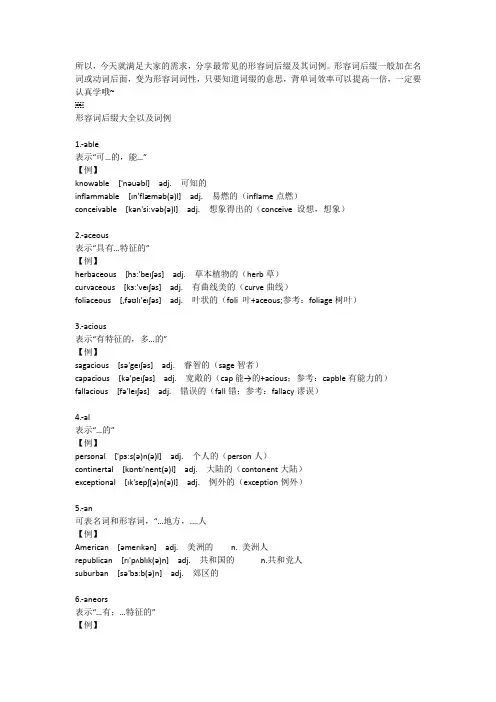
所以,今天就满足大家的需求,分享最常见的形容词后缀及其词例。
形容词后缀一般加在名词或动词后面,变为形容词词性,只要知道词缀的意思,背单词效率可以提高一倍,一定要认真学哦~形容词后缀大全以及词例1.-able表示“可…的,能…”【例】knowable ['nəuəbl] adj. 可知的inflammable [ɪn'flæməb(ə)l] adj. 易燃的(inflame点燃)conceivable [kən'siːvəb(ə)l] adj. 想象得出的(conceive 设想,想象)2.-aceous表示“具有…特征的”【例】herbaceous [hɜː'beɪʃəs] adj. 草本植物的(herb草)curvaceous [kɜː'veɪʃəs] adj. 有曲线美的(curve曲线)foliaceous [,fəʊlɪ'eɪʃəs] adj. 叶状的(foli 叶+aceous;参考:foliage树叶)3.-acious表示“有特征的,多…的”【例】sagacious [sə'geɪʃəs] adj. 睿智的(sage智者)capacious [kə'peɪʃəs] adj. 宽敞的(cap能→的+acious;参考:capble有能力的)fallacious [fə'leɪʃəs] adj. 错误的(fall错;参考:fallacy谬误)4.-al表示“…的”【例】personal ['pɜːs(ə)n(ə)l] adj. 个人的(person人)continertal [kɒntɪ'nent(ə)l] adj. 大陆的(contonent大陆)exceptional [ɪk'sepʃ(ə)n(ə)l] adj. 例外的(exception例外)5.-an可表名词和形容词,“…地方,.…人【例】American [əmerɪkən] adj. 美洲的n. 美洲人republican [rɪ'pʌblɪk(ə)n] adj. 共和国的n.共和党人suburban [sə'bɜːb(ə)n] adj. 郊区的6.-aneors表示“…有;…特征的”【例】simultaneous [,sɪm(ə)l'teɪnɪəs] adj. 同时发生的spontaneous [spɒn'teɪnɪəs] adj. 自发的miscellaneous [,mɪsə'leɪnɪəs] adj. 各种各样的(miscell混杂)7.-ant表示“ …的”【例】discordant [dɪ'skɔːd(ə)nt] adj. 不一致的(dis不+cord心…不是一条心)resistant [rɪ'zɪstənt] adj. 抵抗的(resist抵抗,对抗)repentant [rɪ'pentənt] adj. 后悔的(pent难过,repent后悔)8.-ar表示“…的”【例】titular ['tɪtjʊlə] adj. 名义上的(来自title名义)linear ['lɪnɪə] adj. 线的(line线)familiar [fə'mɪlɪə] adj. 熟悉的(family家庭)9.-arian表示“…的(人)”【例】humanitarian [hjʊ,mænɪ'teərɪən] adj./n. 人道主义的(人)(human人)vegetarian [vɛdʒɪˈtɛːrɪən] adj./n. 素食的(人)(vegetable 蔬菜)10.-ary表示“…的”【例】honorary ['ɒn(ə)(rə)rɪ] adj. 荣誉的(honor荣誉)imaginary [ɪ'mædʒɪn(ə)rɪ] adj. 想象的(imagine想象)stationary ['steɪʃ(ə)n(ə)rɪ] adj. 静止的(station车站;驻扎)11.-ate表示“具有…的”【例】considerate [kən'sɪd(ə)rət] adj. 考虑周到的(consider考虑)moderate ['mɒd(ə)rət] adj. 有节制的(moder模,规矩)effeminate [ɪ'femɪnət] adj. 柔弱的(ef+femin女人)12.-atic表示“有…性质的”【例】dogmatic [dɒg'mætɪk] adj. 教条的(dogma教条)aromatic [ærə'mætɪk] adj. 芳香的(aroma芳香)fanatic [fə'nætɪk] adj. 狂热的(fan入迷者)13.-arive表示“有…倾向(性质)的”【例】talkative ['tɔːkətɪv] adj. 好说话的(talk讲话)argumentative [ɑːgjʊ'mentətɪv] adj. 好争吵的(argument争论)sedative ['sedətɪv] adj. 镇静的(sed坐+ative)14.-atory表示“有…性质的”【例】condemnatory [,kɒndəm'neɪt(ə)rɪ] adj. 谴责的(condemn谴责)defamatory [dɪ'fæmət(ə)rɪ] adj. 诽谤的(defame诽谤)mandatory ['mændət(ə)rɪ] adj. 命令性的(mand命令+atory)15.-en表示“由…制成”,通常加在名词后面【例】wooden ['wʊd(ə)n] adj. 木制的(wood木头)woolen ['wulən] adj. 羊毛制的(wool羊毛)waxen ['wæks(ə)n] adj. 蜡制的(wax蜡)16.-ent表示“…的”【例】sentient [ˈsentiənt] adj. 有知觉的(sent感觉+I+ent)obedient [ə'biːdɪənt] adj. 服从的(obey服从)insistent [ɪn'sɪst(ə)nt] adj. 坚持的(insist坚持)17.-eous表示“有…的”【例】righteous ['raɪtʃəs] adj. 正义的(right正确+eous)gaseous ['gæsɪəs] adj. 气体的(gas气体)aqueous ['eɪkwɪəs] adj. 水的(aqu水+eous)18.-ern表示“…方向的”【例】western ['west(ə)n] adj. 西方的southern ['sʌð(ə)n] adj. 南方的northeastern [,nɔ:θ'i:stən] adj. 东北方的19.-esque表示“如…的”【例】picturesque [,pɪktʃə'resk] adj. 如画的(picture图画)arabesque [,ærə'besk] adj. 阿拉伯式的(arab阿拉伯)gigantesque [,dʒaɪ'ɡæntesk] adj. 巨人一般的(gigant巨人)20.-etic表示“属于…的”【例】theoretic [θɪr'rɛtɪk] adj. 理论上的(theory理论)energetic [,enə'dʒetɪk] adj. 精力旺盛的(energy精力)sympathetic [sɪmpə'θetɪk] adj. 同情的(sympathy同情)21.-fold表形容词或副词,“倍,双重”【例】twofold ['tuːfəʊld] adj./adv. 两倍threefold ['θriːfəʊld] adj./adv. 三倍manifold ['mænɪfəʊld] adj. 繁多的(mani=many)22.-form表示“有…形状的”【例】dentiform [dentɪfɔːm] adj. 牙齿状的(denti牙齿+form)cruciform ['kruːsɪfɔːm] adj. 十字形的(cruci十字+form)cubiform ['kjuːbɪfɔːm] adj. 立方体的(cube立方体+form)23.-ful表示“有…的”【例】grateful ['greɪtfʊl] adj. 感激的(grate感激)rueful ['ruːfʊl] adj. 后悔的(rue悔恨)hopeful ['həʊpfʊl] adj. 有希望的(hope希望)24.-ial表示“有…的”【例】beneficial [benɪ'fɪʃ(ə)l] adj. 有好处的(bene好+fic做+ial)impartial [ɪm'pɑːʃ(ə)l] adj. 公正的(in不+part部分;偏见+ial)commercial [kə'mɜːʃ(ə)l] adj. 商业的(commerce商业+ial)25.-ian表示“…国家的”【例】Egyptian [ɪ'dʒɪpʃ(ə)n] adj. 埃及的Canadian [kə'neɪdɪən] adj. 加拿大的Athenian [ə'θi:njən] adj. 雅典的26.-ible表示“能…的”【例】invincible [ɪn'vɪnsɪb(ə)l] adj. 不可征服的(in不+vinc战胜+ible)eligible ['elɪdʒɪb(ə)l] adj. 合格的(e出+lig选择+ible…挑选出来的…合格的)irascible [ɪ'ræsɪb(ə)l] adj. 易发怒的(irasc愤怒+ible)ible 该词缀在意义上与“-able”相同,但主要用于拉丁语后。
英语常见形容词后缀
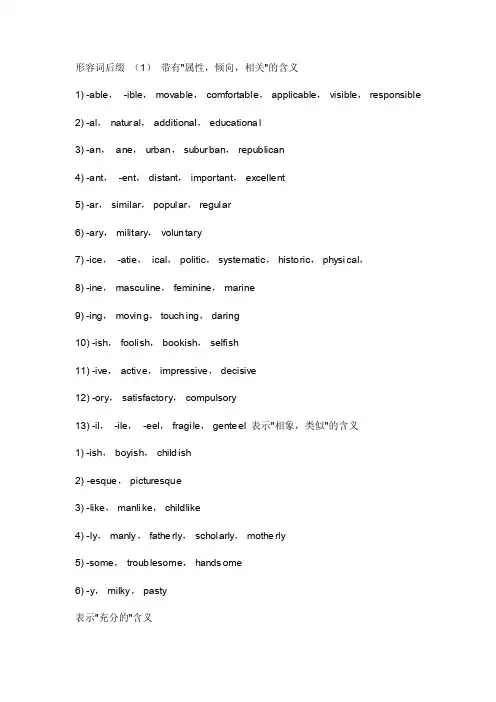
形容词后缀(1)带有"属性,倾向,相关"的含义1) -able,-ible, movabl e, comfor table, applic able, visibl e, respon sible2) -al, natura l, additi onal, educat ional3) -an,ane, urban, suburb an, republ ican4) -ant,-ent, distan t, import ant, excell ent5) -ar, simila r, popula r, regula r6) -ary, milita ry, volunt ary7) -ice,-atie,ical, politi c, system atic, histor ic, physic al,8) -ine, mascul ine, femini ne, marine9) -ing, moving, touchi ng, daring10) -ish, foolis h, bookis h, selfis h11) -ive, active, impres sive, decisi ve12) -ory, satisf actor y, compul sory13) -il,-ile,-eel, fragil e, gentee l 表示"相象,类似"的含义1) -ish, boyish, childi sh2) -esque, pictur esque3) -like, manlik e, childl ike4) -ly, manly, father ly, schola rly, mother ly5) -some, troubl esome, handso me6) -y, milky, pasty表示"充分的"含义1) -ful, beauti ful, wonder ful, helpfu l, truthf ul2) -ous, danger ous, genero us, courag eous, variou s3) -ent, violen t,表示由某种物质形成,制成或生产的含义1) -en, wooden,golden, woolen2) -ous, gaseou s3) -fic, scient ific表示"倍数"的含义1) -ble, double, treble2) ple, triple3) -fold, twofol d, tenfol d 表示"数量关系"的含义1) -teen, thirte en2) -ty, fifty3) -th, fourth, fiftie th表示国籍,语种,宗教的含义1) -an, Roman,Europe an2) -ese, Chines e,3) -ish, Englis h, Spanis h表示"比较程度"的含义1) -er, greate r2) -ish, reddis h, yellow ish3) -est, highes t4) -most, foremo st, topmos t其他的含义-less,表示否定,countl ess, stainl ess, wirele ssⅠ.后缀-able与-ible形容词后缀-able与-ible是同义后缀,加在动词后,使动词变为形容词,其意义相当于情态动词can +此动词被动式。
英语词缀总结大全——后缀篇

英语词缀总结大全——后缀篇很多学生在背单词时只能靠死记硬背,找不到规律,因此即使当时能记住,过不了多久就又都忘了。
其实,掌握了单词的词缀规律,在记单词方面就会事半功倍。
下面,小编就特意为大家整理了一份英语单词中最常见的词缀,一起来看吧。
后缀1. -ability 表名词,意为“能...;性质”2. -able 表形容词,意为“可...的,能...”3. -ably 表副词,意为“能...地”4. -aceous 表形容词,意为“具有...特征的”5. -acious 表形容词,意为“有特征的,多...的”6. -acity 表名词,意为“有...倾向”7. -acle 表名词, 意为“...物品,状态”8. -acy 表名词, 意为“...性质,状态”9. -ad 表名词,意为“...东西,状态”10. -ade 表名词, 表示1)状态,物品;2)个人或集体11. -age 1)表示费用;2)表示场所,物品;状态,总称12. -ain 表名词,意为“...人”13. -air 表名词,意为“人、物”14. -aire 表名词,意为“...人”15. -al 表形容词,意为“...的”16. -al 表名词,表示人,物,状态17. -ality 表名词,表示状态,性质18. -ally 表副词,由al+ly构成,意为“...地”19. -an 表名词和形容词,意为“...地方,...人”20. -ance 表名词,表示性质,状况21. -aneity 表名词,表示性质,状态22. -aneous 表形容词,意为“...有; ...特征的”23. -ant 1)表形容词,...的;2)表名词,意为“...人”“...剂”24. -ar 表形容词,意为“...的”25. -ard 表名词,意为“不好的人”26. -arian 表形容词或名词,意为“...的(人)”27. -arium 表名词,表示地点,场所28. -ary 1)表名词,人,场所,物;2)表形容词,意为“...的”29. -ast 表名词,意为“...人,物”30. -aster 表名词,意为“不怎么样的人”31. -ate 1)表动词,意为“做,造成”;2)表形容词,意为“具有...的”;3)表名词,表示人或地位32. -atic 表形容词,意为“有...性质的”33. -ation 表名词,表示行为,过程,结果34. -ative 表形容词,意为“有...倾向(性质)的”35. -ator 表名词,通常由 ate 结尾的动词而来,表示做事的人或物36. -atory 1)表名词,表示场所,地点;2)表形容词,意为“有...性质的”37. -cy 表名词,也作-acy, 表示性质,状态38. -dom 表名词,表示状态或领域39. -ee 表名词,表示被动或主动的人40. -eer 表名词,意为“...人员”41. -el 表名词,表示人或物42. -en 1)表动词,变成;2)表形容词,由...制成的,通常加在名词后面43. -en 表名词,表示人或物44. -ence 表名词,表示性质,状态45. -ency (ence 的变体)表名词46. -enne 表名词,表示女性47. -ent 1)表形容词,意为“...的”;2)表名词,意为“...药剂”“...人”48. -eous 表形容词,意为“有...的”49. -er 1)表动词,表示反复做;2)表名词,表示物品,机器;3)表名词,意为“...人”50. -ern 1)表形容词,意为“...方向的”;2) 表名词,意为“...场所”51. -ery 表名词,表示1)场所,地点;2)行为,情况52. -esque 表形容词,意为“如...的”53. -ess 表名词,表示女性,雌性54. -et 表名词,表示小东西55. -etic 表形容词,意为“属于...的”56. -ette 表名词,表示小的东西或状态57. -ety 表名词,表示状态58. -eur 表名词,意为“...人”59. -faction 表名词,表示达到的状态,由 -fy 转化而来60. -fic 表形容词,意为“产生...的”61. -fication 表名词,由 fic 变化而来62. -fier 表名词,表示人或物,由-ify转化而来63. -fold 表形容词或副词,意为“倍,双重”64. -form 表形容词,意为“有...形状的”65. -ful 1)表形容词, 意为“有...的”;2)表名词, 表示满,量66. -fy 表动词, 意为“...化,成为... ”(更多时候作-ify)67. -hood 表名词, 表示时期,性质等68. -ia 表名词, 1)表示某种病;2)表示总称,状态69. -ial 表形容词,意为“有...的”70. -ian 1)表名词,表示某种人;2)表形容词, 意为“...国家的”71. -ibility 表名词,意为“具备...性质的”72. -ible 形容词,意为“能...的”73. -ic 表形容词, 意为“....的”(有时作-tic)74. -ic 表名词,表示1)某种药;2)人或学科75. -ical 表形容词,意为“...的”76. -ice 表名词,表示行为,状态77. -ics 表名词,表示学科,学术78. -id 表形容词,意为“如...的”79. -ie 表名词,表示小东西或人80. -ier 表名词,表示人或物81. -ile 1)表形容词,意为“...的”;2)表名词,表示物体82. -ine 1)表形容词,意为“...的”;2)表名词,表示①人或女人②状态, 药物等83. -ing 1)表形容词,意为“正...的,令人...的”2)表名词,表示行业;物品;状态84. -ion表名词,表示1)动作或状态分为-sion和-tion两种;2)表示某种物,用品85. -ior 表形容词,意为“较...的”86. -ious 表形容词, 意为“....的”87. -ise 1)(-ize 的变体)表动词,意为“...化”;2)表名词,表示物品,状态88. -ish 1)表形容词,意为“像...一样,有的...”,通常放在具体名词后;2)表动词,造成...;3)表示国家的或语言89. -ism 1)表示学术或学术流派;2)表示行为, 现象,状态;3)表示疾病;4)表示具备某种性质;5)表名词,表示各种主义,宗教90. -ist 1)表名词,表示信仰者,专家或从事人;2)以-ist 结尾的单词,大多可同时作名词和形容词91. -istic 表形容词,由-ist + ic 构成,意为“...的”92. -it表名词,1)通常是抽象名词;2)意为“...人”93. -ite 1)表形容词,意为“有...的”;2)表名词,表示人或物;3)表动词,意为“促成”94. -ition 表名词,表示行为过程,状态95. -itious 表形容词,-ition变化而来,意为“...的”96. -itive 表形容词,意为“...的”97. -itor 表名词,表示…人98. -itude 表名词,表示性质,状态等99. -ity 表名词,指具备某种性质100. -ive 表形容词,根据不同的单词结尾可分-sive, -ative, ive, itive101. -ivity 表名词,由-ive+ity 组成,有...能力或特性102. -ization (-ize+ation)表名词,意为“...化或发展过程”103. -ize 构成一些动词104. -kin 表名词,意为“小...”105. -less 表形容词,意为“无...的,不...的”106. -let = -et 表示小107. -like 表形容词,意为“像...一样”108. -ling 表名词,表示小东西或某种人109. -ly 1)表形容词,通常加在名词后;2)表副词,通常放在形容词后110. -ment 1)表名词,行为或结果;2)表示具体物111. -most 表形容词,意为“最...的”112. -ness 表名词,性质, 状态,通常加在形容词后113. -o 1)表名词,表示人,物或状态;2)-o 表名词,用于音乐术语114. -on 表名词,指人、物和一些物理学上的名词115. -oon 表名词,表示人或物116. -or 表名词,人或物器(在一些词根前写成 -ator)117. -orium = arium 表名词,表示地点,场所118. -ory 1)表名词,指场所等;2)表形容词,意为“...的”119. -ose 表形容词,意为“多...的”120. -osity (由-ose+ity组成)表名词,表示多...的状态121. -ot 表名词,意为“...人”122. -ous 表形容词,通常放在一个完整的单词后,意为“...的”123. -proof 表形容词,意为“防...的”124. -ress 表名词,1)指物品;2)指女性125. -ry 1)表示集合名词;2)表示场地;3)表示行业,学科;4)表名词,通常放在一个完整的单词后面,表示状态,性质126. -ship 1)表示某种技能;2)表名词,表示某种关系或状态127. -some 表形容词,意为“充满...的,具有...倾向的”128. -ster 表名词,意为“...人”129. -th 表名词,通常指抽象名词130. -tic 表形容词,通常放在一个名词前,意为“与...相关的,...的”131. -ture 1)在以s结尾的词根后变成-sure;2)表名词,通常在单词或词根以t结尾时使用,表示一般状态, 行为132. -ty 表名词,用在形容词后,把形容词变成名词133. -ular 表形容词, 表示有...形状或性质的134. -ule 表名词,意为“小... ”135. -uous 表形容词,意为“多...的”136. -ward 表形容词+副词,意为“向... ”137. -wise 表副词,表示方向,状态138. -y 1)表名词,加在形容词或以r结尾的单词后;2)表名词,人或小东西,常带有嬉谑性和爱称;3)表形容词,加在名词后变成形容词139. ancy(= ance)表示性质,状况文章来源网络。
考研词汇常见后缀

考研词汇常见后缀一、一般后缀1、-able,-ible,-ile 均表示“可以…的,能…的”(-ile偶尔还能做名词后缀)例如:facile:fac(做)+ile(=ible=able:能、可以)→能做到的→容易做的、容易的missile:miss(投)+ile(名词后缀)→投出去的物体→导弹、投射物2、-acy:名词后缀例如:privacy2 ['praivəsi]:priv(私自的、自己的)+acy(名词后缀)→隐私3、-age:名词后缀例如:package1:pack(=bundle:捆、打包;)+age (名词后缀)→打包、包裹;一揽子计划(即“打包”的计划)4、-al,-ar,-an ①表“名词后缀”②表“形容词后缀”例如:final3['fainl]:fin(完成)+al(形容词后缀:的)→快要完的→最终的、最后的historian6:histori(=history:历史)+an (名词后缀,表人)→历史学家5、-ancy,-ance,-ency,-ence:名词后缀例如:expectancy:expect(期望)+ancy(名词后缀)→期望、期待providence:pro(向前)+vid(看)+ence(名词后缀)→向前看→深谋远虑6、-ant,-ent:①形容词后缀②名词后缀,一般表“人”例如:reluctant4:re(表相反)+luct(=like:喜欢、愿意)+ant(形容词后缀:的)→不喜欢的、不愿意的→勉强的applicant1['æplikənt]:appli(=apply:申请)+ant(名词后缀:表人)→申请人7、-ary,-ery,-ory ①名词后缀②形容词后缀例如:primary5:prim(=prime:起初的、主要的)+ary(形容词后缀)→初级的、主要的boundary2:bound(限定、范围)+ary(名词后缀)→边界、分界线(即:划定范围的东西)8、-ate、-ite、-ute ①形容词后缀②动词后缀,翻译成“使”③名词后缀(很少见)例如:compensate7:com(共同)+pens(钱)+ate (使动词)→使钱给大家→补偿、赔偿infinite:in(表否定)+fin(=bound:限制、限度)+ite(形容词后缀:的)→无限的、无穷的appetite2:appet(=desire:欲望、渴望;而且-pet部分还在可以模仿单词food:食物;)+ite(名词后缀)→对食物的欲望→食欲、胃口9、-cle,icle,-cule 名词后缀例如:particle1:part(部分)+icle(=ic+le:复合名词后缀)→小的部分→微粒、粒子10、-dom 名词后缀例如:kingdom1:king(国王)+dom(名词后缀)→国王统治的地方→王国11、-ed 形容词后缀例如:uncivilized:un(否定)+civiliz(文明)+ed(形容词后缀:的)→不文明的12、-ee 名词后缀,一般表“被…的人”employee8:employ(雇佣)+ee(名词后缀,表人)→雇员13、-en 动词后缀,翻译成“使”例如:deepen:deep(深)+en(使动词)→使变深14、-er,-ur,-or ①名词后缀,表“人”;②偶尔可用作形容词后缀例如:entrepreneur2:entrepren(=enterprise:企业、事业)+ur(=er:表人)→企业家prior4:pri(=pre:在前、优先)+or(=ar:形容词后缀) →优先的、在前的15、-et 名词后缀例如:basket:bask(木头、木条)+et(名词后缀)→篮子(由木条构成)16、-fy,-ify 动词后缀,翻译成“使”例如:specify:speci(=specific:具体的、特定的)+fy(使动词) →使明确、使具体→详细说明,使…具体化17、-ful 形容词后缀例如:resentful:resent(憎恨、怨恨)+ful(形容词后缀:的)→怨恨的、憎恨的18、-hood 名词后缀例如:likelihood:likeli(可能的)+hood(名词后缀)→可能性19、-ic ①形容词后缀②名词,表“人”例如:critic11:crit(=judge:评论、判断;)+ic(少见的名词后缀:表人)→评论家、批评家 historic2[his'tɔrik]:历史上著名的;具有重大历史意义的(-ic为形容词后缀)20、-ics 名词后缀,表“…学”例如:economics[,i:kə'nɔmiks]:经济学(-ics结尾一般表示“某种学问”如:politics6:政治学;physics:物理学)21、-id 形容词后缀例如:solid3['sɔlid] 结实的、固体的;一致的22、-ine ①形容词后缀②动词后缀例如:marine1:mar(=water:水域、海域)+ine(形容词后缀)→海洋的imagine:imag(想象)+ine(动词后缀)→想象(v.)23、-ion 名词后缀例如:tension3:tens(=tense:紧张的)+ion (名词后缀)→紧张、紧张局势24、-is 名词后缀例如:emphasis9:em(=en:使动词前缀)+pha (=phen=men:出现、突出;ph、m音似,n 的增减均合理)+s(送气)+is(名词后缀)→使其出现、变得突出→强调、突出(n.)25、-ise,-ize 动词后缀,翻译成“使”例如:modern(现代)+ize(使动词)→使…现代化26、-ish ①动词后缀,翻译为“使”②形容词后缀例如:punish2:pun(=fine:罚款;)+ish(动词后缀)→罚款、惩罚(v.)foolish:fool(愚弄)+ish(形容词后缀:的)→愚蠢的、傻的27、-ism 名词后缀,表“主义、宗教等”例如:humanism:human(人)+ism(主义)→人道主义28、-ist 名词后缀,表人例如:journalist4:journal(报纸、杂志)+ist(表人)→写报纸、杂志的人→新闻工作者29、-itude 名词后缀,一般翻译成“度”例如:latitude1:lat(横向)+itude(度)→横向的度→纬度、界限30、-ity,-lity,-ility 均为名词后缀例如:priority6:prior(优先于、先于)+ity(名词后缀)→优先权、优先31、-ive ①形容词后缀②名词后缀例如:creative:create(创造)+ive(的)→有创造力的incentive3:in(加强语气)+cent(=stin:刺;而且cent本身就有“美分”的含义,表示“钱”)+ive(名词后缀,很少见)→用来当做激励的钱→刺激(物)、激励(物)32、-less 形容词后缀,表否定,翻译为“无…的,不…的”例如:regardless[ri'ga:dlis]:regard(注意、留意)+less(表否定)→不留意→不管、不顾33、-logy,-ology 名词后缀,表“…学,…术”例如:ideology3:ide(=idea:思想)+ology(某学问)→思想意识、意识形态(学)34、-ment ①名词后缀②动词后缀例如:cement1:cem(=solid:固体;)+ent(名词或动词后缀)→巩固、使团结(v.);segment1:seg(=cut:切割;s、c音似,g、t音似,二者同源)+ment(名词后缀)→切割出来的东西→部分、片段35、-ship 名词后缀例如:worship2:wor(=honor:尊敬; or为后缀)+ship(名词后缀)→尊敬、崇敬、崇拜36、-ure 名词后缀例如:procedure6:pro+ced(走)+ure(名词后缀)→(一步步)向前走→程序、步骤37、-ward 名词后缀,表“方向”例如:backward3:back(后)+ward(向)→向后的、落后的38、-y,-ty ①名词后缀②形容词后缀例如:poverty:pover(=poor:贫穷)+ty(名词后缀)→贫困scanty1:scant(=short:短缺的、不足的)+y(形容词后缀:的)→缺乏的、稀少的39、-ous 形容词后缀例如:vigorous1:vigor(精力)+ous(形容词后缀:的)→精力充沛的二、复合后缀复合后缀指的是由两个或多个后缀组合在一起而产生的新后缀,其词性主要由最后的后缀词汇决定,比如:一个动词后缀(ate)+形容词后缀(ive),最后就是一个复合的形容词后缀(ative)。
考研英语词汇后缀记法
考研英语词汇后缀记法
-ative 有---性质的如:pare---parative比较的
-cy 表示性质,状态如:bankrupt---bankruptcy 破产
-dom 表示性质,状态,领域如:free---freedom 自由
king---kingdom 王国
-eer 表示人如:engine---engineer 工程师
volunteer志愿者
-en 使成为如:deaf---deafen 便聋
sharp---sharpen削尖
-ence , ency 表示性质,状态,行为如:emergency 紧急情况 dependence 依靠
-ent 有---性质的表示人物如:confident 自信的 patient 患者
-er 表人物如:teach---teacher bank---banker
-ery 表示地点,场所如:nurse---nursery 托儿所
-ess 雌性如:act---actress 女演员host---hostess 女主人
-ety表性质,情况如:anxiety 忧虑 variety 种类繁多
-ful 充满的,有---性质的如:delight---delightful令人快乐的
help---helpful 有帮组的
-fy ,-efy , -ify 使变成如:class---classify 分类satisfy 使满意
-hood表示时期,状态,资格如:child---childhood 童年
man---manhood男子气概
-ic ---的表示人物如:atom---atomic原子的mechanic机修工。
考研英语词汇后缀汇总
考研英语词汇后缀汇总 一、名词后缀 1.具有某种职业或动作的人 1)-an, -ian, 表示……地方的人,精通……的人 American, historian 2)-al, 表示具有……职务的人 principal 3)-ant,-ent, 表示……者 merchant, agent, servant, st udent 4)-ar, 表示……的人 scholar, liar, peddler 5)-ard, -art, 表示做……的人 coward, laggard (落伍者), br aggart (夸张者) 6)-arian, 表示……派别的人, ……主义的人 humanitarian, vegetarian 7)-ary, 表示从事……的人 secretary, missionary 8)-ant, 表示具有……职责的人 candidate, graduate 9)-ator, 表示做……的人 educator, speculator (投机者) 10)-crat, 表示某种政体,主义的支持者 democrat, bureaucrat 11)-ee, 表示动作承受者 employee, examinee 12)-eer, 表示从事于……人 engineer, volunteer 13)-er, 表示从事某种职业的人, 某地区,地方的人 banker, observer, Londoner, villager 14)-ese, 表示……国人,………地方的人 Japanese, Cantonese 15)-ess, 表示阴性人称名词 actress, hostess, manageress 16)-eur, 表示……家 amateur, litterateur 17)-ian, 表示……地方人,信仰……教的人,从事……职业的人 Christian, physician (内科医生),musician 18)-ician, 表示精通者, ……家 electrician, magician, technician 19)-icist, 表示……家, ……者, ……能手 physicist, phoneticist, technicist 20)-ic, 表示……者,……师 mechanic, critic 21)-ie, 表示爱,指小 dearie, auntie, lassie (小姑娘) 22)-ier, 表示从事……职业 cavalier, clothier, brazier(黄铜匠) 23)-ine, ina, 表示阴性人称 heroine, ballerina 24)-ist, 表示从事……研究者,信仰……主义者 pianist, communist, dentist,artist, chemist 25)-ive, 表示动作者,行为者 native, captive 26)-logist, 表示……学家,研究者 biologist, geologist (地质学家) 27)-or, 表示……者 author, doctor, operator, 28)-ster, 表示做……事情的人 youngster, gamester (赌徒),s ongster 29)-yer, 表示从事……职业者 lawyer 2.具有抽象名词的含义 1)-acy, 表示性质,状态,境遇 accuracy, diplomacy 2)-age, 表示状态,行为,身份及其结果,总称 courage, storage, marriage 3)-al, 表示事物的动作,过程 refusal, arrival, survival, denial, approval b) 表示具体的事物 manual, signal, editorial, j ournal 4)-ance, -ence表示性质,状况,行为,过程,总量,程度 endurance, importance, dilig ence, difference, obedience 5)-ancy, -ency, 表示性质,状态,行为,过程 frequency, urgency, efficien cy, 6)-bility, 表示动作,性质,状态 possibility, feasibility, 7)-craft, 表示工艺,技巧 woodcraft, handicraft, statecraft (治国策) 8)-cracy, 表示统治,支配 bureaucracy, democracy 9)-cy, 表示性质,状态,职位,级别 bankruptcy (破产),supremacy 10)-dom, 表示等级,领域,状态 freedom, kingdom, wisdom 11)-ery, -ry, 表示行为,状态,习性 bravery, bribery, rivalry 12)-ety, 表示性质,状态 variety, dubiety (怀疑) 13)-faction, -facture, 表示作成,……化,作用 satisfaction, manufacture 14)-hood, 表示资格,身份, 年纪,状态 childhood, manhood, falsehood 15)-ice, 表示行为,性质,状态 notice, justice, service 16)-ine, 表示带有抽象概念 medicine, discipline, famine 17)-ing, 表示动作的过程,结果 building, writing, learning 18)-ion, -sion, -tion, -ation, -ition, 表示行为的过程,结果,状况 action, solution, conclusion,destruction, expression, correction 19)-ise, 表示性质,状态 exercise, merchandise (商业) 20)-ism, 表示制度,主义,学说,信仰,行为 socialism, criticism, colloquialism, heroism 21)-ity, 表示性质,状态,程度 purity, reality, ability, calamity 22)-ment, 表示行为,状态,过程,手段及其结果 treatment, movement, judgmen t, punishment, argument 23)-mony, 表示动作的结果,状态 ceremony, testimony 24)-ness, 表示性质,状态,程度 goodness, kindness, tirednes s, friendliness 25)-or, -our, 表示动作,性质,状态 favor, error 26)-osity, 表示动作,状态 cur iosity 27)-ship, 表示情况,性质,技巧,技能及身份,职业 hardship, membership, friend ship 28)-th, 表示动作,性质,过程,状态 depth, wealth, truth, length, growth 29)-tude, 表示性质,状态,程度 latitude, altitude (海拔) 30)-ure, 表示行为,结果 exposure, pressure, failure, procedure (手续) 31)-y, 表示行为的结果,状态,性质 glory, history, victory, inquiry 3.带有场所、地方的含义 1)-age, 表示住所,地点 village, cottage 2)-ary, 表示住所,场地 library, granary (谷仓) 3)-ery, ry, 表示工作场所,饲养所,地点 laundry, nursery, surgery(手术室) 4)-ory, 表示工作场所,住处 factory, dormitory,laboratory, observatory 4.带有学术,科技含义 1)-grapy, 表示……学,写法 biography, calligraphy, geography 2)-ic, ics, 表示……学……法 logic, mechanics, optics, electronics 3)-ology, 表示……学……论 biology, zoology, technology(工艺学) 4)-nomy, 表示……学……术 astronomy, economy, bionomy(生态学) 5)-ery, 表示学科,技术 chemistry, cookery, machinery 6)-y, 表示……学,术,法 photography, philosophy 5.表示人和事物的总和,集合含义 1)-age, baggage, tonnage 2)-dom, newspaperdom (新闻界) 3)-hood, neighbourhood, womanhood 4)-ery, cavalry, ministry (内阁) 5)-ure, legislature, judicature 6.表示物品和物质名称的含义 1)-ant, ent, solvent, constant 2)-al, signal, pictorial (画报) 3)ar, collar, pillar (石柱) 4)- er, boiler, computer, washer, cooker 5)-ery, drapery (绸缎) 6)-ing, clothing, matting, 7)-ment, instrument, equipme nt, attachment 7.表示细小的含义 1)-cle, particle, 2)-cule, molecule (分子) 3)-el, parcel 4)-en, chicken, maiden 5)-et, pocket, ticket 6)-etta, -ette, etto, cigare tte, essayette (短文) 7)-kin, napkin 8)-ling, duckling, 9)-let, booklet 10)-y, baby, doggy 二、形容词后缀 1.带有属性,倾向,相关的含义 1)-able, -ible, movable, com fortable, applicable, visible, r esponsible 2)-al, natural, additional, educational 3)-an, ane, urban, suburban, republican 4)-ant, -ent, distant, impor tant, excellent 5)-ar, similar, popular, regular 6)-ary, military, voluntary 7)-ice, -atie, ical,politic, systematic, historic, physical, 8)-ine, masculine,feminine, marine 9)-ing, moving, touching, daring 10)-ish, foolish, bookish, selfish 11)-ive, active, impressive, decisive 12)-ory, satisfactory, compulsory 13)-il, -ile, -eel,fragile, genteel (文雅的) 2.表示相象,类似的含义 1)-ish, boyish, childish 2)-esque, picturesque 3)-like, manlike, childlike 4)-ly, manly, fatherly, scholarly, motherly 5)-some, troublesome, handsome 6)-y, milky, pasty 3.表示充分的含义 1)-ful, beautiful, wonderful,helpful, truthful 2)-ous, dangerous, generous,courageous, various 3)-ent, violent, 4.表示由某种物质形成,制成或生产的含义 1)-en, wooden, golden, woolen 2)-ous, gaseous 3)-fic, scientific 5.表示方向的含义 1)-ern, eastern, western 2)-ward, downward, forward 6.表示倍数的含义 1)-ble, double, treble 2)ple, triple 3)-fold, twofold, tenfold 7.表示数量关系的含义 1)-teen, thirteen 2)-ty, fifty 3)-th, fourth, fiftieth 8.表示国籍,语种,宗教的含义 1)-an, Roman, European 2)-ese, Chinese, 3)-ish, English, Spanish 9.表示比较程度的含义 1)-er, greater 2)-ish, reddish, yellowish 3)-est, highest 4)-most, foremost, topmost 10.其他的含义 -less, 表示否定 countless, stainless, wirele ss 三、动词后缀 1.-ize, ise, 表示做成,变成,……化 modernize, mechanize, democr atize, organize 2.-en, 表示使成为,引起,使有 quicken, weaken, soften, har den 3.-fy, 表示使……化, 使成 beautify, purify, intensify, signify, simplify 4.-ish, 表示使,令 finish, abolish, di minish, establish 5.-ate, 表示成为……,处理,作用 separate, operate, indicate 四、副词后缀 1.-ly, possibly, sw iftly, simply 2.-ward, -wards, do wnward, inwards, upward 3.-ways, always, si deways 4.-wise, otherwise, clockwise。
英语常见形容词后缀
英语常见形容词后缀一、必备形容词后缀I. ABLE 〔IBLE, ILE 〕capable of(能做…的,易做…的)notable [ˈnəʊtəbl] adj. 值得注意的,显著的;著名的【记】[not=know; -able= capable of 可知的]credible [ ˈkredəbl] adj.可信的;值得信任的【记】[cred = trust 信任; -ible =capable of 能让人信任 ] II. AL,ANT[ENT]having the quality of(具有…性质的)distant [ˈdɪstənt] adj.遥远的,远离的; 冷漠的【记】[di- = apart 离;st = stand 站立;-ant =having the quality of “相离而立的”]fluent [‘fluːənt] adj.流利的;说话流畅的【记】[flu=flow; -ent= having the quality of 话从嘴中说出的】III. ARY[ORY]1.having the quality of(具有…性质的)2.related(有关系的)ordinary [ˈɔːrdneri] adj. 普通的平凡的;平常的[out of the ordinary非同寻常的]【记】[ordin =order命令,顺序; -ary 形容词后缀按顺序来的,没有什么变化的]necessary [ˈnesɪsərɪ] adj. 必需的,必要的;必然的n. [常pl]必需品【记】[ne-=not不; cess=to go 行走,前进; -ary 形容词后缀不可屈服的]Ⅳ. IC [ICAL]nature of(具有…性质的)politic [‘pɒlətɪk] adj. 政治的; 明智的; 精明的【记】[polit=city, state; -ic=nature of 城市、国家的] logical [ˈlɒdʒɪkl] adj. 逻辑的,符合逻辑的【记】[log=speech; -ical=nature of 话是对的]Ⅴ. OUS1. full of, many(多的)2. having the quality of(具有…性质的)3. like(如同…)obvious [‘ɒbvɪəs] adj.明显的,显而易见的;显著的【记】[ob- = across, in在;vi = way 路;-ous =like 就像摆在路当中一样]ambiguous [æmˈbɪɡjuəs] adj. 模糊不清的,模棱两可的【记】[amb-/ambi-=around, both; ig=drive; -u-; -ous=having the quality of 转圈开的]二、其他常用的形容词后缀1.-an,-ane, -ian, -ain形容词后缀以及指人的名词后缀 nature of, relating to, person who2.-ed形容词后缀 -ed是过去分词词缀3.-en动词以及形容词后缀 make, having the quality of4. -ful形容词后缀 full of , having the quality of5.-id形容词及名词后缀 like , relating to, that which6.-ine形容词及名词后缀 like , relating to, quality, that which 7.-ish形容词、动词、名词后缀 like , relating to,make8.-ive形容词及名词后缀 relating to,having the quality of,tending to, that which9.-less形容词后缀 without10.-ly形容词后缀 having the quality of11.-some形容词后缀 having the quality of12.-y形容词后缀 having the quality of,something done。
历年考研英语使用频率较高的后缀33个
历年考研英语使用频率较高的后缀33个历年考研英语使用频率较高的后缀33个我们都知道英文的单词通常包含有前缀、后缀和词根三部分。
前缀改变词义,后缀改变词性,词根表达最基本的含义。
以下是店铺搜索整理的关于历年考研英语使用频率较高的后缀33个,供参考复习,希望对大家有所帮助!想了解更多相关信息请持续关注我们店铺!1. -able 形容词后缀 suitable, flexible, affordable,lovable2. -age 名词后缀 postage, shortage, advantage3. -al 名词后缀arrival, refusal;-al 形容词后缀natural, structural4. -ance, -ence :名词后缀 importance, appearance, reference5. -ant, -ent 名词后缀 applicant, correspondent, .-ant, -ent.形容词后缀different, important, pleasant6. -dom 名词后缀 kingdom, freedom, wisdom7.–en 动词后缀deepen, fasten;形容词后缀golden, wooden8.-ee 名词后缀,指人employee, interviewee9.-ery 名词后缀bravery, slavery10 .-free 形容词后缀“免于”carefree, duty-free11 .-ful 形容词后缀careful, painful, beautiful, handful12.-hood 名词后缀childhood, manhood13 .- ion, -ition, -ation名词后缀collection, observation, imitation, initiation14.-ity,-ty名词后缀 purity, cruelty,15.-ify 动词后缀classify, simplify, purify, justify16.-ize, -ise动词后缀modernize/modernise, popularize/ popularise, socialize17.-ic,-ical形容词后缀 atomic, ironic, psychological, critical18 .-ish形容词后缀girlish, childish19 .-ive形容词后缀 creative, supportive20.-less形容词后缀,含有否定含义hopeless, painless21.-like 形容词后缀“像。
考研英语词汇常用的后缀,你知道多少个?整理
考研英语词汇常用的后缀,你知道多少个?整理考研英语词汇常用的后缀,你知道多少个?今日我为大家整理的是关于考研英语词汇中常使用的后缀,这对大家备考考研英语会很有关心哦,盼望大家可以好好利用起来,下面就让我们一起来看一下吧。
(1)名词后缀-ability,-ibility 力量able-abilityflexible-flexibility弹性,适应性,机动性,挠性-age时期post-postage邮费,邮资short-shortage 不足-alarrive-arrival到达, 抵达;物refuse-refusal拒绝-an,-ian,-arian 员;人library-librarian第1页/共12页music-musician-ance,-enceappear-appearancerefer-reference 人-ancy,-encyemerge-emergency紧急状况expect-expectancy期望-ant,-ent 人apply-applicant申恳求职人correspond-correspondent 通信员记者-cyaccurate-accuratcy精确的, 精确private- praivit] privacy?隐居, 独处私事, 隐私-domking-kingdom国王,界,领域第2页/共12页free-freedom自由,自主权-ee 人employ-employee雇工interview-interviewee接受面谈者; 被接见者-er,-or,-ar 人paint-painterbeg-beggar 乞丐-ery 行为;身份、制度brave-braveryslave-slavery奴隶身份制度-ese 人China-ChinaeseJapan-Japanese-ess 人actor-actresswaiter-waitress第3页/共12页-ful 量hand-handful一把少数spoon-spoonful一匙的量-hoodchild-childhoodman-manhood成年, 成年期; 男子气概-ics 学科electron-electronicslinguist言学家-linguistics语言学-ion,-ition,-ation 物collect-collectionobserve-observation-ism 主义Marx-Marxismsocialist-socialism第4页/共12页-ist 人psychiatry-psychiatristviolin-violinist-ity,-tycruel-cruelty残忍, 残酷pure-purity纯, 纯净, 纯正, 干净-mentmove-movementretire--retirement增加; 进展, 扩大-nessdark--darknesshappy--happiness-ologyclimate-climatology气候学future-futurology将来学-ship 关系第5页/共12页friend-friendship友情、友情scholar学者-scholarship学问学识,奖学金-sion,-ssion 物decide--decisionexpand--expansion-thgrow--growth增加; 进展, 扩大wide--width宽度, 阔度, 广度-ure 状态close-closure停业、关闭expose-exposure 暴露曝光(2)动词后缀-endeep--deepen变深, 加深fast--fasten系紧, 拴牢第6页/共12页-ifyclass--classify分类; 归类simple-simplify简化-ize,-ise 使怎么样modern--modernize / modernizepopular--popularize / popularize(3)形容词后缀-able,-ible 的suit--suitablequestion--questionable可疑的; 有疑问的-al nature--naturalstructure--structural-an,-arian,-iansuburb--suburbanCanada-Canadian 人的-ant,-ent 的第7页/共12页differ--differentplease--pleasant-ary,-ory 的advise--advisorycustom--customary-ateconsider--consideratefortune--fortunate-en的gold--goldenwood--wooden-ese的,人China--ChineseJapan--Japanese-free 无..的第8页/共12页care--carefreeduty--duty-free-fulcare--carefulpain--painful-ic,-ical的atom-atomic原子的psychology-psychological心理学的-ish的girl--girlish女孩子(似)的, 少女的child--childish孩子的, 孩子气的, 孩子所特有的-ivecreate--creative制造性的, 有制造力的support--supportive支持的, 拥护的; 赞助的-less 无的hope--hopeless不抱盼望的, 无望的第9页/共12页pain--painless-likechild--childlike孩子似的,天真烂漫的lady--ladylike风度雍容如贵妇的,温雅的-ly 的man-manly刚毅的month-monthly一月的月刊-ous,-ious 的danger--dangerouspoison--poisonous-sometire--tiresome令人生厌的trouble--troublesome引起麻烦的, 令人厌烦的, 令人苦恼的-ward 向的down--downward向下的, 往下的第10页/共12页让知识带有温度。