
牛津译林版8A英语八年级上册Unit 5 Wild Animals Integrated skills课件
to live _a_lo_n_e__. There are not many tigers in the world now. Tigers
are in danger because people catch them for their fur, __b_o_n_e_s_ or
other parts of the body.
things far away • can run for(10) _______
without stopping Qualities • often work as a team • never kill for (11) _____
Food animals sometimes (12)_______
thick [θɪk] adj. 浓的;密的; 厚的
a bear
It’s a heavy wild animal with thick fur and sharp paws. It can walk upright.
a tortoise
It can live up to 150 years old.
hunter [‘hʌntə(r)] 猎人
[kætʃ] 捕获 过去式:caught
[kil] 杀害
The hunters catch and kill them for their
fur, bones or other parts of the body.
Tigers
Looks • big and strong • (1)_b_r_i_g_h_t__ eyes • (2)_o_r_a_n_g_e__ fur
Dear Sir or Madam,
We are writing to tell you about some wild animals in danger.
Tigers are big and _st_r_o_n_g_. They have very _b_r_i_g_h_t eyes. Tigers like
Wolves
•
Abilities can see, hear
and
(9)_s_m__el_l
things far away
• can run for(10) __h_o_u_r_s_
without stopping
Qualities
• often work as a team
• never kill for (11) __fu_n__
Wild animals
Welcome to the zoo!
4
67
5
89
32
13
10
1 15
14 12
16
11
Please guess what kind of animal it is according to their looks and qualities.
quality ['kwɒlətɪ] ------qualities特性 才能
with (3)__d_a_r_k__ stripes
Abilities • can (4)__r_u_n__ fast, but
only for a short while • able to (5) _s_w__im___ and climb QQuuaaliltitieiess like to live (6)__a_lo_n__e_
fewer living areas, and people kill them because they think wolves
ared__a_n_g_e_r_o_u__s to humans. They are now in danger.
We think we should help these animals.
catch sb for sth
Wolves are not very big. They can see, _h__e_a_r_ and _s_m__e_l_l things far away. They often work as a t_e_a_m__. Sadly, they have fewer and
A letter from a zoo keeper
a mysterious(神秘) task
Hi,kids!I want to test your listening!
1
2
More wild animals
What else do you want to know about them?
Part A1:
2. While listening: To get more information, write the short form or some letters instead of the whole word. Later on, write its complete form.
Tigers
a giraffe
It has a very long neck.
monkeys
They are very clever. They can climb trees and like eating bananas.
a fox
It has a long body, short legs, a long big tail, in red hair over all .It is very cunning[kʌnɪŋ] (狡猾).
a lion
• It is called “king of animals”
a wolf [wʊlf]
It is not very big and has thick grey fur. It has very good eyesight ,hearing and smell. It often works as a team.
Yours sincerelyຫໍສະໝຸດ Millie Daniel
你的真诚的
Read the letter and find out the following phrases :
1.一会儿_f_o_r_a__s_h_o_r_t_w__h_il_e_ 2.能够做某事__b_e_a__b_le__to__d_o_____ 3.处于危险之中____b_e__in__d_a_n_g_e_r_______________ 4.捉住老虎为了皮毛_c_a_t_c_h_t_i_g_er_s__fo_r__fu__r________ 5.跑数小时不停止__r_u_n__f_o_r_h_o_u_r_s_w__i_th_o_u__t _s_to_p_p__in_g_ 6.丧失居住地_____l_o_s_e_l_iv_i_n_g__a_r_ea_s____________ 7.团队协作___w__o_r_k_a_s__a_t_e_a_m____________________ 8.对人类有危险___b_e__d_a_n_g_e_r_o_u_s_t_o_h__u_m_a__n_s_______
Food animals
sometimes (12)__f_r_u_it__
Danger losing living areas people kill wolves because they think wolves are
dangerous to humans
Part2 Fill in the blanks
a polar bear
It lives in the North Pole.
a zebra
It looks like a horse with black and white stripes on its body.
camels
They are ships of the desert. They can carry people or things. They can walk for a long way without drinking water.
an elephant
• It is the largest animal on land and has a long nose and two long tusks.
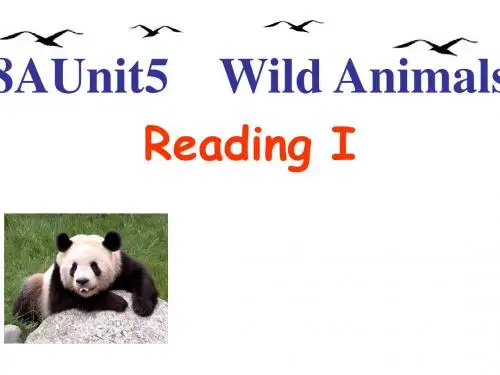
Review on Giant pandas
•lovely
•black and white
•quiet and peaceful
Abilities
•make people happy
Danger •bamboo forests become _s_m_a_ll_e_r _a_nd_
smaller
Welcome to the zoo!
4
67
5
89
32
13
10
1 15
14 12
16
11
a mysterious(神秘) house
Danger losing living areas [lu:z] 失去;输掉 过去式:lost people kill wolves because they think wolves are
dangerous to humans [hju:mən] 人 复数:humans
Looks • not very(7) __b_i_g_ • thick (8)__f_u_r_
• able to (5) _______ and climb QQuuaaliltitieiess like to live (6)_______
Food animals
Danger •Hunters catch tigers for their fur, bones or
other parts of the body.
Looks
• big and strong • (1)________ eyes
牛津译林版八年级上册英语Unit 5 Wild animals Integrated skills课件
Wolves are not very big. They can see, __h_e_a_r_ and s_m__e_ll__ things far away. They often work as a _t_e_a_m_. Sadly, they have fewer and fewer living areas, and people kill them because they think wolves are _d_a_n_g_e_r_o_u_s to humans. They are now in danger. We think we should help these animals. Yours sincerely, Millie Daniel
Dear Sir or Madam, We are writing to tell you about some wild animals in danger. Tigers are big and __s_t_ro_n_g. They have very _b_r_i_g_h_t eyes.
Tigers like to live __a_lo_n_e. There are not many tigers in the world now. Tigers are in danger because people catch them for their fur, __b_o_n_e_sor other parts of the body.
A: …
Make a speech about how to protect wild animals in danger.
八年Байду номын сангаас上册
Unit 5 Wild animals
05牛津译林版 8A Unit 5 Wild animals语法知识点
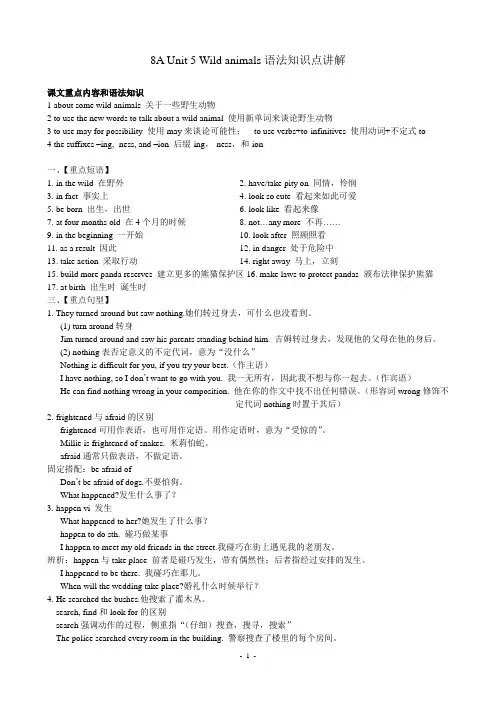
8A Unit 5 Wild animals语法知识点讲解课文重点内容和语法知识1 about some wild animals 关于一些野生动物2 to use the new words to talk about a wild animal 使用新单词来谈论野生动物3 to use may for possibility 使用may来谈论可能性;to use verbs+to-infinitives 使用动词+不定式to4 the suffixes –ing, -ness, and –ion 后缀-ing,-ness,和-ion一、【重点短语】1. in the wild 在野外2. have/take pity on 同情,怜悯3. in fact 事实上4. look so cute 看起来如此可爱5. be born 出生,出世6. look like 看起来像7. at four months old 在4个月的时候8. not…any more 不再……9. in the beginning 一开始10. look after 照顾照看11. as a result 因此12. in danger 处于危险中13. take action 采取行动14. right away 马上,立刻15. build more panda reserves 建立更多的熊猫保护区16. make laws to protect pandas 颁布法律保护熊猫17. at birth 出生时诞生时三、【重点句型】1. They turned around but saw nothing.她们转过身去,可什么也没看到。
(1) turn around转身Jim turned around and saw his parents standing behind him. 吉姆转过身去,发现他的父母在他的身后。
牛津译林版英语八年级上册Unit5Wildanimals(reviewlessons)说课稿
3.通过阅读文章,教授阅读技巧,帮助学生理解文章主旨,提高阅读理解能力;
4.设计口语表达环节,让学生运用所学词汇和时态,进行角色扮演和小组讨论,提升口语表达能力。
(三)巩固练习
为了帮助学生巩固所学知识并提升应用能力,我计划设计以下巩固练习或实践活动:
1.词汇填空:设计一份与野生动物相关的词汇填空练习,让学生在语境中运用词汇;
(2)熟练运用一般现在时态描述动物特征和行为;
(3)提高阅读理解能力,了解野生动物的生存现状;
(4)提高口语表达能力,学会用英语描述动物。
2.教学难点:
(1)词汇的掌握和运用;
(2)一般现在时态的运用;
(3)阅读理解的提高;
(4)口语表达能力的培养。
二、学情分析导
(一)学生特点
本节课面向的是八年级学生,这一年龄段的学生具有以下特点:好奇心强,对新鲜事物充满兴趣;认知水平逐渐提高,具有一定的抽象思维能力;学习兴趣方面,喜欢通过互动、游戏等活泼的形式学习;学习习惯上,已具备一定的自主学习能力和合作学习能力,但还需教师引导和督促。
2.句型转换:给出一些一般现在时的句子,让学生进行句型转换,巩固时态运用;
3.阅读理解:提供一篇关于野生动物保护的文章,让学生运用所学阅读技巧进行阅读,并回答问题;
4.口语表达:组织小组讨论,让学生就野生动物保护问题发表自己的看法,提升口语表达能力。
(四)总结反馈
在总结反馈阶段,我将采取以下措施:
1.引导学生自我评价:让学生回顾本节课所学内容,评估自己在词汇、语法、阅读和口语表达方面的掌握情况;
2.学生在口语表达时,可能存在语法错误和表达不清晰的问题;
3.部分学生可能对一般现在时态的运用不够熟练。
牛津译林版八年级上册Unit5《Wildanimals》(Reading1)说课稿
牛津译林版八年级上册Unit 5《Wild animals》(Reading 1)说课稿一. 教材分析《牛津译林版八年级上册Unit 5 Wild animals(Reading 1)》主要讲述了关于野生动物的保护问题。
通过一篇关于非洲象的阅读材料,引导学生了解非洲象的生活习性以及目前面临的生存困境。
文章语言真实自然,富有感染力,能够激发学生的学习兴趣,同时培养学生的环保意识。
本节课的内容与学生的生活实际密切相关,易于引起学生的共鸣。
二. 学情分析八年级的学生已经具备了一定的英语基础,能够运用英语进行简单的交流。
但他们在阅读理解、词汇积累以及写作方面还存在一定的困难。
因此,在教学过程中,教师需要关注学生的个体差异,善于激发学生的学习兴趣,引导他们主动探究,提高他们的阅读理解能力和环保意识。
三. 说教学目标1.知识目标:学生能够掌握文章中的重点词汇和短语,理解文章的主要内容,了解非洲象的生活习性和目前面临的生存困境。
2.能力目标:学生能够运用所学知识进行阅读理解,提高自己的阅读能力;通过讨论和写作,提高自己的表达和交流能力。
3.情感目标:学生能够树立环保意识,关注野生动物的保护问题,养成关爱自然、保护动物的良好习惯。
四. 说教学重难点1.教学重点:学生能够掌握文章中的重点词汇和短语,理解文章的主要内容,了解非洲象的生活习性和目前面临的生存困境。
2.教学难点:学生能够运用所学知识进行阅读理解,提高自己的阅读能力;通过讨论和写作,提高自己的表达和交流能力。
五. 说教学方法与手段1.教学方法:采用任务型教学法,让学生在完成任务的过程中,提高自己的阅读理解能力和表达能力。
2.教学手段:利用多媒体课件、图片等辅助教学,激发学生的学习兴趣,提高课堂效果。
六. 说教学过程1.Pre-reading:教师通过展示一些关于野生动物的图片,引导学生谈论自己喜欢的动物,激发学生的学习兴趣。
2.While-reading:教师引导学生快速阅读文章,回答一些简单的问题,帮助学生理解文章大意。
牛津译林版八年级上册Unit 5《Wild animals》(Welcome to the unit)课件
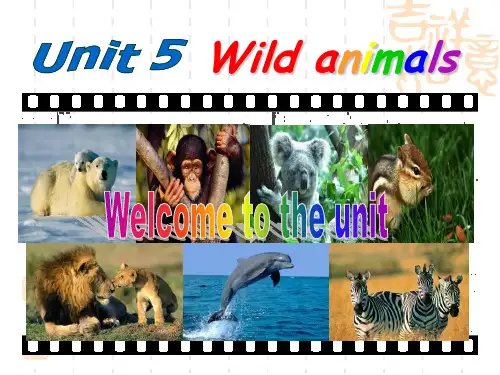
Dolphins
Talk about favourite wild
animals
Listen and fill in the table
Kitty
Wild animals
monkeys
Reason
clever , funny
Simon
lions
strong, run fast
Peter
pandas
Wild animals
Would you like to live in the wild?
Read after the tape
Come on! It’s your turn.
Act out the dialogue with your partner.
What wild animals can you see?
cute
Work in pairs
Talk about the animals you like best and least
A: Which animal do you like best? B: I like …best. A: Why? B: Because … A: Which animal do you like least? B: I like … least. A: Why? B: Because…
Bears are big and strong. They have small eyes, black or brown fur and sharp paws. Bears are good at swimming and climbing trees! They can walk like people. Bears like to move around slowly in the daytime. Because of this, they look a little lazy. They seldom hurt people.
牛津译林版八年级英语上册课件《Unit5 Wild Animals》(reading 1)(共28张PPT) (1)
When the buying stops, the killing can too.
Where there is Xi Wang, there is hope. If we really do something for pandas, the world will be hopeful.
Protecting wild animals is protecting ourselves!
1.Tell something about Xi Wang to your friend. 2.Finish some exercises on the workbook.
Discussion: What action can we take to protect wild animals? Collect money to help p them. Don’t buy fur r coats any more. Stop o eating their meat. Stop t hunting them. Make the sky blue, e make the grass green. Don’t c cut down trees. Stop the farmers taking t the land. Build more reserves Make some laws to protect them
more panda reserves 2.Build _____________________. to protect pandas 3.Make laws _________________. Do you have more ways to protect giant pandas ? Plant more bamboo 4. _____________________________ Stop people cutting down bamboo forests 5.______________________________
牛津译林版英语八上Unit 5《Wild animals》(Grammar)教学设计
牛津译林版英语八上Unit 5《Wild animals》(Grammar)教学设计一. 教材分析牛津译林版英语八上Unit 5《Wild animals》主要介绍了一些野生动物,包括老虎、狮子、熊、大象等。
本单元主要让学生掌握一般现在时的被动语态和一般过去时的被动语态,以及如何运用这些时态描述野生动物的特点和习性。
此外,本单元还包括一些关于野生动物的保护和濒危问题,旨在提高学生的环保意识。
二. 学情分析学生在学习本单元前,已经掌握了动词的现在时态和过去时态,以及一些基本的野生动物知识。
但部分学生对英语语法的学习仍有一定难度,尤其是对被动语态的运用。
因此,在教学过程中,需要关注学生的个体差异,针对不同学生的学习需求进行引导和帮助。
三. 教学目标1.能熟练运用一般现在时和一般过去时的被动语态描述野生动物的特点和习性。
2.能听懂、会说、会读、会写与野生动物相关的词汇和句子。
3.提高学生的环保意识,增强对野生动物的保护意识。
4.培养学生的合作能力和观察能力。
四. 教学重难点1.一般现在时和一般过去时的被动语态的运用。
2.野生动物相关词汇的掌握和运用。
3.对文本内容的理解和运用。
五. 教学方法1.任务型教学法:通过设定各种任务,让学生在实践中学习和运用语言。
2.情境教学法:创设各种情境,让学生在真实的环境中学习和运用语言。
3.合作学习法:鼓励学生分组合作,共同完成任务,培养团队精神。
4.观察法:引导学生观察野生动物的特点和习性,提高观察能力。
六. 教学准备1.教材、课件和教学资源。
2.野生动物的图片、视频等素材。
3.练习题和测试题。
4.分组合作的任务单。
七. 教学过程1.导入(5分钟)利用图片、视频等素材,引导学生谈论他们所知道的野生动物,激发学生的学习兴趣。
2.呈现(10分钟)展示教材中的图片和文字,引导学生观察和描述野生动物的特点和习性。
同时,引入一般现在时和一般过去时的被动语态。
3.操练(15分钟)分组进行角色扮演,让学生运用所学的被动语态描述野生动物的特点和习性。
牛津译林版英语八上Unit5《Wildanimals》(integratedskills)说课稿
牛津译林版英语八上Unit 5《Wild animals》(integrated skills)说课稿一. 教材分析《牛津译林版英语八上Unit 5 Wild animals》主要介绍了一些野生动物,包括老虎、狮子、熊、猴子等。
本单元以动物为主题,通过学习动物的特点、生活习性以及保护动物的重要性,提高学生对野生动物的认识和关注。
本节课为单元的Integrated Skills部分,主要通过听力、口语、阅读和写作等多种形式,让学生综合运用本单元所学知识。
二. 学情分析八年级的学生已经具备了一定的英语基础,对于一些基本的词汇和句型能够熟练掌握。
但是,对于一些较为复杂的动物特点和保护动物的观点表达,还需要进一步引导和培养。
因此,在教学过程中,需要关注学生的个体差异,针对不同水平的学生给予适当的辅导和激励。
三. 说教学目标1.知识目标:学生能够掌握本节课所学的词汇和句型,了解各种野生动物的特点和生活习性。
2.能力目标:学生能够听懂、会说、会读、会写关于野生动物的短文,提高学生的综合语言运用能力。
3.情感目标:学生能够认识到保护动物的重要性,培养关爱动物的情感。
四. 说教学重难点1.重点:学生能够掌握本节课所学的词汇和句型,运用所学知识进行口语交流和写作表达。
2.难点:学生能够正确使用一般现在时描述动物的特点和生活习性,以及表达保护动物的观点。
五. 说教学方法与手段1.任务型教学法:通过设置各种任务,激发学生的学习兴趣,提高学生的参与度和积极性。
2.情境教学法:创设生动、真实的情境,帮助学生理解动物的特点和生活习性。
3.合作学习法:鼓励学生分组讨论、合作完成任务,培养学生的团队协作能力。
4.多媒体教学手段:利用多媒体课件和视频,丰富教学内容,提高学生的学习兴趣。
六. 说教学过程1.导入:通过展示一些野生动物的图片,引导学生谈论自己喜欢的动物,从而引入本节课的主题。
2.展示:教师通过多媒体课件,展示本节课所学的词汇和句型,让学生初步感知和理解。
牛津译林版英语八上Unit 5《Wild animals》(integrated skills)教学
牛津译林版英语八上Unit 5《Wild animals》(integrated skills)教学设计一. 教材分析牛津译林版英语八上Unit 5《Wild animals》(integrated skills)以野生动物为主题,通过介绍非洲、亚洲和北极地区的动物,让学生了解不同动物的生活习性和保护状况。
本单元包括阅读、听力、口语、写作和语法等多个方面的内容,旨在提高学生综合运用英语的能力。
二. 学情分析八年级的学生已经具备一定的英语基础,能够运用英语进行简单的交流。
但他们在口语表达、听力理解、阅读分析和写作技巧方面仍有待提高。
此外,学生对野生动物保护的认识有待加强。
三. 教学目标1.知识目标:学生能够掌握有关野生动物的词汇和表达方式,了解不同动物的生活习性和保护状况。
2.能力目标:学生能够运用英语进行听力、口语、阅读和写作练习,提高综合运用英语的能力。
3.情感目标:学生能够认识到保护野生动物的重要性,增强环保意识。
四. 教学重难点1.重点:野生动物相关词汇和表达方式的掌握,阅读和听力理解的提高。
2.难点:口语表达和写作技巧的运用,对野生动物保护意义的深入理解。
五. 教学方法1.任务型教学法:通过完成各种任务,激发学生的学习兴趣,提高学生的参与度。
2.情境教学法:创设真实的语境,让学生在实践中学习和运用英语。
3.合作学习法:鼓励学生分组讨论,培养学生的团队精神和沟通能力。
六. 教学准备1.教师准备:教材、教学课件、野生动物图片和视频、相关阅读材料。
2.学生准备:完成预习任务,了解野生动物的基本知识。
七. 教学过程1.导入(5分钟)利用图片和视频展示不同野生动物,引导学生谈论自己喜欢的动物,激发学生的学习兴趣。
2.呈现(10分钟)教师展示课文标题《Wild animals》,引导学生预测文章内容。
然后逐段呈现课文,让学生注意生词和短语。
3.操练(15分钟)学生分组进行角色扮演,模拟课文中的对话,巩固所学词汇和表达方式。
牛津译林版英语八上Unit 5《Wild animals》(Welcome)教学设计
牛津译林版英语八上Unit 5《Wild animals》(Welcome)教学设计一. 教材分析牛津译林版英语八上Unit 5的主题是“Wild animals”,本节课的主要内容是让学生掌握关于野生动物的词汇和表达方式,同时通过讨论和思考,提高学生对动物保护的意识。
教材中包含了丰富的图片、词汇和对话,为教学提供了很好的素材。
二. 学情分析学生在进入八年级时已经具备了一定的英语基础,能够进行简单的英语交流。
但是,对于一些较为复杂的野生动物的词汇和表达方式可能还比较陌生。
因此,在教学过程中,需要引导学生逐步掌握新词汇,并通过实际操作和练习,提高学生的语言运用能力。
三. 教学目标1.知识目标:让学生掌握关于野生动物的词汇和表达方式,了解动物保护的重要性。
2.能力目标:通过讨论和思考,提高学生对动物保护的意识,培养学生运用英语进行交流的能力。
3.情感目标:培养学生热爱大自然,关爱野生动物的情感。
四. 教学重难点1.重点:让学生掌握关于野生动物的词汇和表达方式。
2.难点:如何引导学生通过实际操作和练习,运用所学知识进行交流和讨论。
五. 教学方法1.任务型教学法:通过设定各种任务,让学生在实际操作中运用所学知识。
2.情境教学法:通过创设各种情境,让学生在真实的环境中学习和使用英语。
3.小组合作学习:通过小组讨论和交流,提高学生的参与度和合作能力。
六. 教学准备1.教学课件:制作包含野生动物图片、词汇和对话的教学课件。
2.教学材料:准备与野生动物相关的故事、文章等阅读材料。
3.教学设备:多媒体投影仪、音响设备等。
七. 教学过程1.导入(5分钟)利用多媒体展示一些野生动物的图片,引导学生谈论这些动物的特点和生活习性。
2.呈现(10分钟)通过课件展示本节课的主要词汇和表达方式,如:tiger, lion, panda, giraffe等,同时呈现相应的句子,让学生跟读并进行模仿。
3.操练(10分钟)将学生分成小组,每组选择一种野生动物,用英语介绍这种动物的特点和生活习性。